A Federal Communications Commission report cited research indicating that scheduled maintenance accounted for approximately 20% of broadband-network failures. That figure reframes network infrastructure maintenance: it isn't enough to do the work on schedule. Teams must control how they make changes, prove backup paths work, and verify service before they close the window, as the FCC report on broadband reliability makes clear.
What Network Infrastructure Maintenance Is For
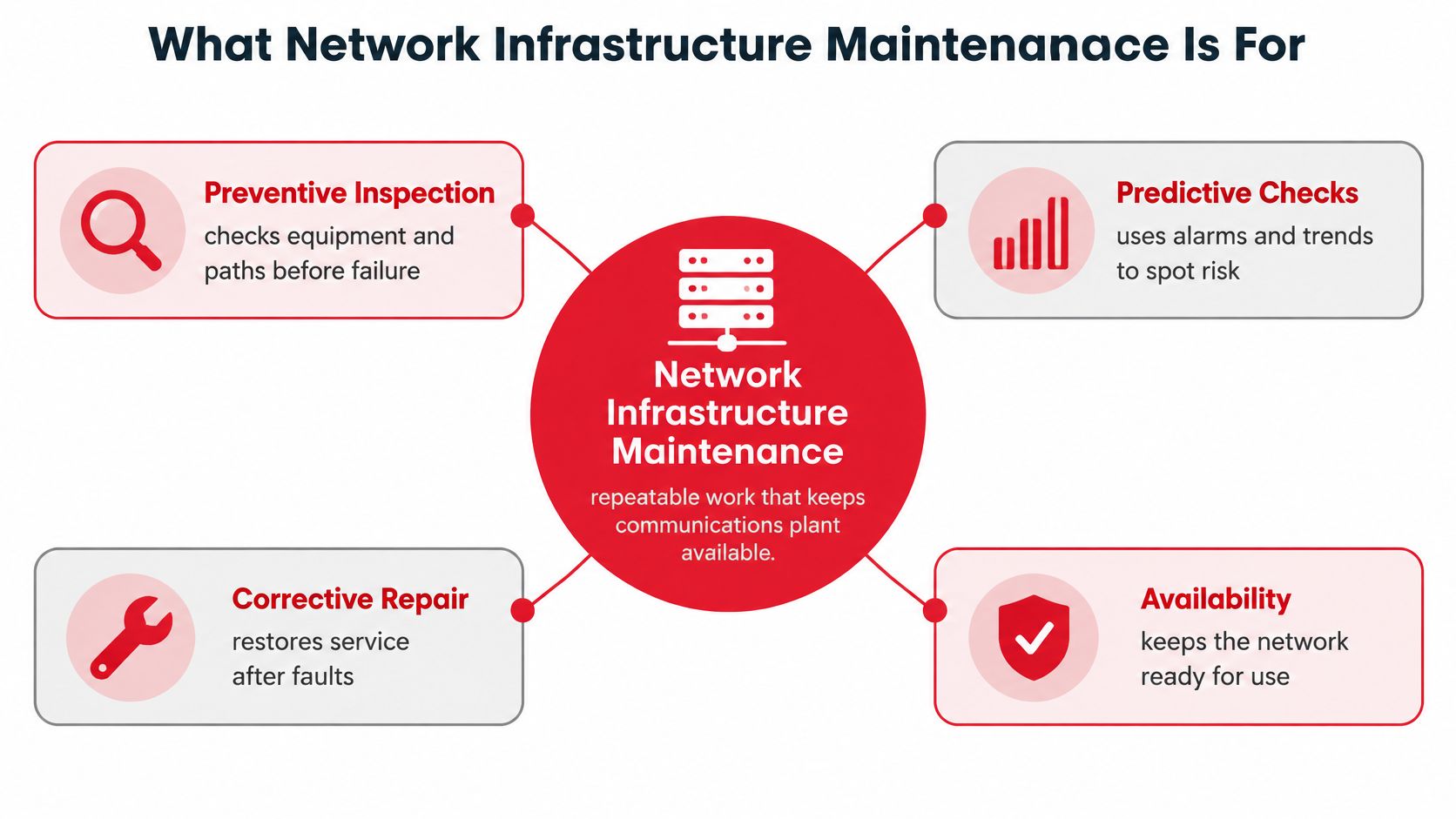
Network infrastructure maintenance is the repeatable work that keeps communications plant available. It includes preventive inspection, predictive checks based on alarms and performance trends, corrective restoration after faults, and controlled upgrades. The equipment may be copper or coaxial cable, fiber outside plant, macro wireless sites, small cells, or the power, grounding, and structured cabling inside a data center.
Consider a regional provider preparing to replace equipment on a route carrying customer traffic. The work may prevent future failures, but the change itself can interrupt service if the crew isolates the wrong path, applies an incorrect configuration, or discovers that the backup route isn't ready. The FCC report notes that human error and procedural problems can contribute to maintenance-related failures. Reliable plant therefore depends on trained people, good records, and disciplined execution as much as it depends on sound physical equipment.
The business case comes down to four outcomes operators feel directly:
- Service availability: customers can reach the services they rely on.
- Emergency-call continuity: communications paths remain usable when people need help.
- Customer experience at peak: the network can carry service through busy periods.
- Fewer repeat dispatches: teams fix root causes in a controlled window instead of returning to the same fault.
A highway lane closure is a useful analogy. Closing a lane with signs, a detour, and a clear work plan can protect both the crew and the road. Closing the only open lane at rush hour, without a working detour, turns planned work into an incident. In a network, traffic rerouting and a proven backup path are the detour. A plan needs peer review, configuration validation, a rollback procedure, monitoring during the change, and a post-maintenance test before the window is considered complete.
A device showing normal status isn't the same as a redundant path that has been tested under load. A backup link may look healthy while hiding a bad patch record, degraded optics, or insufficient capacity. Treat “up” and “proven” as different conditions in the maintenance record.
The next decision is cadence. Rather than assigning every asset the same calendar interval, set the schedule based on the consequence of failure, the conditions around the asset, and whether redundancy has been tested.
How Often to Maintain Each Network Asset
Intervals follow failure consequence and untested redundancy. Equipment age matters less than either. Seven factors set each asset's place in the schedule: criticality, redundancy, environmental exposure, access time, traffic concentration, vendor support, and observability. The table turns those factors into a planning basis for each asset class.
| Asset context | Planning basis | What sets the interval | Core check | Bring the window forward when |
|---|---|---|---|---|
| Rural fiber outside plant | Long cycle; most visits arrive through triggers because access is slow and redundancy is thin | Exposure, long access time, thin redundancy | Closure inspection plus baseline optical compare | Storm damage, loss drift, or a planned cutover |
| Urban fiber and small cells | Shorter recurring cycle paced by alarm history and permit windows | Traffic concentration, permits, shared structures | Cabinet, power, backhaul, and splice events | Recurring alarms or a failed failover test |
| Macro wireless sites | Seasonal cycle built around tower access and weather | Tower access, grounding, batteries, backhaul | Site visual, ground, battery health, alarm path | Seasonal weather or a carrier upgrade |
| Data-center interconnect and cabling | Recurring audit cycle, plus a mandatory check before any primary-path isolation | Change volume and power dependency | Patch audit, optics, and a live failover | Before any primary path is taken offline |
| Enterprise or ISP edge | Short cycle that lengthens only when records and live state keep agreeing | Support gaps and weak observability | Configuration baseline, errors, and UPS health | Records and live state disagree |
| Hyperscale power and connectivity fit-out | Routine power and label checks between builds, plus a review before any shared-path change | Consequence of one shared path | UPS, grounding, labels, and as-builts | A redundant path has never been proven |
Age alone is a weak scheduler. The Uptime Institute 2025 Annual Survey found that 50% of surveyed data-center operators had experienced at least one impactful outage in the prior three years, that power led the causes at 45% of incidents, and that one in ten outages was serious or severe, with IT and networking outages increasing. A program that inspects only generators, UPS systems, and environmental conditions can leave the connectivity side unexamined.
Read the table row by row. Rural fiber earns a longer planned cycle because reaching it is slow, so its real cadence comes from triggers: a storm, a drifting loss reading against the baseline trace, a scheduled cutover. Urban plant works the other way. Shared structures and dense traffic turn recurring alarms into the earliest warning a schedule can get. Macro sites live on the weather calendar and on tower access. Data-center paths get checked before a primary goes offline, so the failover is proven while a working path still exists.
Scheduling rule: Derive each asset's interval from its risk factors and planning basis. Bring the work forward when a trigger appears, and count a window as closed only when its proof is filed: test traces, failover results, and as-builts that match the plant.
Treat an untested backup as a scheduling input. Until a failover test has pushed real traffic across a secondary path, that path is a hypothesis, and an unproven one moves the asset up the calendar. Postpone a window only when waiting is safer than intervening, and record the reason, the rescheduling condition, and the approver. A postponed window with no recorded reason is an unplanned outage waiting for a date.
Tasks for Wireline Fiber Wireless and Facilities
Fiber maintenance needs two complementary tests. An optical loss test set (OLTS) measures end-to-end insertion loss across a qualified span; an optical time-domain reflectometer (OTDR) locates and measures individual events such as splices, connectors, bends, and breaks. Relying on an OTDR alone can mislead: it may underestimate multimode-fiber loss by as much as 3 dB on a 10 dB link, and reflective events can appear as misleading gains. For single-mode outside-plant work, common planning values are about 0.1–0.2 dB per fusion splice and approximately 0.3 dB for a mechanical splice, as described in the Fiber Optic Association's outside-plant testing guidance.
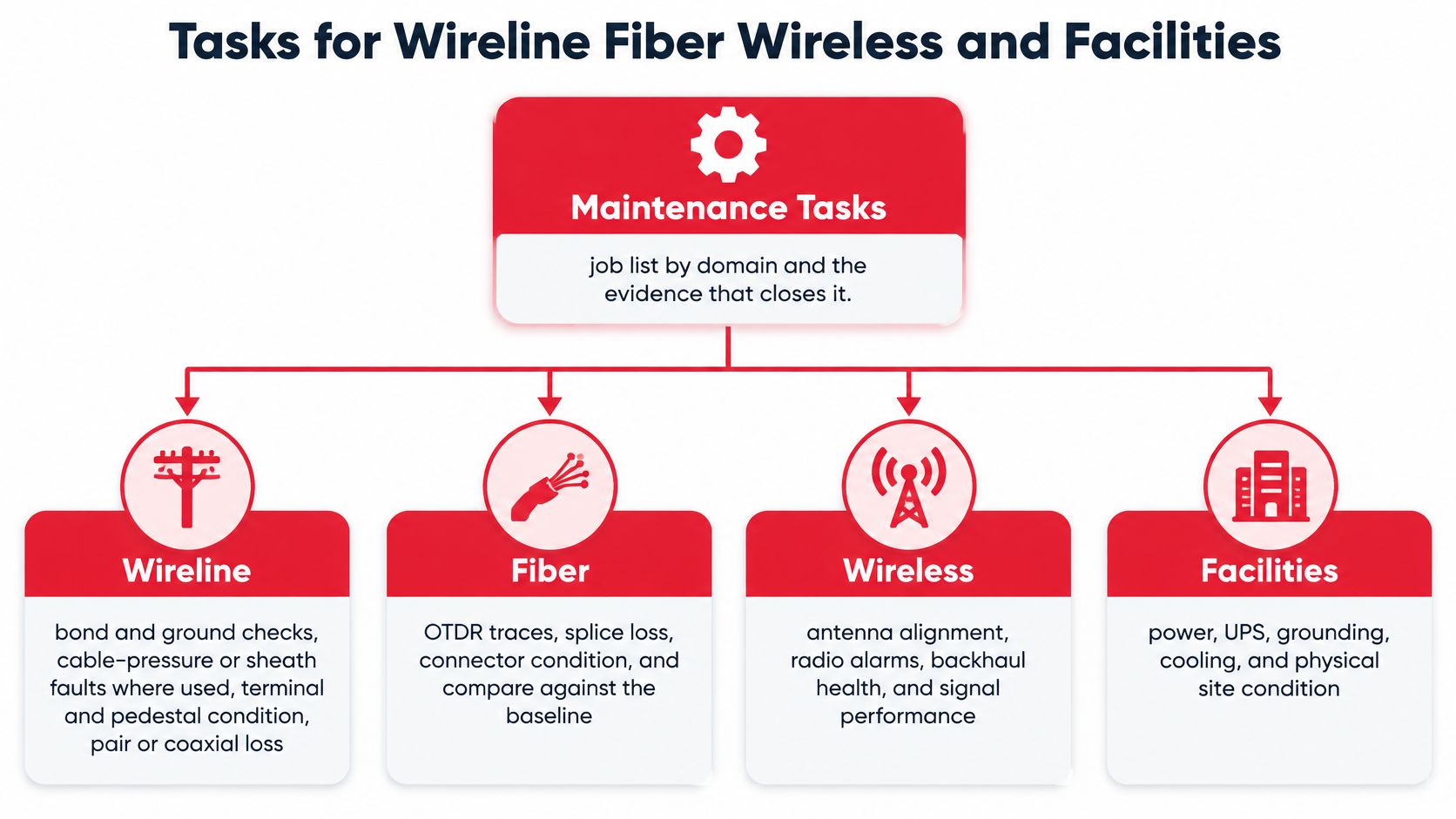
| Domain | Typical tasks | Proof the work passed |
|---|---|---|
| Wireline copper or coax | Check grounds, sheath or pressure faults where used, pedestals, and pair or coaxial loss against the last record. Complete locates before digging. | Updated test sheet and locate ticket attached to the asset |
| Fiber outside plant | Measure end-to-end loss with OLTS and analyze events with OTDR. For single-mode outside plant, use the splice planning values above. | Baseline and post-repair traces archived with the as-built |
| Macro and small-cell wireless | Review alarms, battery and rectifier condition, grounding, the antenna path, and backhaul errors. | Alarm status, battery reading, and backhaul error check recorded |
| Data-center power and cabling | Audit patching, check optic light levels, review transfer tests and thermal conditions, and confirm the configuration baseline. | Failover result and a diagram that matches the floor |
At commissioning, record the fiber's OLTS loss, OTDR trace, test wavelength, fiber identification, instrument, and event locations. This baseline gives the restoration crew something specific to compare against when a link degrades. If a new event appears, the trace can help distinguish a kink, splice anomaly, or shifted cable from the span's original condition.
After a repair, repeat both tests. File the results with the updated as-built so the next crew can see what changed and where. The same principle applies outside fiber: a radio alarm review should have a recorded outcome, and a facility transfer test should identify which path carried the load.
Before dispatch, identify the proof each task needs and the asset record where the crew will store it. A test that exists only on a technician's device doesn't help the next shift diagnose a fault or verify a change.
A job isn't finished when the crew leaves the site. It's finished when the evidence is attached to the asset ID.
Policies Records Safety and KPIs That Count
The policy backbone is an asset register. It should connect each fiber segment, splice closure, cabinet, radio site, power system, and transport device to its configuration, test history, alarms, and restoration notes. That record lets an approver understand what a proposed change touches and gives the field team a reference for validating the live plant. Communications-network maintenance guidance from the Fiber Optic Association on restoration and maintenance planning emphasizes measurable goals and repeatable methods, not just reactive repairs.
Build the operating policy in a clear sequence:
- Name an approver for each maintenance window and define who can stop the work.
- Standardize the method so crews follow an approved sequence rather than inventing steps on site.
- Make evidence the completion rule. A closed ticket needs test results and matching records, not just a checked box.
Safety requirements should be specific to the work. Underground crews need traffic control and current locates. Tower crews need fall protection and a rescue plan. Fiber teams need eye protection and a reliable way to identify dark fibers before handling them. Work on DC plants, UPS systems, and generators requires lockout and control of stored energy.
Prioritize work using signals that expose deterioration or operational risk: recurring alarms, optical-loss drift, battery health, thermal excursions, packet errors, outage frequency, and mean time to repair. For example, a fiber span with rising loss may be worth correcting during a planned window before it becomes a break. The same logic applies to wireless environmental conditions, grounding problems, and configuration drift in a data center.
| KPI | What it reveals | Better direction |
|---|---|---|
| Repeat incidents on the same asset | A repair or baseline that didn't hold | Down |
| Mean time to repair | Access, spares, skills, and records | Down |
| Change-related incidents | Windows that create outages | Down |
| Preventive-task completion | Schedule drift versus completed work | Up |
| Jobs validated end to end | Paper closures without a test | Up |
| Records matching live plant | Stale as-builts and incorrect failover paths | Up |
Review these six indicators regularly as a closed loop. Repeat incidents and unexplained degradation should fall, restoration should get shorter, preventive work should finish, and the records should match what's in the field. If an inspection leaves the same alarm in place with no diagnosis or action, the team hasn't improved the asset.
Use OTDR comparisons to catch non-catastrophic fiber stress, such as a kink that raises loss before a complete break. Apply the same approach to environmental monitoring, grounding, power redundancy, and configuration baselines in wireless and data-center environments. Retire any metric that can be improved by closing tickets early; the scoreboard should reward verified reliability, not administrative speed.
How to Change the Network Without an Outage
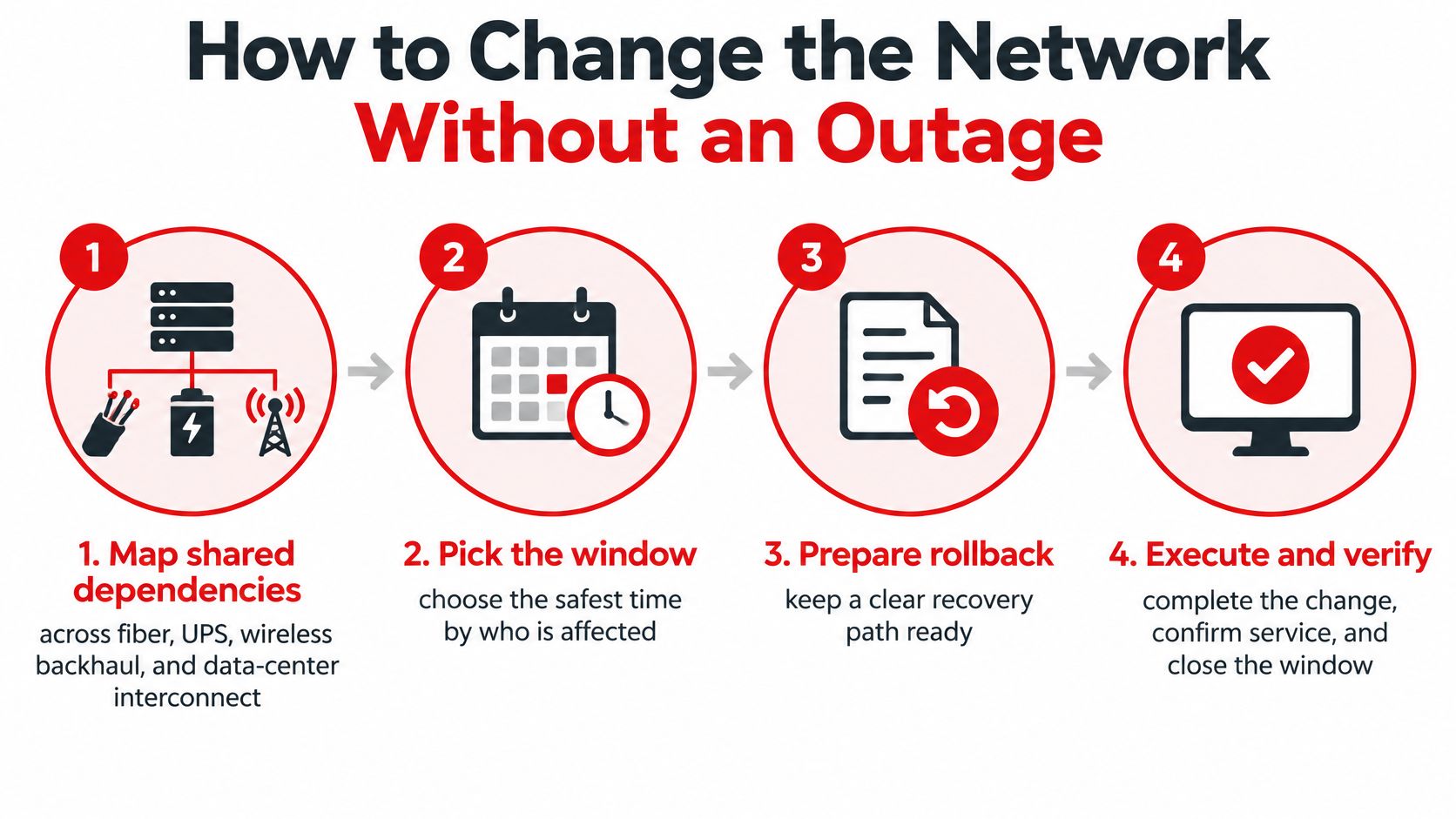
A maintenance window is a change that can fail. Give the team a written sequence, a named approver, and a clear rollback condition before work starts. Uptime Institute reported that IT- and network-related issues represented 23% of impactful data-center outages in 2024, that failures to follow procedures became a larger contributor than the previous year, and that 87% of organizations experiencing a major outage believed better management or processes could have prevented it. Those findings in its 2025 Annual Outage Analysis support written plans and agreed rollback triggers, not informal handoffs.
Map shared dependencies. Trace the relationships among fiber, UPS, wireless backhaul, and data-center interconnects. Choose the window by who would lose service if two dependent paths failed together.
Write, review, and approve the plan. Specify the work sequence, affected services, monitoring signals, rollback steps, and the person authorized to proceed. Have a peer review the plan before the approver signs off.
Prove the backup path and its capacity. Test failover while the primary is still available. Confirm that the alternate route works and can carry the expected service before isolating the primary.
Make the cutover in sequence. Change one planned component at a time, keep monitoring live, and communicate status to the people responsible for operations and customer impact.
Stop or roll back at the agreed trigger. Don't improvise if alarms, errors, or service checks cross the threshold in the plan. Restore the known-good state before deciding on another attempt.
Validate end to end and archive the new baseline. Confirm service from the affected edge through the relevant network path. Store the test results and update the configuration and as-built records.
Adding redundancy doesn't remove maintenance risk when diagrams, escalation trees, or configuration records are wrong. For teams coordinating complex work across departments, a practical project implementation plan from Tuff can help clarify owners, dependencies, approvals, and handoffs before a maintenance window opens.
The FCC formalized nationwide communications-outage reporting in 2004 through its Network Outage Reporting System. Qualifying wireline, cable, satellite, wireless, interconnected VoIP, and signaling-system providers must report significant outages lasting at least 30 minutes when they also meet service-impact thresholds. The FCC Network Outage Reporting System requires an initial report within three calendar days and a final report no later than 30 days after discovery. Preserve incident data, identify affected services, document the cause, and record corrective actions. A maintenance-caused outage follows the same reporting process, and the rollback notes help establish the cause.
For response, treat the incident as a clock, not a hero story: detect the disruption, preserve logs and alarms, identify affected services, stabilize the path with a bypass or temporary splice when appropriate, and assign one communicator to coordinate updates. The FCC reporting framework makes outage handling part of operational accountability, not just an internal service-level matter.
A good drill makes failure safe to practice. Schedule failover exercises for critical paths, record what failed, correct the records or capacity problem, and retest before relying on that redundancy in a live incident.
Cases Where the Program Held or Failed
On a regional fiber span, service remained up and no hard-down alarm appeared. During a scheduled comparison with the commissioning baseline, the crew found a new OTDR event consistent with a kink from a shifted cable. They corrected the route in a maintenance window, repeated the OLTS and OTDR tests, and attached the new results to the as-built. The team caught a developing fault before it became a night cut followed by a long locate.
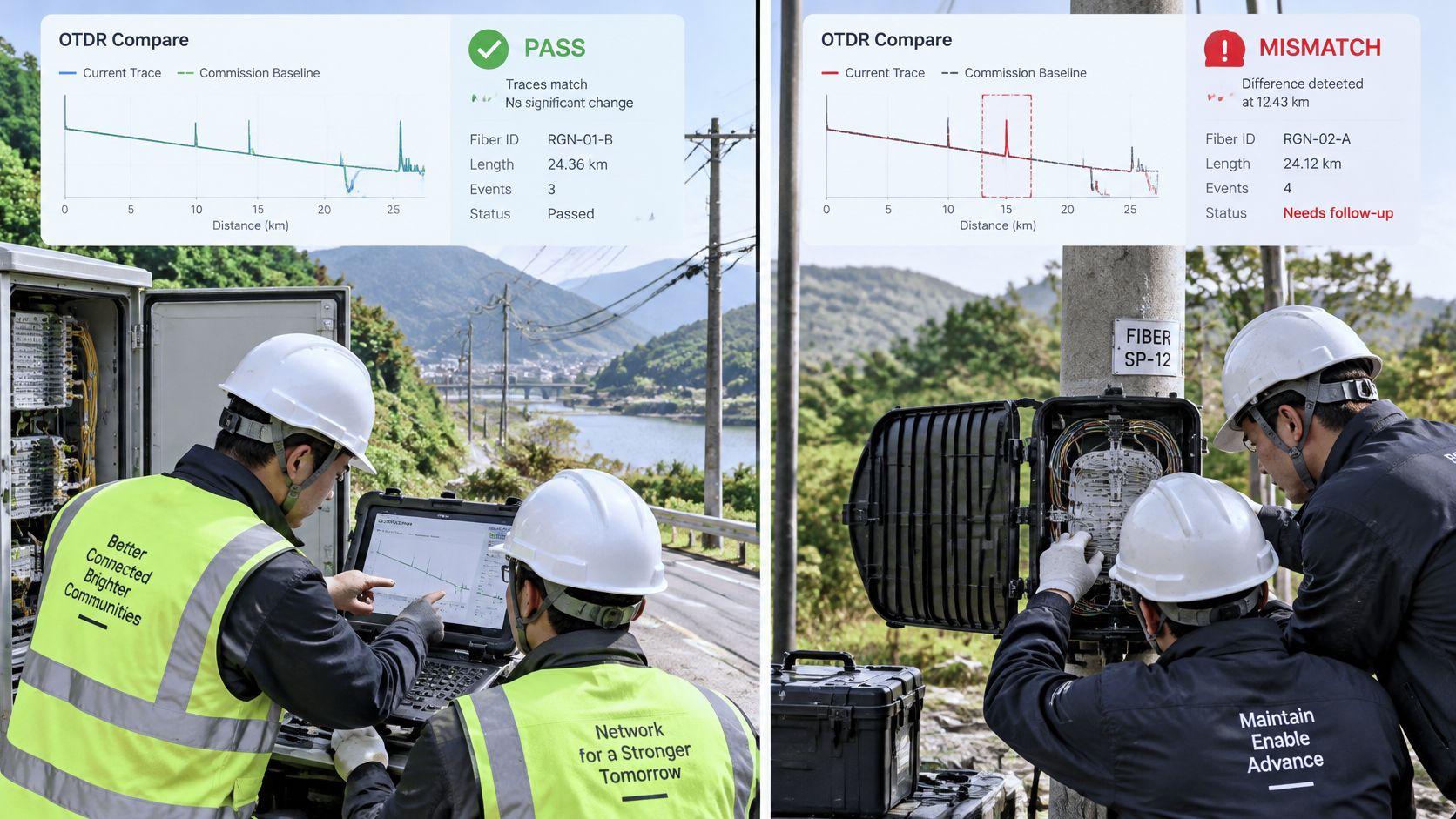
The point isn't that every small change in a trace means a cable is about to fail. It's that non-catastrophic loss is still actionable when a comparison gives the team a reason to inspect and a way to confirm the repair. The baseline turns “the link seems fine” into a testable decision.
A facility team faced a different problem during a UPS maintenance window. The records marked a redundant interconnect as in service, but the planned failover exposed mislabeled patching and a backup optic over its loss budget. The team couldn't release the primary path. The immediate risk came from inaccurate records and unproven connectivity, not from a lack of spare equipment.
A short field explainer can help crews and facility teams align on what they're checking before a job begins:
Contrast both cases with a weak maintenance pattern: a crew reboots a device, closes the ticket without a baseline or end-to-end test, and sees the same alarm return. Flat or rising repeat incidents show that the work cleared a symptom without proving the repair held.
A wireless site can fail the same logic test. A macro site may pass a visual climb inspection while the team has no battery conductance reading or backhaul error record. When the grid blinks, the next outage becomes the test of the site's readiness.
An untested path isn't redundancy. Which of your last five maintenance tickets would hold up to the fiber comparison and the failed-failover test?
Choosing a Maintenance Partner
Use a partner for work your own team won't staff or can't perform with its available access and equipment. That may include after-hours response, fiber splicing and OTDR/OLTS testing, tower or small-cell access, and data-center fit-out. Evaluate the partner against the operating requirements, not just the promised scope.
- One accountable party: The same team should understand the design, support the maintenance window, and deliver the closing as-built. That continuity helps keep the baseline connected to the repair.
- Mobilization outside business hours: Confirm that the response commitment is written into the contract, along with who dispatches crews and equipment.
- Test records tied to assets: Require OLTS and OTDR baseline and post-repair results, where relevant, linked to the asset ID and delivered with the repair package.
- Worksite safety: Review procedures for underground locates and traffic control, aerial fiber work, and tower climbing with fall protection.
- Live-path change experience: Ask how the team proves a failover, manages a rollback, and documents a failed cutover before a primary path is released.
Southern Tier Resources is one option for this scope. The company provides engineering, design, construction, and maintenance for wireline and wireless communications, including fiber splicing and testing, broadband builds, wireless deployment, and data-center infrastructure fit-outs. It provides end-to-end services from design through deployment and maintenance, with crews and equipment available 24/7.
Before awarding work, ask for references on a comparable maintenance window, a sample post-repair test package, and the escalation path if a cutover fails. Confirm that the sample includes the records your operations team needs, not just a completion note.
Start the Next Maintenance Cycle
Start with a bounded review of your most consequential assets, then use its results to build the next maintenance window.
- Select the highest-consequence assets. Identify the assets whose failure would cut the most customers or affect a public-safety path.
- Mark every alternate path tested or untested. Base that status on recorded failover results, not an equipment dashboard alone.
- Schedule work against actual triggers. Bring untested paths and assets above their alarm or drift triggers into the next appropriate window.
- Make test evidence a closure requirement. For fiber, require OLTS and OTDR results. For facility paths, attach a failover note before the ticket closes.
- Assign an owner for the six KPIs. Have that person review the scoreboard before the first window so the team has a baseline for evaluating the program.
Then choose one external work package with a clear boundary, such as baseline testing on one metro ring or a failover audit in one data-center hall. Keep it to a single window before committing to a broader program. The first job should produce useful traces, test outcomes, and updated records that operations staff can use.
For operators who need outside crews for this work, Southern Tier Resources provides communications engineering, design, construction, and maintenance for wireline and wireless networks, along with end-to-end delivery from design through maintenance. Use the partner criteria above to assess whether its scope fits the work and the evidence your team requires.
The decision for the next window is simple: will you schedule it around the consequence of failure and prove the backup path, or leave the risk in place until the next unplanned cut?
Southern Tier Resources provides engineering, construction, and maintenance for wireline and wireless networks, including fiber splicing and testing and data-center fit-outs. If your next maintenance cycle needs field crews, test equipment, or support connecting the work to dependable records, visit Southern Tier Resources to discuss the scope.