A crew is three days behind on a make-ready. The pole sits beside a marked gas line, the bucket is already on the shoulder, and the splice window closes at dusk. Right then the safety program either holds or it turns into a muttered "be careful" while someone starts climbing.
Programs don't usually fail in the binder. They fail when the job hazard analysis is a copied form from last week's span, when the traffic plan is "cones if we have time," and when the only person who can stop work is also the person scored on feet of fiber placed.
A red schedule doesn't suspend the hazard. It only shortens the time you have to control it.
Treat accident prevention strategies as ten layers of defense, in the order a field lead should build them. Name the hazard before anyone is exposed. Engineer it out where you can. Control falls, energy, trenches, and traffic. Put PPE and proven competence on whatever risk remains. Then learn from the near miss before it becomes a fatality.
Each layer below names the environment it serves first, wireline, wireless, or data center, the standard that governs it, and the trade-off crews hit when the schedule is already red. Some controls cost an hour. Skipping them costs a crew.
1. Hazard Identification and Job Hazard Analysis
Say the task is a pole change-out on a joint-use span, wireline first. Before the auger turns, the crew walks the hole, the anchors, the drop, and the traffic side. A job hazard analysis, the sheet many crews still call a JSA, breaks that work into steps and ties each step to a hazard and a control.
OSHA's leading-indicator publication recommends tracking near-miss and hazard reports, training completion, and corrective-action closure, because those show whether controls exist before an injury, while TRIR and DART only score what already happened. I want every high-risk task to carry a finished pre-task plan. An injury-only dashboard stays quiet right up until it isn't.
Keep the JHA honest on that pole:
- Write it with the crew: The climber and the ground hand, not a supervisor already driving to the next site.
- Rewrite it when conditions change: Rain, a fresh locate, or a new splice order voids yesterday's sheet.
- Name the control and the owner: "Be careful" is not a control.
Data center fit-out crews should run the same pass before an overhead lift over live rows. Ten minutes on that aisle beats a generic orientation that never mentions the busway. The trade-off is those minutes against a copied form that hides the gas line.
2. Hierarchy of Controls
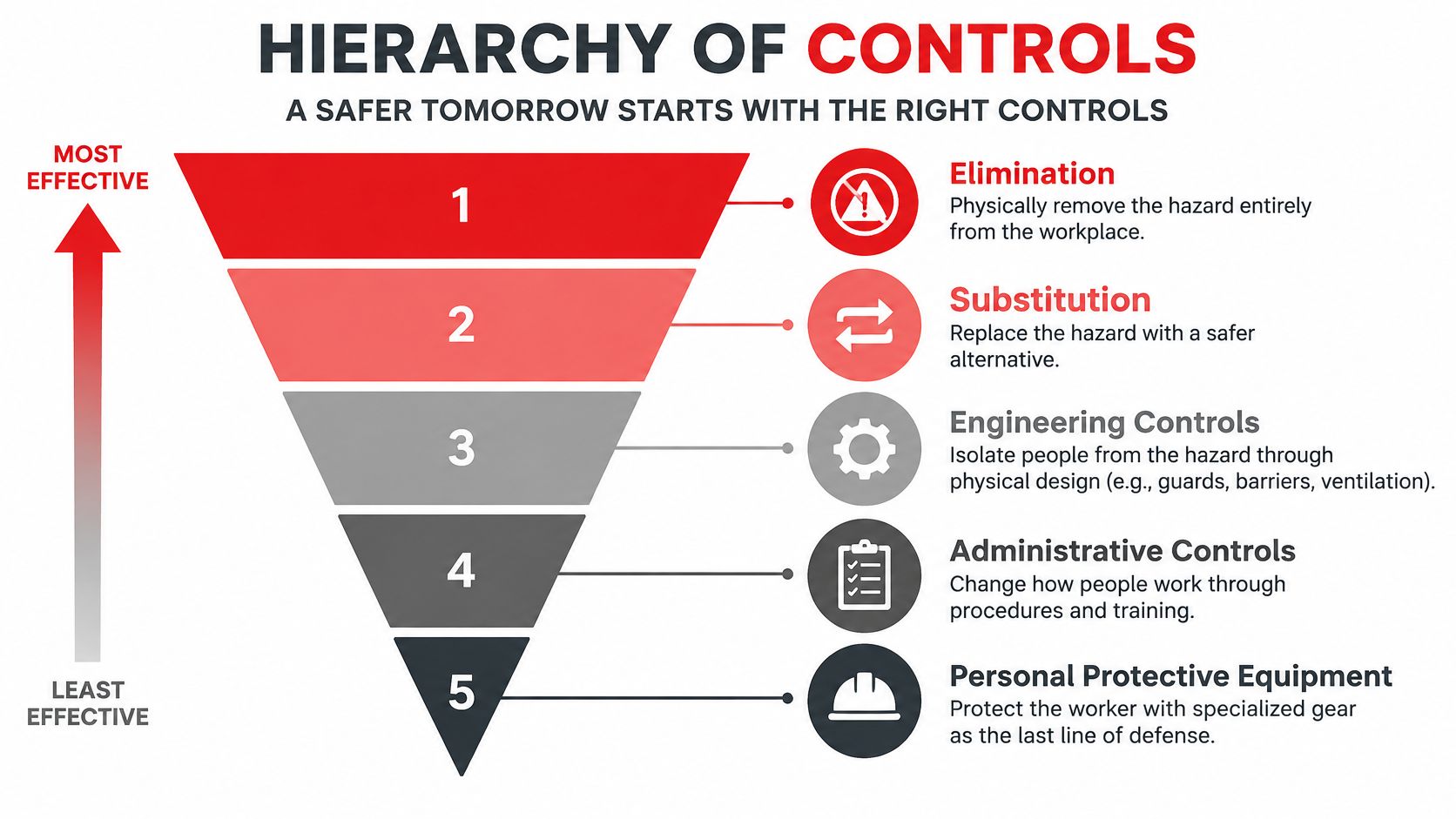
PPE is the last vote, not the first. The hierarchy runs elimination, substitution, engineering controls, administrative controls, then PPE. On a fiber lateral I'll take vacuum excavation or a directional bore over an open trench beside a gas main, even when the bore crew costs more that day. On a macro site, ground-based alignment beats another hour on the steel if the radio plan allows it.
Field rule: If you can't remove the hazard, write down why the higher control was rejected before you buy more gloves.
Procurement belongs in this layer. Spec the lift, the trench box, or a remote splice setup when you buy the job, not after the crew is mobilized. Rules and PPE still matter. They shouldn't be the whole program because engineering looked expensive on bid day. Wireless, wireline, and hall work all lose the same way when the cheapest control is the only one anyone funded.
3. Fall Protection and Fall Prevention
Wireless crews live with this layer. Falls from poles, towers, and roofs are where one missed step becomes fatal. OSHA's accident record describes a February 2025 communication-tower incident in which a worker lost footing while climbing to support installation of a telephone communication dish. Sequence, weather, gear, and rescue readiness matter more than another generic harness talk.
Before anyone leaves the ground, the rescue kit is on site and a named ground person has drilled the pick-off. Inspect the harness, lanyard, and connectors, and pull damaged gear out of service that shift. Use the same rated anchors every time. Don't invent a tie-off because the drawing shifted overnight.
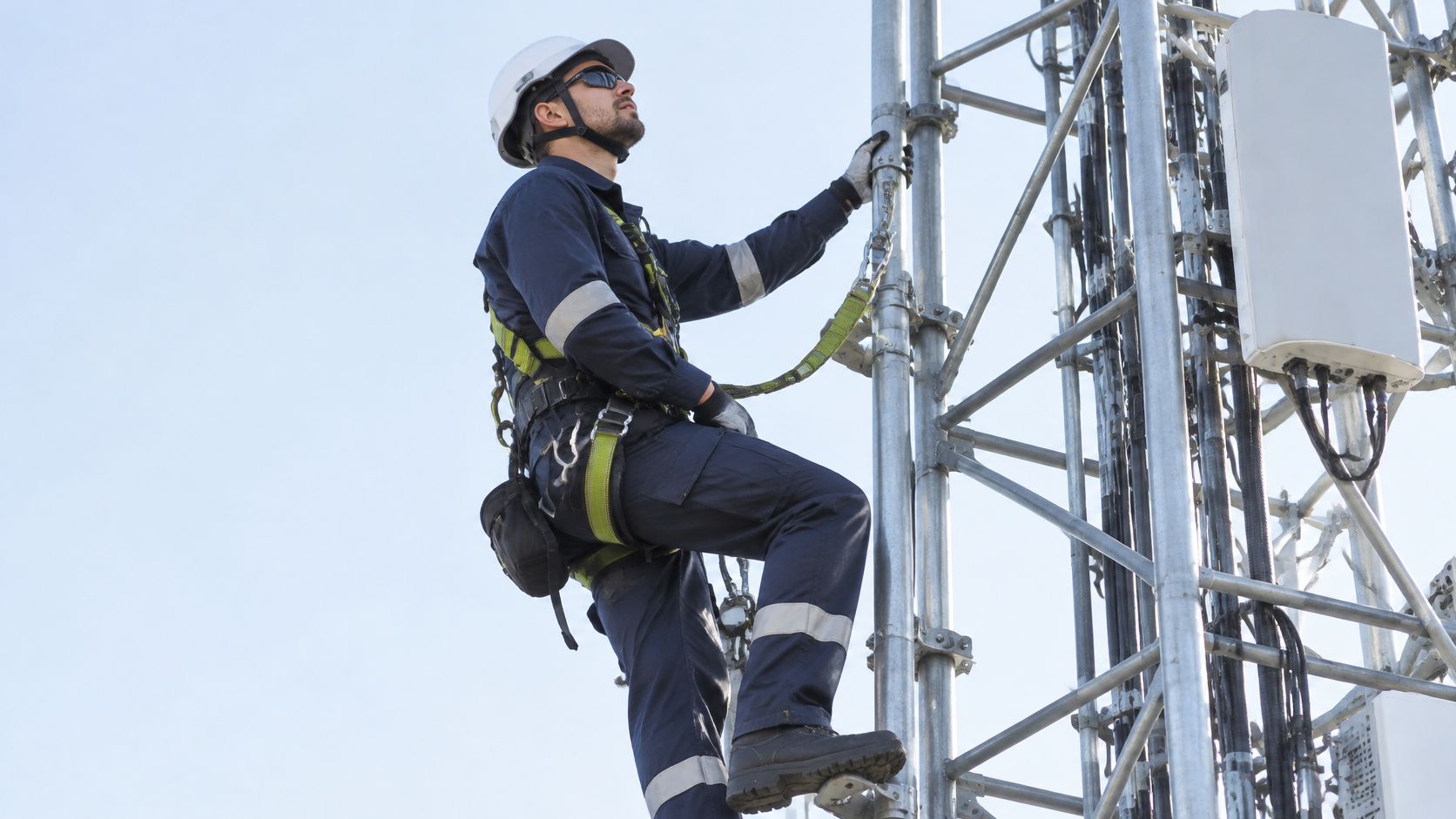
OSHA construction fall-protection rules, plus the tower consensus practice your client specs, govern the climb. The trade-off is the first hour of a macro upgrade. A connected climb system and a rescue plan slow that hour. Climbing "just this once" without them is how a footing slip becomes a fatality with nobody ready to get the climber down before suspension trauma sets in.
4. Lockout/Tagout (Hazardous Energy Control)
Data halls and shelter sites, this is the layer that keeps a "simple" rectifier swap from becoming an arc. Lockout/tagout isolates electrical, battery, and stored energy before anyone opens a cabinet. OSHA 1910.147 is the governing standard, and the site procedure should match it step for step.
A workable sequence on a PDU or power plant:
- List every source: Utility feed, batteries, capacitors, and any generator interlock.
- Hang personal locks: One lock per worker. Only the person who applied it removes it.
- Prove zero energy: Test the meter on a known live source, then on the conductors, then on the live source again.
- Hold locks across the shift change: A handover doesn't mean the outgoing tech pulls locks for the next crew.
Wireless techs hit the same rule on outdoor cabinets when backup batteries stay hot after the AC breaker is open. The trade-off is the change window. A full lockout in a live hall can push that window. Working hot because the window is short isn't a control. It's a bet the crew doesn't get to renegotiate after the flash.
5. Electrical Safety and Arc Flash Risk Management
Shock, arc flash, and arc blast show up in data halls, at cell-site power plants, and anywhere telecom gear sits beside utility gear. NFPA 70E is the practice set I expect on the permit, with approach boundaries, an arc-flash study, and PPE matched to the incident energy on the label.
Say a fit-out crew has to land a breaker in an energized switchboard because the hall won't drop the row. A qualified person decides whether that work stays energized, checks the label, and sets the boundary. Labels go stale after a gear change. If the study is two upgrades behind, the calorie rating on the shirt is a guess.
What belongs on the cart before the door opens:
- Insulated tools and a meter rated for the voltage in front of you.
- Gloves and sleeves where the assessment calls for them, including near energized drops on a pole.
- Barriers so a cable puller doesn't drift inside the limited approach boundary.
De-energize when the client will give you the window. Energized work is the documented exception, not the default because the technician is already on site and the ticket is aging.
6. Excavation Safety and Underground Utility Locating
Fiber and conduit, this is wireline work. The kill paths are a cave-in and a struck gas line, power cable, or existing fiber. In the U.S. you start with 811, call before you dig, then treat the marks as a clue, not a guarantee.
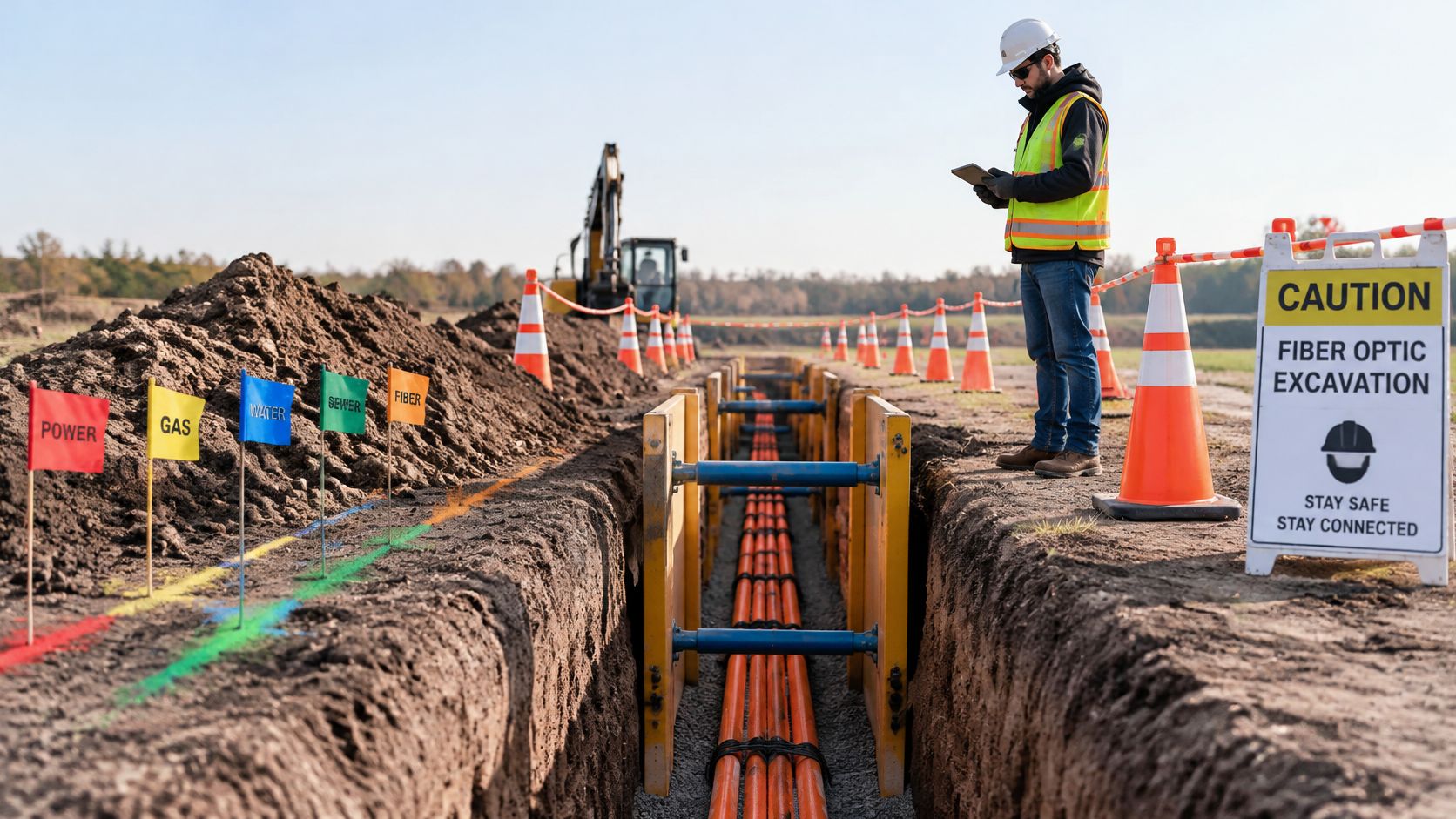
A vacuum truck exposing the utility inside the tolerance zone is slower than a bucket and cheaper than a rupture. On a deep urban conduit run, a trench box or shoring goes in before anyone works the bottom. A competent person inspects the excavation daily and again after rain. Spoil piles and trucks stay back from the edge. Two feet is the baseline I won't bargain down on a tight shoulder.
OSHA Subpart P governs the excavation. The trade-off shows up when locates expire and the bore crew is already paid for the day. Refresh the marks. Don't "stay close to the paint" with a mini excavator because the ticket is a day old and the inspector isn't on the block yet.
7. Work Zone Traffic Control and Vehicle Safety
Roadside cabinets and make-ready put crews in the path of passing traffic. WHO road-safety guidance reports that every 1% increase in mean vehicle speed produces approximately a 4% increase in fatal-crash risk. A cone line with no buffer isn't a plan when speeds never really drop.
The MUTCD governs temporary traffic control in the U.S., and the permit agency can tighten it further for a municipal fiber build.
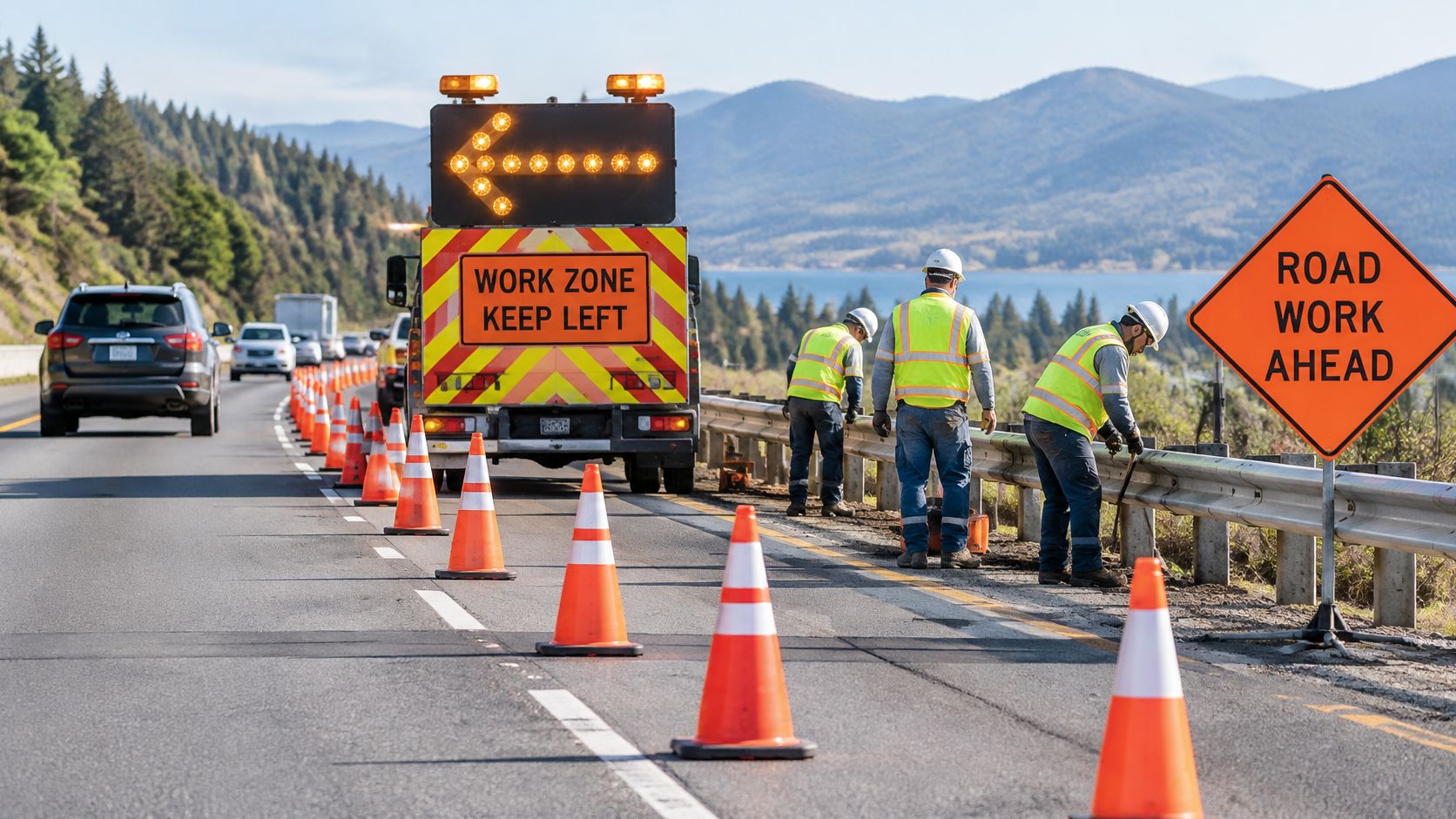
Set this before the first cone drops:
- Match the signed plan: Flagger certifications included, not a helper with a paddle.
- Keep a real buffer: Nobody steps into the live lane to grab a tool.
- Spot every reverse: Truck, trailer, and the bucket in a gravel lot.
- Light the work: Day shifts when you can. At night, light the workers, not only the arrow board.
A missed circle check on the bucket is an accident prevention failure before you reach the pole. Lane rental and a certified flagger cost money. A struck-by on a rural shoulder costs more, and the crew doesn't get that hour back.
8. Personal Protective Equipment (PPE) Program
This is the last layer, and it fails when people treat it as the first. Hard hats, eye and face protection, hearing protection, high-visibility clothing, gloves, and boots. ANSI-rated head and vest protection on every roadside and tower site. In a data hall, cut-resistant gloves and eye protection during a pull and a termination, because fiber shards and sharp tray edges don't care that you're indoors.
A written hazard assessment picks the kit for the task. One hard hat for every job is how crews skip hearing protection beside a compressor and wear a face shield they don't need in a dry manhole.
A 2025 evidence briefing found very limited evidence that emerging technologies improve worker safety outcomes, and it warned that poorly designed wearables can harm worker health or workplace relationships. Lloyd's Register Foundation's briefing is why I pilot alert precision, false alarms, and crew trust before I scale a sensor. A specific JHA still beats an unvalidated dashboard.
Inspect PPE daily, replace damaged items that shift, and have a supervisor look. Offer sizes that fit. A vest that won't close stays in the truck. Heat and cost are the trade-off. Buy the lighter high-vis garment and the right size. Don't drop the assessment because "everyone already knows the PPE."
9. Training, Competency, and Qualification Programs
OSHA 10 for new ground hands, OSHA 30 for the leads, climbing and rescue cards before anyone is assigned steel, and a qualified electrical worker before energized work. Site orientation isn't competency. Competency is a demonstrated climb, a demonstrated lockout, or a demonstrated vacuum exposure inside the tolerance zone, watched by someone who is allowed to fail the person.
Track expiration dates in one system. A lapsed rescue card on a macro crew is an assignment error, not a paperwork nit. Short refreshers tied to last month's near miss beat an annual slide deck nobody remembers on the steel.
Classroom time has to sit next to supervised reps. The trade-off is a day off production. Sending an unproven climber up because the certified tech called out is the more expensive choice, even if that choice closes the ticket before dark. Wireline splicing, tower rigging, and hall terminations each need their own sign-off. A general "safety trained" stamp covers none of them.
10. Incident Reporting, Near-Miss Tracking, and Root Cause Analysis
Three near slips on wet gaffs in one week are a warning, even if nobody is injured. Record them and look for a pattern that could affect every climbing crew.
A safety management certificate provides a framework for tracking incidents and corrective actions. It does not, by itself, show whether crews follow those actions on a pole, in a trench, on a tower, or in a data center.
Use a short mobile form crews can complete at the site. Investigate conditions such as schedule pressure, poor anchors, or missing feedback, then assign each corrective action an owner and due date. Keep the loop simple: log each report, assign an owner, and close critical items before the crew demobilizes. For an employer-facing overview of risk control and claims management, see a practical guide for New Jersey employers.
If a near miss leads only to blame, crews will stop reporting. Make the report useful by fixing the condition and telling the crew what changed.
Ten Accident Prevention Strategies at a Glance
| Item | Primary Risk Addressed | Key Standard | Best For |
|---|---|---|---|
| Hazard Identification and Job Hazard Analysis | Task-specific hazards and exposure | OSHA 29 CFR 1926; ISO 45001 | Planning and reviewing job tasks |
| Hierarchy of Controls | Ineffective or low-level hazard controls | NIOSH hierarchy of controls; ANSI/AIHA Z10 | Choosing the most effective risk controls |
| Fall Protection and Fall Prevention | Falls from poles, towers, rooftops, and platforms | OSHA 29 CFR 1926 Subpart M; ANSI/ASSP Z359 | Elevated telecom and construction work |
| Lockout/Tagout (Hazardous Energy Control) | Unexpected equipment energization | OSHA 29 CFR 1910.147; NFPA 70E | Equipment servicing and maintenance |
| Electrical Safety and Arc Flash Risk Management | Shock, arc flash, and arc blast | NFPA 70E; OSHA 29 CFR 1910 Subpart S | Electrical work and power equipment operations |
| Excavation Safety and Underground Utility Locating | Cave-ins and buried utility strikes | OSHA 29 CFR 1926 Subpart P; CGA Best Practices | Fiber, conduit, and trenching projects |
| Work Zone Traffic Control and Vehicle Safety | Roadway strikes and vehicle incidents | MUTCD Part 6; ANSI/ISEA 107 | Roadside work and travel between sites |
| Personal Protective Equipment (PPE) Program | Task-related injury exposure | OSHA 29 CFR 1910 Subpart I; ANSI/ISEA standards | Selecting and managing task-specific PPE |
| Training, Competency, and Qualification Programs | Unsafe work from skill or knowledge gaps | OSHA 29 CFR 1926.21; ANSI/ASSP A10.48 | Verifying worker readiness for assigned tasks |
| Incident Reporting, Near-Miss Tracking, and Root Cause Analysis | Repeat incidents and unaddressed hazards | OSHA 29 CFR 1904; ISO 45001 | Learning from incidents and tracking corrective actions |
Building a Safety Culture That Survives a Tight Schedule
A crew reaches a pole with a narrow work window, or a trench crew faces pressure to restore a road before the end of the shift. The safe choice depends on how the job was planned, equipped, and staffed before the deadline arrived. The ten strategies work as a prioritized defense-in-depth system: identify hazards, reduce exposure, control remaining risks, and learn from what nearly went wrong.
Road safety shows why layered controls matter. The World Health Organization's account of global road safety reports that road-traffic deaths fell from approximately 1.25 million in 2010 to 1.19 million in 2021, alongside measures such as safer infrastructure, speed management, vehicle standards, and emergency care. No single measure carries the full load. At a telecom worksite, the same principle applies: traffic separation, safe equipment, clear procedures, and a workable rescue plan need to support one another, especially when the shift runs late.
Do this before the next mobilization:
- Review job hazard analyses. Check active wireline, tower, and data center work plans. Each should identify a control and who is responsible for it.
- Confirm the rescue plan before a climb. Make sure the required kit is on site, responsibilities are assigned, and a drill is scheduled under your standard.
- Review near misses regularly. Sort patterns by crew, task, and subcontractor, then address recurring issues before the next job starts.
Southern Tier Resources provides engineering, construction, and maintenance for wireline, wireless, and data center infrastructure, with a safety-first culture and skilled crews. Contact the Southern Tier Resources team in Carrollton, Texas, to discuss safety planning for your next build.