
Comparing per-splice rates is the wrong place to start when buying fiber splicing work. A low rate doesn't tell you whether the contractor has included acceptance testing, reserved qualified crews, or agreed to correct failed work without another mobilization charge. Compare the cost of an accepted, documented route, not just the cost of making its joints.
Good fiber splicing contracts connect technical requirements to commercial consequences. They tell the field crew what to build, the engineer how to verify it, and procurement who pays when the work fails or conditions change. If those answers aren't explicit before award, the apparent savings can disappear into retesting, truck rolls, delays, and disputed invoices.
What a Fiber Splicing Contract Covers
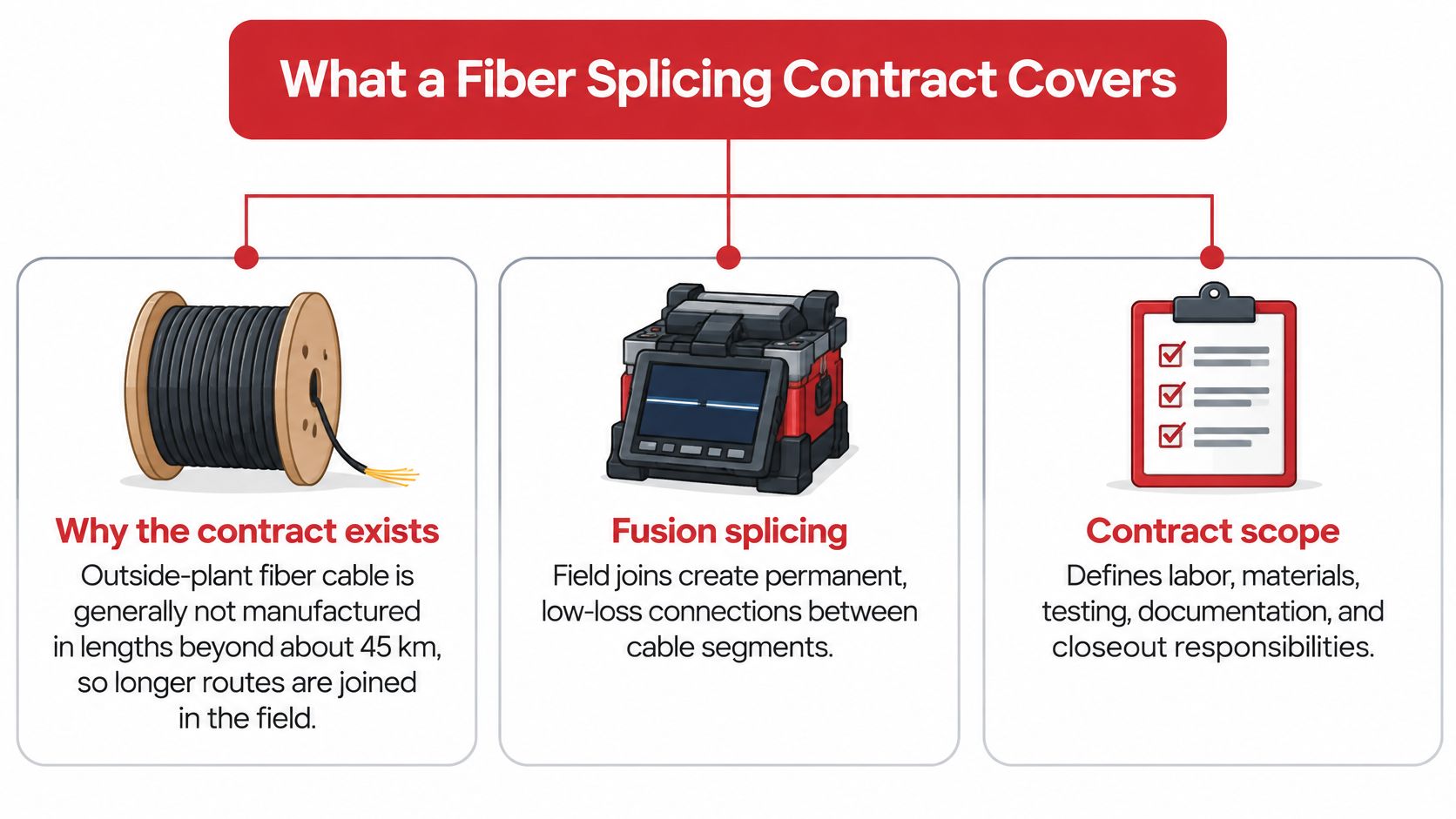
Long outside-plant routes usually need field joints, commonly made by fusion splicing. A contract defines who makes those joints, what work is included, and what evidence the buyer needs to accept the completed installation.
Define the work before requesting prices
List splice preparation, fusion work, protection sleeves, enclosure installation, tray routing, slack storage, labeling, loss testing, bidirectional OTDR traces, and closeout documentation. Identify the fiber type so the contractor can apply the specified procedures and test settings to the cable being installed.
Set out the agreement in a practical hierarchy:
- Scope: Cable schedules, splice diagrams, locations, quantities, and exclusions.
- Workmanship: Approved preparation procedures, materials, and enclosure requirements.
- Verification: Test methods, acceptance thresholds, and required records.
- Commercial controls: Pricing, changes, response obligations, and remedies.
Specify which fibers must be tested, including whether unused fibers are included or excluded. The buyer needs verifiable optical performance and usable records, not just a completed splice count.
Document control also affects execution. Require the parties to identify the approved scope revision and how updates will be distributed. Teams comparing document-sharing options can compare document sharing tools when deciding how to distribute approved project documents and manage access.
Scope test: If the draft can't identify cable IDs, enclosure locations, fiber counts, and test methods, bidders may price different work. Resolve those details before requesting comparable bids.
Required Clauses at a Glance
Required clauses and what each must specify
| Clause | Must specify | Common gap |
|---|---|---|
| Scope of work | Splice count, fiber counts, cable IDs, enclosure locations, splice method | Priced by splice count with no route or cable IDs |
| Testing | Test method, owner-approved wavelengths, bidirectional OTDR, end-to-end loss testing | General industry-standard language with no method named |
| Acceptance criteria | Engineered loss budget, per-splice limit, averaging rule, retest rule | No threshold and no dispute path |
| SLAs | Mobilization time, emergency restoration response, reporting turnaround | No response times for restoration events |
| Warranties | Duration, start date, workmanship versus design-caused loss, remedy | Warranty start date tied to vague completion |
| Change orders | Trigger events, written pre-approval, pricing basis, schedule effect | Verbal approval of extra splices |
| Liability | Liability cap, exclusions, consequential damages, indemnity | Uncapped exposure after a network outage |
| Staffing | Named qualified technicians, training records, subcontractor approval | Unlimited crews assumed at the unit rate |
| Documentation | As-built drawings, trace files, averaged loss tables, calibration records | Paper-only closeout with no searchable data |
Treat this checklist as a procurement control, not a substitute for project schedules. Each clause needs an accountable party, a measurable obligation, and a consequence for nonperformance. An attachment that contains the details must have a revision identifier and a clear place in the contract's order of precedence.
Resolve the gaps that create extra invoices
Scope and acceptance need to describe the same asset. If the price schedule counts individual splices but acceptance applies to complete links, identify who investigates a failed link when its individual splices appear acceptable. Otherwise, the owner and contractor can disagree about whether troubleshooting is included.
The same distinction matters for enclosure work. Opening an existing closure, identifying active fibers, protecting live service, and reorganizing trays isn't equivalent to splicing prepared cable in an accessible new enclosure. Separate those activities in the rate schedule instead of expecting a universal splice rate to absorb them.
Staffing must support the promised schedule. A contractor can offer competitive unit pricing without reserving anyone for your project. Require a mobilization plan that states crew availability, concurrent assignments, supervisory coverage, and the approval process for replacement personnel.
Make obligations work together
The warranty clause shouldn't excuse defects that the acceptance clause requires the contractor to correct. The change-order clause shouldn't permit additional charges for correcting the contractor's own workmanship. Likewise, the documentation clause should define whether missing files prevent acceptance or merely create a minor punch-list item.
Use the liability provision to allocate exposure deliberately. Have counsel coordinate the cap, indemnity obligations, insurance requirements, and treatment of consequential damages. A broad indemnity can undermine a carefully negotiated cap if the agreement doesn't explain their relationship.
Finish the review by marking every obligation that relies on industry standard alone. Replace that shorthand with the applicable document and revision, the measurement method, the required result, and the person authorized to resolve a disagreement.
Test Methods and Loss Thresholds to Specify
Test methods and splice-loss references for acceptance
| Test or threshold | What it proves | Where to specify | Reference value |
|---|---|---|---|
| Bidirectional OTDR | Event location and splice loss in both directions | Every outside-plant fiber | Averaged bidirectional loss at owner-approved wavelengths |
| End-to-end insertion loss | Total link loss against the engineered budget | Each link | Pass against the owner's loss budget |
| Connector inspection | Contamination and end-face condition | Each connector before mating | Pass under the specified inspection standard |
| Visual fault locator | Visible evidence of breaks and some macrobends | Accessible patch and drop cables | Pass or fail under the specified inspection procedure |
| Polarity check | Correct transmit and receive alignment | Duplex links | Pass against design polarity |
| Splice-loss objective | Expected per-splice performance | Each fusion splice | Owner's specified workmanship target |
| Splice-loss upper limit | Acceptance ceiling | Each fusion splice | Owner's engineered event limit |
| Commercial maximum benchmark | Generic guidance for comparison | Each fusion splice | Applicable benchmark, subject to the engineered budget |
No single test proves the entire installation. An OTDR helps locate events and assess splice performance, but it doesn't replace an end-to-end insertion-loss measurement. A connector can also need cleaning even when another test hasn't clearly isolated contamination.
A visual fault locator is useful for accessible troubleshooting, not proof that a long outside-plant link meets its loss budget. Polarity checks answer a different question again: whether the intended transmit path reaches the correct receive position.
Borrow the structure of public acceptance specifications
The USDA Rural Utilities Service cable specification provides a public model for OTDR testing from the central office or launch point, acceptance testing, and witnessing by the owner's representative. Borrow that discipline where appropriate, but don't imply that a public-program requirement automatically governs an unrelated private project.
Separate the workmanship objective from the rejection threshold. The objective tells the crew what performance to pursue; the ceiling determines whether the owner may reject an event. If they're different, say whether a result between them requires explanation, corrective action, or acceptance without further work.
The owner should also specify how apparently negative splice-loss events are handled. Don't let a favorable-looking trace in one direction become an automatic pass. Require paired measurements and an agreed averaging method, with questionable traces reviewed rather than selectively discarded.
Specify the measurement setup
Require launch and receive fibers appropriate to the test setup, clean reference connections, approved instrument settings, and consistent fiber identification. Name who approves the procedure before production testing begins.
Include a trace-review process. The contractor should flag unexpected events, explain discrepancies between measured and scheduled length, and identify files that require engineering review. An automatically generated pass label isn't enough if the trace can't be matched to the installed cable.
Fill the acceptance limits from the owner's engineered loss budget. Use generic benchmarks to check the specification, not to replace engineering judgment.
Sample Testing and Acceptance Clauses
Acceptance should address both link performance and individual events. The FOA Installation Standard supports end-to-end loss testing and bidirectional OTDR measurement, and identifies a 0.3 dB TIA-568-based maximum benchmark while noting that properly executed single-mode fusion splices commonly perform below 0.1 dB.
Those references aren't interchangeable project limits. Route length, connector count, architecture, and operating margin determine what the owner can accept. Put the controlling values in the testing schedule and state that the engineered requirements govern.
Draft clauses for the testing schedule
Test equipment and link testing
Contractor shall test each completed link using a calibrated light source and power meter or optical loss test set against the approved engineered loss budget. Contractor shall use calibrated OTDR equipment for required event testing and record instrument serial numbers, calibration dates, test wavelengths, reference method, and fiber identifiers in the test package.
This establishes separate evidence for total link loss and localized events. The owner must complete the wavelength and equipment requirements before signing, not leave the crew to select them during closeout.
Splice measurement and reporting
Contractor shall obtain OTDR traces from both ends of each designated outside-plant fiber using approved launch and receive fibers. Contractor shall report the averaged bidirectional loss for each splice in an event table linked to the native trace files. Fusion-splicer estimates shall not constitute acceptance measurements.
A splicer's displayed estimate is useful during production, but it isn't the contractual measurement. Matching event tables to native files also lets the reviewer examine the underlying evidence instead of relying on a summary spreadsheet.
Failure, cure, and retesting
Contractor shall investigate each failed result, record the root cause, and correct contractor-caused workmanship defects at its own expense. Failed splices requiring correction shall be re-spliced and retested, together with the affected link, before acceptance. The correction deadline shall be the calendar-day cure period entered in the project schedule, measured from receipt of written defect notice.
Don't require repeated re-splicing when engineering identifies a design-caused budget failure. Record that determination and route the design correction through the authorized change process.
Secure access to the evidence
Use the following proposed administrative term, adjusting the review interval to the project rather than treating it as an industry requirement:
The owner's representative may witness all testing and shall receive native trace files at least five business days before acceptance.
Acceptance Matrix for Contract Terms
Attach a completed acceptance matrix to the statement of work. Its purpose is to eliminate field decisions about evidence, exclusions, and deadlines that the buyer should settle before award.
Appendix terms to complete before execution
Test equipment. Contractor shall provide the calibration status, serial number, and calibration date for each OTDR and loss test set used. Equipment substitutions require an updated register.
Launch and receive cables. The approved procedure shall identify cable lengths, fiber compatibility, and connector types at both ends of the trace. The setup must permit review of the end connections rather than conceal them in instrument dead zones.
Averaging rule. Contractor shall pair directional measurements by fiber and event, calculate the agreed bidirectional average, and report the results in a consolidated searchable table.
Wavelengths. The testing schedule shall state the required single-mode outside-plant wavelengths and the applicable multimode test windows. Contractor shall not substitute instrument defaults for the approved schedule.
Retesting. Contractor shall record the failure, cause, corrective action, and replacement test files. Retesting shall include the corrected event and affected end-to-end link.
Dark fibers. Unused fibers shall receive the specified acceptance tests unless individually excluded in the signed cable schedule. An exclusion must identify the fiber, reason, and responsible approver.
Emergency restoration. The restoration schedule shall distinguish temporary service recovery from permanent acceptance. It shall set a permanent-repair and retest deadline and identify who authorizes continued temporary operation.
Data ownership. Owner shall receive native trace files, searchable results, and associated drawings. Any software-license restrictions or dependencies needed to review those files shall be disclosed before award.
Cure period. The commercial schedule shall state the cure period in calendar days after written notice and the owner's remedy for failure to cure. It shall also identify the escalation contact.
Check the matrix against the design
Engineering should verify that every required measurement supports an acceptance decision. Procurement should check that the price includes producing, reviewing, correcting, and resubmitting that evidence.
Don't sign a matrix containing blank deadlines, unidentified schedules, or unresolved exclusions. Those omissions aren't minor administrative details, they're unallocated work.
Warranties, SLAs, Change Orders and Liability Terms
A warranty doesn't settle every failed-test dispute. SLAs address response failures, warranties address defective workmanship, change orders address authorized scope changes, and liability terms address financial exposure. Combining them into a general promise to complete satisfactory work leaves each party room to interpret the remedy differently.
Separate service recovery from defect correction
Define when the response clock starts, what constitutes mobilization, and whether arrival means reaching the site or beginning authorized work. State the access, safety, permitting, and outage-window conditions that can suspend the clock.
A proposed SLA might read:
Contractor shall mobilize qualified splicing crews within 48 hours of an emergency restoration notice and deliver a written status report within 4 hours of the end of each shift.
These are negotiable example intervals, not universal response standards. Price them against actual geography and reserved capacity, and specify escalation and remedies for missed targets.
Start the workmanship warranty at documented acceptance, not an undefined installation-complete milestone. State its duration in the commercial schedule and distinguish contractor-caused defects from owner-design deficiencies, third-party damage, and later alterations. Require evidence before assigning responsibility.
Control changes before crews perform them
Unexpected splice counts, added enclosures, unmarked conduit, and permit delays need different treatment. Some change the physical scope; others affect access or productivity without adding splices. Require notice, supporting records, and a schedule-impact assessment for each claimed change.
Use this draft language:
No additional work shall be performed or invoiced unless a written change order, signed by both parties before work begins, describes the added splices, pricing basis and schedule effect.
For emergency work, add a separate authorization path with named decision-makers and a spending limit entered in the schedule. Otherwise, an absolute pre-approval rule can conflict with the restoration obligation.
Align liability with insurance and governing law
A proposed starting clause is:
Contractor's aggregate liability shall not exceed the total contract value or the insurance limits stated in Schedule C, whichever is greater, and neither party is liable for consequential damages except in cases of gross negligence or willful misconduct.
Have counsel review enforceability, indemnity treatment, and the relationship between policy limits and available coverage. Identify service credits and business-interruption claims expressly instead of assuming their classification.
Finally, enter a calendar-day cure period beginning on receipt of written defect notice. State who verifies the cure, who can authorize substitute performance, and how recoverable correction costs are documented.
Pricing Models and Labor Cost Drivers
Labor assumptions deserve more scrutiny than the headline splice rate. A Fiber Broadband Association report cited in Pew's broadband workforce analysis places labor at about 64% of above-ground fiber-project costs and 72% of below-ground costs. These are project-level shares, not splicing-only cost percentages.
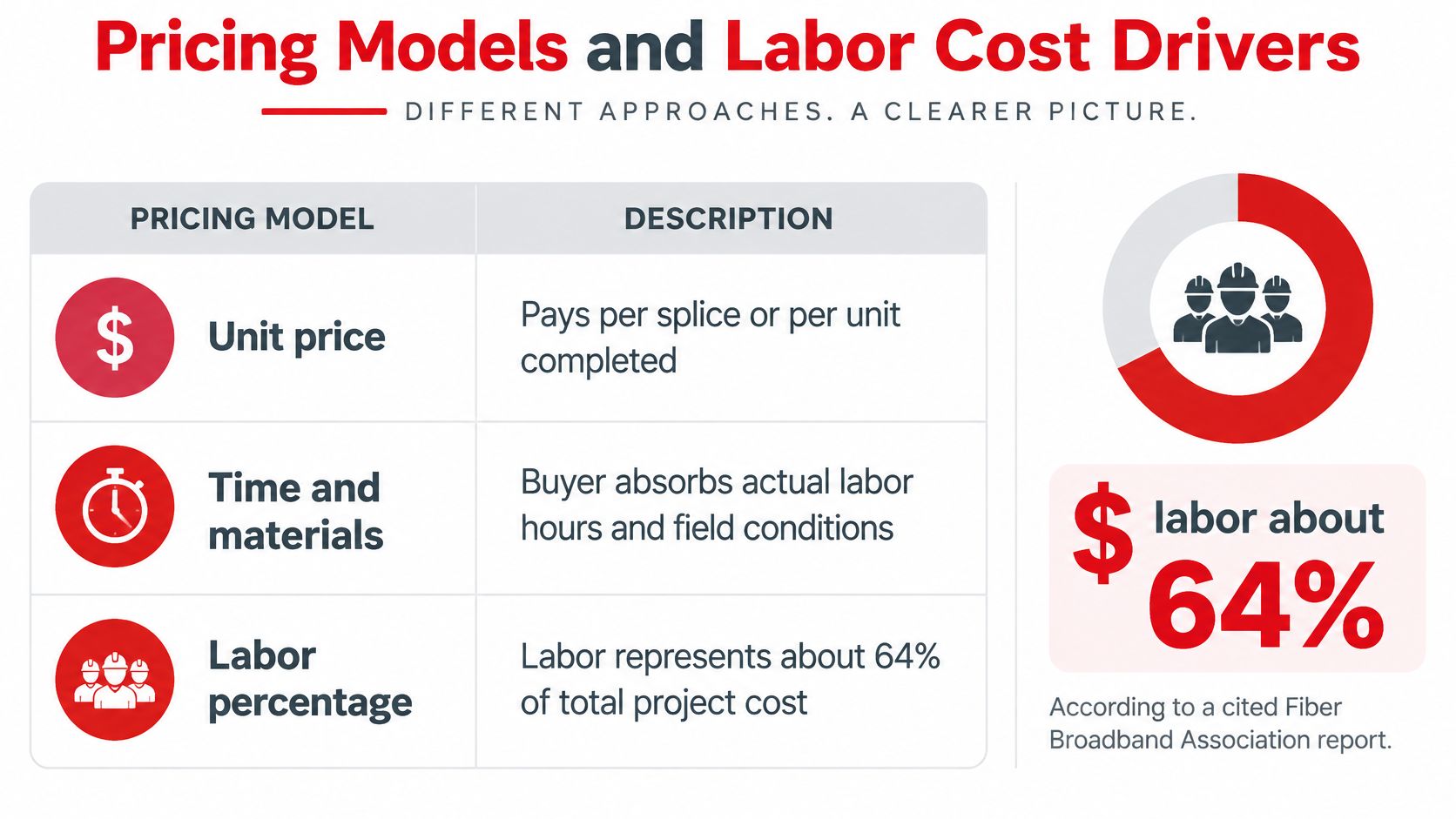
Pricing models compared for splicing work
| Pricing model | Best fit | Main risk | Contract control |
|---|---|---|---|
| Unit rate per splice | Well-defined splice counts | Splice count inflation and undefined test scope | Define splice types, test scope, and rework rules |
| Unit rate per fiber | Long, uniform fiber runs | Fiber counts that differ from as-built | Reconcile counts against the cable schedule |
| Time and materials | Uncertain routes and restoration work | No cost ceiling | Set a rate card, hour caps, and approval gates |
| Fixed price per route | Defined routes with stable access | Disputes over unknown site conditions | List exclusions and change triggers |
| Standby or on-call retainer | Restoration and maintenance readiness | Paying for idle crews | Define response time and minimum callout |
| Hybrid unit rate and retainer | Multi-market programs needing reserved capacity | Complex invoicing | Separate the capacity fee from splice fees |
Buy capacity deliberately
Require minimum staffing, named lead technicians, substitution rules, and subcontractor approval. For restoration coverage, identify the service territory, competing commitments, and priority rules when simultaneous incidents occur.
A hypothetical per-splice bid may assume a four-person crew working uninterrupted full days. A fixed-route proposal may instead include restricted work windows and a defined restoration commitment. Those aren't equivalent offers, even if procurement divides both totals by the same splice count.
Long build windows also need a controlled escalation mechanism. Identify the eligible labor categories, adjustment trigger, evidence required, notice procedure, and treatment of already authorized work. Avoid an unrestricted right to increase rates after award.
Keep broader construction benchmarks in scope
Hengtong International reports a 2024 median labor cost for underground fiber installations of $13.23 per foot. That measures underground installation labor, not a fiber-splicing rate, so it belongs in a broader route-construction comparison.
For a comparable underground scope, multiply the benchmark by route footage as a reasonableness check, then reconcile included activities. Don't allocate the entire result to splicing or use it to override a project-specific estimate.
Evaluate bids using the quoted work, mandatory testing, expected mobilizations, reserved capacity, and expressly excluded tasks. Contractor-caused rework should remain the contractor's responsibility rather than becoming an assumed owner allowance.
Price the splice, but contract the crew and the response time. A cheap unit rate isn't an advantage if the buyer must separately purchase the resources needed to finish and accept the route.
Compliance and Inspection Checklist
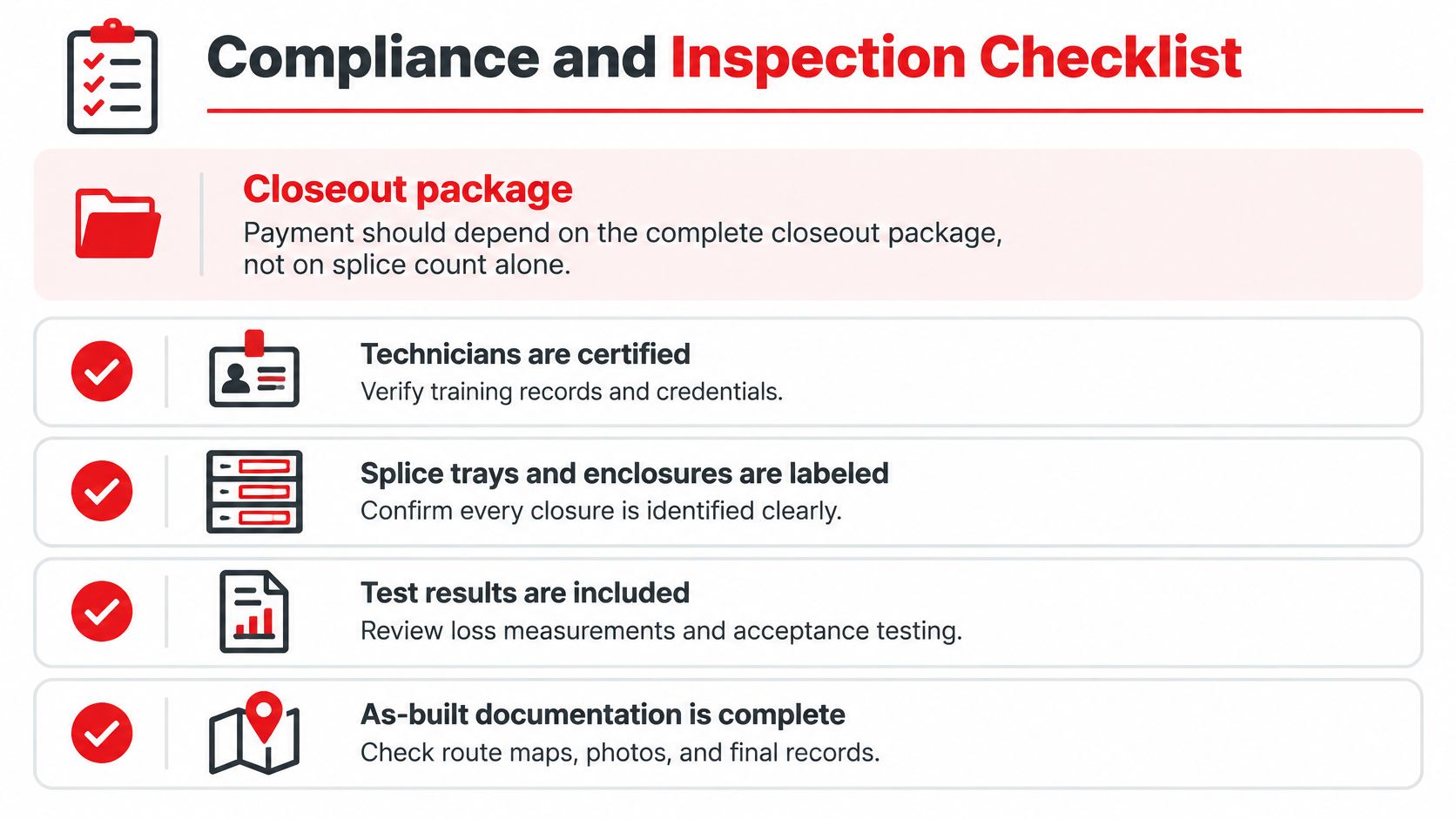
Turnover depends on traceable evidence, not just a closed enclosure. The Fiber Optic Association's testing guidance describes OTDR testing, insertion-loss measurements, connector inspection, and other applicable checks as complementary tools. Require a closeout package that ties results to the installed assets.
Inspect workmanship and traceability
Technician qualifications. Review training records and any credentials required by the contract. Record who performed and supervised the work.
Preparation and cleaning. Check work against approved stripping, cleaning, cleaving, and handling procedures. Contamination or damaged fiber can compromise the joint.
Sleeves and routing. Inspect splice protection, tray organization, and enclosure-specific bend-radius compliance. Confirm that closing the enclosure has not stressed the fibers.
Location identification. Match cable, fiber, enclosure, or handhole IDs with GPS or stationing references. These links let maintenance crews locate the documented work.
Slack and sealing. Check stored slack, cable restraint, entry seals, and moisture protection before accepting the enclosure.
Audit the turnover package
OTDR evidence. Require native bidirectional traces and searchable, consistently named averaged event tables. Unidentified files are difficult to audit or use in fault investigation.
Insertion-loss records. Confirm that records identify fiber IDs, wavelengths, instrument serial numbers, calibration status, and pass criteria. These details support a reproducible acceptance decision.
As-built completeness. Require technician and date records, specified photographs, and final route and splice diagrams that reflect field changes.
Witness records. Record attendance, observations, and any formally waived witness opportunity. This creates a clear record of the inspection process.
Failure history. Retain root-cause notes, correction records, and replacement results. A passing final file should not erase evidence of earlier defects.
Applicable specifications. Identify public-program, state, owner, and manufacturer requirements by document and revision. Generic promises of compliance do not identify the standards being applied.
Chris at SnapDial described Southern Tier Resources' work this way: “They delivered the project on time and provided thorough as-built plans.” The contract should still define what detailed documentation means for the specific network, including required records, file formats, naming conventions, and cross-references.
Test package usability before sign-off. Ask an operations reviewer to locate an enclosure, identify its fibers, open the corresponding traces, and reconcile the installed configuration with the drawing. Missing cross-references should be corrected during closeout, before they become a maintenance problem.
Make final payment or substantial completion conditional on an accepted, searchable closeout dataset, subject to the agreed payment provisions and applicable law. Define review and resubmission steps so the contractor has a clear route to acceptance and payment.
Contract Skeleton and Pre-Signing Review
Use this skeleton to assemble the agreement and its project-specific schedules:
- Definitions. Define splice, OTDR, loss budget, defect, and acceptance.
- Scope and deliverables. Attach cable, enclosure, and splice schedules.
- Testing and acceptance. Specify methods, wavelengths, limits, reporting, and witness rights.
- Staffing and subcontractors. Identify qualifications, capacity, and approval requirements.
- SLAs and restoration. Establish response obligations and reporting.
- Warranty and cure. State commencement, duration, exclusions, and correction deadlines.
- Change orders. Include authorization procedures and the agreed rate card.
- Liability and insurance. Coordinate caps, indemnity, exclusions, and coverage.
- Documentation and payment. Define the closeout package and acceptance-dependent milestones.
- Termination and disputes. Establish notice, escalation, evidence preservation, and resolution procedures.
Complete the signing review
First, remove unresolved terms. Replace general promises with measurable obligations and complete every referenced attachment. Retain named standards where relevant, but don't let them substitute for project-specific acceptance requirements.
Second, obtain technical and legal approval. Engineering should confirm the loss budget and testing procedure; counsel should review risk allocation, insurance, cure provisions, and enforceability. Documind's guide to protect your interests when reviewing contracts offers a general review resource, alongside that specialist review.
Third, reconcile the documents. Check the acceptance matrix against the inspection checklist, pricing schedule, and payment conditions. Resolve conflicting revisions before issuing the package.
Send the same approved scope to every bidder. Require bidders to list exceptions explicitly so procurement can compare accepted deliverables and committed capacity on equal terms.
Southern Tier Resources offers fiber optic splicing and testing services backed by over 20 years of industry experience. Visit Southern Tier Resources or call (469) 405-4671 to discuss your cable schedules, testing requirements, crew needs, and closeout deliverables before requesting a project proposal.