Community broadband projects stopped being a side experiment a while ago. A 2022 Urban Institute review found more than 900 U.S. communities had adopted some form of community broadband, and Canada's Broadband Fund had already funded 68 projects and awarded $771.1 million to reach 326 communities by its published tally, including 139 Indigenous communities Urban Institute review. That scale changes the conversation. These builds are now mainstream infrastructure, which means the hard problems are the same ones that have always controlled any utility-grade rollout, route access, power, backhaul, permitting, and the discipline to sequence them correctly.
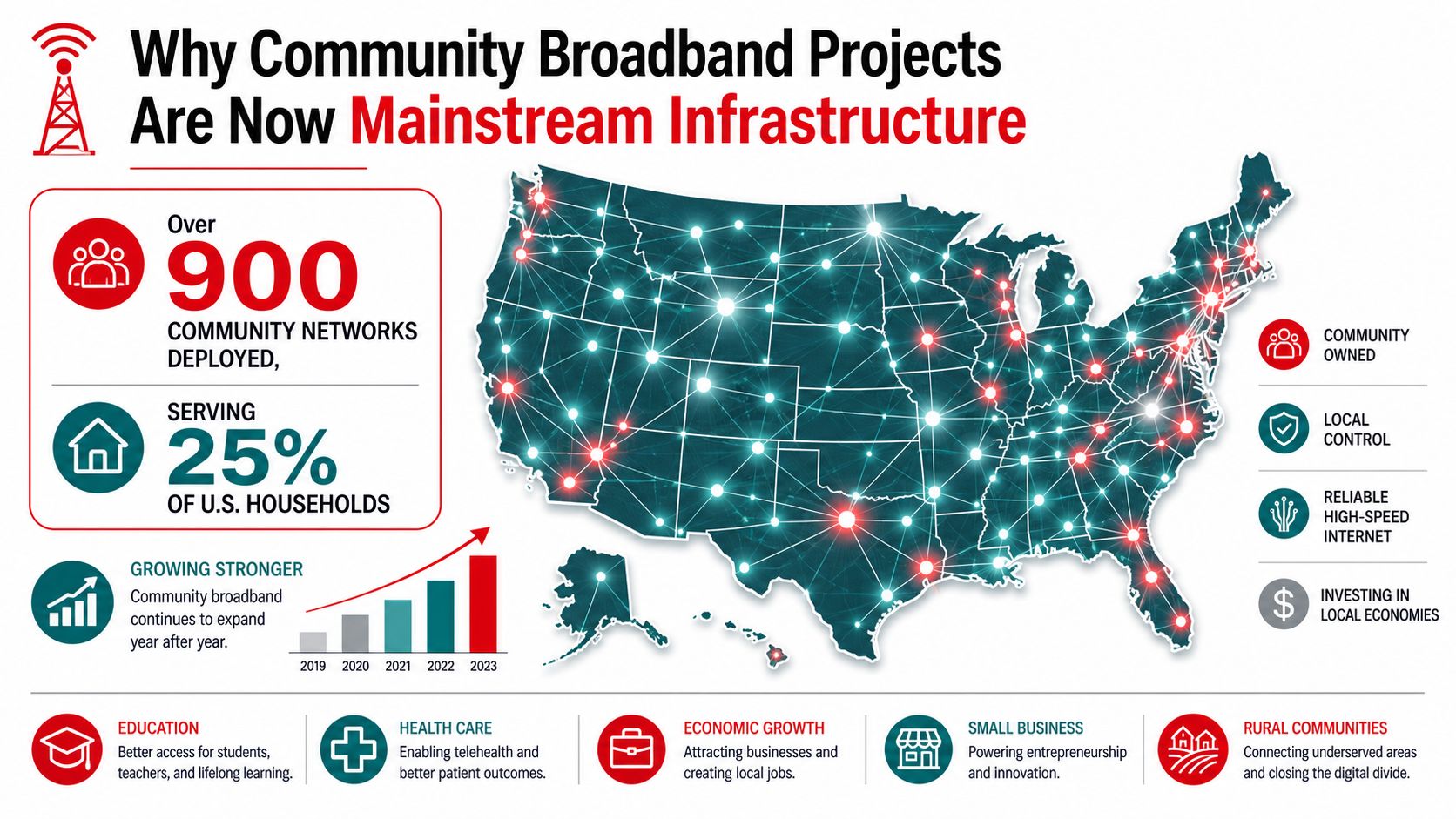
Why Community Broadband Projects Are Now Mainstream Infrastructure
The biggest mistake I still hear is treating community broadband projects like a policy novelty. The capital flowing into the sector says otherwise. The NTIA reported appropriated broadband funding increased sharply versus FY20, a signal that public agencies now treat broadband as infrastructure work, not a side program Urban Institute review.
That shift shows up in the organizations doing the work. Municipal networks, electric cooperatives, and public-private partnerships are no longer fringe models. They are practical delivery vehicles because they can align local geography, local accountability, and long planning horizons. In the field, that matters more than branding. A community-owned network does not win because it sounds local, it wins when it can hold up through a multi-year construction curve and still stay focused on take rates, plant quality, and customer adoption.
The policy center of gravity has moved too. Canada's Broadband Fund is now supporting transport, community reach, and connected road corridors at scale. That matters because transport and last-mile access are being treated as linked parts of the same system, not separate budget lines.
Practical rule: if the funding conversation starts and ends with fiber counts, the project is probably under-scoped.
The launches that land well are the ones that pair public money with local execution capacity. That means real engineering oversight, strong make-ready management, and a board or council that understands this is a utility program. Site assessments with aerial drones help teams verify route conditions early, before crews get boxed in by access problems or avoidable rework, and they support the field planning that keeps schedules realistic.
The Structural Economics of Rural and Remote Builds
Low-density builds fail for structural reasons, not because crews lack the skill to pull cable. When households are spread out, every mile of route has to carry more cost across fewer premises, so both capex and opex rise. That is why financing turns into the bottleneck. The project can be technically sound and still stall if the business case cannot absorb route length, terrain, and construction risk.
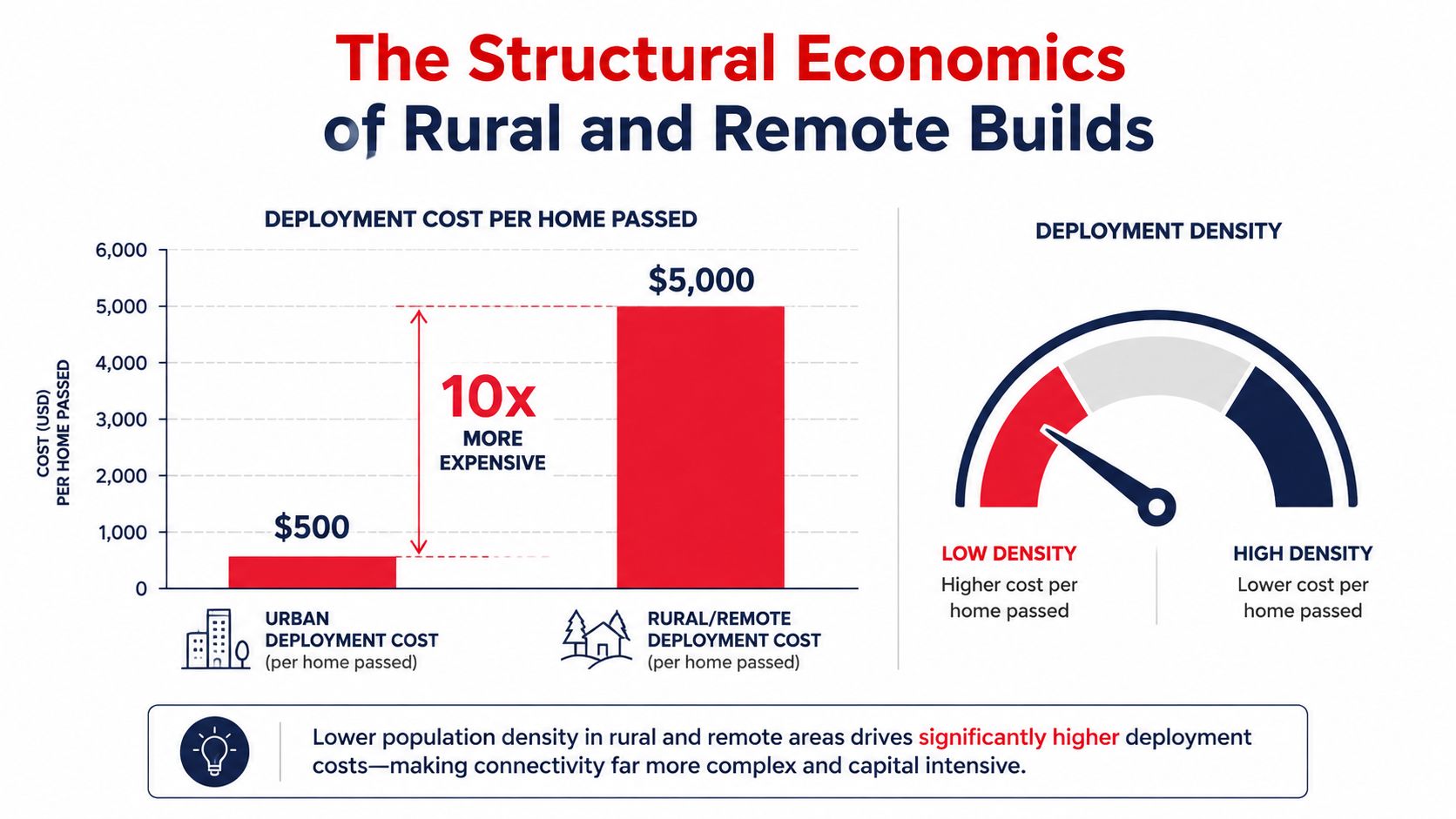
The cooperative benchmarking data makes that reality concrete. NRTC's 2025 Rural Broadband Benchmarking Report found a median build timeline of 5 years, a median project size of 2,800 fiber miles, 29,600 homes passed, and 1,500 businesses passed NRTC benchmark report. It also reported a median residential take rate of 48% and median business take rate of 32%. Those are not vanity metrics. They show that even after a long build, subscriber penetration still depends on pricing, activation, and local trust.
What the economics usually miss
Earlier benchmarking showed project timelines generally ran 4 to 6 years, capex often ranged from $28 million to $84 million, and cost per mile was commonly $20,000 to $30,000 depending on aerial versus underground construction and make-ready requirements NRTC benchmark report. Those ranges explain why a rural project can look fine on paper and still buckle in procurement. The route is longer, labor is harder to schedule, and every utility touchpoint adds uncertainty.
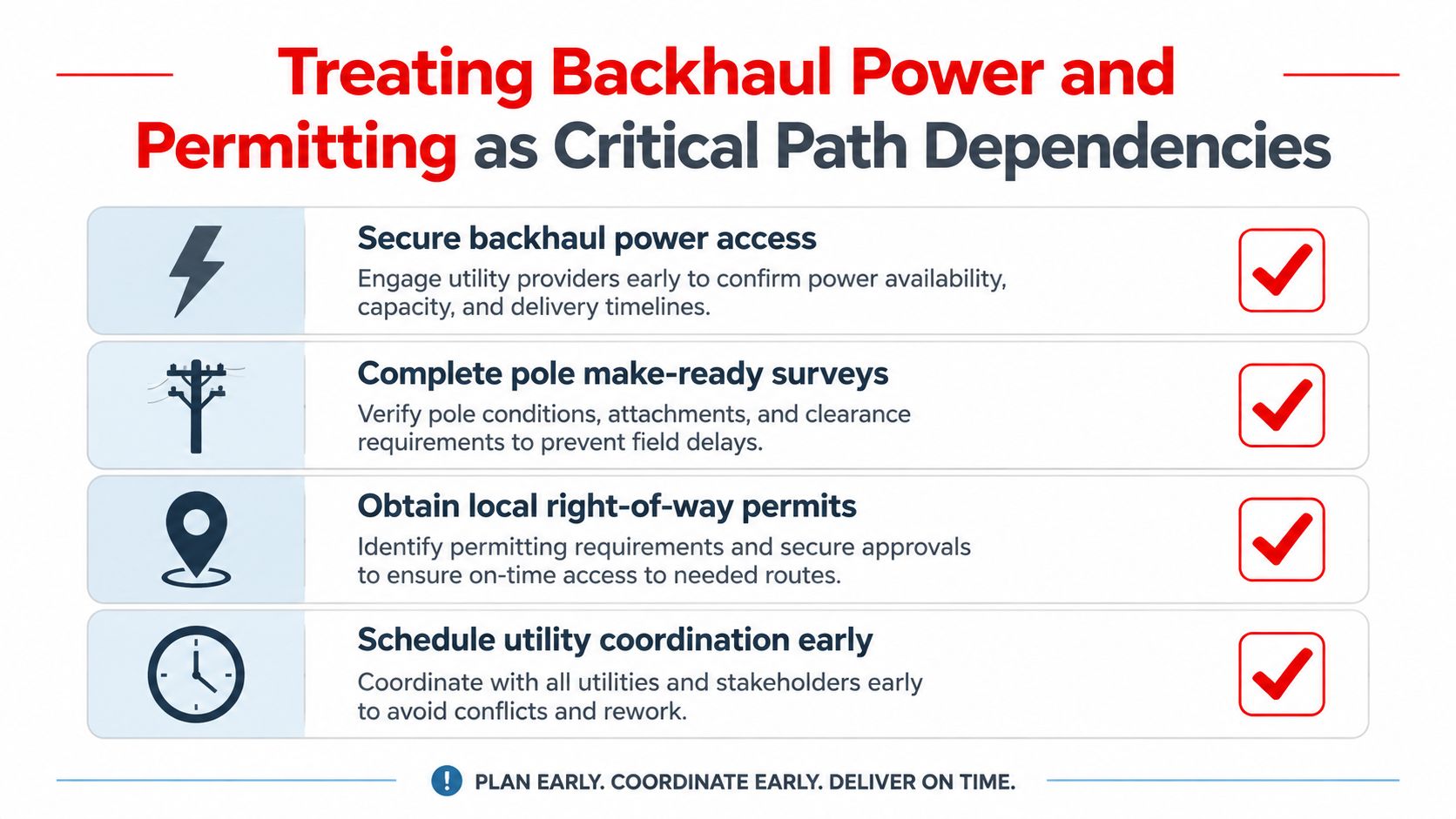
Make-ready, permitting, backhaul, and power planning sit on the critical path long before the first splice. Teams that treat them as side tasks usually lose months. In practice, the cleanest way to reduce blind spots is site assessments with aerial drones, because they let planners verify route conditions early and flag access problems before crews are committed to a bad sequence.
The other part of the economics is local adoption. A network can be built cleanly and still underperform if the community does not understand the service, the installation window, or the value of switching. Resources from community engagement strategies for broadband projects matter because take rate is tied to trust and outreach, not just plant design.
The cleanest takeaway is simple. In community broadband projects, the engineering is hard, but the economics are harder. If the capital stack and take-rate assumptions cannot absorb long routes, delayed permissions, and utility coordination, no amount of good intent will save the schedule.
Choosing a Governance Model and Funding Strategy
Governance sets the pace of a project, defines who carries the risk, and determines how decisions get made when the first utility conflict or permit delay shows up. Municipal networks work best where local government wants direct control over pricing policy, customer standards, and reinvestment. Electric cooperatives often fit rural footprints better because they already operate with utility-style asset management and long planning horizons. Public-private partnerships can spread risk, but only if the contract makes it clear who owns the next delay, the next make-ready issue, and the next customer-facing problem. Nonprofit models can work where grant dependence and community mission matter more than near-term cash flow, but they still need disciplined operating controls.
Match the structure to the operating reality
The practical test is straightforward. Who can borrow, who can permit, who can maintain, and who can answer when a splice enclosure fails in winter? A structure that looks tidy in a board presentation can fall apart once procurement, compliance, or make-ready starts to move.
Practical rule: choose the governance form that can survive bad weather, not the one that reads best in a press release.
Funding strategy should follow the same discipline. Public support now comes through state programs, NTIA support, USDA-style rural lending, and local bonding, and each source fits a different part of the build. NTIA guidance prioritizes projects serving unserved and underserved locations under 25/3 Mbps or between 25/3 and under 100/20 Mbps Pew state broadband review. That means the application has to reflect the actual service gap, not just the desire to build.
Build the stack in the right order
Start with the grant that best matches the geography and the service gap, then layer in local match, then look at debt. Pushing debt to the front usually backfires because lenders want proof that the grant path, right-of-way work, and deployment plan are already credible. Communities also need engagement capacity, and a practical planning partner can matter here. Southern Tier Resources offers engineering, construction, and maintenance support for wireline infrastructure, which can fit into a broader delivery plan when a municipality or cooperative needs execution support rather than a policy consultant.
For communities reviewing public-sector bids and vendor outreach, public sector network tenders can help show how infrastructure work is being packaged and competed. The point is not to copy another jurisdiction. It is to see how serious bidders describe scope, milestone gates, and service boundaries.
If a project is still shaping its resident outreach, that work should be done before grant submission. A useful reference point is this community engagement strategies for broadband projects resource. The projects that move fastest are the ones that already know how they will explain construction, adoption, and accountability to residents.
NTIA and USDA lending can support the stack when the project is already grounded in a realistic service plan and a credible operating model. If you need a practical walkthrough on the financing side, how to apply for SBA funding is a useful reference for understanding how small-business lending steps are documented, especially when a local entity is trying to bridge grant timing with early project costs.
Closing the Affordability Gap Beyond Fiber Deployment
Coverage alone doesn't close the digital divide. That's the part too many project summaries skip. County Health Rankings notes that broadband initiatives have to account for the cost of service, devices, and digital literacy, and that low-cost internet is the necessary first step for meaningful adoption County Health Rankings. That's the true test of whether a network is serving people or just passing by them.
The practical answer is paired interventions. Low-income pricing tiers help, but they rarely solve the whole problem on their own. Device lending, public access computing centers, and digital navigator support all make the network easier to use. Communities that ignore those pieces often end up with strong plant and weak uptake, which is a bad result for everyone involved.
Broadband buildout is necessary. Adoption is the part that proves it mattered.
The affordability issue shows up in public funding design too. NTIA reports the Broadband Infrastructure Program has already connected 40,000 previously unserved households, nearly 3,000 businesses, and more than 130 anchor institutions County Health Rankings. Those are meaningful buildout outcomes, but they still don't tell you whether residents can subscribe month after month. That's why digital inclusion plans are no longer optional extras. They're part of the operating model.
A good adoption plan starts before construction finishes. Staff the outreach role early, line up device access pathways, and make sure the customer journey is simple enough that first-time users don't drop off after activation. If the network launches without those supports, the project has technically succeeded and practically underperformed.
Treating Backhaul Power and Permitting as Critical Path Dependencies
Most schedule overruns in community broadband projects start with dependencies that were treated like background tasks. They're not background tasks. Backhaul, power, pole readiness, and permitting are the critical path. International and government sources note that rural and isolated deployments are frequently delayed by unavailable electric power, weak road access, lengthy land-use approvals, and shortages of skilled technicians ITU report. If those aren't mapped early, the route design becomes a moving target.
Validate the field before you lock the design
The right sequence is straightforward. Confirm backhaul availability, verify power access, map pole ownership, and identify every approval body that can pause the job. Do that before contracts are signed, not after crews are mobilized. Once a contractor starts pricing against a bad assumption, change orders arrive fast and everyone loses time.
Aerial and underground routes both have risks, but they fail in different ways. Aerial work is highly sensitive to make-ready timing and pole attachment coordination. Underground work tends to suffer when right-of-way, soil conditions, or utility conflicts aren't fully understood. Either way, route certainty comes from validation, not optimism.
Pre-construction checks that save the schedule
- Utility coordination: Get the power company, pole owner, and construction lead in the same planning loop early.
- Right-of-way review: Confirm land access, road crossings, and any local approval path before final route marking.
- Environmental and land-use checks: Identify whether any local review can slow excavation or pole work.
- Materials and crew timing: Align equipment deliveries and technician availability with the actual permit calendar, not the preferred one.
A practical project team also keeps a single log of open dependencies, because nothing slips faster than a permit nobody owns. Shortages of skilled technicians and difficult terrain add pressure once construction starts, so the plan has to assume some friction rather than pretending it won't exist ITU report.
If you want the cleanest field lesson, it's this. A project that clears backhaul, power, and permitting early usually spends less time recovering from surprises later.
From Make Ready Construction Through Fiber Splicing and Testing
A community broadband build becomes real the moment the field crews start touching poles, conduit, and strand. Make-ready is usually first because nothing else should proceed until the aerial path is physically ready. After that comes trenching or aerial placement, then cable placement, then splicing, then testing and acceptance. The sequence sounds linear on paper, but in practice it's only linear if the earlier dependency work was honest.
Where projects slow down in the field
The most common delay is not fiber placement itself. It's waiting on the utility side of the job to clear the way. Once crews can move, quality control has to stay close behind them. Every splice closure, slack loop, and handoff point should be documented because as-built plans and test records are not paperwork after the fact, they're part of the network's operating memory.
That's why experienced teams keep close control of handoffs. A contractor who can build quickly but can't document accurately creates a future maintenance problem. A network that launches without clean records becomes harder to troubleshoot, harder to expand, and harder to defend in grant compliance reviews.
Operational truth: the cheapest mile is the one you don't have to revisit.
Turnkey infrastructure partners can help because they can keep design, construction, splicing, and documentation aligned in one chain of responsibility. That said, a municipality or cooperative still needs to know enough to ask the right questions. If a crew can't explain how acceptance testing will be recorded, or how a splice map will be turned into a usable asset record, the project is still under-managed.
For teams that want a deeper field reference on the join work itself, this guide on how to splice fiber optic cable is a useful companion. The point isn't just technical familiarity. It's knowing where workmanship turns into long-term reliability.
Procurement Best Practices and Partner Selection
Procurement is where a lot of good projects get weakened. The temptation is to optimize for the lowest apparent bid, but community broadband projects need more than a low number. They need a contractor who can show up with the right crews, manage safety, and absorb the messy middle between design and activation. That's why RFPs should reward proof of relevant project experience, crew availability, and clean safety records, not just generic telecom language.
Turnkey versus multi-vendor
A single turnkey contractor simplifies accountability. One team owns design support, permitting coordination, construction, splicing, and often maintenance handoff. That can reduce interface risk, which is valuable when the owner's internal capacity is thin. The downside is concentration risk. If that vendor slips, the whole project slips.
A multi-vendor structure spreads responsibilities. You might have one firm for engineering, another for construction, and a specialized splicing partner. That can work well when the owner has strong project management, but it increases the chance of scope gaps and blame shifting. Cooperative purchasing agreements can help with speed and standardization, but only if the scope is already well defined.
What to ask before award
- Safety performance: ask for the actual site safety process and how crews are supervised.
- Mobilization capacity: confirm how fast the vendor can field crews and equipment.
- Relevant references: look for similar terrain, similar route density, and similar permitting conditions.
- Milestone payments: tie cash flow to completed deliverables, not calendar dates.
- Performance guarantees: make sure the contract spells out documentation, testing, and acceptance standards.
A procurement team that wants to see how network work is packaged in the market can also use public sector network tenders as a reference point. The useful insight is how bidders translate scope into deliverables, not how they market themselves.
For municipalities and cooperatives that need a broader contractor shortlist, this internal directory on https://southerntierresources.com/fiber-optic-construction-companies/ can help frame the difference between engineering names, construction crews, and true end-to-end delivery partners. The right selection usually saves more time than any small bid difference could.
Lessons from Real World Community Broadband Deployments
The clearest lesson from real deployments is that success comes from coordination, not just capital. Pew's state broadband review emphasizes stakeholder engagement, policy frameworks, planning and capacity building, and ongoing evaluation as the ingredients that keep projects moving Pew state broadband review. That aligns with what the field shows every day. The projects that land well are the ones that line up governance, engineering, and adoption before construction starts.
California is a useful model because it has continued funding both infrastructure and digital inclusion, including more than $42 million in CASF grants for digital divide work and nearly $53 million for rural and tribal broadband expansion Pew state broadband review. Pairing those categories keeps the conversation honest. Build the network, then make sure residents can use it.
A practical readiness checklist is hard to fake:
Governance settled.
Funding stack mapped.
Backhaul and power validated.
Permitting path understood.
Construction partner selected.
Adoption plan funded.
The strongest projects don't treat launch day as the finish line. They treat it as the first operating checkpoint.
Community broadband projects work when leaders stop separating infrastructure from inclusion. The network has to be buildable, affordable, and supportable, or the public investment never reaches its full value. Communities that keep those three realities tied together are the ones most likely to turn planning into durable service.
If you're planning a municipal, cooperative, or rural broadband build and need a partner that can handle design, make-ready, fiber construction, splicing, testing, and documentation, Southern Tier Resources works across that full lifecycle. Visit Southern Tier Resources to see how its field and engineering teams support community broadband projects from early route planning through activation and maintenance.