If you're responsible for network coverage, a new site build, an upgrade program, or a portfolio of wireless assets, you're probably not looking for a dictionary definition of a cell tower company. You're trying to solve a real problem.
Maybe a carrier needs to add capacity without breaking service at an existing macro site. Maybe an enterprise facility has decent outdoor signal and poor indoor performance. Maybe a tower owner needs a contractor who can move from permitting to punch list without gaps, excuses, and finger-pointing.
That’s where the conversation changes. A cell tower company isn't just a landlord with vertical steel, and it isn't just a construction crew that shows up with a crane. In practice, the right partner sits at the intersection of site strategy, engineering, civil work, power, backhaul, integration, and long-term maintenance. The difference between a smooth deployment and a costly one usually comes down to who owns the details from start to finish.
The Hidden Backbone of Our Connected World
You see the result before you ever notice the infrastructure.
A phone call stays clear on the highway. A field technician uploads photos from a remote site. A dispatcher routes crews in real time. A cloud application responds fast enough that nobody thinks about the path the data took. That experience feels digital, but the delivery system is deeply physical.
Behind every routine connection is a chain of assets. There’s a site on the ground. There’s steel in the air. There’s shelter space, power, grounding, cabling, radios, antennas, and a backhaul path carrying traffic into the wider network. Someone has to find that location, secure it, design it, build it, test it, and keep it running.
That “someone” is often a mix of tower owner, carrier, and infrastructure partner. In day-to-day operations, the cell tower company becomes the hidden backbone that makes wireless service dependable instead of fragile.
Why the sector matters more than ever
The scale of the market shows how central this infrastructure has become. The global telecom towers market was valued at USD 30.41 billion in 2025 and is projected to reach USD 42.65 billion by 2034, while North America held 40% of global market share in 2024, according to Fortune Business Insights’ telecom towers market analysis.
Those figures matter, but the field reality matters more. Growth today isn't just about erecting new towers wherever land is available. A lot of the work sits in smarter upgrades, denser deployments, and more disciplined use of existing sites.
What clients usually discover late
Many clients start with a coverage problem and only later realize they have an execution problem.
A site can look simple on paper and still fail in the field because access was underestimated, utility coordination lagged, zoning assumptions were wrong, or the design team didn't account for how crews would install equipment safely. That’s why practical planning beats theoretical planning every time.
Practical rule: Good wireless infrastructure work starts with constructability, not just coverage maps.
For teams thinking about regional resilience and field communications, this guide on reliable mobile communication for nationwide coverage is useful because it frames connectivity the way operators experience it in real conditions, not just in ideal diagrams.
What Is a Cell Tower Company
A cell tower company is easiest to understand if you compare it to commercial real estate.
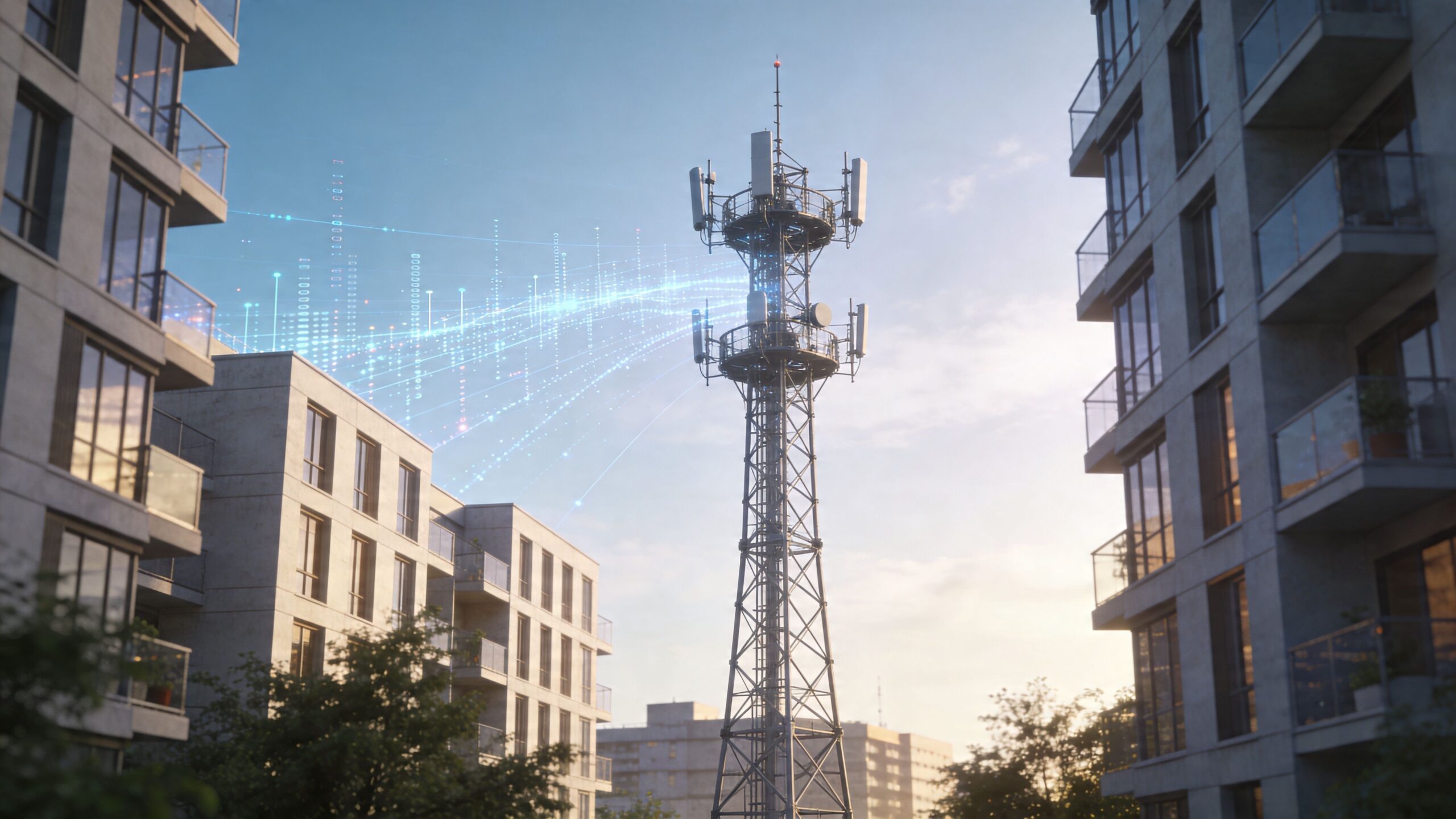
One party owns or controls the property asset. Another rents space to operate a business there. A third may handle design, build-out, upgrades, and maintenance. Wireless infrastructure works much the same way, except the “building” is a communications site and the tenants are carriers or other network operators.
The three roles clients need to separate
These roles get blurred in conversation, and that causes procurement mistakes.
Mobile network operators
MNOs deliver service to end users. They hold spectrum, run the network, and decide where coverage and capacity need to improve. They may own some infrastructure, but the operating model has shifted heavily toward leasing.
The modern wireless industry relies on MNOs leasing space on towers owned by independent firms, and the U.S. has approximately 125,000 cell towers, managed by a mix of public tower companies and carriers, according to Wireless Equity’s history of the telecom and wireless infrastructure industry.
Tower owners and tower companies
A tower company or TowerCo typically owns, leases, or manages the physical site asset. That includes the tower structure, compound, access rights, and lease arrangements for multiple tenants.
Their business model depends on making one site useful to more than one carrier or operator. That’s why lease management, structural capacity, zoning status, and tenant coordination matter so much.
Infrastructure partners
This is the role many buyers need, even if they start by asking for “a tower company.”
An infrastructure partner handles the work required to turn a planned site into an operating one. That can include site walks, A&E support, permitting coordination, civil construction, utility interface, antenna and radio installation, cabling, testing, documentation, and maintenance. If you want a practical overview of those delivery capabilities, this page on cell tower construction services shows the type of execution scope buyers should be asking about.
Why the industry moved this way
Carriers used to own more of the physical footprint directly. Over time, the independent tower model made more sense for many deployments.
A specialist owner can manage the property and tenancy side. A carrier can focus on network operations. An infrastructure partner can execute field delivery and maintenance. That separation often improves speed and accountability, if responsibilities are clearly assigned.
The worst projects are the ones where every party controls a piece of the work and nobody owns the outcome.
What a client should ask first
Before you issue an RFP, ask one question: Do you need an asset owner, a service provider, or both?
If you need vertical real estate, lease negotiation, and site availability, you're dealing with a tower company. If you need an end-to-end build or upgrade, you're looking for an execution partner. Sometimes those overlap. Often they don't.
That distinction prevents a lot of costly confusion.
Exploring Wireless Infrastructure Types
Not every wireless problem needs a new macro tower.
That’s one of the first realities clients run into. A coverage gap in a rural corridor, a capacity issue in a dense downtown block, and poor indoor service inside a large facility may all show up as “bad signal,” but they require different infrastructure choices.
Macro towers
A macro tower is the broad-coverage workhorse. These are the sites commonly associated with the term “cell tower.” They carry equipment high enough to serve larger areas and support carrier-grade network layers across broad geographies.
They’re also where many upgrade programs land first. As carriers move from 4G to 5G, existing macro sites often need substantial equipment modifications, and 4G infrastructure has reached capacity, which means operators need more cell sites to support fuller 5G coverage, as explained in APWIP’s overview of cell towers and technology.
In practice, macro work is rarely just “hang a new antenna.” It can involve:
- Structural review: Existing mounts, loading, and available space have to support the planned configuration.
- Ground space planning: Cabinets, shelters, power gear, and cable routing need to fit safely and logically.
- Tenant coordination: Work windows and access rules get more complex when multiple operators share the same site.
- Backhaul and power readiness: A radio upgrade that outruns the site’s power or transport design creates a new bottleneck instead of solving the old one.
Small cells
A small cell solves a different problem. It’s about targeted coverage and added capacity in places where a macro layer alone won’t perform well enough.
Urban streetscapes, campuses, transportation corridors, and dense commercial zones often need these more distributed nodes. They’re useful where user concentration is high or where the built environment blocks or weakens signal propagation.
What works with small cells is disciplined placement and utility coordination. What doesn’t work is treating them like miniature macro sites. Pole rights, make-ready work, municipal design standards, and fiber access often drive the timeline more than the radio hardware itself.
DAS
A Distributed Antenna System, or DAS, is usually the right answer when the problem is inside the building.
Large venues, campuses, hospitals, industrial facilities, and complex commercial interiors often defeat outdoor signal. Thick walls, low-E glass, interior layout, and equipment interference can all reduce performance. DAS distributes signal through an indoor network of antenna points so users get more consistent service where they work, move, and gather.
A DAS project succeeds or fails on coordination. The RF design matters, but so do ceiling access, pathway routing, power, head-end space, firestopping, and coordination with the building owner’s construction rules.
Passive and active infrastructure
Clients also need to separate passive from active infrastructure.
Passive infrastructure includes the physical site elements that support the network:
- Tower or pole structure
- Foundations and concrete pads
- Shelters, cabinets, and compound fencing
- Grounding, cable trays, and physical mounts
Active infrastructure includes the electronics that make the site function as part of the network:
- Antennas
- Radios and transceivers
- Baseband or related network equipment
- Power systems tied to operating equipment
This distinction matters during budgeting and responsibility mapping. One contractor may handle passive scope. Another may install active gear. The best outcomes happen when both scopes are sequenced by one accountable delivery plan, especially on wireless tower projects where construction and integration affect each other directly.
Comparison of Wireless Infrastructure Solutions
| Infrastructure Type | Primary Use Case | Coverage Area | Ideal Location |
|---|---|---|---|
| Macro Tower | Broad outdoor coverage and multi-carrier deployment | Wide-area coverage | Rural corridors, suburban zones, highway routes, existing tower compounds |
| Small Cell | Capacity relief and targeted outdoor coverage | Localized coverage | Urban streets, campuses, dense commercial areas |
| DAS | Consistent indoor cellular performance | Building or venue specific | Hospitals, arenas, office towers, industrial facilities |
Choose infrastructure based on the service problem, not the equipment trend. The newest hardware won't fix a mismatch between site type and user environment.
From Greenfield to Go-Live The Project Lifecycle
Most cell site delays aren't caused by one catastrophic error. They're caused by ordinary misses that stack up.
A lease redline sits too long. Utility coordination starts late. The civil crew arrives before the compound layout is finalized. Equipment ships before the site is ready to receive it. Integration gets scheduled without confirming backhaul readiness.
That’s why disciplined project flow matters more than flashy presentations.
A simple process view helps clients see where projects usually go right or wrong.
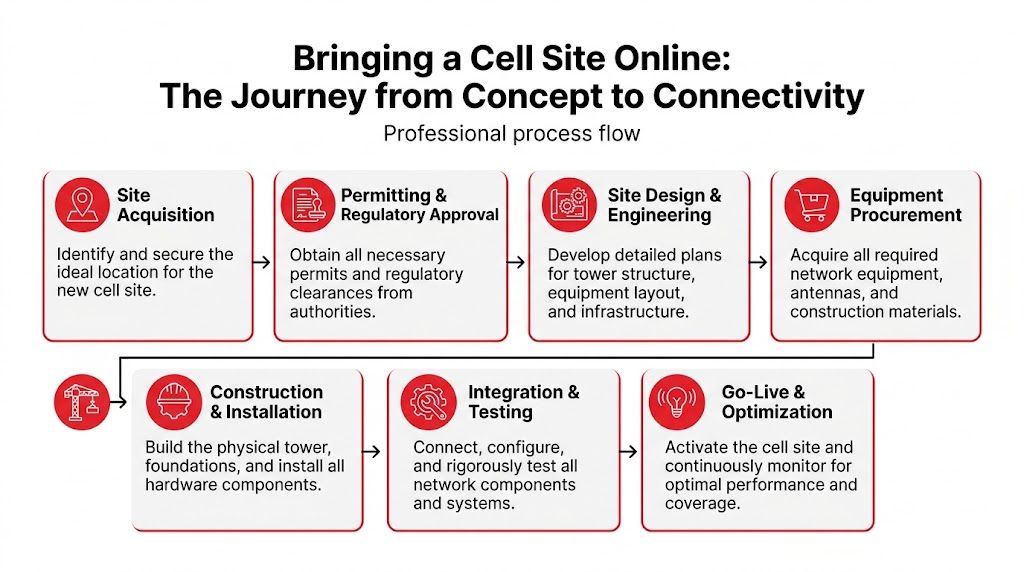
Site acquisition and design control
A greenfield project starts with location control. An existing-site upgrade starts with access control. In both cases, the early work decides whether the rest of the schedule is realistic.
Site acquisition
This phase is part search, part negotiation, part risk filtering. A workable location isn't just one that looks good on a map. It needs practical access, acceptable lease terms, feasible utility service, and a regulatory path that doesn't collapse once formal submissions begin.
What works:
- Early constructability review: Walk the site before assumptions harden.
- Access verification: Confirm road, gate, and staging conditions before mobilization planning.
- Landlord clarity: Resolve use rights, easements, and restoration obligations in writing.
What doesn't work is locking in a site purely because the RF plan likes it.
A&E and site design
Architectural and engineering work turns a target site into a buildable one. That includes structural requirements, equipment layout, grounding, civil details, power planning, and documentation for permit packages.
Experienced project managers push hard on sequencing. If design teams work in isolation from field crews, the drawing set may look complete and still create installation problems.
Permitting and procurement
Permitting is where many schedules become fiction.
Local zoning boards, municipal reviewers, utilities, landlords, and third-party stakeholders rarely move in a straight line. Projects succeed when someone keeps each track active at the same time instead of waiting for one item to finish before starting the next.
Before field work starts, I want three things confirmed: approved design, site access, and a procurement plan tied to the actual construction sequence. If those three don't line up, the schedule is already slipping.
Later in the process, the site has to be tied into the broader network. Cell towers connect to the core network through backhaul such as fiber-optic cables or microwave dishes, and the supporting design needs resilient infrastructure, backup power, and fault-tolerant architecture to protect uptime, as outlined in T-Mobile’s explanation of how cell towers work.
A useful field reference on the overall workflow is this video:
Construction installation and activation
Once permits, design, and materials align, physical deployment begins. At this stage, schedule pressure is highest because multiple crews, vendors, and inspections converge.
Construction and civil work
The physical build usually includes foundations, compound work, grounding, fencing, utility preparation, and structural installation. On upgrades, it may also include platform changes, mount modifications, cable management improvements, and compound reconfiguration.
The field reality is simple. A clean site is faster to build. A crowded or poorly documented site is slower, riskier, and more expensive to change.
Technology installation
After the passive elements are ready, active equipment goes in. Antennas, radios, associated gear, and transport components have to be installed in the right order, labeled correctly, and tested against the approved design.
This stage breaks down fast when crews don't have clear responsibility boundaries. One partner should own the master schedule and the turnover criteria.
Integration testing and go-live
A site isn't done when equipment is mounted. It’s done when the network accepts it, alarms are clear, performance is verified, and as-built records reflect the field condition.
Field lesson: Go-live problems usually trace back to something small that wasn't reconciled earlier, a mislabeled cable, a missed grounding detail, an incomplete backhaul handoff, or documentation that didn't match the install.
The strongest delivery model is a single accountable partner managing handoffs across the full lifecycle, because the client shouldn't have to referee between design, construction, and maintenance teams after every issue.
How to Select the Right Tower Partner
Price matters. It just isn't the first filter.
When buyers choose a cell tower company or infrastructure partner based mainly on bid spread, they often inherit schedule drift, rework, safety exposure, and weak documentation. Those costs don't always show up in the proposal. They show up during construction, cutover, and maintenance.
What to evaluate before commercial terms
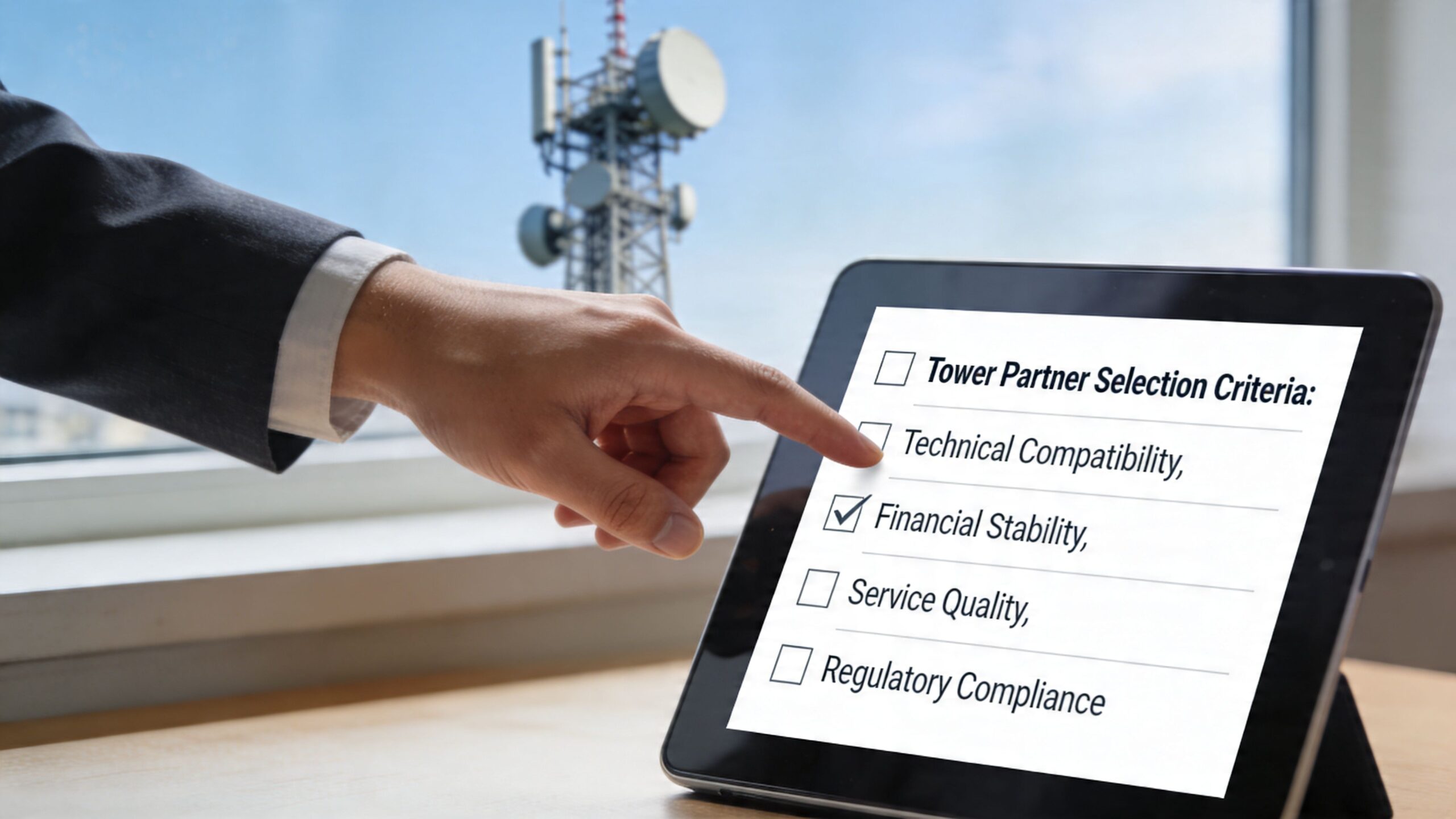
A strong partner reduces operational risk. That should be the frame for every selection decision.
- Safety program quality: Ask for a documented safety process, climb and RF protocols, field reporting discipline, and evidence that supervisors enforce standards instead of treating them as paperwork.
- Technology fit: A contractor who understands macro modifications may not be the right fit for small cell, fiber-connected sites, in-building systems, or data-center-adjacent infrastructure.
- Turnkey capability: The fewer handoff gaps, the fewer failure points. Design, permitting, construction, closeout, and maintenance should connect cleanly.
- Documentation standards: As-builts, test records, punch tracking, labeling discipline, and turnover packages need to be part of the scope from day one.
- Response model: If the site supports critical operations, ask how the partner handles outages, after-hours mobilization, and escalation.
Questions worth asking in the interview
Good vetting sounds operational, not promotional.
Ask questions like these:
- Where do your projects typically stall? A credible partner will name real friction points.
- Who owns schedule coordination across subcontractors and vendors? If the answer is vague, expect handoff problems.
- How do you manage changes discovered in the field? Field changes are normal. Undisciplined change handling is not.
- What does your closeout package include? If documentation is an afterthought, maintenance will suffer later.
- How do you protect uptime during upgrade work? This matters most on live multi-tenant sites.
What a reliable partner looks like in practice
You want a team that can talk through trade-offs without hiding behind jargon.
If a municipality delays permit comments, they should explain the schedule impact and recovery options. If a site lacks practical fiber access, they should say that early. If an equipment plan creates structural or power strain, they should challenge it before the field crew gets boxed in.
One example of that broader execution model is Southern Tier Resources, which provides end-to-end engineering, construction, and maintenance across wireless, fiber, and related infrastructure scopes. That kind of integrated delivery can be useful when the project crosses disciplines and the client wants a single accountability path.
A good tower partner doesn't just tell you what they can build. They tell you what will create risk, what needs to change, and who is responsible for each next step.
Understanding Regulatory and Safety Compliance
Compliance isn't a side task attached to a cell site project. It shapes whether the project can be built, how it must be built, and what conditions apply once the site is live.
Clients sometimes think of compliance as “permit paperwork.” In reality, the regulatory load stretches across airspace review, RF considerations, environmental process, site safety, electrical work, and ongoing field practices.
The main compliance lanes
The easiest way to understand the industry is to separate it into categories.
Siting and regulatory approvals
A proposed site may need review tied to local zoning, land use, and public process. Depending on the site and scope, teams may also need to account for federal requirements involving airspace, environmental review, and communications rules.
What matters operationally is this: approvals affect design, schedule, and even site viability. They aren't boxes to check after engineering is finished.
For buyers trying to understand how those obligations connect to real project delivery, this overview of telecom regulatory support and compliance considerations is the kind of reference that helps frame the full requirement set.
Electrical and installation discipline
Power, grounding, labeling, access control, and equipment identification all affect safe operations. Those details matter during commissioning, but they matter even more during troubleshooting and emergency response.
While the standards vary by jurisdiction and application, the logic is universal. Clear labeling and documented electrical organization reduce risk for every technician who touches the site later. A useful outside example is this guide to Australian switchboard labelling requirements, because it shows how disciplined identification practices support safer field work and cleaner maintenance.
Safety culture matters more than slogans
Wireless construction and maintenance involve working at height, energized systems, RF-aware work practices, weather judgment, and site-specific hazards. A safe partner doesn't rely on posters and toolbox talk alone.
Look for signs of an embedded safety culture:
- Pre-task planning: Crews review hazards before work starts.
- Stop-work authority: Field teams can pause unsafe activity without retaliation.
- Access control: Only authorized personnel enter active work zones.
- Documentation discipline: Incidents, near misses, and corrective actions are recorded and acted on.
A company that treats compliance as a real operating system will usually deliver better quality too. Clean safety practices and clean project execution tend to travel together.
FAQs for Carriers Enterprise IT and Tower Operators
The questions below come up repeatedly because each stakeholder sees a different part of the same infrastructure problem.
How should carriers approach rapid 5G-related upgrades without creating service disruption
Start with site triage, not blanket deployment.
Some sites need equipment changes first. Others need transport, power, or compound rework before new radios make sense. The practical mistake is pushing a radio plan into a site that isn't ready to support it.
For live sites, protect uptime by setting clear maintenance windows, pre-staging material, validating access, and confirming rollback procedures before crews mobilize. On shared sites, tenant communication has to be treated as a formal workstream, not a courtesy email.
A carrier should also choose partners who can manage both passive and active dependencies. Upgrade programs fail when civil, electrical, transport, and RF scopes move on separate tracks without one accountable owner.
What should enterprise IT teams do when outdoor signal is decent but indoor performance is poor
Don't assume the nearest macro site is the whole answer.
Indoor service issues often come from building materials, floor layout, glass, equipment density, and the way users move through the space. The right fix may be a DAS, a small-cell approach, targeted indoor distribution, or a hybrid strategy based on how the facility is used.
Start with a proper site assessment. Look at user locations, carrier requirements, cabling pathways, head-end space, power availability, and facility rules. Then make sure the delivery team can coordinate with building operations, low-voltage trades, and life-safety constraints.
The best enterprise deployments are the ones that respect the building as much as the RF design.
What matters most for tower operators managing multi-tenant sites
Standardization and access discipline.
On a multi-tenant site, every added layer of equipment makes future work harder unless records stay current. Operators need accurate as-builts, clear equipment identification, controlled change management, and a repeatable site access process.
Maintenance should also be planned around what fails in the field. Power issues, cable degradation, weather exposure, grounding concerns, and transport trouble all affect service continuity. If those items only get attention after alarms, the site is already operating in a reactive mode.
How important is maintenance response capability today
It's critical, especially on sites supporting high-visibility traffic and public dependence.
A key operational challenge across tower portfolios is maintaining uninterrupted service, and practical solutions include 24/7 mobilization and a safety-first culture, particularly as tower sites support critical communications and emerging hyperconverged edge computing use cases, as noted by RCR Wireless on current cell tower operational demands.
That aligns with field reality. Response capability isn't just about getting someone on the road. It’s about sending the right crew with the right access, documentation, parts visibility, and escalation path.
If a maintenance partner can't tell you how they mobilize, how they make the site safe, and how they document restoration, they aren't ready for critical infrastructure work.
What does a successful partnership look like over the long term
It looks boring in the best way.
Schedules are realistic. Documentation is current. Scope changes are controlled. Site issues are surfaced early. Safety expectations are consistent. Everyone knows who owns the next action.
That kind of relationship doesn't come from buying the cheapest labor. It comes from choosing a partner who understands the full lifecycle of wireless infrastructure and can carry responsibility from the first site walk through ongoing maintenance.
If you need a single accountable partner for wireless and wireline infrastructure work, Southern Tier Resources supports carriers, ISPs, data center operators, and network teams with end-to-end engineering, construction, testing, documentation, and maintenance. That’s often the difference between a project that merely gets built and one that performs reliably after go-live.