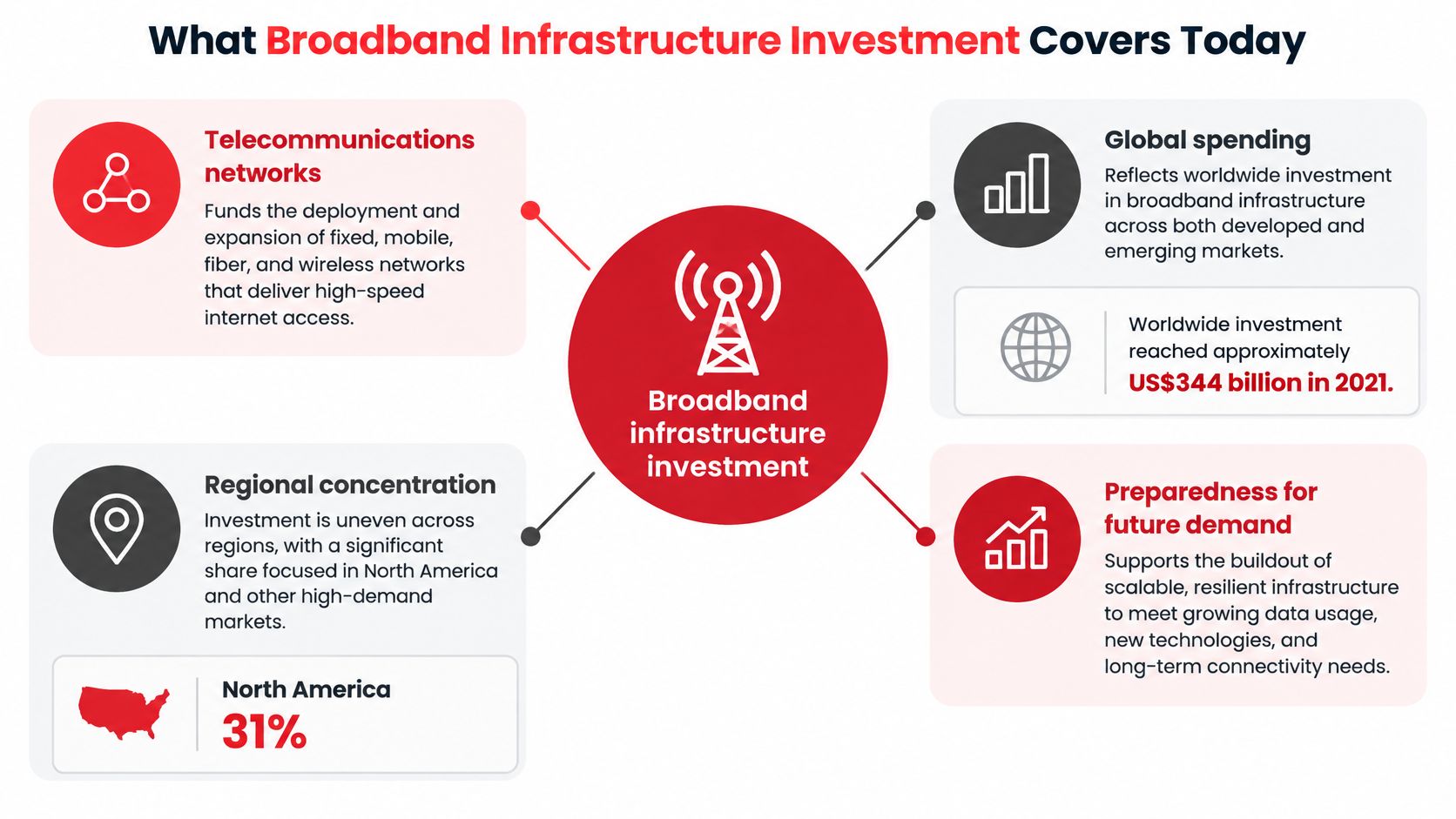
Worldwide investment in telecommunications networks reached approximately US$344 billion in 2021, exceeding prepandemic levels, according to the World Bank's broadband infrastructure analysis. That scale reframes broadband infrastructure investment: it isn't just a matter of stringing fiber to homes. Capital flows through international cables, national backbones, local access networks and the construction work that connects them. Yet spending alone doesn't make a network successful. The decisive questions are which layer receives investment, what it costs to build and maintain, and whether people can afford to use it.
What Broadband Infrastructure Investment Covers Today
Capital follows capacity. In 2020, North America accounted for 31% of global telecommunications network investment, East Asia and the Pacific 29%, and Europe and Central Asia 28%, nearly 90% combined. Sub-Saharan Africa drew 1%. Those shares, reported in the World Bank's broadband infrastructure analysis, cover telecommunications networks broadly rather than broadband construction alone. The pattern is blunt: spending clusters where networks already exist, and the financing gap sits where they do not. Connecting the remaining unconnected populations is a different funding problem from upgrading plant that already carries traffic.
The network behaves like a road system. National backbones and submarine cables are motorways, carrying traffic between countries and major network hubs. Middle-mile routes work like arterial roads, linking those hubs to towns and local exchanges. Last-mile access networks are residential streets, and the final connection to a home or business is the driveway. Each layer solves a different connectivity problem, requires different civil works and electronics, and reaches revenue at a different point in the build. A budget written the same way for a backbone and a residential access network will be wrong twice.
An investor choosing where to spend capital is effectively choosing which part of that road system to build or improve. Submarine cable systems and national backbones need large-scale coordination and long payback horizons. Middle-mile routes can attach underserved regions to existing infrastructure at moderate cost. Last-mile networks put service in front of customers, and the premises connection completes the individual link. Treating these layers as interchangeable obscures where cost and funding decisions get made.
Premises passed is the wrong success metric. Premises activated is the one that repays the capital, and the gap between the two is set long before construction crews arrive. Survey accuracy, pole data quality and adoption assumptions determine whether a build clears its cost of capital. Validation spending belongs in the same conversation as construction spending, because a design that skips field validation usually returns as redesign during the build at a higher price.
Match the funder to the network layer
Carriers and ISPs commonly invest in access networks and capacity they can operate and sell to subscribers. Data center operators need dependable, high-capacity connections into their facilities. Municipalities and cooperatives may support local builds where commercial investment doesn't reach, often coordinating public resources with a network operator. International and national routes require financing and partnerships suited to infrastructure that serves many providers and communities at once.
Before evaluating a project, write down which layer it builds, which class of funder is most likely to support that layer, and what civil works it requires. That classification makes the next questions more concrete: who pays for construction, who operates the resulting asset, and what demand or public benefit justifies the spend?
Cost Components From Design to Long-Term Operations
A fiber build budget needs to account for more than cable and installation. The table separates the work into six cost components, identifies the main driver for each and highlights where estimating commonly fails.
| Component | What It Covers | Main Cost Driver | Where Budgets Go Wrong |
|---|---|---|---|
| Design and engineering | Route design, pole loading analysis, make-ready engineering | Route density and quality of pole data | Late redesign after field surveys |
| Make-ready | Pole attachment rearrangement, permits, utility coordination | Number of poles and third-party owners | Delays from pole owners and permit queues |
| Civil construction | Trenching, boring, aerial lashing, duct placement | Terrain, soil, road crossings, labour | Underestimated trenching in rock or dense urban cores |
| Fiber placement and splicing | Cable installation, splice closures, fusion splicing | Fiber counts and number of splice points | Rework caused by poor splice documentation |
| Testing and acceptance | Optical testing, end-to-end continuity checks, as-built records | Test scope and fiber count | Skipped tests that surface later as outages |
| Operations and maintenance | Locates, repairs, monitoring, planned upgrades | Plant age and cut frequency | Under-budgeting for ongoing maintenance over the asset life |
The largest architectural choice is often how close fiber goes to each customer. OECD cost studies report Australian average deployment costs of approximately AUD 1,100–1,400 per premises passed for national broadband deployment. In the same studies, fibre-to-the-node architectures could cost roughly one-quarter to one-half as much as fibre-to-the-home. Estimated fiber deployment costs in highly urbanized South Korea were approximately USD 110–170 per home. These are market-specific benchmarks, not universal bid prices, but they demonstrate how substantially architecture and density can change capital requirements, as described in the OECD broadband cost studies8/FINAL/en/pdf).
Density changes the economics of the route
In dense areas, one duct, pole line or stretch of civil work can serve more subscribers. In sparse areas or difficult terrain, the same construction cost is spread across fewer premises. That's why route design and construction method need to be tested against local conditions before the project commits to a technology choice.
Full fiber may be justified where expected take-up, long-term capacity needs and asset life support its higher initial cost. In high-cost areas, shared duct access, aerial construction, standardized designs and coordinated make-ready work can help control the build. Trenching is the groundwork for underground wiring, and overlooking its site-specific demands can become one of the most expensive estimating errors. Southern Tier Resources offers trenching services that deliver the groundwork needed for underground wiring.
A useful estimate keeps premises passed, premises connected, route miles, pole attachment or trenching costs, and electronics on separate lines. Cost per passed premise can look attractive even when a project's returns weaken because customers connect slowly or activation costs are high. Construction estimating software, such as Exayard construction estimating software, can help teams organize quantities and cost assumptions before they become commitments. The core discipline is to preserve the distinction between building within reach of a customer and paying to connect that customer.
Funding and Financing Options Compared
No single funding source suits every broadband project. The choice affects who supplies capital, which locations qualify and who bears the risks of construction and operation.
| Funding Option | Who Provides Capital | Best Fit | Main Trade-off |
|---|---|---|---|
| Private capital | Carriers, ISPs and infrastructure investors | Dense areas with clear take rates | Return pressure and shorter payback expectations |
| Public grants | Federal, state and local government programs | Rural and high-cost areas with weak commercial returns | Eligibility rules, reporting and compliance burden |
| Public-private partnership | Public owner and private operator share risk and returns | Municipal networks and open-access models | Governance complexity and long contract terms |
| Tax-based incentives | Government through tax treatment of qualifying capital spending | Projects that meet program criteria and have tax capacity | Benefit depends on timing and the investor's tax position |
The U.S. experience shows the different roles private and public capital can play. From 2009 through 2017, the telecommunications industry invested approximately US$795 billion in capital expenditures, including broadband-related infrastructure. During the same period, federal agencies committed about US$47.3 billion specifically toward rural broadband through programs administered by the FCC, the Rural Utilities Service and the NTIA. The FCC also reported that private-sector broadband capital expenditures reached US$65 billion in 2010. These historical figures, presented in a Government Accountability Office review, show why broadband deployment relies on continuing industry investment while public funds target places where commercial returns are inadequate.
Combine sources around the gap
A project doesn't have to choose between private capital and public support as if they were alternatives. Private capital may fit dense routes where subscriber demand supports the investment. A grant can help close the financing gap in a rural area where construction costs and low density make a purely commercial build unattractive. A public-private partnership can allocate ownership and operations differently, for example, with a municipality owning passive infrastructure while an operator runs services.
The funding mix should follow the economics of the route, not the appeal of a funding label. Grants can bring additional reporting and eligibility requirements, so project schedules and budgets need to account for them. Partnerships may bring public priorities and private delivery capabilities together, but they need clear rules on maintenance, access, service responsibilities and performance.
Before choosing, put three questions to the project team:
- Who carries construction risk? Define responsibility for quantities, unexpected site conditions, delays and changes.
- How long must the asset stay in use? Align the operating and maintenance plan with the expected life of the infrastructure.
- What reporting comes with the money? Budget for documentation, compliance and evidence of completed work.
Permitting, Map Risk and Contracting Models
A broadband project can be aimed at the wrong locations before construction begins. The U.S. BEAD program distributes approximately US$42.45 billion, with state allocations and initial eligible-location lists based substantially on the FCC National Broadband Map. Congressional Research Service reporting notes that remote, rural and Tribal deployments can face high construction costs, difficult terrain, low customer density and weak returns. If an address is incorrectly labeled as served, it may become difficult to fund later. Those risks are covered in the Congressional Research Service's analysis of broadband mapping and deployment.
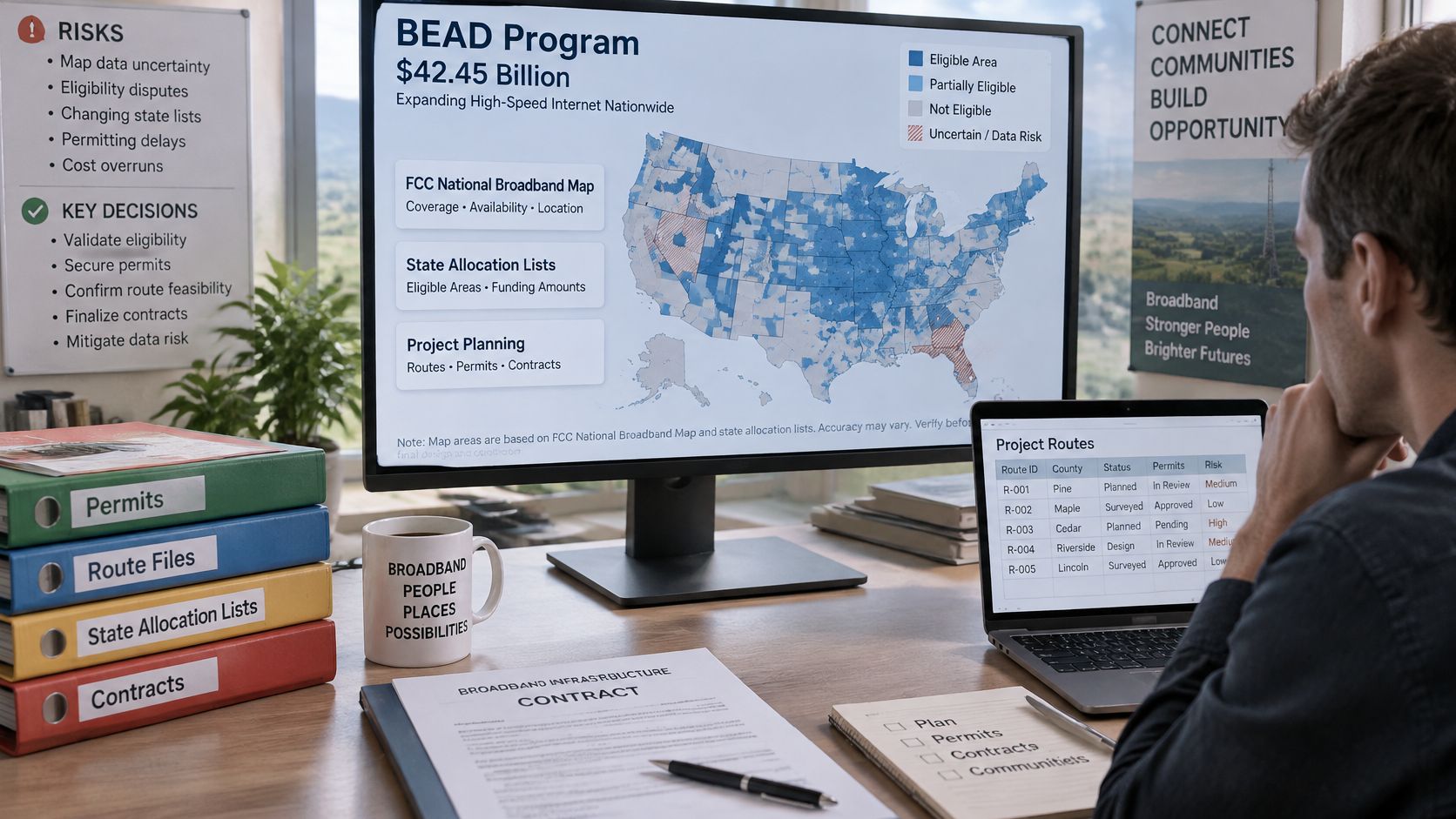
A desktop map review isn't enough to validate a construction program. Budget for field checks before crews mobilize, and make the results part of the investment record:
- Audit addresses against the locations and coverage shown on the map.
- Survey routes in the field so construction plans reflect actual access and site conditions.
- Verify poles and make-ready needs with the relevant owners before scheduling work.
- Capture as-built records after construction so the documented network matches what crews installed.
A map error can direct capital away from an eligible community; a permit delay can leave crews and equipment waiting; incomplete records can complicate operations after the build. Rights-of-way, road crossings and pole-owner approvals may take longer than the civil work they enable. Southern Tier Resources provides engineering, design, construction and maintenance services for wireline and wireless communications.
Put responsibility where the risk sits
Contract structure determines who has the information and incentive to resolve problems. A multi-vendor arrangement that separates design, construction and maintenance can give an owner control over each workstream, but leaves that owner coordinating the handoffs. A unit-price civil contract can make installed quantities easier to track, while leaving the owner exposed to quantity changes such as rock excavation or additional road crossings. One accountable partner across design, build and maintenance can suit an owner without in-house engineering, provided the contract defines deliverables and acceptance clearly.
The allocation test is practical: map error belongs with whoever validates locations, make-ready delay with whoever manages pole applications, and splice quality with the party whose work is inspected and accepted. Contracts should make those responsibilities explicit, rather than assuming that a general promise to complete construction resolves them.
Phasing the Build From Survey to Acceptance
Treat each construction phase as a release gate. The next crew should start when the current phase has produced the evidence needed to build safely and accurately, not because the schedule says it's time.
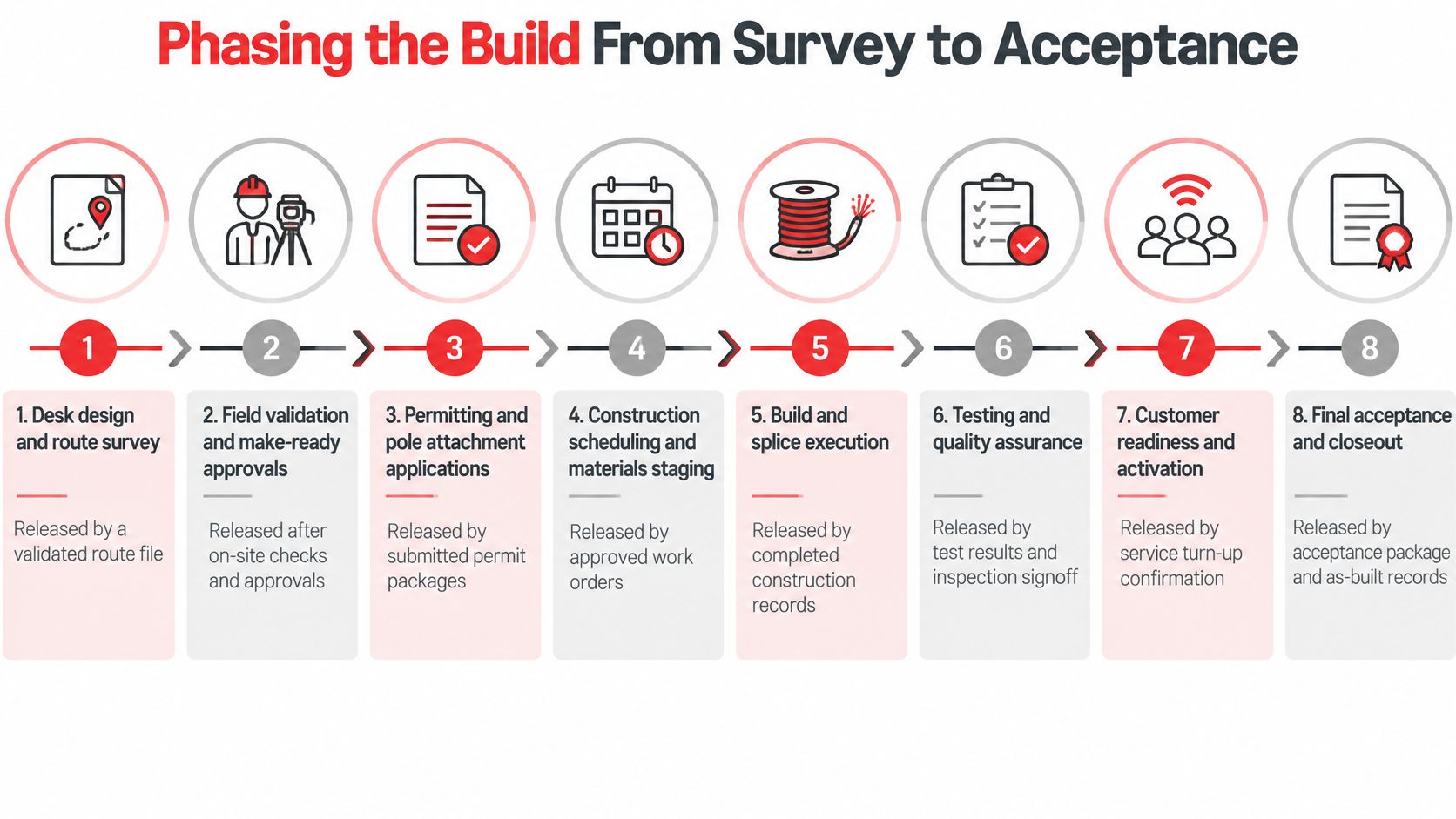
Release work by deliverable
- Desk design and route survey. Release the route for field work when the route file is validated.
- Field validation and make-ready approvals. Release construction planning when pole applications are approved and field conditions are confirmed.
- Civil construction. Release each completed trench, bore or aerial strand section with records of the installed work.
- Cable placement and splicing. Release the fiber when splice records and closure lists are complete.
- Testing. Release the plant when optical tests and end-to-end continuity results are documented.
- As-built documentation. Release the records when plans match the infrastructure in the ground.
- Acceptance and handover. Release the asset to operations with a signed acceptance package.
- Operations and maintenance. Transfer the plant into the locating, repair and monitoring processes that will keep it serviceable.
The precise sequence can vary with contract and network design, but splicing and testing must happen before handover. A test skipped during construction can reappear as an outage rather than a manageable punch-list item. As-builts also lose value when crews have left and the details of a duct route or splice location are no longer at hand.
Schedule rule: Start the slowest approval first. Hold the next crew until the current phase's deliverable is signed.
Pole-owner approvals, rights-of-way and road crossings can control the schedule more than the civil work. Start those applications early, rather than beginning with the easiest trench and waiting later for a critical approval. Southern Tier Resources offers fiber optic splicing and testing services, and supplies crews and equipment to customers 24/7.
Building a Business Case and Tracking Returns
Broadband delivers economic value through adoption, not through physical availability alone. World Bank evidence summarizes cross-country findings that a 10% increase in broadband penetration is associated with a 0.25–1.4% increase in GDP. Research in Sub-Saharan Africa found that access to fast internet increased an individual's employment probability by approximately 3.1–13.2%. The World Bank also notes that a 10% increase in mobile broadband adoption can produce approximately 0.6–2.8% GDP growth. These findings and their limits are discussed in the World Bank's analysis of infrastructure and economic development.
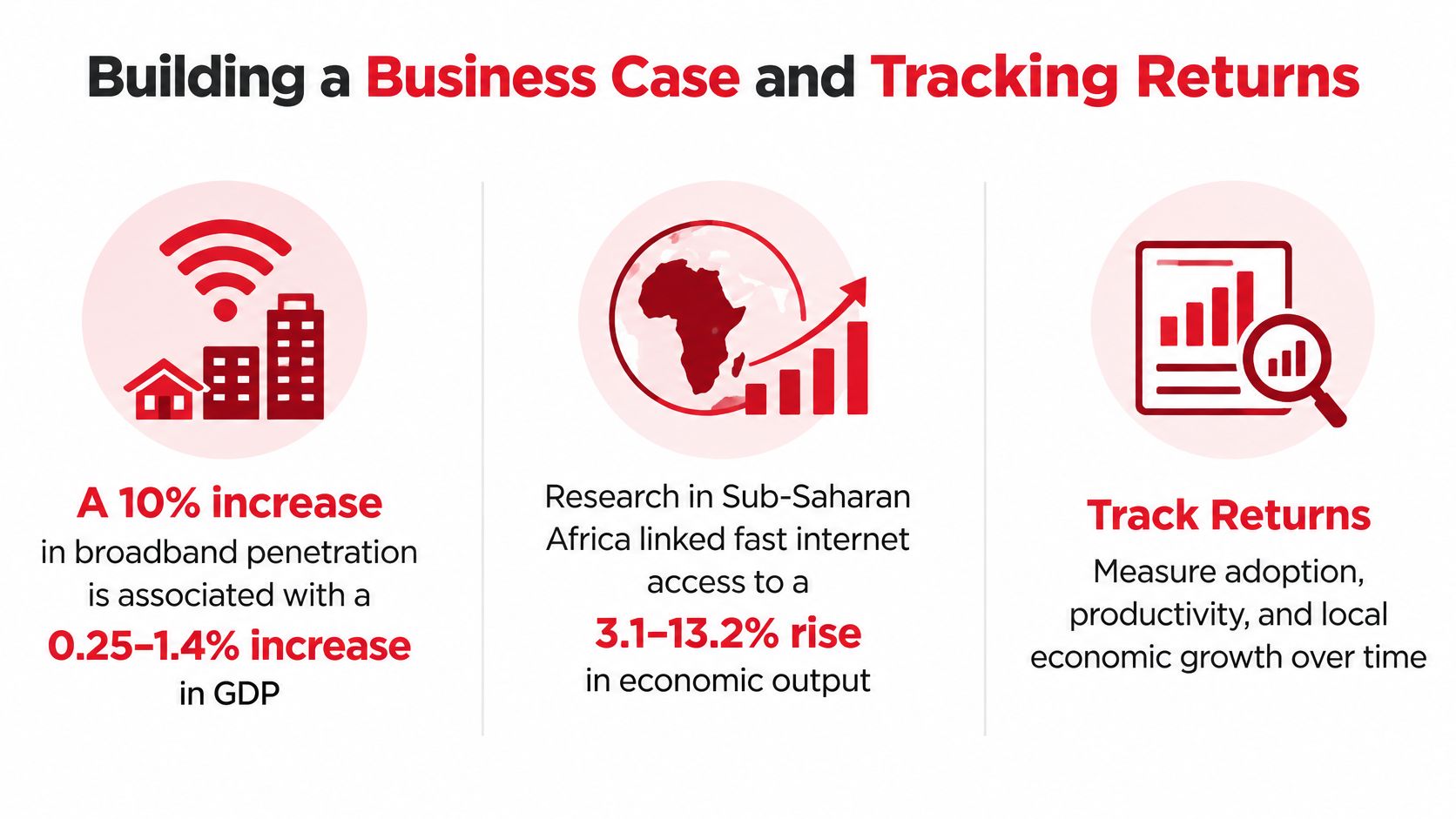
The pathway runs through people and businesses using the connection: communication, digital commerce, remote work, information access and more productive operations. Affordability, devices, skills and service quality affect whether a passed premise becomes an active customer. A business case that counts locations but doesn't model the transition from availability to paid service is missing a central driver of revenue.
Model adoption before scaling the build
Build a low, expected and high take-rate case before committing all the capital. For each case, show the activation delay, revenue per connected premise and payback period. Keep the assumptions visible: how many passed premises can realistically subscribe, how quickly they'll activate, and whether service remains affordable for the intended customers. Don't conceal a weak low case behind an optimistic take-rate assumption.
Use the scenarios to test staging. If early adoption comes in below plan, the next construction tranche can be delayed or redesigned rather than funded automatically. If take-up is strong, check that aggregation and backbone capacity can support the additional subscribers; a successful access build can still disappoint if traffic bottlenecks elsewhere.
Use an operating scorecard
| KPI | What It Measures | Signal the Investment Is Working |
|---|---|---|
| Take rate | Connected premises divided by premises passed | Rising steadily after activation campaigns |
| Churn | Share of subscribers lost in a period | Stable or falling after the first year |
| Cost per passed premise | Total build cost divided by premises passed | Falls as density and asset reuse improve |
| Cost per connected premise | Total build cost divided by active subscribers | Converges toward the business-case target |
| Revenue per connected premise | Average monthly revenue from each active subscriber | Holds up against affordability limits |
| Maintenance cost per route mile | Annual repair and locate spend per mile of plant | Flat or declining after acceptance |
| Reliability and latency | Outage minutes and latency against service levels | Within contracted service levels |
Pair construction milestones with adoption, affordability and service measures. Release the next tranche of capital only when take rate and cost per connected premise meet the thresholds agreed in the business case. That approach makes demand a funding decision, rather than an assumption buried in the original spreadsheet.
Where Carriers Municipalities and Data Centers Put Capital
The same network investment can mean three distinct assets, depending on who's paying. A carrier or ISP evaluates routes through the expected connection and service revenue. A municipality or cooperative may focus on extending service where a commercial build doesn't pencil out. A data center operator needs resilient connectivity into a campus, not a count of residential premises passed.
For carriers and ISPs, the critical question is whether customers will activate and sustain service along the planned route. A fiber architecture should be chosen to match demand, capacity needs and operating economics, not applied uniformly because it's the most ambitious option. For municipalities and cooperatives, grant or partnership structures need to support the service after construction. Contracts that reward only completed construction can leave the operator with weak incentives to connect customers or maintain the network.
Data center operators should evaluate route diversity, restoration arrangements and service requirements for connections into their facilities. A route that looks adequate on a premises-passed map may be irrelevant to campus resilience if it doesn't provide a meaningful alternative path. The investment case should measure the connectivity outcome the facility needs.
Germany's telecommunications companies invested €13.2 billion in fixed assets in 2023, focusing primarily on optical-fiber and 5G network rollout, according to the German Federal Network Agency. The figure captures a mix of fixed-asset investment, not a broadband-only total. It illustrates why fiber and mobile deployment belong in the same capital conversation: mobile access still relies on suitable backhaul, and adding access capacity without accounting for that supporting network can shift congestion rather than solve it.
Score the asset that the investor actually needs. A subscriber network, a community-owned plant and a diverse data center connection call for different measures of success.
Confirm the Investment Case Before Committing Capital
A passed premise isn't a customer, and availability doesn't guarantee sustainable adoption. During BEAD planning, every U.S. state identified affordability as a barrier to broadband adoption. Michigan reported that roughly 730,000 households still faced barriers involving affordability, adoption, device access, digital skills or combinations of those factors, according to the Pew Charitable Trusts' analysis of broadband affordability.
That evidence changes how a board should evaluate projected revenue. Exclude households that can't afford service or lack the means to use it from the revenue base until the project has a credible plan to address those barriers. Then test whether the low take-rate case can cover maintenance and electronics using cost per connected premise, not cost per passed premise.
Finally, tie further capital releases to the take-rate and connected-cost thresholds in the approved business case. That keeps construction progress from being mistaken for proof of commercial or public value. Southern Tier Resources provides end-to-end services from design to deployment and maintenance, and its website includes an RFP Listings section for project opportunities.
Board verdict: If the low take-rate case can't meet its operating and affordability gates, delay or resize the build. A network that passes premises but doesn't connect them hasn't met the investment objective.
Southern Tier Resources supports broadband projects with engineering, design, construction, fiber splicing, testing, documentation and ongoing maintenance. If your team is evaluating a build or preparing a project scope, visit Southern Tier Resources to discuss the infrastructure work required from route planning through operation.