The Electrical Safety Foundation International (ESFI) is a U.S. organization that publishes electrical injury data, safety guidance and training resources for workers. ESFI's analysis of electricity-related workplace fatalities from 2011 to 2023 found that 74% involved workers in non-electrical occupations (ESFI workplace safety analysis). For telecom and data-center crews, the finding means electrical risk cannot be assigned only to electricians.
Aerial fiber work, pole transfers, generator cutovers and rack power work can bring non-electricians near energy they do not install or control. Safety briefings and controls need to account for those roles, not just licensed electricians.
What the Electrical Safety Foundation Does
The Electrical Safety Foundation International (ESFI) is a U.S. organization that tracks electrical injuries and fatalities, publishes safety guidance and supports training for workers. It's most useful to telecom and data-center teams as an evidence source, not as an authority that approves a job plan.

Three Working Areas
First, ESFI analyzes U.S. Bureau of Labor Statistics Census of Fatal Occupational Injuries and Survey of Occupational Injuries data, with historical series extending from 1992 for nonfatal injuries and from 2003 for fatalities in its ESFI workplace electrical fatalities and injuries release. That long series lets you compare electrical-risk trends across decades instead of reacting to a single year.
Second, the foundation publishes guidance on hazards such as arc flash, overhead power lines and energized equipment. Third, it provides training and employer resources that translate those hazards into field planning, crew briefings and program checks.
- Data: Long-running fatal and nonfatal series you can track against your own incident and near-miss records.
- Guidance: Hazard framing for temporary power, overhead lines, energized equipment and similar exposures.
- Training resources: Material employers can adapt for supervisors, subcontractors and adjacent trades.
What ESFI Is Not
Think of ESFI like a weather service for electrical danger. It measures where risk sits and publishes information crews can plan around, while the employer and crew still make decisions on the job.
ESFI isn't a regulator. It doesn't inspect your site, issue citations or replace your energized-work program.
Enforceable requirements come from OSHA rules and consensus standards such as NFPA 70E, which ESFI materials reference. Read the Electrical Safety Foundation figures alongside the standard that governs the work, then convert them into site-specific procedures, boundaries, labels and stop-work rules.
Workplace Electrical Injury Numbers That Matter
ESFI's 2011–2023 analysis found that 74% of workplace fatalities involving electricity were among workers in non-electrical occupations. That distribution matters for fiber, tower and data-center crews: electrical exposure is not limited to electricians.
| Measure | Figure | Period |
|---|---|---|
| Electricity-related workplace fatalities | 1,940 total: 74% non-electrical occupations, 26% electrical occupations | 2011 to 2023 |
| Contact with electricity as share of all workplace fatalities | 5.6% | 2011 to 2023 |
| Overhead power lines as share of electrical fatalities | 48.2% | 2011 to 2023 |
| Nonfatal electrical injuries with days away from work | 5,180 combined | 2023 and 2024 |
Read Fatal and Nonfatal Rows Together
The fatality figures show that electrical risk reaches well beyond electrical trades. In the ESFI workplace safety analysis, analysts reported 1,940 workplace fatalities involving electricity from 2011 through 2023. Workers in non-electrical occupations accounted for 74%, while workers in electrical occupations accounted for 26%. Contact with electricity represented 5.6% of all workplace fatalities over the same period.
Overhead power lines accounted for 48.2% of electrical fatalities in ESFI's 2011–2023 analysis. For fiber crews, that concentration points to a practical priority: identify line exposure during planning for pole work, lifts, ladders and equipment staging.
Cite the Period With Every Number
There were 5,180 nonfatal workplace electrical injuries involving days away from work during 2023 and 2024 combined, according to the ESFI compilation of Bureau of Labor Statistics data. This two-year total should not be compared directly with a single-year figure from another release.
A safety plan, toolbox talk or client report should state the measure, period and worker population alongside each figure. That context keeps a multi-year fatality share distinct from a two-year injury total.
Planning rule: Give overhead-line exposure and non-electrical roles explicit attention. A program focused only on electricians misses most of the workplace fatalities in this analysis.
For field crews, that means identifying overhead conductors before work begins, confirming subcontractors understand the hazards, and establishing clearance procedures for tasks near energized systems.
Arc-Flash Hazards in Telecom and Data-Center Work
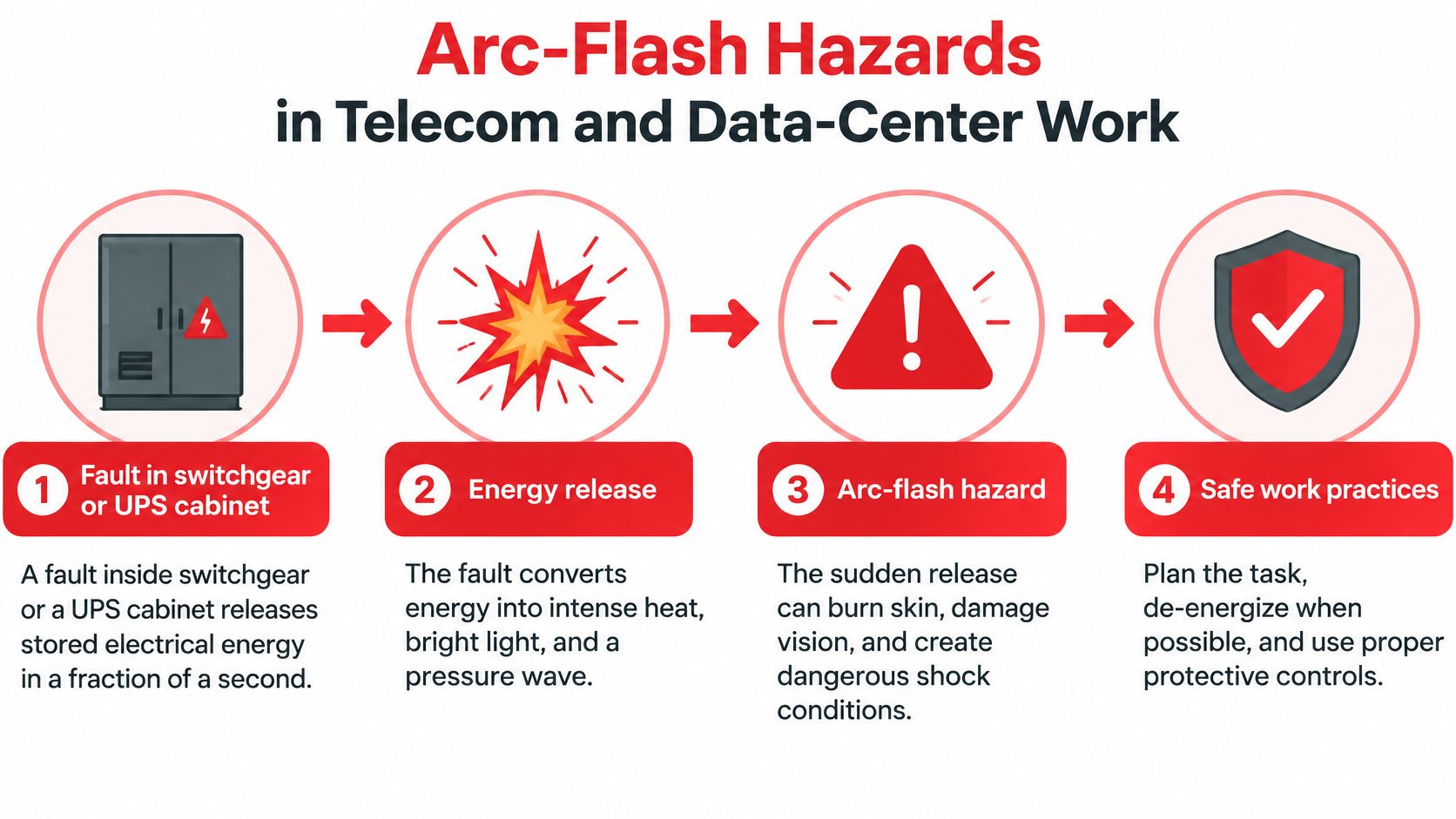
Say a fault occurs inside switchgear or a UPS cabinet during a data-center fit-out. Stored electrical energy releases in a fraction of a second, before a technician can step back or close a door.
The fault converts energy into intense heat, pressure, molten metal and light. Severity rises with available fault current, clearing time and worker proximity, so a worker close to the equipment faces a different exposure from someone standing across the room.
How Often and How Severe
The Fire Protection Research Foundation estimates approximately 5 to 10 arc-flash explosions occur daily in the United States, while U.S. Bureau of Labor Statistics data cited by NFPA records an annual average of about 150 worker fatalities and 2,428 injuries involving exposure to electricity, as summarized in the OSHA arc-flash guidance publication. Those figures come from different sources and methods from ESFI's series, so use them to establish scale, not as interchangeable trend lines.
Recurring faults deserve investigation before the next energized task, not a reset and a return to work. Teams that need a structured method to troubleshoot recurring electrical faults can use fault history, protection operation records and inspection findings to decide whether equipment should stay out of service.
Control Sequence Before Work Starts
- Complete a documented electrical risk assessment. Identify the task, energy sources, exposed workers and consequences before anyone opens equipment.
- Identify shock and arc-flash boundaries. Boundaries tell each worker where unqualified access ends and where task-specific protection begins.
- Verify equipment labels and studies. Check labels against the short-circuit and coordination studies so PPE and boundaries reflect the installed system.
- De-energize and apply lockout/tagout. Establish an electrically safe work condition whenever the task allows it.
- Test for absence of voltage. A switch position or indicator light doesn't prove conductors are de-energized.
- Apply temporary grounding where applicable. Grounding controls accidental energization and stored or induced energy during the task.
- Select PPE from incident-energy analysis. If energized work is justified, choose arc-rated PPE from the equipment analysis rather than generic clothing categories.
OSHA notes that workers closer to energized parts require greater training and protection. That principle should drive crew assignment, not just PPE selection. Don't assign the nearest task to the least experienced technician because the schedule is tight.
Confirm every panel, UPS and switchboard in scope has a visible label before any crew enters the room.
If a label is missing, damaged or inconsistent with the one-line diagram, stop and resolve it. The crew can't select boundaries or PPE from equipment data that doesn't exist.
Grounding and Bonding Keep Crews and Equipment Safe
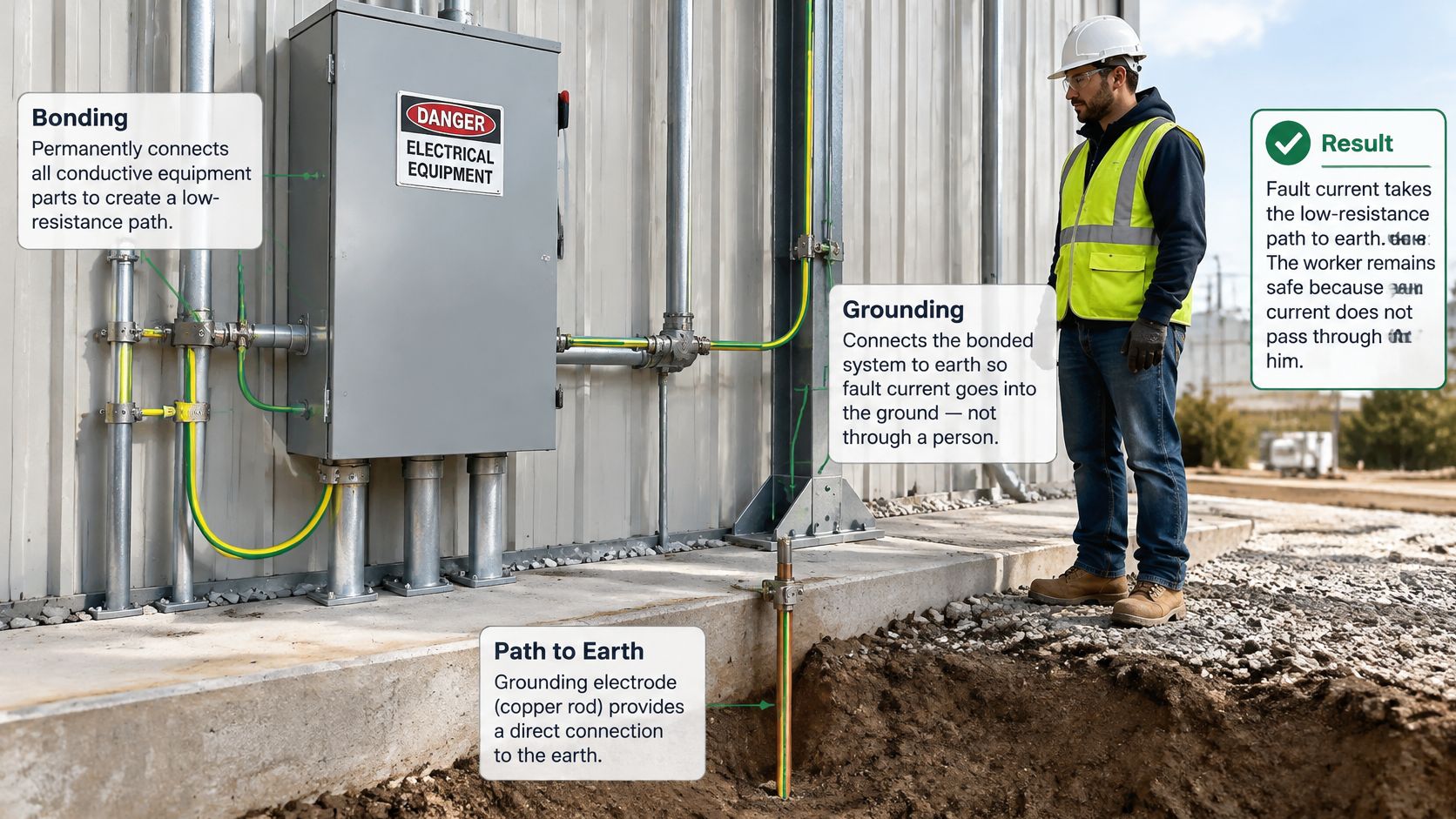
Think of bonding as a drain path. Fault current needs a clear, controlled route, or it can raise the voltage on metal parts and find a route through a person.
The field installation below shows why access, routing and connection quality need inspection after installation, not only during design.
Definitions That Drive the Work
NIST defines bonding as permanently connecting conductive equipment parts to a low-impedance ground-fault current path so overcurrent protection can operate, while grounding establishes a conductive path that prevents hazardous voltage buildup, in the NIST electrical safety annex. The two functions work together to limit voltage from lightning, line surges and unintended energization.
A continuous, low-impedance path lets fault current rise rapidly enough to trip protective devices. Fast clearing limits touch voltage and fault duration, which protects both the worker touching a cabinet and the network equipment connected to it.
Loose, corroded, painted, plastic or improperly spliced connections break that chain. The enclosure can remain energized while protective devices don't receive enough fault current to operate quickly.
What to Bond and Test
At fiber huts, wireless sites and data-center fit-outs, bond these conductive systems to the site grounding electrode system:
- Racks and cabinets: Include doors and movable sections where the design requires continuity.
- Cable trays and conduits: Verify joints and transitions, not only the connection at the grounding bus.
- Generator systems: Confirm bonding after installation, relocation or temporary-power changes.
- Metallic building steel: Tie applicable structural metal into the site system according to the design.
Use bare, clean metal contact surfaces, never painted or plastic surfaces for grounding conductor attachment. Inspect continuity after modifications and document test results in as-built records so the next crew can verify what changed.
The walkthrough below is useful for reviewing how grounding and bonding connections should be examined in the field.
A common failure pattern looks minor. A cabinet was bonded at install, moved during a later fit-out, and reconnected over paint or with a loose lug. It looks finished, but only a continuity test reveals that the protective path is gone.
Electrical Risk Beyond Electrical Trades
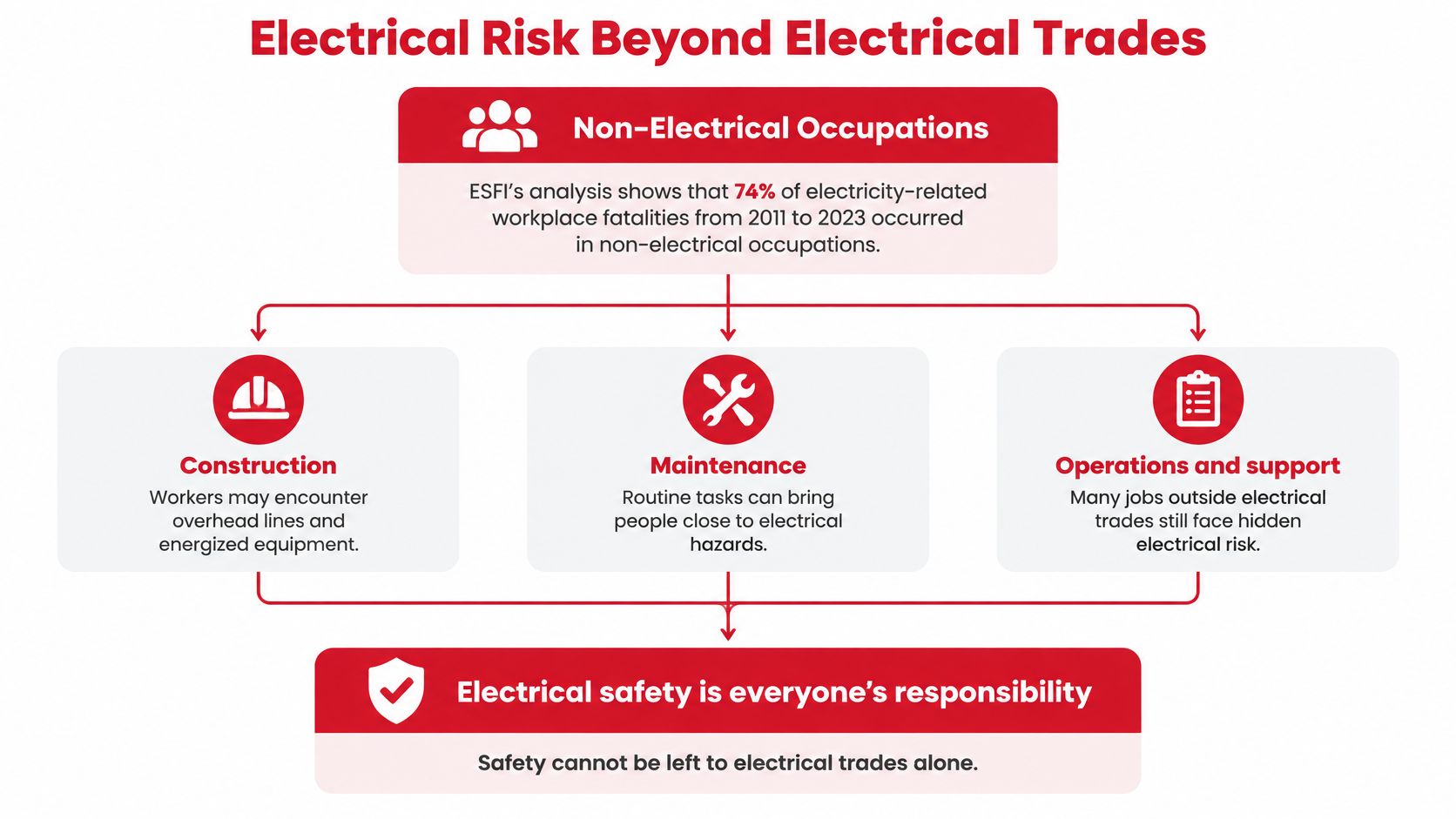
ESFI's 2025 analysis shows 74% of U.S. workplace electrical fatalities from 2011 to 2023 occurred in non-electrical occupations, according to the ESFI updated workplace safety statistics release. Electrical safety therefore can't be delegated to electricians who may not be present when exposure occurs.
Roles That Meet Energy Indirectly
Exposed roles include fiber-construction laborers, tower crews, utility-locate teams, truck drivers, grounds crews and data-center contractors. They may not call themselves electrical workers, but they work near overhead lines, temporary power, generators, batteries and distribution equipment.
Aerial fiber installation, make-ready work and pole transfers bring crews and conductive equipment near existing conductors. Traffic-control setup can place workers and signs below lines, while fit-out work introduces temporary distribution, battery systems and energized cabinets.
Overhead power-line contact accounted for 48.2% of workplace electrical fatalities during the same 2011 to 2023 period. That makes line identification and clearance verification a construction-planning task, not a reminder added after mobilization.
Role-Based Decision Rules
- Verify clearances before staging: Check ladders, lifts, cranes, poles and material against overhead conductors before equipment is positioned.
- Name one utility-coordination owner: One person confirms line status, required clearances, protective measures and any utility attendance.
- Set a stop-work trigger: Stop when a worker or conductive object could enter the approach distance of a line that hasn't been verified de-energized.
- Control conductive equipment: Keep metal ladders and aerial lifts under a documented approach plan, and use non-conductive equipment where the task requires it.
- Reassess temporary power: Recheck boundaries and bonding whenever generator operation, temporary distribution or battery work changes.
Equipment control also includes removal from service. When meters or testers are damaged, obsolete or no longer supported, supervisors should tag them out of use and recycle electrical test equipment through an appropriate disposal route rather than leaving unreliable instruments in crew trucks.
The contrarian conclusion is practical. Reducing incidents may depend less on advanced electrician training than on mandatory hazard recognition for every adjacent trade, with authority to stop work before a routine task becomes an electrical contact.
Verify Controls and Audit the Program
| Hazard | Where It Appears | Control to Verify |
|---|---|---|
| Overhead power lines | Aerial fiber installation, make-ready work, pole transfers | Documented clearance distances and utility coordination before equipment is staged |
| Arc flash | Switchgear and UPS work during data-center fit-outs | Incident-energy analysis, equipment labels and arc-rated PPE chosen from that analysis |
| Shock from energized equipment | Rack power distribution and cabinet work | Lockout/tagout and absence-of-voltage testing before work |
| Improper bonding | Racks, cable trays, conduits and tower steel | Continuity test on bare metal and an as-built record of the result |
| Temporary power and generators | Site power during outages or cutovers | Bonded generator system and a marked exclusion zone around operating equipment |
| Conductive equipment near energy | Aerial lifts, metal ladders and tools near lines | Approach distances enforced and non-conductive equipment where lines are present |
Use the Table Before Mobilization
Start in preconstruction, not at the pole or switch room door. Survey for overhead conductors and energized systems, document clearance and grounding procedures for the job, and confirm subcontractors understand site-specific hazards before entry.
A fiber crew on a pole and a fit-out technician in a switch room need the same working vocabulary. Both should know the applicable boundary, who can cross it, which label or record supports the decision, and what condition triggers a stop.
The table is a planning checklist. It doesn't replace the employer's energized-work program, OSHA requirements or NFPA 70E procedures, and it shouldn't be used to justify energized work that the governing program prohibits.
For organizations formalizing this review, structured risk assessments for workplace safety can connect hazard identification, ownership, corrective actions and follow-up dates. Use that structure to close findings, not merely to store completed forms.
Six Checks to Run This Quarter
- Overhead line clearances recorded: Review the preconstruction survey for every active job and confirm clearances are documented before staging.
- Labels and analysis in place: Inspect every panel, switchboard and UPS in scope for a visible label supported by incident-energy analysis.
- Lockout/tagout procedure available: Confirm each crew has a written procedure that includes absence-of-voltage testing for its equipment.
- Bonding continuity recorded: Check as-built records for racks, cable trays and generator systems, including results after modifications.
- Role-based briefing completed: Verify non-electrical crews and subcontractors received hazard recognition and stop-work instructions for their actual tasks.
- Quarterly outcomes tracked: Record nonfatal injuries with days away from work, near misses and training completion against work exposure.
Assign Ownership and Compare Against Exposure
Give each check one owner and a completion date. Then test the evidence against a recent job by asking for the survey, label, procedure, continuity result or briefing roster. If the record can't be produced, the control isn't verified.
Exposure matters when you interpret results. Fewer incidents during a quarter with fewer overhead or energized tasks doesn't prove the work became safer. Compare outcomes with crew hours, task counts and near misses so managers don't mistake reduced exposure for improved control.
Don't close an audit item because a procedure exists. Close it when a named owner produces current field evidence from a real job.
Southern Tier Resources provides engineering, design, construction and maintenance services for wireline and wireless communications, where these controls cut across fiber construction, wireless work and facility fit-outs. That cross-functional scope is exactly why electrical hazard recognition belongs in project planning rather than a separate trade packet.
Make one decision before the next energized or overhead task. Verify the control in the relevant table row, assign the gap to one owner, and don't mobilize until the evidence is in hand.
Southern Tier Resources delivers engineering, construction and maintenance for wireline and wireless networks, including fiber builds and data-center infrastructure fit-outs where electrical controls must be planned before crews mobilize. If you're preparing an overhead fiber project, wireless upgrade or powered facility fit-out, visit Southern Tier Resources to discuss a scope built around documented clearances, verified bonding, labeled equipment and role-based field briefings.