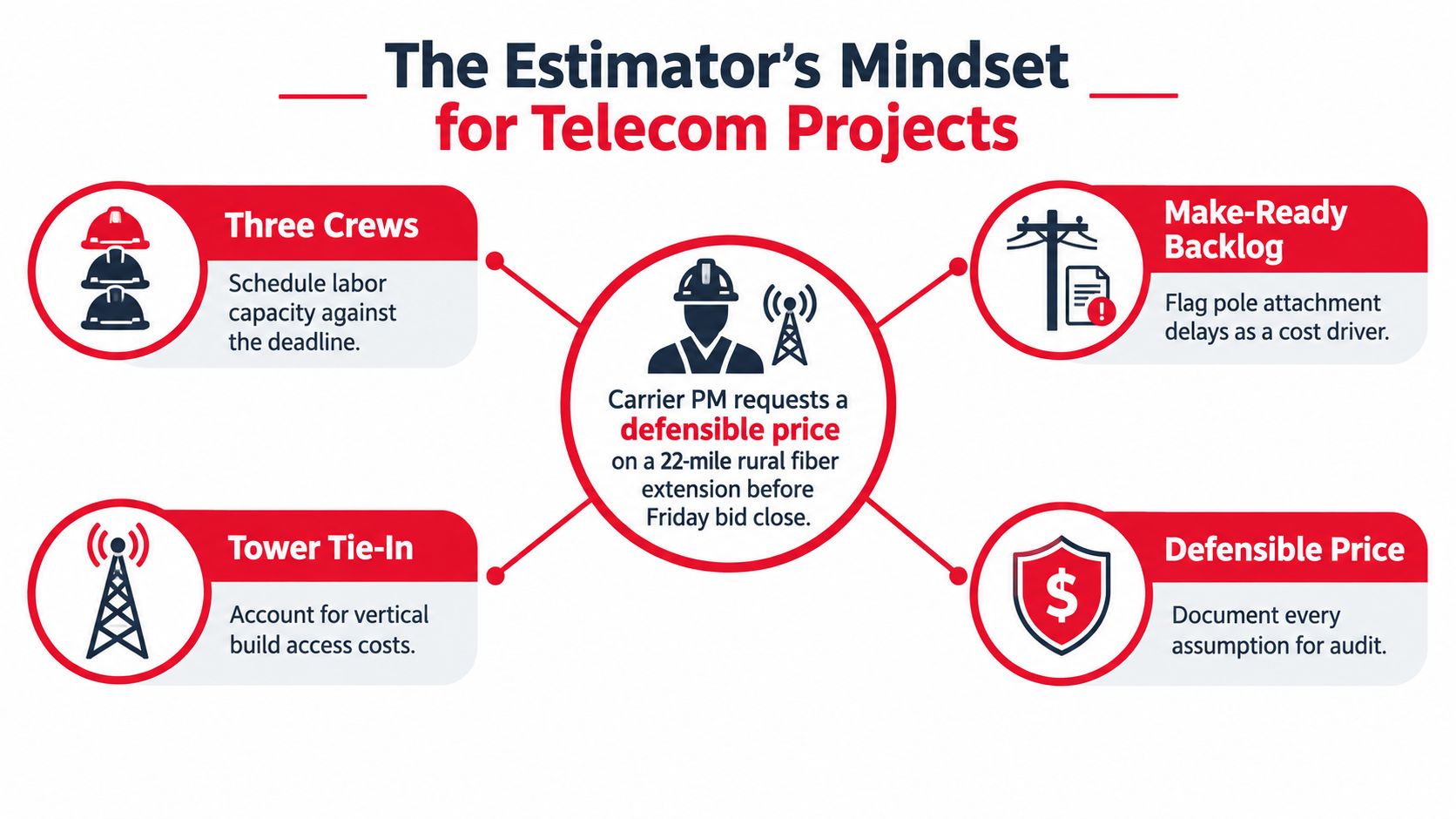
A carrier project manager walks in mid-week with a familiar problem: a defensible price is needed on a 22-mile rural fiber extension before Friday's bid close. Three crews are available, the make-ready queue is already backed up, and a tower collocation deadline is pressing from the other side of the schedule. A catalog rate for fiber per foot won't answer the core question. The estimate has to show what the work includes, which assumptions drive the total, and what happens if the route, market, or approval process moves against the plan.
That's the practical meaning of construction cost estimation in telecom. It isn't a single spreadsheet total created once before procurement. It's a controlled workflow that starts with scope, converts quantities into unit-priced work, separates cost behavior, and stays alive as design and field conditions change. A literature review of 258 transport projects in 20 countries found that 86% experienced cost overruns, with an overall average overrun of 28% (transport project cost-overrun review). Telecom work has its own causes, but the warning applies: a neat base estimate can still conceal weak assumptions.
The Estimator's Mindset for Telecom Projects
The first move isn't opening a rate book. It's writing down what must be true for the price to hold.
On the rural fiber job above, I'd put every line into one of four buckets: labor, materials, equipment and logistics, or policy pass-throughs. Labor includes crew composition, supervision, productivity, overtime exposure, and access constraints. Materials include fiber, conduit, poles, lash wire, hardware, splice cases, cabinets, antennas, and structured cabling. Equipment and logistics cover trucks, excavation equipment, fuel, mobilization, delivery, staging, and restoration. Policy pass-throughs include permits, locates, pole attachment fees, traffic control, prevailing wage requirements, and utility-owner charges.
Practical rule: If a cost driver behaves differently under risk, it deserves its own line and cost code.
A flat contingency can hide the difference between a crew shortage and a tariff-driven cable increase. That makes the bid harder to defend and makes change-order recovery harder because nobody can identify which assumption moved. Separate buckets let the project manager compare the estimate with actual cost, release reserve against evidence, and explain a variance to finance without rebuilding the bid.
The five-class accuracy framework reinforces the relationship between estimate confidence and design maturity. A Class 5 estimate can range from roughly −50% to +100%, while a Class 1 estimate tightens to about −3% to −10% below and +3% to +15% above actual cost (five-class estimating framework and benchmarking guidance). Early area-based or parametric pricing has a place, but it shouldn't be presented as detailed takeoff accuracy.
Four questions for every line
Before accepting a number, ask:
- What quantity does it represent? Feet, spans, poles, structures, cabinets, splice points, crew days, or equipment days.
- Which bucket owns it? Don't bury permit fees inside installation labor.
- What assumption supports the rate? Region, quarter, access method, wage basis, quote validity, and expected production.
- What would cause it to change? A permit delay, longer route, utility redesign, material escalation, or productivity loss.
For teams building a data-driven estimating process, Faberwork's Snowflake telecom success stories offer useful context on organizing operational information for telecom decisions. The estimating workflow itself still needs project-specific judgment. A shared data platform won't correct an undefined route or an omitted make-ready obligation.
Keep the working estimate, assumptions, and revision history accessible to the people who own delivery. A practical starting point for telecom infrastructure teams is Southern Tier Resources, where engineering, construction, testing, and maintenance work can be coordinated around the same project definition.
Defining Scope Before Any Number
Scope is the most underpriced hour in telecom estimating. If the scope brief is vague, the spreadsheet only gives the ambiguity a decimal place.
Write a one-page scope brief before touching unit rates. Start with route miles or pathway footage, structure count, span count, aerial and buried percentages, soil or rock assumptions, road and railroad crossings, splice locations, handholes, cabinets, building entrances, and restoration requirements. For tower work, state whether the job includes structural analysis, reinforcement, rigging, antenna removal, transmission-line work, grounding, testing, and close-out documentation. For a data center fit-out, define the boundary between owner-furnished equipment, contractor-installed infrastructure, power distribution, containment, ladder rack, bonding, and structured cabling.
The questions that move the total fastest are usually contractual, not mathematical:
- Who obtains permits and pays associated fees?
- Who performs utility locates and manages damages or rework?
- Are traffic control, railroad coordination, and environmental reviews included?
- What does make-ready include, and who pays the utility owner?
- Are special crossings, rock excavation, groundwater, restoration, or night work included?
- Which materials are contractor-furnished, and which are owner-furnished?
- What counts as complete, including testing, as-builts, labeling, and acceptance?
A usable scope brief
Use the project type to determine which fields deserve the most detail.
| Scope Element | Rural Fiber Build | Tower Modification | Data Center Fit-Out |
|---|---|---|---|
| Primary quantity | Route footage, aerial spans, buried footage, handholes | Antenna positions, mounts, feeders, steel modifications | Cabinets, cable paths, tray or ladder-rack footage |
| Site condition | Soil, rock, roads, waterways, existing utilities | Access road, compound, rigging zone, structural condition | Live environment, floor loading, overhead or raised-floor pathways |
| Access method | Plow, trench, HDD, aerial construction | Crane, gin pole, bucket truck, controlled climbing | Lift equipment, material staging, escorted access |
| Interfaces | Utilities, municipalities, railroads, property owners | Carrier tenants, structural engineer, utility power | Owner-furnished gear, electrical contractor, facilities operations |
| Acceptance | OTDR, power meter, splice records, as-builts | Structural close-out, sweep, grounding, documentation | Labeling, test results, bonding, owner sign-off |
A brownfield fiber job needs an existing-condition review, not just a route map. Confirm usable conduit, abandoned cable, vault condition, splice case capacity, and building entrance constraints. A tower modification needs the latest tower drawings and a clear answer on whether the structural analysis is already complete. A small data center build needs a firm demarcation between cabling, power, cooling, fire protection, and owner-supplied equipment.
Freeze assumptions before pricing
At the end of scope review, produce a signed or acknowledged basis of estimate. List inclusions, exclusions, design status, schedule basis, geographic market, labor rules, tax treatment, and quote dates. If the owner can't answer a question before bid close, carry it as a visible assumption with an owner and a review trigger. Never let uncertainty disappear into a general contingency.
Building Labor, Equipment, and Materials Lines
A priced estimate becomes credible when someone can trace each total to a quantity, a rate, and a production assumption. The basic structure is simple:
Extended cost = quantity × unit rate
The work is deciding whether the quantity and rate describe the field reality.
Build labor from production
Labor starts with crew composition, not an average hourly number. Identify the foreman, operators, linemen, laborers, splicers, testers, riggers, and supervision required for each activity. Then define production units such as aerial lash footage, plowed footage, HDD footage, tower work shifts, splice closures, or inside-plant cable pulls.
A rural aerial build might use a crew-day assumption for lash and placement, while an underground section may need separate production for trenching, conduit placement, pull rope, restoration, and testing. HDD should be split by bore type, setup, drilling, pullback, and restoration. A data center estimate should distinguish pathway installation from cable installation, termination, labeling, testing, and documentation.
Don't copy a production rate from another region without calibrating it. Terrain, permitting windows, traffic control, union rules, weather, crew familiarity, congestion, and material staging can all change the output. Use awarded and completed work as a benchmark, but normalize the comparison to the same cost code, location, price basis, and scope.
Price equipment and materials separately
Equipment lines should show ownership or rental basis, operator treatment, fuel, mobilization, and expected utilization. Typical lines include bucket trucks, mini-excavators, HDD rigs, trailers, splicer trucks, cranes, lifts, generators, and temporary power. A daily rental rate that excludes delivery or standby isn't comparable with an owned-equipment burden.
Material lines need specification, not just product names. Fiber pricing depends on strand count, jacket, armor, messenger, reel configuration, and delivery. Conduit depends on diameter, wall type, innerduct configuration, fittings, and pull requirements. Tower materials may include mounts, steel, transmission line, grounding, connectors, and weatherproofing. Data center cabling needs category or fiber type, connectorization, pathway hardware, labeling, and test requirements.
| Line Item | Unit | Illustrative Rate (USD) | Notes |
|---|---|---|---|
| Aerial fiber placement | Per foot | Region-specific | Illustrative only, calibrate to crew, route, and quarter |
| Underground conduit installation | Per foot | Region-specific | Separate excavation, conduit, restoration, and traffic control |
| HDD crossing | Per crossing or foot | Region-specific | Define bore length, diameter, soil, casing, and restoration |
| Fusion splicing | Per splice or closure | Region-specific | State splice count, closure type, prep, and documentation |
| Bucket truck | Per day | Region-specific | Confirm rental, ownership, delivery, fuel, and standby basis |
| Fiber cable | Per foot | Vendor quote | Record strand count, jacket, reel, lead time, and quote expiry |
| HDPE conduit | Per foot | Vendor quote | Record diameter, SDR or wall basis, fittings, and delivery |
| Data center fiber cabling | Per link | Vendor quote | Include installation, termination, labeling, and test records |
These rates are illustrative placeholders, not guaranteed prices. Tag each with region, project scale, quarter, source, and validity date. The estimate should show whether a material number comes from a firm quote, a budgetary quote, a historical actual, or an internal allowance.
A unit rate without a production basis is an opinion wearing a spreadsheet format.
Historical data improves estimation when it's structured. Research reviews have reported predictive-model MAPE ranging from 2% to 21%, with the middle 50% of models around 5% to 13%, while another survey found average error under 10% across modern methods (review of construction cost prediction methods). Those findings don't make a model reliable by themselves. Consistent scope, units, site conditions, procurement assumptions, and cost codes do.
Make-Ready, Permitting, Testing, and Data Center Fit-Out
The base construction line often looks complete because the visible installation work is priced. The money leaks through the interfaces.
Make-ready deserves its own cost family. Include pole-loading analysis, field inspection, engineering revisions, attachment applications, utility review, rearrangement, replacement hardware, transfer work, and utility-owner charges. If the make-ready backlog can delay production, model the resulting crew idle time, remobilization, resequencing, and temporary storage separately. Don't treat every utility response as a free administrative event.
Municipal and crossing requirements need similar treatment. Rights-of-way fees, encroachment permits, traffic control plans, lane closures, railroad coordination, environmental review, bore permits, restoration bonds, and inspection charges may sit with different parties. Read the contract and permit matrix together. A permit included in the scope but excluded from the price is still an estimate gap.
Price acceptance work as production
Testing isn't a close-out afterthought. For fiber, define OTDR traces, launch and receive methods, power meter verification, splice-loss limits, connector inspection, labeling, redlines, and final records. Price the technician time, equipment, travel, retests, report preparation, and owner review. A splice can be physically complete while the project remains commercially incomplete because the trace set or as-built package is missing.
Tower work needs its own acceptance logic. Include sweep testing where required, grounding verification, torque records, structural close-out, photo documentation, and carrier-specific punch-list work. If a rigging crew must return because an owner changes an antenna configuration, that exposure should be visible.
Protect the data center boundary
Data center fit-outs commonly hide cost in pathway and coordination details:
| Category | Typical Items | Where It Hides |
|---|---|---|
| Pathways | Busways, ladder rack, tray, overhead conveyance, raised-floor pathways | Assumed to exist or assigned to another trade |
| Connectivity | Fiber trunks, copper cabling, panels, cassettes, connectors | Owner-furnished equipment boundary |
| Grounding | Bonding conductors, racks, trays, telecom grounding | Electrical scope or commissioning gap |
| Identification | Labels, port maps, rack elevations, test records | Close-out documentation |
| Access | Escorts, lifts, staging, off-hours work, security procedures | General conditions |
| Changes | Rework caused by late owner-furnished equipment | Change-order process |
Create separate codes for make-ready, permits, traffic control, splicing, testing, and data center fit-out. That separation allows the project team to compare budget, committed cost, actual cost, and recoverable change work without hiding everything in markup.
Risk, Escalation, and Scenario-Based Contingency
A flat contingency pad is easy to type and difficult to defend. It treats a permit delay, a cable price change, a diesel increase, a steel shortage, and a labor productivity problem as if they were the same risk. They aren't.
Current market conditions make the distinction more important. Recent market data shows final-cost indices running about 5.6% year over year nationally, while some forecasts indicate materials-price growth could reach roughly 8% in 2026 (JLL's 2026 US construction perspective). Those figures are market context, not a plug for every estimate. A fiber-heavy project, a steel-intensive tower modification, and a fuel-sensitive rural build won't respond identically.
Separate the risk behavior
Build the risk register around four cost groups:
- Labor: Wage rules, crew availability, overtime, productivity, weather, and remobilization.
- Materials: Fiber, copper, steel, conduit, electronics, connectors, and vendor quote validity.
- Logistics: Freight, fuel, equipment transport, staging, access, storage, and standby.
- Policy pass-throughs: Permits, tariffs, prevailing wage, pole attachment fees, environmental requirements, and utility-owner charges.
Then create base, stretched, and stressed scenarios. The base case uses the current approved scope and supported quotes. The stretched case assumes selected delays, less favorable productivity, or expiring vendor pricing. The stressed case combines the highest-impact credible events, such as a make-ready delay with a long-lead material shift and added mobilization.
Don't assign escalation globally if the inputs move independently. Fiber cable, copper, steel, and diesel need separate assumptions and dates. If the estimate has a cable quote with a stated expiry date, the risk is not “inflation.” It may be a procurement decision tied to release timing, allocation, freight, or policy.
Size reserve against evidence
A small Monte Carlo mindset is useful even without specialized software. Rank the top cost drivers, assign an estimated probability and impact, and identify which risks overlap. Don't add every maximum outcome together. A permit delay may cause crew standby, but it may also move work into a better material-delivery window. Document the relationship.
Revisit the register during long builds, at least monthly when the schedule and market exposure justify it. Tie reserve releases to measurable triggers such as notice to proceed, permit receipt, approved make-ready, long-lead delivery, completed route verification, or accepted test results. Contingency is a controlled reserve, not a hidden markup.
Recent research describes a shift toward dynamic, AI-assisted and digital-twin forecasting. One review identified 41 papers in 2025 alone on ML and AI construction cost prediction, and newer work describes 4D and 5D digital twins combining scan-to-BIM, computer vision, and Bayesian forecasting (research on AI and digital-twin construction forecasting). The practical lesson isn't to buy a model before fixing the data. It's to maintain a living estimate that can absorb field quantities, productivity, commitments, and approved changes.
Designing the Cost Workbook and Sample Calculation
A strong workbook makes the estimate auditable without making it slow. I use separate tabs for scope, quantities, unit rates, labor, equipment, materials, pass-throughs, escalation, contingency, and summary. The summary should roll up from source rows, never from manually retyped totals.
Give every cost a home
A practical code structure might look like this:
| Tab / Code | Purpose | Sample Value |
|---|---|---|
| Scope / Basis | Define inclusions, exclusions, schedule, and assumptions | Rural aerial fiber segment |
| 0100 Labor | Crew hours, burden, supervision, productivity | Crew-day quantity |
| 0200 Equipment | Rental or ownership burden, fuel, mobilization | Bucket truck day |
| 0301 Fiber Cable | Cable quantity, specification, quote source | 144-count cable footage |
| 0310 Conduit | HDPE, innerduct, fittings, delivery | Conduit footage |
| 0400 Splicing | Closures, splice labor, prep, records | Closure quantity |
| 0500 Testing | OTDR, power meter, retests, reports | Test package |
| 0600 Permitting | ROW, traffic control, crossings, inspections | Permit allowance |
| 0700 Make-Ready | Engineering, utility fees, rearrangement | Pole attachment package |
| 0800 DC Fit-Out | Pathways, racks, cabling, bonding, labels | Cabinet work package |
| 0900 Risk | Scenario exposure and controlled reserve | Risk register roll-up |
The sample calculation below is deliberately a framework, not a market quote. Suppose the takeoff contains 2,000 feet of 144-count fiber and a 7 to 13 easement daily pace. Record the selected production assumption, derive labor days from quantity divided by production, add splice labor based on actual closure and splice quantities, then add equipment days and material cost from current vendor pricing. The per-foot total is the extended direct and indirect estimate divided by the installed footage, but the workbook should preserve the underlying lines.
| Calculation Component | Formula | Sample Value |
|---|---|---|
| Fiber quantity | Takeoff | 2,000 feet |
| Production basis | Quantity ÷ daily pace | Use selected pace within the stated range |
| Installation labor | Labor days × loaded crew-day rate | Source from labor tab |
| Splice labor | Closures or splice units × rate | Source from splice tab |
| Equipment | Equipment days × burden rate | Source from equipment tab |
| Materials | Cable quantity × quoted material rate | Source from vendor row |
| Unit result | Total estimate ÷ installed footage | Derived summary value |
The displayed pace is an illustrative assumption, not a verified production statistic. Calibrate it against route conditions, crew makeup, access, and local history before using it in a bid.
Keep formulas clean
Use named ranges for escalation factors, protect formula cells, and add a revision log with estimator, date, scope revision, and changed assumptions. Store quote expiry dates beside vendor rates. Separate bid, buyout, and final cost so the historical database doesn't confuse an early allowance with a delivered result.
For spreadsheet structure, teams can also review guidance on how to capture extras in estimates, especially items that tend to vanish when the bid is compressed into a client-facing quotation. The final workbook should let a reviewer trace every summary value back to a quantity row and then to a documented assumption.
QA Checklist and Lifecycle Cost Discipline
The last review should be designed to find omissions, not admire the total. Start with recent awarded work and compare equivalent cost codes. A rate can look reasonable while still being wrong for the route because it includes different restoration, traffic control, supervision, or material scope.
Run the bid through four reviews
Quantity review. Re-measure fiber footage, conduit, handholes, pole attachments, splice points, cabinets, tower steel, feeders, and data center pathway counts. Compare drawing takeoff with field notes and route constraints.
Scope-gap review. Put civil, aerial, inside plant, wireless, testing, and fit-out scopes side by side. Confirm that mobilization, restoration, grounding, documentation, and owner interfaces belong to someone.
Commercial review. Verify permit, make-ready, traffic-control, tax, insurance, bond, escalation, and contingency assumptions. Check that quote expiry dates align with procurement timing and that the schedule supports the assumed labor and equipment utilization.
Formula review. Test quantity extensions, unit conversions, lookup tables, escalation dates, scenario toggles, and summary roll-ups. Lock approved versions and retain the previous estimate so scope changes remain visible.
Use a separate quality process for electrical and infrastructure work rather than treating QA as a final signature. A useful reference is ATEK Distribution's overview of quality assurance for electrical contractors, which reinforces the value of staged checks throughout delivery.
Audit test: A reviewer should be able to choose any summary line and find its quantity, rate, source, assumption, and approval history without asking the estimator to recreate the bid.
Lifecycle discipline starts by separating CAPEX from OPEX. The construction estimate should identify maintenance splicing, emergency restoration, inspection, monitoring, replacement, and service reserves rather than burying them in installation cost. Mark each rate as first-year, current-market, or escalation-adjusted so the same data can feed procurement and the operating budget without mixing price bases.
A living estimate also tracks what has changed after award. Replace forecast quantities with installed quantities, replace allowances with commitments, and preserve the reason for each variance. That record improves the next fiber build, tower upgrade, or data center fit-out far more than a polished but untraceable final number.
Southern Tier Resources provides engineering, construction, testing, documentation, and maintenance support for fiber, wireless, and data center infrastructure, which fits the living-estimate discipline described here. If you need a partner to turn a defined scope into buildable telecom work and maintain accountability through delivery, visit Southern Tier Resources to discuss your project.