Direct field rework averages 5% of total project costs, with observed studies ranging from about 2% to 20% depending on project type and quality controls. A separate synthesis found median rework costs of 4.03%, while one field study reported a 4.4% total field rework factor.
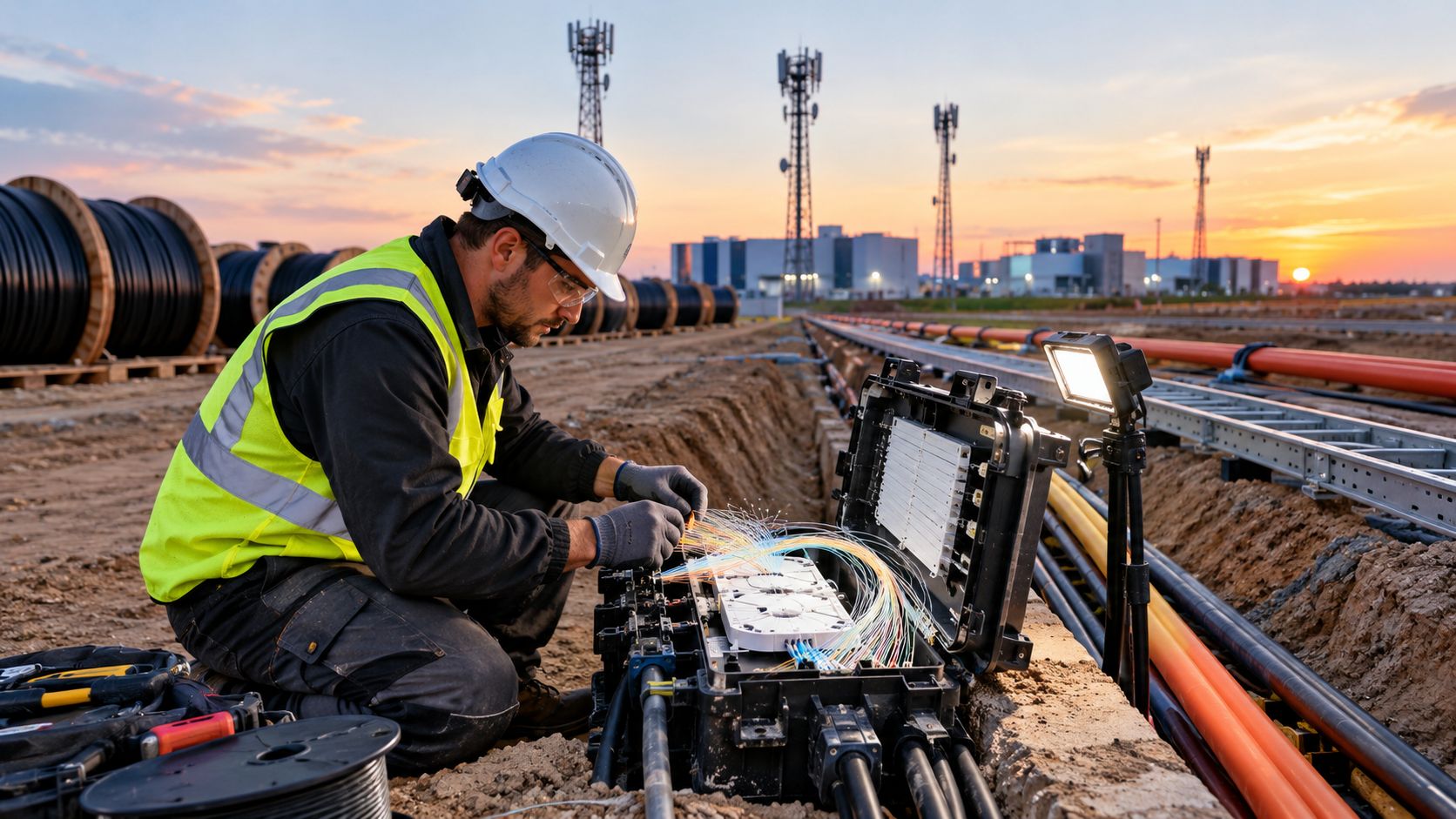
The defect usually appears at the worst possible time. A fiber route has already been trenched, reinstated, and handed to operations when intermittent loss begins appearing across several spans. Or a data center fit-out reaches commissioning, only for the team to discover that cable labels don't match the rack schedule, grounding verification is incomplete, or a clearance issue forces installed equipment to be moved. The work looked complete. The records were nearly complete. The infrastructure still wasn't ready.
That gap is where construction quality assurance earns its place. QA isn't a closeout folder assembled after installation. It's the system that defines acceptable work, assigns responsibility, checks critical activities before they become inaccessible, and carries verified information into operations. Quality control inspects the installed result. Quality assurance designs the process that makes the right result repeatable.
Why Construction Quality Assurance Matters for Telecom and Data Centers
A telecom or data center project has little tolerance for defects that remain hidden behind finished work. On a fiber build, the risk may begin with poor material handling, excessive pulling tension, contaminated connectors, badly prepared splice trays, or a route that doesn't match the approved design. On a data center fit-out, the same risk can involve power distribution, structured cabling, containment, grounding, cooling interfaces, or equipment clearances.
The problem isn't limited to a visible punch-list item. A splice with marginal performance can pass a superficial visual inspection and still create trouble during service activation. A mislabeled patch panel can leave the physical installation intact while making troubleshooting slow and error-prone. A missing as-built change can force technicians to investigate the field instead of relying on the handover package.
QA prevents late discovery
Construction quality assurance starts before crews mobilize. The project team translates specifications, drawings, client standards, method statements, and testing requirements into a practical operating system. That system should answer five basic questions:
- What must be built: Define the approved design, materials, tolerances, and performance requirements.
- Who verifies it: Assign responsibility to the installer, supervisor, quality manager, independent tester, and client representative.
- When verification occurs: Place inspections at hold points before work is covered or the next trade proceeds.
- What evidence is required: Specify test results, photographs, approvals, redlines, and corrective-action records.
- What happens after failure: Establish a clear path for nonconformance review, repair, retesting, and closure.
The business reason is direct. The Construction Industry Institute rework summary places direct field rework at an average of 5% of project costs, with a broader range of about 2% to 20% across studies. That cost affects more than the budget. Rework consumes crew capacity, disrupts sequence, delays energization or service activation, and creates uncertainty about which records can be trusted.
Practical rule: If the only time quality receives management attention is during punch list, the project is already paying for the defects that QA should have prevented.
A reliable QA program gives carriers, ISPs, data center operators, and owners confidence that the installed asset matches the design and can be maintained after turnover. It also gives field leaders a defensible answer when conditions change. Instead of relying on memory or informal messages, the team can show who approved the change, what was inspected, what was tested, and how the final configuration differs from the original plan.
Core Elements of a Construction Quality Assurance Program
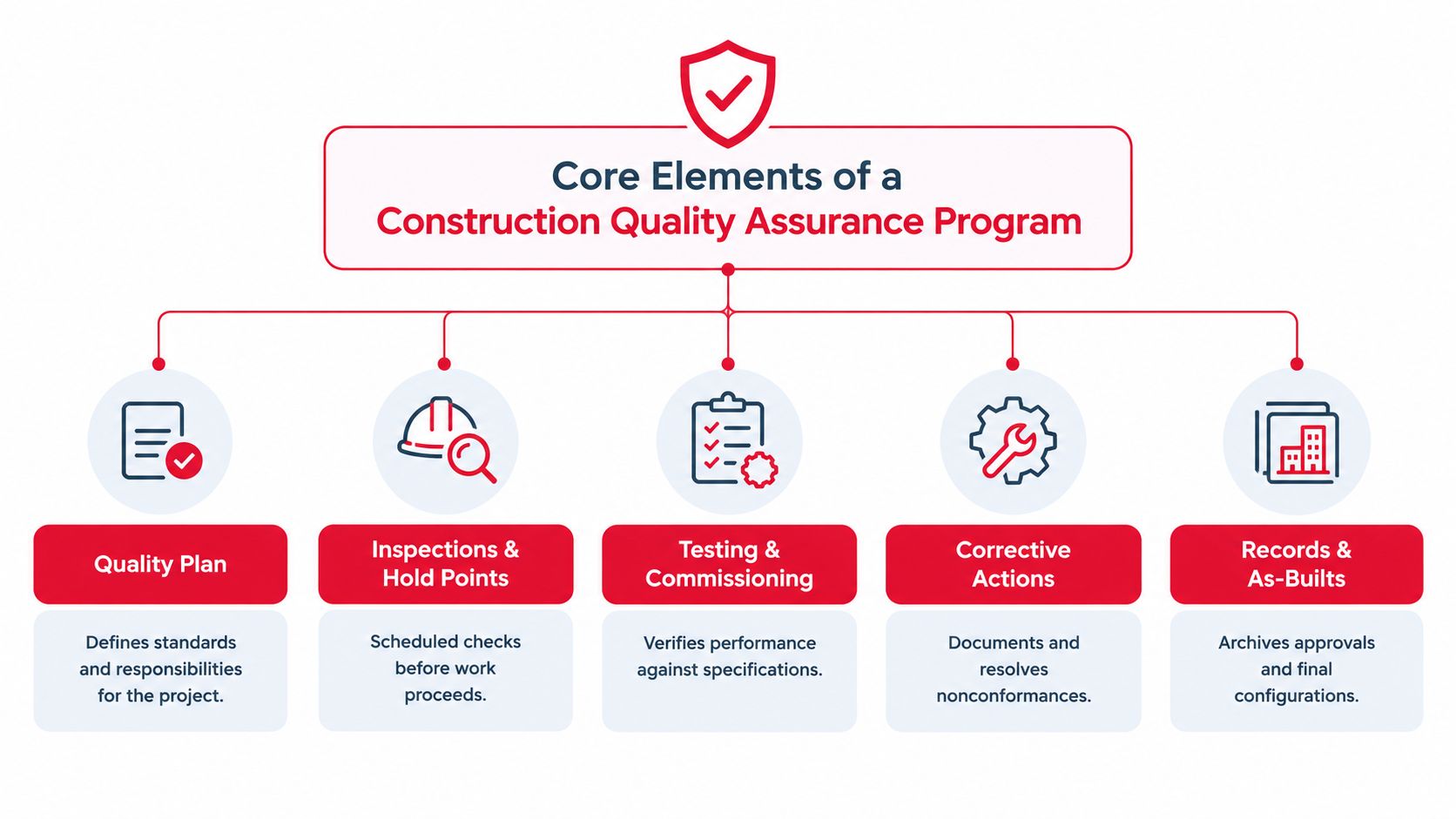
A useful QA program is not a binder. It's a connected set of decisions, checks, records, and feedback loops. If one element is missing, the others become less reliable. A detailed checklist can't compensate for an unapproved design, and a complete test report can't correct a process that allowed the wrong material into the work area.
Standards and acceptance criteria
Start by converting contract requirements into field language. The quality plan should identify governing codes, client standards, approved submittals, installation procedures, testing methods, and acceptance thresholds. The ISO 9000 family was introduced in 1987, while Singapore introduced CONQUAS in 1989 for public buildings and BQAS in 1991 for private-sector work, milestones documented in this construction quality assurance history. U.S. federal transportation QA procedures were also formalized under 23 CFR Part 637.
The specific framework matters less than whether the crew can use it. A fiber supervisor needs clear requirements for route preparation, bend control, splice protection, labeling, and test evidence. A data center foreman needs an agreed inspection sequence for containment, cable pathways, grounding, rack installation, patching, and system integration.
Processes and hold points
The inspection and testing plan should sit beside the schedule, not in a separate quality folder. A hold point prevents the next activity from proceeding until an authorized person verifies the current work. Examples include inspecting conduit before backfill, checking grounding before energization, recording cable pathways before ceiling closure, or approving a splice enclosure before the route is released.
The best process is often the simplest one that the field team will follow. If a checklist takes so long that supervisors complete it after the work is covered, it isn't controlling quality. Teams that want a practical overview of how structured controls can reduce rework on projects should focus on timing, ownership, and evidence rather than adding paperwork for its own sake.
Roles and records
The installer should check the work before requesting inspection. The field supervisor should coordinate access, sequence, and correction. The quality manager should audit the process and identify recurring failures. Independent testers should report results without allowing schedule pressure to soften acceptance criteria.
Records then connect those people to the work. A useful package includes approved drawings, material approvals, inspection forms, test results, photographs, nonconformance reports, corrective actions, and final as-built information. File names, location references, asset identifiers, and revision status need to be consistent enough that another team can find the evidence without calling the original supervisor.
Metrics that drive action
Avoid measuring only the number of completed checklists. Better indicators include recurring defect types, open corrective actions, failed first inspections, late test submissions, missing records, and deviations discovered after a trade has moved on. The point isn't to punish crews. It's to reveal where the process creates avoidable variation.
A strong program feeds those findings back into training, method statements, procurement checks, and design review. That feedback loop turns QC observations into QA improvement.
Inspection, Testing, and Commissioning Workflows
Quality becomes visible in the field through a sequence of controlled activities. The sequence matters because each stage depends on the evidence from the stage before it. Testing a finished fiber route can't replace a missed inspection of conduit placement, and commissioning a data center system can't resolve an undocumented change in the power or cabling layout.
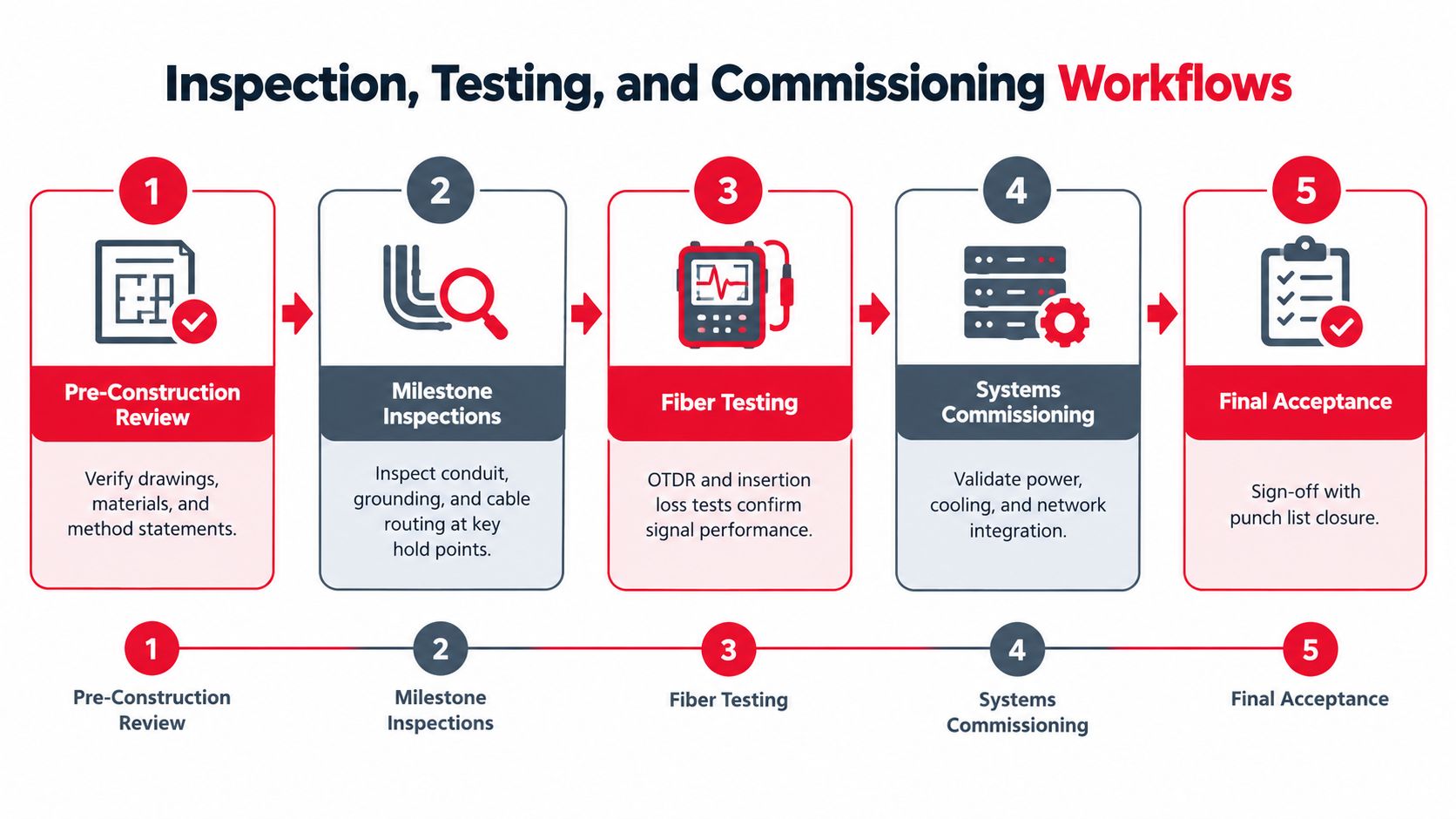
Start with a pre-construction review
Before work begins, bring the design, construction, testing, and operations representatives into the same review. Confirm that the drawings are current, materials match approved submittals, access constraints are understood, and the method statement reflects actual site conditions.
For a fiber route, review crossings, duct configuration, pull plans, splice locations, restoration requirements, and test points. For a data center fit-out, review rack elevations, pathway capacity, cable separation, grounding details, equipment interfaces, labeling conventions, and commissioning dependencies. Resolve ambiguity before crews are standing in front of it.
Inspect at workface milestones
Inspection should occur when the work is still accessible and correction remains contained. A practical sequence may include:
- Verify preparation: Check materials, tools, approved information, environmental conditions, and crew readiness.
- Inspect the first installation: Use the first completed section to confirm the method and establish the expected standard.
- Release hold points: Inspect conduit, grounding, supports, pathways, cable routing, splice closures, or other concealed work before the next activity.
- Record evidence immediately: Capture location-linked photographs, measurements, approvals, and open items while the crew and installation are present.
- Confirm correction: Reinspect failed work and close the record only after the corrective action is verified.
Field progress tools can support this sequence when they connect installed work, inspection status, photos, and schedule activities. Guidance on progress tracking for builders is useful here because quality records have more value when the team can see which work areas are ready, blocked, or awaiting verification.
Test the installed system, not just the components
Fiber testing should follow the approved test plan and identify the route, strand, tester, test settings, direction, and result. OTDR traces can help locate reflection events and abnormal loss, while insertion loss testing verifies end-to-end performance against the project requirement. Failed results need a controlled investigation, not a quick retest until the number changes.
In a data center, commissioning should build from component checks to subsystem validation and then integrated operation. Verify power paths, controls, cooling interfaces, network connectivity, alarms, and monitoring behavior in the sequence required by the commissioning plan. Invite the operations team early enough to challenge assumptions about access, labeling, maintainability, and alarm response.
Keep final acceptance objective
Final acceptance isn't a visual walk with a large spreadsheet. It requires an agreed list of completed inspections, passed tests, resolved nonconformances, approved deviations, and usable as-built records. A project is ready for handover when the owner can operate and maintain the asset with confidence, not just when the installation looks finished.
Common Failure Modes and How to Prevent Them
Most defects in telecom and data center work aren't mysterious. They follow predictable points of failure where design information, field execution, testing, and documentation stop connecting.
A fiber build may show excessive splice loss because the enclosure was prepared in poor conditions, the fiber was contaminated, the splice tray was crowded, or the wrong strand identification was used. The visible correction might be a new splice, but the process fix could involve better work-area controls, tool inspection, crew training, and a required first-splice verification.
A grounding issue has a similar pattern. The installer may have completed the connection, but the team didn't verify continuity before equipment was energized. In a data center, that missed checkpoint can affect safety, commissioning, and the acceptance record at the same time.
Defects that deserve targeted controls
- Poor cable routing: Crews install against an outdated pathway or fail to protect bend radius. Freeze the approved route, mark changes clearly, and inspect before closure.
- Mislabeled cables: The physical installation is complete, but labels don't match the rack, panel, or splice schedule. Require point-to-point verification by someone other than the person who created the label.
- Incomplete test records: A result exists without a location, strand, instrument, or revision reference. Make those fields mandatory before the test can be accepted.
- Clearance conflicts: Equipment or containment is installed without considering adjacent systems, access, or future maintenance. Use coordinated drawings and inspect interfaces before final fixing.
- Repeated nonconformances: Several crews make the same mistake because the method statement or training is unclear. Treat the pattern as a QA failure, not a series of isolated worker errors.
Fix the system, not only the symptom
A nonconformance report should identify the affected work, requirement, immediate correction, responsible party, verification method, and recurrence prevention. If the same defect returns, escalate the response. Review procurement, design release, briefing quality, supervision, and inspection timing.
Recent coverage of handover failures highlights a persistent weakness: hidden failure costs can consume the largest share of total quality cost, while prevention spending can be as low as 12% of total quality expenditure, as reported in this analysis of earlier QA intervention. More inspections won't solve a process that catches defects only after the work is inaccessible. The better response is to move verification closer to the point of installation and connect findings to the people who can change the process.
Digital Verification and Modern QA Approaches
Paper checklists still have a place. They're easy to understand, inexpensive to deploy, and useful when connectivity is limited. Their weakness is what happens afterward. A paper form can sit in a vehicle, lose its location context, or reach the office after the next trade has already covered the work.
Digital QA adds value when it improves a decision, not just when it replaces handwriting. BIM comparison can identify deviations before closeout. Reality capture can preserve evidence of concealed conditions. Mobile forms can attach photographs and test files to a specific asset or location. Sensors can provide useful environmental or equipment information when the project has a defined response process.
| Method | Traditional Approach | Digital Approach |
|---|---|---|
| Design verification | Supervisors compare printed drawings and field measurements manually. | Teams compare coordinated models, scans, and approved revisions to identify deviations. |
| Inspection records | Crews complete paper forms and submit them later. | Inspectors use mobile forms with required fields, timestamps, photographs, and location data. |
| As-built capture | Drafting teams update redlines after receiving marked-up documents. | Reality capture and connected records support earlier, location-linked updates. |
| Test management | Results arrive as separate files with manual naming and filing. | Test data is associated with strands, racks, circuits, systems, or work packages. |
| Issue resolution | Email threads and spreadsheets track open defects. | Corrective actions carry owners, due dates, evidence, status, and approval history. |
Choose technology around the risk
A small, repetitive build may not justify a complex model or sensor network. A multi-site fiber program can benefit from standardized mobile inspection forms and centralized records because distributed crews create consistency challenges. A high-complexity data center fit-out may justify BIM-based deviation checks and reality capture because congested interfaces are difficult to validate visually.
The trade-off is real. Digital tools require configuration, training, device management, data standards, and disciplined adoption. A badly configured platform can make a weak process harder to follow. Teams should pilot the workflow around a critical activity, such as pre-closure cable inspection or commissioning evidence, then expand after field users confirm that it saves time and improves traceability.
Industry discussion increasingly connects QA with BIM, digital twins, reality capture, and connected-data workflows. Client mandates such as ISO 19650 also push teams toward better information management, as reflected in construction technology trend analysis. The practical shift is from document control alone to data integrity, where the final record must remain connected to the installed asset throughout its lifecycle.
Integrating QA with Safety, Maintenance, and As-Built Documentation
A quality checkpoint often protects more than workmanship. Verifying grounding before energization supports both acceptance and worker safety. Confirming clear access around equipment protects maintainability. Recording the final route of a fiber cable helps future technicians avoid unnecessary excavation or service disruption.

The project team should review safety and quality controls together at the same workface. Before a crew enters a restricted area, confirm the permit and access requirements. Before equipment is energized, verify the required installation, inspection, test, and authorization records. Before a ceiling closes, confirm that concealed work has been photographed and released.
As-built information should be created during execution, not reconstructed at the end from memory. Capture route changes, rack positions, splice locations, cable identifiers, equipment serials, test references, and approved deviations while the people who performed the work are still available. Teams exploring documenting as built conditions with AI should still define the required fields and approval process first. Automation can accelerate capture, but it can't decide whether a design change is approved or whether an asset identifier is correct.
Maintenance teams need more than a polished drawing set. They need records that answer where the asset is, what connects to it, what was tested, which configuration was accepted, and what restrictions apply. A good handover package turns construction evidence into an operating resource.
The following video can help teams frame the relationship between project documentation and long-term facility management:
The strongest programs make the same data useful to safety, commissioning, operations, and maintenance. That reduces duplicate entry and gives every stakeholder a more consistent view of the asset.
Key Takeaways and Next Steps for Implementation
Construction quality assurance works when it changes what happens before, during, and after installation. It should prevent the wrong material from reaching the workface, stop defective work from being covered, produce reliable test evidence, and leave operations with records they can use.
Start with one active project and audit the process at the workface. Don't begin by reviewing the appearance of the final binder. Ask whether the team can answer these questions without delay:
- Design control: Is the crew working from the current approved information?
- Acceptance criteria: Can the supervisor explain what passes before installation begins?
- Hold points: Are concealed and high-risk activities inspected before the next trade proceeds?
- Testing: Does each result identify the asset, location, method, and acceptance decision?
- Accountability: Does every open issue have an owner and a verified closure?
- As-builts: Can operations find the final configuration without reconstructing it from emails?
- Feedback: Do recurring defects change training, procurement, design review, or work instructions?
Prioritize the gap that creates the most downstream exposure. On a fiber program, that might be strand identification and test traceability. In a data center, it might be interface coordination between power, cooling, containment, and structured cabling. Fix the workflow, brief the crews, verify the first installation, and then monitor whether the same issue returns.
Digital tools and evolving information standards will continue to influence QA, but the principle won't change. A connected platform can't replace ownership, and a scan can't replace an acceptance decision. The practical advantage comes from embedding verification into the delivery sequence so the project produces reliable infrastructure and reliable evidence at the same time.
Southern Tier Resources provides engineering, construction, testing, documentation, and maintenance for fiber, wireless, and data center infrastructure, supporting QA from design review through handover. Visit Southern Tier Resources to discuss a lifecycle delivery approach for your next network or facility project.