
A fiber build can have plenty of people, cable, and equipment on the payroll and still lose a day before lunch. The trenching crew reaches a corridor that isn't released, the bucket truck is assigned to make-ready work in another area, and the splicing team waits for a span that hasn't passed inspection. On a data-center fit-out, the same failure appears differently: connectivity crews are ready, but power, pathways, or another trade controls access to the room.
That is the field reality behind construction resource allocation. The work doesn't move because a spreadsheet says resources are available. It moves when the right crew, machine, material, permit, and prerequisite arrive at the same workfront at the same time.
Why Construction Resource Allocation Is Different on Telecom Builds
A fiber program can have crews working across several states while the next productive workfront is still unavailable. One team is trenching, another is handling utility make-ready work, a third is placing cable, and splicers are terminating an earlier section at a central office. Each activity has different readiness conditions, travel demands, skills, equipment, and access constraints.
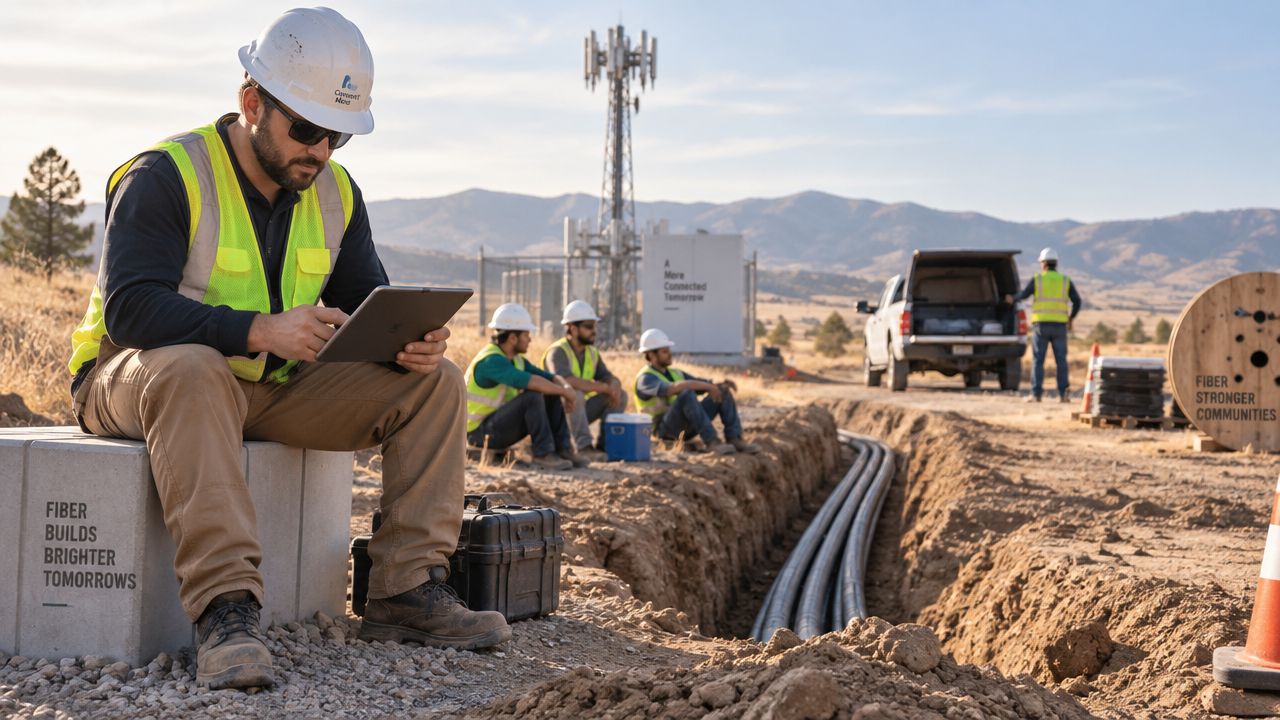
Headcount alone creates a misleading picture of progress. A make-ready crew may be fully staffed while the utility owner has not released the pole line. A fiber crew may have cable on site but no approved bore path. A wireless team may reach a cell site before structural, electrical, grounding, or access requirements are complete. The labor is present, but the workfront cannot produce a completed network asset.
The budget exposure is significant. Contractor budgeting research reports that only 31 percent of construction projects stay within 10 percent of their original budgets, the average cost overrun is 32.5 percent, and labor and materials together account for 60 percent to 75 percent of total construction costs (contractor budgeting research on labor and material costs). Poor allocation therefore affects both production and the largest cost categories.
Three telecom scopes, three allocation models
Fiber routes require mobile crews, traffic control, trenching or boring equipment, reels, conduit, vault hardware, restoration capacity, and testing resources. Permit status, utility conflicts, and geography can matter more than route length when managers decide where a crew should work next.
Wireless deployments combine access windows, lifting equipment, structural work, power, grounding, radios, antennas, and specialized subcontractors. A tower crew cannot recover time lost because electrical readiness or site access is incomplete.
Data-center infrastructure concentrates interdependent work in restricted rooms. Structured cabling, containment, power distribution, grounding, testing, and commissioning must share space without blocking another trade. Managers allocate by sequence, release conditions, and room access, not by utilization alone.
The same discipline applies across these scopes: assign people and equipment only after confirming the prerequisites that let them produce verified output.
Software can connect schedules, field records, cost information, and approvals. Teams comparing that category can review RapidStart construction software alongside the systems already used by project controls and field operations.
Practical rule: A crew is available only when the workfront, prerequisites, equipment, materials, and access conditions are ready.
Understanding the Three Cost Pillars in Telecom Construction
A fiber crew arrives at a permitted route with a bore rig, traffic control, and a full day planned. The reel has not reached the staging area, the utility conflict remains unresolved, and inspection coverage is unavailable. Labor is on site, yet production cannot start. That delay reflects a resource-allocation failure across labor, materials, equipment, subcontractors, and project controls.
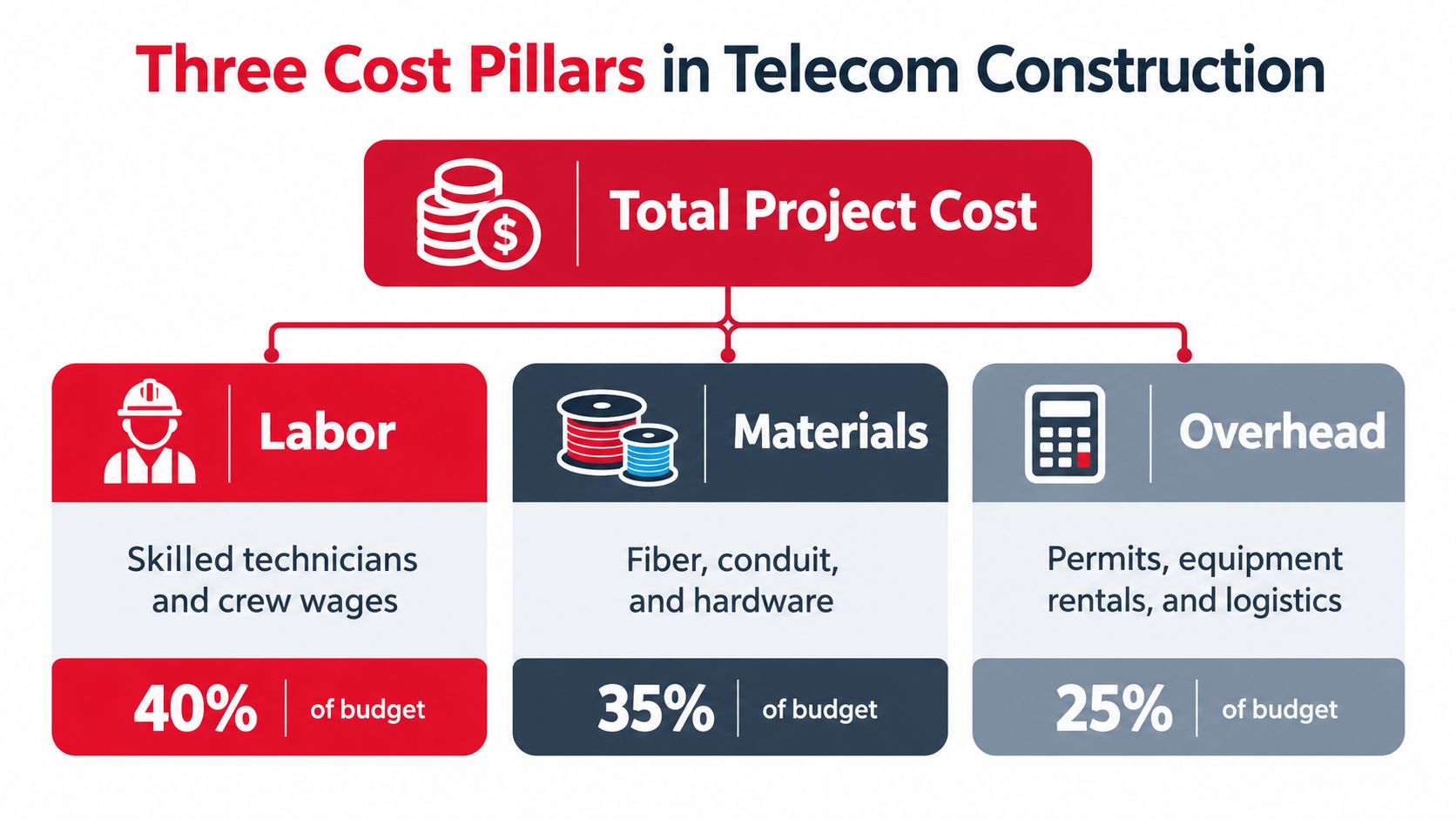
Industry analysis identifies labor, materials, subcontractors, and equipment as major construction spending categories. It also cites research indicating that about 40 percent of construction workers' time is non-productive because of waiting or idle time. The same reference defines productivity as output per labor hour while emphasizing the combined effectiveness of labor, equipment, and capital (construction productivity beyond labor). For a telecom manager, the practical question is how much scheduled crew time can become accepted network output.
Labor is a capability constraint
Fiber work requires different labor profiles at different stages. Directional drilling, aerial make-ready, cable placement, fusion splicing, testing, and restoration each depend on specific skills and field experience. Crews for wireless rigging, electrical installation, civil preparation, and data-center commissioning have the same limits.
Allocate labor by skill, location, readiness, and expected output. A general laborer cannot replace a certified splicing team, and a tower crew cannot make up for an electrical technician who is unavailable. Adding headcount to the wrong work package increases cost without removing the constraint.
Materials determine whether work can flow
Materials create a timing trade-off. Late delivery stops production. Early delivery can create extra handling, protection, and inventory exposure for cable, conduit, closures, cabinets, and rack hardware. On a distributed fiber program, tie every material group to a workfront, installation sequence, storage condition, and acceptance status.
Separate substitutable items from specified components. Restoration materials may have approved alternatives. A particular closure, connector, cabinet, or optical component may require the exact specified product, so its procurement status can control the sequence.
Equipment and subcontractors amplify capacity and risk
A trencher, bore rig, bucket truck, fusion splicer, test set, crane, or lift may serve several workfronts. The allocation plan must include transport, setup, inspection, fuel, operator capability, and the next confirmed location. A machine parked at an unreleased fiber route or cell site is a cost exposure, not usable capacity.
A smaller crew with steady material flow and a correctly staged machine can outperform a larger crew working around missing prerequisites. Equipment availability, subcontractor commitments, access windows, and inspection timing must therefore be planned together.
| Cost pillar | Fiber route implication | Wireless implication | Data-center implication |
|---|---|---|---|
| Labor | Match crews to civil, aerial, placement, splicing, restoration, and testing tasks | Protect specialized tower, electrical, and rigging capacity | Coordinate trade skills for cabling, power, testing, and commissioning |
| Materials | Sequence reels, conduit, closures, vaults, and restoration inputs | Stage radios, antennas, grounding, and hardware by access window | Control rack, pathway, cabling, power, and labeling dependencies |
| Equipment and subcontractors | Rotate boring, trenching, bucket, and test resources by corridor readiness | Align lifts, trucks, rigging, and site access | Reserve lifts, test equipment, and specialist subcontractors around room readiness |
Treat the three pillars as one operating system. Labor without materials produces waiting. Materials without access create storage and handling exposure. Equipment without a released workfront turns rental and subcontractor commitments into dead time. A sound allocation decision connects every resource to a ready task, a defined output, and the next field constraint.
Planning and Forecasting Resources Before Mobilization
A fiber crew arrives at a permitted corridor, but the traffic-control plan is incomplete and the reel has not reached the staging area. The crew is technically available, yet production stops before the first bore. Forecasting prevents that failure by tying mobilization to field-ready work, not to headcount sitting on the bench.
Break the telecom program into packages a supervisor can verify, then assign labor, equipment, materials, access, and acceptance requirements to each one. On a fiber route, separate permit release, traffic control, excavation or boring, conduit placement, cable placement, vault completion, restoration, splicing, testing, and as-built documentation. A cell-site build may require separate packages for civil preparation, foundation or structural work, equipment installation, power, grounding, transport, integration, and closeout. For a data-center fit-out, isolate pathways, containment, structured cabling, labeling, power coordination, testing, and commissioning.
Build the forecast from verified output
Use verified output per labor hour when reliable field history exists. Headcount provides capacity on paper, but the working forecast should state what a particular crew can complete under comparable conditions, equipment, access, terrain, permitting, and inspection requirements. A boring crew on an open rural route does not produce at the same rate as one working around utilities and restricted access, and a splicing team on an accepted route cannot be compared directly with one waiting on enclosure corrections.
BLS reports that U.S. construction labor productivity grew 2.0 percent in 2024, while broader research cited by the Federal Reserve found construction productivity declined by more than 30 percent from 1970 to 2020. The same BLS source shows different long-term patterns by segment, including 3.7 percent annual growth in multifamily construction and 0.0 percent in highways in one series, and reports subcontractors accounted for 44.2 percent of labor hours in single-family construction, 74.5 percent in multifamily, 43.2 percent in highways, and 84.9 percent in industrial construction (BLS construction labor productivity data). These figures are not telecom production rates. They reinforce the need to use work-specific history rather than apply a generic factor to fiber, make-ready utility work, wireless sites, or live data-center floors.
Account for subcontractor control
Subcontractors change who controls the production sequence. Before mobilization, name the owner for each handoff, inspection, record, and correction. A prime contractor may control the schedule while a civil subcontractor controls excavation, a utility contractor controls make-ready work, and a testing specialist controls acceptance. If those boundaries remain unclear, crews can complete physical work that cannot be closed or billed.
Confirm the following:
- Workfront readiness: Verify permits, access, utility coordination, drawings, safety controls, and predecessor acceptance.
- Crew capability: Match each package to the actual skill mix, certifications, and supervisory coverage.
- Equipment demand: Reserve machines by location and sequence, including transport and setup time.
- Material release: Tie deliveries to approved quantities, storage conditions, and installation dates.
- Subcontractor interfaces: Assign responsibility for every handoff, inspection, record, and correction.
- Acceptance path: Define the tests, documentation, and customer approval required before completion.
A field office or mobile work trailer can hold permit records, drawings, daily coordination materials, and communication tools when crews are spread across a corridor. The ANTS Trailers work trailer guide offers a practical reference for matching trailer configuration to project operations.
Field test: If the supervisor cannot state what the crew will install, what could stop it, where the equipment goes next, and how the work will be accepted, the forecast is not ready for mobilization.
Scheduling Parallel Workfronts and Leveling Resources
A telecom schedule should show movement across workfronts, not just a list of activities. On a fiber program, trenching in Corridor A may overlap with make-ready work in Corridor B, while the central office prepares for termination and testing waits for accepted spans. That overlap creates opportunity, but only if dependencies and shared resources remain visible.
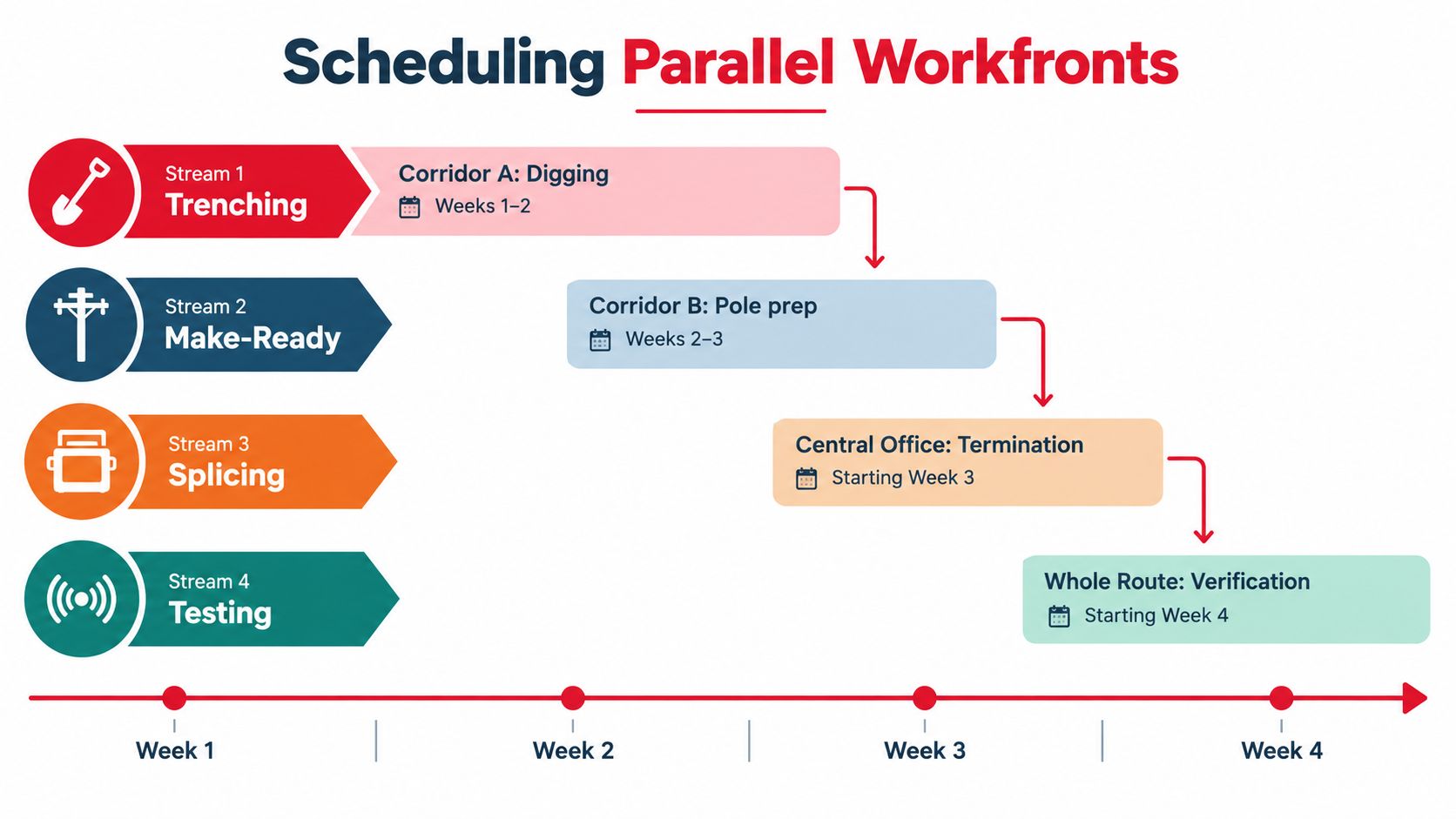
The first scheduling mistake is to spread a scarce resource across too many fronts because each project manager wants progress. A fusion splicing team assigned to multiple routes may appear busy, but constant travel and incomplete handoffs can reduce completed output. The same problem occurs when a bucket truck is moved between make-ready locations without a confirmed release sequence.
Use a short lookahead with explicit constraints
A useful lookahead is built around what can realistically start, not what the master schedule says should start. For every upcoming package, show:
- Ready work: The permit, access, design, material, and predecessor conditions are confirmed.
- Blocked work: The package has a named constraint, owner, and expected release.
- Shared resources: Crews, test sets, lifts, trucks, and specialist subcontractors are assigned visibly.
- Next handoff: The receiving crew and acceptance requirement are identified.
Level resources around the constraint that governs network completion. If make-ready work controls the next aerial placement sequence, protect that crew and its bucket truck. If testing controls customer acceptance, don't let test equipment remain assigned to low-priority troubleshooting while completed spans wait.
Measure commitments, not activity theater
Percent Plan Complete, or PPC, is calculated as work performed divided by work committed on the weekly work plan. Paired with a Capacity-to-Load Ratio, it helps identify whether a crew is under-committed or over-committed before delays spread (construction capacity planning metrics study).
PPC works only when commitments are specific and prerequisites are checked. A team can report acceptable aggregate completion while individual packages miss access, inspection, or material conditions. Review misses by cause, such as permit, design, material, equipment, labor, or predecessor, then change the next plan rather than asking crews to work faster.
A route-level dashboard should show planned and completed work by corridor, crew, equipment class, and acceptance status. That view makes it easier to move resources without sacrificing the handoffs that protect quality.
Building Contingencies Without Padding Every Estimate
A fiber route can be fully trenched and still miss its next milestone because a permit, splice crew, or acceptance test is unavailable. A useful contingency plan answers two operational questions: which failure could stop the highest-value sequence, and what response can start when it occurs? Distributing extra labor, equipment, and materials across every activity raises cost without showing who owns the risk.
A reactive plan waits for a utility relocation delay, damaged reel, absent splicing technician, or power issue. The recovery bill may then include emergency mobilization, overtime, expedited logistics, or crews sitting idle. A proactive plan identifies those dependencies before award, assigns an owner, and reserves a specific response for the workfront most exposed to disruption.
Protect the dependency chain
Telecom schedules depend on conditions field managers cannot control. Permit release affects make-ready and civil work. Power availability affects wireless activation and data-center infrastructure. Room turnover affects structured cabling and commissioning. Customer acceptance affects closeout and billing.
Map every dependency to the resource it could strand. A delayed permit may leave a bucket truck, aerial crew, and traffic-control team without productive work. A power delay may leave electrical specialists and connectivity installers waiting in a data-center room. A missing closure can stop splicing even when the route is physically ready.
A contingency belongs beside a constraint, not evenly across every line of the estimate.
Compare broad padding with targeted reserves
| Approach | What it does well | Where it breaks |
|---|---|---|
| Broad estimate padding | Creates a simple allowance for uncertainty | Hides the actual risk and can make the bid uncompetitive |
| Reactive recovery | Avoids reserving unused capacity | Often creates rushed logistics, overtime, and poor sequencing |
| Targeted resource reserve | Protects critical workfronts and known dependencies | Requires disciplined risk ownership and regular review |
| Flexible work packaging | Allows crews to move to ready work | Fails if alternate work lacks materials, permits, or supervision |
The targeted model requires clear trigger conditions. Release a reserve splicing team only when accepted spans reach the defined readiness point. Hold a second lift or bucket truck near a cluster of sites when access windows are limited. Schedule a data-center specialty subcontractor around power and pathway turnover, not a calendar date alone.
Scale the response to project complexity
One industry analysis reports that mega projects over $1 billion rose 47 percent in 2025 and represented one in five nonresidential construction starts. It also identifies BIM, analytics, and collaborative tools as increasingly important for managing timelines, resources, and safety (construction industry takeaways for 2026).
For large telecom and data-center programs, contingency planning should include interface control. Use the model or coordination record to locate congested areas, preserve access for critical trades, and maintain an alternate sequence that can start without disrupting the primary path. The aim is not spare capacity on every crew. It is a ready response to the constraints most likely to strand expensive specialists.
Measuring Allocation Performance and Choosing the Right Tools
A resource plan becomes useful only when field data changes the next allocation decision. Daily reports, time records, production quantities, equipment movement, material receipts, test results, and constraint reasons should connect to the same work package. Otherwise, the office sees labor cost, the superintendent sees progress, and the scheduler sees dates, but nobody sees the operating cause.
Start with three measures. Output per labor hour shows whether a crew is converting time into installed or accepted work. PPC shows whether the team completed what it committed to that week. Capacity-to-Load Ratio shows whether available crew or equipment capacity is being assigned beyond a practical level.
Read the measures together
A single metric can mislead:
- High output with low PPC: The crew may be productive on small tasks while larger commitments remain blocked.
- Low output with high PPC: The plan may be too conservative or may count easy activities while deferring difficult work.
- Low capacity relative to load: Re-sequence work, add qualified capacity, or reduce commitments before the crew starts absorbing delay.
- Good aggregate performance with repeated package misses: The schedule is hiding variability and unresolved prerequisites.
Review these measures at different cadences. Supervisors need same-day visibility into readiness, equipment, safety, and production. Project managers need a weekly view of commitments, completions, causes of variance, and upcoming constraints. Program leaders need cross-project visibility into scarce crews, test equipment, specialized subcontractors, and material exposure.
Close the planning loop
A workable tool workflow follows the flow of the job:
- Scope data becomes work packages. Route segments, poles, sites, rooms, racks, and test groups receive clear identifiers.
- Work packages become resource demand. The plan records crew type, equipment, material, access, predecessor, and acceptance requirements.
- The schedule becomes field commitments. Supervisors commit only work that has a realistic path to start and finish.
- Field records become verified progress. Crews report installed quantities, blocked reasons, equipment status, inspections, and test outcomes.
- The next plan uses the evidence. Managers adjust production assumptions, move resources, and escalate constraints based on actual causes.
BIM and collaborative coordination platforms can be useful on data-center fit-outs and dense wireless infrastructure, particularly where multiple trades share space. Field scheduling and reporting systems are more valuable when they capture the facts supervisors need without forcing them to duplicate entries across disconnected tools.
Choose tools for decisions, not dashboards
A tool should answer operational questions quickly. Where is the next ready fiber workfront? Which bucket truck is committed twice? Which splice crew is waiting for acceptance? Which material delivery threatens tomorrow's plan? Which subcontractor controls the blocked predecessor?
Estimating technology can support the front end when it preserves assumptions and ties quantities to labor, equipment, and sequence. A practical overview of AI estimating tools for contractors can help teams compare capabilities, but estimates still need review by people who understand route conditions, make-ready exposure, access limits, and customer standards.
For distributed telecom programs, keep project controls, field coordination, and closeout records connected. Southern Tier Resources operates across engineering, fiber construction, make-ready work, splicing, testing, wireless deployment, data-center infrastructure, documentation, and maintenance, so its delivery model reflects the same resource handoffs that managers need to measure.
The strongest system is not the one with the most screens. It's the one that makes a blocked workfront visible early, assigns an owner to the constraint, shows the next available resource, and records whether the corrective action produced accepted work. That is how construction resource allocation shifts from schedule maintenance to operational control.
Southern Tier Resources provides engineering, construction, testing, documentation, and maintenance for fiber, wireless, and data-center infrastructure, with crews and workflows aligned to complex telecom workfronts. Visit Southern Tier Resources to discuss a resource-conscious delivery plan for your next network build, fit-out, or maintenance program.