You’re probably dealing with one of two situations right now. Either a network expansion is moving from boardroom ambition into real capital deployment, or an existing build is slipping because design, permitting, make-ready, construction, and closeout are being managed by too many separate parties. In both cases, the same question surfaces fast: who owns the whole outcome?
That’s where design line construction matters in telecom. Not as a buzzword, and not as a generic construction label, but as a disciplined way to plan, engineer, build, document, and maintain network infrastructure under one accountable operating model. For carriers, ISPs, wireless operators, municipalities, and data center stakeholders, this isn’t a branding exercise. It’s the difference between a build that moves in sequence and one that stalls at every handoff.
The confusion starts early. Search for the term and you’ll run into content centered on a San Francisco residential builder, not telecom deployment. That noise leaves executives without a practical guide for applying design line construction to fiber, wireless, utility coordination, data center connectivity, and restoration work. The telecom version is different. It has different risks, different compliance demands, and a much narrower tolerance for failure.
The Design Line Construction Dilemma in Telecom
A new C-level stakeholder often sees the project at a high altitude. There’s a market to enter, a service gap to close, a customer commitment to meet, or a capacity constraint to remove. The network team sees something else entirely. They see route feasibility, pole ownership, underground conflicts, permit dependencies, cutover windows, test plans, restoration obligations, and the ugly cost of rework when any of those elements get disconnected.
That disconnect is why the phrase design line construction deserves a telecom-specific definition.

Search results don't match telecom reality
Today’s search results doesn’t help. Existing content on “design line construction” overwhelmingly focuses on a single San Francisco residential construction company, leaving a major gap in how the concept applies to wireline and wireless deployment. The same source also notes that AI-driven design-line optimization reduced fiber deployment costs by 22% in major U.S. markets in the last 12 months, yet the available content still doesn’t address implementation challenges for municipalities expanding broadband, according to Design Line Builds references cited in the verified dataset.
That mismatch matters because telecom leaders don’t need advice on luxury home construction. They need a framework for building infrastructure that supports service activation, uptime, capacity growth, and compliance.
The wrong interpretation of the term leads to the wrong vendor short list, the wrong expectations, and the wrong delivery model.
Why siloed execution breaks down
A fiber overbuild, small-cell densification effort, or data center connectivity project can look manageable on a spreadsheet. In the field, it rarely is. One group completes route engineering. Another handles utility coordination. A permit specialist manages local approvals. Separate crews perform make-ready, line work, splicing, and testing. Documentation comes last, if it comes cleanly at all.
That structure creates predictable friction:
- Scope drift: Design assumptions change after field conditions surface.
- Schedule drag: One vendor finishes, another isn’t mobilized.
- Budget uncertainty: Responsibility gets debated after costs appear.
- Weak closeout: As-builts, test records, and punch items arrive late or incomplete.
What telecom leaders actually need
Telecom design line construction should mean one integrated delivery path from concept through maintenance. The business reason is simple. Networks aren’t finished when crews leave the site. They’re finished when the infrastructure is safe, documented, tested, accepted, and supportable in live operations.
If you’re making portfolio-level decisions, that’s the frame to use. Don’t ask whether a contractor can build. Ask whether the operating model connects engineering decisions to field execution and ties field execution to operational handoff.
Defining Turnkey Design Line Construction for Networks
In telecom, turnkey design line construction is a single-source delivery model that unifies planning, engineering, permitting, make-ready, build, testing, documentation, and ongoing support under one accountable partner. That’s the practical definition. Everything else is detail.
A useful analogy is commercial tower development. You can hire an architect, then a structural engineer, then a site contractor, then a steel team, then a commissioning firm, and hope information survives every handoff. Or you can choose an integrated model where one lead organization manages the sequence and owns the coordination. Telecom builds behave the same way.
What the integrated model changes
Under a fragmented model, every participant optimizes their own scope. Under a turnkey model, the lead partner optimizes the project.
That changes how decisions get made:
- Route choices get evaluated against permitting difficulty, not just engineering preference.
- Pole loading concerns get surfaced before construction crews are dispatched.
- Material strategy gets tied to schedule risk instead of handled as a late procurement task.
- Testing and documentation are planned at the front end, not treated as closeout cleanup.
This is why the integrated approach keeps expanding in complex construction. The U.S. design-build market, which mirrors this operating model, is projected to grow at a 5.2% CAGR from 2022 to 2026, reaching over $405 billion and representing up to 47% of total construction spending in key sectors, according to the DBIA mid-cycle survey report.
What design line construction includes in telecom
For network infrastructure, the model usually covers a chain of responsibilities that should never be treated as separate silos:
Feasibility and field validation
Route assumptions need field truth early. Desktop design alone won’t protect schedule.Engineering and constructability review
Drawings have to survive utility review, municipal scrutiny, and real-world installation conditions.Permitting and right-of-way coordination
At this stage, many projects slow down because legal access and physical feasibility get handled out of sequence.Make-ready and civil preparation
Pole replacements, transfers, boring paths, vault placement, and restoration planning all sit here.Installation, splicing, testing, and records
The network isn’t deployment-ready until the technical handoff is clean.
Practical rule: If one company designs the route, another secures approvals, a third performs make-ready, and a fourth closes documentation, no one owns the full risk chain.
What doesn't work
What doesn’t work is treating telecom construction like a set of isolated work orders. That approach looks cheaper at procurement time because each scope appears narrower. Then the change orders arrive. The schedule starts slipping between dependencies. Leadership gets status updates, but not clarity.
A strong design line construction model doesn’t eliminate complexity. It puts complexity under one management structure with one escalation path. That’s what a C-level stakeholder should want. Not more vendors. Better control.
The 8 Phases of a Network Infrastructure Build
Telecom leaders don’t need every field detail, but they do need a clear operating map. Network deployment follows a sequence. If a team skips steps, collapses them too early, or treats them as independent workstreams, cost and schedule reliability usually suffer.

The phase map executives should track
| Phase | Primary Objective | Key Deliverables |
|---|---|---|
| Planning and feasibility | Confirm the business case can be translated into a buildable route or site plan | Feasibility findings, preliminary scope, high-level risks |
| Site acquisition | Secure access rights and viable locations | Rights-of-way, access agreements, site approvals |
| Design and engineering | Convert concept into buildable plans | Construction drawings, route plans, technical specifications |
| Permitting and approvals | Obtain regulatory and local authorization to proceed | Permit packages, agency responses, approval records |
| Material procurement | Align equipment and materials with build sequence | Procurement list, delivery plan, inventory coordination |
| Construction and installation | Execute field build safely and according to design | Installed plant, make-ready completion, field progress records |
| Testing and commissioning | Verify performance and readiness for service | Test results, punch list resolution, commissioning status |
| Handover and documentation | Transfer a supportable asset into operations | As-builts, closeout package, maintenance baseline |
Phase 1 planning and feasibility
Strategy and geography intersect. Teams validate service goals against route reality, site constraints, utility conditions, and local access issues. A project that looks elegant in a planning deck may be impossible to construct economically without a different alignment or method.
Strong teams also use this phase to identify whether aerial, underground, or mixed construction is the better fit. They review congestion, surface restoration exposure, utility conflict density, and likely approval friction. The point isn’t to finalize every detail. It’s to avoid launching an engineering effort around assumptions that won’t survive the field.
Phase 2 site acquisition
For wireless and facility projects, this means securing a location. For fiber, it often means obtaining rights-of-way, easements, utility access, and crossing permissions. This phase is less visible to non-operators, but it can decide the entire timeline.
A route isn’t real until the access path is real. If acquisition trails engineering by too much, the design team keeps drawing against moving boundaries. If acquisition starts too late, crews can’t mobilize even when materials and permits are in place.
Phase 3 design and engineering
At this stage, a concept becomes a construction package. Route sheets, attachment detail, boring profiles, vault placement, splice strategy, slack planning, and restoration assumptions all need to be nailed down well enough for field execution.
Good engineering teams design for constructability, not presentation. They ask hard questions early. Can the crew physically install this in the expected window? Will utility owners accept the proposed arrangement? Is maintenance access preserved after cutover?
Design quality is measured in the field, not in the review meeting.
For projects involving utility attachment, practical coordination often starts with specialized field and pole workflows such as utility pole design and engineering support, because attachment viability, loading, and make-ready obligations can reshape the route before construction starts.
Phase 4 permitting and approvals
Permitting is where many executive schedules become fiction. Municipal review cycles, agency comments, environmental constraints, traffic control requirements, and utility owner conditions rarely move at the same speed.
The mistake is treating permits as paperwork. They’re construction constraints expressed in legal form. A strong permitting function translates field conditions into complete, review-ready submissions and tracks revisions before they become field stoppages.
Phase 5 material procurement
Procurement should follow design intent and schedule logic, not just lowest unit cost. Fiber, handholes, conduit, hardware, cabinets, anchors, and restoration materials all have different lead-time and substitution risks. If the bill of materials and field sequence aren’t aligned, crews lose time waiting or improvising.
This phase also affects quality. When procurement teams swap products without full engineering review, closeout problems show up later in testing, maintenance, or owner acceptance.
Phase 6 construction and installation
This is the visible phase, but it shouldn’t be the only one leadership pays attention to. Construction success depends heavily on what happened before mobilization. Aerial line work, underground trenching, directional boring, cabinet placement, pole transfers, and structure installation all depend on clean prerequisites.
Field leadership matters here. So does daily communication. The most effective construction teams don’t just report footage installed or sites completed. They report constraints removed, pending blockers, restoration status, and what has to happen next to protect the sequence.
Phase 7 testing and commissioning
Many organizations underestimate this phase because physical installation feels like the finish line. It isn’t. Testing validates whether the network can be accepted into service with confidence.
For fiber, that means clean splice records, continuity confirmation, and organized test output that operations can use. For wireless and facility work, it means confirming installed systems meet the intended operating condition before handoff. Testing should resolve uncertainty, not generate a stack of loosely organized files no one trusts.
Phase 8 handover and documentation
The project isn’t complete until the asset is supportable. That means accurate as-builts, closeout records, test documentation, material reconciliation where required, and a clean punch process. This is also where future maintenance costs are implicitly determined.
Poor handover creates long-tail operational pain. Trouble tickets take longer. Outage response gets slower. Network changes become riskier because field records don’t match the asset in place.
A disciplined design line construction model treats documentation as part of production, not administration. That’s one of the clearest differences between a build that merely gets installed and one that’s ready to operate.
Navigating Compliance Quality and Safety Standards
In telecom construction, speed only matters if the asset is compliant, supportable, and safe. A project can appear to move quickly and still carry hidden defects that surface during inspection, utility review, storm events, or routine maintenance. That’s why compliance and quality control can’t sit off to the side as a support function. They have to be built into the delivery model.
Clearance rules aren't optional
One of the clearest examples comes from transmission-related standards that often affect adjacent telecom work, especially on shared corridors and utility structures. A minimum design margin of 2 feet is mandated for conductor-to-ground and conductor-to-object clearances to ensure NESC compliance, accounting for sagging, terrain, and installation tolerances. Without that buffer, 15% to 25% of lines in medium or heavy NESC loading districts fail post-installation inspections, according to the SPP minimum design standard.
That matters to telecom executives for a simple reason. Shared-space infrastructure doesn’t forgive loose assumptions. If make-ready engineering ignores clearance reality, later work gets delayed, redesigned, or rejected. If field teams build to the drawing without validating field conditions, the organization inherits compliance exposure it didn’t budget for.
Quality has to be designed in
A compliant build starts long before a crew sets a pole or places conduit. It starts with engineering assumptions that account for actual loading, actual terrain, actual utility owner standards, and actual access conditions. It continues with permit packages that reflect that design accurately. It then reaches the field through staking, construction notes, inspection workflows, and disciplined closeout.
The weak version of quality control is catch-and-correct. The stronger version is prevent-and-verify.
That’s why permitting discipline also belongs in the quality conversation. Teams that understand local review expectations, utility requirements, and access sequencing typically avoid the churn that comes from incomplete submittals and late-stage redesign. For organizations managing broad deployment footprints, this kind of telecom permitting support often becomes one of the biggest schedule stabilizers in the entire program.
Safety protects more than the crew
Safety is often described as a moral obligation, and it is. It’s also an operational and brand issue. Unsafe sites create injury risk, public exposure, stop-work consequences, and reputational damage. In network deployment, they also create service risk because rushed or improvised work tends to produce later failures.
The discipline shows up in ordinary actions. Traffic control is properly staged. Utility locates are respected. Crew briefings reflect current field conditions, not generic paperwork. Access points are secured. Restoration is planned, not deferred. Documentation is collected while facts are fresh.
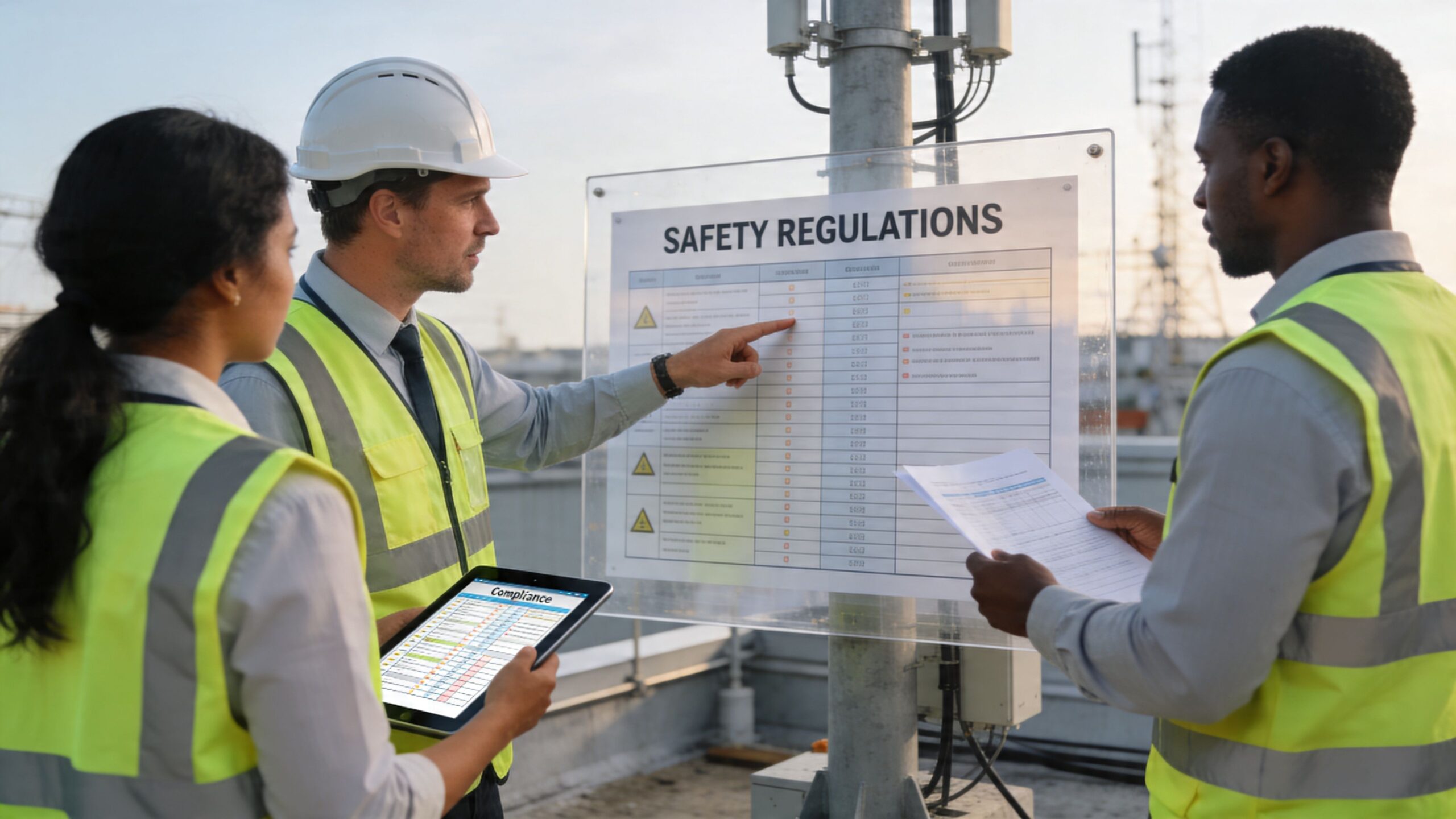
A useful visual example of why field discipline matters appears below.
Field reality: Most compliance failures don’t come from not knowing the rule. They come from letting schedule pressure overrule the rule.
What executives should ask for
Senior stakeholders don’t need to audit every code requirement themselves. They do need evidence that the delivery organization is managing compliance as part of execution. The right questions are practical:
- How are field conditions reconciled against design assumptions?
- Who owns utility and municipal standard alignment before construction starts?
- How are inspection deficiencies closed and documented?
- What records will operations receive at handoff?
- How does the safety program govern mobilization, restoration, and emergency response?
When those answers are vague, the project is carrying hidden risk. In design line construction, compliance, quality, and safety aren’t side tasks. They are the operating discipline that keeps the build usable after the ribbon cutting.
Identifying Key Drivers of Project Cost and Timelines
Executives usually ask for one number and one date. That’s understandable, but telecom deployment doesn’t behave that cleanly. Cost and schedule are outputs of several variables interacting at once. The organizations that control those variables early produce more reliable budgets and fewer unpleasant revisions.
The variables that move budgets fastest
The first driver is route and geography. Dense urban construction, utility congestion, traffic management, restoration demands, and narrow work windows create a different cost structure than rural aerial deployment. The second is construction method. Aerial attachment, trenching, directional boring, and facility work each carry different labor sequences, equipment needs, risk profiles, and inspection points.
The third is make-ready complexity. Here, many early estimates break. If the route requires pole replacement, heavy transfer work, structure reinforcement, or layout changes, both cost and duration can move quickly. A project that looked straightforward during concept review can become materially different after utility analysis and field validation.
Why build standard matters financially
The temptation in cost planning is to focus on unit price. The more useful question is total lifecycle expense under real field conditions. Using Grade B Construction, which has 25% to 50% higher strength capacities than Grade C, reduces outage rates by 30% in major markets and helps avoid rework costs that can reach 5% to 10% of total project budget, according to the technical reference on transmission line design and construction standards.
That’s a strong reminder that cheap scope decisions can become expensive operating decisions. Structural adequacy, code compliance, and make-ready accuracy should be treated as financial controls, not engineering luxuries.
Why early coordination changes the schedule curve
Integrated planning has the biggest effect on schedule where dependencies are easy to underestimate:
- Permitting velocity: Review cycles, revisions, and local constraints can outrun field productivity.
- Material availability: Long-lead components and substitutions can break sequence.
- Crew timing: Construction windows matter less if prerequisites aren’t cleared.
- Documentation discipline: Delayed records often delay billing, acceptance, and service turn-up.
Organizations trying to improve predictability often benefit from studying how structured estimating and procurement processes support better field execution. Practical resources on bidding programs for construction are useful here because they show how upstream bid discipline can tighten downstream schedule and cost control.
For active deployment portfolios, a realistic timeline framework also needs milestone visibility across engineering, approvals, construction, and closeout. That’s why teams often formalize telecom project scheduling and sequencing before volume ramps up. It gives leadership a better way to see which delays are ordinary and which ones threaten the business case.
The schedule that matters isn’t the one on the kickoff slide. It’s the one that reflects field dependency, access reality, and approval timing.
How to Select the Right Turnkey Construction Partner
The delivery model is only as good as the partner running it. If the selected firm can’t connect engineering, field operations, compliance, and closeout, the promise of design line construction collapses into the same fragmented behavior under a different label.
That’s why vendor evaluation should be treated as a strategic decision, not just a procurement event.

Start by filtering out category confusion
A leading search result for “design line construction” is a residential builder in San Francisco with an estimated annual revenue of $6.2 million, which is a useful reminder that name recognition is not capability alignment. Partner vetting has to confirm that the firm’s experience matches the multi-million-dollar scale and technical specificity of telecom infrastructure, not high-end home construction, according to company profile information in the verified dataset.
That sounds obvious, but it’s a real risk in executive research. Similar terminology can hide completely different operating models.
The shortlist criteria that matter
A serious telecom construction partner should be able to demonstrate strength in five areas.
- End-to-end telecom execution: They should manage planning, engineering, permitting, make-ready, construction, testing, and documentation as one continuous workflow.
- Field-proven safety discipline: Ask how safety governs daily operations, restoration, public protection, and emergency mobilization.
- Documentation maturity: As-builts, test records, and closeout packages should be accurate enough for operations teams to use without reinterpretation.
- Escalation clarity: You need to know who owns blockers, who resolves utility issues, and who communicates changes before they become claims.
- Operational flexibility: Network projects rarely run only in standard business hours. The partner should be prepared for restoration work, constrained access windows, and phased cutovers.
Ask for evidence, not just assurances
Executive diligence yields significant returns. Don’t settle for broad statements like “we handle turnkey projects.” Ask how the organization reconciles field survey changes into engineered drawings. Ask who owns permit revisions. Ask how testing records map into final as-builts. Ask how they handle a route that is technically buildable but commercially weak because of access friction or delayed make-ready.
A helpful comparison point comes from adjacent power and facility environments. Guides on evaluating commercial industrial electrical contractors are useful because they frame contractor selection around technical depth, safety discipline, and delivery accountability rather than low-bid optics. Telecom executives should apply the same standard.
The right partner doesn’t just answer scope questions. They expose risk early, translate it into decisions, and own the consequences of execution.
What a strong partner relationship looks like
When the fit is right, communication gets simpler. Leadership sees one accountable operating picture instead of a patchwork of vendor updates. Engineering changes move into field execution faster. Permitting issues surface earlier. Closeout quality improves because the same organization has lived with the project from start to finish.
That’s what telecom leaders should buy when they buy design line construction. Not labor alone. Not drawings alone. A managed outcome.
Building the Future of Connectivity Together
Design line construction in telecom isn’t a narrow construction term. It’s a business operating model for deploying critical infrastructure with stronger control over risk, sequence, quality, and handoff. When planning, engineering, permitting, make-ready, installation, testing, and documentation are managed as one delivery chain, leaders get a clearer view of cost, schedule, and accountability.
That matters because network infrastructure doesn’t create value when it is merely installed. It creates value when it can be activated, maintained, scaled, and trusted. A siloed model makes each handoff somebody else’s problem. An integrated model keeps the full lifecycle in view from the first route decision to the final as-built package.
For C-level stakeholders, that shift is practical. It improves governance. It sharpens forecasting. It reduces the noise that comes from managing too many disconnected vendors. It also aligns construction activity with the business outcome, which is reliable connectivity delivered on a timeline the market can use.
The search noise around “design line construction” has made this topic harder to understand than it should be. In telecom, the meaning is now clear. It is the disciplined, turnkey execution of network infrastructure by a partner that can own the full chain of delivery.
Reliable networks won’t be built by fragmented effort. They’ll be built by organizations that design with construction in mind, construct with operations in mind, and hand over assets that the business can trust on day one.
If you’re evaluating how to structure a fiber, wireless, or data center infrastructure program, Southern Tier Resources offers the kind of end-to-end telecom delivery model this article describes, spanning engineering, permitting, construction, splicing, testing, documentation, maintenance, and emergency response. For teams that want one accountable partner across the project lifecycle, it’s a practical place to start the conversation.