You're reviewing a proposal to put compute at an aggregation site. The application team wants faster responses, the network team wants less backhaul traffic, and procurement wants a hardware list. Nobody has yet confirmed who replaces a failed fan, how long the batteries support the load, or whether the backup fiber shares the primary route's duct.
That's where edge computing infrastructure becomes an engineering problem rather than a server-placement exercise. A useful design must survive the full operating lifecycle, including commissioning, software changes, environmental stress, component failures, and eventual replacement.
What Edge Computing Infrastructure Really Means
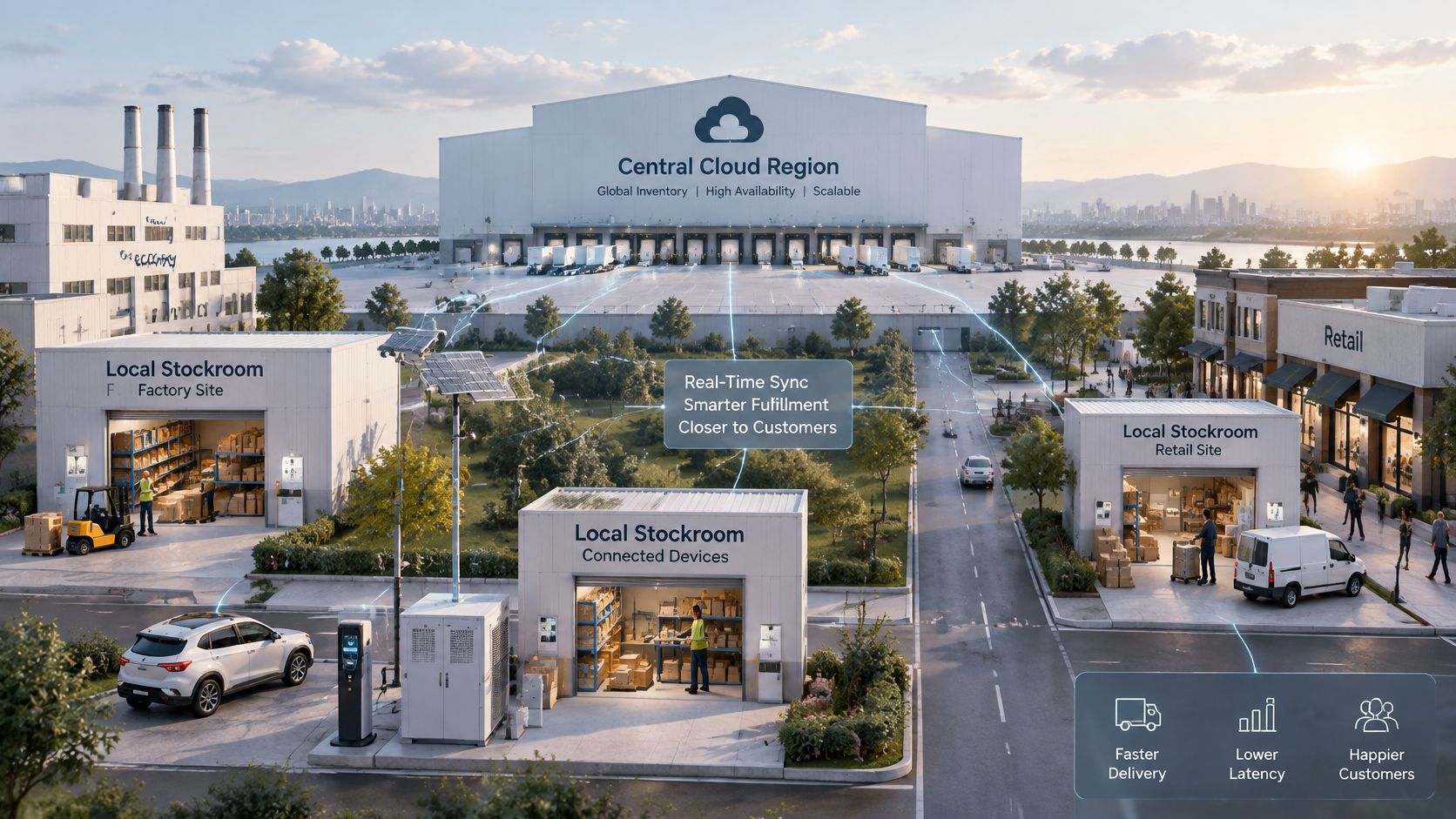
A cloud region is a large central warehouse. Edge infrastructure is a collection of local stockrooms placed where demand sits. Stocking every local room with everything would be expensive, so you distribute only what needs to be close.
Edge computing infrastructure comprises the physical and logical resources that run compute and storage near users, sensors, and machines. That includes micro data centers, edge nodes, switching, backhaul, power, cooling, enclosures, and management software. It extends cloud computing rather than replacing it.
The progression wasn't a single invention: commercial CDNs moved popular content closer to users in the late 1990s, mobile and IoT growth distributed data generation during the 2000s, fog computing described an intermediate layer during the 2010s, and the OpenFog Consortium published its reference architecture in 2017, as summarized in this distributed-computing history.
For a carrier, the architecture can span customer equipment, access networks, aggregation buildings, regional facilities, and central clouds. Modern radio-access and transport networks provide opportunities to host or connect compute nearer to devices, but proximity alone doesn't establish a business case.
Start with the application boundary
Say a factory needs to reject defective products while retaining inspection records centrally. Local infrastructure can make the immediate decision without becoming the permanent home for every analytical workload.
Ask:
- Data origin: Where is the information generated?
- Response deadline: How quickly must a usable answer return?
- Disconnected behavior: What must continue when the upstream link fails?
Edge is a placement decision, not a place.
Micro Data Centers, Edge Nodes and Connectivity Explained
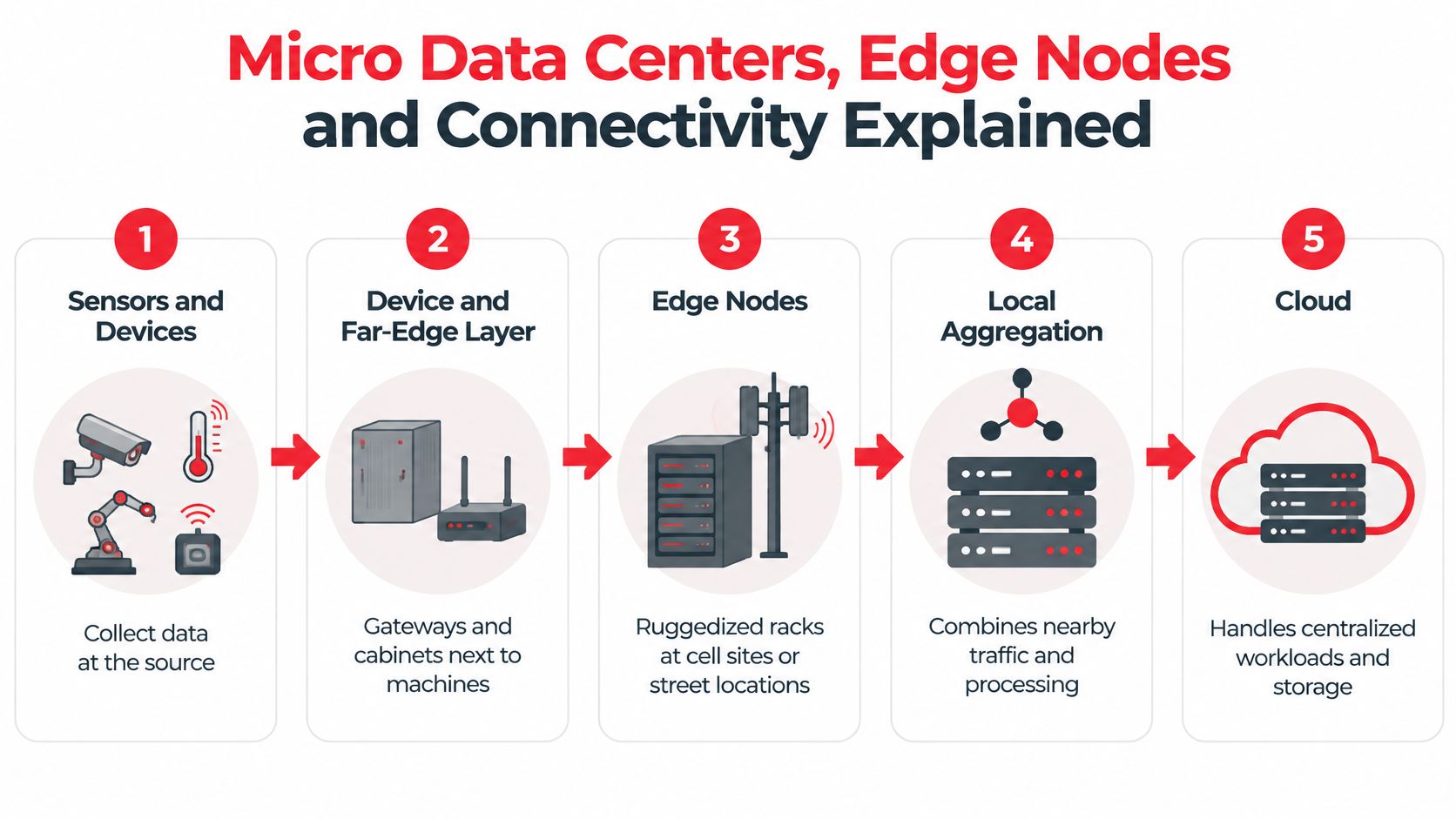
Follow the traffic from the source. Sensors and cameras produce information; gateways terminate protocols and filter it; nearby servers execute selected applications; aggregation facilities combine workloads; central platforms handle consolidated processing and storage.
The device and far-edge layer sits beside machinery or inside roadside cabinets. An edge node is the compute deployment, potentially a ruggedized server or rack at a cell site, street location, or building room. A micro data center packages facility functions around a compact deployment, including power distribution, thermal management, containment, and monitoring.
Match the tier to the response budget
A Carnegie Mellon University analysis reported 74 milliseconds average round-trip time from 260 worldwide vantage points to their optimal Amazon EC2 instances, before adding the wireless first hop. That's a measurement from a particular analysis, not a prediction for your network.
Applications requiring tightly bounded responses are candidates for lower tiers. However, the application's response budget includes transport, queuing, execution, and the return path, not just a network ping.
Edge infrastructure tiers and where they sit
| Layer | Typical location | Main role | Latency reference |
|---|---|---|---|
| Device and far edge | Factory floor, roadside cabinet | Sensing, filtering, local control | Must meet the local control deadline |
| Edge node | Cell site, street cabinet or building room | Inference, caching, local applications | Must meet the application's interactive deadline |
| Micro data center | Aggregation hub or metro building | Hosting several racks of applications and storage | Validate the complete access-to-application path |
| Regional or central cloud | Distant cloud region | Training, orchestration, archive, disaster recovery | Measure regional round-trip time before placement |
These are functional tiers, not fixed performance classes. A well-connected aggregation building can outperform a physically closer cabinet served by congested transport.
Check the supporting infrastructure
Each deployment needs compute, storage, switching, an appropriate enclosure, power, heat rejection, and remote management. Fiber backhaul connects sites upstream; wireless fronthaul or backhaul connects radio locations where appropriate. Diverse paths and accurate synchronization matter where the application or radio function requires them.
Treat local energy controls as a separate engineering interface. For teams assessing coordinated batteries or other distributed energy assets, the Connect VPP guide to distributed energy provides useful context, but participation in an energy scheme must never compromise protected IT reserve capacity.
Select the tier only after you've traced the actual traffic route and identified its dependencies. A server's address tells you less than its measured service path.
Deciding When Edge Beats Cloud for Each Workload
Workload placement by latency and data needs
| Workload | Best placement | Deciding factor |
|---|---|---|
| Interactive industrial control | Far edge or micro data center | Tightly bounded end-to-end control deadline |
| Machine vision on camera streams | Edge node | Raw video would exceed practical backhaul capacity |
| Connected vehicles and AR | Edge node at network aggregation | Interactive response and mobility requirements |
| Batch analytics and model training | Central cloud | Delay tolerance and pooled capacity |
| Cacheable content | Regional or CDN node | Reuse justifies shared local copies |
| Data bound to one jurisdiction | Local micro data center | Applicable residency requirements determine placement |
These are starting positions, not automatic approvals. Industrial safety functions may require dedicated local control systems, and a jurisdiction can contain suitable centralized facilities.
Don't default to edge. Intermittent workloads can leave purchased servers idle, delay-tolerant jobs rarely justify dedicated field infrastructure, and cacheable content may need a CDN rather than a new application platform.
Cost deserves an early veto: 43% of respondents identified cost as an obstacle, compared with 37% citing cybersecurity and 30% physical security, according to the survey discussed by 451 Alliance.
Require a measurable local advantage
Evaluate the latency budget, data-egress charges, availability target, local processing value, site power capacity, compliance constraints, and technician access. Edge becomes compelling when unreliable connectivity would interrupt essential work, information must remain within an approved boundary, or response time materially affects safety or revenue.
In a specific IoT comparison, measured total latency fell from 5.00 seconds in the cloud configuration to 1.00 second with edge execution, an 80% reduction, according to the published IoT cloud-edge study. That result demonstrates a mechanism, not a transferable production benchmark.
For streaming designs, RenderIO's edge architectures for live video offers a focused reference for separating video-processing decisions from general-purpose workload placement.
Placement rule: Choose the most centralized deployment that meets the application's requirements, then move outward only when a measured constraint justifies it.
Prove the choice with a bounded workload before extending it across the estate. Include a rollback path so a disappointing pilot doesn't become a permanent operating obligation.
Edge Use Cases for Carriers, Data Centers and Enterprises
A carrier, a colocation operator, and a manufacturer can buy similar servers yet need entirely different deployment models. The deciding factor is the service each organization must deliver, not the equipment category.
Edge use cases by sector
| Sector | Use case | Typical placement | Deciding factor |
|---|---|---|---|
| Carriers | Radio-access functions and MEC | Edge node at cell site or aggregation point | Response deadline and backhaul limits |
| Carriers and ISPs | Cabinet-based caching and filtering | Far-edge cabinet | Avoiding unnecessary WAN transport |
| Data center operators | Regional inference and caching | Micro data center in metro hub | Client proximity and content reuse |
| Data center operators | Overflow model training | Central or regional cloud | Capacity pooling and cost |
| Manufacturers | Machine vision on the production line | Edge node on factory floor | Raw video exceeds practical backhaul capacity |
| Enterprises | Branch analytics under residency rules | Local micro data center | Approved data boundary and offline continuity |
Carrier infrastructure versus metro hosting
For carriers, some radio-access functions have timing and transport requirements that constrain placement before application economics enter the discussion. MEC hosting adds another question: can the operator isolate customer workloads without allowing them to consume resources reserved for network services?
Cabinet caching and filtering are narrower propositions. They make sense where sufficient traffic can be served or reduced locally, but an underused cache adds maintenance without enough transport benefit.
For data center operators, a metro micro data center can host regional inference and shared caches for nearby customers. Training overflow belongs in pooled regional or central capacity when the local facility lacks suitable electrical, cooling, or scheduling headroom.
Factory deployments versus enterprise branches
Consider a production line whose cameras produce more raw video than its WAN can carry economically. Put inference near the line, retain the evidence needed for quality review, and define what the system does when the model service becomes unavailable.
A branch office presents a different case. Local analytics might support an approved residency boundary and continuity during an upstream outage, while overnight reporting remains centralized. Don't move reporting locally just because a server is already present.
For every candidate, identify the specific service benefit and the operating owner. Then require the site-class cost model to support the deployment before committing construction resources.
Integrating Edge With Fiber and Wireless Networks
A practical integration path starts with transport. Fiber rings feed aggregation hubs, micro data centers connect at suitable handoff points, and wireless fronthaul or backhaul links radio sites to the required processing resources.
Multi-access edge computing, or MEC, places computing capabilities near access networks. In mobile deployments, that can mean hosting near the radio-access edge, but application traffic must reach the local workload without an unnecessary trip through a distant core.
Document the user-plane breakout, routing policy, service discovery, security boundary, and return path. A nearby server won't help if the network sends the application session elsewhere first.
Optimize the whole execution path
A 2025 study of flux-balance allocation for mobile edge computing reported 2.13 ms average latency for a 1 Mbps task and 973.4 J average energy consumption, with energy use 53.56% lower than one comparison allocation scheme, in Scientific Reports. Those are algorithm- and workload-specific results, not service guarantees.
The useful engineering lesson is that distance, contention, and energy must be considered together. A close server with a saturated accelerator or deep execution queue can be a worse destination than a less congested aggregation node.
Expose telemetry that allows the orchestrator to distinguish those conditions:
- Compute state: CPU utilization, memory pressure, accelerator occupancy, and thermal throttling.
- Transport conditions: Radio quality, available throughput, packet loss, and path changes.
- Execution backlog: Queue depth, job age, and application completion time.
- Energy state: Power draw, battery condition, and available operating reserve.
Make orchestration physically achievable
Use admission control to protect established services when capacity tightens. Permit workload migration only where application state, data policy, and destination capacity allow it, and account for migration traffic rather than treating relocation as free.
Multi-objective placement needs accurate topology information. Label actual shared-risk routes, not merely circuit names, and distinguish an independent path from another service delivered through the same entry conduit.
Physical design must support the policy. Preserve compute headroom for failover, provide power redundancy appropriate to the service target, and commission low-latency backhaul under load.
Where timing matters, validate the synchronization chain and its failure behavior. Fiber continuity tests alone won't establish whether an application remains within its operating limits during a path switch.
Site Selection, Power, Cooling and Security Requirements
Use a consistent survey form for every candidate location. Record constraints before selecting equipment, because a cabinet that fits the server may still be unsuitable for its electrical demand, heat output, or maintenance clearance.
Survey from the outside inward
- Location and access: Trace fiber entrances and route diversity, confirm technician access arrangements, and inspect flood exposure, airborne dust, drainage, and nearby construction activity. Verify that crews can work safely without blocking traffic or critical facility access.
- Power: Confirm available capacity at the actual distribution point, not just the building service rating. Record grid interruptions, power quality, battery condition, generator arrangements, and how maintenance can occur without isolating the entire load.
- Cooling: Use the equipment's permitted inlet conditions and the site's expected ambient conditions to evaluate heat rejection. Account for solar loading, blocked filters, recirculation, and loss of active cooling.
- Enclosure and space: Select protection appropriate to humidity, dust, water, and corrosion. Leave working clearance, label patching, preserve fiber bend radius, and make replaceable components accessible without dismantling adjacent equipment.
A climate-controlled equipment room and an unconditioned street cabinet aren't interchangeable. Say identical servers occupy both: if the roadside cabinet has an unprotected single power circuit, a circuit failure can stop its workload while a building-room deployment with independent feeds remains available.
Secure the maintenance path
Physical security should include locked enclosures, tamper detection, access records, and a clear process for issuing and revoking keys or credentials. Overton Security's guidance on physical safeguards for data centers is a useful reference when translating facility protections into site-specific controls.
For remote administration, use encrypted management connections, identity-based access, least privilege, and a separate management boundary. Don't leave vendor access permanently enabled because commissioning was easier that way.
Field check: If a technician can't replace the likely failed component safely with the equipment in place, revise the layout before approving it.
Attach photographs, electrical schedules, thermal assumptions, and access restrictions to the site record. Those details become acceptance criteria and maintenance instructions, not forgotten survey notes.
Running Remote Edge Sites Without On-Site Staff
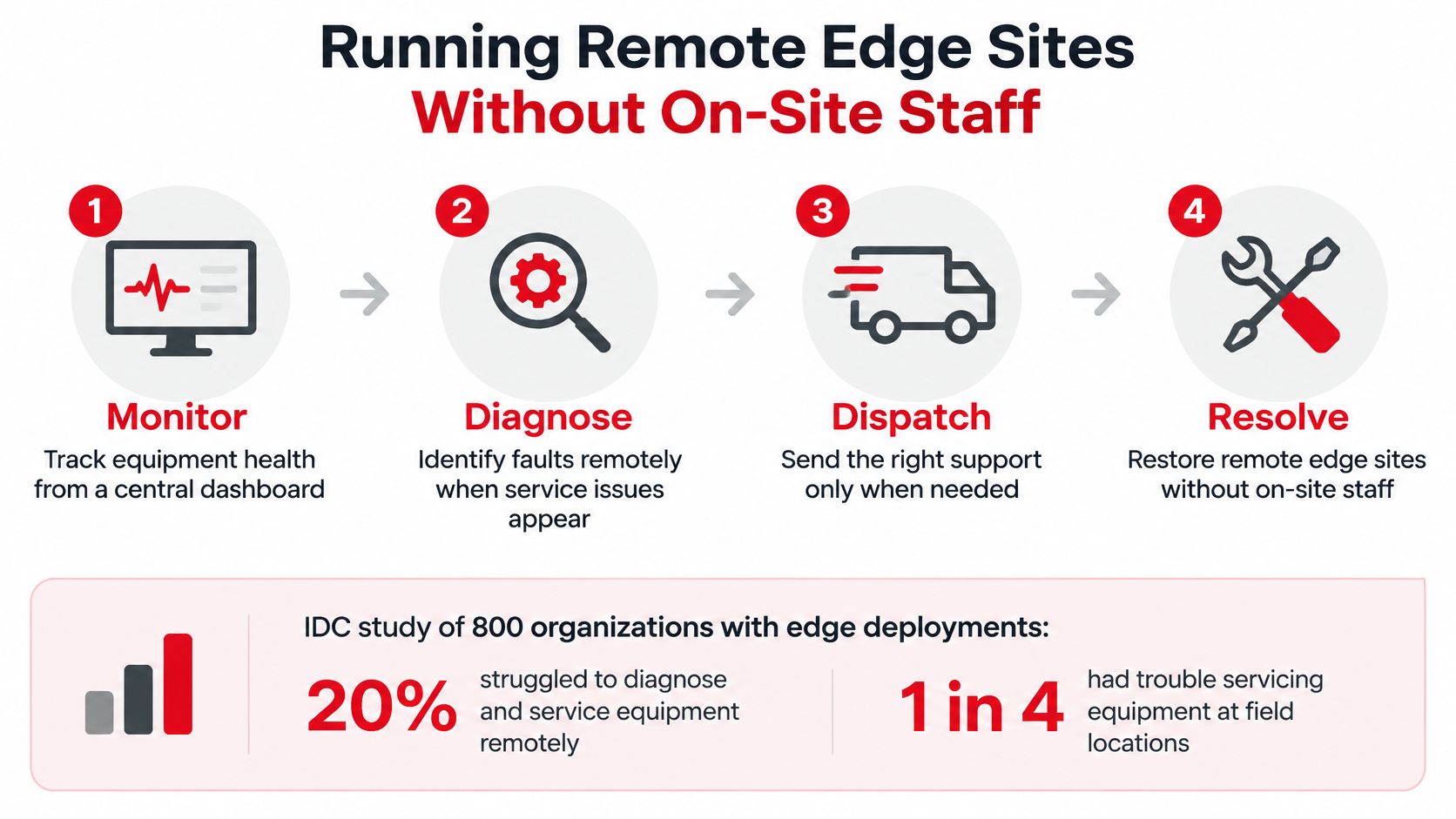
An IDC study of 800 organizations with edge deployments found that 20% had difficulty diagnosing and servicing equipment remotely, one in four struggled with servicing at field locations, and 24% reported equipment damage caused by the surrounding environment, according to the IDC-Cisco edge white paper.
These findings point to a practical requirement: the operations team needs enough information and control to distinguish a failed application from a failed circuit, an overheated enclosure, or a disconnected sensor. Otherwise, technicians arrive with incomplete instructions and the wrong replacement parts.
Commission for the person answering the alarm
Capture the installed configuration. Record as-built drawings, cable routes, equipment serials, rack elevations, patch assignments, and power dependencies before handover. Store optical test results, configuration backups, firmware versions, and clearly labeled photographs in the same site record.
Test the service, not just the ports. Use a traffic generator and application instrumentation to measure median and tail latency, jitter, packet loss, and sustained throughput under realistic load. Exercise link failure, server failure, power transfer, restart, and restoration, including the application's behavior while dependencies are unavailable.
Configure actionable telemetry. Set temperature, humidity, door-state, battery, and power alarms from equipment limits and the approved site design. Include alarm delay and hysteresis where appropriate, then test that notifications reach the responsible team rather than merely appearing on a dashboard.
Keep management access available when the production path fails. An independently reachable console or out-of-band management service can determine whether the team restores service remotely or sends a crew to inspect a screen.
Prepare the repair before the failure
Stock spares by site class. Standardize replaceable power supplies, fans, optics, storage devices, and approved cable assemblies where practical. Place critical parts at regional hubs, track compatibility, and test stored replacement equipment before treating it as available inventory.
Write executable remote-hands procedures. Specify the exact asset, connector, isolation step, replacement sequence, and post-change test. Assign escalation ownership and response targets, including landlord access, safety authorization, specialist support, and who can approve a service-impacting action.
Budget dispatches accurately. Include travel, access delays, labor, replacement freight, and repeat visits in the operating forecast. Compare that exposure with the capital saved by omitting redundancy or serviceable enclosure features, rather than assuming a lightweight installation remains cheap after deployment.
A reset isn't a completed repair. Require the responder to confirm application recovery, inspect the initiating fault, reconcile replacement serials, and update the record so the next technician doesn't inherit obsolete instructions.
Maintain a tested rollback route. Preserve approved cloud connectivity for fleet management, archival storage, training, and disaster recovery, but verify capacity and data-policy constraints before relying on it.
Some applications can move; others must enter a controlled local state. Document that distinction explicitly, including how buffered information is reconciled when connectivity returns.
Model Edge Costs Before You Commit to Sites
The global edge computing market was valued at approximately $33.4 billion in 2025, according to Grand View Research. Market size doesn't make an individual site economical.
Compare deployment choices using the same workload, service target, evaluation period, and replacement assumptions. Include the physical work as well as the IT equipment.
The business case needs an explicit comparison of all deployment options.

Calculate by site class
Separate staffed metro facilities, enterprise rooms, outdoor cabinets, and difficult-access locations. A fleet-wide average can conceal a site class that requires expensive civil work or disproportionate maintenance.
Include:
- Initial investment: Design, permits, construction, electrical work, fiber extensions, enclosures, hardware, installation, and acceptance testing.
- Recurring expense: Power, connectivity, software licences, monitoring, security controls, field support, spares, and replacement logistics.
- Avoided expense and operating value: Demonstrable reductions in transport or cloud egress, plus defensible value from improved response or continuity.
Don't count reduced WAN traffic as cash savings unless it changes a bill, avoids an upgrade, or releases useful capacity. Keep safety obligations separate from speculative revenue estimates.
Compare centralized, regional, and far-edge options side by side. Simple payback is incremental initial investment divided by positive annual net benefit; if the annual benefit doesn't exceed the additional operating cost, there's no simple payback to report.
Use the video as a discussion aid, not a substitute for site-specific quotations and measurements.
Make the pilot earn expansion
Pilot a representative site class, including its maintenance arrangements. Measure application performance, power consumption, support effort, and recovery behavior, then revise the model using observed operating requirements.
Validate workload placement, run the cost model, and finish the serviceability plan before ordering hardware. If regional or central infrastructure meets the requirement at lower lifecycle cost, choosing it is sound engineering.
For engineering, construction, and maintenance support, visit Southern Tier Resources to discuss fiber connectivity, wireless infrastructure, or data center fit-outs for your edge deployment. Bring your candidate sites, workload requirements, and recovery targets so the discussion can address power and connectivity integration, testing, as-built documentation, and ongoing serviceability.