A crew is preparing to splice into a feeder at a rooftop telecom site. The job was reviewed yesterday, the JSA is already filed, and everyone knows the sequence. Then a junior technician notices that the lockout has been applied to the cable assumed to be de-energized, not the feeder the crew is about to access. The team stops before the splice begins.
That intervention illustrates the difference between hazard identification and paperwork completion. The JSA mattered because the crew repeated the review at the point of work, questioned an assumption, and updated its understanding of the site. In telecom projects, that discipline has to cover fiber cuts, tower climbs, excavation, energized rooms, lifting, weather, and live-network changes without slowing crews with documents nobody uses.
What Hazard Identification Means in Modern Telecom Projects
Hazard identification is the disciplined practice of finding conditions that could cause harm before people are exposed to them. It includes physical, electrical, chemical, ergonomic, environmental, and organizational threats. The process also continues after the first review because the risk picture changes when the location, crew, equipment, sequence, weather, or system state changes.
A completed JSA from yesterday can't answer every question about today's work. A third-party tenant may have altered an electrical configuration, a carrier may introduce an unplanned network event, or rain may change the stability of an excavation. A fiber crew may also face a less visible exposure, such as laser energy from an uncleared patch panel or a broken fiber viewed without the right inspection method.
Practical rule: Treat hazard identification as an upstream control. It should shape the method, equipment, permits, isolation plan, crew assignments, and stop-work conditions before production begins.
What the review must catch
Routine hazards deserve deliberate attention because familiarity makes them easy to overlook. A tower crew may expect fall exposure and still miss a rigging conflict. A splicer may understand electrical contact and still fail to confirm whether a cabinet shares a joint-use power space. A data center technician may plan a maintenance window without accounting for a carrier event that changes the operating condition.
Non-routine work deserves even more scrutiny. Fiber cutovers, emergency repairs, commissioning, make-ready work, shutdowns, SIMOPs, and live-network tie-ins create conditions that a steady-state checklist can't represent. Regulatory guidance on hazard identification emphasizes reviewing abnormal and infrequent tasks, maintenance, seasonal variation, adjacent-area interactions, and changes to the hazard register, as described in the WorkSafe WA hazard identification guidance.
A repeatable field sequence
Use a short, visible process:
- Define the exact task. State what the crew will do, where it will happen, and what system state must exist before work starts.
- Break the task into steps. Include setup, access, execution, testing, restoration, and cleanup.
- Ask what can change. Check adjacent contractors, energized assets, weather, traffic, access restrictions, and network conditions.
- Assign controls to people. Name the person verifying isolation, watching the lift, controlling access, or stopping work.
- Recheck at the point of work. If field conditions differ from the written plan, pause and revise the review.
This approach prevents hazard identification from becoming a binder exercise. It gives every later safety decision a factual starting point.
Regulatory and Standards Context for Hazard Identification
U.S. telecom work often crosses several regulatory boundaries in one shift. A tower crew may work at height near active antennas, a fiber contractor may enter a shared utility corridor, and a data center team may handle energized equipment during a controlled cutover. OSHA requirements establish the regulatory floor, but they don't replace task-specific judgment or client controls.
For general industry and construction, teams commonly work within OSHA 29 CFR 1910 and 1926 requirements. Relevant areas include Subpart M for fall protection, Subpart V for power line work, Subpart S for electrical safety, Subpart D for walking-working surfaces, and Subpart AA for confined spaces. Where telecom work overlaps utility-side generation, transmission, or distribution activities, 29 CFR 1910.269 may also apply.
NFPA 70E helps teams evaluate arc-flash risk, energized electrical work, approach boundaries, and electrically safe work conditions. NFPA 70, including Article 800, supports decisions involving telecom bonding and grounding. Tower programs may also rely on ANSI/TIA-322 for structural loading and ANSI/TIA-1019 for tower climber safety. ANSI Z10 provides the management-system framework for connecting hazard reviews, worker participation, corrective actions, and continual improvement.
Standards should support judgment
Compliance alone can create a false sense of completion. A form may contain every required field and still fail to ask whether a carrier has changed the network state or whether a crane setup conflicts with the tower's temporary loading condition.
Apply the strictest applicable requirement when standards overlap, document the basis for the decision, and give the crew authority to stop when conditions don't match the plan. For teams working across jurisdictions or delivery models, a practical overview of UK CDM compliance 2026 can also help clarify how designers, contractors, and clients share responsibility for managing construction risk.
Key standards that drive telecom hazard identification
| Standard | Scope | Hazard ID implication |
|---|---|---|
| OSHA 29 CFR 1910 and 1926 | General industry and construction safety | Establishes baseline controls for falls, electrical work, excavation-related tasks, access, and confined spaces |
| OSHA 29 CFR 1910.269 | Utility-side electric generation, transmission, and distribution work | Requires careful evaluation where telecom work meets utility operations |
| NFPA 70E | Electrical safety in the workplace | Drives shock, arc-flash, energized-work, boundary, and isolation reviews |
| NFPA 70, Article 800 | Electrical and telecom installations | Supports bonding and grounding decisions |
| ANSI/TIA-322 | Structural loading for tower and antenna-supporting structures | Connects lift plans, temporary loads, and structural review |
| ANSI/TIA-1019 | Tower climber safety | Informs access, rescue, fall protection, and climbing controls |
| ANSI Z10 | Occupational health and safety management systems | Places hazard identification inside a continuous improvement cycle |
The mature program uses these standards as a foundation, then adds carrier method-of-procedure requirements, client specifications, NESC considerations for utility-adjacent work, and local authority requirements. A checklist should guide the discussion, not blunt it.
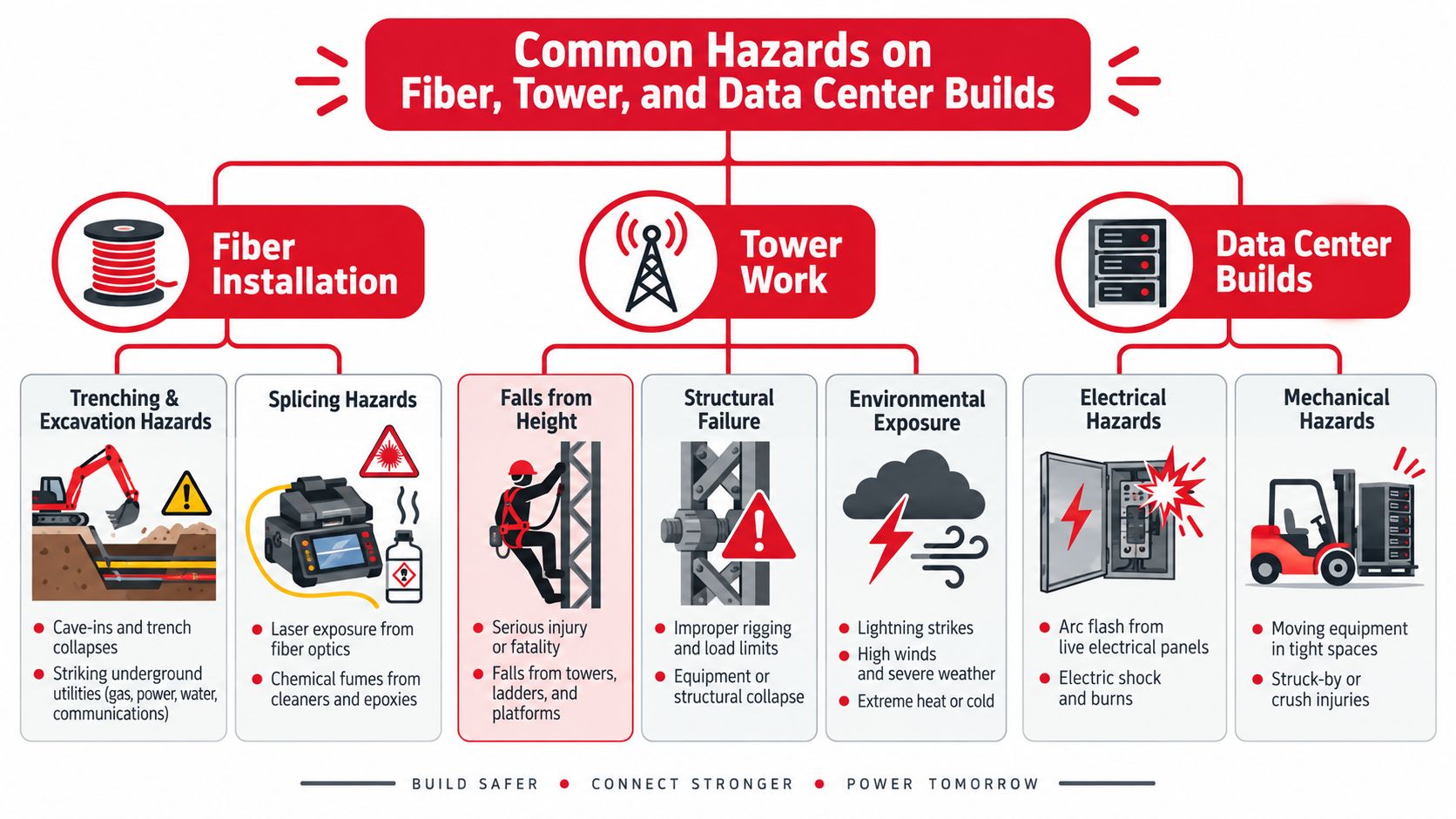
Common Hazards on Fiber, Tower, and Data Center Builds
Telecom hazards rarely arrive in neat categories. They surface at the point where equipment, people, infrastructure, and schedule pressure intersect. The same project may involve excavation in the morning, a tower lift in the afternoon, and energized testing before the shift ends.
Tower work changes the risk profile
The obvious exposure is a fall from height, but the climb plan must also account for structural condition, RF status, dropped objects, weather, rescue access, and the movement of steel during erection. A lift can introduce collapse or struck-by risk when a gin pole, tag line, or load path doesn't match the engineered plan. A representative monopole lift-and-pin scenario shows how a misrigged gin pole can swing into a climbing crew, turning a planned installation sequence into a simultaneous lift and fall-zone emergency.
RF exposure requires a separate confirmation of antenna status and exclusion controls. A tower may look inactive while another carrier or tenant operates equipment nearby. Pinch points also appear during steel alignment, bolting, and component positioning, especially when workers focus on the primary load and lose sight of hands, feet, or escape paths.
Fiber work hides energy in shared corridors
Outside-plant crews face excavation cave-ins, utility strikes, traffic, aerial-span struck-by exposure, and equipment movement around bore pits. Joint-use pedestals and cabinets can contain energized power components, so the crew must identify ownership, isolation responsibility, test requirements, and limits of access before opening the enclosure.
Fiber handling adds hazards that aren't always visible. Class 1M and Class 3B laser exposure can occur when workers view uncleared patch panels or broken fibers without appropriate inspection scopes and procedures. Saw cutting can create silica dust, while cleaners, splicing compounds, and other chemicals require task-specific controls and ventilation decisions.
Data center work is a system-state problem
Fit-outs combine construction hazards with operational continuity. Hot work near energized busways, switchboard cutovers, temporary power, forklifts, suspended loads, raised-floor vaults, and bus ducts all require separate review. The control-room team must also evaluate whether a planned maintenance window overlaps with an unplanned carrier event, because a technically correct step can still produce an unintended outage if the operating picture has changed.
The timing of review matters. Tower risks often expand during mobilization and lifting, fiber risks appear during access and tie-in, and data center risks intensify during energization, commissioning, and turnover. A pre-task review should therefore ask not only “What are we doing?” but also “What changed since the last approved state?”
The following video provides a visual supplement for crews reviewing common worksite exposures:
Choosing the Right Identification Method for Each Job
JSA, JHA, formal risk assessment, and HAZOP aren't interchangeable labels. Each tool has a different purpose, level of detail, and tolerance for uncertainty. The right choice depends on task complexity, system impact, crew experience, and whether the work needs engineered controls.
A short, familiar fiber splice in a controlled communications room may need a focused JSA completed immediately before work. A tower modification involving multiple trades, temporary loads, and engineered rigging needs a deeper JHA. A greenfield data center fit-out that changes energized busway conditions calls for a formal risk assessment with design, operations, electrical, and construction participation.
Four tools, four levels of analysis
| Method | Best for | Crew time | Depth | Regulatory fit |
|---|---|---|---|---|
| JSA | Short, defined, repetitive field tasks | Low | Focused on task steps and immediate controls | Strong for daily field execution |
| JHA | Multi-step work with interacting hazards | Moderate | Connects each step to hazards and controls | Strong for construction and complex telecom work |
| Formal risk assessment | Cross-discipline work or changes to system state | Higher | Evaluates scenarios, interfaces, consequences, and control hierarchy | Useful for high-risk work and management approval |
| HAZOP | Process deviations in a defined operating or vendor process | High | Structured node and deviation analysis | Best suited to process and facility engineering contexts |
Use escalation rules, not personal preference
A useful decision rule is straightforward:
- Choose a JSA when the task is short, known, and repeatable, but still requires a point-of-work check.
- Choose a JHA when the sequence has multiple steps, crews, systems, or engineered controls.
- Choose a formal risk assessment when the work crosses disciplines, changes system state, or affects operational continuity.
- Choose HAZOP when a process change or deviation must be analyzed node by node, especially in a vendor or manufacturing environment.
The trade-off is real. Over-engineering routine work consumes attention and encourages rushed signatures. Under-analyzing a live tie-in or tower modification leaves the crew without a shared model of the risk. If the organization uses FMEA, the guide to mastering RPN for FMEA can help teams structure severity, occurrence, and detection discussions, but the scoring process shouldn't replace field verification.
Every method should end with named controls, owners, and stop-work triggers. A risk score without an action owner is only a description of concern.
Integrating Hazard Identification Across the Project Lifecycle
Hazard identification works best when it starts before the crew arrives. A project team that waits for mobilization has already lost opportunities to change the design, price the work accurately, select qualified crews, and coordinate with facility operations.
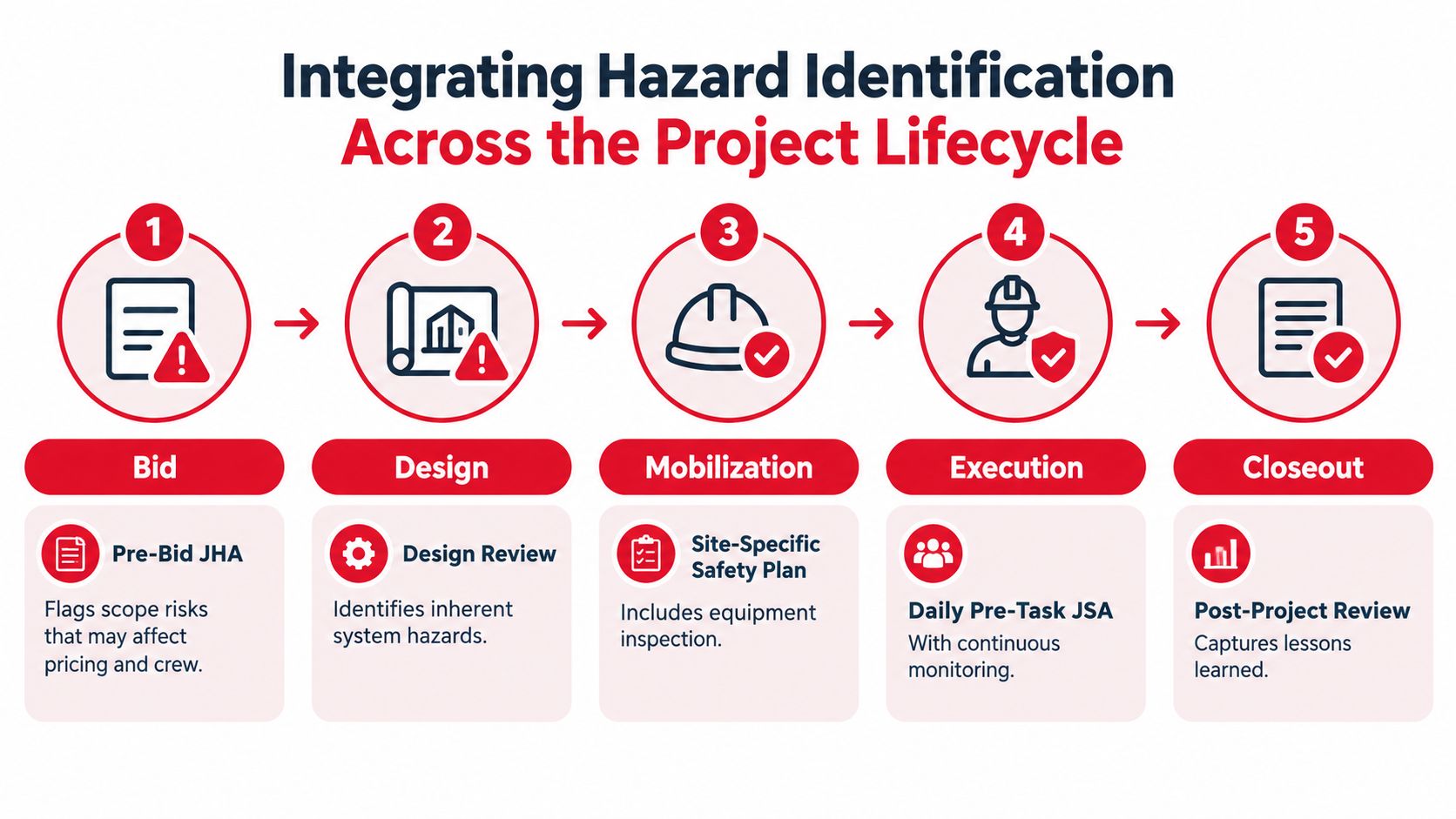
Bid and design
The bid-stage pre-construction review should identify access constraints, shared corridors, energized rooms, traffic exposure, tower loading requirements, specialized equipment, and likely permit dependencies. That information affects pricing, schedule allowances, crew selection, subcontractor scope, and the feasibility of the proposed method.
During design review, engineers and construction leaders should look for hazards embedded in drawings and layouts. Equipment placement can create access or lifting problems. A poorly located cabinet can increase exposure to traffic or energized infrastructure. A method of procedure should explain the safe sequence, isolation points, testing steps, rollback path, and communications plan before operations approves the work.
For facility teams building a broader risk process, practical facility risk planning offers useful context for connecting asset conditions, operational dependencies, and planned work.
Mobilization and execution
Mobilization converts project assumptions into site facts. Before tools leave the truck, verify utility locates, access routes, permits, equipment condition, emergency contacts, rescue arrangements, RF status, and client-specific requirements. The site-specific plan should identify who owns each verification and what evidence proves completion.
Execution requires a rhythm rather than a single form:
- Start each shift with a pre-task brief. Confirm the task, roles, hazards, controls, and changes.
- Refresh the JSA when work changes. Stop if the crew encounters an unexpected utility, altered network state, weather shift, or new contractor interface.
- Use near misses as triggers. A near miss should update the relevant hazard register and work method, not disappear into a closed report.
- Set explicit stop-work conditions. Examples include uncertain isolation, wind or lightning that changes climbing risk, scope drift, or unplanned energized exposure.
Closeout
Closeout should capture what the crew learned while the details remain fresh. Consolidate revised JSAs, design changes, near misses, corrective actions, and client feedback into the project hazard register. The next bid team should receive those lessons so the organization doesn't price the same uncertainty repeatedly.
Assign each phase a document, owner, and deadline. That simple governance step prevents the program from depending on one safety manager's memory.
Checklists and Templates That Survive the Field
A field checklist succeeds when a foreman can use it before work starts, understand every prompt, and mark the response without leaving the work area. It fails when the document is too long, too generic, or designed for an office review rather than a muddy truck hood.
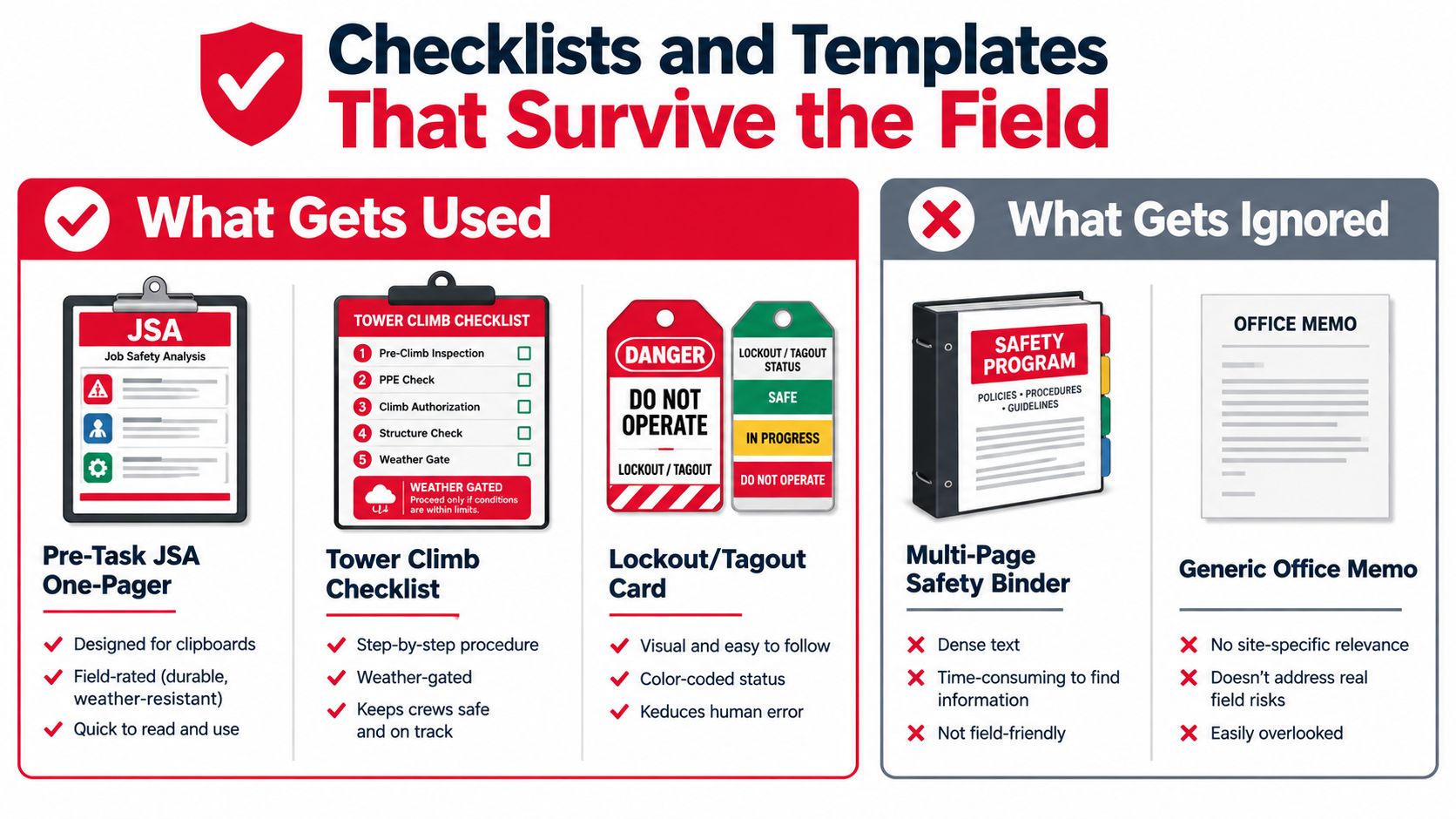
Build templates around failure modes
A pre-task JSA one-pager should force the crew to identify the task steps, people exposed, controls, responsible person, and stop-work triggers. Keep the writing space practical for a clipboard and make the first question specific to today's location and system state. That prevents a signature from substituting for comprehension.
A tower climb checklist should connect each activity to its hazard. Include access inspection, fall-protection equipment, rescue readiness, weather, RF confirmation, dropped-object controls, rigging, exclusion zones, and communication methods. Make the climb weather-gated, so the crew must actively confirm that conditions remain acceptable rather than treating a morning approval as permanent.
The live-network tie-in card needs to be visual and unambiguous. It should require verification of:
- Isolation: Confirm the correct equipment, feeder, breaker, or circuit and identify who controls it.
- Test equipment: Confirm the tester is suitable, functional, and used at the required verification points.
- Network state: Confirm the approved maintenance window, affected services, rollback path, and operations contact.
- Fiber condition: Confirm patch-panel status and inspection requirements before viewing or handling fibers.
- Restoration: Assign the person who verifies covers, labels, guards, and system status before release.
For hot work, use a permit aligned with NFPA 51B and include combustible-material control, fire watch, extinguishing equipment, post-work monitoring, and authorization. A lift and aerial-device checklist should connect inspections and setup to OSHA 1926.453 requirements, manufacturer instructions, ground conditions, overhead hazards, and the planned load path.
Make documentation hard to ignore
Laminate reusable forms for rain, mud, and repeated handling, then provide a QR code to the controlled digital version. The code should open the current document, not an uncontrolled download that crews may keep using after revisions.
Digital forms add value when they capture location, time, crew, photos, corrective actions, and approval history without forcing workers through unnecessary screens. They create little value if the foreman completes them after the work to satisfy an audit.
The strongest form is short enough to finish before the first climb, lift, cut, or connection.
Test every template with the people who use it. Ask them which questions cause confusion, which controls are routinely missed, and which fields add no decision value. Remove anything that doesn't change the work plan.
Training, Documentation, and Continuous Improvement
A durable hazard identification program rests on three connected disciplines: competency-based training, defensible documentation, and feedback that changes future work. Weakness in one area undermines the others. A trained technician can't improve the program if the organization loses the review record, and a complete database can't protect a worker who doesn't understand the control.
Train for the work people actually perform
Start with a skills matrix that maps roles to hazard identification competencies. A tower hand may need to recognize structural, fall, RF, rigging, rescue, and weather risks. A fiber splicer needs competence in electrical exposure, excavation interfaces, laser safety, chemical handling, and live-network controls. A data center fit-out technician may need to identify arc-flash exposure, hot work, confined spaces, lifting, temporary power, and operational dependencies.
The 2020 peer-reviewed construction study found that workers recognized roughly 47% of safety hazards on average, with recognition above that average for gravity, motion, electrical, and temperature hazards, but below 10% for pressure, chemical, and radiation hazards, according to the published study on construction worker hazard recognition. The practical lesson isn't that workers lack commitment. It's that recognition depends on hazard type, training, task familiarity, and the structure of the review.
Use classroom instruction to establish principles, then move quickly into field practice. Have trainees lead a JSA at a real cabinet, vault, tower base, or data hall. Ask them to identify what could change, who may be exposed, what evidence confirms isolation, and what condition would stop the work. Supervisors should coach the quality of the questions, not merely check whether a form contains signatures.
Document decisions, not just attendance
Standardize the forms and keep a controlled JSA library, hazard register, corrective-action log, training matrix, and approved work methods. Version-control procedures and require review before scope changes. A revised drawing, new subcontractor, altered access route, or different energization sequence should trigger a documented check.
The 2006 construction safety study found that only 6.7% of analyzed method statements identified all hazards that should have been identified, based on knowledge available at the time, as reported in the ASCE construction safety study0733-9364(2006)132:2(197)). The same study reported maximum hazard-identification levels of 89.9% in the nuclear sector, 72.8% in railway projects, and 66.5% in projects spanning railway and general construction. The sharp variation shows why a mature telecom program should test the quality of its reviews instead of assuming that a completed method statement is complete.
A sound record answers five questions:
- What was the task? Identify the exact scope, location, equipment, and system state.
- What could cause harm? Record hazards in language the crew recognizes.
- Who was exposed? Include workers, facility staff, the public, adjacent contractors, and network operators.
- What control was selected? State the isolation, engineering measure, administrative control, or PPE requirement.
- Who verified it? Name the person, time, evidence, and condition for recheck.
Measure leading behavior
Lagging indicators such as injuries and outages matter, but they arrive after the control failed. Leading indicators help managers see whether crews are finding risk early and whether the organization responds.
| Metric | Type | Target benchmark | Data source |
|---|---|---|---|
| JSA completion before work starts | Leading | Defined by project governance and verified before task release | Digital forms, supervisor checks |
| Near-miss submissions | Leading | Encouraged through accessible reporting and reviewed for action | Near-miss system |
| Hazard re-identification after change | Leading | Required when scope, crew, location, weather, or system state changes | Revised JSAs and hazard register |
| Corrective-action closure | Leading | Assigned, tracked, and verified by an accountable owner | Corrective-action log |
| Training competency validation | Leading | Confirmed through demonstrations tied to assigned tasks | Skills matrix and field assessments |
| Recordable injuries | Lagging | Reviewed as an outcome, not the sole measure of safety | Incident records |
| Unplanned service interruption | Lagging | Investigated alongside work controls and operational coordination | Operations and outage records |
Avoid using completion rates as a vanity metric. A team can finish every form and still miss the critical hazard. Supervisors should sample the quality of hazard descriptions, compare planned controls with field conditions, and interview workers about why a control matters.
Use technology as an additional set of eyes
EHS reporting for 2026 describes a shift from periodic audits toward real-time detection using sensors, analytics, workflow automation, and computer vision. The reporting also identifies potential uses such as detecting PPE gaps, exclusion-zone breaches, ergonomic risks, and unsafe behaviors continuously, while academic and technical literature describes simulation, machine learning, and historical hazard-data mining as tools for classification and pattern detection. These developments are summarized in the 2026 EHS trends research.
A camera may flag missing fall protection on a tower climb or an exclusion-zone breach near a lift. Sensors may identify entry into a restricted area or a change in environmental conditions. Analytics may reveal that a particular task repeatedly produces the same near miss.
That technology still needs governance. Teams must validate alerts, manage privacy, define retention, test false positives, and give workers a way to challenge an incorrect interpretation. AI should augment HAZID, not replace the crew that understands the equipment, sequence, and local conditions.
Review trends on a regular management cycle, then feed the results into toolbox talks, revised JSAs, training refreshers, design reviews, and bid assumptions. Southern Tier Resources' telecom infrastructure services include engineering, construction, maintenance, fiber deployment, wireless work, and data center fit-outs, areas where a project-specific hazard register can connect task hazards, exposed people, controls, and required actions.
The practical standard is simple. A hazard review should change what people do, not merely prove that a meeting occurred.
Southern Tier Resources can support telecom hazard identification through construction risk assessment, pre-construction hazard analysis, engineering, deployment, and maintenance across fiber, wireless, tower, and data center work. If you need a partner that can connect field controls with project delivery, visit Southern Tier Resources to discuss your next infrastructure project.