Budget a new US macro cell tower at $150,000 to $300,000 per site, before unusual land, utility or carrier-equipment requirements, in figures from the FCC's 20th Mobile Wireless Competition Report as summarized by Inside Towers. Budget collocation on an existing tower at about $25,000 to $30,000. Those two answers respond to the same question, and the gulf between them is the clearest evidence of what you are buying.
Steel is the visible part; the site work drives the bill. A new build has to create the site: land rights, foundation work, access, electrical service, backhaul and permits, then erect steel and integrate radios. Collocation costs only a fraction because the compound, power, transport and vertical asset already exist.
That is why published answers to how much does it cost to build a cell tower can run from a small-cell node to a seven-figure complex macro site without anyone being wrong. Each quote is counting a different scope, so compare scope before price: the lower number usually leaves more of the site to someone else.
Typical Cell Tower Costs at a Glance
The first number to fix in memory is a planning benchmark, not a bid. In the United States, the practical benchmark for constructing a new macro cell site is approximately $150,000 to $300,000 per site, per figures cited in that FCC report summary. Read what the range contains: site acquisition, engineering, permitting, foundation work, tower erection, antennas, radios, cabling, electrical service and commissioning all sit inside it.
The same summary places colocation on an existing tower at about 30% of the total cost of building a new tower, and it separates macro sites from small cells by estimating small-cell per-site costs, capital and operating combined, at less than half those of a macro site. Every scenario below is a capital planning range drawn from those FCC-cited averages and from public planning estimates.
| Scenario | Typical capital cost | Scope note |
|---|---|---|
| New macro tower, typical US site | $150,000 to $300,000 | Planning benchmark; excludes unusual land, utility or equipment needs |
| Rural macro tower | About $275,000 | Excludes land; road access, electrical power and fiber can add more |
| Complex macro site | $200,000 to $300,000, or over $1 million | Unusual structure, multiple tenants, heavy power work or difficult access |
| Collocation on an existing tower | $25,000 to $30,000 | Reuses the foundation, compound, power and transport |
| Small cell node | $35,000 to $50,000 | Lower capital and operating cost than macro; review and backhaul still apply |
How to read the ranges
Treat each row as a capital planning envelope, never as a bid price. The scope column carries more information than the dollar column, because a rural tower budgeted near $275,000 climbs steeply once a new access road and a utility extension get priced. A number quoted without its scope can't be compared to anything.
Three questions settle most ambiguity before you argue about money:
- Is land included? Purchase or ground lease is often the first cost committed and the last one disclosed.
- Is this the tower or a working site? Steel, foundation and erection are one scope. Radios, power, backhaul, integration and commissioning are another.
- Is the site new or shared? A greenfield build carries civil and structural work that a colocation inherits for free.
Answer those three and the ranges stop contradicting each other.
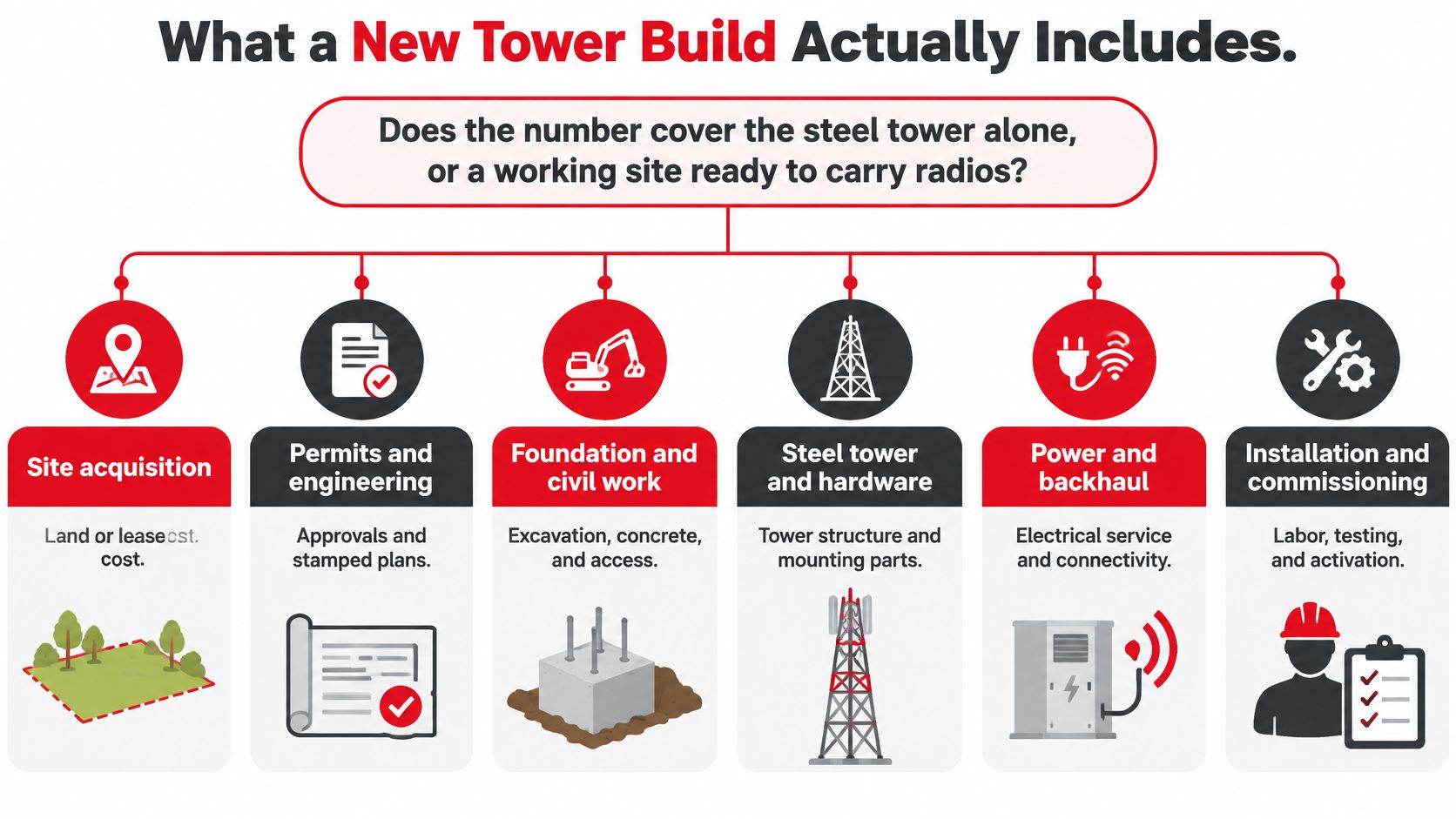
What a New Tower Build Actually Includes
Two honest quotes for the same site can differ by several hundred thousand dollars. The difference is almost always scope, meaning whether the figure covers a steel structure or a site ready to carry traffic. Sketchy cost comparisons between greenfield macro sites, collocations, small cells and mid-life upgrades usually trace back to this one ambiguity.
Published wireless infrastructure cost analysis separates the budget into structural steel, foundations, land or lease, engineering, geotechnical work, access roads, utility power, fiber or microwave backhaul, radios and antennas, integration, testing and permitting, and reports macro-cell installation commonly at roughly $150,000 to $250,000, with complex U.S. sites reaching $200,000 to $300,000 or exceeding $1 million when unusual structures, multiple tenants, difficult access, major power work or extensive site preparation are involved, according to this infrastructure cost analysis. The same analysis found that where NEPA or NHPA review was required on a small-cell deployment, those reviews represented an average 29% of total deployment cost and added approximately $9,730 per reviewed site.
Where the money actually goes
Site acquisition comes first, because the parcel shapes everything downstream. A cheap plot with a zoning problem or a weak coverage footprint costs more than the lease saves. Engineering and surveys follow: structural design, geotechnical investigation, environmental screening. Then the physical build, where the foundation and tower steel sit as the largest visible items.
The connective work is where budgets break. Access roads, electrical service and backhaul tie the site to the grid and the network, and on a remote parcel those three can rival the tower itself. Radios, antennas and cabling arrive after the steel is up, and integration, testing and commissioning close the job.
| Cost line | What it covers | Main cost driver |
|---|---|---|
| Land or ground lease | Site purchase or lease and access rights | Market, zoning and lease terms |
| Engineering and surveys | Structural, geotechnical and environmental design work | Quality of tower records and soil conditions |
| Foundation and tower steel | Concrete foundation, tower structure, grounding and fencing | Height, wind and ice loading, soil bearing capacity |
| Access roads and utilities | Road access, electrical service and site power | Distance to road and grid |
| Backhaul | Fiber or microwave link to the network | Distance to existing fiber and route terrain |
| Radios and antennas | Antennas, radio units and cabling | Number and weight of antennas |
| Integration and commissioning | Testing, alignment and handover to operations | Scope of network integration |
The same tower can price very differently depending on where it lands, what records exist for the structure and what the borings find. We provide engineering, design, construction and maintenance services for wireline and wireless communications at Southern Tier Resources, and the budgets we build keep those lines separate for exactly that reason.
Practical rule: ask any quote to show each line above individually, and challenge anything buried inside a general contingency. An unexplained total can't be compared with another bid, and it hides the risk you'll actually pay for later.
Engineering and Study Costs Before Construction
Studies are a real budget line, not a rounding error, and they land before anyone breaks ground. FCC cost schedules identify approximately $5,000 to $12,000 for a structural load study on a documented tower, $16,000 to $25,000 to map an undocumented or poorly documented tower and prepare load-study documentation, and $1,500 to $5,500 for a structural capacity study associated with equipment replacement, per the FCC cost schedules. For a new tower subject to federal environmental review, an Environmental Assessment typically costs $5,000 to $15,000, with exceptional cases reaching $25,000.
The cause and effect is straightforward. Incomplete tower records add field survey and documentation hours. Heavier or additional antennas can trigger reinforcement, redesign or a reduced available loading figure. Environmental complexity extends consultant labor and schedule exposure, and schedule exposure is where contingency drains.
| Study or review | Typical cost | Trigger |
|---|---|---|
| Structural load study, documented tower | $5,000 to $12,000 | Adding or changing antennas on an existing tower |
| Mapping undocumented tower and load documentation | $16,000 to $25,000 | Missing or poor tower records |
| Structural capacity study for equipment replacement | $1,500 to $5,500 | Swapping equipment on a loaded structure |
| Environmental Assessment, new tower | $5,000 to $15,000, exceptional cases to $25,000 | Federal environmental review |
Why missing records cost more
An undocumented tower forces a full field survey before any engineer can sign off on a new antenna load. That's the difference between the $5,000 to $12,000 documented-tower study and the $16,000 to $25,000 mapping exercise. Tower companies that digitize structural records early avoid that gap on every subsequent tenant.
Give structural engineering, geotechnical design, environmental and cultural-resource review, permitting and construction management their own allowances rather than lumping them into construction contingency. The FCC schedules also note that tower costs rise with difficult soil and other site conditions, so obtain geotechnical and structural inputs before you commit to a fixed-price build. A fixed price signed on assumed soil is a change order waiting for a signature.
Rural and Corridor Projects Cost More
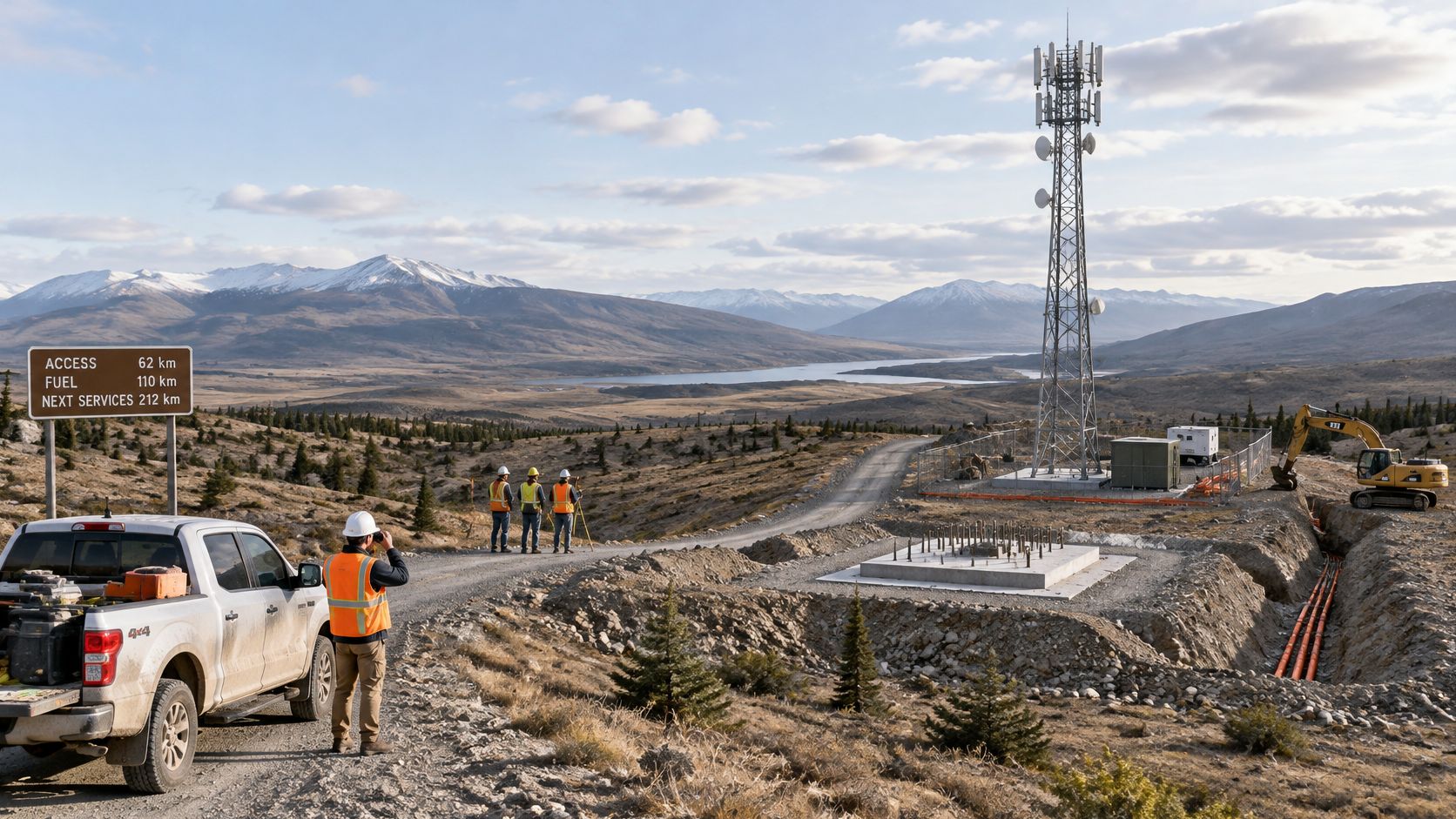
A ridgeline site can carry a sound tower design and still sit miles from everything the tower needs. The steel is ordinary. The access road is four miles of new gravel, the power line needs a quarter-mile extension, and fiber stops at a junction two valleys away. The New York State Upstate Cellular Coverage Task Force report put a typical rural macro tower installation at about $275,000, excluding land costs, with road access, electrical power and fiber-optic connectivity driving cost alongside tower construction and radio equipment.
That figure excludes land, which is the first clue that two rural quotes can price different scopes. A structurally simple tower becomes expensive because of what surrounds it, and on a remote build, utility and transport distance set the ceiling rather than tower height.
Pricing corridor programs
Corridor-scale work bundles towers, small cells and civil works into one program, so pricing it by tower count produces nonsense. The same task force plan estimated $965,575 for a new tower in one corridor project, and roughly $31.2 million for 100 new small cells across 99.8 wireless-corridor miles, about $312,638 per mile.
A per-mile figure is the honest unit for that kind of program, because the program is a coverage architecture rather than a shopping list of structures. Coverage planning also leans on demand evidence, and Statlyst internet usage data gives planners a reference point for how much household and mobile traffic a region generates before a corridor budget is justified.
Before you apply a rural figure to your own site, confirm which scope each quote counts. Check four distances in every itemized bid:
- Road distance to the compound
- Grid distance to the service point
- Fiber distance to the nearest splice point
- Terrain work required between all three
Difficult terrain adds cost in ways that don't appear on a tower drawing. Rock excavation, seasonal access restrictions and helicopter or specialty lifting all enter the civil budget, and each lengthens the schedule that carries your financing cost.
Rural sites rarely fail on steel. They fail on the road, the transformer and the fiber run.
Permit Fees and Recurring Charges Over Time
Permitting charges behave more like a financing schedule than a filing fee, and budgeting them as a one-time administrative line is the most common quiet error in a tower pro forma. Documented U.S. fee schedules show local charges running from thousands to tens of thousands of dollars, including $6,000 for communication towers above 50 feet in Gwinnett County, $17,500 for a new tower in Grant County, New Mexico, and more than $13,000 to $16,000 in San Diego before additional environmental or historic-review fees, per a Federal Register notice on communications facility fee schedules.
Then the annual charges begin.
Recurring right-of-way charges can exceed $27,000 annually for some Phoenix macro facilities and reach $30,000 annually in Scottsdale, depending on installed ground equipment, the same notice shows. Small cells carry lower capital cost per site than a macro tower, but they can face repeated attachment, right-of-way, review and backhaul costs that a single macro site avoids.
What drives the spread between two similar projects
Six variables move both the one-time fee and the annual charge: jurisdiction, environmental or historic status, public versus private land, utility availability, equipment footprint, and where the structure height falls relative to local review thresholds. A site on private land in a permissive county and a site inside a city with a right-of-way ordinance belong to different cost classes even when the towers are identical. That gap shows up twice, once at permit issuance and again every year the site operates.
Before you budget: request the full fee schedule, the height threshold that triggers review, the environmental and historic triggers, and the basis for any annual charge from the local authority. Get it in writing before design starts.
Ground rent, electricity, backhaul leases, maintenance and inspection stack recurring cost on top of those right-of-way charges, and no published fee schedule fixes them. Build each one from local lease, utility and service quotes, then spread the total across the expected life of the site. A $30,000 annual charge held over fifteen years becomes a $450,000 line, and it belongs in the route comparison at the decision stage rather than after commitment.
Colocation, Small Cells or a New Tower
Three deployment routes cover most coverage decisions, and the right choice depends on which scope is being priced. Collocation uses the lowest amount of new capital when a suitable structure already exists. A new macro tower makes sense when no workable structure is available and long-term capacity or control matters. Small cells fit dense urban areas where the problem is capacity rather than basic coverage.
A practical U.S. benchmark puts a new macro-cell tower at approximately $150,000 to $300,000 before unusual land, utility or carrier-equipment requirements, against an average of about $25,000 to $30,000 for collocation on an existing structure, per the FCC infrastructure cost filing. The gap is civil and structural scope. A greenfield site needs land access, geotechnical investigation, foundations, tower steel, compound construction, fencing, grounding, access roads, electrical service and often backhaul. Collocation reuses the foundation, compound, power and transport already in place.
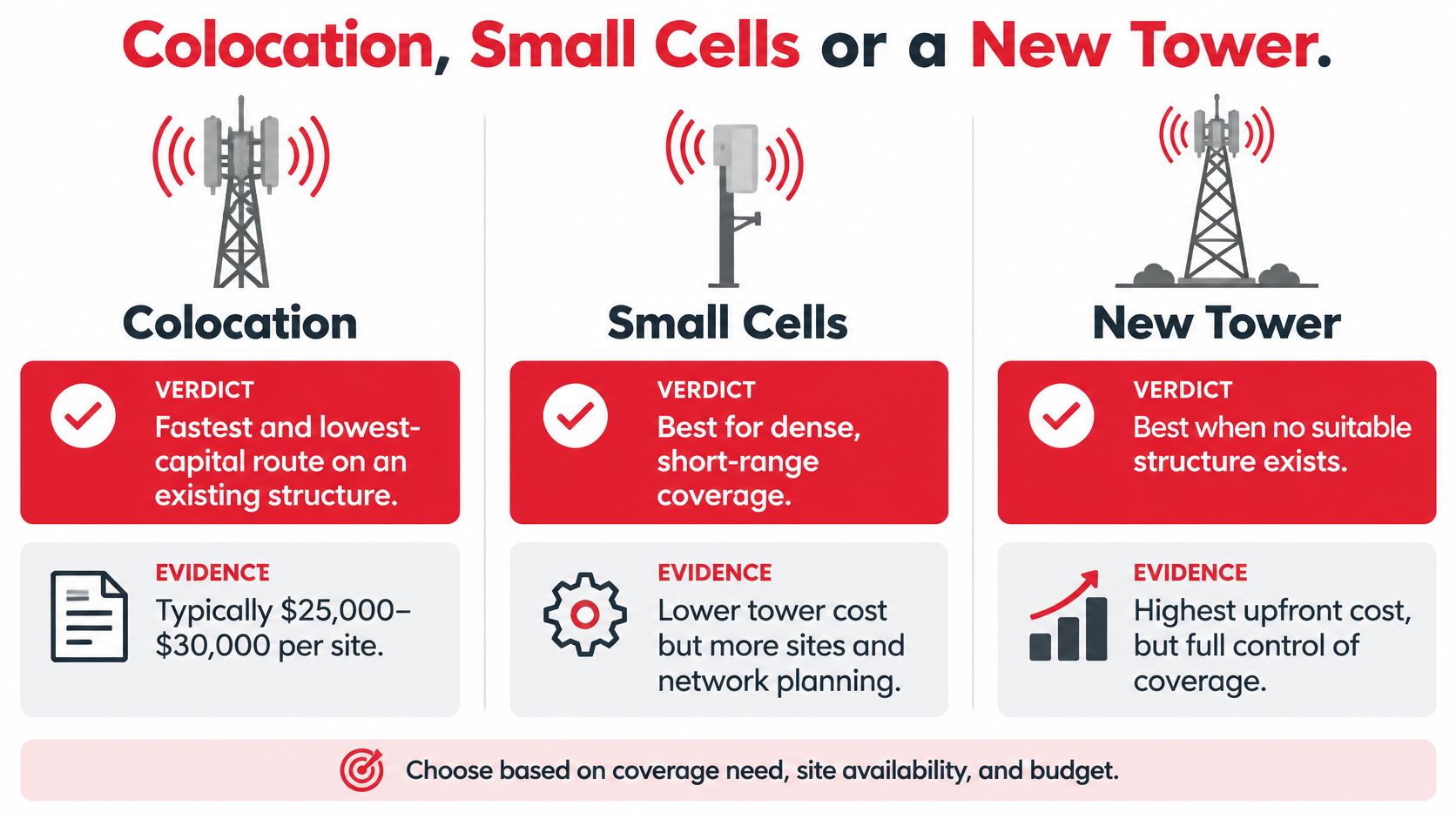
The same filing also shows why any single tower price can mislead: complete site development rises sharply when terrain, soil bearing capacity, wind and ice design, tower height, zoning, environmental mitigation, utility distance or antenna loading add work beyond the base structure.
| Situation | Best route | Typical capital cost | Watch-outs |
|---|---|---|---|
| Fastest coverage on an existing structure | Collocation | $25,000 to $30,000 | Structural reinforcement, new power, transport or zoning can raise cost |
| New capacity where no structure exists | New macro tower | $150,000 to $300,000 | Land, geotechnical work, access roads and backhaul; complex sites can exceed the base range |
| Dense urban capacity | Small cell nodes | $35,000 to $50,000 per site | Attachment, right-of-way review and backhaul requirements can reduce the apparent savings |
Compare the routes on lifecycle cost per unit of coverage or capacity rather than cost per structure. A collocation that requires reinforcement, a new power service and a new transport route can approach a modest greenfield figure. A new tower carrying three tenants spreads its cost across all three. Small cells can look inexpensive per node while serving a much smaller coverage area than a macro facility.
Southern Tier Resources offers wireless deployment with turnkey capabilities, keeping the civil, power, backhaul and radio scopes in one estimate instead of four. That makes it easier to compare a build proposal against collocation or small-cell alternatives on the same scope.
Judge the route by the coverage it delivers over ten years, not by the day-one invoice.
Get an Itemized Budget Before You Commit to a Build
A signature-ready total starts as a scope statement. Require the quote to separate land or lease, engineering and studies, foundation and steel, access and power, backhaul, radios and antennas, integration and testing, permit fees, and every recurring charge across the lease term. If a bidder gives one figure for "site complete," ask which of those lines it absorbs and which it excludes.
- Confirm the scope. State in writing whether the figure covers the tower alone or a working site.
- Check land treatment. Purchase, lease or easement, and who carries the escalation.
- Pull the local fee schedule. Height threshold, review triggers and the basis for annual charges.
- Model recurring cost over life. Ground rent, power, backhaul lease, maintenance and inspection, spread across the expected site life.
- Compare on lifecycle cost per unit of coverage, using the route comparison above rather than cost per tower.
Steps three and four decide whether the budget survives contact with the site, because they depend on a second party's fee schedule and on annual charges that never appear on a construction invoice. A low steel number can still lose to a higher bid once escalation, power, backhaul and inspection are priced across the same term.
If you want help applying this framework to your site, call Southern Tier Resources at (469) 405-4671 to discuss engineering, construction and turnkey wireless deployment for your coverage plan.