
You're three weeks into a fiber route, the design is locked, and the poles are still waiting on someone else's crew. The cable company has to move its strand. The phone company wants its own window. The electric utility will not book until both transfers are done. Your splice date slips, and the tracker only says "waiting on make-ready."
That stall is what the one touch make ready process was built to shorten. One qualified crew can finish eligible communications-space work in a single visit, but only when classification, notices, and the record set are right before anyone climbs. On these routes, the schedule is won or lost on evidence.
What the One Touch Make Ready Process Is and Why It Exists
A city pole is a shared ladder. Power sits at the top. Below it, several owners hang cable, fiber, and hardware in the communications space. Before one crew could finish the prep in one stop, each owner climbed in turn.
Say a new fiber route has to clear an existing coax bundle along a commercial street. You filed with the pole owner and waited. The first attacher moved its wire. The second booked a later week. A third found a conflict and sent the job back. Each handoff meant another mobilization and another week the route did not move.
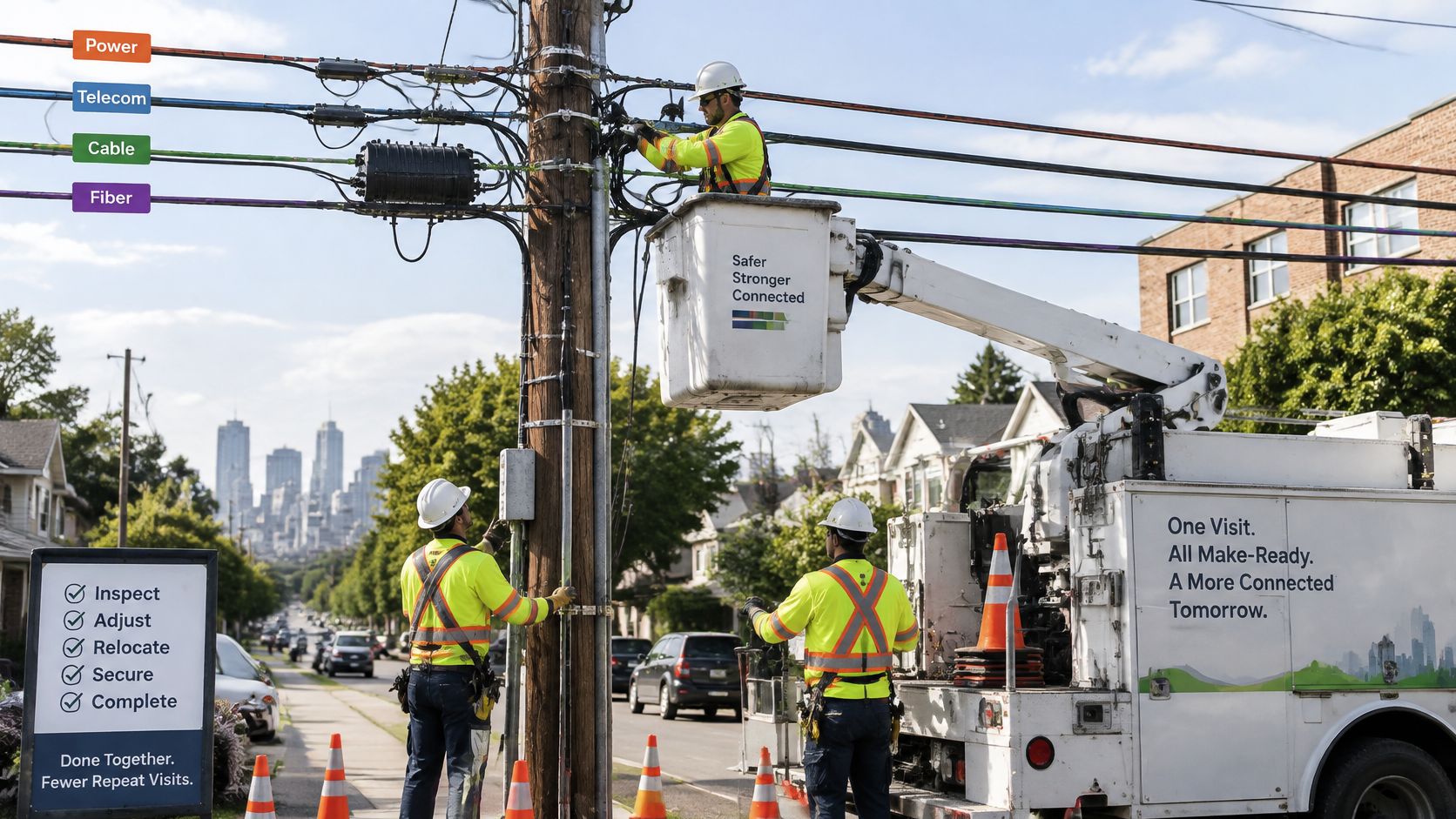
The one touch make ready process flips that sequence for eligible work. The new attacher coordinates the survey, sends the required notices, and performs simple make-ready in the communications space instead of waiting for each incumbent to act alone.
The FCC one-touch make-ready rules come from the Third Report and Order, adopted on August 2, 2018 and released on August 3, 2018. The rules took effect on October 15, 2018, and the OTMR provisions became operational on May 20, 2019. That framework requires at least 3 business days' advance notice for surveys and 15 days' advance notice before make-ready begins. After the work, existing attachers must be notified so they can inspect it.
What you gain and what stays out
You get fewer work cycles, less dependence on each incumbent's calendar, and a shorter path from permit to strand. You don't get a pass on every pole.
Complex work stays outside simple OTMR. That includes likely service outages, facility damage, splicing of existing communications attachments, or relocation of existing wireless attachments.
If the job needs a splice into someone else's cable, or a move of an existing radio, it isn't a one-touch job.
Before you staff the route, ask one question. Does every pole on this segment qualify as simple communications-space work, or does part of it still need the old sequential path?
Roles and Responsibilities of Each Party
The new attacher carries the schedule. You give the notices, you hold the survey file, and you answer when an incumbent says a transfer looks wrong. Everyone else has a narrower job, and mixing those jobs is how routes stall.
| Party | Main responsibility | Must provide | Typical risk |
|---|---|---|---|
| New attacher | Coordinates survey, notices, and make-ready work | Survey data, notices, preconstruction package | Notice errors or incomplete documentation |
| Utility or pole owner | Reviews applications, completes surveys and estimates | Completeness decision, survey results, estimates | Delays from missing information or objections |
| Existing attachers | Inspect completed work within the window | Inspection feedback, damage claims | Disputed or undocumented changes to their equipment |
| Contractor | Determines whether work is simple and performs it | Qualifications, pole-by-pole records, photos | Misclassified work that is reclassified as complex |
| State or municipal regulator | Sets rules where the state regulates attachments | Jurisdiction-specific procedures | Different timelines and eligibility rules by market |
How the rows actually play out
The utility or pole owner decides whether the application is complete, runs surveys and estimates on the conventional path, and can object in writing. A written objection treats the work as complex, so the one-touch path stops on that pole.
Existing attachers don't build your route, but they keep the right to inspect and to file a damage claim. If your photos don't show their equipment before the move, their claim is hard to answer.
The contractor makes the first call on whether the work is simple. A crew that is qualified for communications-space transfers, and that will stop when a pole doesn't match the package, is the control. An unqualified crew that "makes it fit" creates the reclassification.
State and municipal regulators rewrite the table where they, not the FCC, set attachment rules. A municipally owned pole or a state-certified utility can change who reviews, who may climb, and which clock applies.
Confirm ownership on each pole before you assign duties. A route that starts on an investor-owned utility and crosses onto a municipal pole is two workflows, not one.
Stage-by-Stage Timeline and Deadlines
Read the table as a planning clock for federally regulated attachments, not as a promise that crews will be done on the last day. Windows scale with order size, and work above the communications space runs longer than work inside it.
The FCC large-order schedule lists 10 business days for completeness review, 45 days for OTMR merits review, 90 days for survey or merits review, 29 days for the estimate, and up to 120 days for communications-space make-ready or 180 days for work above the communications space after payment.
| Stage | Responsible party | Deadline or window | Notes |
|---|---|---|---|
| Survey notice | New attacher | At least 3 business days before survey | Required notice before surveys begin |
| Advance notice of make-ready | New attacher | At least 15 days before work begins | Identifies the work to existing attachers |
| Application completeness review | Utility | 10 business days | Large-order schedule; missing data can restart the clock |
| OTMR merits review | Utility | 45 days | Large-order schedule |
| Survey or merits review | Utility | 90 days | Large-order schedule |
| Estimate | Utility | 29 days | Estimate precedes payment |
| Construction window, communications space | Contractor and new attacher | Up to 120 days after payment | Large-order schedule |
| Construction window, above communications space | Contractor and new attacher | Up to 180 days after payment | Power-space and complex work take longer |
| Completion notice | New attacher | Within 15 days after completion | Lets owners and attachers schedule inspection |
| Inspection window | Utility and existing attachers | At least 90 days | Disputes usually surface here |
What changes the window
A small order doesn't inherit the large-order construction caps. Work in the communications space is the shorter construction window. Work above that space, including power-space facilities and complex rearrangements, takes the longer one and more utility oversight.
Missing survey, pole-loading, or clearance data at completeness review can restart the clock. OTMR can cut incumbent-transfer waiting. It doesn't erase engineering, utility review, the estimate, or the post-payment construction window.
Two gates before you publish dates
Put every route through two controls, the same way you would when managing workflow dependencies across teams.
- Permit-readiness gate: Complete application, survey, and pole-loading and clearance documents are in the file.
- Production gate: The contractor is approved, incumbent notices are out, materials are staged, and outage or traffic control is planned, with inspection closeout assigned.
Date the route from those gates. If a pole fails the simple-work test, don't put it on the shorter construction bar.
Run the Route Step by Step and Keep Closeout Records
Treat the field day as the last step, not the first. The FCC OTMR order lets a new wireline attacher elect the survey, the notices, and make-ready for eligible simple make-ready in the communications space. Qualified contractors can finish that work in a single field mobilization, with at least 15 days' advance notice to existing attachers and notice within 15 days after completion. Inaccurate loading data, weak clearance analysis, a bad transfer, or damage to incumbent facilities comes back as rework.
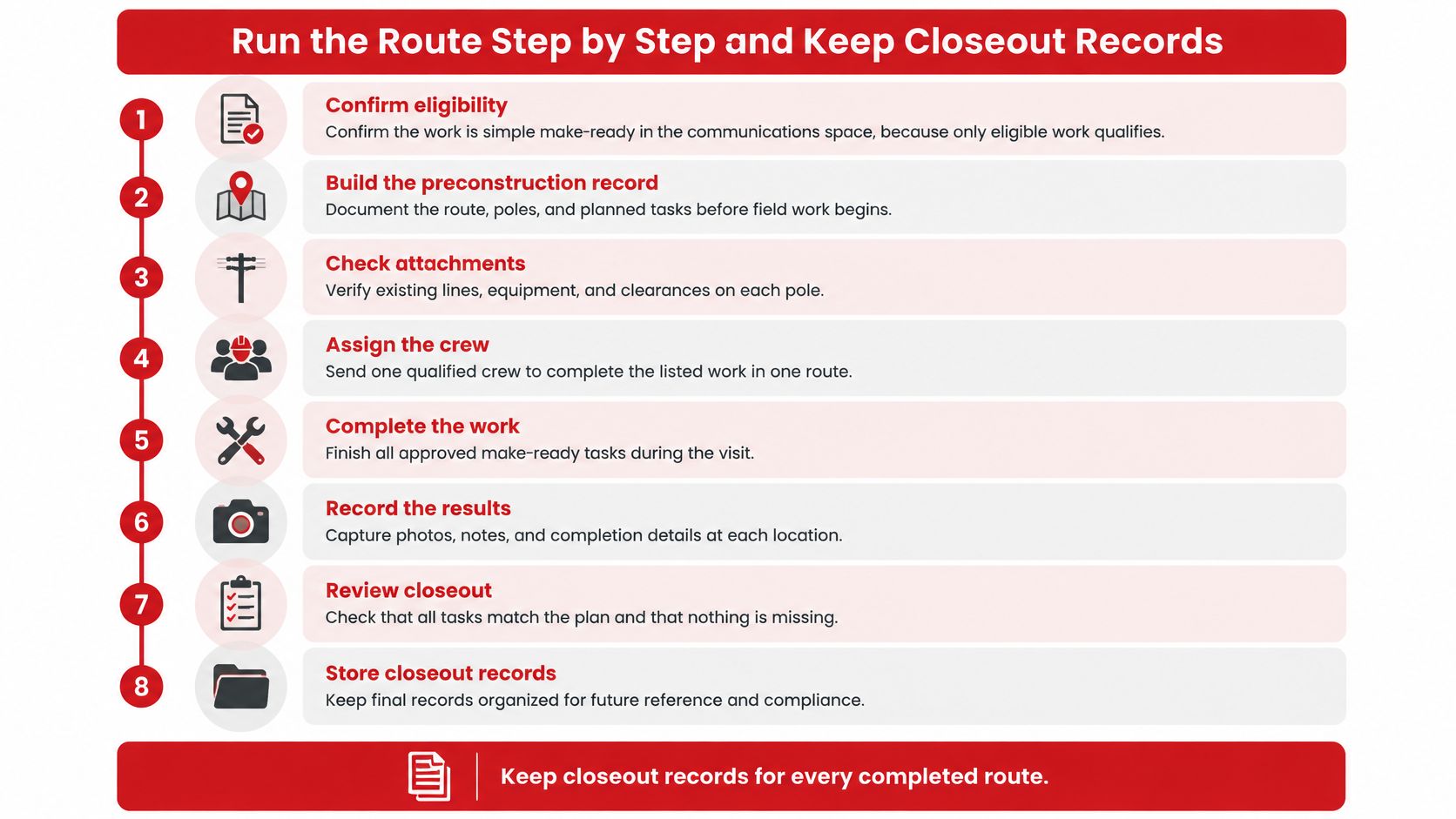
Eight steps and why each one exists
- Confirm the work is simple make-ready in the communications space. Only that class is eligible. Rearranging electrical facilities, or any complex make-ready, is outside this path.
- Build the preconstruction package before dispatch. Pole-by-pole survey results, engineering calculations, attachment heights, and the communications-space classification are the crew's instructions. Add contractor qualifications and the traffic-control plan to the same file.
- Send the survey notice at least 3 business days ahead. Existing attachers need time to know someone will be on their plant.
- Send written advance notice at least 15 days before make-ready starts. Name the work. A crew that rolls early breaks the notice and hands the incumbent a clean objection.
- Qualify the contractor and approve traffic control before the truck leaves. The person who classifies the pole has to be allowed to stop, not pushed to "get the span done."
- Finish the eligible work in one mobilization and photograph every pole before and after. One visit is the point. Photos are what make that visit defensible.
- Notify the utility and existing attachers within 15 days after completion. Under the pole-attachment rules, those parties then get at least 90 days to inspect.
- Hold that inspection window and log every exception. A later damage claim is normal. An empty file is not.
Two slips show up constantly. Pole-loading numbers that don't match the field, and a contractor who starts before the notice period ends. Both turn a fast day into a dispute.
The file that answers a claim months later
Faster construction doesn't drop governance. One contractor can touch several owners on one visit, so the record has to be standard.
Index the closeout by pole number:
- Before-and-after photographs: Same face of the pole, readable attachment heights.
- Attachment inventory: Whose plant was on the pole, and where it sat after the move.
- Clearance measurements: Communications-space separations the design required.
- Contractor qualifications: Proof the crew was approved for this class of work.
- Redlines: What changed from the package once the crew was on site.
- Inspection notices: Who was told, and on what date.
- Exception log: Poles skipped, conflicts found, work left for a complex path.
- Chain of custody for removed hardware: What came off the pole and where it went.
Build the closeout before the crew leaves the span. You won't rebuild it from memory during the inspection window.
Chris at SnapDial put the standard this way: "They delivered the project on time and provided as-built plans." That is the bar. A complete as-built, not a stack of unsorted truck photos, is what you hand an attacher who says equipment was damaged or moved months later.
Where OTMR Breaks Down and How to Fix It
Say the fiber leaves an investor-owned utility and, six poles later, lands on a municipal electric system in a state that regulates attachments itself. The federal one-touch rules don't follow the strand across that line.
An ISE magazine analysis reports that 23 states and the District of Columbia have taken pole-attachment authority. Eligibility, timelines, contractor rules, and dispute paths can differ by market. The useful question is whether this route, pole by pole, can use OTMR at all.
Classification is the second break. Federal rules require the attacher to identify OTMR in writing and put on the contractor the call of whether the work is simple. The utility can object in writing. After that objection, the work is treated as complex.
OTMR can cut sequential coordination. Poor classification or a thin file moves the pain into rework, disputes, and a date you can no longer defend.
| Symptom | Likely cause | Fix |
|---|---|---|
| Utility objects and work is treated as complex | Contractor misjudged scope or evidence is thin | Stop, document the scope, and re-file as complex with survey data |
| Long delays on a pole in one state | State regulates attachments, so FCC rules don't apply | Confirm jurisdiction and the state procedure before filing |
| Application stalls after completeness review | Survey, pole-loading, or clearance data is missing | Complete the package before the application clock starts |
| Rework after installation | Pole loading or clearance data doesn't match field conditions | Re-run engineering calculations and verify on site before dispatch |
| Existing attacher disputes equipment changes | No before-and-after photos or attachment inventory | Keep a closeout package for every pole |
What to build instead of another process poster
Carriers and municipalities need a jurisdiction-and-risk matrix, not another step diagram. For each pole, record state certification, the utility tariff, whether the owner is a municipality or a cooperative, any collective-bargaining limit on who may climb, and whether the work is simple.
A written objection isn't a negotiation. It reclassifies the pole. Stop the crew and rebuild the file.
Keep the audit trail with that matrix: the OTMR election, the contractor's simple-work call, the photos and calcs that support it, and any utility objection. That packet is what you use when a pole crosses a jurisdiction line mid-route.
Confirm Eligibility and Choose Your Next Step
Run a go or no-go test before you promise a delivery date. Fail any check and the pole leaves the one-touch path.
Check jurisdiction. Confirm whether the pole sits under FCC attachment rules or under a state that regulates attachments itself. Federal OTMR doesn't apply on the state side.
Check classification. Each pole's work has to be simple make-ready in the communications space, backed by survey notes and engineering calculations. A guess from the sidewalk isn't a classification.
Check readiness. The preconstruction package is complete, and the survey notice and the advance make-ready notice are ready to send on the required clocks.
A failed check means the conventional sequential process, or a refile once the evidence supports a simple-work call. Don't blend the two on one spreadsheet row and hope the utility sorts it out.
Three actions after the test
- Date the route from the stage timeline. Separate permit-readiness from production, and use the longer window wherever work sits above the communications space.
- Build a pole-by-pole eligibility sheet. Record state status, ownership, scope classification, and the evidence behind the simple-work call.
- Adopt one closeout template. Every pole gets the same indexed set, so an inspection 90 days later doesn't depend on who was in the bucket.
In 2025, the Federal Register notice of the FCC proposal set out a 15-day deadline for a utility to grant or deny a complete one-touch make-ready application, extended to 30 days for mid-sized orders and 45 days for large orders. That is a proposal, not a final rule. Plan on the timelines in force today, and revisit the sheet if the Commission adopts the shorter grant-or-deny clock.
Southern Tier Resources designs, builds, and documents fiber routes, including make-ready construction, splicing, testing, and as-built records for carriers and ISPs. If your next build needs a single partner from permitting through closeout, visit Southern Tier Resources and tell us which routes you're trying to get on pole.