Most network builds don't lose their handover date in the trench or on the pole. They lose it weeks earlier, when an unwalked route becomes a baselined schedule, a make-ready assumption becomes a crew booking, and nobody owns the date power arrives. Knowing how to reduce project delays starts with naming which date controls service, not which crew can work faster.
Why Network Schedules Slip Before Mobilization
Preparation quality can determine whether a network schedule holds long before the first crew mobilizes. A route based on records rather than field conditions can send the design, procurement, and construction teams toward the same wrong assumption. The schedule may look complete while its release dates remain unproven.
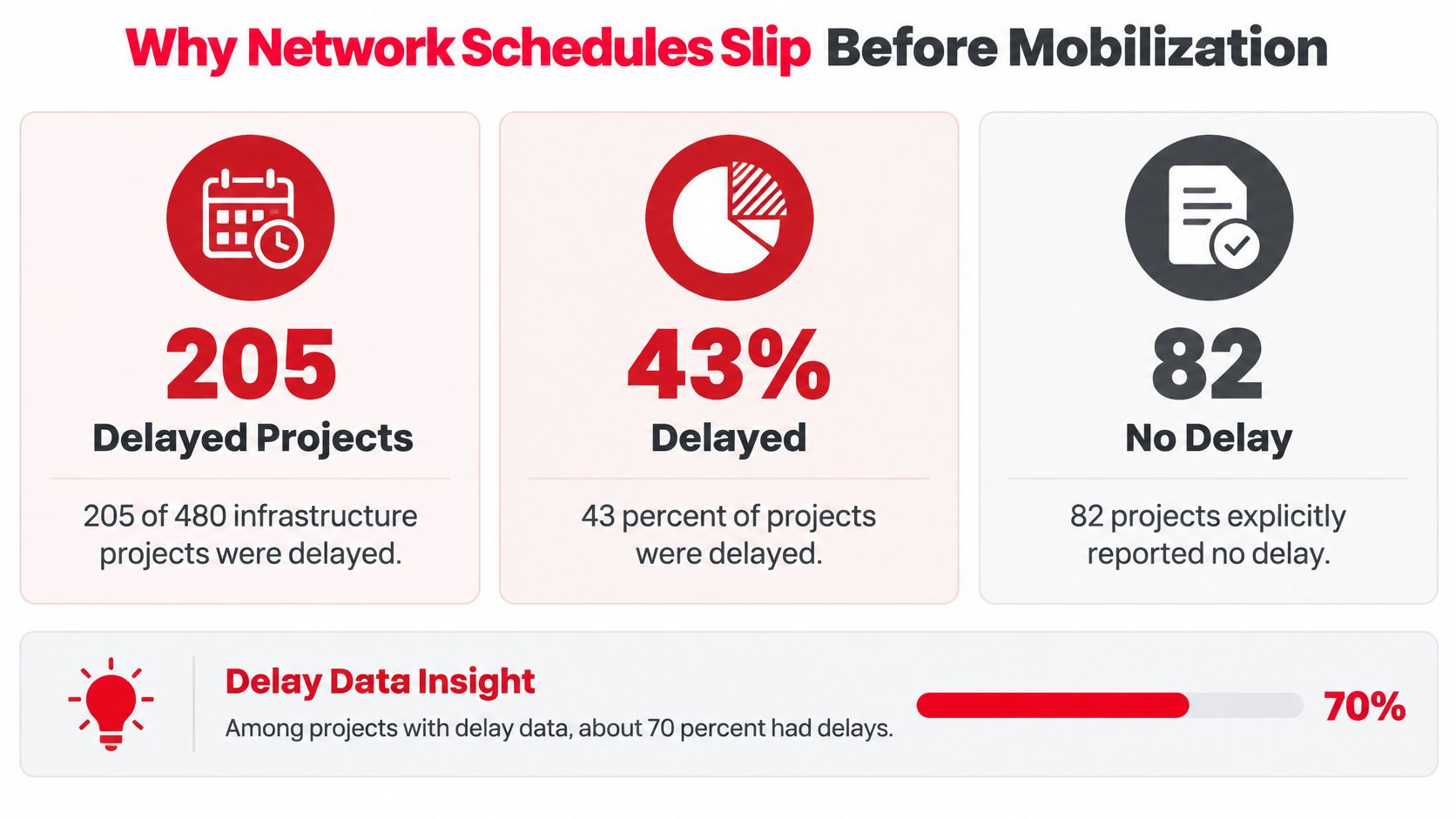
What weak preparation looks like on a network build
Across broadband, small-cell and macro wireless, and data-center fit-outs, early gaps often surface as field delays. A route has not been walked, so pole records may not reflect loading or clearance. A make-ready application has been filed, but no owner has issued a release. Splice counts, test thresholds, labeling, grounding, and owner-witness requirements remain undefined. The resource plan lists crews and equipment without tying them to funding, staffing, or need dates.
Those gaps rarely stop the schedule at kickoff. They emerge as idle civil crews, cable in a pathway that cannot be accepted, racks awaiting grounding sign-off, or a splicer returning because test evidence misses an unpublished standard. Checking these dependencies early is like assessing potential flight delays before departure: you have more options while the work is still being planned.
A pathway that cannot be tested, energized, or turned up is not progress toward handover. It is unfinished inventory.
The schedule should measure time to a usable network or energized facility, not just percent complete. Civil work can advance quickly and still leave the controlling date unchanged if permits, make-ready, power, testing, or documentation are outstanding. Faster construction can even worsen the handover risk when crews build ahead of those releases.
Phase Gates That Keep the Handover Date Honest
A gate isn't a status meeting. It's a stop point with one owner, one control that must close before work proceeds, and one KPI that tells you if the handover date is still honest. Paste this into kickoff and fill in names before you debate durations.
Delay control by project phase
| Phase | Typical delay driver | Owner | Control before it slips | KPI |
|---|---|---|---|---|
| Preparation and feasibility | Unclear scope and unfunded plan | Owner PM and designer | Constructability review, acceptance criteria, funded resources | Scope baseline date |
| Permitting and make-ready | Pole, ROW, and utility approvals | Permit lead | Constraint log with a named release date | Days the permit is on the critical path |
| Supply and long-lead gear | Fiber, racks, transformers, switchgear | Procurement | Reserved manufacturing slots against the need date | Lead time versus installation need date |
| Field production | Access windows and stacked crews | Superintendent | Six-week look-ahead; only constraint-free weekly work | Percent Plan Complete by workstream |
| Testing and turnover | Open tests, labels, and as-builts | QA and splice lead | Hold points for test, grounding, labeling, and owner witness | Days from physical complete to service activation |
Read the table as a chain of permissions. Preparation doesn't pass because drawings exist. It passes when the designer and owner PM can show a walked route or surveyed room, a constructability review with closed comments, acceptance criteria a tester can execute, and money and crews committed to the sequence. Permitting doesn't pass because applications are submitted. It passes pole by pole and parcel by parcel when the permit lead can point to a release date for each approval sitting on the critical path.
Supply works the same way. Procurement owns the gap between factory lead time and installation need date, so "ordered" isn't a status. Reserved, released for fabrication, shipped, and received against a specific workfront are statuses. In the field, the superintendent protects crews by refusing to promise work that still lacks access, locates, materials, or an approved design. At turnover, QA and the splice lead own hold points, not a punch list assembled after the customer asks why service isn't live.
Gate rule: If a gate has no owner and no release date, treat it as a delay already in progress, not a risk to monitor.
Use the model to test the gates, not to decorate them
A federated 4D or 5D model earns its cost when it links civil drawings, utility information, pole or tower assets, pathways, equipment rooms, power, structured cabling, and access constraints to activities, quantities, and cost codes. Run the sequence in time and you'll see conflicts a static drawing hides. Cable pulling scheduled before pathway acceptance. Duct-bank work colliding with restoration. Rack energization before grounding and commissioning. A shutdown window that serves two trades at once.
Published case evidence in a review of 4D and 5D scheduling applications reports delay reductions of 15% to 50% across global case studies, while one cited Chinese subway application reported a 15% reduction in delays. Treat those numbers as benchmarks beside your gates, not as a promise. They depend on model quality, how often field production updates the model, and whether contractors plan from it.
I would not fund a model that only renders geometry. It needs constructability logic, temporary works, shutdown and access windows, current drawings, splice-test dependencies, labeling and documentation deliverables, energization hold points, and owner-witness requirements. Clash detection won't catch a missing permit or an unreserved transformer slot. At each gate, require clashes, permit dependencies, long-lead equipment, work-area access, and test criteria closed or explicitly excepted, then issue an exception report when daily production varies from the model. Otherwise you'll get a physically complete installation that still misses turnover because nobody modelled the work after installation.
How to Run a Six-Week Constraint Look-Ahead
Don't start by refreshing the bar chart. Start by deciding which tasks are allowed to become promises. A constraint-driven Last Planner routine gives fiber, wireless, and data-center teams a weekly filter between the master schedule and the crew's day.
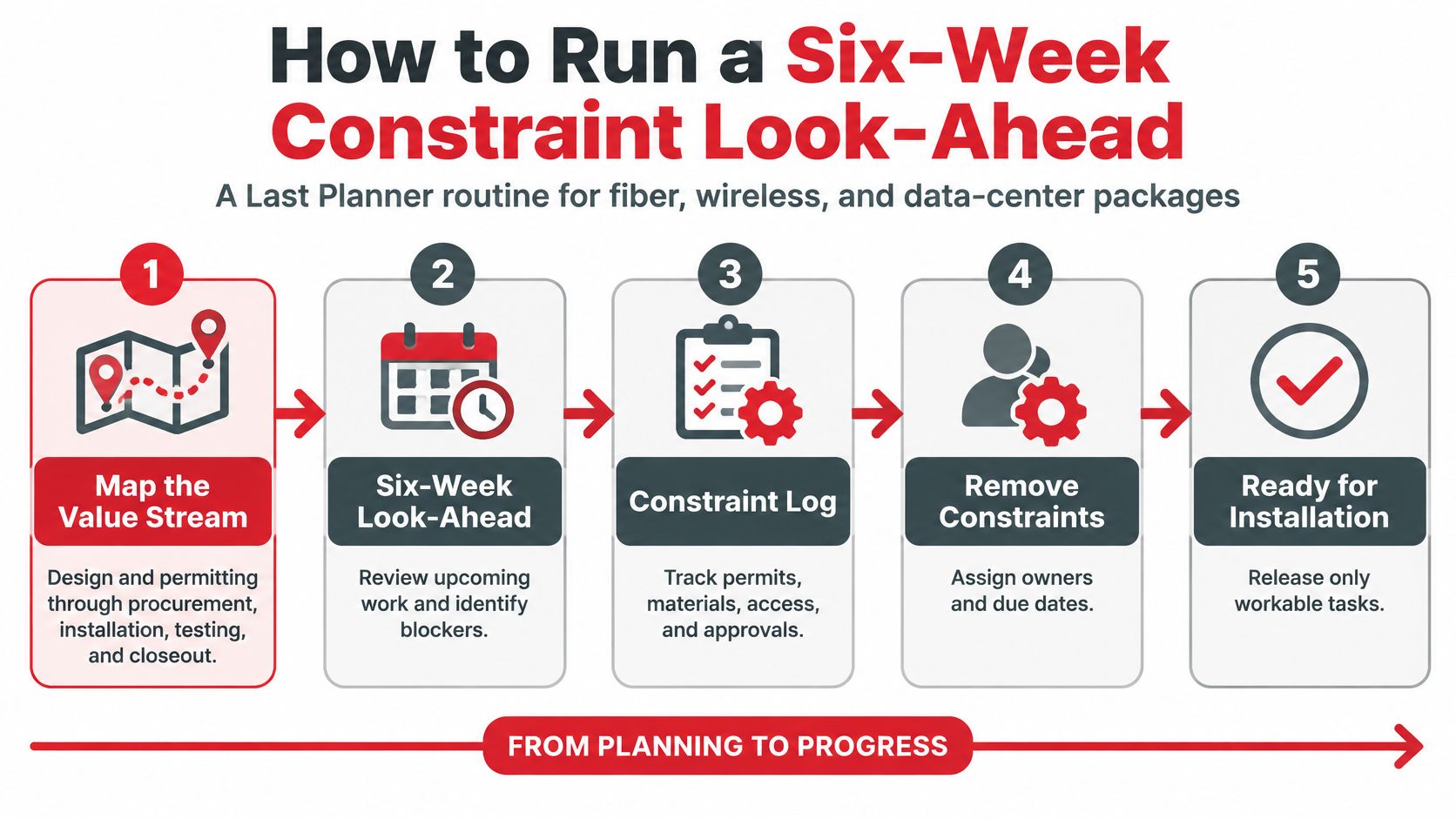
The six moves, in order
- Map the value stream end to end. Walk design and permitting through procurement, installation, testing, and closeout with the people who hand work to each other. Then pull-plan backward from the required in-service or energization date, so predecessors inherit dates from the handover they serve.
- Build the six-week look-ahead. List work entering the next six weeks and expose every constraint against it, including permits, utility locates, make-ready approvals, materials, access windows, design clarifications, and qualified crews. Six weeks is long enough to release most field constraints and short enough that owners can't hide behind a distant milestone.
- Give each constraint one owner and one release date. Not a department, not "the utility," not a shared inbox. One named person who reports status, escalates blockers, and confirms release with evidence. A constraint with no owner stays red.
- Commit only constraint-free work. The weekly board contains tasks the crew can start and finish as defined, with materials on hand, access confirmed, predecessor accepted, and test or documentation requirements understood. Everything else stays in the look-ahead where it belongs.
- Score Percent Plan Complete at week end. Count completed commitments against promised commitments, segmented by civil, make-ready, cabling, splicing, testing, and as-builts. Segmentation matters because a strong civil week can hide a splicing backlog until turnover collapses.
- Run a 5 Whys review on every miss. Ask why until you reach a cause you can fix, such as a locate ticket released without a site contact or enclosures ordered to install date instead of need date. When a cause repeats, escalate it. Don't re-baseline the milestone and call that recovery.
Set the score honestly
A systematic review of 83 lean-construction studies found Percent Plan Complete values of 55% to 85%, with typical lean-adoption improvements of 15 to 20%, rework reductions of 10% to 35% when Last Planner is combined with BIM-based coordination, and lead time reductions of 12% to 30% from lean procurement and digital logistics. Use that range to calibrate, not to boast. Establish your baseline in the first honest weeks, then improve in 5 to 10 percentage-point increments by removing recurring causes.
Three habits produce a false score. Teams count a task complete while testing or as-builts remain open. They hide constraints in texts and side conversations where the coordinator can't age or escalate them. They track milestone dates only, so weekly unreliability stays invisible until float is gone.
Leave the first session with a red, amber, green constraint list and a PPC baseline by workstream. If you leave with only a prettier schedule, you didn't run a look-ahead.
Keep the meeting short and evidence-based. Owners confirm release dates or move them in front of the group, the superintendent accepts or rejects tasks for the coming week, and QA confirms what "done" means for test and documentation. That discipline is how to reduce project delays week by week, because it stops unready work from consuming crew time and creating rework downstream.
Worked Timeline Mitigations and Subcontractor Handoffs
Say a fiber build is planned over 120 days and stalls around day 45 because one pole make-ready approval never had a release date. The civil crew is ready, cable is staged, and the splice window is booked, but the controlling approval is still a conversation. Treat the day counts below as placeholders for your own calendar. The sequence is the point.
An illustrative recovery sequence
- Day 0, reset from handover: Pull-plan backward from the in-service date. Give every make-ready approval, utility locate, access window, and crew booking an owner and a release date on one log.
- Day 7, segment the route: Split the route into three segments. Civil crews start the first released segment instead of waiting for the entire route to clear, and each segment carries its own permit and test status.
- Day 14, protect the pull: Confirm pathway acceptance before scheduling the cable crew. If a pull starts into an unaccepted pathway, log it as a rework risk, not as earned progress.
- Day 30, order to need date: Release transformers, splice enclosures, and other long-lead items against the date the workfront needs them for staging and inspection, not the later install date.
- Day 60, hold energization: Don't energize racks until grounding and commissioning sign off. A powered rack that fails witness testing costs more time than a short, planned hold.
Make subcontractor handoffs explicit
Give each subcontractor one written interface agreement before mobilization. It should state access windows, predecessor acceptance, the labeling standard, test-witness requirements, deliverable format for as-builts, and who can authorize a field change. "Coordinate with others" isn't an interface.
Assign one coordinator to hold the constraint log across all subcontractors. That person runs a 15-minute daily call on the critical segment only, confirms today's access and materials, and closes yesterday's handoff defects. Other segments report through the weekly look-ahead so the daily call stays focused.
When a subcontractor misses the same commitment twice, escalate to the owner PM with the cause and the decision needed. Don't absorb the miss by moving dates in the background. Repeated misses usually mean the predecessor, crew qualification, material, or access assumption is wrong, and only an owner-level decision will fix it.
Power Readiness Before You Speed Up Civil Work
A site can be nearly built and still be months from serving a customer. On data-center and telecom projects, the handover date depends on usable power, not civil percent complete. Adding trench crews may finish buildings, huts, or halls earlier without changing when they can be energized.
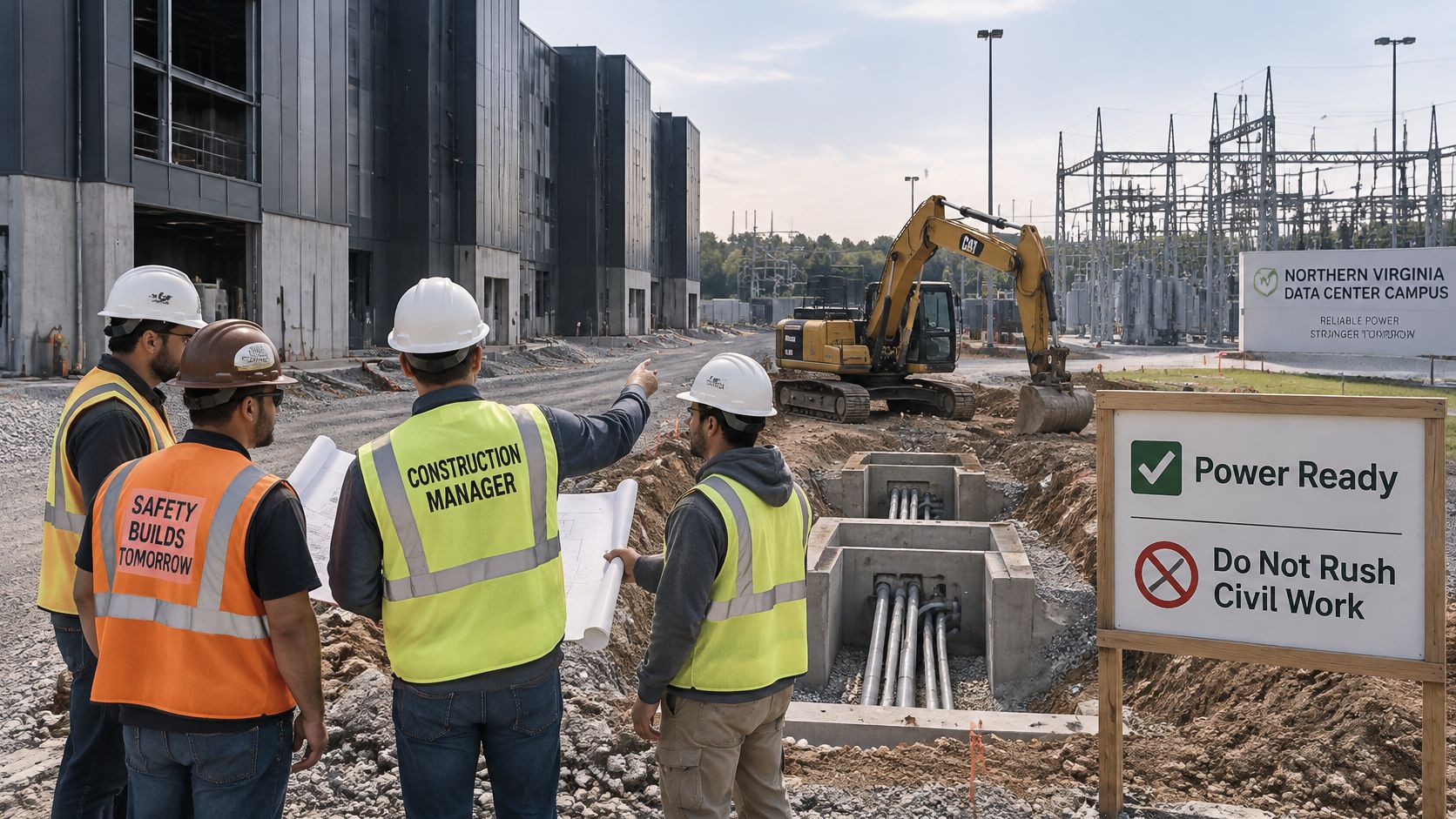
In Northern Virginia, large data-center campuses may require 3 to 5 years to receive power because substations and transmission upgrades must be completed. Procuring transformers and switchgear can add roughly two years, according to EY analysis of power delays in engineering and construction. Interconnection-to-operation timelines can run many years. Against that schedule, saving two weeks in trenching is not meaningful recovery unless it changes the date power is available.
Start the power gate before final site selection
Order a utility capacity study while you can still choose another site, phase the load, or redesign the service. Map transmission and substation dependencies in sequence. For each one, name the party responsible and the approval that releases the next step. Flag transformers, switchgear, generators, and protective devices with long lead times. Reserve manufacturing slots against need dates, and confirm factory test and delivery requirements early.
Set an interim energization plan only if partial load provides usable service, such as commissioning, a first hall, a hut, or staged tenant fit-out. If a temporary feed cannot support a meaningful operational milestone, don't count it as an activation date.
Before approving acceleration money, ask whether added civil output changes the energization sequence. A field walkthrough with the electrical lead should end with a named power milestone and its owner, not a general assurance that the utility is engaged.
Acceleration rule: Civil, rack, or fit-out work completed before power may increase total delay costs. The team pays to finish early, then may have to protect completed work, retest it, and remobilize.
Broadband and wireless projects face the same schedule logic at smaller scale. Make-ready, backhaul availability, and the service entrance can control handover more than trenching output. A pole set without released backhaul or a meter is not ready to serve customers. A fiber route with its splices closed but no powered active equipment is not in service.
Keep a separate power-readiness schedule. Track the utility study, interconnection milestone, substation or transmission dependency, switchgear and transformer need-by dates, temporary power decision, grounding and commissioning hold point, and the first date a customer can take service. Separate tracking makes dependencies visible when general construction progress looks strong.
A verbal utility assurance is not a reliable handover date until the study, agreement, and construction sequence support it. Before authorizing acceleration, identify the controlling dependency in one line: power, make-ready, backhaul, or labor. If labor does not control handover, direct the money toward the dependency that does.
Tips for Changing Scope Without Resetting the Date
"Freeze the scope" sounds disciplined until a crew opens a handhole that isn't on the drawing, a pole fails loading review, or a permitting agency requires a redesign. Field learning is real. The goal isn't zero changes. It's a short, controlled path from discovery to a buildable decision.
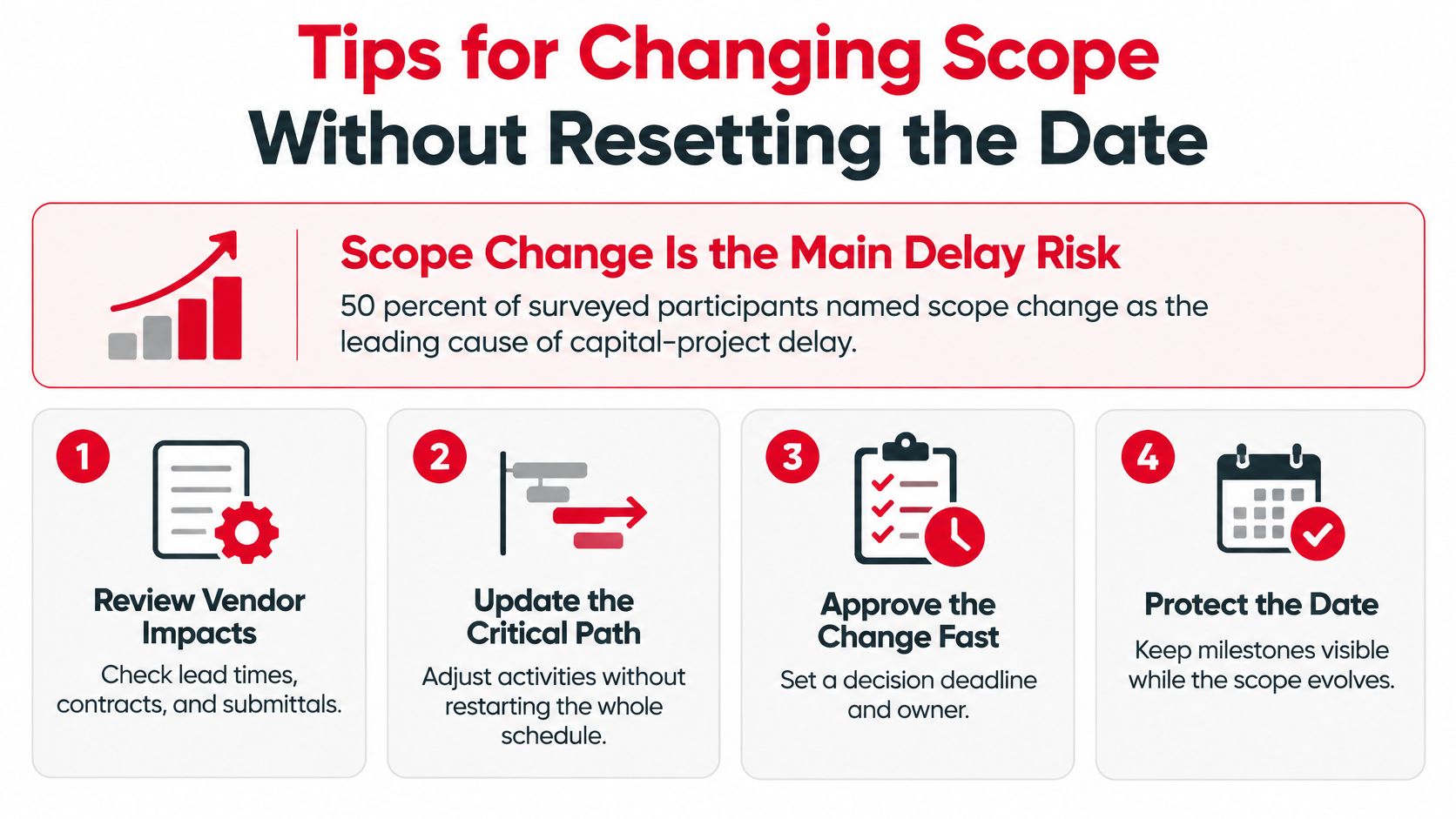
Scope changes were identified as the leading cause of capital-project delays by 50% of surveyed participants, followed by vendor performance at 46%, with regulatory compliance and supplier shortages each at 36%, in survey results summarized in an AIX Energy analysis of infrastructure delay risk. That ranking argues for managing decision speed, not pretending change can be banned.
Tips you can adopt this week
- Keep a quantified change budget: Set aside defined hours and dollars for field adaptation, draw against it visibly, and escalate when the balance no longer covers the remaining risk. An unquantified allowance invites teams to hide change until it becomes a claim.
- Classify before you debate: Sort every issue as safety, regulatory, constructability, or customer impact at intake. Category determines who decides and how fast. Don't let the field crew, designer, and owner argue category while the workfront sits idle.
- Preapprove repeat alternatives: For recurring conditions such as a loaded pole, shallow utility conflict, grounding miss, or blocked cable route, approve the standard alternative, unit cost, and documentation in advance. The field team executes a known play instead of waiting for a bespoke design.
- Use one decision record: Put survey photos, measurements, redlines, permit comments, the approved alternative, and the as-built note in a single record tied to the location. Testing and maintenance shouldn't rediscover the same conflict months later.
- Price the schedule effect immediately: State whether the change consumes float, moves a release date, needs a new material slot, or shifts a test window. A technically approved change that nobody sequenced is still a delay.
Put every change on a decision clock
Track elapsed time from issue discovery to an approved, buildable decision, plus rework hours and repeat site visits. Don't celebrate a low change-order count if each decision takes weeks and crews revisit the same site three times. Count matters less than cycle time and whether the decision stays decided.
Set target bands as team commitments, not industry law. I would use same-day decisions for safety and regulatory items, two working days for constructability items with an approved alternative, and the next weekly planning meeting for customer-impact items that need commercial review. If an item misses its band, it escalates with the options and schedule consequence attached.
A change with no category, no owner, and no clock goes back to the requester. That's not bureaucracy. It's how you keep design churn from masquerading as field necessity.
You can tell a necessary adaptation from avoidable churn in one meeting. Necessary adaptation cites field evidence, a code or permit requirement, or a customer acceptance need, and it fits a category and budget. Churn restates a preference, reopens a closed standard, or lacks evidence from the site. Approve the first quickly. Make the second compete for the change budget and the handover date in the open.
Lock Turnover Metrics Before the Next Crew Rolls
A segment can be physically complete and still be weeks from usable service. Before the next look-ahead, define activation in terms a tester, inspector, and customer will accept. For a network segment, that means splice tests pass the stated threshold, labels match the records, as-builts are accepted, grounding is verified, and the customer can use the service. For a facility, confirm required energization and commissioning witnesses, alarms, access, and operations documentation.
Track three closeout numbers
- Days from physical completion to service activation: Shows how much time sits between construction completion and usable service.
- Rework hours after the test window opens: Distinguishes punch work from defects in splicing, labeling, grounding, or routing.
- Repeat site visits caused by missing documentation: Reveals when closeout slips because the record package is incomplete.
Review these measures while the crew and designer are still assigned. Turn each miss into a changed constraint, an approved alternative, a checklist item, or an acceptance test for the next route, site, or hall. A lessons session only helps the next schedule when it changes the baseline.
Keep safety in the release gate. Skipping locates, exceeding make-ready limits, or bending energized-work rules can turn a short-term schedule gain into a stop-work, utility strike, injury, or failed inspection.
One accountable partner across the lifecycle can reduce handoff gaps. Southern Tier Resources provides end-to-end services, from design to deployment and maintenance. Chris of SnapDial said, “They delivered the project on time and provided detailed as-built plans.”
Choose the single date that must move first, whether it is power, a permit release, a factory slot, or a test window. Name the owner and the evidence required to release it. Then decide whether another crew can help. More labor on a blocked workfront only builds a larger queue.
If power, make-ready, permitting, or turnover documentation controls your next in-service date, discuss that constraint with Southern Tier Resources before authorizing more crews. The company provides end-to-end services, from design to deployment and maintenance. Discuss the single date that has to move first and the gate that will prove it moved.