
What are buyers really evaluating when they search for National Technologies Inc, the infrastructure company or the legacy manufacturer? That confusion matters, because the wrong entity leads procurement teams to the wrong geography, the wrong capabilities, and the wrong owner history before they've even started a vendor comparison.
National Technologies Inc. is not a single, simple search result. The name points to a legacy manufacturing presence at nationaltechnologies.com, but the current NTI brand is a Network Connex company centered on fiber optic installation, data center fit-out, structured cabling, OSP and ISP fiber, and DAS work, which is exactly why buyers need to verify they're looking at the right firm before they judge delivery risk National Technologies Inc. company profile . For infrastructure teams, that distinction isn't cosmetic. It affects who you call for a field deployment, who owns the corporate relationship, and which website describes the operating model you'd put into a bid list.
Clearing Up the National Technologies Inc Confusion
Searchers usually land in one of two places, and that mismatch is the first sign that the information around National Technologies Inc is uneven. One result points to a legacy manufacturing company tied to the National Technologies name, while the other leads to the current telecom infrastructure provider operating as NTI, with work centered on outside plant fiber, data center buildouts, structured cabling, and distributed antenna systems. Buyers trying to qualify a carrier build partner need to separate those entities before they score capabilities or compare delivery risk.
The entity buyers should evaluate today
The current NTI is the infrastructure company connected to Network Connex, not a pure manufacturing business. Its public positioning centers on network construction and integration work, which shifts the procurement question from product output to field execution. Can the company mobilize crews, coordinate access, and keep work moving in sites that do not tolerate delay? The current National Technologies Inc. company profile also points to nationwide deployment and multiple U.S. locations, which is consistent with a field-services operating model rather than a single-site manufacturer.
For procurement teams, that distinction changes how vendor scoring should work. A buyer who assumes the wrong corporate identity can misread labor depth, regional coverage, and documentation expectations before the first scope review. A team evaluating a field contractor needs evidence of how it schedules crews, manages site access, and documents completion, not a profile built around factory output.
Practical rule: if the buyer intent is telecom infrastructure, confirm the current NTI brand and corporate lineage before comparing scopes, pricing, or regional support.
The naming collision is the issue here. The legacy name still appears in search results, but the operating context that matters for carrier and hyperscale work is network infrastructure delivery, and that is the version procurement teams should place on the bid list.
NTI's Growth Trajectory and Market Position
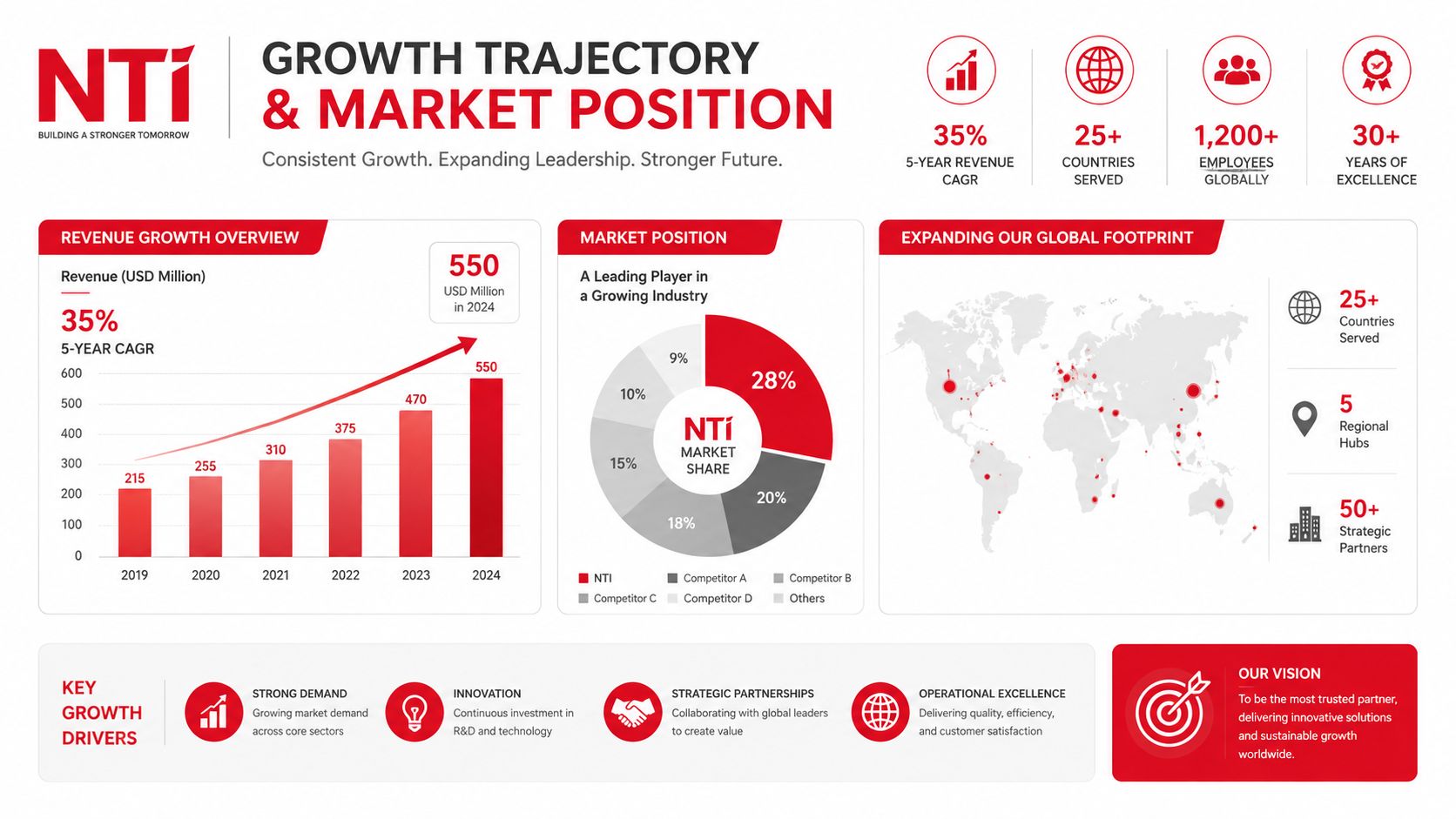
How should a procurement team read NTI's growth if the brand name is tied to a legacy manufacturing identity? The current operating picture is better understood through financial scale and delivery footprint than through the older name. The company was founded in 2009 and is headquartered in Downers Grove, Illinois. By 2024, its reported revenue had reached $380 million, up from $65 million in 2020, while total assets rose from $600 million to $850 million over the same period, and net income increased from $6.5 million to $43 million PrivCo financials . That kind of expansion suggests a business that has been taking on more work, building out its operating base, and supporting more complex deployment activity without relying on a single-site profile.
What the scale signals for buyers
Carrier infrastructure teams do not buy revenue. They do, however, need to know whether a vendor has the capacity to absorb multiple scopes at once, manage field labor, and keep documentation moving when projects overlap. A company that moved from $65 million to $380 million in four years has likely been carrying a larger mix of projects, coordinating more subcontracting or direct labor, and supporting a wider set of customer demands than a small regional contractor can usually handle. That does not prove execution quality, but it does point to a supplier that is operating at meaningful scale.
The asset growth is a second indicator that matters for procurement. Moving from $600 million to $850 million in total assets suggests a larger operating base that can support equipment, facilities, and working capital tied to rollout work. For buyers, that can matter when schedules tighten, access windows shift, or several sites need to mobilize in parallel. It also reduces the chance that a supplier is structurally thin when the work load spikes.
Independent company data adds a more granular, if imperfect, view of staffing. One source places NTI at approximately 171 employees in the U.S., while another reports 154 employees and $40.8 million in annual revenue for 2024 IBISWorld company profile . The gap does not undercut the broader read. It indicates a mid-sized business with enough footprint to matter and enough operational strain that staffing, scheduling, and crew allocation still need active management.
For procurement teams, that combination is the useful takeaway. NTI appears to sit in the range where corporate growth can improve coverage and capacity, while also making execution discipline harder to judge from scale alone. That is the right lens for comparing it with vendors such as Southern Tier Resources. The review should focus on labor availability, mobilization speed, and documentation quality, since those are the factors that decide whether a vendor can deliver on multi-site infrastructure work, not just look large on paper.
Buyer takeaway: treat NTI as a scaled telecom-services provider with a real operating footprint, then verify execution evidence before assigning it a role in your bid list.
Core Infrastructure Services and Deployment Capabilities
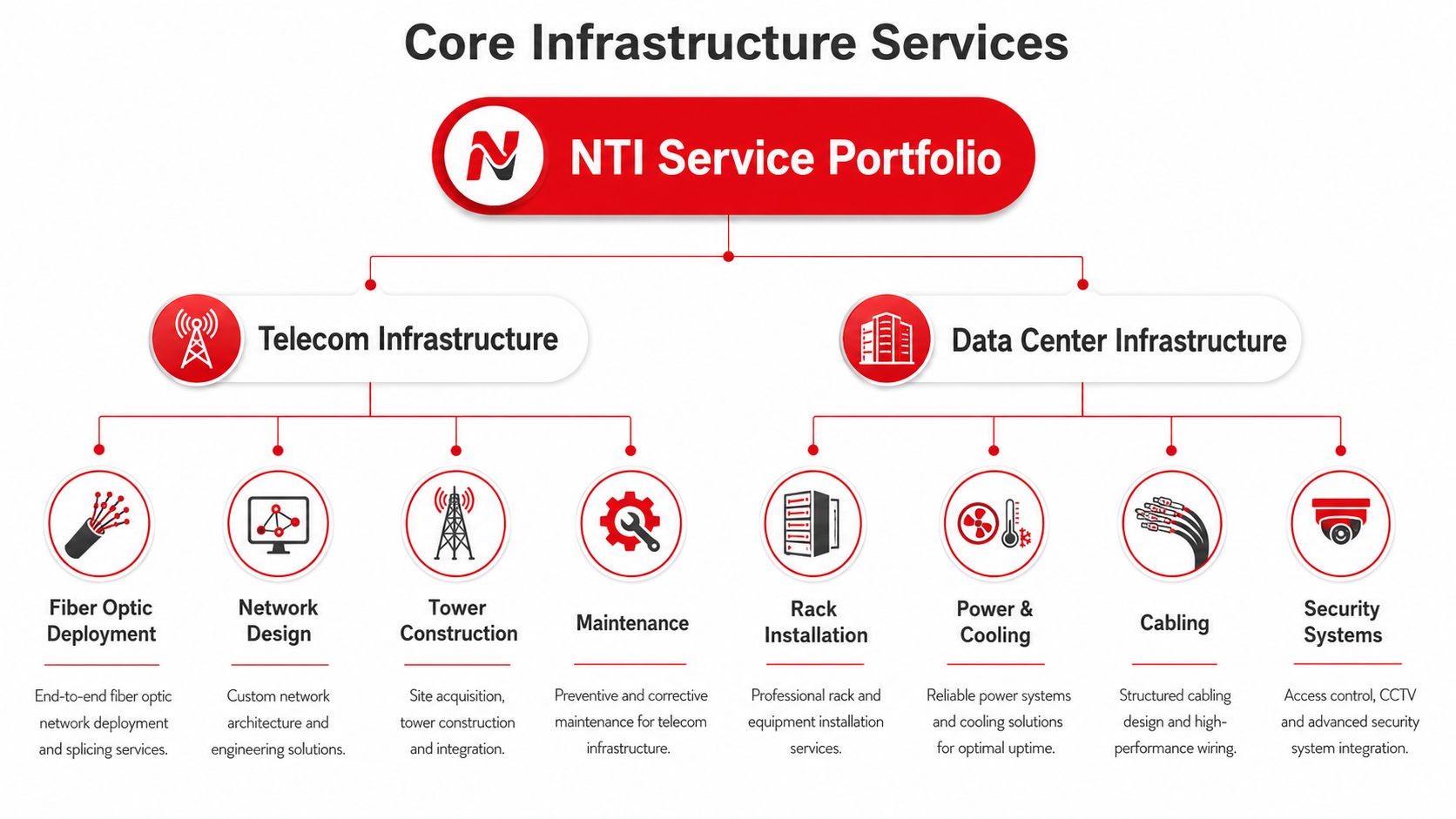
NTI's service menu spans the parts of network construction that procurement teams usually have to stitch together from multiple vendors. The relevant question is not whether the list is broad. It's which parts of the list map to your project type, your access constraints, and your documentation requirements. For a carrier or data center operator, that distinction determines whether NTI is a lead contractor, a subcontractor, or not a fit at all.
Where the service lines fit in real projects
Fiber optic installation is the most obvious fit for greenfield broadband, make-ready work, and backbone extensions. That's the service line that matters when a carrier needs field crews who can move from design intent to physical deployment under permitting and access constraints. Data center fit-out is a different type of engagement, because the buyer is usually integrating power, pathways, and connectivity inside a controlled facility environment where coordination errors become schedule risk. Structured cabling usually serves enterprise or campus settings, where clean termination, labeling, and handoff documentation matter more than outside plant scale. DAS deployment fits wireless coverage projects where signal distribution inside buildings or across constrained sites is the actual problem National Technologies Inc. company profile .
That mix is useful because it shows NTI is not only a one-line contractor. It can sit across wireline and wireless environments, which helps when a buyer wants fewer handoffs between field work and closeout. The company's public materials emphasize multiple U.S. locations and nationwide deployment, so the operating model appears built for mobilization rather than purely local work National Technologies Inc. company profile .
For buyers comparing workflows, a useful external reference is services for IT decision-makers from ARPHost, LLC, because it shows how infrastructure services are often evaluated through service scope, support structure, and continuity planning rather than isolated labor tasks.
The documentation and mobilization lens
The most important procurement question is whether NTI can document what it installs and hand the project back cleanly. As-built accuracy, testing records, and closeout quality often decide whether an installed network becomes an operating asset or an ongoing support problem. That's where 24/7 mobilization language should be tested against actual handoff discipline, not just availability claims.
For organizations that want a comparable service framing, the internal view of turnkey network solutions helps clarify how buyers often define end-to-end delivery across engineering, construction, and maintenance.
Decision point: if your project depends on clean closeout, ask NTI how it packages as-builts, test results, and turnover documents for multi-site work.
Technical Manufacturing Capabilities and Tolerances
NTI also publishes manufacturing capability data that helps gauge the firm's technical depth, even if manufacturing is not the main reason many buyers engage it today. The company operates a 56,500 sq ft manufacturing footprint and lists PCB fabrication tolerances down to .004 in./.004 in. inner and outer layer trace/space, a .010 in. minimum drilled hole, and 1 to 18 layer builds NTI technical capabilities . Those limits point to boards with tighter geometry and higher routing density than basic fabricators can usually support, which matters if a project includes custom electronics or hardware tied to network systems.
What those tolerances mean in practice
A .004 in. trace/space capability matters when routing margin is tight and layer density drives the layout. Smaller geometry requires more control around registration, fabrication discipline, and process consistency. The .010 in. drilled hole minimum also affects design tradeoffs, because via size shapes how engineers balance board complexity against manufacturability. The ability to build 1 to 18 layers shows the shop can handle more complex stackups than simple low-layer work, which is relevant for buyers specifying embedded electronics or control components that need tighter packaging.
Procurement teams in telecom and data center infrastructure should still read those specs in context. They matter if the scope includes specialized electronics or custom hardware, but they are not the main basis for choosing NTI as a field-services partner. If a project is a fiber rollout, a data hall fit-out, or a DAS deployment, execution quality in the field carries more weight than board-level fabrication alone.
For teams that want a broader comparison point on production-oriented work, serial production services by AAM from American Additive Manufacturing is a useful reference because it separates manufacturing depth from installation or integration services.
Why this still matters to infrastructure buyers
The technical footprint still has value. It suggests NTI has worked in environments where precision and process discipline matter, and those habits can carry into documentation quality and quality control. A vendor that can hold tighter tolerances is often operating with more formal process controls, which is relevant for buyers trying to judge whether the same discipline will show up in turnover packages and issue resolution.
Procurement teams should not overread it. A good manufacturer is not automatically a good mobilization partner, and a strong mobilization partner is not automatically a good manufacturer. For infrastructure buyers, the manufacturing data is a signal that NTI has technical breadth, but the decision still turns on service fit, labor quality, and handoff consistency.
Comparing NTI to Southern Tier Resources and Peer Vendors
Procurement teams rarely lose money on the first vendor pitch. They lose it when the supplier's delivery model does not match what the job requires in the field. A useful comparison between NTI and Southern Tier Resources starts with execution criteria, not broad service overlap. Southern Tier Resources, headquartered in Carrollton, Texas, is positioned around engineering, construction, and maintenance for wireline and wireless networks, with an emphasis on fiber optic deployment, data center fit-outs, and turnkey wireless work. NTI sits in the same broad infrastructure universe, but its current brand is tied to a different corporate history and public footprint.
Side by side on the criteria buyers actually use
| Criteria | National Technologies Inc | Southern Tier Resources |
|---|---|---|
| Geographic footprint | National and multi-location positioning, with public emphasis on U.S. deployment | Headquartered in Carrollton, Texas, serving carriers, ISPs, data centers, and wireless operators |
| Service breadth | Fiber installation, data center fit-out, structured cabling, OSP and ISP fiber, DAS | Engineering, construction, maintenance, fiber installation, wireline and wireless work |
| Mobilization model | Nationwide deployment language suggests broader mobilization capacity | 24/7 mobilization is part of the stated operating model |
| Documentation focus | As-builts and closeout quality matter, but public detail is limited | Detailed as-built plans and transparent communication are explicit service features |
| Long-term delivery risk | Mid-sized operating base with evidence of growth and consolidation | Long-tenured field-services positioning for wireline and wireless infrastructure |
For buyers comparing utility and telecom contractors, that contrast is easier to read if they start with utility contracting companies, because that framing matches the way field execution is usually procured.
How to read the comparison
NTI looks stronger when the buyer wants a larger, nationally framed provider with broader corporate scale and a service set that reaches into both telecom and data center work. Southern Tier Resources is clearer where the buyer wants an execution model spelled out in practical terms, especially around turnkey network delivery and documentation. That difference matters because many infrastructure bids are won or lost on permit coordination, make-ready sequencing, and closeout packages, not on headline breadth.
Procurement rule: select the vendor whose public operating model matches the parts of the job that are hardest to recover if they slip.
In peer-vendor reviews, NTI should be judged against the same field criteria carriers use for multi-site rollouts. Labor availability, mobilization speed, documentation quality, and handoff consistency usually matter more than a generic claim of national reach. If a competitor can show tighter as-builts, clearer closeout packages, and better local crew access, that may outweigh a broader brand footprint.
Southern Tier Resources offers a useful benchmark because its public profile is more explicit about construction sequencing and service coverage. NTI can still be the better fit for programs that need broader organizational scale, but procurement teams should separate scale from execution. A larger name does not automatically mean fewer delays, cleaner turnover, or stronger local coordination.
The decision point is straightforward. Use NTI when the project benefits from a wider infrastructure platform and the team can verify field support, then compare it against vendors that present their operating model more concretely. Use Southern Tier Resources and similar peers when documentation discipline and deployment responsiveness are the main buying criteria.
Evaluating NTI for Your Specific Project Requirements
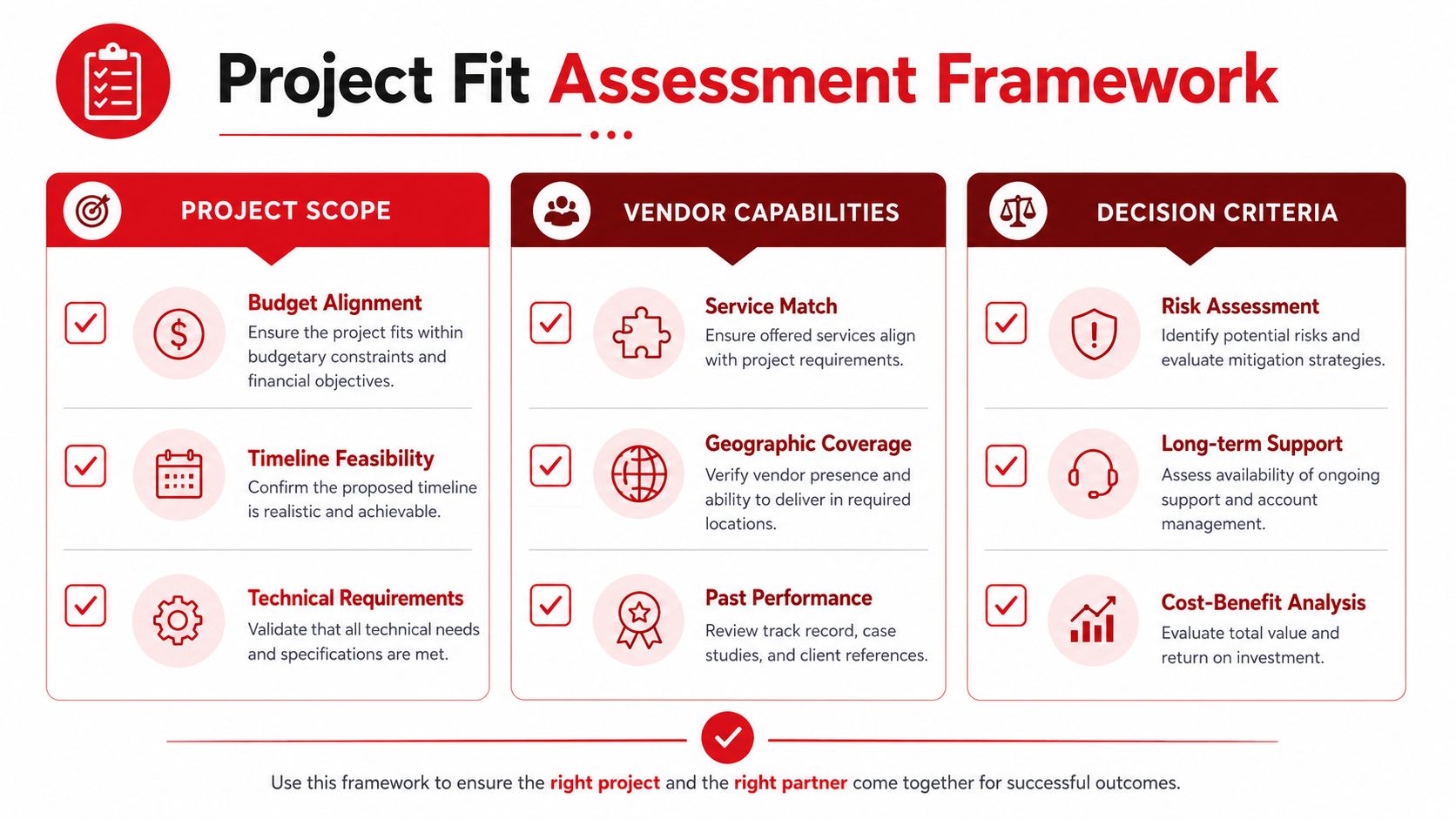
The right vendor decision starts with project shape, not brand familiarity. NTI can be a strong fit when the job calls for multi-site infrastructure delivery, but buyers should pressure-test that fit against scale, timing, complexity, and documentation needs before awarding work. A company can have meaningful footprint and still be wrong for a schedule that depends on very tight coordination.
Questions that separate fit from wishful thinking
The first filter is project scope. Single-site upgrades, straightforward fiber pulls, and standard structured cabling jobs need fewer layers of coordination than multi-region rollouts or mission-critical data center turn-ups. If your program spans multiple markets, ask how NTI sequences labor and whether it can support staggered mobilization without creating local bottlenecks.
The second filter is technical complexity. A basic cable placement scope is one thing. A project with strict uptime expectations, cross-connect dependencies, or careful turn-up sequencing is another. Ask for recent examples of work in environments similar to yours, then compare those examples against the parts of your scope that are hardest to rework.
The third filter is documentation quality. Buyers often underestimate how expensive weak as-builts can be. If the project needs clean OSP records, splice documentation, test results, or compliance handoff packages, demand to see samples before the award.
A short checklist for the sales call
- Budget alignment: Confirm how NTI handles change orders and access-driven overruns.
- Timeline feasibility: Ask what triggers mobilization delays and how crews are staged.
- Service match: Verify whether the work is self-performed or passed to partners.
- Geographic coverage: Map your sites against the company's actual operating footprint.
- Past performance: Request examples that resemble your schedule pressure and handoff requirements.
A practical video reference can also help teams organize the evaluation process:
Red flag: if a vendor can describe the service line but not the handoff package, the project is probably more operationally sensitive than its proposal suggests.
Execution Risk in Today's Constrained Infrastructure Market
The market around fiber and data center builds is tighter than many buyers expected. Recent industry research indicates that AI workloads have pushed global data-center demand higher, while power and capacity constraints have become a major bottleneck in new builds, especially across key U.S. markets NTI market gap research . That changes the buying equation. Raw construction capacity matters less when the project is held up by power availability, labor access, or coordination failures.
What buyers should demand under pressure
In this environment, NTI's value proposition lives or dies on execution under constraint. A carrier doesn't just need crews. It needs crews that can work around permitting delays, coordinate make-ready work, keep splice quality consistent, and avoid turn-up slippage when downstream dependencies stack up. Those are the failure points that convert a promising rollout into a bad quarter.
That's also why buyers need to probe labor availability directly. National-scale branding doesn't tell you whether the right crews are free in the market you care about. Neither does a broad service list tell you whether documentation will be usable when the network is handed to operations.
The best comparison point is not whether NTI can do the work in theory. It's whether the firm can absorb disruption without pushing the project back into another planning cycle. For teams building across multiple sites, that's the difference between a vendor and a risk buffer.
For procurement teams building a field-services strategy, logistics planning is the right lens to apply because it forces attention onto staging, access, and schedule protection instead of brochure language.
Bottom line: in constrained markets, the winning vendor is the one that reduces delay risk, not the one that talks most confidently about capacity.
Southern Tier Resources delivers engineering, construction, and maintenance for wireline and wireless infrastructure, including fiber deployments, data center fit-outs, and turnkey network work. If you're comparing vendors for a multi-site rollout, use that same execution lens here and review how Southern Tier Resources approaches mobilization, documentation, and field delivery before you decide who should carry the project.