
By 2024, 5G coverage reached 51% of the world's population, while 4G still reached 92% and 3G or better reached 96%. That isn't a story about raw availability anymore, it's a story about densification, indoor reach, and rural extension, with 5G coverage still sitting at 84% in high-income countries and only 4% in low-income countries, plus a 67% urban versus 29% rural split (ITU mobile network coverage data). The antenna is rarely the hard part now. The hard part is everything around it, backhaul, power, permitting, fiber, vendor coordination, and the long tail of keeping the network usable after turn-up.
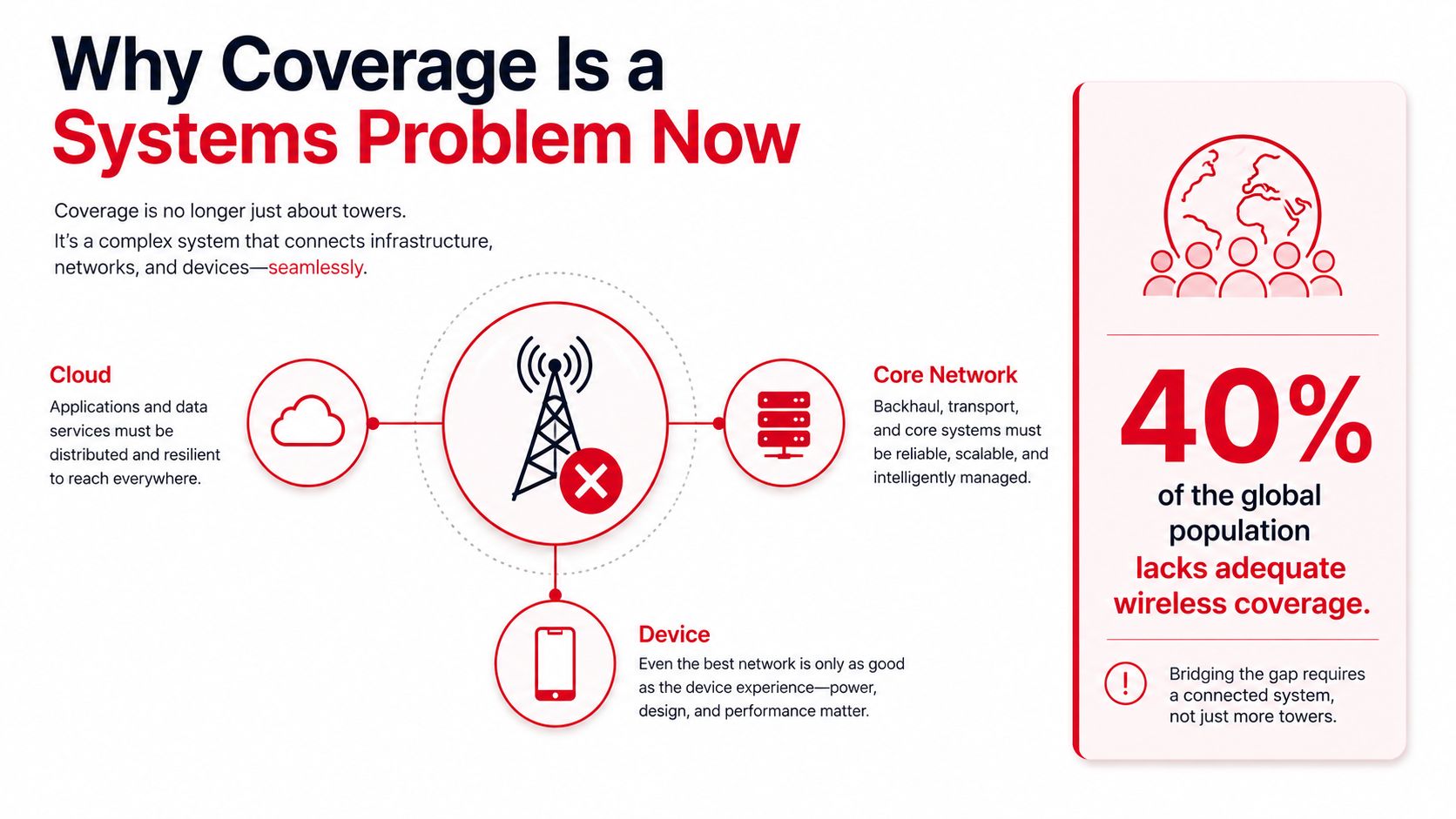
Why Coverage Is a Systems Problem Now
Coverage used to be treated like a radio planning task. Put up a tower, tune the sector, add an access point, and expect the problem to disappear. Real deployments do not work that way, because coverage quality depends on the whole delivery chain, not just the RF layer.
The practical issue is consistency. Wireless service may exist on paper, but the experience can still fall apart inside a building, at the edge of a campus, or along a rural corridor where power, fiber, and access are limited. For carriers, tower companies, neutral hosts, enterprise network leads, municipalities, and data center operators, the question is whether the design holds up where people use it.
Practical rule: If a project team talks only about antennas and radios, the design is probably incomplete.
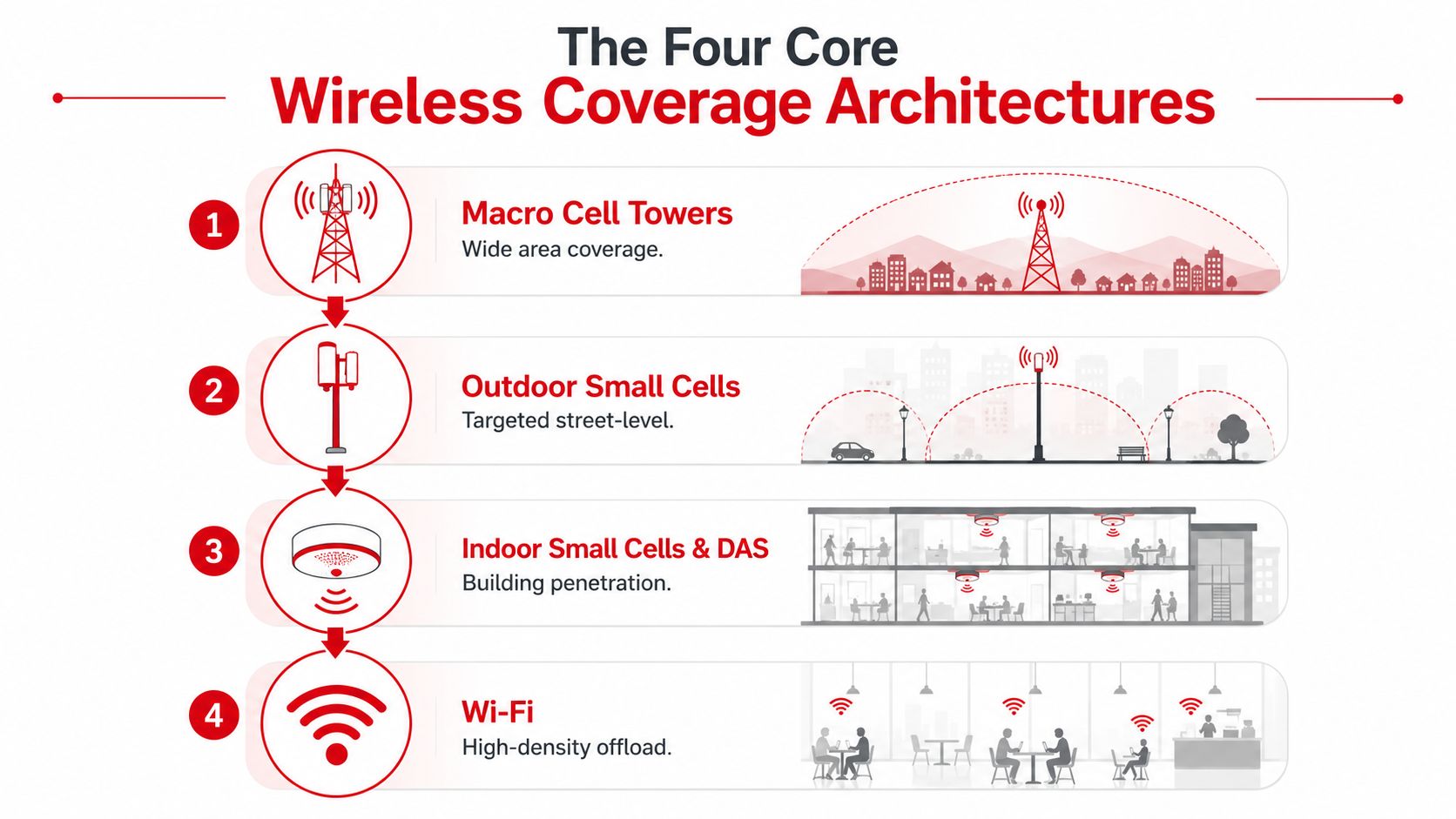
The right frame is layered. Macro sites cover broad areas, small cells close street-level and density gaps, and in-building systems handle penetration, mobility, and operator sharing. In enterprise settings, a separate layer of passwordless WiFi for network teams can reduce friction where device onboarding and user experience matter, so platform choices need to be evaluated as part of the broader connectivity stack, not as isolated gadgets.
The Four Core Wireless Coverage Architectures
Each architecture solves a different bottleneck, and each one creates a different kind of operational burden. That is the part many buying guides skip. They name the technologies, but they do not explain what gets easier, what gets harder, and who carries the consequences when the network starts carrying real traffic.
A practical way to judge these options is to ask what they do to site count, transport, permitting, and lifecycle support. Coverage is rarely a pure radio decision. It is a systems-integration decision that ties the antenna to power, fiber, vendor support, and the operating model that keeps the site alive after turn-up.
Macro cell towers
A macro cell tower is the wide-area workhorse. It gives the broadest footprint and fits open geography, lower user density, and situations where the design has to cover the most ground with the fewest sites. The trade-off is direct, macro gives you reach, but it does not solve indoor loss, street-level congestion, or handoff issues in dense zones.
Macro is the right anchor when the target is regional continuity. It is also the least forgiving when the site count has to stay low because of cost or zoning pressure. For highways, suburban edges, and rural gaps, macro usually stays in the design conversation longer than any other layer.
Outdoor small cells
Outdoor small cells are the curbside, pole-mounted answer to localized demand. They work best where the macro layer is too coarse and the coverage problem lives at street level, in a corridor, or around a venue perimeter. The strength is precision. The weakness is dependence on power, backhaul, and placement discipline.
That dependence changes the delivery model. A small cell with weak transport or poor siting can look fine on a plan and still underperform once live traffic hits it. Acceptance thresholds below should drive the final call on whether the design is ready for service.
Indoor small cells and DAS
Indoor small cells and DAS, distributed antenna systems, are what you deploy when the building itself is the problem. Concrete, steel, elevator cores, and complex floor plans eat signal, and user expectations do not drop just because the wall is thick. A DAS can support a carrier-specific or neutral-host model, while small cells are often easier to localize to a single tenant or function.
The choice comes down to operating model as much as radio performance. A building that needs multi-operator service, dense uplink use, and room for future bands usually points toward DAS. A smaller tenant footprint or a more limited coverage problem may fit indoor small cells better, especially when CAPEX and construction scope have to stay tighter.
Wi-Fi
Wi-Fi is the capacity offload layer, not a substitute for every cellular problem. In well-designed deployments, it handles high-density indoor traffic, controlled mobility, and device-heavy environments where the network team can manage the access layer directly. The key decision is whether Wi-Fi is being used as a convenience layer, a capacity layer, or part of the primary user experience.
That is also where acceptance thresholds matter more than vendor claims. The practical test is whether the design can hold service quality under load, especially in the spaces where roaming, contention, and user density are hardest to manage. The same principle appears in the technical WLAN specification used for structured campus planning, where the focus is on predictable service, not just signal presence.
Modern dense builds also rely on 4×4 MU-MIMO and wider channels to raise aggregate capacity. That matters because coverage engineering is now about user density, airtime contention, and how many active devices a cell can support without collapsing the experience. The radio is only one part of that equation.
Terrestrial, Non-Terrestrial, and Hybrid Designs
A lot of teams still start with a terrestrial bias, then try to force every site into the same pattern. That works in cities and on fiber-rich campuses. It falls apart in persistent not-spots, remote corridors, and places where construction cost outruns the business case.
A useful way to compare the options is by CAPEX, deployment speed, and backhaul availability. Terrestrial builds usually offer the most operational familiarity, but they need access, power, permits, and a transport path. Non-terrestrial options like LEO satellites, UAVs, and high-altitude platforms help where the ground layer is slow, expensive, or impossible to extend quickly (MDPI rural connectivity review). Hybrid designs win when the site can't wait for full terrestrial buildout or when the economics only work if another layer absorbs part of the coverage burden.
The important thing is to stop treating the decision as ideological. If backhaul is already in place, terrestrial usually stays attractive. If fiber is absent and the corridor is hard to build, hybrid often becomes the only sane path. That's where Southern Tier Resources fiber network services matter as part of the architecture conversation, because the wireless layer won't outperform its transport.
Practical rule: If transport is uncertain, don't over-spec the radio design and hope the rest catches up later.
What doesn't work is pretending backhaul is an afterthought. Wireless teams can tune radios, but they can't create transport, power, or access rights out of thin air. Non-terrestrial layers are a useful fit when the build sequence is constrained, but they're most valuable when they're integrated deliberately into a wider connectivity plan, not bolted on after the terrestrial design stalls.
How to Choose the Right Architecture for a Given Site
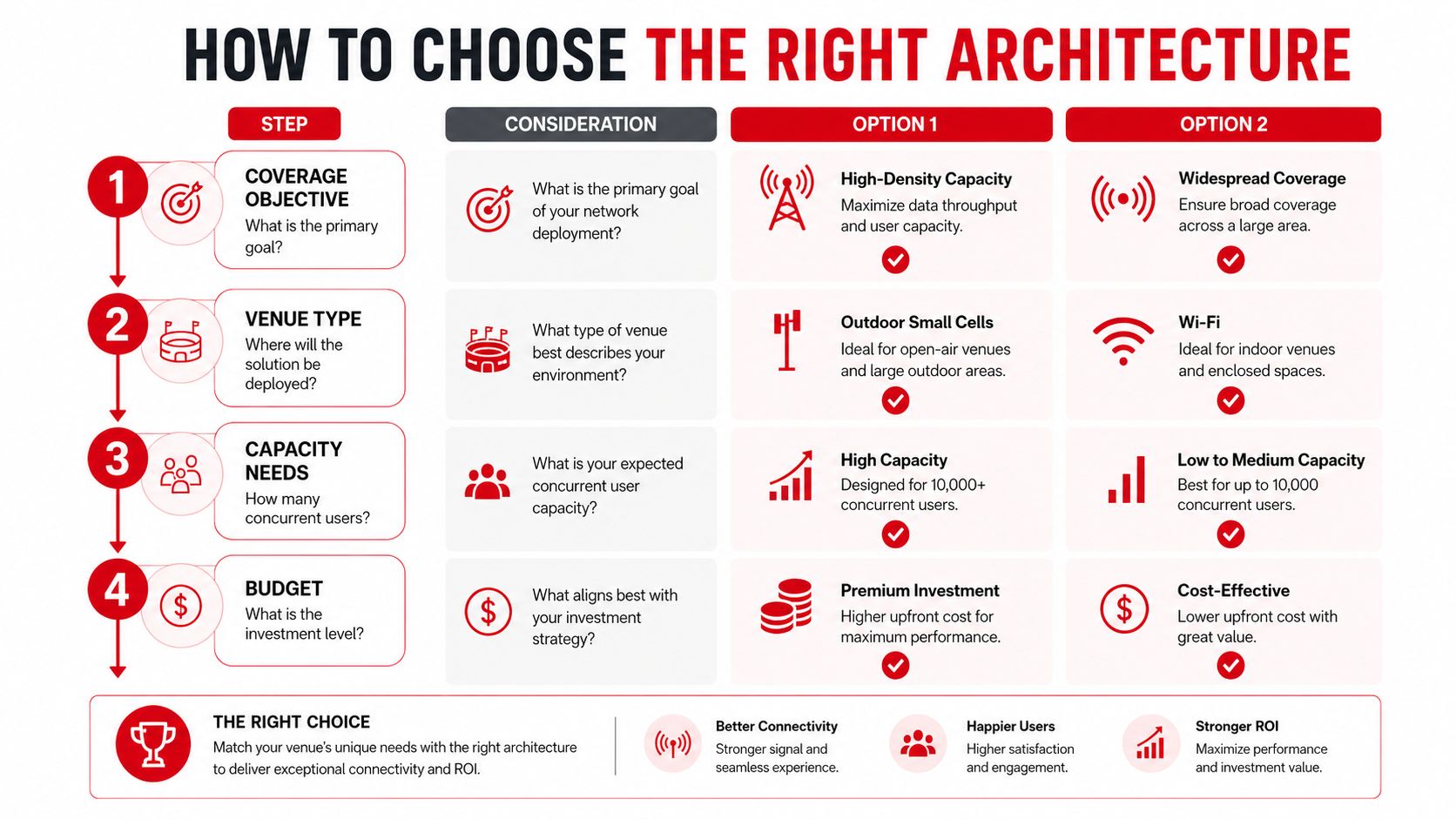
The site decision should start with the coverage objective, not the vendor pitch. Are you trying to solve indoor voice, outdoor mobility, private network performance, guest access, or enterprise-grade failover? Each answer points to a different architecture mix.
Start with the venue and the user pattern
A dense urban corridor usually pushes you toward outdoor small cells plus macro support. An enterprise campus often needs indoor systems, structured cabling, and Wi-Fi offload. A rural utility cooperative may need a wider-area macro plan with selective hybrid support where density is sparse and backhaul is expensive.
A hyperscale data center hall is its own category. The requirement is rarely “more bars.” It's multi-operator in-building service, predictable handoff, and a transport path that won't fail under operational demand. That's why the same radio technology can be the wrong answer if the facility design, cabling plant, and carrier coordination aren't aligned.
Match the architecture to the bottleneck
- Coverage objective: If the issue is dead zones, a building-focused system may be enough. If the issue is regional continuity, macro stays on the table.
- User density: High density pushes the design toward small cells, DAS, or Wi-Fi capacity planning.
- Spectrum and mobility: If mobility and multi-operator service matter, indoor cellular systems become more attractive.
- Timeline and budget: Faster delivery often favors existing pathways or hybrid builds, while custom work increases coordination time.
| Architecture | Best Fit | Capacity Profile | Typical Timeline | Cost Driver |
|---|---|---|---|---|
| Macro Cell Towers | Wide-area reach, rural coverage, regional continuity | Broad coverage with fewer sites | Longer, because of siting and integration | Tower access, power, transport |
| Outdoor Small Cells | Streets, venues, corridors, targeted gaps | Focused capacity at specific locations | Moderate, dependent on permits and backhaul | Pole access, fiber, make-ready work |
| Indoor Small Cells and DAS | Campuses, hospitals, data centers, enterprise buildings | Strong indoor service and mobility support | Moderate to longer, depending on building complexity | Cabling, headend design, carrier coordination |
| Wi-Fi | High-density indoor offload and controlled environments | Strong capacity for managed device populations | Often faster if the wired plant is ready | Cabling, access point count, network management |
A good planning team doesn't ask which architecture is “better” in the abstract. It asks which one is least likely to fail under the site's actual constraints. That's the difference between a design that looks good in a slide deck and one that still works after the first busy week.
Deployment, Permitting, and Backhaul Integration
A rollout usually starts with a simple request and quickly turns into a multi-party logistics exercise. One carrier wants coverage. A city wants compliance. A utility wants a clean attachment process. The building owner wants minimal disruption. The fiber team wants clear route access. If those conversations don't start early, the project slips long before the first radio is hung.
I've seen the cleanest deployments happen when one team owns site acquisition, zoning, permitting, make-ready work, fiber backhaul, and cutover coordination together. That keeps the schedule honest. It also prevents the classic failure mode where the radio is ready but the transport path isn't, or the pole is approved but the power drop still needs engineering review.
For aerial and UAV-adjacent planning, it also helps to have a current regulatory reference handy, which is why the Ace Aviation Aerospace Academy drone guide is useful reading for teams that touch drone-based inspection or survey workflows.
What tends to slow projects down
The delays usually show up in predictable places. Pole attachments can stall while make-ready work gets queued. Municipal approvals can stretch when drawings don't match local expectations. Power coordination can lag when the utility's process doesn't align with the construction calendar.
That's also where structured cabling and fiber routing earn their keep. If the backbone is underbuilt, the wireless layer gets blamed for problems it can't solve. If the transport is clean, the wireless team can focus on optimization instead of emergency troubleshooting.
Southern Tier Resources wireless network installation services fit into that model because installation and integration are where a lot of coverage programs either hold together or unravel. Wireless scope is rarely isolated, and the project team that understands the neighboring workstreams usually delivers the smoother cutover.
The best deployments don't feel like radio projects. They feel like coordinated infrastructure programs with RF attached.
Testing, KPIs, and Acceptance Criteria
A coverage project can pass every drawing review and still fail in the field if the acceptance criteria are vague. The handoff has to define what users will experience, because the test is whether the network holds up under movement, load, and interference. In buildings, signal level by itself does not prove that roaming, uplink, or throughput will hold when the space is busy.
The design targets discussed earlier still matter, but acceptance testing should go beyond repeating target numbers. The job at this stage is to prove that the installed system matches the plan, that client behavior is stable at the edges of the coverage area, and that capacity does not collapse when the site is populated. For denser Wi-Fi builds, the question is not whether the radio plan included advanced features, it is whether those features deliver the expected service after installation, channel coordination, and tuning are complete.
The KPI stack that matters
- Signal Strength: Measured in dBm, but only meaningful when viewed alongside the noise floor and the actual client experience.
- Signal-to-Noise Ratio: Shows whether the received signal is clean enough to support stable service under real use.
- Throughput: Confirms whether users can move data at the rate the site was meant to support.
- Uplink Performance: Matters for calls, uploads, telemetry, video, and connected devices that spend more time sending than receiving.
- Roaming and Handoff: Proves whether a user can move through the space without drops, stalls, or sticky clients.
Acceptance testing should include drive testing, walk testing, and a written record of any weak spots that were corrected before handoff. In a dense venue, that means checking corners, transition zones, and areas near interference sources, not just the center of the floor plate. In a campus or data center, it means verifying the network after the site is occupied, because an empty building behaves differently from one that is carrying real traffic and real people.
What to demand in the handoff package
Ask for test routes, floor plans with measured results, and an as-built record that matches the final installation. If the contractor cannot show where performance was verified, you are inheriting uncertainty. Coverage that cannot be documented is difficult to trust, no matter how good it looked during commissioning.
Maintenance, Monitoring, and Capacity Expansion
Coverage work doesn't end at turn-up. Once the network is live, it becomes a living system that needs inspections, configuration control, and periodic capacity review. The crews that disappear after commissioning leave operators with a network that may still work, but not necessarily well.
The maintenance playbook starts with preventive inspections, hardware checks, and firmware or configuration review. Then comes monitoring, because alarms only help if someone is watching for drift, degradation, or a site that starts to underperform before the user complaints begin. As-built documentation matters here too, because every future repair is faster when the field record matches what was installed.
If the site is a home or small office environment, a simple extend WiFi range guide can help frame the basics. In larger commercial systems, the same principle applies, but the execution is more rigorous, with backhaul, power, and spare parts all tied to a formal support plan.
Capacity expansion should be triggered by traffic growth, user complaints, or a change in site use. A venue that was fine last year may now be carrying denser uplink demand, more devices, or a different operator mix. The network team that waits until users notice the problem is already behind.
Practical rule: If operations don't own the site history, performance starts drifting the moment construction wraps.
Vendor Selection and the Turnkey Partnership Model
The vendor question is really an accountability question. A component vendor can sell radios, antennas, or gear. A system integrator can stitch parts together. A turnkey partner can own design, permitting, construction, integration, and maintenance as one chain of responsibility.
That matters because wireless coverage fails at the handoffs. The radio vendor blames transport. The installer blames the carrier. The carrier blames the building. A single accountable partner reduces that churn and shortens the path from problem to fix. Southern Tier Resources turnkey network solutions fit that model because the value is lifecycle control, not a single scope line.
The traits that matter most are plain enough. Look for safety culture, fiber capability, data center experience, and 24/7 mobilization. If the partner can't work across the physical layer and the integration layer, they're not really delivering wireless coverage solutions, they're delivering fragments of one.
Southern Tier Resources supports wireless coverage programs with engineering, construction, fiber, and ongoing maintenance across the full lifecycle. If you're planning macro, small cell, DAS, or an in-building rollout, visit Southern Tier Resources to see how a single accountable infrastructure partner can help align design, backhaul, and deployment from start to finish.