Pole make-ready costs have sometimes exceeded 150% of the original construction budget, according to the Fiber Broadband Association's fiber deployment cost report. That's a more useful starting point for buying network cabling installation services than the price of cable. Your real purchase is an operable network, including the pathways, approvals, acceptance evidence, and records needed to maintain it.
A cheap installation rate won't protect you from an excluded restoration scope or a handover package nobody can use. Evaluate proposals by total project exposure and operational readiness, not just installed footage.
What Network Cabling Installation Services Cover
| Service | Scope | Typical deliverable |
|---|---|---|
| Structured copper cabling | Cat6 and Cat6A runs for offices, labs and IT rooms | Certified test report per link |
| Fiber-optic outside plant | Aerial or underground singlemode trunks between sites | OTDR and loss results per fiber |
| Splicing and termination | Fusion splices, connectors and patch panels | Splice logs and port maps |
| Trenching and conduit | Underground pathways for fiber and copper | Route drawings and restoration records |
| Data center fit-out | Cable runs, management and connectivity for rack rows | Cable schedules and as-built diagrams |
| Wireless backhaul cabling | Fiber feeds to small cells and tower sites | Splice and test records with as-builts |
Network cabling installation services span horizontal office wiring, campus backbones, carrier routes, and rack-level connectivity. Those jobs share installation disciplines, but they don't share identical equipment, access requirements, or acceptance criteria.
An office contractor may be well equipped to terminate copper outlets without having the crews or equipment for underground construction. An outside-plant contractor may build a fiber route without including the rack hardware, patching, or interior distribution needed to connect your equipment.
Map services to physical boundaries
Consider a campus expansion. The underground route needs conduit and restoration, the building entrance needs an agreed termination point, and the equipment room needs panels and patching. If separate contractors own those activities, define who supplies the transition hardware and who tests the completed connection.
The same discipline applies to wireless backhaul. A fiber feed reaching the site boundary isn't necessarily a usable handoff at the radio equipment. Identify the actual endpoint, connector interface, enclosure, and party responsible for final connectivity.
Worldwide fixed-broadband subscriptions reached approximately 20 per 100 inhabitants in 2024, according to the International Telecommunication Union. That global context helps explain why installation work includes both new access infrastructure and upgrades within existing facilities.
At Southern Tier Resources, we provide broadband fiber-optic cable installation and trenching for underground wiring, alongside data center infrastructure fit-outs. The useful procurement question isn't whether a provider installs cable, but which physical boundaries its scope includes.
Scope rule: Mark every route and room on the drawing, then assign one accountable owner to each connection between them.
Before requesting a quote, mark which services you need one provider to cover end to end. Leave no building entrance, splice enclosure, or equipment-room transition unassigned.
Choosing Between Fiber and Copper Cabling
| Medium | Reach decision | Best use | Installation consideration |
|---|---|---|---|
| Cat6 copper | Verify the application against installed length and alien-crosstalk conditions | Desks and short horizontal runs | Less upgrade headroom than Cat6A |
| Cat6A copper | Confirm the complete channel against the selected Ethernet application | Horizontal runs requiring higher bandwidth | Larger cable diameter can require larger pathways |
| OM4 multimode fiber | Match the application's reach specification to the optics and link loss | In-building backbones and data center links | Optics and connectors must match the fiber type |
| OS2 singlemode fiber | Select optics for route length and the engineered loss budget | Campus, building-to-building and carrier routes | Account for optics, termination, and splicing requirements |
Choose the medium for the application and route, not by cable category alone. Copper suits desk connections and powered endpoints. Fiber suits backbone routes where distance, electrical isolation, or expansion requirements make copper inconvenient.
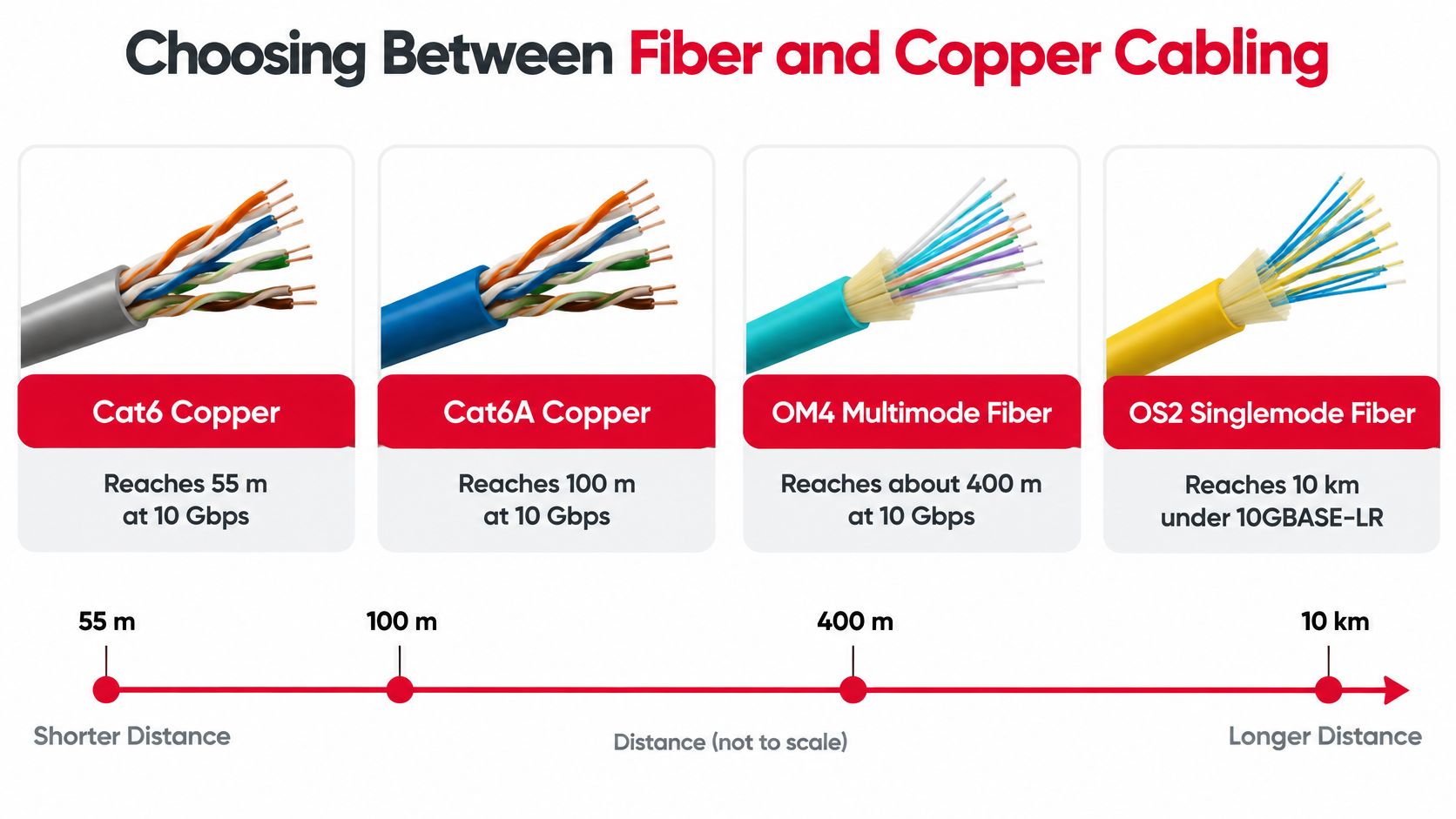
Treat reach charts as screening tools, not design approval. The installed channel, transceiver specification, connectors, and loss budget still need checking before procurement.
Compare the installation consequences
Copper's practical advantage is Power over Ethernet. Access points, phones, cameras, and other compatible endpoints can receive power and data through the same connection. Fiber doesn't supply endpoint power, so a fiber-to-device design needs a separate power arrangement.
Cat6A can provide useful upgrade headroom, but its larger cable diameter affects tray loading, conduit selection, patch-panel density, and termination space. Reusing an existing pathway without checking those constraints can turn a straightforward cable upgrade into construction work.
Fiber requires disciplined bend-radius control, connector inspection, and suitable termination skills. Fusion-spliced pigtails and factory-terminated assemblies offer different trade-offs: field splicing accommodates route uncertainty, while preterminated assemblies depend on accurate measurements and suitable pulling access.
Don't assume singlemode optics always cost more than multimode. Compare the actual transceivers, platform compatibility, and lifecycle requirements. A longer-reaching optical design may avoid intermediate powered equipment, but it still needs an engineered loss budget.
According to ITU's affordability report, global fixed-broadband traffic increased approximately 121%, from 140 GB per subscription per month in 2019 to 310 GB in 2024. That doesn't predict your building's traffic, but it supports leaving room for additional fibers and usable pathway capacity.
Before approving the drawing, answer:
- Longest route: What is the actual installed length, including vertical travel and service loops?
- Upgrade target: Which application must the cabling support at the next equipment refresh?
- Expansion space: Can another cable be installed without removing the working network?
For mixed-use buildings, copper to endpoints and fiber in the backbone is often the practical combination.
The Project Lifecycle from Site Survey to Handover
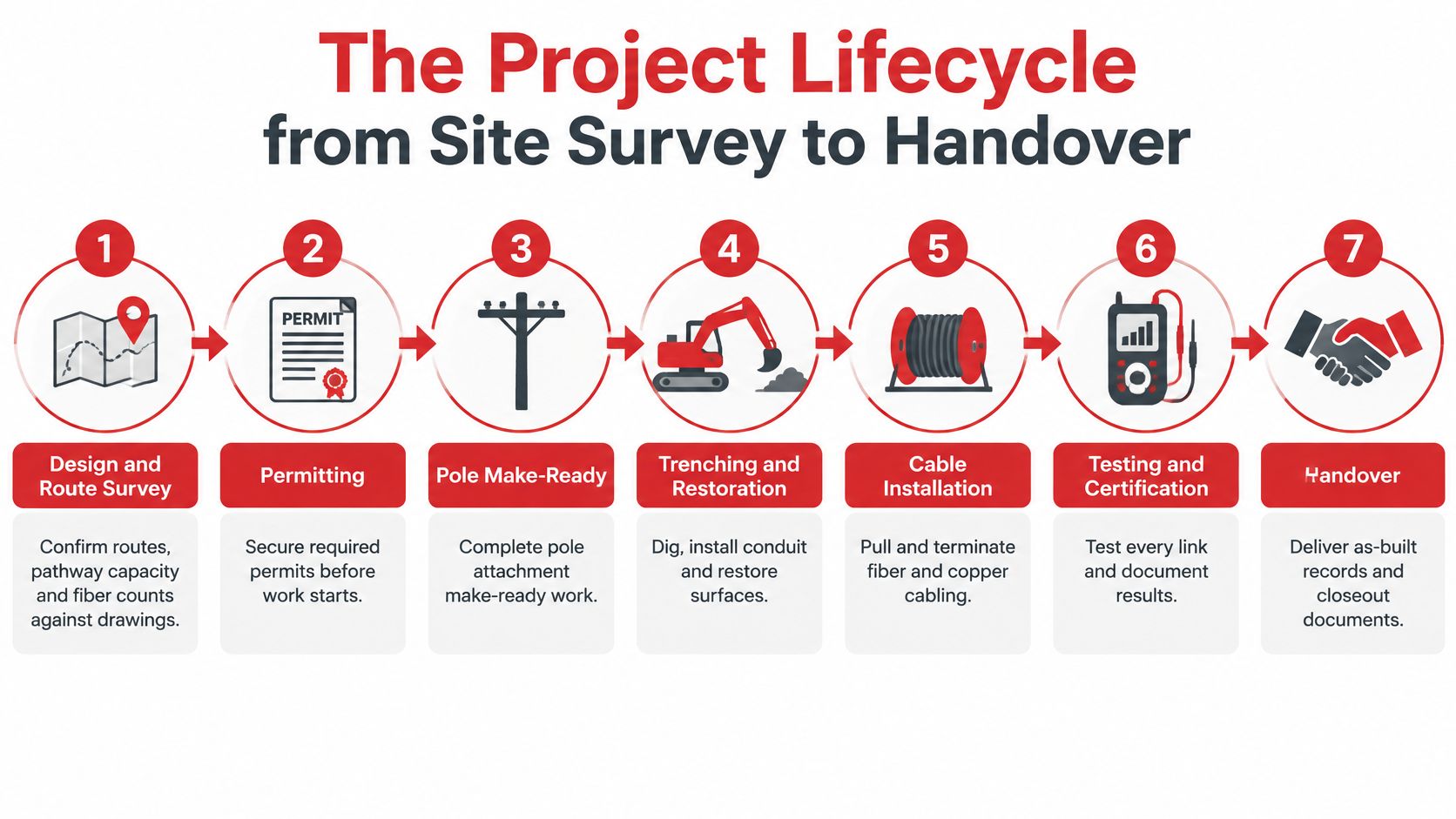
A credible installation plan shows dependencies, not just a mobilization date. Use the workflow below to distinguish work the contractor can control from work awaiting an owner, utility, or permitting authority.
This overview shows the major construction milestones.
Require a release condition for each phase
Design and route survey. Walk the proposed route and reconcile drawings with accessible field conditions. Confirm pathway capacity, entry locations, termination space, and fiber allocation. Your check is an approved route drawing with unresolved conditions identified.
Permitting and utility coordination. Establish which right-of-way, attachment, access, and excavation approvals apply. Track approval dependencies separately from installation duration. Your check is written authorization for the activity being released, not an application receipt.
Pathway installation. Install conduit, innerduct, supports, trays, and pull points to the approved design. Inspect concealed work before covering it. Your check is a usable pathway with accessible pull points and verified transitions.
Cable pulling and termination. Follow the cable manufacturer's pulling-tension and bend-radius limits, protect cable ends, and identify both ends before crews move on. Confirm that installed hardware matches the specified cable system. Your check is a completed termination schedule reconciled to the physical installation.
Splicing. Secure fibers in splice trays, protect completed splices, and retain splice records. A splicer's estimated loss is useful process information, not final link acceptance. Your check is an enclosure and splice record that can be matched to the assigned fibers.
Testing. Certify copper links and test fiber using the approved acceptance plan. Record failures, repairs, and retest results rather than keeping only the final summary. Your check is acceptance evidence for every contracted link.
Handover. Require owner review and formal acceptance before treating the project as closed. Define how outstanding defects affect closeout and the contractual warranty commencement. Your check is a signed acceptance record with any remaining obligations assigned.
Schedule approvals separately from crew work
A trench crew can't resolve an unsigned access agreement by working faster. Likewise, termination crews can't compensate for a pathway that leaves insufficient space at a cabinet entrance.
For a hypothetical campus route, complete the survey and approval checks before committing excavation resources. For a data hall, confirm cabinet positions and cable-management hardware before releasing measured trunk assemblies for manufacture.
We provide end-to-end services from design through deployment and maintenance. That continuity helps assign handoffs, but the proposal should still identify who authorizes each phase and what stops work from progressing.
Use the accompanying video as a discussion aid when reviewing the installation plan.
Testing Methods That Prove a Link Works
Copper needs category certification, and fiber needs measured insertion-loss acceptance. A continuity result or an equipment link light doesn't establish that the installed cabling meets its specified performance requirements.
| Test | Applies to | What it proves | What it misses alone |
|---|---|---|---|
| Copper certification | Cat6 and Cat6A horizontal links | Compliance with the selected category and link configuration | Fiber performance and hidden physical damage |
| OLTS insertion loss | Multimode and singlemode links | Measured end-to-end attenuation against the acceptance budget | Where the loss occurs |
| OTDR trace | Installed fiber routes | Approximate locations of splices, reflections, bends, and breaks | Reliable end-to-end insertion loss on its own |
| Connector inspection | Terminated connectors | Endface condition and visible contamination | Link loss and application reach |
For copper, specify whether the contractor is certifying a permanent link or a channel, and require the matching tester configuration. The instrument must evaluate the full requirements of the selected category. A reduced-frequency test isn't a substitute for category certification.
For fiber, the Fiber Optic Association's testing standard calls for insertion-loss testing with a calibrated source and power meter, ordinarily at 850 and 1300 nm for multimode and 1310 and 1550 nm for singlemode, unless the specification requires different wavelengths.
Use diagnostics to explain failures
An optical loss test set, or OLTS, measures attenuation through the installed link. An optical time-domain reflectometer, or OTDR, infers events from backscattered light. Those are complementary measurements, not interchangeable acceptance methods.
For diagnostic OTDR work, require an orderly setup:
- Reference cables: Use suitable launch and receive fibers so endpoint connections can be evaluated.
- Endface preparation: Inspect connectors and adapters, clean contamination, and inspect again before connection.
- Instrument configuration: Select modules and wavelengths appropriate to the installed fiber.
- Acquisition settings: Match range, pulse settings, and averaging to the route and the events being investigated.
A trace can look orderly while the installed link exceeds its allowed attenuation. Accepting that trace without measured end-to-end loss can leave the owner discovering the problem during commissioning.
An OTDR tells you where to investigate. It doesn't replace the measurement that determines whether the link meets its loss budget.
Our fiber services include splicing and testing. For any procurement, put the acceptance budget and test configuration in writing before installation starts, so the crew isn't negotiating a pass threshold after a failure.
Reject an acceptance plan that relies on OTDR traces alone.
Hidden Cost and Schedule Drivers Beyond the Cable
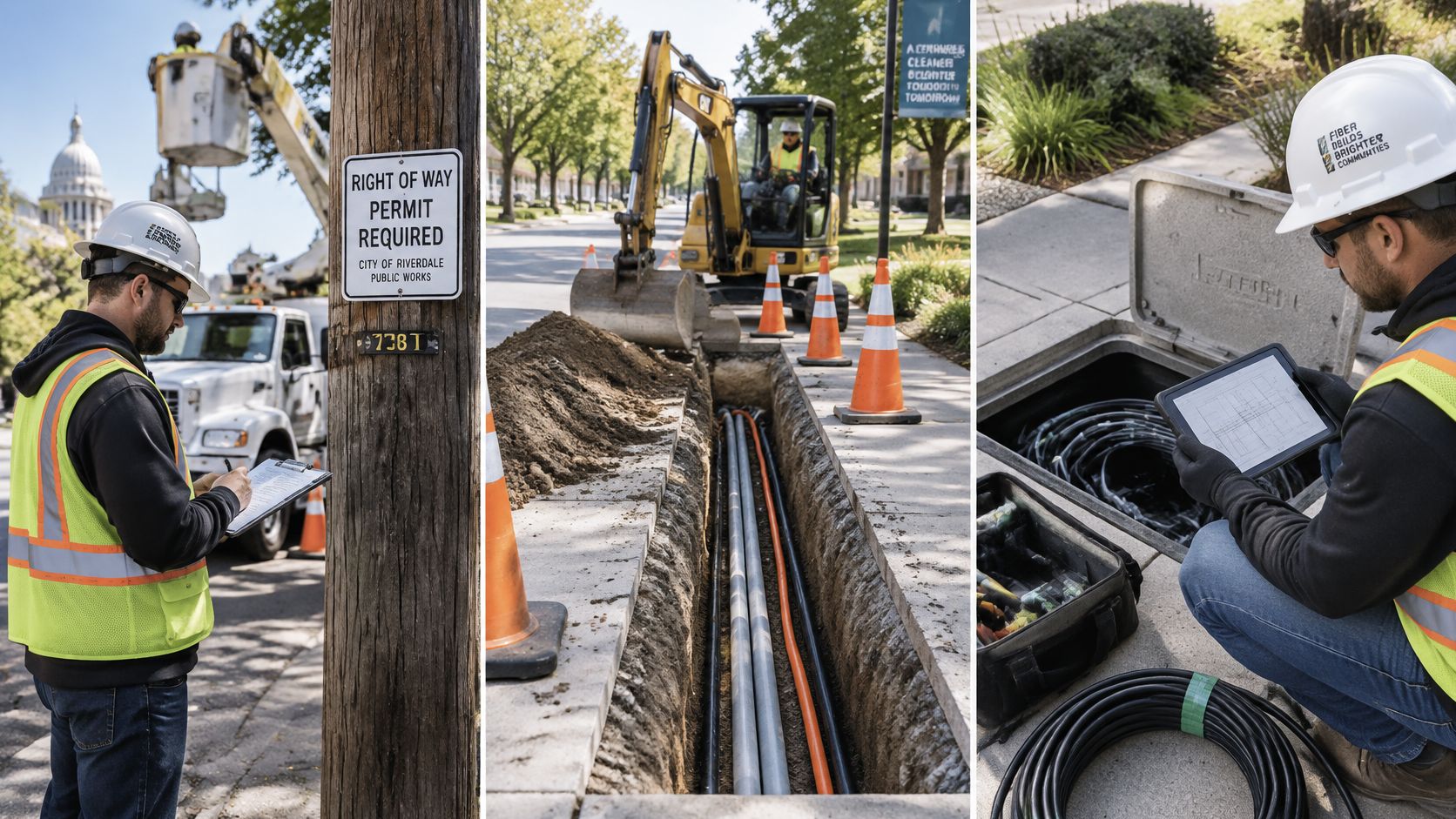
The cable price isn't a reliable proxy for total deployment cost. Outside-plant projects can expose the owner to approval delays, attachment conflicts, surface restoration, and redesign obligations that aren't visible in a cable-and-labor quote.
| Cost driver | Typical exposure | Question to resolve in the contract |
|---|---|---|
| Permitting | Application work, fees, conditions, and approval delays | Who absorbs approval-related schedule changes? |
| Pole make-ready | Attachment rearrangement, utility work, and replacement poles | Who owns attachment conflicts and dependencies? |
| Trenching and restoration | Soil conditions, existing surfaces, and reinstatement requirements | Is complete surface restoration included? |
| Redesign after field changes | Incorrect asset records or inaccessible proposed routes | Who pays when field conditions differ from drawings? |
| Install labor and materials | Crew productivity, access restrictions, and quantity changes | Which quantities and working conditions underpin the price? |
Keep construction access and reinstatement in the commercial review, not just the engineering review.
Price uncertainty before it becomes a change order
Consider a hypothetical aerial build based on an outdated pole inventory. During verification, the utility identifies an attachment conflict and requires a pole replacement before the new cable can be installed.
The financial problem isn't limited to the replacement work. The carrier may also need to revise the launch schedule, resequence crews, and keep temporary arrangements operating. Unless the contract assigns those dependencies, a fixed installation price doesn't resolve the owner's exposure.
Underground bids have a different trap. A low trenching rate that excludes pavement reinstatement, landscaping, spoil disposal, or inspection corrections isn't comparable to a complete construction price. Normalize the scope before comparing rates.
Turnkey doesn't mean risk-free. The contract must assign permit management, utility coordination, restoration, inspection failures, and change-order approval. It should also distinguish a contractor-controlled delay from an external approval dependency.
Commercial checkpoint: Separate permit fees from the cost of waiting for permission to work.
Early engineering and verified asset records can have greater financial value than a small reduction in installation rates. That doesn't justify unlimited investigation. It means spending preconstruction effort where uncertainty could force a route change, additional utility work, or repeated mobilization.
Before signing, inventory poles and attachments, identify likely conflicts, and document who owns redesign. For underground routes, reconcile utility information with the proposed excavation method and identify the conditions that require additional investigation.
Documentation That Keeps Networks Operable
A project can pass testing and still be incomplete for operations. Acceptance evidence proves the installation met a requirement; operational records tell the next technician what exists and how to work on it.
The Cables NYC infrastructure lifecycle guide treats certified testing, cable identifiers, pathway records, and permanent documentation as lifecycle requirements. It also highlights 400G and 800G optical interconnects alongside AI and high-performance computing workloads, where missing polarity records and mislabeled ports complicate changes.
Specify a usable handover package
- Test files: Require native instrument files and readable reports for every link. Associate each result with a unique cable or fiber identifier, rack location, and port assignment. Keep instrument configuration and test metadata with the results.
- As-built drawings: Show actual routes, splice locations, enclosures, conduit, and pull points. Specify editable and viewing formats compatible with the owner's records system, rather than accepting an unidentified drawing export.
- Label schedules: Reconcile cable, panel, and port identifiers at both ends. Field labels, drawings, and test files must use the same naming convention.
- Polarity and capacity records: Record polarity arrangements, spare fibers, available conduit, and pathway occupancy. Distinguish installed spare capacity from space merely reserved in a design.
Test the records before accepting them
Select a link from the report and locate it using only the package. Then select a physical port and find its route, termination, and test evidence. If either exercise requires calling the installation crew, the records need improvement.
Documentation can't correct a bend-radius violation or a congested pathway. It can expose those constraints before an upgrade depends on spare capacity that isn't usable.
Assign a records owner after handover. Moves, additions, and changes should update the same controlled records, not create disconnected spreadsheets that gradually contradict the physical network.
Before signing, request a representative handover package and confirm the exact test formats, identifier relationships, and update responsibilities. Make document acceptance a deliverable, not an informal promise.
Standards, Safety and Service Terms
Put checkable requirements in the proposal. References to industry standards or safe working practices aren't enough unless the contractor identifies what applies to the work.
Define technical and safety controls
- Governing standards: Identify the applicable editions of ANSI/TIA-568 or ISO/IEC 11801 for structured cabling. Define copper certification by category and link configuration, and identify the applicable fiber insertion-loss procedure, such as TIA-568.3 and the relevant IEC procedure for the fiber type.
- Site safety: Require utility-location controls before intrusive work, appropriate aerial fall protection, traffic management, and excavation protection. Include live-fiber checks, eye protection, and safe disposal of fiber scraps.
- Inspection hold points: Specify which inspections must pass before concealment, connection, or energization, and identify who releases the work.
For a practical starting point when reviewing task-specific controls, browse job-specific safety program examples from SiteSafetyPack. Adapt the program to the actual site and governing requirements.
Separate response from repair
An outage-response commitment needs a defined trigger, severity classification, coverage window, and escalation contact. Acknowledgment, dispatch, site arrival, and restoration are different milestones. Don't accept an undefined response promise as a repair guarantee.
State the warranty duration, exclusions, maintenance schedule, and responsibility for retesting after changes. Identify whether manufacturer-system coverage and installer workmanship coverage impose different conditions.
Before approval, resolve three questions: Which standard governs this link? Which hold point stops the job? What contractual remedy applies if the service target is missed?
Confirm Scope and Vendor Terms Before You Sign
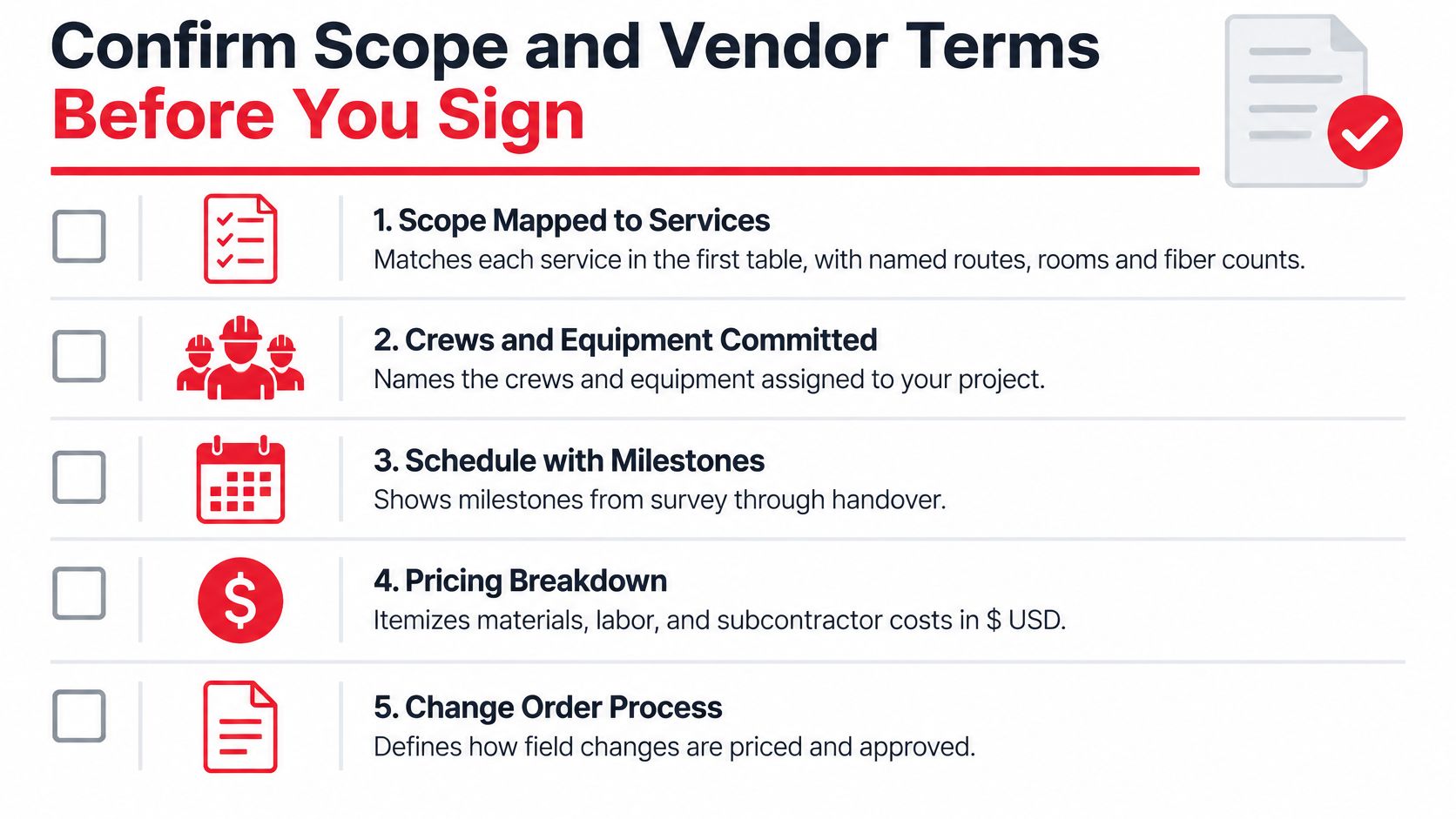
A proposal is ready for comparison when the engineering, construction, and operations teams can interpret it without guessing. Use the checklist to identify omissions before negotiating the final price.
Score evidence rather than assurances
- Scope mapping: Match the service categories under What Network Cabling Installation Services Cover to named routes, rooms, endpoints, and fiber allocations.
- Delivery resources: Use the lifecycle checkpoints to assess the mobilization plan, committed equipment, subcontractor boundaries, and outage-support arrangements.
- Commercial exposure: Apply the hidden-cost review to exclusions, utility dependencies, restoration, and authorization for field changes.
- Acceptance methods: Check that the testing schedule names the required measurements, acceptance criteria, and report formats.
- Operational records: Compare the proposed closeout package with the documentation requirements, including ownership and delivery milestones.
- Support obligations: Evaluate response definitions, warranty coverage, maintenance commitments, and escalation procedures against the service terms.
A missing item shouldn't automatically eliminate a provider. An unwillingness to resolve it in writing is a stronger warning. Keep clarifications with the final contract so the purchasing team doesn't lose technical commitments negotiated during review.
Build a comparable shortlist
Send the same route list, pathway information, endpoint schedule, and acceptance requirements to a small shortlist. Require each bidder to identify assumptions separately from exclusions and priced allowances. That makes a complete proposal distinguishable from one that merely has a lower opening price.
Southern Tier Resources is one option for that comparison. We provide engineering, design, construction, and maintenance for wireline and wireless communications, with crews and equipment available to customers 24/7. Our services include fiber splicing, testing, and data center infrastructure fit-outs.
Use the proposal to verify which of those capabilities are committed to your specific project. Company-wide availability isn't the same as a project-specific restoration obligation, and a broad service portfolio doesn't replace an agreed scope.
Choose on risk allocation, acceptance evidence, and a sample handover package, not the lowest unit rate. The right agreement lets your operations team inherit a network it can identify, troubleshoot, and expand without reconstructing the installer's decisions.
Southern Tier Resources offers engineering, fiber construction, splicing, testing, data center fit-outs, and ongoing network maintenance. Visit Southern Tier Resources to discuss your routes, installation scope, acceptance requirements, and handover expectations before requesting a project proposal.