A backhoe cuts a metro fiber ring at 2 AM. Traffic should move over the redundant path, but a recent BGP change advertises a more-specific prefix on that route. Instead of containing the fault, the network sends more customers into the failure. The operations team sees alarms from several systems, lacks a single view of the affected services, and can't quickly confirm which customers sit downstream of the damaged fiber.
That incident isn't just a construction problem or a routing problem. It's a network infrastructure management problem. Without coordinated monitoring, provisioning, lifecycle control, automation, and documentation, a localized fault becomes a service outage, a difficult escalation, and a reputational event. With those functions connected, the same fiber cut becomes a documented incident with a known failover path, accurate customer impact, and measurable restoration performance.
Why Network Infrastructure Management Matters Now
Modern networks have become too distributed for teams to manage them as collections of individual devices. Fiber routes, optical systems, BGP policies, wireless sites, data center fabrics, cloud connections, and field assets interact constantly. A change in one layer can alter traffic behavior somewhere else, often outside the team that made the change.
The pressure is visible in infrastructure investment. The global data center infrastructure management market was valued at USD 3.66 billion in 2025 and is projected to reach USD 15.73 billion by 2034, with a 17.6% CAGR, according to Fortune Business Insights' data center infrastructure management market analysis. That expansion reflects a practical need to coordinate power, cooling, capacity, assets, connectivity, and uptime across increasingly dense facilities.
Fiber deployment creates a similar management challenge outside the data center. In the United States, fiber availability reached about 60% of households by the end of 2025, with approximately 84.6 million homes passed and 39.3 million actively connected, as reported in GovTech's coverage of fiber broadband deployment. The same source reports that fiber served 45% of rural locations as of June 2025, compared with 62% of suburban locations and 70% of urban locations. Each new route adds construction records, splice plans, testing results, permits, carrier handoffs, and maintenance obligations.
The outage cascade
A managed response to the fiber cut starts with correlated alarms. The NOC identifies the failed span, verifies whether the protection path is healthy, checks routing behavior, and confirms customer impact against an accurate service and topology record. Engineers can then withdraw the unsafe route, activate the approved failover procedure, dispatch a field crew with the correct splice information, and record each action for later review.
An unmanaged response looks different:
- Monitoring is fragmented: Teams receive separate optical, routing, and customer alarms without a shared incident view.
- Provisioning lacks guardrails: A route policy change can reach production without validation against redundancy or prefix controls.
- Documentation is stale: Nobody can quickly verify the affected fiber pair, downstream services, or alternate path.
- Automation is disconnected: Tools may restart interfaces or alter routes without understanding the physical failure.
- Lifecycle records are incomplete: The team may not know whether the protection equipment, optics, or field hardware is within support.
For operators building a formal response, a strategic infrastructure action plan can help connect asset condition, operational risk, and improvement priorities. The important principle is simple: infrastructure management turns complexity into an operating system for reliable service. It gives people the information and controls they need before production breaks, not only after an alarm appears.
Defining Network Infrastructure Management
Managing network infrastructure is like managing a city's utilities. Someone must plan where the roads and pipes go, install them, enforce traffic rules, monitor congestion, dispatch repair crews, maintain records, and explain service conditions to the people who depend on the system.
In a network, those responsibilities cover the physical and logical components that carry traffic. The physical layer includes racks, power systems, copper, fiber, antennas, patch panels, routers, switches, optical transport, and data center cabling. The logical layer includes addressing, VLANs, routing policy, access controls, overlays, service templates, and the relationships between infrastructure and applications.
A practical definition is the end-to-end discipline of planning, provisioning, monitoring, securing, maintaining, automating, and documenting network assets and the services that depend on them. It includes the work performed before deployment, during a change, during an incident, and throughout the asset's useful life. Foundational network infrastructure concepts, including hardware, cabling, protocols, management software, and network services, are outlined in Kentik's network infrastructure guide.
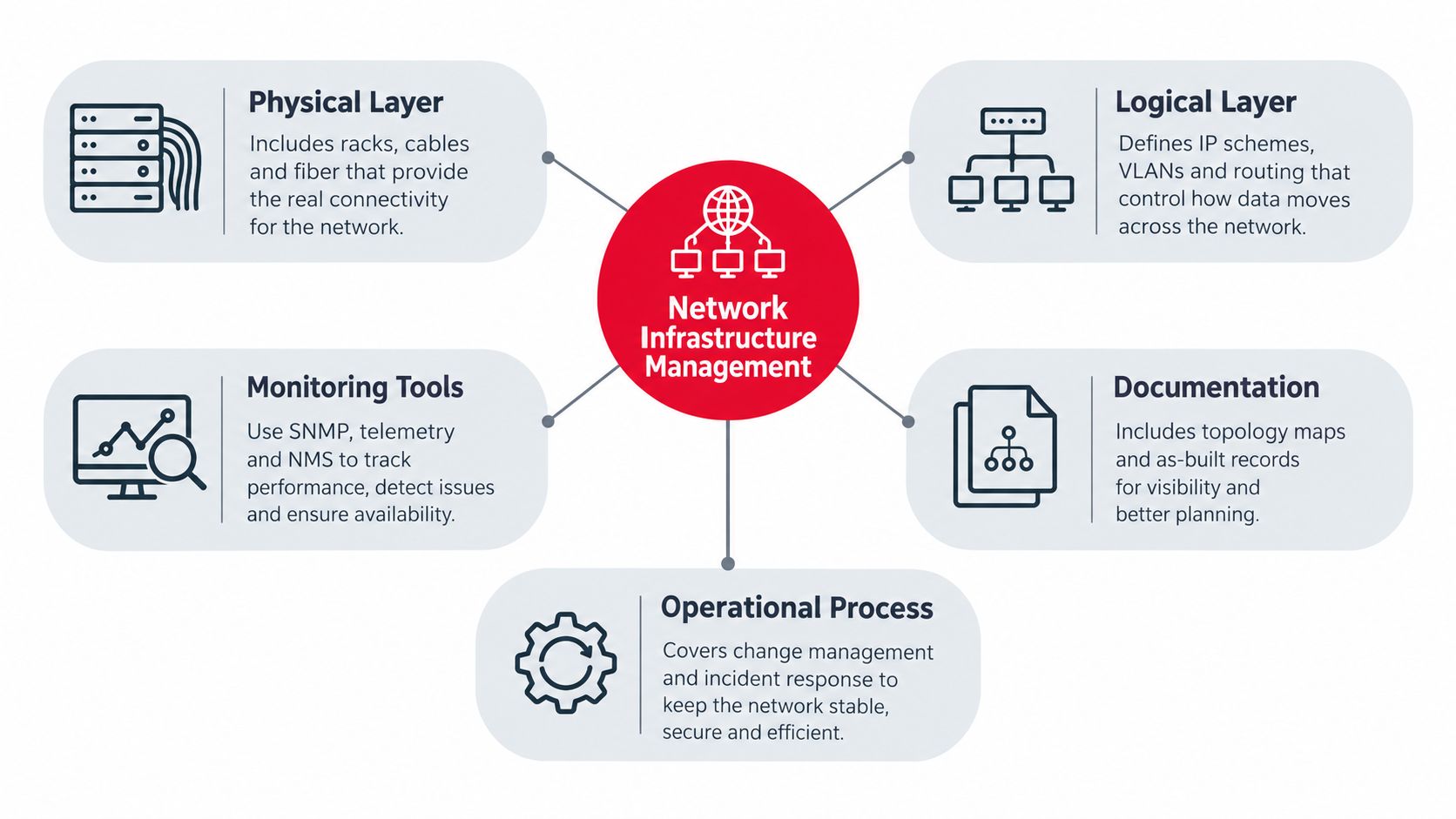
The five-part mental model
Network operations center monitoring is one part of the discipline, not the whole discipline. Security operations adds another perspective, but network infrastructure management also owns the availability, capacity, configuration, physical condition, and operational history of the environment.
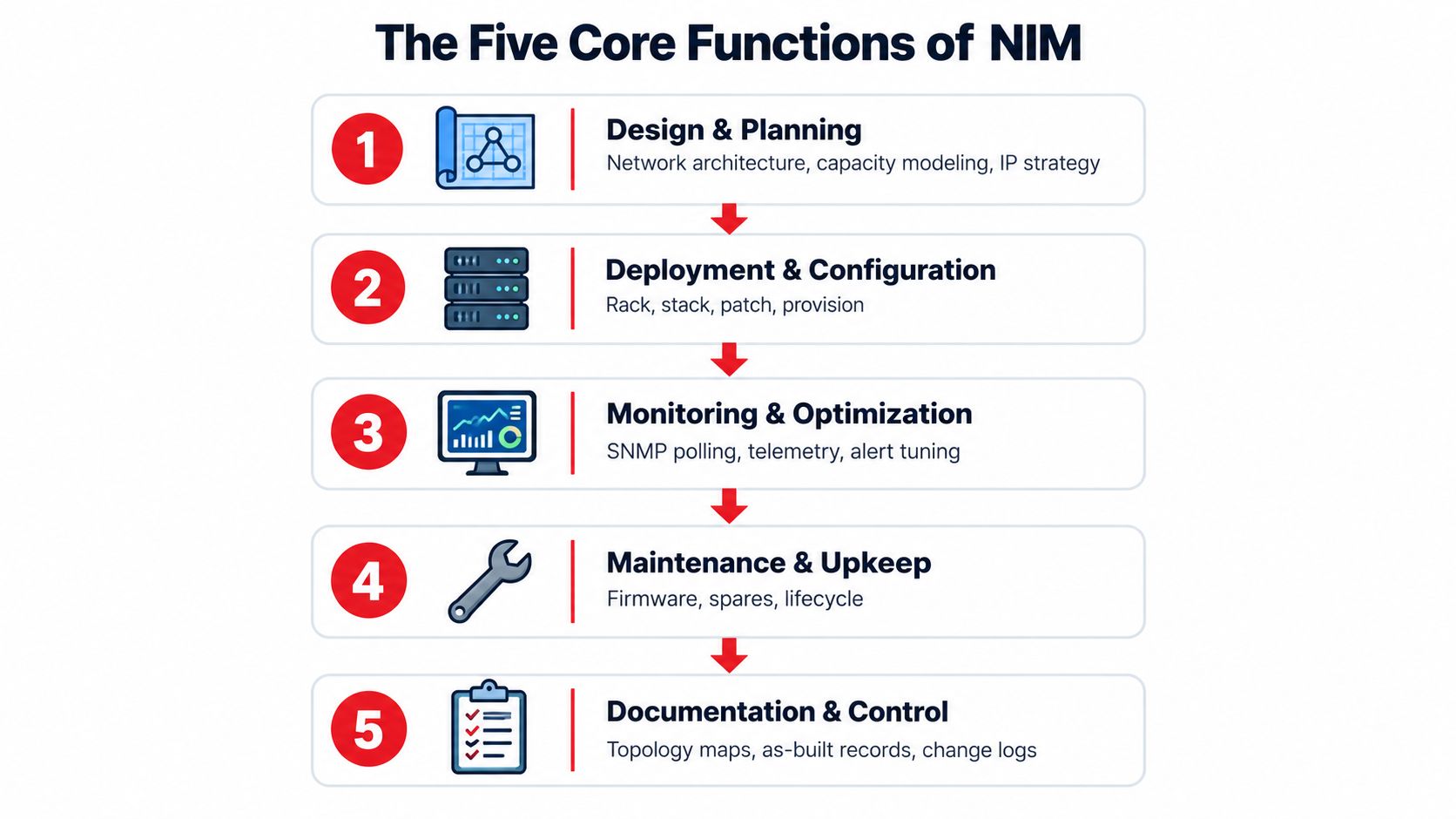
Use five functions to establish the boundaries:
- Monitoring shows what the network is doing and identifies changes in health, performance, and reachability.
- Provisioning turns an approved design into consistent device, circuit, policy, and service configuration.
- Lifecycle and maintenance keeps equipment, software, facilities, spares, and physical plant supportable.
- Automation applies repeatable actions, validates changes, and reduces manual handling where the risk is understood.
- Documentation preserves the topology, asset relationships, configuration history, and field truth that engineers need to operate safely.
The functions depend on one another. Monitoring is less useful when an alert can't be tied to a documented circuit. Automation is less safe when it can't validate the intended state. Provisioning is harder to audit when the change record doesn't preserve the before-and-after configuration.
For leaders who need a broader architectural view before setting operating standards, this network architecture guide for CTOs provides useful context on how design choices shape scalability, security, and operational responsibility. The management question follows naturally: who owns each function, what evidence proves it was performed, and what happens when the expected control fails?
The Five Core Functions Explained
The five functions are most valuable when they share information. A monitoring alert should identify a real asset, connect it to a service, open the right maintenance record, and provide enough history for an engineer to decide whether to repair, fail over, or escalate.
Monitoring
Monitoring combines reachability, performance, health, and service context. In a large data center, operators watch throughput, latency, packet loss, interface utilization, optical condition, and hardware health. Streaming telemetry from an optical line system might reveal degrading signal quality before a hard failure, giving the team time to move traffic or schedule a controlled repair.
The objective isn't to collect every possible metric. It's to detect conditions that change a decision. A high interface utilization alert matters when it indicates congestion, not just because a graph crossed a color threshold. A hardware alarm matters more when the asset has a known protection path and serves a documented customer group.
Provisioning
Provisioning should convert an approved service design into a repeatable deployment. A service-template-driven VLAN and BGP workflow, for example, can apply validated values across devices instead of relying on an engineer to reproduce a long command-line session under time pressure.
Templates don't eliminate engineering judgment. They put judgment in the design and approval stages, where it can be reviewed, then make the production execution consistent. Good provisioning also tests reachability, policy intent, rollback readiness, and documentation updates before the change closes.
Lifecycle and maintenance
Every asset has a support condition, a software state, a physical environment, and a replacement path. Lifecycle management connects those facts to maintenance windows and capacity plans. A scheduled IOS-XR upgrade should be considered alongside hardware end of life, traffic levels, redundancy behavior, spare availability, and the rollback image.
Maintenance fails when teams treat it as a calendar exercise. The right question is whether the proposed action reduces operational risk without creating an untested dependency. A router that still forwards traffic may nevertheless be a serious risk if its software, optics, or replacement parts are no longer supportable.
Automation
Automation is useful when the desired state and the failure boundaries are clear. A closed-loop workflow might flap an interface, collect diagnostics, and revert a configuration if the fault persists. That workflow needs approval rules, logging, rate limits, and a clear handoff to a human operator.
The industry is moving beyond basic task automation toward policy application, upgrades, compliance enforcement, traffic shaping, and self-service. Network World's 2026 networking trends coverage also highlights the emerging possibility of fully autonomous Tier 1 and Tier 2 incident response and change management. The hard problem isn't whether software can make a change. It's whether the organization can audit that change, contain a bad decision, and assign accountability.
Documentation
A field technician restoring a damaged route needs the correct fiber pair, splice enclosure, route segment, circuit identity, and service relationship. An engineer troubleshooting a loop needs current VLAN and topology information. Documentation turns both tasks from investigation into execution.
That includes topology maps, IPAM records, circuit IDs, port assignments, equipment inventory, configuration backups, change history, and field-verified as-builts. The record should update during the change window, not weeks later when memory has already become unreliable.
Practical rule: If an alert, change, or dispatch record can't identify the affected asset and its dependencies, the five functions aren't operating as one system.
For teams that also need to validate defensive controls, a guide to ethical hacking for providers can inform how network testing fits into the broader management process.
KPIs, SLAs, and What Actually Causes Outages
A KPI is useful only when someone can act on it. An SLA is more than a number in a contract. It defines the service behavior that operations, engineering, vendors, and customers must recognize as acceptable.
Metrics that support decisions
Operations leaders usually negotiate a combination of detection, restoration, performance, and capacity measures. MTTD tells you how quickly the team recognizes a fault. MTTR tells you how quickly it restores service or reaches a stable workaround. Availability captures continuity, while latency, jitter, and packet loss show whether a technically reachable service is usable.
| KPI | Typical target | What it signals |
|---|---|---|
| Mean time to detect | Agreed incident threshold | Whether monitoring identifies faults quickly |
| Mean time to repair | Agreed restoration threshold | Whether people, spares, access, and procedures are ready |
| Availability | Contracted service objective | Whether service continuity meets the SLA |
| Packet loss | Application or carrier threshold | Congestion, failing links, or impaired transport |
| Jitter | Voice and real-time application threshold | Variation that can degrade interactive traffic |
| Latency | Path-specific SLA threshold | Distance, congestion, routing, or processing delay |
| Capacity utilization | Planned operating threshold | Whether growth or failover could exhaust resources |
SLAs also cascade. A carrier-to-carrier handoff can affect an ISP commitment, while a data center fabric issue can affect a cloud or enterprise service. Operators should therefore measure the dependency chain, not only the customer-facing endpoint.
Why change control deserves attention
Physical failures are visible, but operational errors often create broader impact. A major outage analysis found that configuration and change-management failures accounted for 50% of major network-related incidents, while third-party provider failure contributed 34%, hardware failure 31%, firmware or software error 26%, and line breakages 17%, according to Network World's analysis of data center reliability.
Consider a stale firewall rule that blocks a newly rerouted service. Packet loss and reachability alarms might identify the symptom, but change correlation and policy validation could identify the cause earlier. An untracked IP allocation can create an overlap that affects a region, while IPAM consistency checks and route monitoring can expose the condition before customers report it.
Operational lesson: A repair team can't compensate for a change process that repeatedly introduces faults faster than monitoring can isolate them.
The right KPI set connects each failure mode to an observable signal and an owner. If the organization measures only uptime, it may miss rising latency, degraded optical health, capacity exhaustion, or a growing backlog of unsupported assets.
How Carriers, Data Centers, and Wireless Operators Apply It Differently
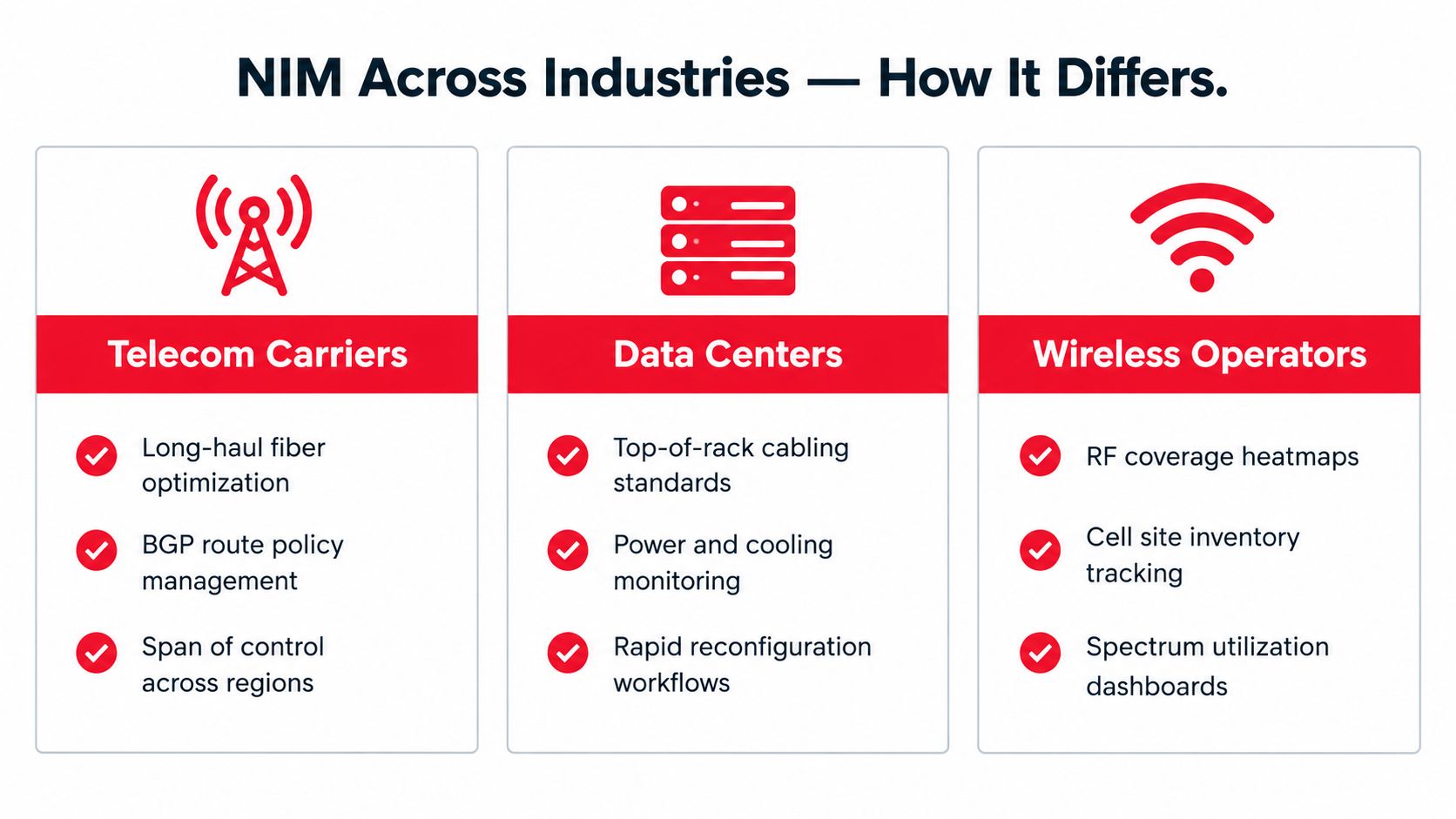
The five functions remain consistent across network environments, but the operating constraints change substantially. A carrier manages geographic routes and interconnection policy. A data center manages dense east-west traffic and tenant boundaries. A wireless operator manages radio performance, site access, transport, and coverage obligations at the same time.
| Environment | Primary operating concern | Typical management emphasis |
|---|---|---|
| Telecom carriers | Transport continuity and interconnection | Optical monitoring, route diversity, BGP policy, circuit records, field restoration |
| Data centers | Fabric performance and controlled tenant access | DCIM, SDN controllers, intent-based provisioning, power and cooling visibility |
| Wireless operators | Radio service and distributed site operations | RAN counters, coverage analysis, cell inventory, backhaul, site maintenance |
Carrier operations
Carriers need accurate route diversity and physical-path records. A logically redundant connection isn't resilient if both paths share a duct, pole line, building entrance, or power source. Provisioning must also protect BGP policy, peer relationships, and wholesale commitments.
Their monitoring stack often combines optical line systems, network management platforms, element managers, and field dispatch systems. Documentation has to connect a circuit ID to carrier handoff details, splice locations, equipment, and customer services.
Data center operations
Data centers prioritize rapid, repeatable changes without sacrificing isolation. Engineers need visibility into fabric paths, interface utilization, optics, hardware health, power, cooling, and capacity. DCIM helps connect facility conditions to network assets, while SDN controllers and intent-based workflows can apply consistent configuration across a fabric.
The failure mode differs from a rural fiber break. A mistaken policy, overloaded uplink, failed optic, or incorrect tenant segment can spread quickly across interconnected systems. Automation is therefore valuable, but only when the controller has tested intent, clear boundaries, and an auditable rollback path.
The scale of data center infrastructure management spending reflects this coordination burden. Operators increasingly manage physical plant, connectivity, energy use, and service continuity as one operational problem, not as separate facilities and networking tasks.
Wireless operations
Wireless operators add the radio access layer. Teams monitor cell performance counters, coverage, interference, transport health, site power, and equipment condition. They also coordinate landlords, tower crews, permitting authorities, backhaul providers, and emergency-service requirements.
What stays constant is the need for reliable lifecycle records, approved changes, automated checks, and field-verified documentation. What changes is the evidence required to prove service health. A carrier may focus on optical signal and route protection, while a wireless operator may start with coverage or radio performance before tracing the fault into transport.
Documentation and As-Built Records as Operational Assets
Documentation isn't administrative overhead. It is a control that limits the amount of guesswork an engineer or field technician must perform during a failure.
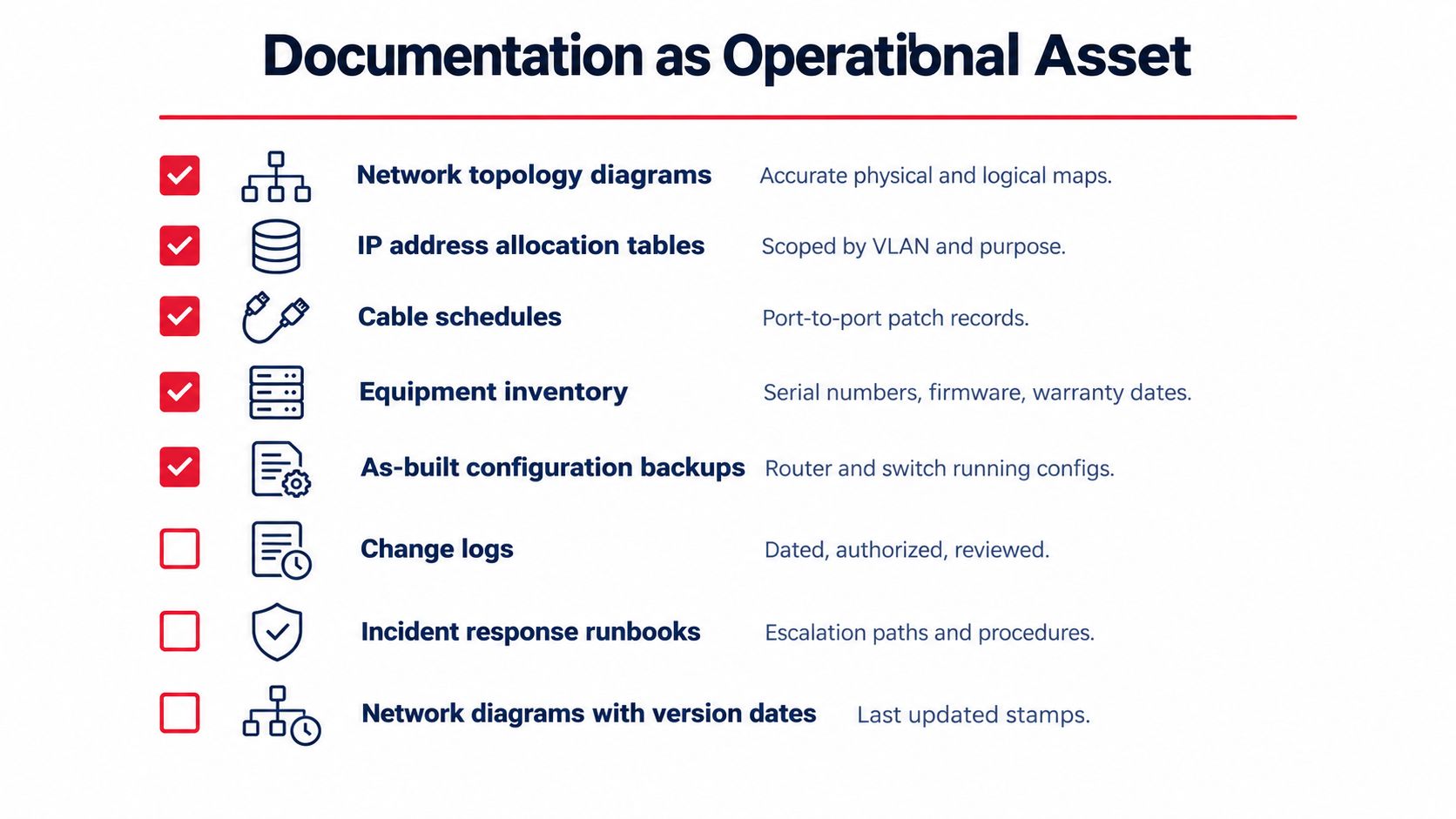
A trustworthy record includes physical and logical topology diagrams, IPAM allocations, circuit IDs, carrier handoff details, cable schedules, equipment inventory, firmware state, configuration backups, change history, rollback notes, incident runbooks, and field-verified as-builts. The record should describe what was installed, not what the original design intended.
The production cost of stale records
An undocumented VLAN extension can create an unexpected spanning-tree path. An unmarked fiber pair can send a restoration crew toward the wrong cable. A missing circuit record can delay a vendor escalation because nobody can prove which service, handoff, or contract applies.
These are not paperwork defects. They are incident-response defects. When technicians cannot identify the right port, route, enclosure, or dependency, they spend the restoration window reconstructing the network from labels, device output, and tribal knowledge.
The outage data cited earlier makes this discipline more important. If configuration and change-management failures represent the largest listed category of major network incidents, accurate records provide a direct defense against the assumptions that cause those failures.
Make the record part of the change
The best documentation process has a transaction attached to every material change. The change cannot close until the topology, asset relationship, configuration backup, and as-built information reflect the approved result. Field crews should submit splice and test evidence as part of completion, not as a separate administrative task.
Documentation earns its value during the outage, but teams create that value during ordinary change windows.
A record also needs ownership. Assign someone to review changes, reconcile inventory, retire obsolete diagrams, and verify that automated discovery matches the intended state. If no role owns data quality, the documentation system will slowly become another source of operational uncertainty.
Choosing the Right Operating Model and Partner
The build-versus-partner decision should start with the five functions, not with a generic question about outsourcing. Ask which team can monitor the environment continuously, provision safely, maintain the lifecycle, operate automation, and keep as-built records accurate under field conditions.
A fully in-house NOC gives the organization direct control over priorities, escalation, and institutional knowledge. It also requires enough staffing, specialist skills, tooling, spares, and regional response capability to cover the actual network. A fully outsourced model can provide operational scale, but the contract must preserve engineering authority, change visibility, and access to records.
A hybrid model often separates responsibilities deliberately. A partner may own Tier 1 monitoring, routine provisioning, field coordination, and as-built updates, while the carrier or enterprise retains architecture, complex engineering, security decisions, and escalation ownership.
| Model | Monitoring | Provisioning and lifecycle | Documentation | CapEx | Scalability | Best fit |
|---|---|---|---|---|---|---|
| In-house | Direct control with internal coverage | Internal engineers own changes and maintenance | Institutional ownership | Higher internal tooling and staffing needs | Constrained by hiring and regional reach | Teams with strong operational depth |
| Outsourced | Provider operates agreed monitoring and escalation | Provider executes defined work under change controls | Contractual deliverables and shared systems | Shifts toward service expense | Broadens access to crews and specialist coverage | Organizations prioritizing operational capacity |
| Hybrid | Partner handles defined first-line functions | Shared ownership with clear escalation | Joint records, audits, and acceptance criteria | Shared investment | Balances internal expertise with external reach | Complex networks with uneven regional needs |
What to test during selection
Vendor proposals should answer practical questions rather than repeat capability labels:
- Restoration evidence: Can the provider show how it measures repair performance for comparable fiber, transport, wireless, or data center environments?
- Regional coverage: Does it have field crews, spares, access procedures, and escalation contacts where the network operates?
- Change discipline: Does every change include approval, validation, rollback, and post-change review?
- Record quality: Will the provider deliver audit-ready topology, test results, configuration history, and as-built updates after work closes?
- Shared accountability: Is there a documented RACI for monitoring, provisioning, lifecycle, automation, and documentation?
Network resilience is increasingly treated as a strategic priority, and Network World's reporting on network resiliency describes the growing need for unified visibility across hybrid, multicloud, edge, wireless, and data center environments. A healthy partnership should therefore include joint post-incident reviews, shared runbooks, transparent performance reporting, and a process for improving controls after failures.
Southern Tier Resources provides engineering, construction, testing, documentation, and maintenance for fiber, wireless, and data center infrastructure, including structured cabling, fiber splicing, as-built records, and infrastructure fit-outs. If your team needs a partner aligned to the five-function operating model, visit Southern Tier Resources to discuss the network environment, field requirements, and ownership model you need to support reliable service.