
The permit is on someone's desk, the crew is lined up, and the schedule still isn't moving. That's usually the point where telecom teams realize the permit application process isn't a form-filling exercise, it's a chain of reviews, corrections, and jurisdiction handoffs that can either clear the path or stall the whole build.
For fiber and wireless projects, much of the work starts before submission and continues well after it. The teams that keep projects moving treat permitting like an operational pipeline, with scoping, completeness, review management, and resubmittals all handled deliberately.
Understanding Telecom Permit Types and Pre-Application Due Diligence
A telecom route can look straightforward on paper and still trigger three or four separate approval tracks in the field. A single build may need a right-of-way encroachment permit, a pole attachment agreement, local planning approval, utility coordination, and, for shelters or cabinets, a building permit. The mistake I see most often is assuming one agency's yes means the rest will fall into place. They won't.
Start by mapping authority, not just route miles
Before you draw a final route or lock a construction window, identify who controls each segment. City streets, county roads, state highways, utility easements, and private parcels can all sit under different review authorities, and each one may want different drawings, contacts, and supporting documents. That's why pre-application scoping matters more than some acknowledge. It flushes out hidden requirements before you've spent money on a design that won't be accepted.
For projects that touch land-use or subsurface work, don't ignore the technical inputs that support the permit. A geotechnical investigation can shape foundation design, bore methods, and restoration assumptions, which is why a service like Southern Tier Resources geotechnical survey can be relevant early rather than as an afterthought.
Practical rule: If you can't name the approving agency, the reviewing department, and the approval that must come first, you're not ready to submit.
Use pre-application meetings to surface the hidden asks
Pre-application meetings aren't bureaucratic ceremony. They're your chance to learn what the public checklist doesn't say. Some jurisdictions want title documents, some want utility conflict notes, and some care significantly about traffic control phasing before a reviewer will even open the plan set.
That's where a structured permit help resource can save weeks of guesswork. A practical example is Treecorp Solutions permit help, which reflects the kind of jurisdiction-by-jurisdiction thinking telecom teams need when they're trying to avoid avoidable redesigns.
For wireless work, the same logic applies to small cells and macro sites. A rooftop or pole-mounted installation may need planning review, structural analysis, and a lease or access agreement, while a tower upgrade may also trigger environmental or historic review. For fiber, the route can be clean for blocks and then suddenly cross a bridge, drainage feature, or controlled corridor that changes the approval path entirely.
The cheapest permit is the one you don't have to resubmit.
Assembling a Complete Permit Application Package
Incomplete packages are where projects lose time. Not because reviewers are being difficult, but because a reviewer can't move on missing information, unclear drawings, or mismatched forms. For telecom projects, that usually means the application stalls on something mundane, like an unsigned form, an outdated site plan, or a utility note that doesn't match the civil sheet.
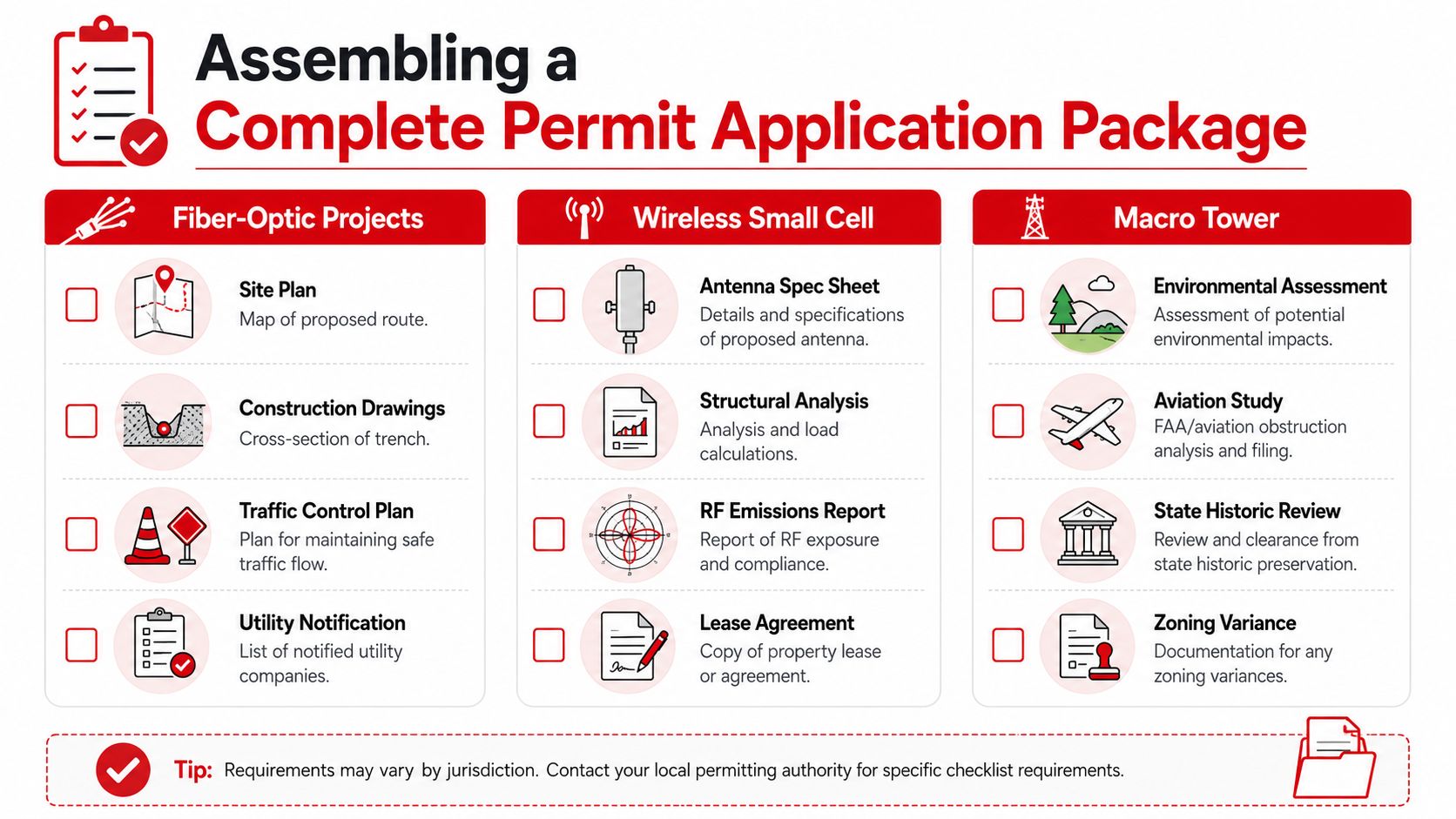
Build the package so reviewers can work from top to bottom
A well-prepared submission package is easy to review. The cover sheet should clearly state the project's nature, location, the specific permit requested, and who to contact for clarifications. Following this, the package must progress logically, with site plans, civil drawings, surveys, calculations, exhibits, and supporting approvals arranged in the sequence the agency is likely to examine them.
For fiber, that usually means route plans, trench or bore details, restoration notes, traffic control, and utility coordination. For wireless, it means equipment cut sheets, structural or mount calculations, location exhibits, and any lease or access documents the agency expects. If the project touches drainage, access, or earthwork, include the supporting calculations up front instead of waiting for a reviewer to ask.
The reason this matters is simple. Reviewers don't reward clever presentation, they reward complete information. A cleaner submission reduces the chance that someone has to stop, request a correction, and push your file back into the queue.
Document conflicts before the agency finds them
The strongest packages call out known conflicts directly. If there's a utility crossing, a make-ready issue, or a known pole limitation, show it clearly and explain the mitigation. If you're attaching to existing infrastructure, the make-ready engineering should be readable enough that a reviewer can tell what changes are proposed without hunting through the set.
What works: front-loaded QA/QC, consistent file names, and one version of truth for every drawing and form.
What fails: a package that looks complete until a reviewer compares the plan set against the narrative and finds they don't match.
For teams that want a stricter checklist, the discipline outlined in documentation best practices is the right mindset, even if your internal process is much less formal. The point isn't perfection. It's eliminating the easy reasons for rejection before the file ever leaves your desk.
Navigating the Review and Resubmittal Lifecycle
Submission is not approval. It starts a review cycle that can pause, restart, or loop several times before a permit is in hand. In telecom work, that is often where schedules slip, because the file stalls in comment resolution rather than at the front desk.
Know where the file can stop moving
Most agencies begin with a completeness check. If anything essential is missing, the reviewer can stop the clock until the packet is corrected. The U.S. Army Corps of Engineers lays out that kind of sequence in its permit workflow guide, with completeness review first, then public notice, comments, applicant responses, and final decision review. One missing response can hold up everything that follows.
Some jurisdictions also publish queue behavior or processing patterns so applicants can plan around them. General permit activity, tracked by analysts at Trading Economics, shows how permit volume can swing over time, which is a useful proxy for why review lines get longer when activity spikes. The point for telecom teams is practical. A busy permitting office takes longer to turn comments, and a quiet office can still slow down if the initial packet is incomplete.
Treat comments like a work order, not a debate
A comment letter is a task list. Read it line by line, assign each item to engineering, civil, legal, or field operations, and answer every point with the revision attached to the exact sheet or exhibit the reviewer requested. If a reviewer asks for clarification, give it in plain language and only push back when the request conflicts with the governing standard.
That approach keeps the resubmittal focused. Reviewers want to see that each comment was handled, where it was handled, and how the revised document changed. In the field, I have seen clean responses move faster than long explanations, especially when the reviewer is juggling multiple telecom, road, and utility files at once.
Some agencies are explicit about timing. Loudoun County says plans review for certain residential gas permits is approximately 10 days after the completeness check, which shows how review timing can be framed once intake is clean and the packet is ready. For telecom, the exact timing varies, but the operating rule stays the same. Completeness first, decision second.
A slow review is annoying. A stalled resubmittal loop is expensive.
Coordinating Across Multiple Jurisdictions and Agencies
Most telecom routes don't live in one clean jurisdictional box. A fiber line may touch a city street, a county road, a state highway, and a utility corridor before the day is over. Each authority can ask for different exhibits, different sequencing, and different approvals before it will let the next step proceed.
Build a jurisdiction matrix before you file anything
A simple matrix beats memory every time. Track the permit type, the agency, the expected sequence, and the prerequisites for each segment. That one document helps a project team see where an access permit depends on a planning approval, where a stormwater signoff must come before a road opening, and where a utility coordination letter is needed before submittal.
| Permit Type | Agency | Typical Timeline | Prerequisites |
|---|---|---|---|
| Road opening or encroachment | City, county, or state road authority | Varies by jurisdiction | Route confirmation, drawings, traffic control, utility review |
| Access or driveway approval | Transportation department | Varies by jurisdiction | Complete packet, site access details, sometimes pre-application meeting |
| Planning or land-use approval | Local planning department | Varies by jurisdiction | Title or land-use documents, site plans, supporting exhibits |
| Stormwater or drainage approval | Local public works or engineering staff | Varies by jurisdiction | Civil plans, drainage calculations, restoration details |
| Utility coordination or make-ready | Utility owner or pole administrator | Varies by route | Pole data, attachment design, conflict notes |
The coordination challenge is not just paperwork. It's sequencing. If one agency needs a finished approval from another before it will open its own review, your schedule needs to reflect that dependency. Otherwise, the file sits in someone's inbox waiting for a document that hasn't been created yet.
Align the message across agencies
Different offices often want different levels of detail, but they all need the same story. The route, scope, construction method, restoration approach, and contacts should line up across every submission. If the civil sheet says one thing and the narrative says another, the reviewer won't guess which version is right.
That's where a strong stakeholder communication plan helps. A communication plan for transformation leaders isn't telecom-specific, but the discipline transfers well. Keep one owner for agency follow-up, one log for comments, and one path for approving revisions. You're managing relationships and dependencies as much as drawings.
For broader coordination, the internal playbook at community engagement strategies is useful when a route moves through neighborhoods, business districts, or publicly sensitive areas that need clear outreach before they'll support the work.
Common Permitting Pitfalls and How to Avoid Them
Most permitting failures aren't dramatic. They're ordinary mistakes repeated on a tight timeline. The project team assumes something is already approved, or it waits too long to answer a request, or it sends a revised set without controlling the version history.
The traps that cost the most time
- Submitting before zoning is confirmed: The file may be accepted, but the route can still get rejected later if the land-use basis isn't solid.
- Underestimating fees and bonds: Some agencies won't issue until the financial side is complete, and that creates a last-minute block.
- Treating environmental review as secondary: If a permit depends on environmental or historic inputs, leaving them late can reset the whole sequence.
- Ignoring version control: If the reviewer can't tell which plan set is current, every comment round gets harder.
- Assuming one approval covers all others: It doesn't. Each authority still has to sign off on its own scope.
- Missing response deadlines: Some processes can stall or reset if the applicant doesn't respond in time, which is especially painful on multi-agency work.
Fix the process, not just the form
The best preventive action is discipline before submittal and speed after comments arrive. Lock the plan set, review the fees, confirm the prerequisites, and assign an owner for every agency touchpoint. Then respond to comments quickly with clean redlines and a short explanation of what changed.
A telecom permit application process succeeds when the team treats follow-up as part of the job, not a side task. Once the submission is out, the bottleneck is usually communication, not construction.
If your file is sitting still, the fastest move is often a complete, documented answer to the last comment you received.
Building Your Telecom Permitting Timeline and Checklist
A practical timeline starts from the construction start date and works backward. If the route needs multiple approvals, the pre-application meeting comes first, then the document prep window, then submission, then the review period, then any revision cycle, and finally permit issuance. The schedule should assume at least one correction loop, because that's how real projects behave.
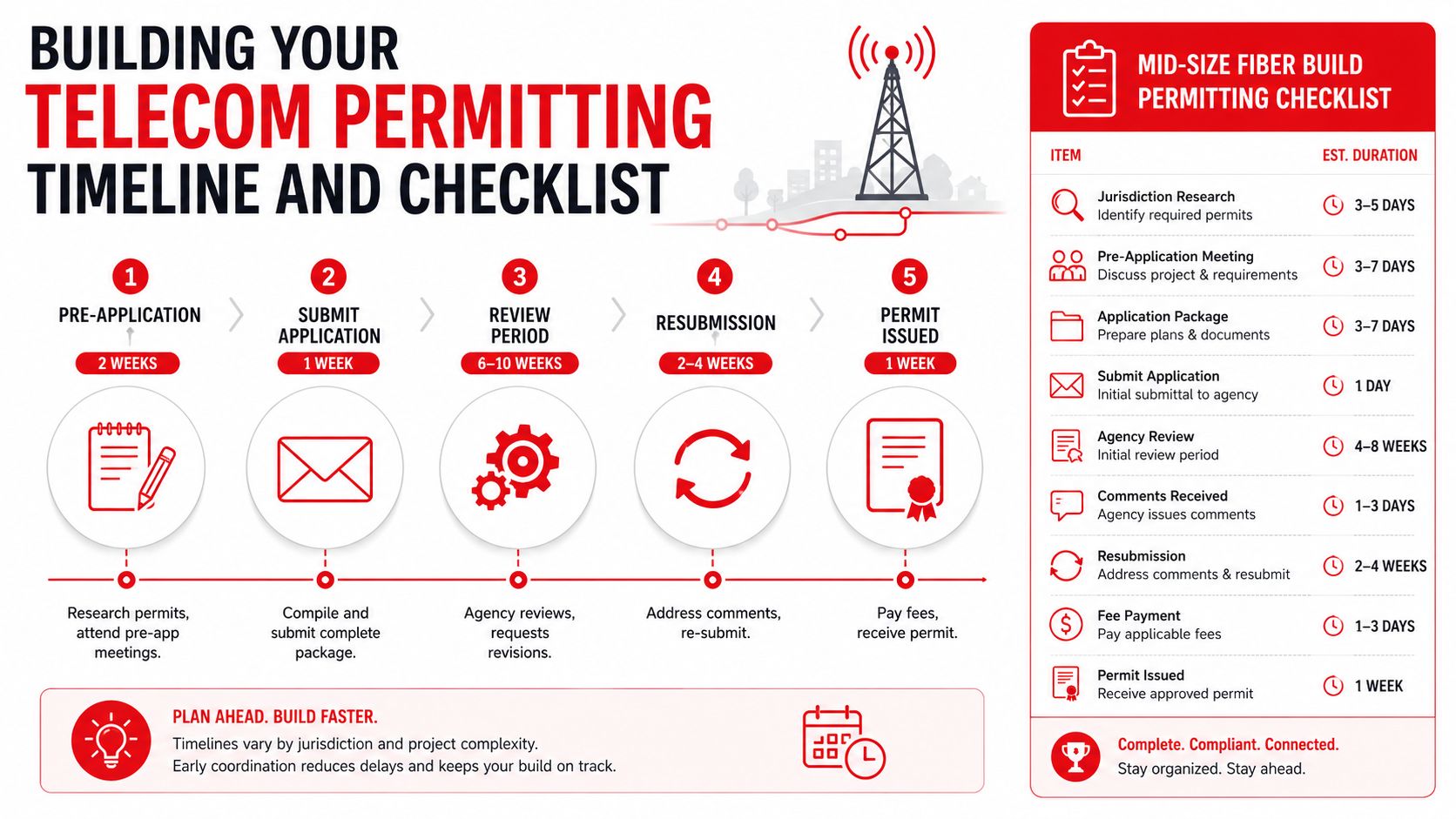
Use a working checklist, not a static template
For a mid-size fiber build, the checklist usually starts with jurisdiction scoping, utility research, and route confirmation. Then comes the package build, including drawings, traffic control, and supporting calculations. After submission, track every comment, revision, and resubmittal in one place so nothing gets lost between engineering and field scheduling.
For wireless small cell work, add lease status, attachment design, structural support, and any local planning or aesthetic requirements that could hold up issuance. For macro sites, keep the environmental, aviation, and zoning tracks visible from day one. The permit calendar should show not only what's due, but what depends on something else being finished first.
Build slack into the schedule on purpose
The schedule that looks cleanest on a slide deck is usually the one most likely to slip. Build a buffer for the review loop, because the first submittal rarely closes every question. The team that protects the critical path is the one that plans for revision instead of pretending it won't happen.
For daily control, keep three fields visible on every project record. Current status, reviewer feedback, and next action owner. That's enough to expose whether the job is moving or just sitting in administrative limbo.
Southern Tier Resources helps carriers, ISPs, wireless operators, and infrastructure teams move from design through permitting, construction, and turn-up with fewer handoff gaps. If you're managing fiber or wireless work and want a partner that understands the field, the documents, and the agency side of the permit application process, visit Southern Tier Resources to see how they support telecom builds end to end.