
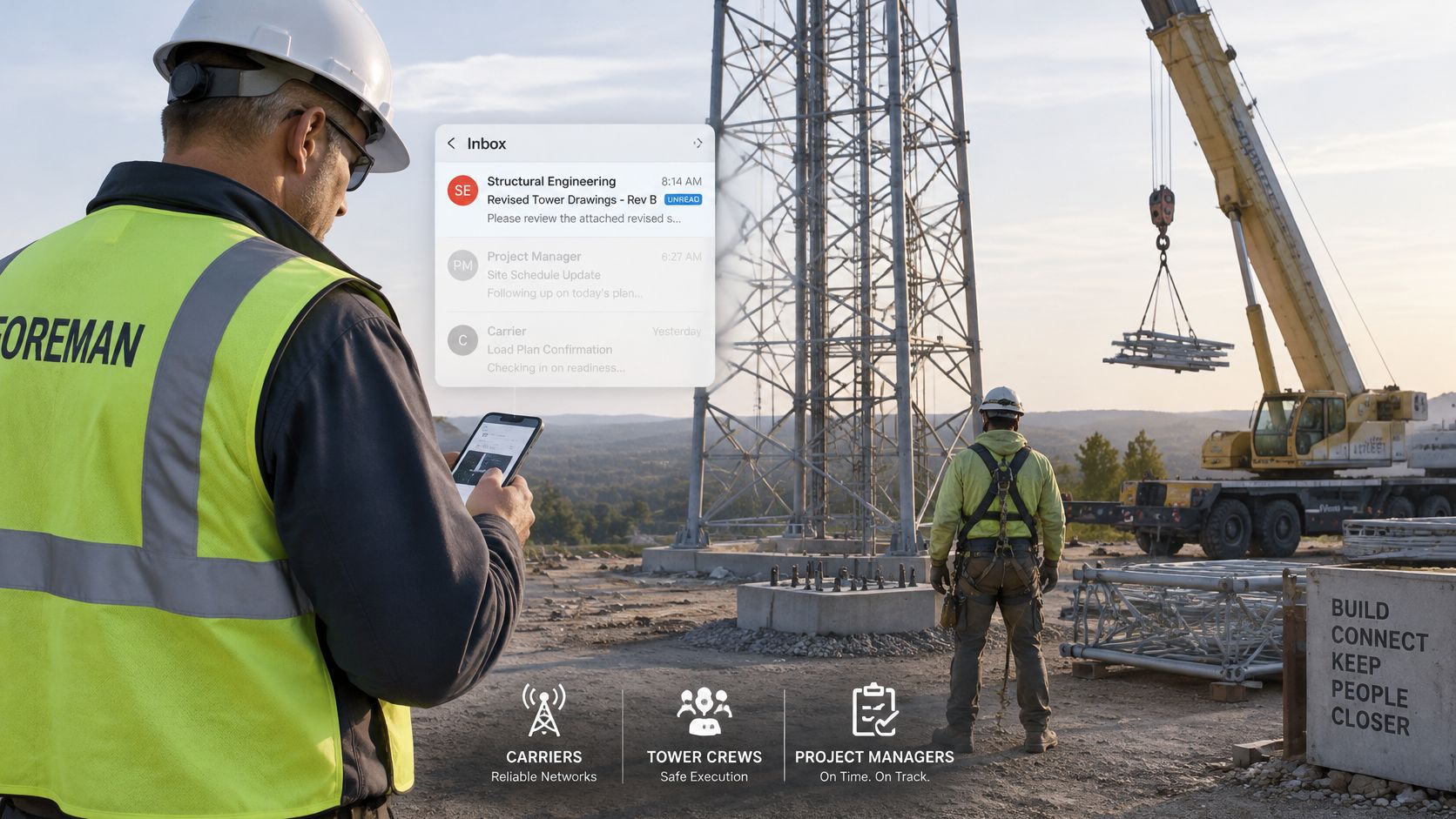
The crane is already on site. The latest structural revision is sitting in an engineer's inbox, and the climber is waiting for a load call nobody repeats. The carrier wants a completion time, but the crew still doesn't know who can authorize the next move.
Why a Tower Job Stalls on Messages
Adding more messages won't fix this job. When the construction manager and the carrier representative can each say go, more traffic creates competing instructions. Clear ownership, not more chatter, closes the gap.
That applies whether you're a carrier, tower company, ISP, or municipal broadband team running a greenfield monopole, a collocation, or a structural upgrade. Each job needs someone who owns the decision, someone who acknowledges the instruction, and evidence that the task finished before another activity begins.
Give each decision an owner
New wireless tower construction in the United States increased from 1,781 towers in 2023 to 1,891 towers in 2024, according to FCC and FAA database analysis reported by Inside Towers. For owners managing deployments, the practical challenge is keeping each site's permissions, drawings, and field instructions aligned without burying crews in updates.
Build tower construction communications around a closed loop:
- Site authority: A named communications lead controls field traffic and routes decisions to the qualified activity owner.
- Design authority: An issued drawing set defines what the crew may build.
- Approval authority: A permit register distinguishes submitted, under review, approved, and released for construction.
- Operational acceptance: A documented handoff gives maintenance responsibility for what was installed.
A message isn't complete because someone sent it. It's complete when the right person acknowledges it and the required action is confirmed.
Keep the scope practical. These controls govern the messages that move work between phases; they don't replace engineering, a lift plan, or a rescue procedure. Use the numbered field sequence to establish release points, then fill out the message matrix before the pre-task briefing.
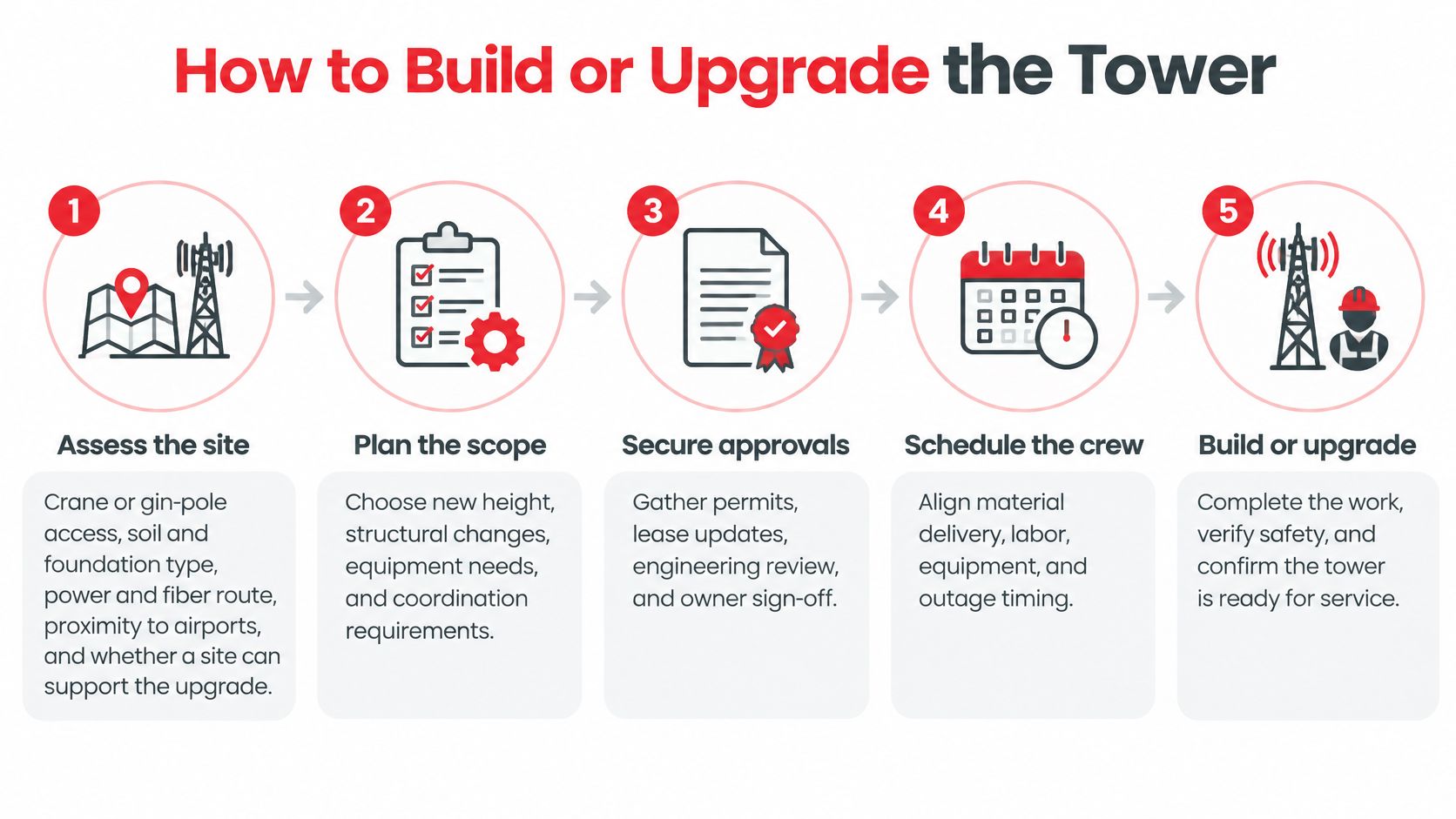
How to Build or Upgrade the Tower
Spend money in the order that uncertainty gets resolved. Buying steel early can protect availability, but it can also leave you storing material that no longer matches the approved foundation or antenna configuration.
Resolve the site before releasing fabrication
Assess the site. Walk the crane or gin-pole access route, inspect the laydown area, and reconcile the survey with actual conditions. Confirm geotechnical information, foundation type, power service, fiber routing, and airport proximity. For a collocation, have the structural engineer evaluate the proposed loading before releasing antenna installation. Concrete check: the site assessment must identify any condition that prevents the proposed equipment from reaching its working position.
Lock the design. Have the responsible engineers resolve wind and ice loading, foundation details, mounts, equipment placement, and reinforcement. Publish the issued revision in a controlled document repository, such as SharePoint, and download a field-accessible copy. Concrete check: the drawing revision on the foreman's tablet matches the revision on the fabrication release. A field markup is a question for engineering, not permission to improvise.
Run approvals and procurement together, with release gates. The permitting owner tracks agency approvals while procurement checks material availability and cancellation terms. File the FAA obstruction notice where required, confirm FCC antenna structure registration applicability, and have the responsible lift planner align the work with applicable OSHA construction requirements before booking the crane. Concrete check: the construction release identifies outstanding conditions explicitly; an application receipt doesn't count as approval.
Stage the logistics. Agree on delivery access, unloading order, laydown space, exclusion-zone boundaries, and equipment setup. The lift planner and site supervisor must establish weather cutoffs and the method for measuring conditions before equipment arrives. Concrete check: the delivery manifest matches the erection sequence, so the crew doesn't have to move stored sections during lifting.
Release physical work by verified condition
Erect or reinforce the structure. Release foundation loading against the engineer's acceptance criteria and supporting test records, not a calendar assumption. Check steel member identification, monopole section orientation, connections, and reinforcement against the issued drawings. Concrete check: the structural lead records acceptance of the installation stage before the crew adds the next load.
Install the communications equipment. Mount radios, antennas, microwave dishes, cable supports, grounding conductors, and cabling against the approved configuration. The carrier owns the operational permission for power or fiber cutovers; the installer executes the authorized work. Concrete check: the cutover instruction identifies the affected circuit, expected service impact, rollback authority, and person confirming restoration.
Test and commission. Complete antenna-line sweep testing, passive intermodulation testing where specified, microwave alignment, grounding verification, and alarm-path checks. Label test files by site, sector, port, and installed configuration rather than leaving instrument-generated filenames. Concrete check: a reviewer can trace each result to the equipment and cable shown in the as-built record.
Demobilize against acceptance. Don't release specialist equipment while its operator is still needed to resolve an inspection finding. The construction lead checks documentation readiness and obtains the owner's disposition of remaining defects. Concrete check: every unresolved item has an accountable owner and an agreed completion condition.
The owner's commissioning checklist should distinguish tested, accepted, and accepted with exceptions. Include equipment identification, required test results, alarm verification, service restoration, and the disposition of defects. A signature authorizes a defined operational state; it shouldn't mean only that the crew has left.
Permit Clocks and Who Sends the Update
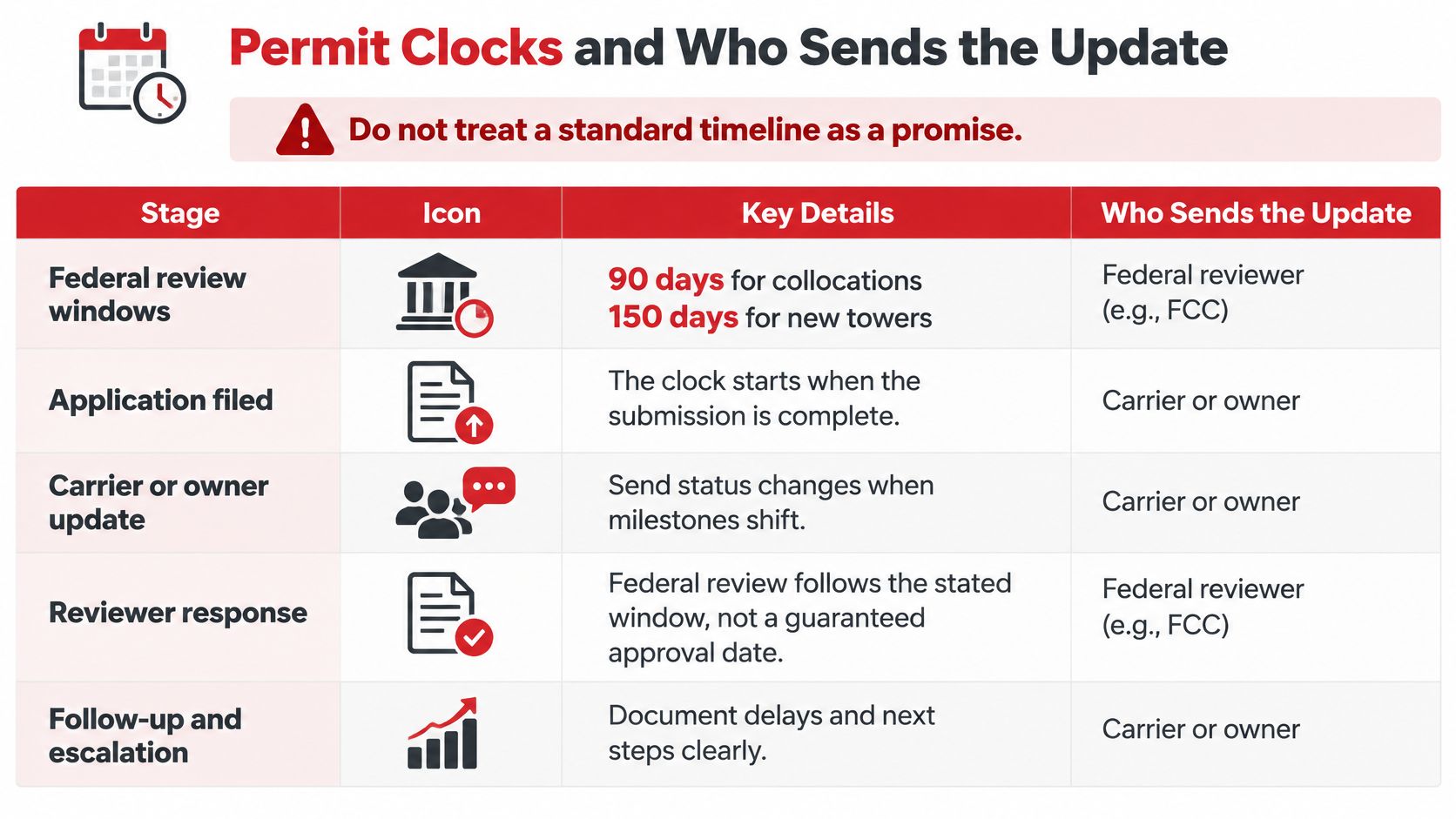
Don't treat a standard timeline as a promise.
Permit review clocks and the status to publish
| Review | Planning clock | Publish | Escalate when |
|---|---|---|---|
| Collocation | 90 days presumptively reasonable | Milestone and confidence, not only a target date | Drawings incomplete or silence past midpoint |
| Other siting application | 150 days presumptively reasonable | Same register fields | Jurisdiction or scope changes |
| Small-cell collocation | 60 days | Drawing set and make-ready owner | Utility owner is unnamed |
| Small-cell new structure | 90 days | Notice status and environmental screen | Local notice dispute |
| BLM or Forest Service land | 270+ days for 36% of reviews | Confidence kept separate from target date | No single permit register |
The USTelecom permitting comments identify presumptively reasonable review periods of 90 days for collocations and 150 days for other applications, small-wireless periods of 60 days for collocations and 90 days for new structures, and testimony citing government data that 36% of Bureau of Land Management and U.S. Forest Service reviews exceeded 270 days.
These aren't interchangeable scheduling commitments. Have the permitting specialist establish which review framework applies, when its clock begins, and whether a completeness issue or other event affects it.
Publish the dependency, not just the date
Say a collocation stalls because the equipment schedule doesn't match the submitted drawings. The useful update isn't “agency delay.” It names the engineer correcting the package, the response deadline, and the effect on construction release.
A federal-land review needs a different message. The owner needs the outstanding review actions, agency dependencies, and schedule confidence, not a copied local-jurisdiction target.
Keep a single permit register containing:
- Application identity: Site, scope, jurisdiction, submission reference, and applicable review path.
- Accountable owner: The person authorized to coordinate responses and publish status.
- Agency exchange: Latest comment, response owner, response due date, and preserved correspondence.
- Schedule assessment: Target date, confidence note, and evidence supporting any committed date.
A shared Excel register can work. An elaborate dashboard won't help if each contractor maintains a different definition of approved.
Change the message when the dependency changes
Crossing a county line requires confirming jurisdiction and notice requirements. Environmental or historic review needs a named specialist and a deliverable, while utility make-ready needs a utility contact who accepts ownership. A notice dispute needs a recorded issue and response path, not an optimistic construction date.
Incomplete drawings and unclear response ownership are preventable sources of delay. Publish milestone changes rather than a weekly narrative, and use the review midpoint as an internal escalation checkpoint when comments remain unanswered.
Construction shouldn't receive a date labeled committed until the register owner has evidence supporting that commitment.
The Message Matrix and Closed-Loop Radio Protocol
Tower construction communications matrix
| Activity | Decision owner | Required message | Stop if |
|---|---|---|---|
| Site access and briefing | Site communications lead | Call signs, lift plan, weather limit, rescue route | Radio check fails or exclusion zone is unset |
| Climb or reposition | Ground lead, with climber confirmation | Intent, explicit acknowledgment, then completion | No acknowledgment or lost contact |
| Hoist and gin pole | Lift lead on a dedicated channel | Load weight, tag line clear, all clear | Two supervisors issue commands or a load call isn't repeated |
| Antenna or dish placement | Ground supervisor, after RF lead clearance | Azimuth, height, mount confirmed | Live RF exposure isn't controlled or attachment is unconfirmed |
| Foundation and steel | Structural lead | Member ID matches the current revision | Drawing on site isn't the issued set |
| Demobilization | Construction lead, with maintenance acceptance | As-built, punch list, rescue notes | A field change is undocumented |
Brief the authority before the activity
Read the applicable rows in work order. Start with access and climbing, brief structural work before erection, then cover equipment placement and closeout. Identify the individual filling each role, not just the company responsible.
Decision owner doesn't mean sole technical authority. The ground supervisor can release placement only after the RF lead confirms the exposure controls; the supervisor cannot override that clearance. Likewise, the site communications lead manages traffic but doesn't replace the qualified lift director or structural engineer.
The NIOSH-derived guidance discussed in Safety+Health recommends maintaining communications for all workers and using step-by-step confirmation when tower workers change positions or detach and reconnect fall-arrest systems. Build that confirmation into the task, rather than adding a generic reminder at the end of the briefing.
Use distinct call signs, such as Ground, Climber, and Lift. Avoid similar-sounding names, and identify the intended recipient before giving an instruction.
Before anyone climbs, verify radio coverage at the base, planned working elevation, hoisting area, and exclusion zone. Check battery condition, microphone operation, channel selection, and whether hearing protection makes speech intelligible.
Read back the action, not just the receipt
Use a briefing script the crew can execute:
- State intent: The climber identifies the intended movement and destination.
- Acknowledge explicitly: Ground repeats the movement being authorized, after checking conflicting activity.
- Confirm completion: The climber reports the completed movement and secured position.
- Release the next task: The activity owner authorizes the next load or movement only after receiving that confirmation.
Use stand by, stop, all clear, and emergency as the standard control terms, supported by plain descriptions of the task. A nod or a casual okay doesn't establish which instruction was understood.
Radio discipline: All clear describes a verified condition. It isn't a substitute for identifying who is authorized to move what.
Reserve a dedicated channel for the lift or rescue team. Agree on a backup method, such as a wired intercom or rehearsed hand signals where visibility permits; another channel on the same failed radio isn't an independent backup.
For the equipment-planning side, TP Training's guidance on checking whether a lift should proceed is a useful companion to the site-specific lift plan. It doesn't replace the designated lift authority's decision.
Check radios before each shift and stop controlled movement immediately on a dropout, following the planned safe-hold procedure. Tie-off changes, tag-line handoffs, and initial load movement leave little room for correction. Track acknowledgment compliance and drill completion locally rather than treating message volume as evidence of control.
When the Signal Drops and Work Stops
A fall can begin before anyone finishes an improvised warning. Structural collapse, electrical exposure, an uncontrolled hoist, weather, falling objects, and equipment failure also demand controls that exist before the event.
The NIOSH tower-work alert identified 118 tower-related deaths from 1992–1998, including 93 falls and 18 tower collapses. That historical benchmark supports prioritizing climbing and structural-work checkpoints; it doesn't establish that communication failures caused those deaths.
Communication failures and the stop-work fix
| Symptom | Likely cause | Fix |
|---|---|---|
| Two people say go | More than one supervisor on the channel | One ground lead and a lift-only channel |
| Climber moves without an answer | Open loop | Hold until the acknowledgment is explicit |
| Radio dies at height | Unmapped dead zone | Checkpoint plus intercom or hand signals |
| Crew keeps working after a dropout | No stop rule | Immediate stop; emergency words only |
| Wind or heat spikes mid-lift | No trigger owner | Pre-agreed weather stop and rescue brief |
| Live power or fiber surprise | Late carrier notice | Named escalation before energizing |
Make the stop condition executable
A stop command must lead to the safe state defined in the work plan. For a suspended load, that means the operator follows the planned hold or landing procedure, not an abrupt action that creates another hazard.
Require load commands to be repeated before execution. If the readback doesn't match, the lift lead resolves the discrepancy before authorizing movement.
Map dead zones during planning and verify them under actual working conditions. Hand signals are useful only when the designated people can see and interpret them; they aren't a rescue plan for someone out of sight behind steelwork.
Assign weather and crew-condition monitoring to a named person. That person needs authority to act on the agreed wind, heat, lightning, or fatigue trigger without negotiating with the schedule owner.
Audit what happened after the call
An emergency message must identify the site, tower elevation, injury type, and access route. Keep those details on the briefing sheet so the caller doesn't have to reconstruct the address under pressure.
Review the control records before releasing the next climb:
- Pre-shift checks: Record failed equipment and its replacement.
- Missed acknowledgments: Identify the task and correct the cause.
- Emergency drills: Verify responders can find the access point and use the rescue route.
- Stop-work events: Record who authorized restart and what changed.
Don't reward crews for reporting fewer stops. Reward them for identifying an unsafe condition and closing it correctly. An unconfirmed critical movement is a failed control, even when nobody gets hurt.
Hand the Tower to Maintenance
The tower isn't finished when the installation crew loads its tools. It's finished when maintenance can identify the installed configuration, understand the outstanding defects, and respond without calling someone who has already moved to another project.
Deliver an operational record
Prepare the handover package while work is underway. Reconstructing cable routes, buried grounding connections, and equipment labels from a final photo walk usually leaves gaps.
- As-built record: Show what was mounted, including equipment identification, cable routing, grounding, mount details, and approved field changes. Include photographs with enough context to establish location.
- Test pack: Preserve original instrument files alongside readable reports. Make failed results and subsequent retests traceable rather than deleting the failed attempt.
- Open punch list: Give each item an owner, due date, acceptance criterion, and operational restriction where relevant.
- Rescue and access notes: Record gate access, approach constraints, rescue provisions, site hazards, and emergency contact ownership.
Name the maintenance owner who accepts these records. A shared mailbox can distribute documents, but it can't accept responsibility for an unresolved alarm or authorize service restoration.
Transfer authority with the equipment
Confirm with the carrier who owns power, fiber, and the alarm feed after cutover. Record the escalation path for dropped sectors, persistent alarms, and later collocations, including who can authorize intervention and who verifies recovery.
Schedule the first inspection around weather exposure, unresolved installation risks, and the carrier's change window. Don't substitute a vague annual visit for a site-specific inspection decision.
If maintenance uses drones for visual surveys, separate aircraft readiness from tower acceptance. Ace Aviation Aerospace Academy's training in engineering skills for drone maintenance is relevant to teams maintaining that inspection equipment; aerial images still don't replace required hands-on checks or electrical testing.
Maintenance should inherit the evidence and the authority to act, not just a folder of photographs.
Carry the permit register, approved drawing set, and subsequent revisions into the maintenance record. Retire superseded copies from active use while preserving the revision history. The next collocation should start with the installed configuration, not an old leasing exhibit.
Apply the same discipline to later work: name the climb lead, verify the radio check, and obtain explicit acknowledgment of the authorized scope before changing equipment.
Crew lead checklist for this week
- Fill the matrix: Assign named decision owners and stop conditions for the current job.
- Assign the register: Name the permit-register owner and confirm who can publish committed dates.
- Brief before climbing: Don't release the climb until the crew understands both the activity matrix and the approval status affecting its work.
Southern Tier Resources provides engineering, construction, and maintenance for wireline and wireless networks, including tower construction and upgrades. Visit Southern Tier Resources to discuss a project scope that connects permitting, field execution, testing, and documented handover under a single accountable partner.