What is OHE, really, when the same acronym can point to rail electrification, data science, education, or telecom plant? That confusion is why so many searches miss the practical answer. In network infrastructure, OHE usually means the overhead plant that carries communications circuits above ground, and that's the meaning that matters most to carriers, ISPs, utilities, and construction crews working on aerial routes.
The problem is simple, but the consequences aren't. If a crew, planner, or reviewer starts with the wrong definition, the discussion goes sideways before anyone talks about poles, attachments, clearances, or make-ready. For telecom and utility professionals, OHE is the overhead system that has to be designed, permitted, built, inspected, and maintained in the field, where access is tight and every attachment has to earn its place.
Decoding OHE in Network Infrastructure
OHE is an ambiguous acronym, and that ambiguity is the first thing to clear up. In abbreviation databases, it can mean Over Head Equipment in rail electrification, but it also appears as Office of Higher Education, Office of Health Economics, One Hot Encoding, and other expansions, which is why a generic search often misses the intended meaning unless the domain is stated up front. The practical fix is to name the field first, then define the term inside that context, as shown in the abbreviation listing for OHE.
For telecom and utility work, the meaning is narrower and more useful. Here, OHE refers to the overhead infrastructure that supports communications networks above ground, usually on poles and support structures rather than inside duct or conduit. That includes the physical plant that carries aerial fiber, copper, coaxial, and related attachments across streets, rights-of-way, and utility corridors.

Why the distinction matters on the job
A crew leader doesn't get paid to argue vocabulary, but bad terminology creates bad scopes. If a customer says “OHE” and means aerial telecom plant, the work may involve pole surveys, lashers, strand, attachments, and utility coordination. If they mean something else, the equipment list and safety plan change immediately.
Practical rule: always identify the industry before you use the acronym. In the field, context prevents wrong material orders, wrong clearance assumptions, and wrong crew mobilization.
For search and documentation, that distinction matters too. A proposal, permit set, or as-built package should spell out the meaning on first reference so the reader doesn't have to guess. That's especially important in mixed-discipline projects where wireless, wireline, and utility teams all touch the same corridor.
Unpacking the Different Meanings of OHE
The rail meaning is the most technical non-telecom use, and it helps explain why the acronym causes so much confusion. In railway electrification, OHE means Overhead Equipment, the traction system suspended above the track that delivers electrical energy to the locomotive pantograph. A conventional configuration uses a 65 mm² cadmium-copper catenary wire and a 107 mm² hard-drawn grooved copper contact wire, with the contact wire typically held around 5.60 m above rail level in standard practice, because stable pantograph contact depends on keeping height and stagger within tight limits to reduce arcing, wear, and current-collection loss, as described in the rail reference for OHE basic configuration.
Rail OHE also shows how much structure matters. Training material for Indian railway OHE cites minimum mast implantation depths of 2.80 m for new masts, 3.0 m for critical locations such as TTC, portal, ACC, ACA, ATD, and FTA, and 4.75 m minimum implantation for platform masts. Those depths reflect the need to resist wind, dynamic pantograph forces, and alignment drift while keeping clearance and service reliability intact, as detailed in OHE material online.
Other meanings you'll still run into
Telecom isn't the only field that uses the acronym. In computing, One Hot Encoding is another common expansion, and it can appear in documentation, searches, and analytics workflows. That's why a query like “what is OHE” can be hard to answer without first asking which industry the reader means.
For field teams, the lesson is useful even outside rail. Acronyms travel poorly across disciplines. A planner writing for telecom should use Overhead Plant or Overhead Equipment for telecom on first mention, then define the assets in plain language so contractors, permitting staff, and engineering reviewers stay aligned.
The safest habit is to replace an acronym with the actual asset name whenever there's room for it. Clear writing prevents wrong assumptions, and wrong assumptions are expensive on aerial jobs.
The Anatomy of a Telecom Overhead Plant
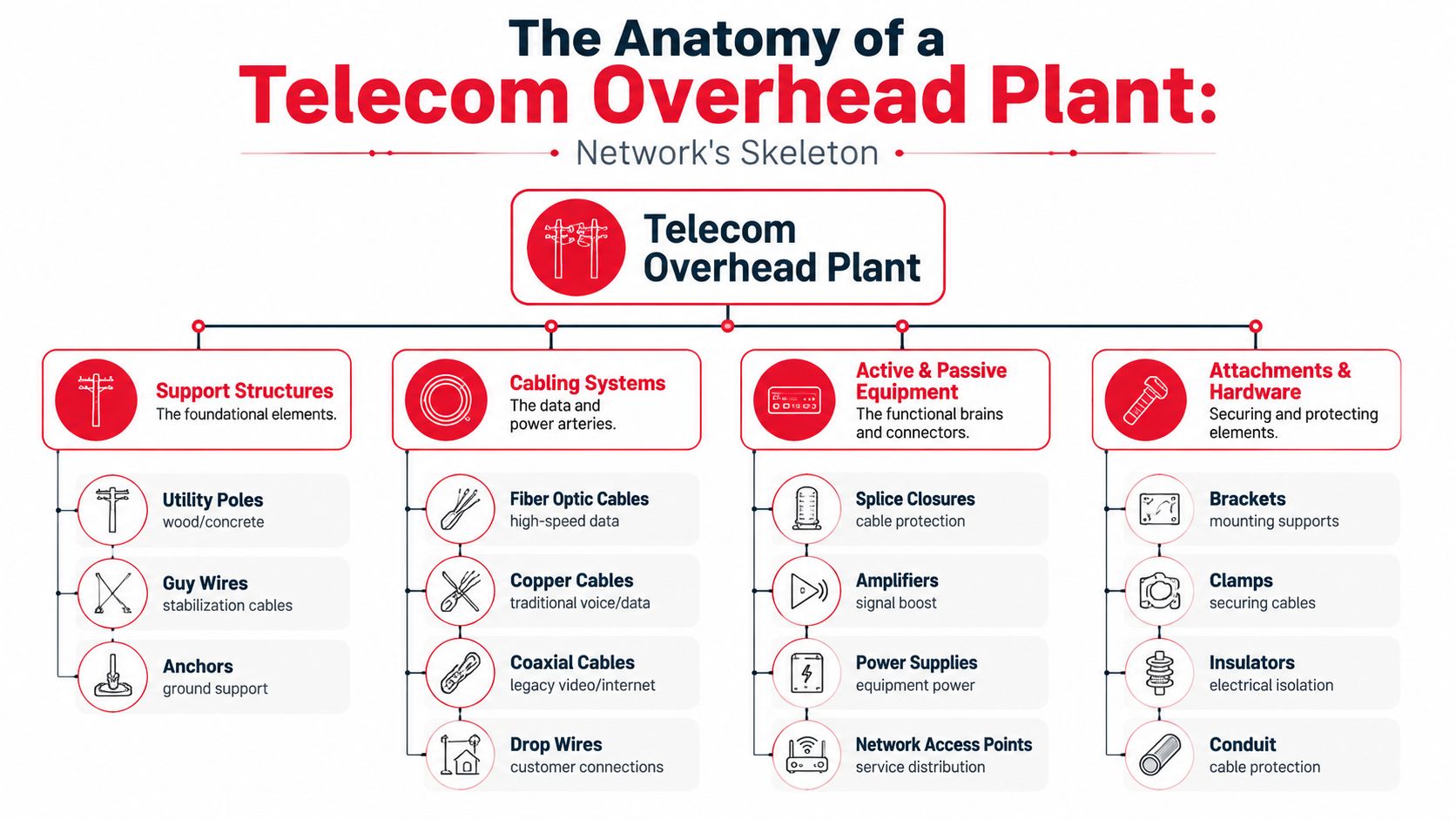
A telecom overhead plant is the network's skeleton and circulatory path at the same time. The poles carry the load, the messenger wire or strand carries the tension, and the cable carries the service. If any one of those pieces is undersized, poorly attached, or installed out of sequence, the whole route becomes harder to maintain and easier to damage.
Support structures and load path
Utility poles are the base structure, but they're not just vertical wood or concrete members. They're load-bearing assets that must handle cable tension, attachment hardware, wind loading, and the weight of future additions. Guy wires and anchors become critical when the pole line needs extra stabilization, especially in long spans, corners, or locations with heavy attachment density.
Cable systems and service delivery
The cabling layer is the nervous system. Fiber optic cable carries high-speed data, copper still appears in legacy plant, coaxial remains in some distribution networks, and drop wires connect the network to customer premises. In the field, each cable type brings different attachment rules, bend sensitivity, and storage requirements, which is why crews have to treat aerial routes as engineered systems, not just hanging lines.
Hardware, closures, and make-ready
The small parts matter more than outsiders expect. Splice closures protect the fiber, distribution terminals organize service handoffs, and clamps, grips, dead-ends, and brackets keep the plant from moving in wind or under tension. Make-ready engineering is the work of preparing a pole for new attachments, and it often decides whether a build moves smoothly or gets stuck in coordination.
Aerial routing only works when the support system is ready before the cable arrives. That's why good field teams verify pole condition, attachment ownership, clearance conflicts, and existing load before they schedule production. For a broader construction workflow context, the telecom route planning mindset is well aligned with the practical steps described in fiber optic construction practices.
Overhead vs Underground Deployment A Strategic Comparison
Overhead and underground plant solve the same service problem in very different ways. Aerial construction usually wins when speed, access, and incremental expansion matter most. Underground construction usually wins when aesthetics, physical protection, or corridor control are the priority, but it usually asks for more civil coordination and more upfront work.
The decision is rarely about one being “better” in the abstract. It's about matching the deployment method to the route, the municipality, the utility environment, and the service objective. A suburban broadband build, a rural extension, and a downtown street reconstruction can all justify different answers.
| Factor | Overhead Plant | Underground Plant |
|---|---|---|
| Deployment style | Uses poles, strand, and aerial cable | Uses buried conduit or direct-buried facilities |
| Speed of field work | Usually faster to access and extend | Often slower because excavation and restoration are involved |
| Maintenance access | Easier to inspect and repair from above | Harder to reach, especially after restoration is complete |
| Right-of-way pressure | Depends on pole ownership and attachment space | Depends on trench access, permits, and subsurface conflicts |
| Visual impact | More visible in the streetscape | Less visible once restored |
| Damage exposure | More exposed to wind, falling trees, and vehicle strikes | More protected from weather and surface impacts, but still vulnerable to digs and flood-related issues |
Overhead plant often fits projects that need practical reach and flexible expansion. Underground plant often fits locations where the community expects a cleaner streetscape or where the owner wants physical protection for the network. The trade-off is that aerial work can be easier to troubleshoot, while buried plant can be harder to locate and restore after a fault.
Project managers also need to think about operations, not just installation. If a route crosses multiple pole owners or a dense utility corridor, overhead work can become coordination-heavy. If a route demands roadway cuts, restoration windows, and subsurface verification, underground work can become schedule-heavy.
Field reality: the cheapest-looking route on paper is often the most expensive one in the field if access, restoration, or pole-attachment coordination gets underestimated.
For a heavy-civil lens on the kind of coordination underground work demands, the project discipline discussed in heavy civil construction is a useful contrast. Aerial work trades excavation for attachment management, and that difference drives most of the planning logic.
Key Considerations for OHE Projects
Telecom overhead projects succeed or fail on the details that don't make it into glossy diagrams. Engineering has to be right, the paperwork has to clear, the crew has to work safely at height, and the plant has to survive long after the final tensioning run is complete.
Engineering and design discipline
Pole loading analysis should come before construction, not after the truck rolls. The designer has to know what the pole can take, what already occupies the space, and what future attachments may be added later. Clearances, attachment heights, and route geometry need to be checked against real conditions, not assumed from old records or desktop maps.
Permitting and right-of-way control
Pole ownership, joint-use rights, and municipal requirements can slow a project faster than any field issue. The best crews still stall if the attachment permissions aren't lined up early. Good coordination also protects the schedule when multiple stakeholders share the same pole line or corridor.
Safety and quality control
Working at height, around traffic, and near energized facilities takes discipline. Crews need proper fall protection, traffic control, and a clear plan for electrical hazards and rescue response. Quality control matters just as much, because bad tensioning, weak bonding, or sloppy hardware installation often shows up later as service complaints or repeat truck rolls.
Maintenance and restoration readiness
Aerial plant needs regular inspection, vegetation management, and storm response planning. In practice, the network owner needs a way to document what was built, what was changed, and what must be checked after weather events. That documentation becomes the difference between a manageable repair and a long, uncertain hunt through old work.
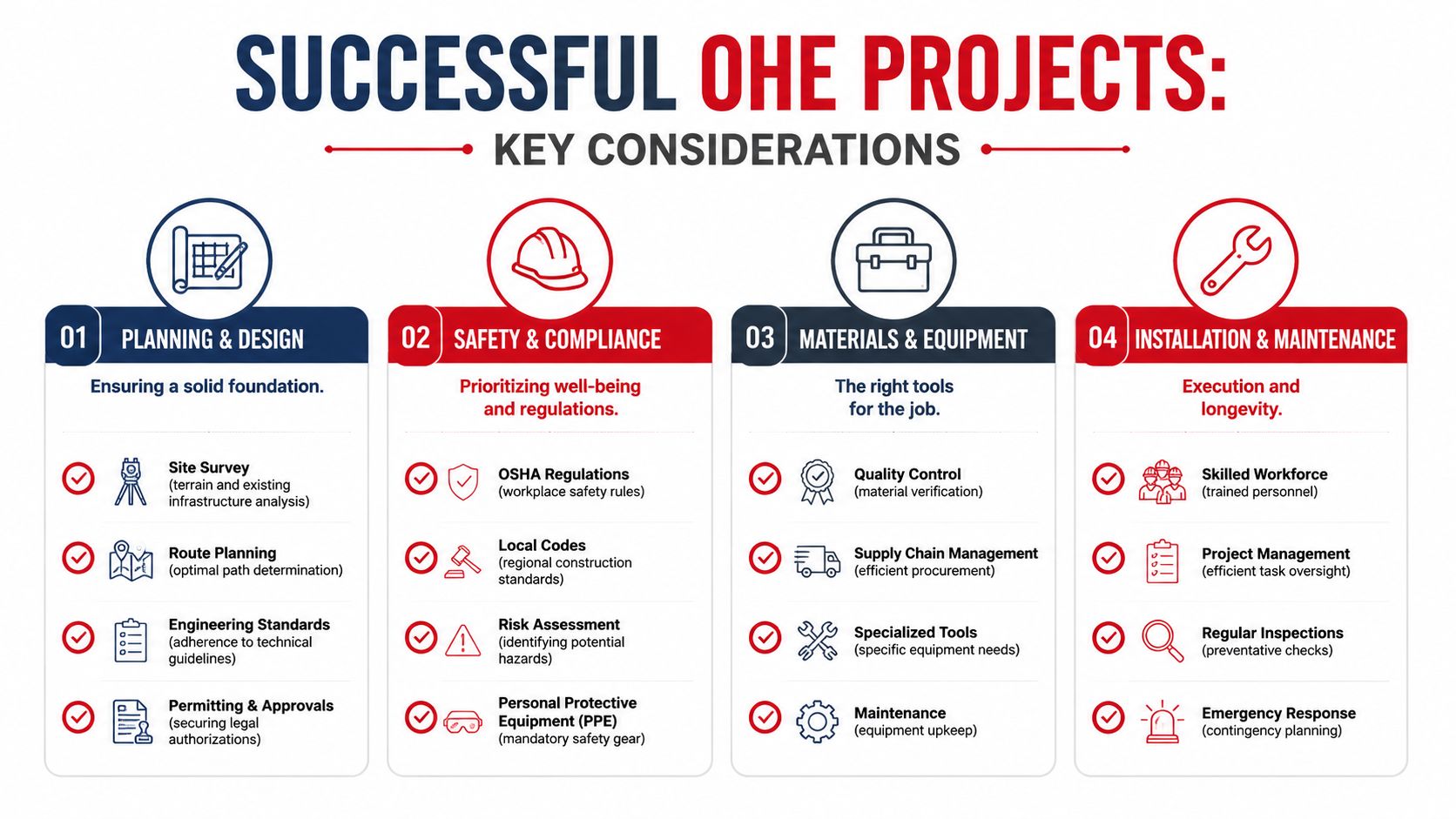
A strong OHE project team doesn't treat these pillars as separate silos. The engineer, permit coordinator, foreman, and maintenance lead all need the same facts in front of them. When they do, the project is easier to build and much easier to keep in service.
OHE Best Practices and Real-World Examples
Good overhead work starts before the first attachment goes up. Crews should survey poles early, document existing attachments carefully, and keep as-builts clean enough that the next maintenance visit doesn't start with guesswork. Utility relationships matter too, because aerial work is usually shared space, and shared space punishes poor communication.
Two project patterns that show what works
In a rural broadband build, overhead plant is often the fastest way to extend service across a long route with limited access. The winning move is usually disciplined make-ready, clean pole records, and a crew that can keep the strand line straight while protecting existing attachments. That's where aerial construction gives smaller communities a practical path to service without waiting on a full trench program.
In a dense urban small cell deployment, the challenge shifts from distance to congestion. Existing light poles and attachment space can support new equipment, but only if the owner, engineer, and field crew are aligned on loading, clearances, and attachment order. The best outcomes come from tight coordination, not improvisation.
What field crews should get right every time
- Tension control: keep strand and cable installed to the intended profile, because sloppy tensioning creates sag, stress, and repeat visits.
- Bonding and grounding: make sure the protection scheme is installed correctly, because good hardware without good grounding still leaves risk on the table.
- Documentation: record every change in a way that the next crew can trust, especially after make-ready or emergency restoration.
- Partner coordination: work from the same plan as the pole owner and the utility contacts, because aerial space is shared space.
For teams that need a reference point on anchorage quality in fiber and utility builds, the construction discipline behind quality transmission anchorage is the kind of standard that keeps overhead plant stable over time. The best OHE jobs don't just get built, they stay understandable, maintainable, and safe.
If you're planning an aerial build, a make-ready program, or a pole-line recovery, bring in a team that knows overhead plant from survey to closeout. Talk with Southern Tier Resources about engineering, construction, and maintenance support that keeps the work moving and the plant dependable.