A crew arrives to extend a fiber route, only to find the planned trench crossing an unverified utility corridor. The excavator is ready, traffic control is in place, and the schedule assumes production starts that morning. One missing locate confirmation turns the first shift into a stop-work meeting, a redesign discussion, and a client update nobody wanted to make.
That situation isn't unusual in telecom construction. Risk assessment for construction works when it changes field decisions before exposure begins, not when someone files a completed form. On fiber, wireless, tower, and data center projects, the assessment must connect design assumptions, permits, site conditions, crew actions, controls, documentation, and the handoff to operations.
Why Risk Assessment Matters on Telecom and Data Center Sites
Construction safety starts with a difficult reality. The International Labour Organization's construction safety material says at least 108,000 workers are killed on construction sites every year, representing about 30% of occupational fatal injuries worldwide. It also describes construction fatalities as occurring at roughly one every ten minutes. Those figures explain why formal hazard identification developed as a way to control recurring, high-consequence exposures before work starts.
A telecom site concentrates many of those exposures in a small footprint. A crew may move from traffic control to excavation, from conduit installation to pulling fiber, and then into energized rooms or tall structures. The work changes faster than a generic safety document can keep up.
The exposures that stop projects
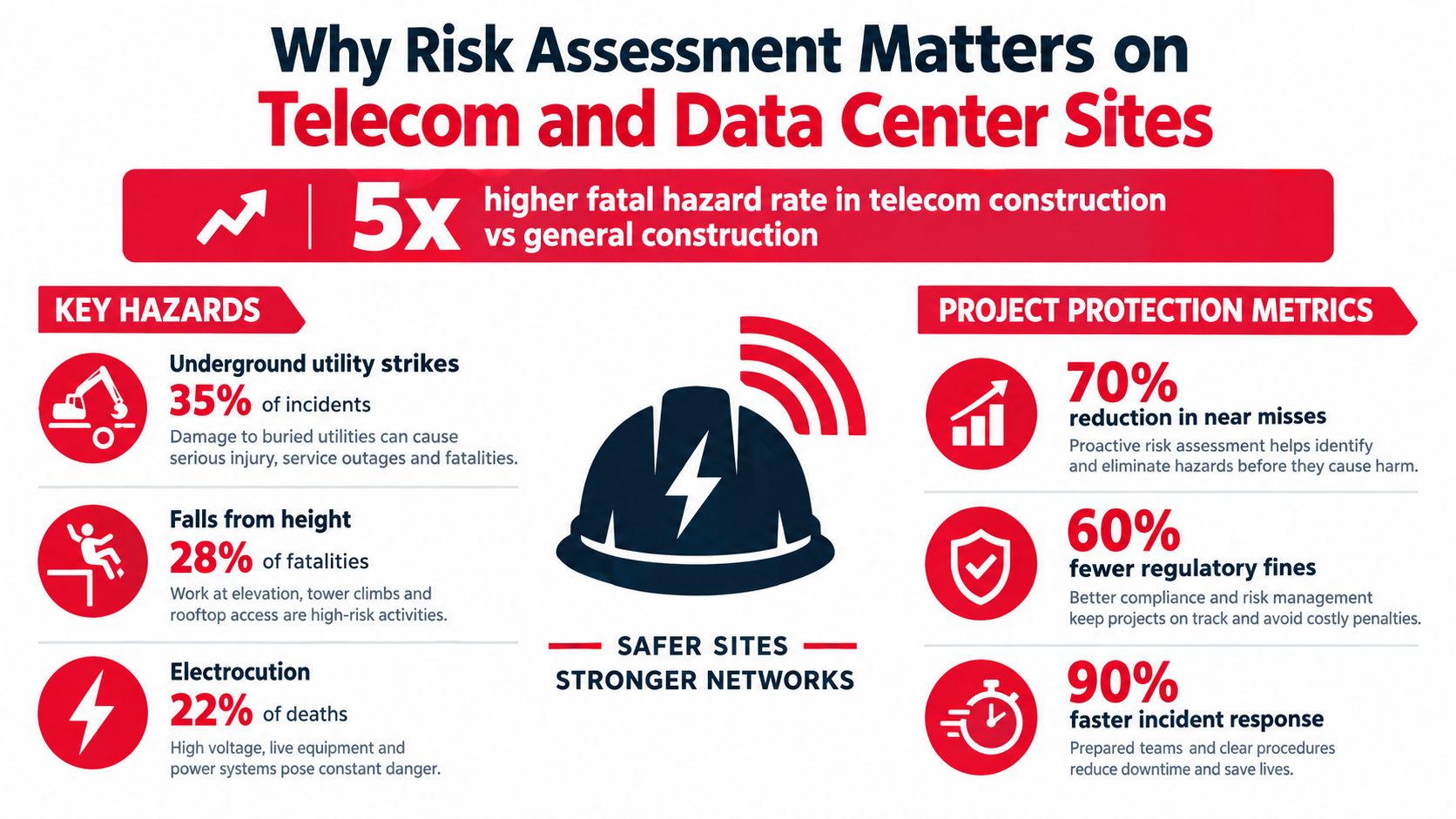
The most serious risks usually come from predictable interfaces:
- Work at height: Tower climbs, rooftop antennas, ladders, temporary platforms, and open edges require more than a harness stored in a truck. The crew needs an approved access method, rescue planning, inspection records, and a clear decision about weather and changing conditions.
- Excavation and utilities: Fiber routes cross roads, private property, existing conduit, gas lines, water services, and legacy communications infrastructure. A drawing is an input, not field verification.
- Electrical exposure: Data center fit-outs and wireless power integration can put installers near energized equipment, temporary power, batteries, grounding systems, and commissioning activities.
- Lifting and temporary works: Cabinets, generators, cable reels, structural steel, and tower components create struck-by, dropped-object, rigging, and stability concerns.
The United States Bureau of Labor Statistics reported 1,034 workplace deaths in private-sector construction in 2024. Falls, slips, and trips accounted for 389 of those fatalities, and 95.9% of the fatal fall, slip, and trip cases involved a fall to a lower level, as summarized in this construction fatality analysis based on BLS data. Construction also accounted for 48.8% of fatal falls, slips, and trips in private industry that year. The point isn't to memorize the figures. It's to recognize that the highest-consequence events often arise from ordinary tasks performed without verified controls.
Field rule: If the assessment doesn't change the crew's method, access, sequence, permit, or stop-work trigger, it hasn't done its job.
A safety-first delivery model links the assessment to schedule and budget protection. Southern Tier Resources' approach, from design and permitting through construction, testing, documentation, and maintenance, reflects that connection. Teams looking beyond paperwork can also use this practical resource on injury prevention in construction Australia to strengthen prevention thinking across planning and field execution.
Identifying Hazards Before You Break Ground
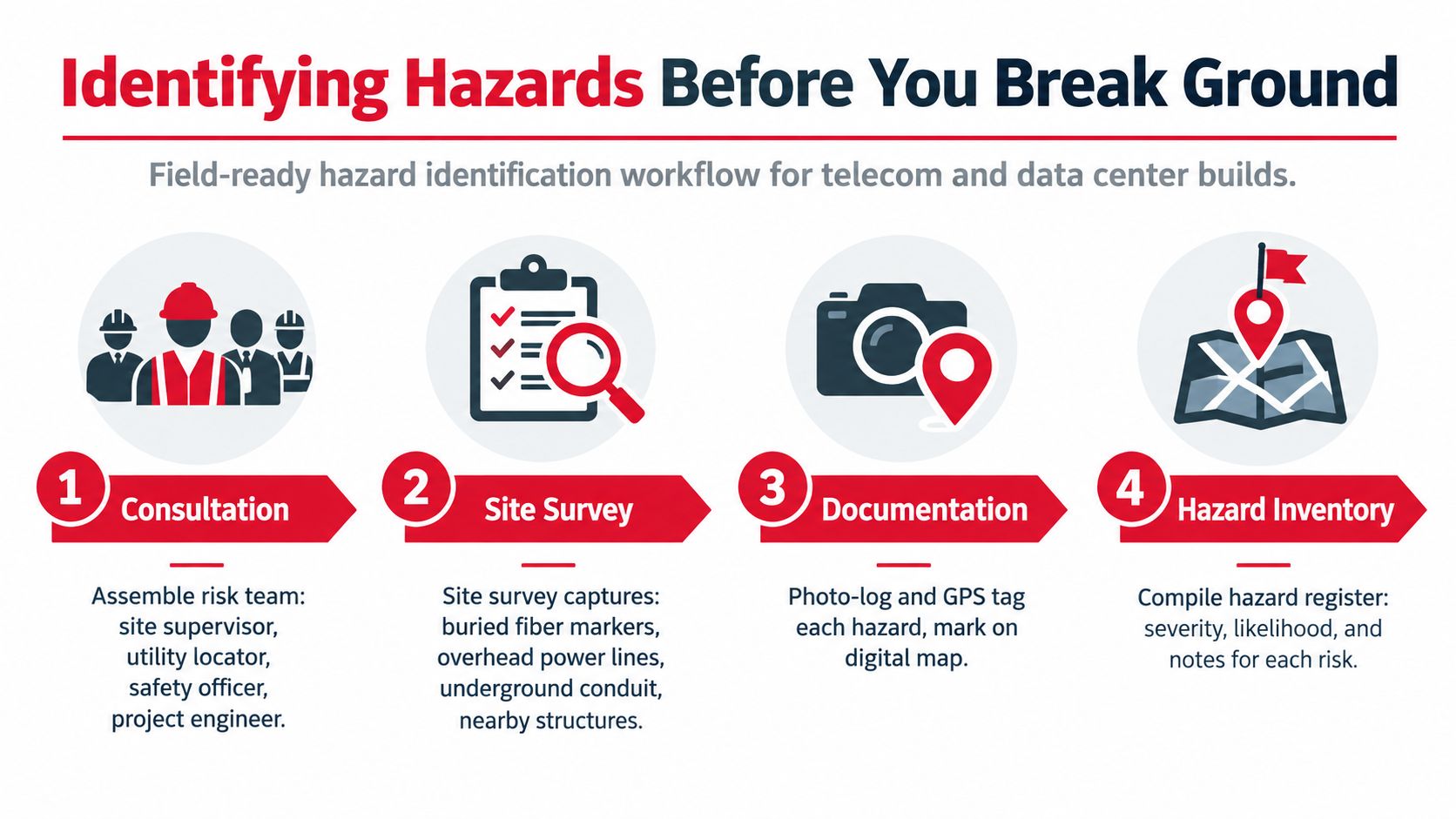
Start with the people who understand how the design will meet the ground. A risk team for a fiber or data center project should include the site supervisor, project engineer, utility locator, safety representative, and the foreman responsible for the immediate work. Bring in the owner's representative, facility operations contact, traffic-control lead, environmental specialist, or tower engineer when the work creates those interfaces.
A remote document review won't reveal every field condition. Walk the route, room, compound, roof, or tower base and compare what you see with the construction package.
Build the inventory from the work sequence
Review the project in the order the crew will encounter it. For a broadband route, that may mean traffic setup, saw cutting, excavation, conduit placement, boring, vault work, cable placement, splicing, testing, restoration, and demobilization. For a data center, review delivery, laydown, material movement, electrical isolation, overhead work, structured cabling, labeling, testing, and client turnover.
Capture hazards under practical headings:
- Civil and utility: Unverified lines, unstable trench walls, water ingress, traffic exposure, spoil placement, bore-path conflicts, confined vaults, and inadequate access.
- Structural and elevated work: Tower loading, roof conditions, anchor points, dropped objects, ladder transitions, crane setup, wind, and rescue access.
- Electrical and commissioning: Energized equipment, temporary supplies, grounding, arc-flash boundaries, battery systems, backfeed potential, and simultaneous work by multiple trades.
- Environmental and community: Heat, lightning, poor visibility, noise, dust, public access, protected areas, contaminated soil, and adjacent operations.
- Information and change: Design gaps, conflicting drawings, missing permits, late make-ready decisions, undocumented field changes, and unclear ownership.
Photograph each significant condition and record its location on a drawing or digital map. Mark the relevant permit, utility record, drawing reference, and person responsible for verification. A hazard register should show the task, hazard, people exposed, existing controls, initial rating, required action, owner, due date, residual rating, and closure evidence.
Treat assumptions as open hazards
The assumptions that cause trouble are often small: a conduit shown on a plan but never opened for verification, a roof area assumed to support a lift, a room believed to be de-energized, or a tower member expected to accept a new load without engineering confirmation.
For excavation, require locate documentation, a route walk, visible markings, and physical verification where the risk warrants it. Potholing, vacuum excavation, and adjusted alignment can be safer than forcing the original plan through an uncertain corridor. For HDD, compare geotechnical information, crossing requirements, entry and exit conditions, and emergency response arrangements before mobilization.
Security belongs in the same early review. Uncontrolled public access, unsecured cabinets, open vaults, poor lighting, and missing material controls can create safety and continuity problems. A useful companion resource is Wisenet Security Ltd.’s practical collection of construction site security tips, particularly when sites remain active between shifts.
The register must stay alive. At the start of each shift, the supervisor should ask what changed since the last review, including weather, access, crew composition, equipment, nearby work, permits, and client operations. If the answer changes exposure, update the task controls before work continues.
Evaluating and Scoring Risks With a Practical Matrix
A crew is ready to excavate when the locator identifies a possible utility conflict, the electrical lead questions an isolation boundary, and another contractor blocks the delivery route. Which issue gets attention first? A hazard list records the exposures, but a consistent scoring method helps the team set priorities before work starts.
Define the scales before anyone assigns ratings. Likelihood should reflect credible exposure under the planned method, not the assumption that every worker will remember the briefing. Impact should cover worker and public safety, equipment, service continuity, schedule, and cost. Keep each definition short enough for use during a pre-task review.
A practical risk level comes from multiplying likelihood by consequence. A Risk Priority Number can provide another ranking layer when hazards have similar overall ratings. The calculation is useful only when it supports a clear decision, such as stopping excavation to verify a crossing before the crew mobilizes.
A focused ranking example
The following examples are illustrative decision aids, not incident statistics or predictions.
| Hazard Example | Likelihood | Impact | Risk Score |
|---|---|---|---|
| Unverified utility crossing before excavation | High | Severe | High |
| Tower work with incomplete rescue arrangement | Medium | Severe | High |
| Energized room entry without confirmed isolation | Medium | Severe | High |
| Cable reel movement on a controlled laydown area | Medium | Moderate | Medium |
| Temporary lighting gap in a restricted work zone | Low | Moderate | Low |
Field review should challenge every rating. A utility locator may identify a drawing conflict that raises the likelihood of a strike. The electrical lead may show that the planned isolation is incomplete because another source can backfeed the equipment. The superintendent may know that a delivery route becomes inaccessible after another contractor stages materials nearby.
The construction risk-assessment review describes a staged process that includes forming a risk team, surveying conditions, identifying hazards, evaluating alternatives, preparing the construction plan, and monitoring the result. It also addresses assigning unacceptable risks to owners with deadlines and checking whether controls work. That evidence belongs in the risk record, not just the original score.
Don't over-model the wrong risks
A probability matrix works well for initial screening. More demanding tools, including Monte Carlo simulation and decision-tree analysis, fit the highest-ranked risks when financial or schedule exposure justifies the added engineering time. The construction risk quantification guidance recommends reserving those methods for the top 5 to 10 risks after initial prioritization.
Heavy modeling too early can consume engineering time without improving the decision. Focused analysis is more useful for the risks that could stop a route, delay a data hall, damage existing infrastructure, or injure a worker. Record the assumptions, selected control, approval, and later field result in the project record. That connection supports accurate as-built documentation, monitoring after turnover, and lessons learned for future telecom and data center work.
Building Mitigations Controls and Communication Workflows
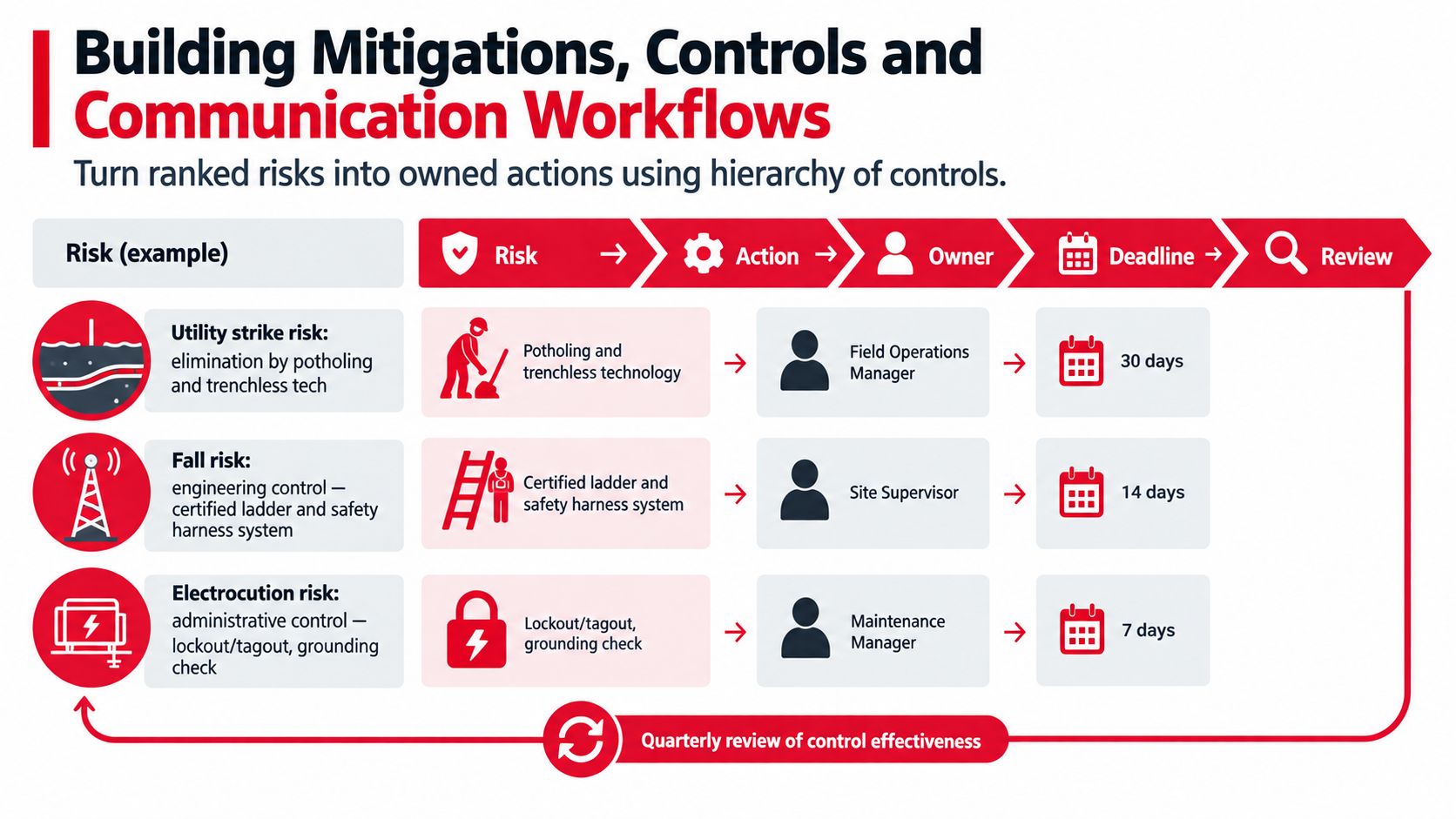
A high risk score is not a control. It becomes useful only when the team turns it into a specific action with an owner, deadline, verification method, and review point.
Use the hierarchy of controls rather than defaulting to reminders. Eliminate the exposure where practical, engineer it out when elimination isn't possible, then use administrative controls and personal protective equipment as supporting layers.
Match the control to the task
For a suspected utility conflict, the strongest response may be redesigning the alignment, using trenchless construction, or exposing the crossing before excavation. “Watch the marks” is not an adequate substitute for physical verification when the consequence of a strike is severe.
For tower work, specify the access system, certified anchor arrangement, fall-arrest equipment, dropped-object controls, weather limits, communication method, and rescue plan. The supervisor should verify that the planned system matches the actual structure, not just the generic method statement.
For electrical integration, define the isolation boundary, lockout/tagout procedure, grounding verification, test equipment, authorized personnel, and return-to-service approval. A permit should identify the equipment and work limits clearly enough that another trade can't mistake a nearby energized asset for the isolated one.
A control plan should connect directly to the method statement and daily briefing:
- Action: State the physical or procedural control in plain language.
- Owner: Name the person who can make the control happen, not only the company.
- Deadline: Set the point before which work can't proceed.
- Evidence: Identify the photo, permit, test record, inspection, or sign-off that proves completion.
- Review: Define when the supervisor checks effectiveness and what would trigger reassessment.
Make communication operational
Toolbox talks should address the day's actual workfront. A briefing for fiber splicing in a controlled room should not read like a tower-climbing briefing. Discuss access, adjacent operations, energy state, housekeeping, emergency contacts, environmental conditions, and the precise stop-work triggers.
Permit-to-work systems are especially important where construction overlaps live facilities. The permit should identify the task, location, authorized crew, isolation status, time window, affected stakeholders, and closeout requirements. For traffic-exposed civil work, the traffic-control plan, route conditions, public interface, and emergency access must be visible to the people setting up and supervising the work.
Stop-work authority only works when the crew trusts that raising a concern won't be treated as a production failure. A worker who sees an unmarked service, damaged ladder, changing weather, or unexpected energized condition should be able to stop the task, make the area safe, and bring the supervisor into the decision.
Control test: Ask who owns the action, what evidence closes it, and what condition makes the crew stop. If nobody can answer, the control is incomplete.
For broader context on structuring construction risk management, look for guidance that connects identification, treatment, communication, and review rather than treating them as separate files.
Permits Utility Strikes As-Builts and Ongoing Monitoring
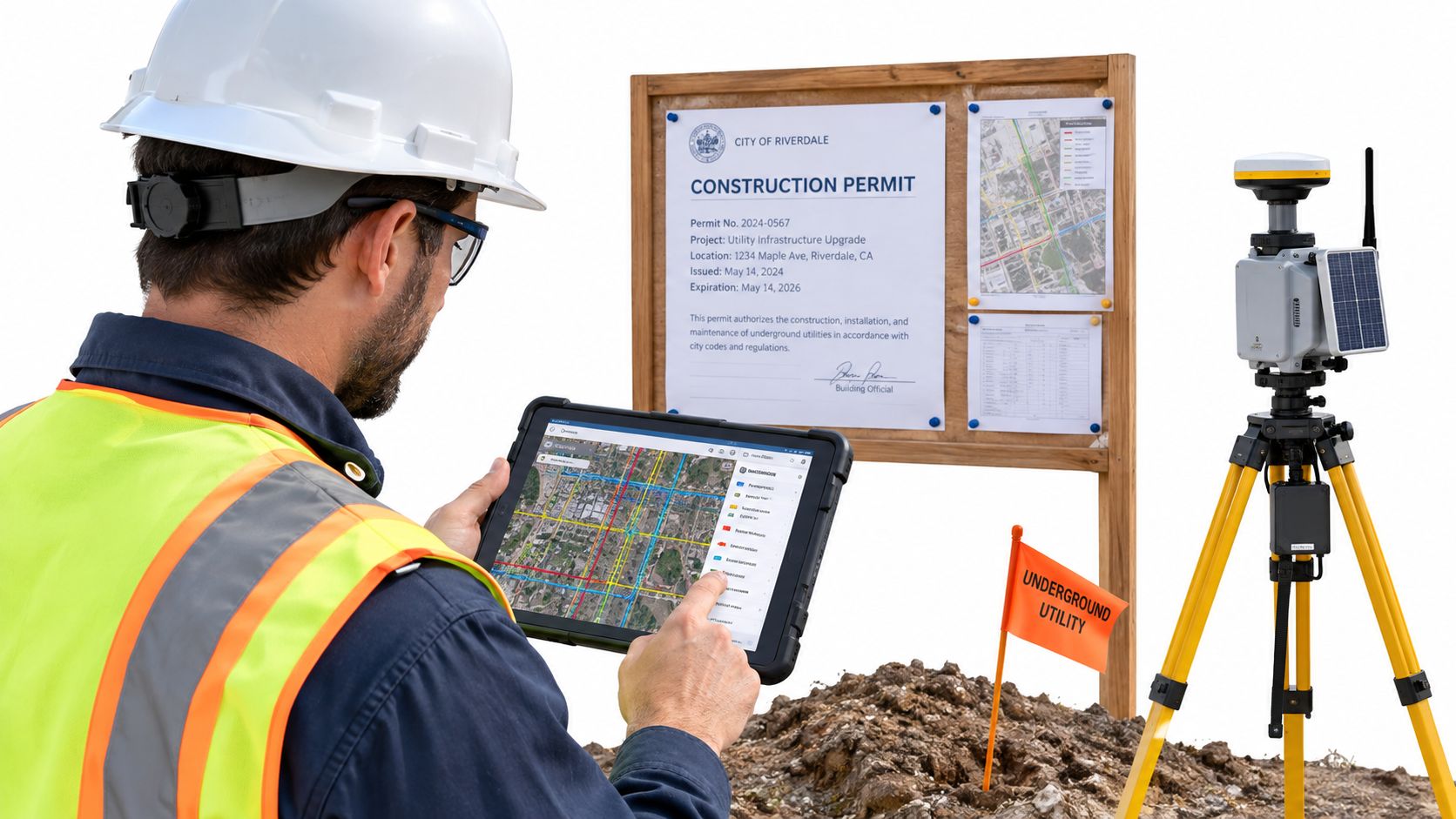
Permits and utility controls shouldn't sit in a separate administrative folder. Put each permit condition, locate requirement, inspection hold point, and restoration obligation into the project risk register where the supervisor can see it.
Before excavation, verify the applicable approvals, locate records, route markings, pothole results, and field changes. If the route shifts, the assessment changes. A new bore entry point, altered trench depth, revised vault location, or conflict with a private service needs a documented decision, not an informal instruction passed between shifts.
Make the as-built record part of risk control
An as-built drawing is more than a closeout deliverable. It tells the maintenance team where the cable, conduit, vault, grounding point, splice case, duct, pathway, and equipment exist. If the record is wrong or incomplete, the next crew inherits uncertainty and may expose workers, customers, or live infrastructure to avoidable risk.
Capture changes as the work happens. Record route deviations, depths where required by the project, crossing details, installed materials, pull points, splice locations, equipment identifiers, test results, and photographs tied to location. Coordinate the record with GIS, CAD, asset management, labeling, and client acceptance requirements.
The handover package should answer practical operational questions:
- Where is it: Can a maintenance crew locate the asset without relying on memory?
- What is it: Are cable, conduit, fiber, power, grounding, and equipment identifiers consistent?
- How was it tested: Are test records connected to the installed segment or device?
- What changed: Do approved deviations and field directives appear in the final record?
- What remains open: Are punch items, permit conditions, restoration issues, or monitoring commitments assigned?
Continue the loop after construction
Most programs become less disciplined at handoff. That is where a major blind spot develops. A systematic review of construction risk assessment found that 65% of studies did not integrate post-construction variables, while only 22% addressed accumulating lessons learned across projects. The same review reported that developing economies represented 24% of the studies, indicating underrepresentation in infrastructure-heavy markets outside North America and Western Europe. These findings are documented in the systematic review of construction risk assessment.
For telecom and data centers, post-construction risk includes maintenance access, rework, change orders, capacity additions, temporary bypasses, damaged records, and operational continuity. Establish a monitoring plan before closeout. Define who reviews defects, repeat hazards, permit commitments, near misses, access problems, and asset-record corrections, and then feed those findings into the next design and construction package.
A useful closeout meeting asks more than whether the client accepted the work. Ask which assumption proved wrong, which control required the most supervision, which drawing change arrived too late, and what the next crew needs to know before mobilizing. Record the answer where future project teams can find it.
Putting Your Risk Assessment Into Action
A workable program doesn't require a perfect document on day one. It requires a repeatable operating rhythm that starts before mobilization and continues after the crew leaves.
Use one pilot route, tower upgrade, or data center work package to establish the standard. Build the hazard register from the actual drawings and survey, walk the workfront with the people who will perform it, rank the exposures, assign controls, and refuse to let open high-consequence items disappear into meeting minutes.
Keep the assessment connected to the documents crews already use:
- Design package: Record assumptions, interfaces, access requirements, and constructability decisions.
- Permit register: Track approvals, conditions, inspections, and closeout evidence.
- Method statement: Tie each major task to its controls, sequence, and stop-work triggers.
- Daily briefing: Recheck conditions, crew changes, weather, nearby work, and energy state.
- Inspection record: Verify control effectiveness, not just attendance.
- As-built package: Capture the installed condition and unresolved items.
- Lessons-learned log: Record changes that should influence the next build.
The staged workflow described in construction risk assessment practice guidance is useful because it treats monitoring and review as part of the process rather than a final administrative step. The field version is straightforward: identify, decide, control, verify, document, and improve.
For carriers, ISPs, data center operators, tower companies, municipalities, and utility cooperatives, accountability across interfaces matters as much as technical expertise. A partner that can coordinate engineering, permitting, civil work, fiber installation, wireless construction, testing, as-built documentation, and maintenance reduces the number of handoffs where risk information gets lost.
Southern Tier Resources provides that type of lifecycle support for wireline, wireless, and data center infrastructure, including design, permitting, construction, testing, documentation, and ongoing maintenance. Review the Southern Tier Resources capabilities and use one upcoming project to test whether your assessment controls the work, protects the schedule, and leaves operations with reliable information.
Southern Tier Resources supports telecom and data center builds with engineering, construction, fiber installation, wireless work, testing, detailed as-built documentation, and maintenance coordination. Visit Southern Tier Resources to discuss a risk assessment process that carries accountability from the first site survey through operational handoff.