Organizations lose 9.4% of every dollar invested to poor project performance, according to PMI-linked project management reporting. That figure changes the question. Managing a project budget isn't mainly about keeping a spreadsheet tidy. It's about connecting approved spend to what crews install, how quickly production moves, and how fast scope changes enter the job.
A fiber route can look financially healthy while make-ready work stalls, subcontractors submit claims, and material commitments accumulate. A data center fit-out can show acceptable invoices while delayed power coordination pushes cabling, testing, and commissioning into a more expensive sequence. The controls that protect margin must therefore run through the field, the schedule, procurement, and the change log, not just the finance report.
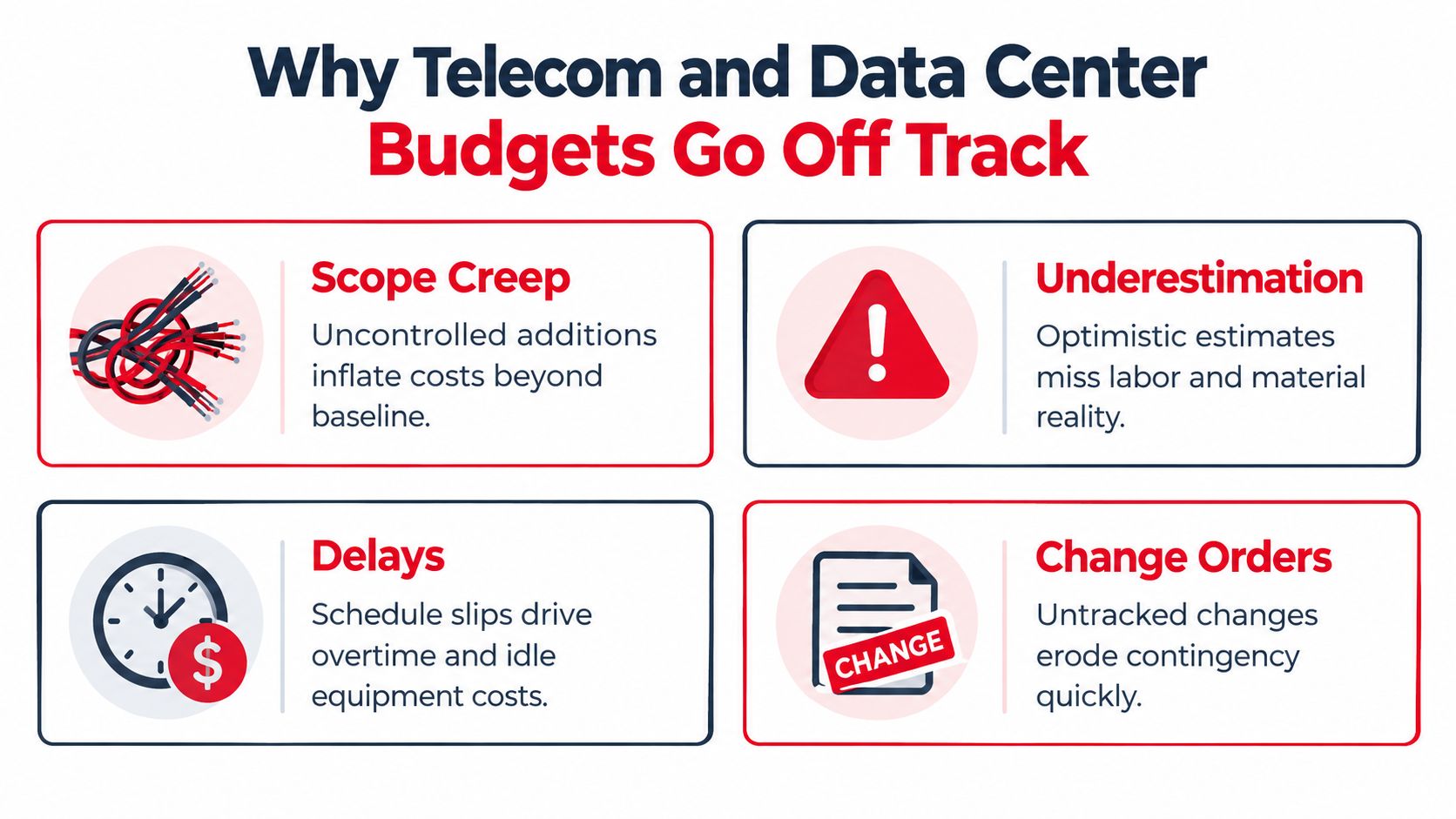
Why Telecom and Data Center Budgets Go Off Track
A typical fiber build starts with a clean estimate. The route appears defined, the unit rates look familiar, and the construction schedule gives each crew a clear production window. Then a pole requires additional make-ready work, a permit condition changes the restoration detail, a utility conflict forces redesign, and the splice team waits for access. Each issue may appear manageable on its own. Together, they consume labor, equipment time, management attention, and contingency.
The same pattern appears in data center work. A structured cabling package depends on rack layouts, pathways, power coordination, access windows, vendor interfaces, testing requirements, and client decisions. A late change to equipment placement can affect cable lengths, pathway loading, labeling, installation sequence, and commissioning. The cost doesn't arrive as one dramatic event. It arrives through rework, idle crews, expedited materials, extended supervision, and delayed billing.
Historical infrastructure data supports this caution. A University of Oxford review of Flyvbjerg's 2016 update, based on 1,603 projects, found an average cost increase of 39% from announcement to completion across infrastructure projects. Rail projects averaged 40%, while road projects averaged 24%. The review is available in the International Major Infrastructure Projects Benchmarking Review.
Budget control is a lifecycle discipline
A reliable budget follows a repeating operating loop:
- Baseline: Define deliverables, quantities, assumptions, timing, and approved funding.
- Track: Capture actual costs, commitments, physical progress, and field constraints.
- Forecast: Recalculate the estimate to complete when production or risk changes.
- Control: Decide whether to resequence work, use contingency, issue a change order, or revise scope.
- Learn: Feed actual production, vendor performance, and change history into the next estimate.
What doesn't work is treating the approved estimate as a promise that conditions won't change. What does work is making the assumptions visible and giving the field team a practical way to report when those assumptions stop being true.
For carriers, ISPs, and data center operators, the shared language matters. Finance needs credible forecasts. Superintendents need usable production targets. Clients need clear explanations before a problem becomes an emergency approval. A baseline built with realistic risk allowances gives all three groups something better than optimism, it gives them a decision framework.
Planning and Estimating a Realistic Budget Baseline
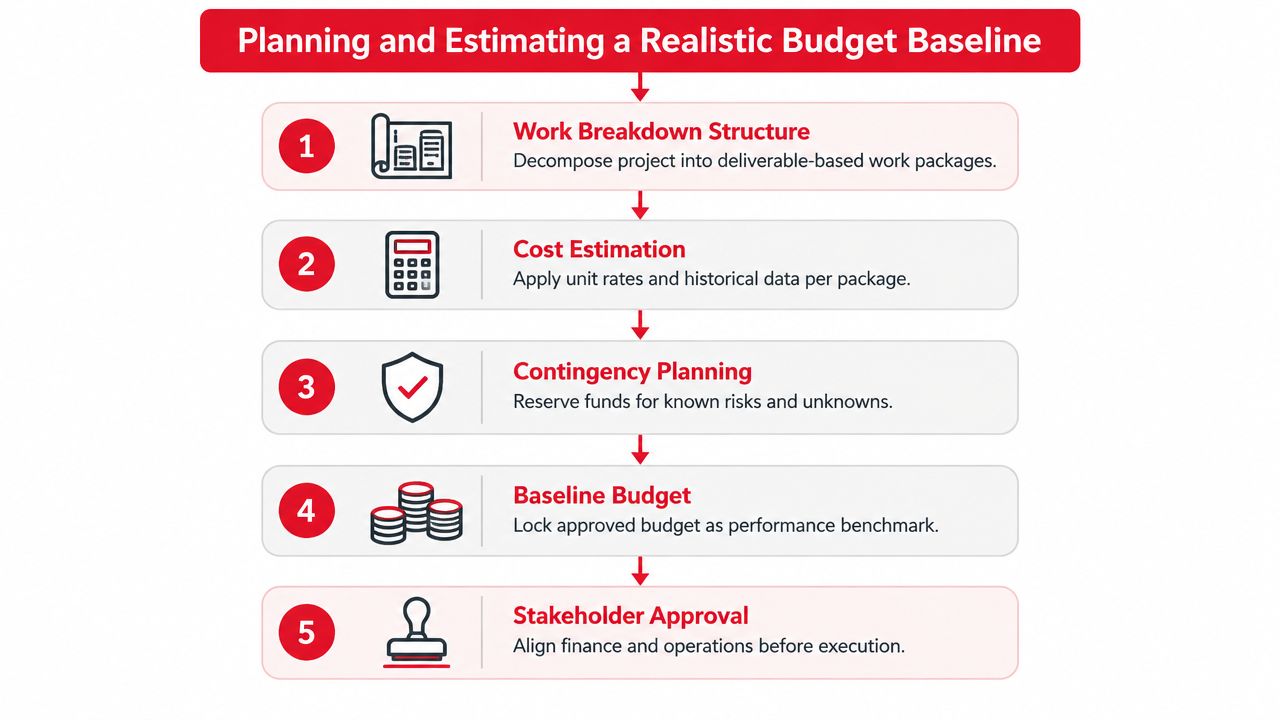
A defensible baseline begins with the work, not the funding ceiling. If the client has supplied a target number, use it as a commercial constraint, not as proof that the scope fits. Build the estimate independently, then show the trade-offs required to bring scope, schedule, and price into alignment.
Build the estimate around deliverables
Start with a work breakdown structure that mirrors how the team will execute the project. A fiber program might separate route validation, survey, design, permitting, make-ready, traffic control, trenching, boring, conduit placement, cable placement, splicing, testing, restoration, closeout, and maintenance obligations. A data center fit-out might separate design coordination, material procurement, pathway installation, structured cabling, labeling, power interface work, testing, commissioning support, and as-built documentation.
For each work package, document:
- Quantity basis: Route length, structures, handholes, racks, cable runs, terminations, or test points.
- Production assumption: Expected crew output under the actual access and site conditions.
- Resource mix: Internal labor, subcontractors, equipment, supervision, engineering, and inspection.
- Material basis: Approved specifications, expected waste, delivery requirements, storage, and handling.
- Schedule position: Planned start, finish, procurement milestone, and dependencies.
- Evidence: Historical actuals, supplier quotations, approved rates, or a clearly labeled assumption.
Use unit-cost estimating where quantities and production rates are stable. Use parametric estimating for repeatable scopes, but don't apply a familiar rate blindly to a route with unusual restoration, difficult access, or unresolved utility conditions. Lump-sum pricing can transfer cost risk to a subcontractor, but it often comes with a risk premium and can create disputes when the scope contains gray areas.
Size contingency for uncertainty
Contingency should answer a risk question, not hide weak estimating. Separate known risks from unknown conditions. Known risks belong in a risk register with an owner, trigger, likely impact, and response. Unknowns require a reserve that management can draw down only through an approved process.
A practical reserve review asks:
- Which assumptions have the weakest evidence?
- Which risks can add both cost and time?
- Which events could affect several work packages?
- Which risks are outside the project team's control?
- What evidence will trigger a reforecast or escalation?
Don't scatter contingency across every line item. That makes the budget look padded and makes reserve consumption difficult to see. Hold it in a visible control account, then record each draw against a specific risk or approved change.
Lock a baseline people can use
Before execution, bring finance, engineering, procurement, construction, and the client or sponsor into the approval discussion. Confirm that the schedule phases, procurement commitments, billing milestones, and cost codes use the same structure. A field supervisor shouldn't have to translate a finance report before identifying which production package is underperforming.
The baseline becomes credible when it includes more than a total. It should show time-phased planned spend, committed costs, cash requirements, production quantities, and assumptions. Once approved, changes should create a controlled revision rather than rewriting the original benchmark.
Tracking Costs and Forecasting Before Overruns Compound
Actual cost alone tells you what has already happened. It doesn't tell you whether the crew has earned the work that cost created. A project can be below its planned spend because production is behind, not because the team is efficient. That distinction is central to how to manage project budgets in live telecom construction.
Connect dollars to physical progress
Set a production measure for each major package. Fiber placement may use accepted route length, while splicing may use completed and tested closures or fibers. Data center cabling may use verified cable runs, terminated connections, tested links, or commissioned areas. The measure must reflect accepted work, not activity that still requires rework or inspection.
Earned value provides a useful discipline:
- Planned value: The budgeted value of work scheduled by the reporting date.
- Earned value: The budgeted value of work physically completed and accepted.
- Actual cost: The labor, material, equipment, subcontract, and other cost recorded for that work.
Cost Performance Index, or CPI, compares earned value with actual cost. Schedule Performance Index, or SPI, compares earned value with planned value. Read them together. A favorable cost result with weak schedule performance can mean the project is spending less because crews haven't reached the planned production level. A strong schedule result with weak cost performance can signal overtime, inefficient sequencing, or expensive subcontractor execution.
Make the forecast operational
Your weekly review should include actuals, open commitments, unpaid work, approved changes, pending changes, remaining quantities, and the estimate to complete. The estimate at completion should then reflect the latest view of total cost, not the original estimate plus whatever invoices have arrived.
Field data needs a clear cadence. Crews should submit quantities, blockers, access issues, equipment use, and daily production notes close to the work. The project team should review cost and schedule variance weekly. Finance should update the broader estimate at completion on a regular monthly cycle, or sooner when a trigger fires.
Useful triggers include:
- Production variance: Actual installed quantity falls below the planned production curve.
- Schedule movement: A permit, access window, material delivery, or predecessor task moves the work sequence.
- Commitment exposure: Vendor or subcontract commitments exceed the remaining package budget.
- Change velocity: New change requests arrive faster than the team can price and approve them.
- Contingency pressure: A drawdown leaves insufficient reserve for unresolved high-impact risks.
- Data latency: Field reports, pay applications, or material receipts arrive too late to support decisions.
Field rule: If the schedule slips, recalculate the budget before the next invoice cycle. Time-related cost rarely waits for month-end reporting.
For teams formalizing the financial side, this practical guide to budget tracking for profitability can help connect project costs with margin decisions.
A dashboard should show the baseline, actuals, commitments, forecast to complete, estimate at completion, earned value trend, schedule status, change-order exposure, and contingency balance. It should also show the operational reason behind each material variance. “Labor unfavorable” isn't enough. “Splicing crew lost access for three shifts and is now working out of sequence” gives the manager something to act on.
Procurement and Vendor Controls That Protect Margin
Materials, labor, and subcontracted production often determine whether the approved budget survives execution. Recent industry guidance places materials and labor at 40% to 70% of total project spend, as summarized by Tolodora's project management statistics brief. That range is broad, but the management implication is direct: procurement decisions deserve the same rigor as forecast reviews.
The cheapest quote isn't always the lowest-cost option. A low unit price can become expensive when the supplier misses a delivery window, ships nonconforming material, or requires the field team to handle repeated substitutions. A higher price may be justified when it protects a critical path, reduces inspection risk, or includes dependable technical support.
Compare the commercial choices
| Procurement Approach | Best For | Budget Risk | Control Tip |
|---|---|---|---|
| Unit-price subcontract | Variable quantities, route construction, uncertain field conditions | Quantity growth can increase total cost quickly | Set production reporting, agreed rate cards, and authorization rules for quantity changes |
| Lump-sum subcontract | Clearly documented, repeatable scope with verified quantities | Gray-area exclusions can become claims and extras | Define inclusions, exclusions, access assumptions, restoration standards, and acceptance criteria |
| Direct material purchase | Standardized fiber, conduit, structured cabling, and common hardware | Excess stock, price movement, storage, and obsolescence | Tie releases to the schedule and approved bill of materials |
| Framework or blanket agreement | Repeated programs with known suppliers | Teams may continue buying without challenging rates or performance | Review pricing, lead times, quality, and service at regular intervals |
| Design-build package | Integrated design and construction responsibility | Limited transparency into assumptions and later changes | Require an open assumptions register, milestone deliverables, and auditable change pricing |
Purchase orders should match the budget's work breakdown structure. If the cost code on a purchase order doesn't map to a forecast package, the team will struggle to see which part of the job is consuming funds. Require approved purchase orders before commitment, and record expected delivery dates, quantities, unit rates, freight, and substitution rules.
Subcontractor payment milestones should follow verified production rather than calendar dates. A pay application for installed and accepted work is more useful than one based only on elapsed time. For broader telecom sourcing and delivery coordination, teams can also review Southern Tier Resources as an infrastructure partner with engineering, construction, maintenance, fiber deployment, and data center fit-out capabilities.
Vendor scorecards should cover more than price. Track schedule reliability, first-time quality, responsiveness to field questions, documentation quality, safety performance, and change-order behavior. A vendor that submits clean quantities and flags constraints early may protect the budget better than one that wins the bid through a narrow rate and recovers margin through extras.
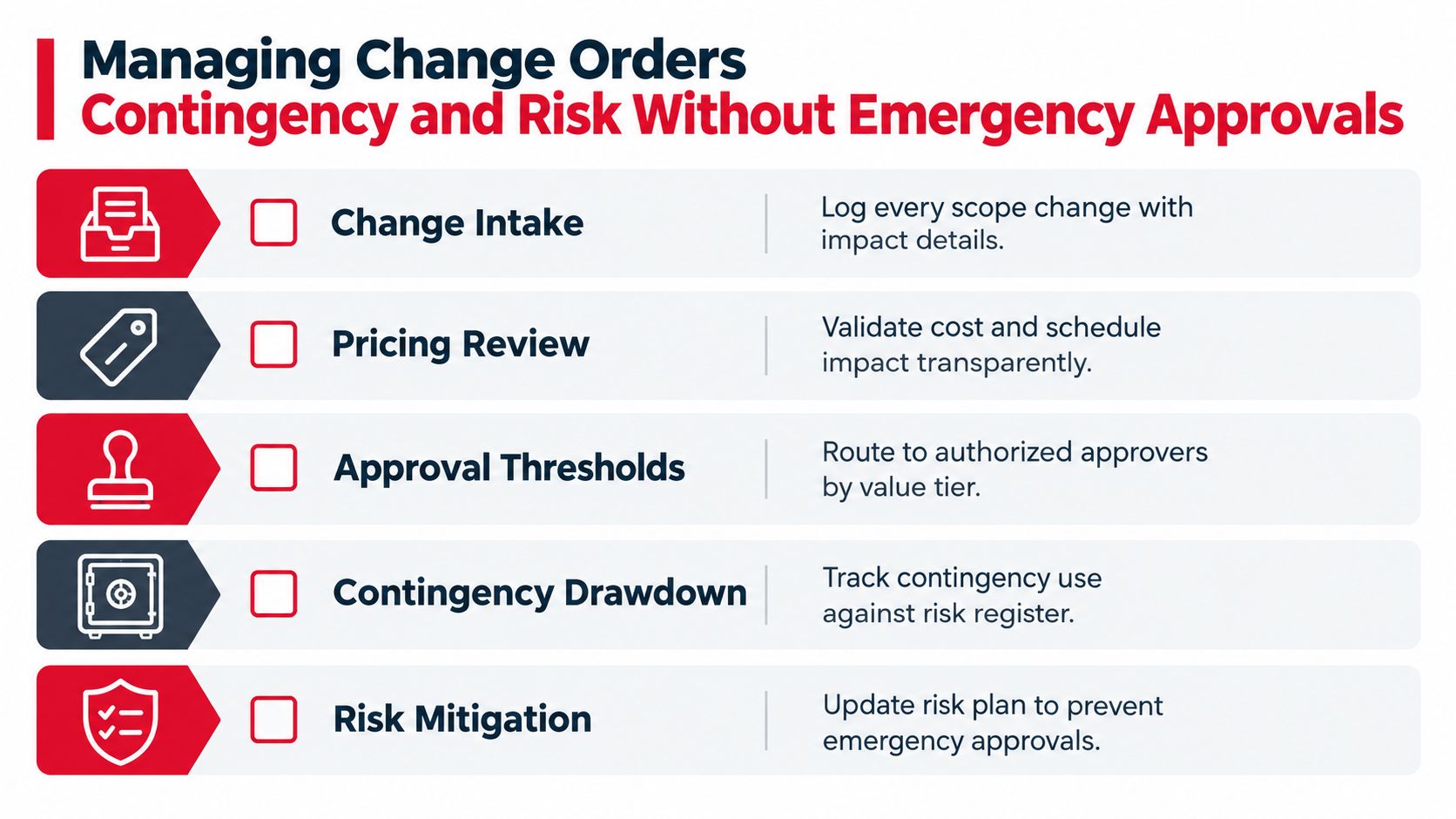
Managing Change Orders Contingency and Risk Without Emergency Approvals
Change orders aren't automatically a budget failure. Uncontrolled change is. A utility conflict, revised rack layout, or new restoration requirement may be legitimate. The failure occurs when the team authorizes work informally, loses the evidence, and discovers the financial impact after the crew has already completed it.
Create one intake path
Every change should enter a log before execution whenever the site condition allows it. The request needs a description, origin, affected deliverable, reason, urgency, schedule effect, labor impact, material impact, equipment impact, and supporting evidence. Attach drawings, photographs, field reports, permit correspondence, vendor quotations, and client instructions.
Separate three categories:
- Baseline work: Already included in the approved scope and budget.
- Risk event: A recognized uncertainty covered by an approved contingency reserve.
- Scope change: Work outside the baseline that requires client or sponsor approval.
That classification prevents contingency from becoming a general-purpose spending account. If a make-ready condition was identified as a risk and funded in the reserve, the draw should reference that risk. If the client adds a new route segment, the team should price it as a scope change rather than consuming contingency.
Price cost and time together
A change-order estimate should include direct and indirect effects. Direct effects include additional labor, materials, equipment, subcontract work, engineering, testing, and restoration. Indirect effects may include remobilization, supervision, extended site facilities, traffic control, storage, standby time, and schedule displacement.
Schedule impact deserves its own line of analysis. A delayed utility release can push crews into a different sequence, extend project management effort, and create idle or remobilization costs. In a data center, late power coordination can move cabling and testing into restricted access windows. Price the actual consequence, not only the visible task.
Use approval tiers that match authority. A field lead may document and stop unauthorized work, while a project manager can approve a minor internal adjustment within delegated authority. Larger changes should route to commercial, finance, or client approval before commitment. The exact thresholds depend on the contract and governance model, but the rule should be unambiguous.
Use trigger-based contingency control
Review the risk register alongside the forecast. Each risk should have a trigger that someone in the field can recognize, such as a rejected permit, an unavailable access window, a material lead-time warning, an inspection failure, or a design revision. When the trigger occurs, the owner updates probability, impact, timing, mitigation, and reserve exposure.
Commercial discipline: A fast verbal decision can keep production moving, but it shouldn't replace a written record.
If work must proceed before commercial approval, document the instruction, the reason for urgency, the not-to-exceed position, and who authorized it. Create a provisional cost code so the expenditure remains visible. Close the item when the final scope, price, schedule impact, and funding source are approved.
Reporting KPIs Dashboards and Lessons That Improve the Next Budget
A dashboard should help a manager decide what to do next. It shouldn't merely display accounting history. The strongest reporting connects financial indicators with production facts, so executives see exposure, field leads see causes, and clients see decisions that require their input.
Track the indicators that change behavior
Use a small set of measures consistently:
- Estimate at completion variance: Compare the current forecast with the approved baseline and explain the largest drivers.
- Forecast accuracy: Compare prior forecasts with actual outcomes to identify systematic optimism or delayed reporting.
- Contingency burn rate: Show approved reserve, committed reserve, consumed reserve, and remaining exposure by risk.
- Change-order velocity: Track new requests, approved changes, pending pricing, rejected changes, and aging.
- Earned value trend: Review CPI and SPI together with physical production and schedule narrative.
- Commitment coverage: Show how much of the remaining work is already committed and whether those commitments match the latest forecast.
- Cost-to-production relationship: Compare spend per accepted unit, such as route length, tested splice work, cable run, or commissioned area.
A change-order log deserves special attention. A rising count isn't necessarily bad if the team is pricing and approving changes promptly. The danger is a growing queue of unpriced work, because production can consume labor and materials before the commercial position is known.
Design reports for decisions
Executives need a concise view of total exposure, funding, forecast, schedule risk, and decisions required. Field leaders need package-level quantities, crew productivity, blockers, and remaining work. Clients need scope status, approved changes, pending decisions, and the effect of delayed information.
Use the same cost codes and work package names in the estimate, purchase orders, field reports, invoices, and dashboard. This common structure removes reconciliation work and reduces the time between a field event and a management response. It also makes closeout evidence easier to assemble.
Turn closeout into estimating intelligence
At closeout, compare the original assumptions with actual results. Record production rates, material consumption, restoration conditions, permit effort, subcontractor performance, rework causes, access delays, testing outcomes, and change-order origins. Keep the lesson specific. “Improve estimating” won't help the next team. “Boring production fell when traffic-control windows were restricted, so future route segments need separate access assumptions” will.
The historical record should influence future unit rates and contingency conversations, but it shouldn't erase judgment. A prior project may have benefited from unusually favorable access or a cooperative utility owner. Preserve the context alongside the number.
A practical closeout checklist includes:
- Reconcile actual costs, commitments, accruals, and approved changes.
- Confirm all production quantities and acceptance records.
- Close or transfer unresolved risks.
- Release unused contingency through the approved governance process.
- Archive change evidence, pay applications, test results, and as-built documentation.
- Update estimating templates and vendor performance records.
- Hold a review with construction, engineering, procurement, finance, and the client.
The core lesson is simple. How to manage project budgets is really how to manage the relationship between planned work and accepted production. Baselines establish intent, field data reveals reality, forecasts expose the consequence, and disciplined decisions protect the margin.
Southern Tier Resources provides end-to-end engineering, construction, fiber deployment, splicing, testing, documentation, wireless work, and data center infrastructure fit-outs for telecom and technology infrastructure programs. Visit Southern Tier Resources to discuss a delivery model that connects field production, schedule control, change management, and budget accountability.