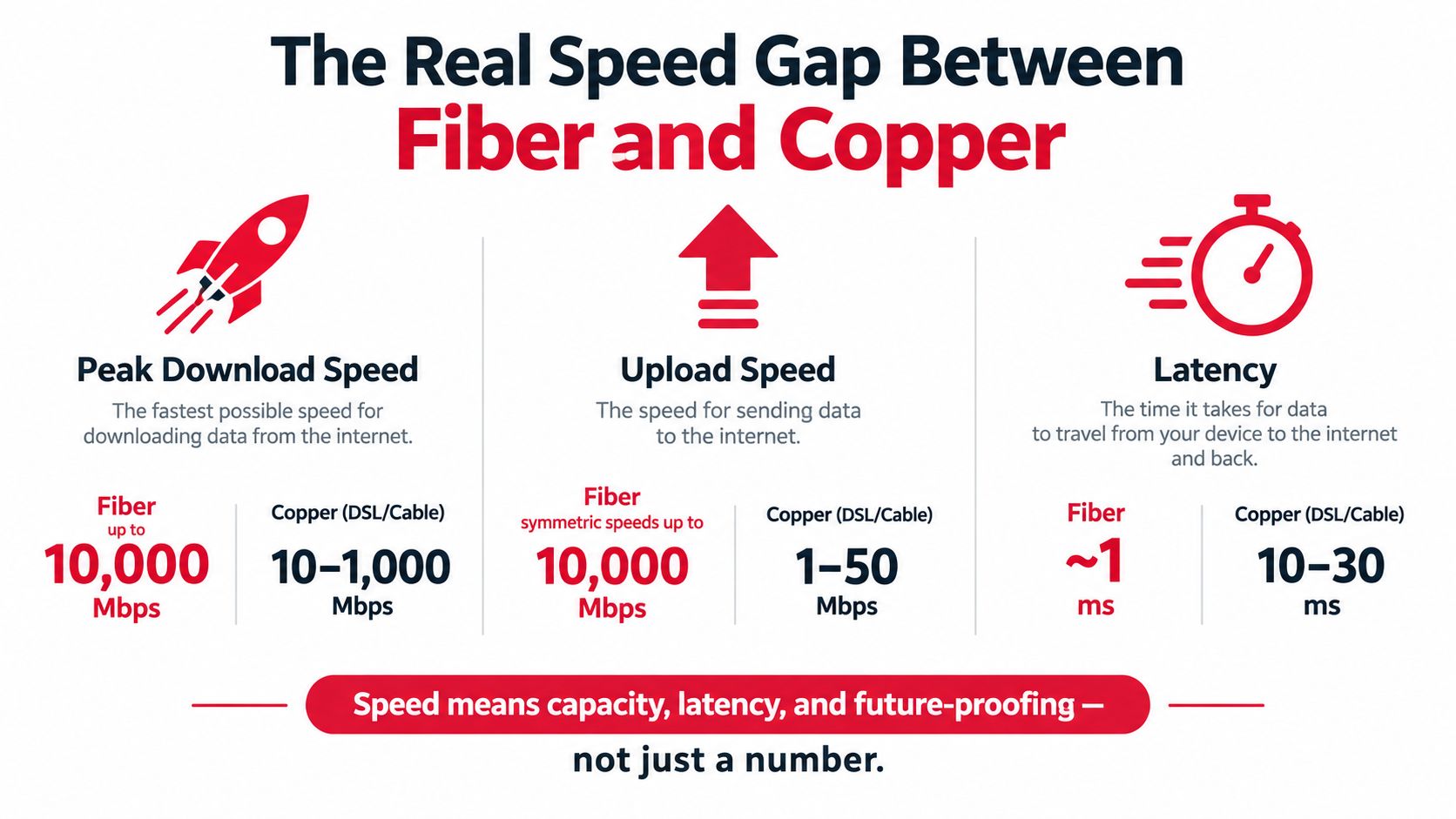
Fiber delivered a weighted mean advertised download speed of 586 Mbps, compared with 31 Mbps for DSL, making it approximately 18.9 times faster in the FCC's September to October 2022 measurements. That result is significant, but real performance still depends on distance, access technology, active equipment, and how far fiber extends into the network.
For a carrier, ISP, or enterprise architect, the useful question isn't whether fiber optic vs copper speed favors fiber. It does. The better question is where fiber creates a material operational advantage, where copper remains practical, and which bottleneck limits the application today.
The answer changes with the link's purpose. A DSL last mile, a short Power over Ethernet connection to a wireless access point, a data-center aggregation path, and an inter-building backbone may all use different media for sound engineering reasons. Bandwidth, latency, reach, interference, power delivery, and lifecycle cost must be evaluated together.
The Measured Speed Gap Between Fiber and Copper
In the FCC's September to October 2022 measurements, the weighted mean advertised download speed was 586 Mbps for fiber and 31 Mbps for DSL, a gap of about 18.9 times (FCC Measuring Broadband America report). For network planners, that matters because it reflects marketed access tiers in an operating broadband market, not a headline laboratory rate that ignores field conditions.
Upload capacity widens the separation. In the same FCC dataset, fiber recorded a weighted mean advertised upload speed of 528 Mbps, while DSL recorded 4 Mbps. That difference directly affects cloud backup windows, user experience in remote work, media transfer, replication traffic, and any design where upstream demand is sustained rather than occasional.
Speed is also consistency
Peak throughput alone is a poor design metric. A service that briefly touches a high rate but drops sharply under load behaves very differently from one that holds its provisioned capacity across the busy hour, and operationally that difference shows up as ticket volume, failed backups, unstable video sessions, and harder capacity forecasting.
The FCC measurements cited earlier also showed that about 85% of fiber subscribers experienced median download speeds above their advertised rate, while fewer than 15% of DSL subscribers did so. That comparison is more useful than a simple top-speed claim because it points to how often customers receive the service profile they purchased.
For a carrier or enterprise architect, the conclusion is practical. The relevant question is not only which medium can post the higher tier on a rate card. It is whether the access segment can deliver predictable downstream and upstream performance at the handoff, over the required distance, with acceptable variation during congestion and normal operating hours.
Practical rule: Treat advertised throughput as one input to the design. Validate delivered throughput, upload capacity, latency, packet loss, and stability at the actual handoff and customer edge.
Copper also needs to be separated by technology. DSL is highly sensitive to loop length, line quality, and the condition of the copper plant. Twisted-pair Ethernet over short structured cabling runs behaves differently, and it adds capabilities fiber does not, such as Power over Ethernet, which can simplify edge-device deployment even when fiber is used deeper in the network.
The useful conclusion is narrower. Fiber provides a much larger capacity envelope and a stronger upstream profile than copper-based DSL, but end-user performance still depends on the remaining copper segment, the active equipment, and the operating constraints of the full path.
Bandwidth Latency and Distance Performance Compared
Peak-period delivery and round-trip delay separate headline speed from usable speed. In the FCC's 2014 measurements, fiber-to-the-home services delivered 113% of advertised download speeds during peak periods, versus 91% for DSL, and average round-trip latency measured 24 milliseconds for fiber, 49 milliseconds for DSL, and 32 milliseconds for cable (FCC 2014 broadband measurements). For networks carrying voice, cloud desktops, video collaboration, industrial control, or transaction-heavy workloads, that gap matters because throughput and delay variation affect the same user session in different ways.
| Performance dimension | Fiber | Copper-based DSL | Engineering implication |
|---|---|---|---|
| FCC weighted mean advertised download speed | 586 Mbps | 31 Mbps | Fiber provides a far larger access-capacity envelope |
| FCC weighted mean advertised upload speed | 528 Mbps | 7 Mbps | Upstream-heavy applications gain much more headroom on fiber |
| 2014 peak-period advertised download delivery | 113% | 91% | Fiber held closer to, or above, the purchased tier during busy hours |
| 2014 average round-trip latency | 24 ms | 49 ms | Fiber showed lower measured response time in that access comparison |
These figures describe measured access-network outcomes, not fixed physical limits for every deployment. Service design, oversubscription, active equipment, and traffic policy still shape results. Latency consistency also matters. A link with adequate average throughput can still perform poorly for interactive workloads if delay rises sharply during contention.
Distance changes the answer
Distance affects copper and fiber differently. On DSL, usable bandwidth falls as the copper loop gets longer because attenuation and line conditions reduce the signal margin. An NBN access-network document explains that operators push fiber deeper into the network because shortening the copper segment improves achievable access performance and reduces the distance-related penalties of the remaining loop (NBN and access-network documentation).
Fiber changes the operating envelope rather than removing all constraints. It supports much higher rates across longer spans, which is why carriers use it for feeder, aggregation, campus, and inter-building links. But the last active hop, queue depth, and service profile still determine what the user experiences at the edge.
Copper retains one practical advantage in some enterprise designs. Power over Ethernet can deliver data and power on the same short twisted-pair run, which simplifies cameras, access points, phones, and sensors. Fiber cannot do that by itself, so designs that extend fiber deeper often still keep short copper drops at the edge.
For planning, the useful question is not which medium appears on a rate card. Document the medium and technology of each segment, the loop length, the upstream and downstream demand, PoE requirements, and measured busy-hour performance. A fiber-fed cabinet with a long copper drop can remove a feeder bottleneck while leaving the subscriber's limiting factor largely unchanged.
Why Replacing Copper Does Not Automatically Reduce Latency
Replacing a copper cable with fiber can improve reach, capacity, and resistance to electromagnetic interference. It doesn't automatically reduce application latency. That distinction matters because network budgets often justify fiber on the assumption that the medium itself determines delay.
NIST's high-speed network analysis states that local-area-network latency depends primarily on effective communication speed and packet length, not on whether the transmission medium is copper or fiber (NIST high-speed network analysis). In its example, transmitting a maximum-length packet at gigabit speed reduced serialization latency from approximately 122 microseconds to 12 microseconds.
Serialization delay is only one part of the path. Switching, routing, queuing, propagation, packet processing, and congestion can dominate the user experience. If a copper link and a fiber link operate at the same line rate and traverse the same active equipment, changing the cable alone won't remove those other contributors.
What fiber does improve
Fiber's practical performance advantage is strongest in areas that frequently become architectural constraints:
- Reach: Fiber supports backbone, inter-building, campus, metro, and wide-area paths that exceed the practical reach of standard twisted-pair Ethernet.
- Capacity scaling: Fiber provides a stronger upgrade path for high-density uplinks and aggregation.
- Electromagnetic immunity: Fiber is useful where electrical interference creates risk for signal integrity.
- Physical separation: Fiber doesn't conduct electricity, which can simplify connections between buildings or environments with different electrical conditions.
Those benefits can reduce indirect sources of delay. A higher-capacity uplink may prevent queues. A longer fiber path may eliminate intermediate active cabinets. Better immunity may reduce errors and retransmissions. But those are network-design effects, not proof that every fiber link has lower latency than every copper link.
Fiber is a capacity and reach decision first. Latency improvements appear when the deployment changes serialization, queuing, routing, or path length, not merely the cable material.
Acceptance testing should therefore measure the service that applications consume. For carrier backhaul, wireless aggregation, municipal broadband, and data-center fabrics, test bidirectional throughput, packet loss, latency, jitter, optical power margin, and interface error counters. A media upgrade justified by latency should include a before-and-after test plan that identifies which delay component the project is expected to change.
This approach prevents an expensive deployment from being judged by an assumption. Fiber may be the correct medium because the existing path lacks reach or upgrade capacity. The resulting application improvement may come from the new architecture, not from photons traveling through glass instead of electrical signals traveling through copper.
Ethernet Speed Scaling Across Distance and Medium
Ethernet speed does not scale uniformly across media. IEEE 802.3 spans 1 Mb/s through 400 Gb/s across twisted-pair copper, multimode fiber, and single-mode fiber, but the practical design question is how much capacity remains available at the required distance, with the required physical layer, and with the required operational constraints (IEEE 802.3 standard information).
For copper, reach usually becomes the governing limit before protocol support does. Standard twisted-pair Ethernet channels are generally capped at 100 meters. Common enterprise examples include 1 Gb/s over Cat5e and 10 Gb/s over Cat6A at 100 meters. Higher-rate copper options can exist, but the allowed channel shortens enough to affect rack layout, cabinet placement, patching practice, and thermal density in active spaces.
Fiber scales differently. Multimode implementations can carry very high Ethernet rates over shorter structured runs, including 400 Gb/s variants with reaches of at least 100 meters in the IEEE specification. Single-mode fiber extends the same Ethernet family into much longer campus, metro, and wide-area paths. That difference matters because throughput planning is rarely isolated from distance planning. It is tied to how many cross-connects, cabinets, and powered aggregation points the physical design can avoid.
Design for the endpoint, not the cable label
A carrier or data-center team should document four items before choosing a medium:
- End-of-life throughput: Specify the capacity required at the design horizon, not only the current port speed.
- Channel length: Include pathway routing, patch panels, cross-connects, and any separation between buildings or cabinets.
- Transceiver and PHY type: Cable category alone does not define the Ethernet implementation or its upgrade path.
- Migration path: Determine whether the next capacity step needs new optics, new cabling, more cabinets, or a full pathway rebuild.
Copper still fits short horizontal runs, powered endpoints, and access-layer links where Power over Ethernet changes the economics. Fiber is usually the better fit for distribution, inter-building segments, splice-point architectures, and high-capacity aggregation, where distance headroom and cleaner scaling reduce future rebuild risk. For teams mapping short-run layouts to channel limits, RV ethernet setup tips is still a useful reference because the same length and routing constraints apply even in more demanding enterprise environments.
The long-term penalty of choosing copper for an aggregation path is often not the immediate port rate. It is hitting a distance or upgrade ceiling before the rest of the network does. Conversely, extending fiber to every endpoint can add unnecessary complexity when the device still needs local electrical power.
That leads to a practical rule for Southern Tier Resources' carrier, ISP, and data-center projects: use fiber where distance, density, interference, or growth sets the design boundary, and keep copper where short reach and endpoint power create more operational value.
Lifecycle Cost and Operational Trade-offs
A fiber decision should survive an operations review, not only a bandwidth review. Installation method, maintenance access, power delivery, fault isolation, migration timing, and future capacity all affect the total cost of ownership.
Fiber's operational case is strengthened by its resistance to weather and electromagnetic interference and by its lower maintenance burden in the analysis published by Corning. That analysis cites a Fiber Broadband Association study estimating that all-fiber networks can save $91 per home passed annually versus DSL, through fewer truck rolls and related operating reductions (Corning analysis of broadband trends).
Where copper still earns its place
Copper has an operational capability fiber doesn't provide by itself: Power over Ethernet. A copper Ethernet run can deliver data and electrical power to devices such as wireless access points, security cameras, and access-control equipment. Replacing those links with fiber may require a separate power design, which can increase installation complexity even when fiber would provide ample bandwidth.
That makes the deployment boundary important. Outside-plant copper that limits broadband capacity may be a strong candidate for replacement. Short in-building copper connected to powered endpoints may remain intentional and efficient.
Cost analysis should separate the following categories:
- Construction cost: Pathway work, make-ready requirements, enclosures, splicing, termination, testing, and restoration.
- Active equipment: Optics, switches, media conversion, power systems, and spare inventory.
- Maintenance exposure: Truck rolls, fault location, environmental damage, interference, and recurring repair effort.
- Migration cost: The labor and outage risk associated with moving customers or applications to the new architecture.
- Capacity timing: The point at which the installed medium requires another rebuild or active-layer change.
For enterprise WAN planning, the access medium is only one layer of the decision. Teams comparing transport architectures can also review compare SD-WAN and MPLS to distinguish the service overlay from the physical connectivity that carries it. A faster physical path won't resolve a poorly designed policy, routing, or failover model.
The same principle applies to video and data-center projects. A fiber build may reduce future pathway disruption, but the project still needs accurate splice records, optical testing, labeling, and maintainable access points.
A later-stage operational review should include a video briefing on deployment context before finalizing the media mix:
The sound financial choice isn't always the medium with the highest nominal rate. It is the medium that meets the service requirement, preserves an upgrade path, and minimizes recurring operational friction across the network's useful life.
When to Deploy Fiber and When to Keep Copper
A partial fiber build can change the network map without changing the customer experience. The deployment decision turns on where the constraint sits: in the backbone, in the last few hundred meters, at the powered edge, or in the operating model needed to support the plant over time.
The most useful distinction is fiber deep into the network versus fiber all the way to the endpoint. Extending fiber to a cabinet, node, or building entrance often improves backhaul and reduces congestion upstream. It does not guarantee fiber-like service at the user port if the remaining copper segment still sets the ceiling for throughput stability, upload behavior, or fault exposure. That is why field surveys should document the remaining copper run, the splice and termination condition, and any active electronics introduced between the fiber handoff and the endpoint.
Match the architecture to the constraint
| Deployment condition | More suitable direction | Reason |
|---|---|---|
| Long outside-plant path | Fiber | Copper reach and signal quality become limiting factors over distance |
| High-capacity aggregation or inter-building link | Fiber | Fiber offers a stronger bandwidth and distance growth path |
| High electromagnetic-interference exposure | Fiber | Fiber avoids electrical signal coupling |
| Short horizontal endpoint connection | Copper may remain suitable | Existing Ethernet and endpoint compatibility can reduce disruption |
| Wireless access point or powered device | Copper may remain suitable | Power over Ethernet carries power and data on one cable |
| Long copper last mile with poor upload performance | Extend fiber deeper or complete FTTH | The remaining copper segment can still dominate service quality |
| Mature short-run installation with modest demand | Evaluate copper first | Replacement may add cost without removing a measured bottleneck |
This matrix is a screening tool, not a substitute for testing. Design records should capture loop or channel length, required downstream and upstream capacity, latency consistency, interference exposure, PoE dependency, pathway condition, sparing, and migration effort.
Distance is only one decision variable. Power delivery matters too. If edge devices depend on PoE, replacing every copper run with fiber can shift cost into local power, battery backup, enclosure design, and maintenance procedures at the far end. In many enterprise floors, access-layer copper stays in place because it supports phones, cameras, access points, and sensors with a single structured cabling system, while fiber carries the higher-capacity uplinks back to distribution.
Partial upgrades also need endpoint evidence. Shorter copper loops and remote electronics can be a rational interim step when full fiber-to-the-premises is not yet practical. But the right comparison is against the service requirement, not against the old baseline. If the final copper segment still constrains upload capacity, latency consistency, or future speed tiers, the project may defer the rebuild rather than avoid it.
For enterprise campuses, fiber usually belongs in backbone and distribution paths once building separation, cabinet density, or uplink growth push beyond copper's practical range. Copper remains useful at the edge where channels are short and powered devices are concentrated. In data centers, the decision should align transceiver choices, rack layout, pathway fill, and the expected migration sequence so that the plant does not force an avoidable redesign later.
Southern Tier Resources provides engineering, construction, fiber splicing, testing, documentation, and maintenance for wireline and wireless infrastructure, including broadband fiber builds and data-center fit-outs. Teams planning a fiber-versus-copper transition should start with a measured inventory, identify the segment that limits service, and then choose the medium that improves capacity without adding avoidable power, maintenance, or migration burden.
Southern Tier Resources can help carriers, ISPs, municipalities, and enterprise teams design, build, splice, test, document, and maintain fiber infrastructure aligned with real distance and capacity requirements. Visit Southern Tier Resources to discuss a broadband, data-center, or wireless deployment where the right medium must support both today's service and tomorrow's upgrade path.