
You're a rural fiber provider planning to extend wireless coverage and upgrade a tower. One proposal includes RF modeling, another includes construction drawings, and a third promises turnkey deployment. The prices aren't comparable because the bidders aren't selling the same scope.
Wireless network design services should buy you an operable asset, not just a coverage map. Before signing, you need to know who validates the site, who proves performance, what the network will cost to operate, and who keeps its records current after installation.
What Wireless Network Design Services Include
A tower upgrade has to fit the network around it. Engineers coordinate spectrum, antennas, transport, structural loading, power, site access, and permitting so the design can be built and operate as intended.
Worldwide 5G connections exceeded 2 billion by the end of 2024, according to figures summarized in the November Ericsson Mobility Report. For network owners, the design task is to fit new equipment into an operating system with existing users, legacy technology, and site constraints. A design drawing shows the intended configuration; structural review determines whether the site can carry the proposed load.
Wireless design service components
| Service component | What it covers | Typical output |
|---|---|---|
| RF engineering | Propagation modeling, interference analysis, link budgets | Coverage and SINR prediction maps |
| Capacity planning | Busy-hour demand, traffic forecasting, carrier additions | Capacity heat maps and densification plan |
| Site surveys | Candidate site visits covering structure, power, access and clutter | Survey report with photos and site data |
| Macro cell design | Tower height, sector layout, antenna and radio configuration | Macro site design and construction drawings |
| Small cell design | Street-level and indoor nodes, backhaul, power supply | Node placement plan and pole attachment drawings |
| DAS design | Distributed antenna layout for venues and buildings | Antenna map, cabling plan and head-end design |
| Backhaul design | Fiber or microwave transport to each site | Transport route and capacity plan |
| Systems integration | Tying radio, core, transport and power together | Integration test plan and acceptance criteria |
RF engineering and capacity planning establish the technical basis. Site surveys test those assumptions against terrain, buildings, access limits, and available utilities. Macro, small-cell, and distributed antenna system (DAS) designs turn the analysis into infrastructure drawings that crews can build from.
Backhaul and integration determine whether the radio network can deliver usable service. A strong signal cannot compensate for an undersized transport circuit or an incompatible core interface. The design should also define measurable acceptance tests, operating-cost assumptions, and maintenance responsibilities, so the owner can assess the installed network beyond its coverage map.
Buy the mix your network needs
A carrier macro network requires sector and mobility planning. A neutral host needs operator-interface coordination. A campus DAS calls for indoor antenna and cabling design, while a municipal fiber-to-tower project may focus primarily on transport engineering. For venue owners, aligning venue infrastructure with business needs helps frame requirements before equipment is selected.
Southern Tier Resources provides engineering, design, construction, and maintenance for wireline and wireless communications, including turnkey wireless deployment. Its end-to-end services extend from design through deployment and maintenance, giving networking and data firms a telecom infrastructure partner across the project lifecycle.
Define the required service mix in the scope. Identify the network's technical needs, the work your own engineers will handle, and the design, construction, and maintenance responsibilities the provider must deliver.
Eight Phases From Discovery to Maintenance
Treat the project as a sequence of approval gates. Each phase should produce something the owner can review before authorizing the next commitment, particularly equipment purchases and civil construction.
The lifecycle below makes those handoffs visible.
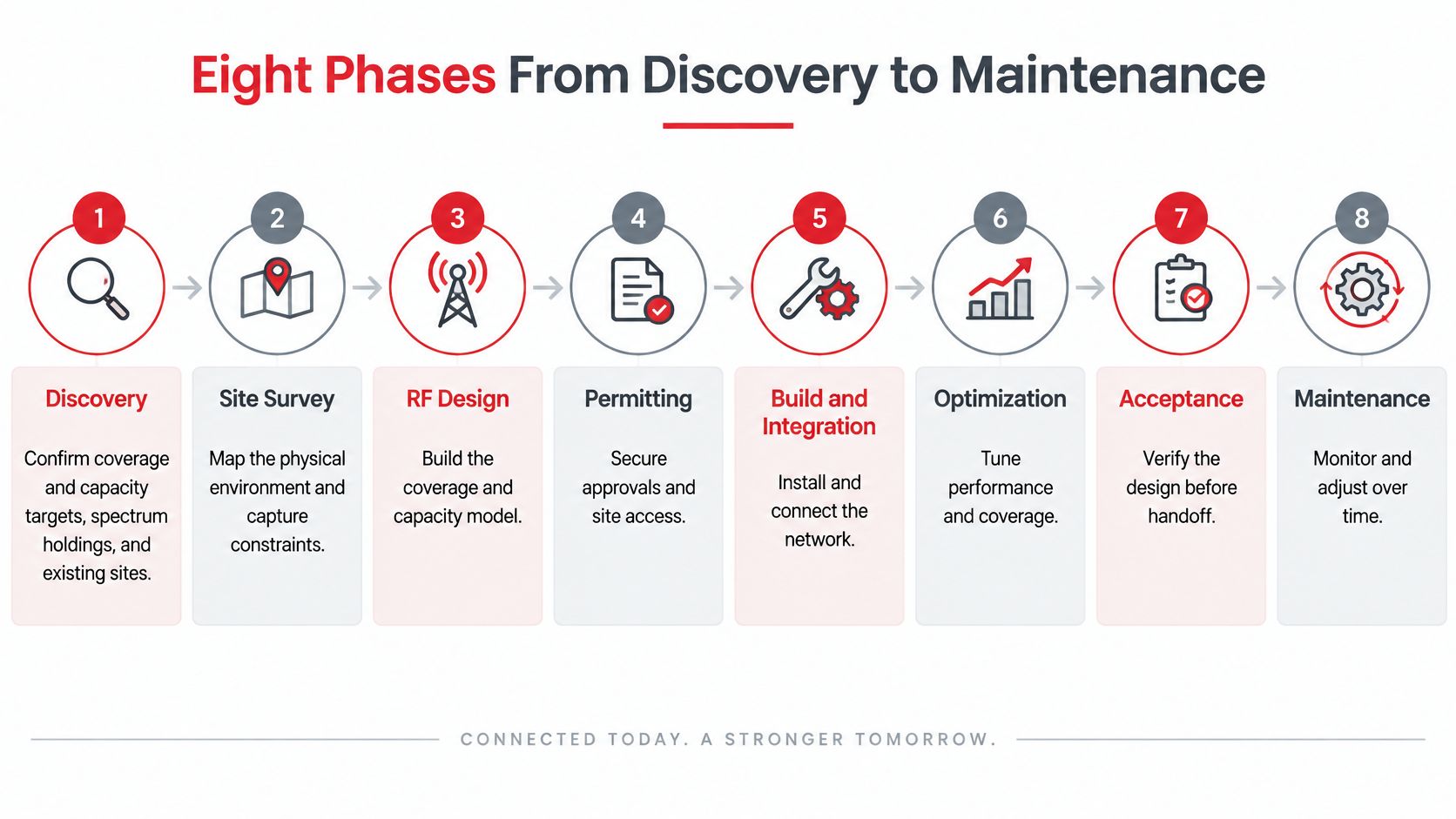
Discovery establishes the operating requirement. Confirm coverage boundaries, capacity expectations, spectrum holdings, existing sites, and the devices the network must support. Don't begin modeling until the owner has approved the traffic assumptions, including uplink demand and critical applications.
Site survey replaces assumptions with field evidence. Visit candidate locations to inspect structures, electrical service, access, surrounding clutter, cable routes, and installation space. Skipping this work can force a redesign after permit drawings have already been submitted.
Design connects RF performance to transport and power. Model propagation and busy-hour capacity together, prepare a link budget for each band, and identify the transport needed to carry the forecast load. A design that demonstrates coverage without examining demand can pass a map review and still disappoint users.
Permitting establishes whether the proposed site can proceed. Identify applicable zoning, pole-attachment, environmental, aviation-notification, and access approvals, then assign an owner to each submission. Ordering location-specific equipment before approvals clear exposes the buyer to substitutions, storage, and stranded purchases.
Construction support turns approved engineering into controlled installation. Complete structural analysis and construction drawings, coordinate material delivery, and inspect installation against the approved revision. A tower arriving before its foundation is ready is a sequencing failure, not an RF problem.
Testing and optimization expose installation and configuration defects. Run field measurements, exercise handovers, check synchronization, and measure uplink, downlink, and latency under representative load. Tune the network before acceptance instead of treating laboratory peak rates as evidence that the installed service works.
Documentation records what was built. Reconcile antenna positions, equipment identifiers, cable routing, fiber assignments, power connections, and configuration changes into the as-built package. Don't let drawing updates accumulate until the field team has demobilized and installation details are harder to verify.
Maintenance preserves the engineering baseline. Define monitoring ownership, fault escalation, inspection tasks, configuration backups, and the conditions that trigger RF retuning or capacity review. Antenna changes and new carriers should enter the same change-control process as the original deployment.
Make handover an approval gate
A complete handover includes a signed as-built set, a test report tied to approved design targets, and a maintenance schedule the owner can execute. Outstanding defects should have named owners and closure criteria, rather than disappearing into an email thread.
Practical rule: Don't close a phase because its activities finished. Close it because its required evidence has been accepted.
We provide end-to-end services from design through deployment and maintenance. Whether you use that model or separate contractors, identify who has authority to approve each handoff and who resolves disagreements between disciplines.
Deliverables and KPIs Your Contract Should Name
| Deliverable | What it proves | Acceptance check |
|---|---|---|
| Predicted coverage map | Expected signal across the service area | Agreed signal threshold met in each target zone |
| Capacity heat map | Busy-hour load per sector at forecast demand | Utilization below the agreed ceiling |
| Link budget per site | Radio reach and margin for each band | Margin stated for every site and band |
| Drive test report | Measured performance on the ground | Throughput and handover interruption within target |
| Synchronization and latency results | Radio timing and delay under load | Sync accuracy and latency percentiles within specification |
| As-built drawings | The configuration actually installed | Matches approved construction drawings and documented changes, with sign-off |
A contract should define how the owner evaluates each deliverable, who approves it, and what happens when it fails. Set targets per zone and per band. Network-wide averages can hide weak coverage at cell edges or inside a critical building, so require results to be reported against the locations and conditions that matter to the project.
For the predicted coverage map, name the propagation assumptions and signal metric. For the capacity heat map, approve the demand model used to forecast busy-hour load. Each link budget should show its losses, gains, and operating margin, so reviewers can understand how the result was calculated rather than relying on a final figure alone.
Measure the service, not the radio setting
3GPP's NR technical overview describes scalable subcarrier spacing from 15 to 120 kHz, slot durations from approximately 1 ms to 0.125 ms, and physical resource blocks containing 12 subcarriers. These radio parameters affect scheduling and usable capacity. They do not, by themselves, prove that applications perform acceptably end to end.
Shorter slots can improve scheduling responsiveness, while transport delay, congestion, and device limitations still affect user experience. Set the acceptance procedure around defined traffic conditions, measurement endpoints, device profiles, and test duration. Include bandwidth, scheduler efficiency, and resource allocation in the test record, so another engineer can interpret the results and compare them with the design assumptions.
Drive-test reports should identify routes, excluded areas, device capabilities, configuration versions, and failed samples. Synchronization and latency reports should state the measurement method and loaded conditions, not just show a favorable value without context.
Keep documentation inside acceptance
As-built drawings should record approved changes and the configuration installed. They should not imply that construction exactly followed the original design when documented changes were made. Chris at SnapDial described the value directly: “They delivered the project on time and provided detailed as-built plans.”
Treat that record as part of approval, not an administrative extra. Maintenance teams use the installed configuration to diagnose faults and plan changes safely. Require sign-off on the as-built package before closing the work, and make sure outstanding defects have owners and clear closure criteria.
Write these KPIs into the scope of work:
- Coverage zones: Name the areas, bands, signal metrics, and required thresholds.
- Busy-hour load ceiling: Define utilization limits against the approved demand model.
- Cell-edge throughput: Specify uplink and downlink performance for representative devices.
- Handover interruption: Set the measurement method and pass criteria.
- Synchronization accuracy: Identify the timing reference and allowable deviation.
- Latency under load: State endpoints, traffic conditions, and required percentiles.
Acceptance should also cover lifecycle costs. Require the design to document energy assumptions and compare total cost over the period the owner expects to operate the network. Specify maintenance responsibilities, fault response, and retesting obligations alongside the technical targets. A result outside specification needs an assigned party responsible for corrective work, followed by a repeat test using the same agreed method.
Spectrum Bands and Small Cell Versus Macro Choices
5G isn't a single radio profile. Choose the spectrum and site architecture for the coverage objective, traffic distribution, and device population, rather than selecting equipment from a peak-speed claim.
The engineering task is to compare candidate layers before committing to locations.

Match the band to the job
The 3GPP 5G system overview describes the licensed NR spectrum framework behind these planning ranges, including carrier bandwidths of up to 100 MHz in the lower ranges and 400 MHz at higher frequencies. These are planning distinctions, not a promise that every band, device, or local allocation supports the maximum.
| Spectrum range | Propagation | Max bandwidth per carrier | Best design role |
|---|---|---|---|
| Below 1 GHz | Strongest reach | Up to 100 MHz | Broad-area and rural coverage |
| 1 GHz to 6 GHz | Balanced reach and penetration | Up to 100 MHz | Urban and suburban capacity layer |
| Above 6 GHz | Weakest, short range | Up to 400 MHz | Dense urban hotspots and small cells |
A layered plan uses low-band macro coverage for reach and mobility, mid-band sites for the principal capacity layer, and high-band small cells for concentrated demand. Actual performance still requires band-specific modeling.
Say you're designing a stadium district. High-band small cells can serve crowd demand around entrances and gathering areas, while macro coverage supports surrounding roads and residential blocks. The design must also handle how traffic moves between those areas before and after an event.
Avoid the peak-bandwidth trap
Selecting high-band spectrum solely for bandwidth can leave coverage gaps and require more mounting locations, transport connections, and power feeds than the buyer expected. Using low-band coverage alone can create the opposite problem: a broad service footprint without sufficient capacity where users congregate.
Model path loss, clutter, antenna height, beamforming, indoor penetration, and inter-site interference together. Also verify the uplink, because an effective downlink prediction doesn't guarantee that the user device can return traffic reliably.
Use this video as a discussion aid alongside the project's band-specific engineering review.
For non-standalone deployments, check LTE coexistence, aggregation support, and device compatibility before freezing the architecture. A spectrum resource has limited practical value if the intended devices can't use its planned combinations.
Give each densification phase a measured busy-hour trigger. Reserve feasible small-cell locations and transport paths early, but release construction when observed demand and performance justify it, rather than following an arbitrary calendar.
Cost and Timeline Drivers Beyond the Quote
The design fee is only one part of the investment. A low engineering quote can leave the owner paying more for construction changes, utility upgrades, inefficient equipment, or difficult maintenance access.
Compare bids using explicit quantities and unit bases, not a single deployment total.
- Site acquisition and permitting: Separate per-site investigations, application work, access agreements, and approval-related allowances.
- Survey depth: Identify charges per site and distinguish desktop review from field inspection and specialist structural work.
- Backhaul: Price fiber by route length and associated civil work, and microwave by engineered link, including mounting and alignment.
- Power and backup: Separate electrical upgrades, battery systems, generators, and the autonomy assumptions used to size them.
- Cooling: Identify equipment-room cooling, ventilation, controls, and their operating requirements.
- Equipment replacement: Include expected replacement events, removal work, disposal, and installation access in the lifecycle model.
Put operating energy beside capital cost
The OECD's analysis of communication-network sustainability reports that network energy consumption represents roughly 20–40% of operators' network operating expenses, while the radio access network accounts for about three-quarters of mobile-network energy use. That makes radio configuration and site power design material procurement decisions.
Densification can improve efficiency where added capacity serves substantial traffic. In a quiet area, extra active equipment may increase power consumption without carrying enough additional traffic to justify it. Sleep modes and traffic-aware scaling need to be evaluated against coverage, availability, and wake-up requirements.
Resilience changes the calculation again. Backup runtime, cooling during outages, generator support, and battery operating conditions must fit the service obligation.
The lowest initial price isn't evidence of the lowest operating cost. Require bidders to expose the assumptions that make their option look economical.
Separate mobilization from readiness
We supply crews and equipment to customers 24/7, but crew availability doesn't remove dependencies on permits, utility connections, or backhaul delivery. The schedule should identify those external commitments and distinguish confirmed dates from planning allowances.
I would request a ten-year total-cost-and-energy model per site as a procurement requirement. Have bidders show energy per gigabyte alongside total site consumption, electricity pricing per kWh, maintenance assumptions, and equipment replacements.
Then test the model against lower and higher traffic scenarios. Ask which costs are committed, which are allowances, and which the owner can change through route selection, equipment choice, or service requirements. Obtain project-specific cost ranges from bidders rather than applying generic deployment prices.
Compliance, Safety and Vetting a Provider
An open or multi-vendor architecture isn't automatically cheaper. The owner still needs someone to prove that radios, software, devices, core functions, and transport work together, and to take responsibility when they don't.
The 2025 Open Network Index, discussed by Dell Technologies, found that 74% of communications service providers had open-network architecture plans, yet fewer than 25% had deployed Open RAN. Planning interest isn't equivalent to deployment readiness.
Use the following checkpoints to evaluate capability before making an architectural commitment.
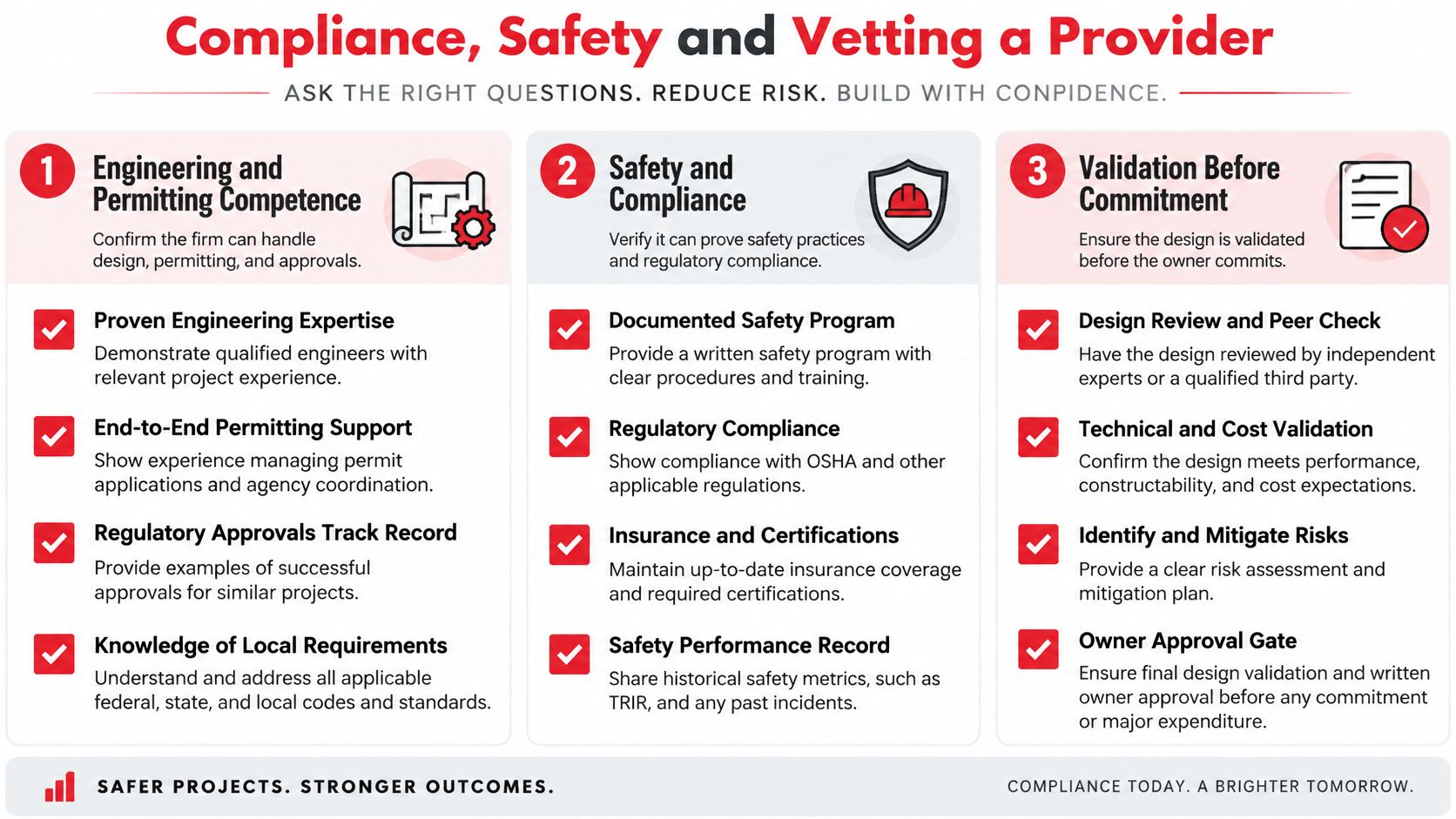
Establish engineering and safety accountability
The proposal should identify the responsible engineers, the applicable design standards, and who determines which approvals apply. Don't accept a general statement that compliance is included without a site-specific compliance register.
- Structural competence: Require tower and mounting analysis against the applicable structural standard, with loads and proposed equipment identified.
- Construction safety: Review crew qualifications, documented safety practices, subcontractor oversight, and applicable occupational-safety obligations.
- Aviation and local approvals: Assign responsibility for aviation-notification screening, zoning, environmental review, and pole access where applicable.
- Spectrum authorization: Confirm that the owner has the required rights to operate the proposed bands and configuration.
- RF exposure: Require site-specific exposure calculations, controlled-access arrangements, and mitigation instructions where needed.
Confirm current requirements with the relevant authorities before the design is frozen. Private-network licensing and spectrum access need jurisdiction-specific review; don't copy a deployment template from another country.
Validate before committing to the ecosystem
Require lab validation using the intended devices, software releases, interfaces, and traffic profiles. Include uplink performance, application latency, legacy integration, failover behavior, and recovery after component replacement.
Assign cybersecurity ownership and software-release governance explicitly. Someone must approve patches, maintain configuration baselines, investigate vulnerabilities, and decide when an upgrade requires regression testing.
For projects that also include venue Wi-Fi, Purple Shield's guidance to prepare venue Wi-Fi for certification can help organize security preparation. It doesn't replace cellular engineering validation or local regulatory review.
Procurement safeguard: Define the fallback architecture and exit conditions before integration begins, including access to configurations, documentation, and operational data.
Request references from comparable builds, current insurance certificates, named delivery teams, safety records, and examples of acceptance reports. Check escalation coverage and documentation practices rather than relying on an architecture label. Our website also has an RFP Listings section, but a listing isn't evidence of engineering qualification.
Confirm the Scope and Acceptance Tests Before You Sign
Choose the delivery model after defining what you need to own at handover. A turnkey contract can simplify accountability, but only if its exclusions, interfaces, approval gates, and maintenance obligations are explicit.
A buyer with experienced in-house engineers may reasonably purchase survey, design, or testing support separately. That approach works when the owner has both the authority and the capacity to coordinate disciplines, resolve interface problems, and maintain the technical baseline.
Turn the buying decision into an executable scope
Write a concise scope naming the required components. Identify the service area, network type, existing assets, owner-supplied information, and excluded work. Include the boundaries between radio, transport, power, civil construction, and core integration so no essential interface is left unassigned.
Set acceptance targets before requesting a final price. Attach a test matrix with zone-specific and band-specific requirements, approved measurement methods, representative devices, and loaded conditions. Identify who witnesses tests, who approves exceptions, and what happens when corrective work is necessary.
Request a phase-by-phase commercial breakdown. Separate design, permitting, construction, testing, documentation, and maintenance so bidders can be compared on equivalent work. Require a written change-control process that distinguishes an owner-requested expansion from correction of a contractor's nonconforming work.
Name the accountable lifecycle owner. That party should coordinate handoffs, maintain the issue register, and confirm that installed changes reach the final records. If the owner retains this role, assign a specific internal lead rather than distributing responsibility informally across departments.
Choose accountability, not just convenience
Southern Tier Resources serves networking and data firms with telecom solutions and offers a turnkey option across engineering, deployment, and maintenance. For an owner seeking a single delivery partner, that model can keep design decisions connected to construction and ongoing support.
For an owner retaining internal engineering control, a narrower service package may be the better purchase. The important distinction is who controls interfaces and accepts the operational consequences, not whether the proposal uses the word turnkey.
Before authorizing a foundation, ask every bidder: Which acceptance tests will you run, and who signs the as-built plans? Then have the answer incorporated into the contract, together with the required evidence and approval authority.
Your next step is to issue the scope and acceptance matrix together. Don't invite bidders to price a network whose definition of completion is still open to interpretation.
Southern Tier Resources offers engineering, design, construction, and maintenance for wireline and wireless networks, including turnkey wireless deployment. Visit Southern Tier Resources to discuss your network requirements and define a scope that connects field engineering, measurable acceptance, and long-term maintenance.