
A cabling installation can pass its electrical tests and still be unusable to the operations team. Missing port mappings, inconsistent labels, and fragmented records can leave technicians unable to identify what connects where, even when individual links pass. The Cables NYC guide to subcontractor deliverables identifies the test records, schedules, and as-built drawings that owners need to make an installation operational.
Hiring structured cabling contractors therefore starts with a different question: what must the building owner be able to operate, verify, and maintain after handover? Price the physical installation, but make usable closeout data part of acceptance, not an administrative task left until the crews leave.
Define the Scope Before You Request Bids
The scope decision that most changes the price is how much infrastructure you're building beyond today's connected devices. Extra fiber strands, available pathway space, and separate routes cost money now. Pulling replacement cable through an occupied facility can also require access coordination, service interruptions, and reopening finished areas.
Specify the expansion requirement before choosing the material. For horizontal copper serving dense PoE deployments, wireless access points, or planned speed upgrades, I would specify Cat 6A permanent links and require the designer to check bundle heating and pathway capacity. Cat 6 can be a reasonable choice for a lower-demand room when its applications, distances, and power requirements are established.
For backbone fiber, state single-mode or multimode, the required strand count, and the spares. Identify whether the duct route shares infrastructure with another carrier or utility. Separate cables in the same vulnerable route aren't equivalent to physically diverse pathways.
Scope Elements to Specify Before Bidding
| Scope element | What to specify | Decision that changes cost |
|---|---|---|
| Horizontal copper | Category, channel-length allowance, cable construction and fire rating | Cat 6A versus Cat 6 for PoE and future speed |
| Backbone fiber | Single-mode or multimode, strand count with spares | Spare strands now versus pulling fiber later |
| Pathways | Tray and conduit routes, fill limits, separation from power | Redundant routes versus a single entry point |
| Telecom rooms | Rack elevations, patch-panel layout, power and cooling | Density planning for expansion |
| Labeling | Identifier scheme shared across drawings and ports | Naming convention that matches the asset database |
| Testing | Certification standard and test equipment class | Per-link certification versus sample testing |
| Documentation | Native tester files, CSV asset data, as-built drawings | Machine-readable records versus PDF-only closeout |
| Maintenance | Move, add, and change process, warranty term | Who updates records after the initial maintenance period |
Networking2000's cabling guidance for London and Essex firms is a useful starting resource when facilities and IT teams need a shared explanation before defining these requirements.
Require Assumptions, Not Blanket Redundancy
Ask bidders to explain the expansion horizon, expected rack growth, and failure scenario behind each redundancy recommendation. Reject both extremes: filling every pathway for the cheapest initial build and buying duplicate infrastructure without identifying the operational benefit.
Staffing continuity belongs in that discussion. The 2025 Uptime Institute survey reported that 75% of data-center operators had workforces that were 10% women or less, illustrating the narrow workforce composition operators must address when planning long-term capacity.
Attach a concise scope statement to the RFP covering applications, materials, routes, growth assumptions, acceptance evidence, and maintenance responsibilities. Every bidder should price that same statement.
Site Survey and Installation Standards to Require
Survey the route before accepting a pathway price. A drawing that shows an available conduit doesn't establish that crews can use it, access it, or pull the proposed cable through it.
Photograph the conditions that will support the installation plan.

Walk the Complete Route
- Trace entrance-to-room pathways. Photograph conduit entries, trays, risers, obstructions, and accessible capacity. These images help resolve disagreements about existing conditions.
- Measure usable capacity and route length. Include vertical transitions and service loops. Flag routes that require a different telecom-room location or another pathway.
- Inspect electrical interfaces. Record separation from power, bonding and grounding points, and existing fire-stopping conditions. Assign corrective work explicitly.
- Identify existing cables. Mark retained services and abandoned runs scheduled for removal. Don't let removal work become an unpriced assumption.
- Check each telecom room. Confirm rack space, equipment access, power, cooling, and floor-loading requirements with the responsible trades.
- Record access restrictions. Include permits, escorts, shutdown approvals, occupied areas, and permitted working hours.
- Issue a keyed survey report. Tie photographs and exceptions to drawing locations and proposed identifiers so field decisions remain traceable.
For education estates, Nutmeg Technologies' school network wiring guidance provides useful context for coordinating communications infrastructure with occupied learning spaces.
Name the Applicable Revisions
Don't accept a proposal that promises only TIA compliance. Require bidders to name the applicable ANSI/TIA-568 documents and revisions, identify exceptions, and align their installation method with their test plan.
The Cabling Installation & Maintenance history of cabling standards explains that ANSI standards are generally reviewed, reaffirmed, revised, or withdrawn on a five-year cycle. A familiar legacy specification isn't proof that a contractor's methods remain current.
Use the following video as a discussion aid alongside the site-specific survey, not as a substitute for inspection.
The survey should finish with an agreed drawing and an exception register. That won't eliminate every concealed condition, but it makes the pricing boundary defensible.
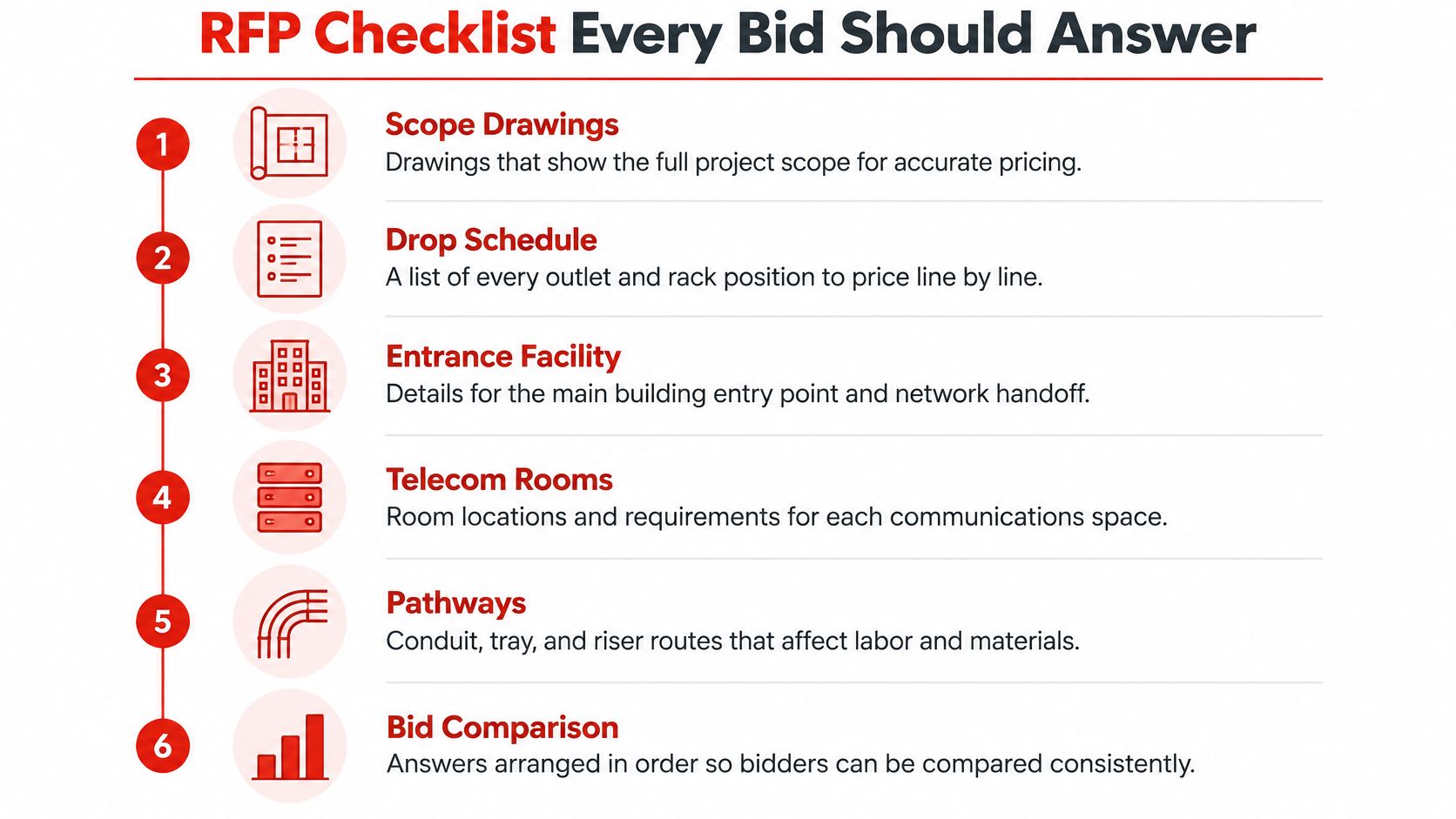
RFP Checklist Every Bid Should Answer
Give bidders an issued drawing set, not a device count in an email. The package should show the entrance facility, network handoff, telecom rooms, horizontal outlets, backbone routes, and work boundaries.
Use the visual checklist to confirm the physical scope is present.
Require Comparable Answers
- Scope drawings and drop schedule. List every outlet, rack position, and backbone connection. Require bidders to acknowledge the drawing revision they've priced.
- Access and security. State work hours, escort rules, restricted areas, and material-storage arrangements. Otherwise, labor allowances won't be comparable.
- Design and testing standards. Name the applicable ANSI/TIA-568 requirements and field-test methodology. Require an explicit list of proposed deviations.
- Test instruments and reporting. Request the tester model, accuracy class, calibration evidence, adapters, and a representative report. Confirm that the proposed limits match the link being installed.
- Deliverable formats. State which records must be editable, which must retain native instrument data, and which drawings must reflect field changes. A promise to supply documentation is too vague.
- Staffing. Require named crew leads, relevant technician qualifications, and coverage during overlapping work fronts. Identify who can authorize technical decisions.
- Safety and insurance. Obtain the written safety program, recent incident history, and evidence meeting the project's insurance requirements. Resolve exclusions before award.
- Mobilization and outage support. Require a start window, material dependencies, escalation contacts, and defined support availability. Distinguish scheduled work from emergency response.
- Warranty and maintenance ownership. Define coverage, exclusions, defect reporting, and responsibility for updating records after changes.
- Commercial controls. Establish change-order approval, unit rates where appropriate, and payment milestones tied to accepted work and evidence.
Control Clarifications Centrally
Send the same package to every bidder. When a question changes the scope, issue the answer to all participants and require acknowledgment.
Our website has an RFP Listings section, but a listing doesn't replace a project-specific bid package. The owner still needs to define technical and commercial requirements clearly enough for a contractor to accept them.
Procurement rule: An unanswered requirement is an exception to resolve, not an assumption to make on the bidder's behalf.
Require each response in the checklist's order. That makes missing answers visible before commercial negotiations begin.
Scoring Bids and Shortlisting Contractors
Score technical responses before comparing totals. A contractor that omitted certification, pathway remediation, or usable deliverables hasn't necessarily found a more efficient installation method. It may have priced less work.
Use the same evaluation sheet for every bidder. Mark each answer as acceptable, clarification required, or unacceptable, and record the evidence behind the decision.
Bid Scoring Criteria With Strong Answers and Red Flags
| Criterion | Strong answer | Red flag |
|---|---|---|
| Standards knowledge | Names applicable TIA-568 revisions and field-test requirements | Old specifications presented without review or generic best practice |
| Test equipment | Suitable certification tester with current calibration evidence | Continuity tester only or no calibration proof |
| Technician capacity | Named crew leads and coverage for peak work | Crew count without names or qualifications |
| Safety record | Written program, incident history, and insurance evidence | No documented program or refusal to explain history |
| Similar references | Comparable projects with reachable contacts | Unrelated small jobs or unverifiable references |
| Sample documentation | Native report sample, asset export, and as-built package | No sample or PDF-only examples |
| Price transparency | Line items mapped to drawings and explicit exclusions | Lump sum with unclear boundaries |
| Mobilization | Start window, dependencies, and outage-support hours | Availability contingent on unexplained prerequisites |
Separate Workforce Scale From Available Capacity
The U.S. Bureau of Labor Statistics occupational profile covers telecommunications equipment installation and repair, excluding line installers. That occupational category isn't a structured-cabling crew roster, and it can't establish whether a particular bidder has qualified technicians available for your project.
Ask who is assigned, what competing commitments they have, and who replaces an absent lead. Request relevant certifications and turnover history without treating a certificate as a substitute for demonstrated work.
Call references and ask:
- Schedule performance: Did the work slip, and what caused the delay?
- Test quality: What failed during initial acceptance, and how did the contractor resolve it?
- Handover discipline: Did accurate as-built plans arrive when operations needed them?
Our credentials include over 20 years of industry experience. Jason of Network Connex describes the relationship directly: “STR has been an outstanding partner for our fiber construction projects.” Apply the same evidence standard to us as to any bidder: relevant references support evaluation, but they don't replace a compliant proposal.
Give technical compliance and documentation more influence than the lowest installation price.
Reject a bid that can't provide a representative test report or identify accountable crew leads. Before award, obtain written agreement on the sample closeout package, identifier traceability, and ownership of subsequent updates.
Managing the Installation and Avoiding Common Pitfalls
A signed scope won't control field changes by itself. The project manager needs a short, repeatable routine that keeps facilities, network operations, and the installation crew working from the same decisions.
Apply Controls While Work Is Accessible
- Hold weekly coordination meetings. Resolve pathway conflicts, access restrictions, and trade interfaces before crews reach the affected area.
- Approve route changes in writing. Require the proposed drawing change, cost, schedule impact, and operational consequence before work proceeds.
- Check labels during room walk-throughs. Compare installed identifiers with the live cable schedule rather than waiting for the final drawing submission.
- Verify trunk polarity as installed. Record the method and endpoint mapping. An optical-loss pass doesn't prove that the intended transmit and receive positions align.
- Release payments against evidence. Require the completed area's results and accepted corrections before treating that area as finished.
- Maintain a delay log. Assign each access, permit, material, or staffing delay a cause, owner, and recovery action.
Common Installation Pitfalls and Controls
| Pitfall | Early warning sign | Control |
|---|---|---|
| Pathway fill exceeded | Crews request unplanned trays or cannot place the designed bundle | Survey measurements and approved route changes |
| Undocumented moves during installation | Site cable IDs differ from drawings | Daily label checks against the live schedule |
| Lump-sum pricing with gaps | Exclusions emerge after award | Line-item scope boundaries and clarification register |
| Testing deferred until completion | Defects appear after access is closed | Certify each completed area |
| Fiber polarity undocumented | Transmit and receive positions don't match the intended patching | Record and verify every trunk's polarity method |
| Staffing reduced during peaks | Crew lead changes without notice | Contractual notification and approved replacement coverage |
Say a crew proposes moving a backbone into another tray to avoid a congested riser. That may solve the immediate installation problem while placing supposedly diverse services in the same route. The network owner must approve that consequence, not just the additional labor.
Field convenience isn't sufficient justification for changing the network's failure exposure.
Keep an approved field-markup set available to everyone supervising work. An instruction buried in a private message isn't a controlled design change.
Acceptance Testing for Copper and Fiber Links
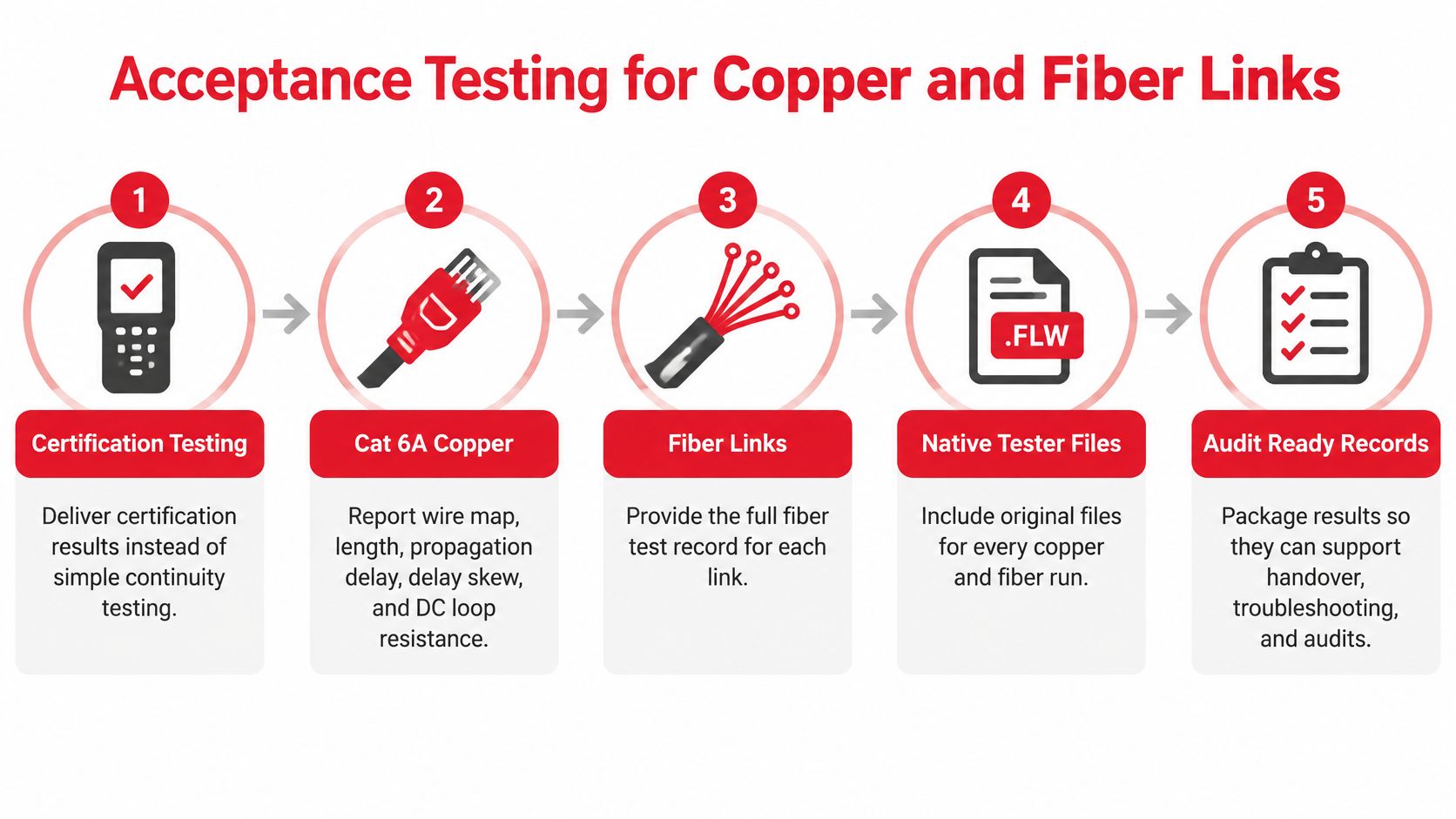
Continuity isn't certification. A wire-map tester can identify basic connection errors, but it doesn't establish the transmission performance required for acceptance.
The field-testing educational brochure identifies ANSI/TIA-1152-A for field-test methodology and instrument accuracy, ANSI/TIA-568.2-E for balanced twisted-pair performance, and a Level IIIe-or-better instrument for Cat 6A permanent-link certification. Require current adapters, firmware, and calibration, and test the permanent link without user patch cords.
Read the Measurements, Not Just the Pass Flag
The copper report must include wire map, length, propagation delay, delay skew, DC loop resistance, DC resistance unbalance, insertion loss, NEXT, PSNEXT, and return loss. Confirm that the operator selected the specified cable category and link configuration before trusting the summary.
| Test | What it measures | Typical failure cause |
|---|---|---|
| Wire map | Pin order, opens, shorts, split pairs | Termination error |
| Length | Installed link length against its configured limit | Longer route or excess slack |
| Insertion loss | Signal attenuation across the link | Excess length or poor connectors |
| NEXT and PSNEXT | Crosstalk between pairs | Excessive untwist or connector damage |
| Return loss | Reflections from impedance discontinuities | Damaged cable or poor termination |
| Delay skew | Timing difference between pairs | Cable construction or damaged pairs |
| DC loop resistance | Resistance through the conductor pair | Poor termination or unsuitable conductor |
| Fiber insertion loss | End-to-end optical attenuation | Contamination, excessive bends, or connection losses |
| Fiber OTDR | Locations and characteristics of optical events | Poor splice, connector, or bend |
Treat a failure as diagnostic evidence. An open or split pair calls for termination inspection; excessive NEXT warrants checking pair geometry and connector assembly. Repeatedly pressing test without recording a repair doesn't establish why the result changed.
This workflow keeps certification evidence connected to acceptance.
Establish Fiber Loss Before Investigating Events
The WiFi Hotshots structured-cabling testing guidance distinguishes Tier 1 insertion-loss testing from Tier 2 OTDR analysis and gives typical test wavelengths of 850 and 1300 nm for multimode, and 1310 and 1550 nm for single-mode. Include OTDR analysis when the owner, specification, or fault-isolation requirement calls for it.
- Inspect and clean connectors. Use an inspection scope and appropriate cleaning tools before mating.
- Verify reference cords and configuration. A damaged reference connector can invalidate the measurement.
- Establish the specified reference method. Record it with the test configuration.
- Measure end-to-end loss. Compare the result with the project's approved optical-loss budget.
- Investigate out-of-limit links. Inspect interfaces and routing before replacing components.
- Capture required OTDR traces. Use appropriate launch and receive fibers to examine connection, splice, bend, and reflectance events.
An OTDR trace helps locate a defect; it doesn't replace end-to-end insertion-loss measurement. Retain both forms of evidence where specified.
Acceptance requires traceability from each outlet or fiber core to its panel position, cable identifier, test configuration, date, result, and final as-built location. Don't accept an unindexed collection of passing reports.
Closeout Records That Stay Usable After Handover
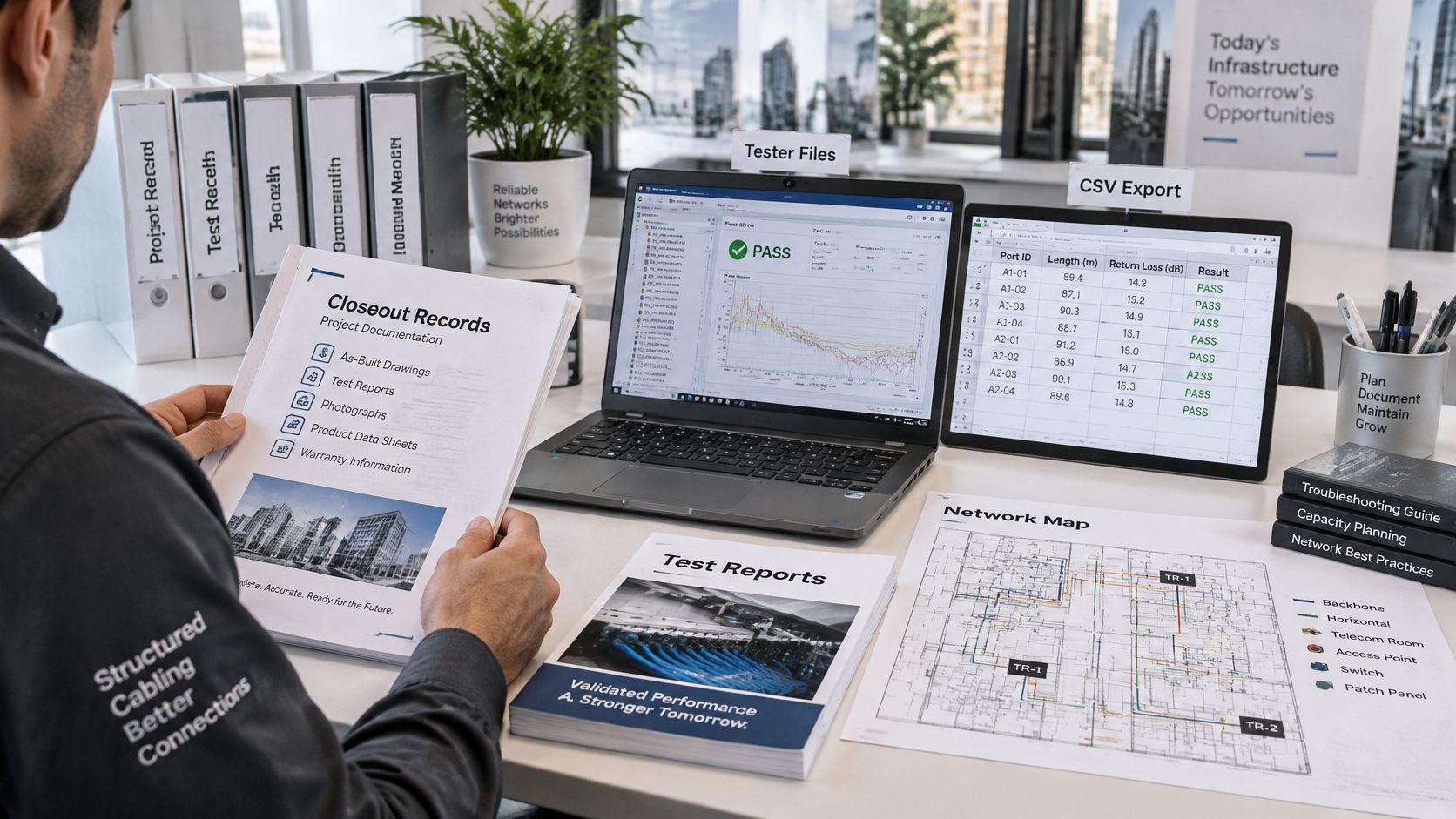
A passing report isn't enough if operations can't associate it with the installed asset. Closeout data becomes the building's operating baseline, supporting fault isolation, capacity decisions, audits, and later construction.
The owner needs records that can be searched, imported, and checked, not just opened on screen.
Specify the Data Structure
Require a closeout manifest that identifies every deliverable and its format:
- Native instrument files: Original copper results, optical-loss records, and specified OTDR traces, including instrument identity and configuration.
- Asset exports: CSV files or an agreed API-ready schema with stable cable identifiers and explicit endpoint fields.
- Physical-layout records: Rack elevations, panel and cassette positions, cable schedules, and final as-built plans.
- Controlled naming rules: Consistent identifiers across physical labels, filenames, drawings, ports, and database records.
- Exception history: Dated failures, repairs, retests, approved deviations, and unresolved items.
Don't accept API-ready as an undefined promise. Agree field names, required values, character encoding, and import validation with the team responsible for the owner's DCIM, GIS, CMMS, or network-asset system.
Test the Documentation
Import a representative package before final submission. Check that identifiers join automatically to port records and floor-plan locations without someone interpreting filenames manually.
For fiber, verify the core-to-rack, panel, cassette, and patch-position mapping. Confirm that polarity is recorded and that labels match the finished drawings. Preserve failed results alongside repair and retest entries rather than overwriting the history.
Chris of SnapDial described our handover this way: “They delivered the project on time and provided complete as-built plans.” Request that same level of detail in the sample package, then verify that the information is usable in your own operating systems.
Assign a named record owner after handover. The maintenance process should require a dated change entry, revised endpoint mapping, applicable retesting, and updated drawings whenever technicians move, add, or remove infrastructure.
Use the first post-handover change as a practical review point. If operations can't update the records cleanly, correct the process before subsequent work makes the baseline unreliable.
Southern Tier Resources provides engineering, construction, testing, and maintenance for telecom infrastructure, including data-center fit-outs. Visit Southern Tier Resources to discuss your cabling scope, acceptance requirements, and closeout expectations, or call (469) 405-4671 with your drawings and proposed schedule.