The advice that circulates most about structured cabling standards is to buy the highest category you can afford, keep the run under 100 meters, and hand over the certification report. Each part of that advice is reasonable. None of it makes a channel compliant on its own.
A tester can pass a permanent link that later fails as a channel once the cords go in. A Category 6A job can sit entirely outside the standard because the pathway crushes the bend radius, or because nobody wrote down which edition governed acceptance. A link can carry traffic for three years before an audit, a tenant fit-out, or a new radio forces the question nobody documented an answer to: what class this plant is.
Compliance is a tested channel plus a lifecycle decision, recorded against a named edition of a named document. Hold that frame before you compare one standard to another, because the comparison only matters after you know which document your project is being measured against.
What Structured Cabling Standards Actually Decide
A lit port proves electrical continuity. It does not prove a compliant channel. The gap between the two is documentation, test method, and a cited edition, and it explains why two buildings with identical cable can give completely different answers when a carrier, an insurer, or a new tenant asks what the horizontal plant is.
Structured cabling is the fixed hierarchical plant. That means work-area outlets, the horizontal cable behind them, optional consolidation points, the telecommunications room or distributor each run returns to, the backbone between distributors, and the cords that finish the channel at both ends. Design the whole path, because the tester measures the whole path whether or not your drawing did.
Three document families show up on drawings. ANSI/TIA-568 carries North American commercial practice. ISO/IEC 11801 is the international generic-cabling framework. EN 50173 governs where European adoption applies. Pathways, bonding, administration, and data-center documents sit beside those three rather than replacing them.
The payoff for designing to them is a single application-independent plant that serves data, telephony, building controls, and wireless backhaul without a rebuild between each, with published test limits and interfaces that stay interchangeable across vendors.
The line I draw in every kickoff: listed components do not create a compliant channel. Only an installed, tested, and recorded channel does.
Where Compliance Actually Lives
Two pressures have moved this from a housekeeping issue to a design issue. Copper runs now routinely exceed the 100-meter channel in campuses, warehouses, and outdoor enclosures, and the industry work addressing that situation treats those runs as noncompliant rather than merely awkward. Data halls built for AI workloads have picked up their own requirements around media, loading, and lifecycle records. Both are design decisions with a paper trail, not installation surprises.
Before you use any comparison of standards, fix three things about your project. Jurisdiction decides whether TIA, ISO, or EN sets the limit. Media decides whether you're arguing about categories at all. Space type decides whether a commercial floor document applies or a data-center document takes over. Get those three wrong and the most careful cable schedule in the world cites the wrong authority.
Major Structured Cabling Standards Compared
| Document | Scope | Typical jurisdiction or space | Design rule to take from it |
|---|---|---|---|
| ANSI/TIA-568.2 | 100-ohm balanced twisted-pair | North American commercial buildings | Categories 5e to 8; 100 m channel, 30 m for Category 8 |
| ISO/IEC 11801 | Generic copper and fiber cabling | International customer premises | Class and optical grade; test permanent link and channel separately |
| EN 50173 series | European generic cabling | CENELEC / EU projects | Use the ISO-aligned class adopted for that country and building type |
| ANSI/TIA-942-C (May 2024) | Data center infrastructure | Enterprise, edge, and hyperscale halls | Topology, redundancy, media, loading, and cabinet provisions beyond a floor standard |
| TIA-569 | Pathways and spaces | Any of the above | Pathway fill, bend radius, and room size so the rated cable can actually be installed |
| TIA-606 | Administration | Any of the above | Identifier scheme and records that match the as-built plant |
| TIA-607 | Bonding and grounding | Any of the above | Telecommunications bonding backbone and conductor sizing |
| IEEE 802.3 | Ethernet PHYs and PoE | Applications on the plant | Optic or copper PHY reach and power must fit the cabling channel budget |
Read a row in a fixed order. Identify the space first, because a commercial floor and a data hall answer to different documents. Then identify the media, since copper and fiber split into separate parts of the same family. Then take the design rule the row names, and only that rule.
The Cabling Documents
ANSI/TIA-568.2 covers 100-ohm balanced twisted-pair in commercial buildings, with categories running from 5e through 8 and a 100-meter channel except for Category 8. ANSI/TIA-568.3 covers optical fiber, including polarity conventions, connector practices, and the OM and OS media designations. Both are performance documents, so they tell you what a passing link looks like, not how to route it.
ISO/IEC 11801 is the global generic framework covering both copper and fiber, written to stay application-independent, and it splits the object under test into permanent link and channel. EN 50173 is the CENELEC adoption path aligned with the ISO classes, and it's what a European tender should name rather than a TIA category pasted into the text.
The Data Center and Companion Documents
ANSI/TIA-942-C is the current data-center revision, and it goes past media into topology, redundancy, and newer provisions covering AI-related technologies, edge facilities, and sustainability. If the room holds racks rather than desks, this is the document that sets the frame.
Cabling performance alone doesn't cover the install. TIA-569 handles pathways and spaces, TIA-606 handles administration and labeling, and TIA-607 handles bonding and grounding. IEEE 802.3 closes the set from the application side, because Ethernet distance and Power over Ethernet are application rules that have to fit inside the cabling channel, never a substitute for it.
The use rule is short. Cite the cabling standard for the media, cite 942 when the space is a data center, and cite 569, 606, and 607 on every install package you issue.
How the Standard Families Split the Job
A specification fails when one document is asked to do four jobs. The layer map below is the one I draw at design review, because it separates what the application needs from what the plant must deliver and what the crew must build.
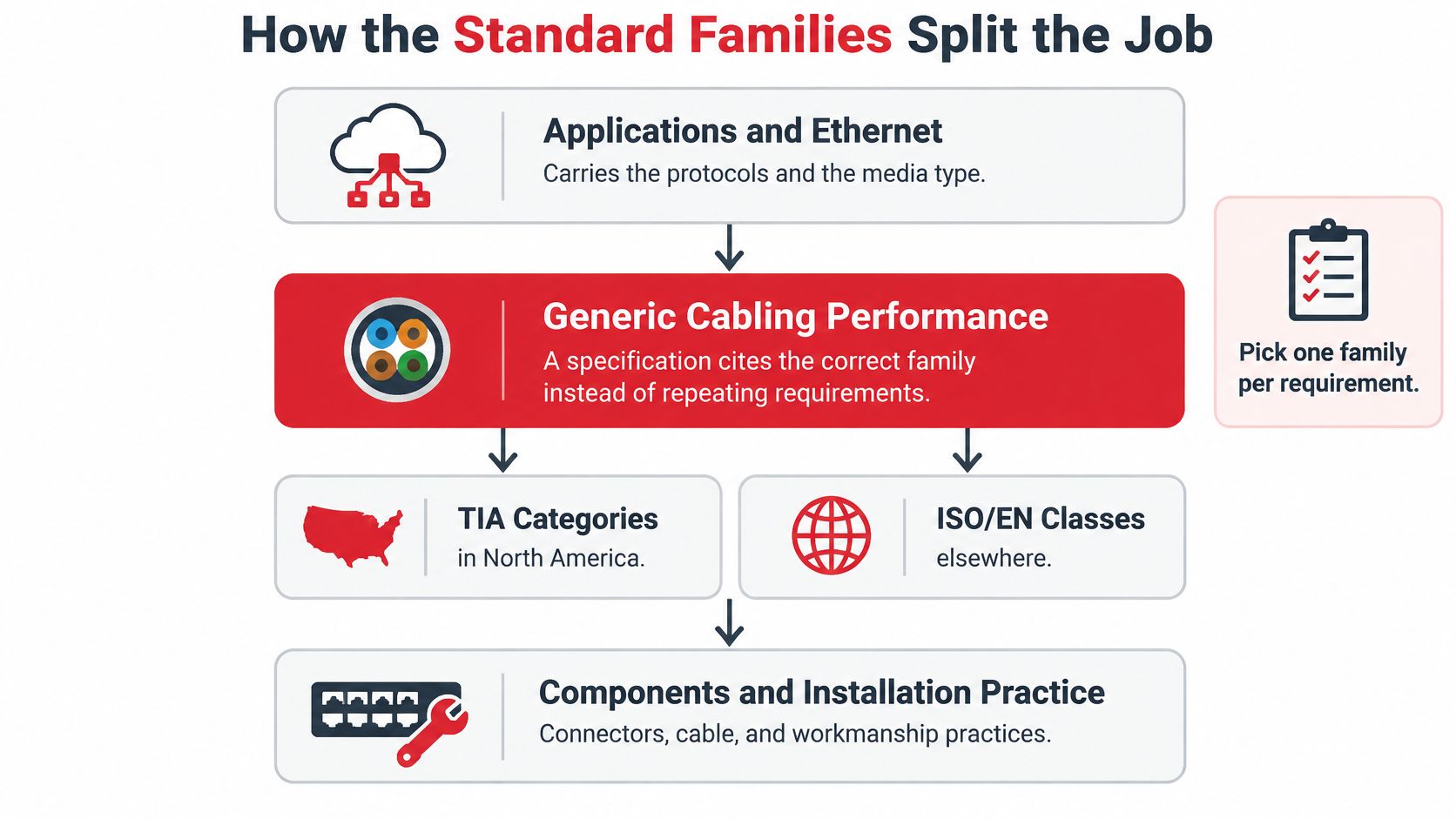
At the top sits the application. IEEE 802.3 selects the PHY, whether that's 1000BASE-T, 10GBASE-T, 25 or 40GBASE-T, a multimode or single-mode optic, or a Power over Ethernet type, and it dictates the media and the reach. The application never gets to redefine the channel underneath it. In the middle sits generic cabling performance, expressed as TIA categories in North America and ISO or EN classes elsewhere, both aimed at balanced copper and optical fiber that outlive any single protocol. At the bottom sits components and installation practice, where connectors, cable, and workmanship decide whether the rated performance survives contact with a real building.
The Wrong Category Can Still Be Compliant
A standards-compliant Category 6A channel can be the wrong choice. If the PHY needs single-mode reach, or the pathway can't hold the bundle at its bend radius, or the cord length in the rack eats the margin, the plant passes its test and still fails the job. Compliance and suitability are two separate questions, and a design review should ask both out loud.
BICSI's TDMM and ITSIMM are method manuals, not a fourth performance standard. They tell crews how to design and install to the documents above, and I keep them on the drawing set for exactly that reason, never as the citation for a channel limit.
For a campus refresh, split one drawing set into five owners: the cable schedule on 568 or 11801, the pathway drawings on 569, the label legend on 606, the grounding riser on 607, and 802.3 in the equipment matrix only. Each owner signs one page, and the arguments stop being about whose standard wins.
European projects need one extra step. Follow the national implementation of EN 50173 rather than pasting TIA category names into the spec, and if a TIA category appears at all, give it a declared class equivalent so the contractor isn't guessing which limit applies at acceptance.
Copper Categories and Compliant Lengths
If a copper run is going to pass, the numbers come first. ANSI/TIA balanced copper uses a 100-ohm channel limited to 100 meters for Categories 5e, 6, and 6A, normally built as up to 90 meters of permanent link plus the equipment and patch cords at each end. Every category below is a variation on that one channel budget.
| Category | Specified bandwidth | Maximum channel | Plan it for |
|---|---|---|---|
| 5e | 100 MHz | 100 m | Legacy 1000BASE-T; avoid as a new horizontal default |
| 6 | 250 MHz | 100 m | 1 Gbps across the full channel; not a full-channel 10GBASE-T design |
| 6A | 500 MHz | 100 m | 10GBASE-T for the full channel, including access-point uplinks |
| 8 | 2000 MHz | 30 m | 25GBASE-T and 40GBASE-T inside the data center |
Category 5e is specified to 100 MHz. It's the legacy floor for 1000BASE-T and it has no business as the default for a new horizontal run where 2.5, 5, or 10 gigabit, or a multi-radio access point, is on the roadmap.
Category 6 is specified to 250 MHz and carries 1 gigabit across the full channel. It doesn't carry 10GBASE-T across the full channel, so a drawing that says Category 6 everywhere and 10GBASE-T at every outlet has a latent failure written into it.
Category 6A is specified to 500 MHz and is the category that holds 10GBASE-T for the whole 100-meter channel, which is why it's the usual horizontal choice for Wi-Fi uplinks and 10-gigabit workstations. Category 8 is specified to 2000 MHz with a 30-meter channel for 25GBASE-T and 40GBASE-T inside the data hall. Nobody should pull Category 8 down a campus corridor.
Alien Crosstalk, Bundle Heat, and PoE
The length limit doesn't rise when you add power. Push many four-pair cables onto one tray carrying PoE and alien crosstalk between adjacent cables, plus the heat from bundled conductors, starts costing margin on the same 100 meters. The fix is design work: reduce cables per bundle, spread the load across trays, reconsider the category, or plan the power budget properly before anyone orders hardware, which is the same discipline as sizing a PoE switch budget against real port draw rather than a nameplate figure.
Practical rule: a tester pass means nothing if the tester was set to the wrong category limit. Match the test setup to the category on the schedule, then record the limit alongside the result.
Anything past these lengths leaves this table entirely. An over-length copper channel is a noncompliance decision with its own alternatives, not a Category 6A run that happens to be longer than the drawing says.
Fiber Classes Permanent Links and Channels
The ISO/IEC 11801 framework is the cleanest worked example of generic cabling, and it earns its place as the international reference because it treats the plant as a system rather than a parts list. It covers 100-ohm balanced copper and optical fiber. Its architecture is application-independent, so one cabling plant can carry data communications, telephony, building controls, and industrial automation. Design to that idea and you stop rebuilding the backbone for every new service.
The class names the glass. Acceptance is the tested permanent link or the tested channel, and that record has to stay valid after the next cord change, not only on the day the crew leaves.
Name the Object You're Certifying
The standard distinguishes a permanent link, the installed fixed cabling between distribution points, from a channel, which adds patch cords and equipment cords at both ends. That distinction is the whole acceptance conversation. Channel performance includes cord-related insertion loss, return loss, and, on copper, crosstalk contributions, so a passing permanent link and a passing channel are two different results from two different setups.
Decide before installation which one is being certified and who can physically access both ends to run it. A contractor who can only reach the patch panel and the outlet cannot certify a channel. A tester set to channel limits on a permanent-link job produces a number nobody can defend.
Polarity, Bend Radius, and Mated Pairs
Most fiber failures I would attribute to installation practice rather than to the glass: dirty end faces, mixed polarity conventions between panels and cassettes, bends tighter than the cable's rating behind a tray or in a cabinet, and too many mated pairs between the switch and the outlet. Each one turns individually compliant components into a noncompliant channel after the fact. A working light does not make that channel compliant.
Specify the complete end-to-end topology, including outlets, patch panels, cross-connects, consolidation points, and cords. Buying connectors and cable in isolation, then hoping the crew assembles a system, leaves the test limits with nothing to attach to.
| Class | Construction | Planning example | Use when |
|---|---|---|---|
| OM3 | 50 µm laser-optimized multimode | About 300 m for 10GBASE-SR | Existing multimode plant and short 10G links |
| OM4 | 50 µm laser-optimized multimode | About 400 m for 10GBASE-SR | New enterprise and data-center multimode |
| OM5 | 50 µm wideband multimode | OM4-class reach plus SWDM | Short-reach wavelength multiplexing is required |
| OS1a | Single-mode indoor premises | Building backbone distances | Indoor single-mode only, not outside plant |
| OS2 | Single-mode | About 10 km for 10GBASE-LR | Campus, PON, outdoor, and data-center interconnect |
Project documentation should identify the applicable ISO class or TIA category, the link type, connector polarity, fiber class, bend-radius requirements, labeling scheme, and test limits before a single cable is pulled. Document the applicable standard edition and test the installed cabling to the cited performance limits for the selected media and link type, so a later amendment is not folded into the acceptance criteria.
Crosswalk Between TIA ISO and EN
Three equivalences are safe to quote. Category 5e lines up with Class D, Category 6 with Class E, and Category 6A with Class EA. Those pairs describe the same performance envelope under different naming systems, and writing both names on one line is a courtesy to a contractor bidding a dual-standard job, not a contradiction.
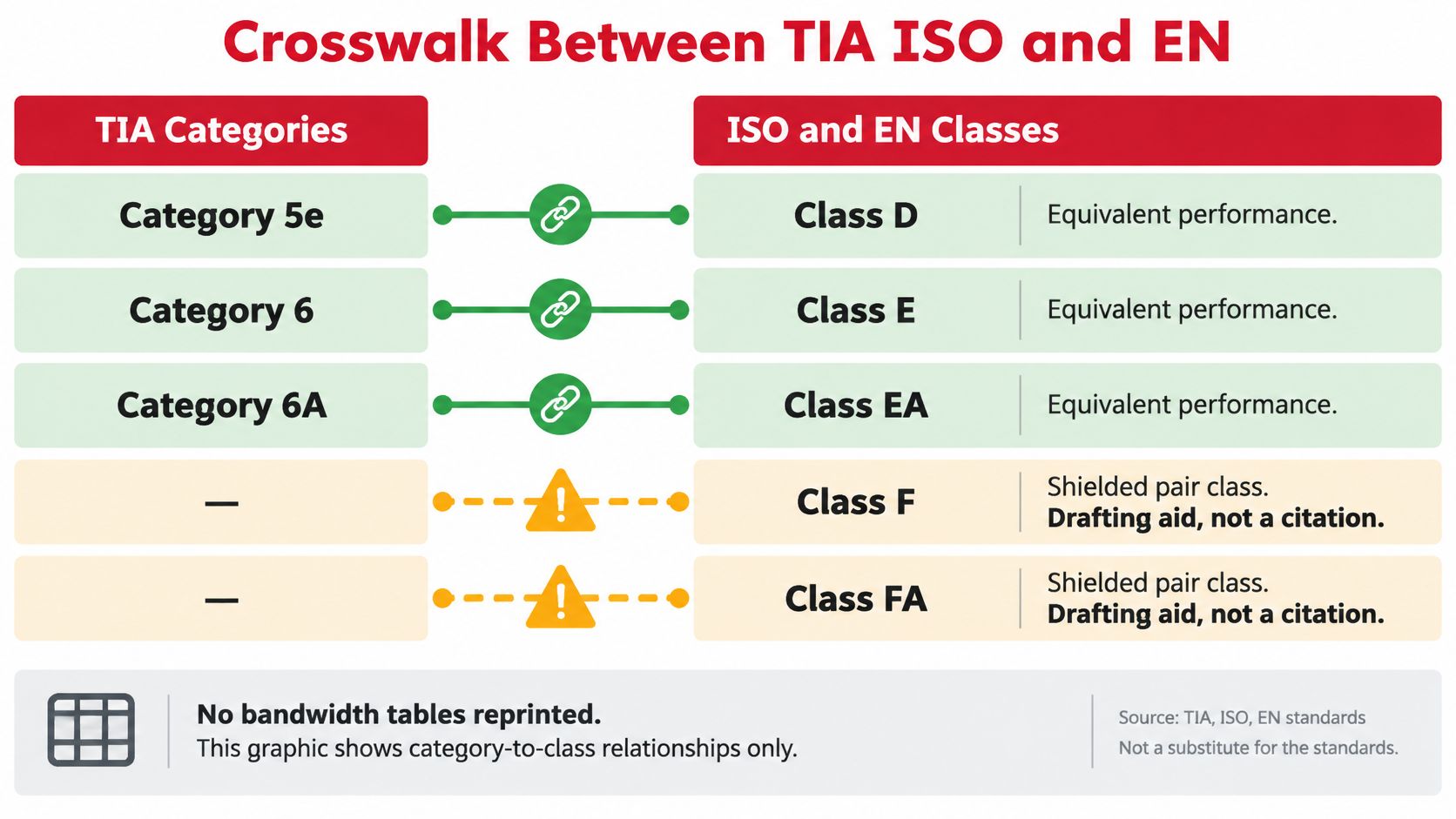
Class F and Class FA, which correspond to Category 7 and Category 7A, are ISO and EN shielded constructions, typically built around non-RJ45 interfaces. They are not TIA categories, so a North American RJ45 plant shouldn't be specified as Category 7 to sound superior to Category 6A. It sounds like a specification written by someone who wanted a bigger number.
Category 8 Has No One-Word Twin
Category 8 is the TIA data-center copper class, and there's no single ISO class you can swap in by name. The mapping in the cited edition decides what it's called, so quote the edition when you make the equivalence. Guessing produces a spec that two bidders interpret two ways.
The mismatches that generate failed tests are predictable:
- Two names for one link. Writing Category 6 and Class EA for the same horizontal run, which invites one bidder to price the cheaper interpretation.
- Mixed limits in the tester. Building a test setup with TIA permanent-link limits and ISO channel limits in the same job file.
- Connector and media drift. Specifying OM4 cable and then borrowing OS2 connector and polish requirements from a single-mode detail.
- Polarity left to the field. Leaving method B or method A as a crew choice, then discovering the mismatch three panels later.
- Untestable scope. Requiring a channel certification when the contractor only has access to the permanent link.
One sentence that survives a dual-standard job: horizontal cabling shall be Category 6A / Class EA, permanent link tested to the cited edition, labeled to TIA-606, with the edition year written into the specification.
Write the year. An unnumbered citation invites whichever amendment is current on the day of acceptance, and that's how two identical buildings end up with two different pass criteria.
Copper Channels Longer Than 100 Meters
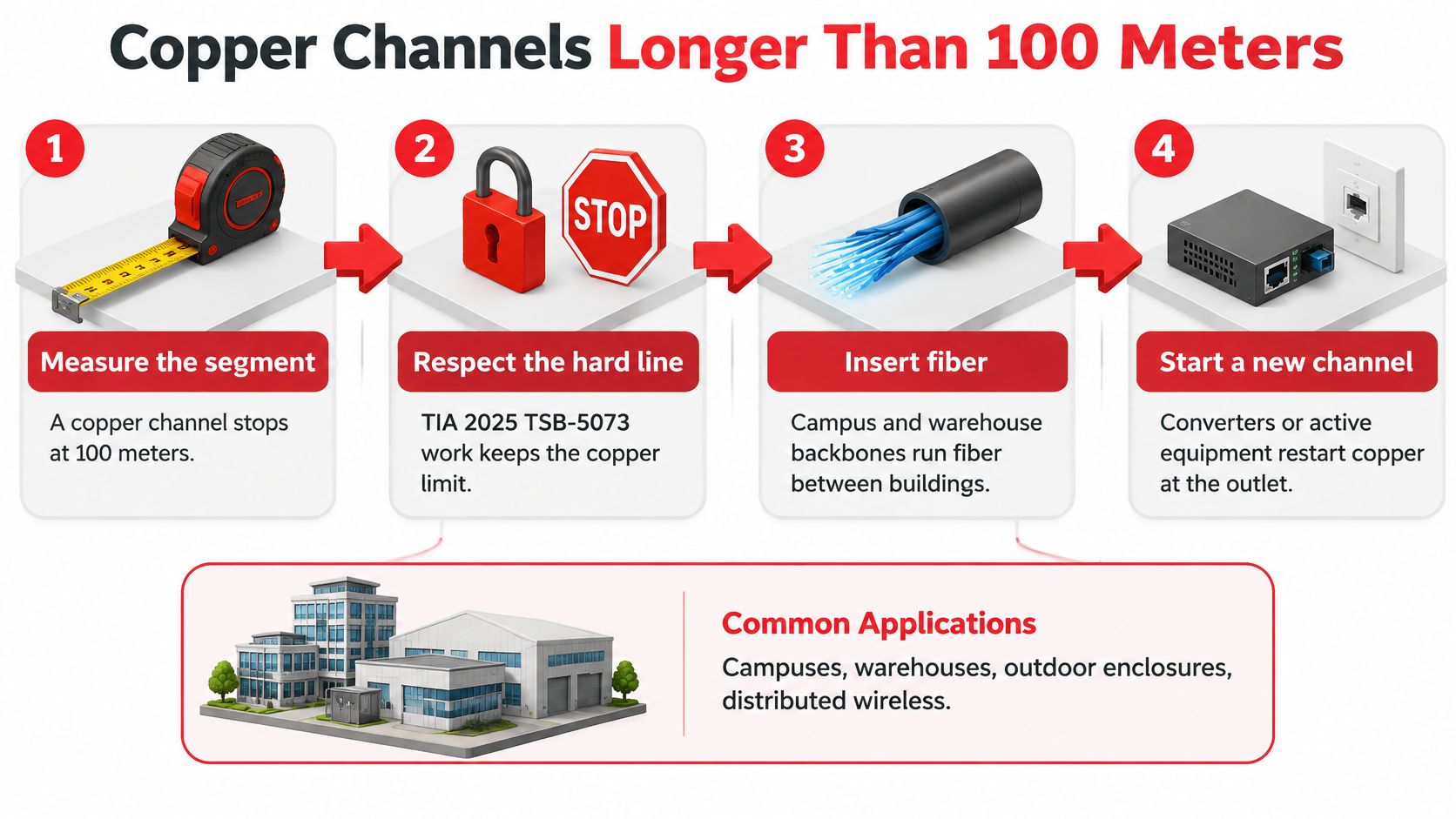
A copper channel past the 100-meter maximum is noncompliant. Passing traffic does not rewrite that result. I treat a lit camera, sensor, or access point as proof of electrical function only, not as a standards pass. Campuses, warehouses, outdoor enclosures, and distributed wireless systems cross the line whenever the outlet sits farther from the distributor than the horizontal rules allow. Record the run as an exception with a chosen remedy. Do not file a long Category 6A home run as standards-based because nobody opened a ticket.
Four Alternatives in the Order to Try Them
Add an intermediate telecommunications room. Bring each copper channel back to 100 meters or less by giving the far zone its own distributor. You spend floor space and a closet build. You keep the horizontal plant inside the length the document allows, which is the fix a campus or warehouse usually needs.
Convert the long segment to fiber. Use multimode where the optical budget fits, and OS2 where it does not. Move the media converter or the switch to the edge. The distance problem then has published optical limits instead of an over-length copper gamble.
Use a powered extender or other active device. This can carry the service, and it changes what you own. The path is no longer a passive standards channel. Plan power at the far end, name the failure mode the owner accepts, and stock spares on site. Put that in the design narrative, not only in the bill of materials.
Read the application limits before you pick media. The protocol you will run has its own distance and attenuation limits on copper and on fiber. Use the applicable TIA application guidance for that protocol, then choose media from the channel budget. A generic Category 6 versus fiber argument skips the number that decides the job.
The Traps Are Cameras, Sensors, and Access Points
Low-bandwidth devices hide noncompliant lengths. A camera running well below the channel rating does not stress the pair, so the run looks fine until the next radio upgrade or a sensor refresh adds throughput nobody sized. Large floors concentrate the problem: distributed wireless, perimeter cameras, and building systems spread across a warehouse.
Keep three records on every affected run: the calculated length, the alternative you chose, and a note that no over-length copper channel is labeled compliant. Outdoor enclosure and outside-plant segments also answer to ANSI/TIA-758. Check that document with the channel rules, before the trench is closed.
Data Center Rules for AI and Lifecycle
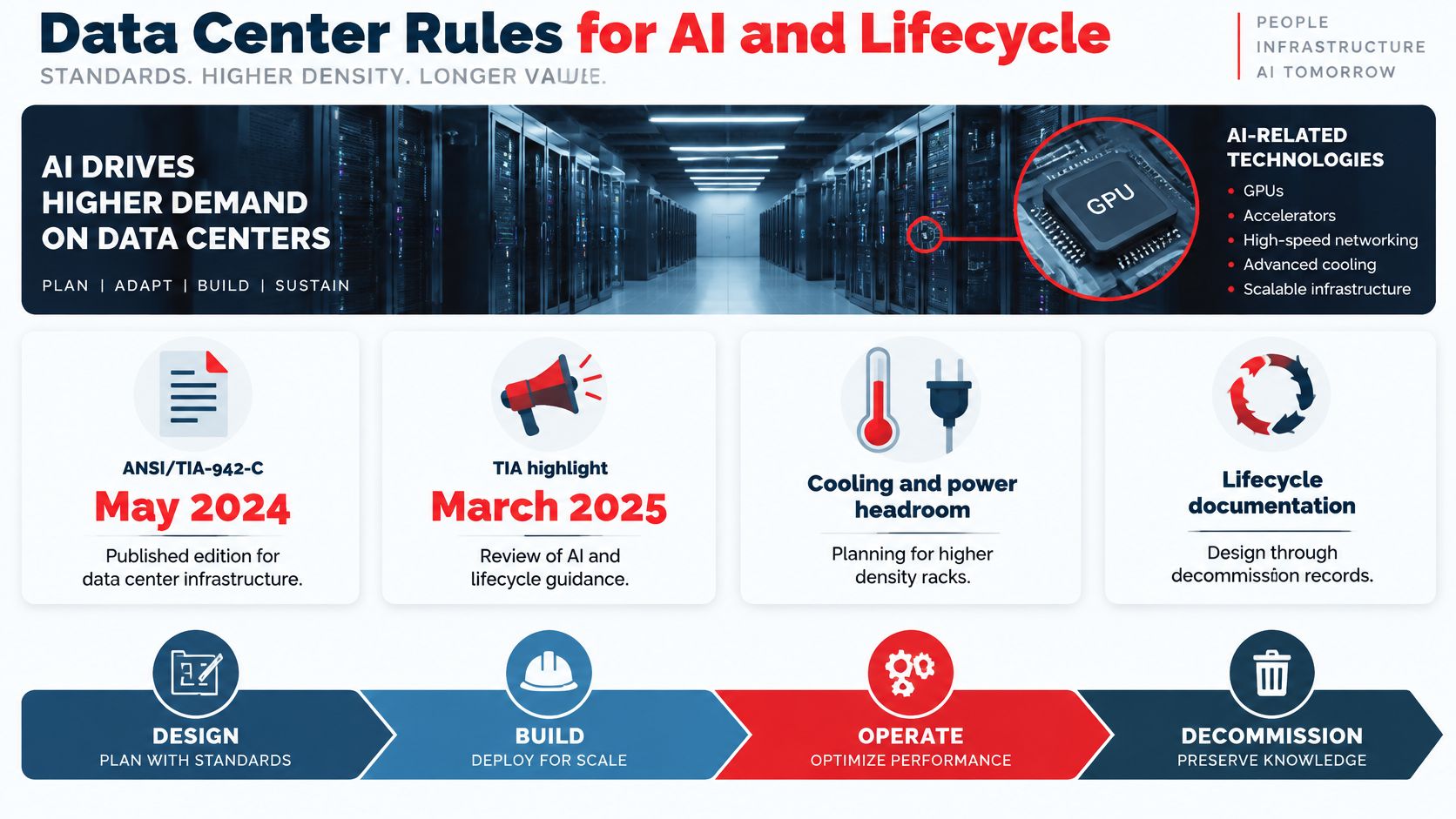
Office horizontals and data hall infrastructure answer to different documents, and the hall has moved. ANSI/TIA-942-C, published in May 2024 and highlighted by TIA in March 2025, adds requirements and recommendations covering AI-related technologies, sustainability, edge data centers, new cable media and connectivity, floor loading, and minimum cabinet width. TIA reported approximately 100 facilities certified to that revision as of March 2025, inside a program of more than 600 facilities certified under TIA-942 overall, per the TIA certification announcement. Treat certification as evidence of a designed topology. It isn't a substitute for a project specification.
Turning the Revision Into Purchases
An owner can buy the revision in specific line items. Cabinet width sized for high-count fiber and future cords, not today's jumpers. Pathway volume that anticipates cable counts before the first tray is hung. Floor loading that includes loaded tray, not just cabinets. Power and cooling coordinated with cabling, so containment and busway don't block the rated bend radius of a bundle. And a media plan that leans single-mode, or the supported multimode class, wherever AI clusters are likely to outgrow short copper.
Dense racks make the documentation problem worse before they make it better, which is why organizing dense rack cabling belongs in the build plan rather than in a cleanup ticket after commissioning.
Current Rules Versus the Coming Quality Standard
Separate what's adopted from what's announced. TIA's data-center quality standard initiative is expected to produce a public-review draft in 2026, with emphasis on infrastructure quality, reliability, sustainability, and lifecycle management. That draft isn't an adopted standard yet, so specify the lifecycle controls directly in the meantime: reserved pathway capacity, labeling and as-built data naming class, polarity, and test limits, acceptance tests of both permanent link and channel, and an upgrade path that doesn't assume empty tray.
A cheap horizontal decision at fit-out can block the next AI deployment by a factor of years. Cabinet width and pathway volume are the two cheapest things to over-provision and the most expensive to retrofit.
Lock the Specification Before You Build
Procurement will buy whatever the package names, and a category nickname is not a compliance decision. I treat the locked specification as the document that decides whether a finished link is a tested channel or only a cable that happens to pass traffic. Write the edition and the year: the TIA category, or the ISO or EN class, and add TIA-942-C when the space is a data center.
Do that on the drawing, link by link, before any pathway exists. Each link needs five fields: the standard, the class or category, the length, the media, and the test type. Permanent link and channel are different tests. Name which one applies, and name who can reach both ends to run it. Copper that will stay inside its category length can remain copper. A run that will not should be redrawn as fiber before the pathway is built, not patched later with a longer copper channel that still lights up and still fails the length rule.
Optical lines need the same discipline. Fiber class, connector polarity, bend radius, and mated-pair count belong on the sheet, not in a field note after the connectors are ordered. Put the pathway standard, the bonding standard, and the TIA-606 labeling scheme in the same package so labeling and test limits are not a separate argument at closeout. Set those limits in the specification and name who stores the results next to the as-builts. A drawing with those fields is the specification. A cable category and an arrow is a shopping list, and a working link can still be noncompliant against it.
Southern Tier Resources provides engineering, design, construction, and maintenance for wireline and wireless communications, from design through deployment and maintenance, which is the sequence these specifications have to survive. If your team needs the plant documented against a named edition, with the fiber splicing, testing, and as-built records to match, contact Southern Tier Resources and bring the drawing set.