Think of fiber optics contractors as the master builders of our digital world. They're the specialized crews who handle the entire lifecycle of a fiber network—from drawing up the initial blueprints and clearing the path for installation to the incredibly precise work of fusing strands of glass thinner than a human hair.
Getting this choice right is absolutely critical. Your network's performance and reliability depend on it.
Why Your Choice of Fiber Optics Contractor Matters
Your fiber optic network isn't just cable in the ground; it's the bedrock of your connectivity. For the project managers and network engineers overseeing these deployments, the stakes couldn't be higher. A poorly chosen contractor can lead to budget-busting overruns, missed deadlines, and even catastrophic network failures down the road.
It's easy to forget that a single bad splice or one piece of sloppy documentation can create a performance bottleneck that will frustrate your team and your customers for years to come.
This guide isn't about generic, high-level advice. It’s a practical framework for finding a partner who can turn a complex design on paper into a rock-solid, high-performance network in the real world. The best teams do far more than just lay cable; they see around corners, manage intricate logistics, and deliver an infrastructure that works perfectly from the moment it goes live.
Building a Foundation for Success
Hiring a fiber contractor is much more than just picking the lowest bid. It requires a thorough look at their technical skills, safety history, and proven capabilities. People often underestimate the long-term financial angle; detailed analysis shows how choosing the right contractor saves money by avoiding costly rework and future problems, a principle that holds true across any specialized construction field.
To get you started, we'll focus on three key areas to help you make a smart, informed decision:
- Core Services: What does a full-service contractor actually do? We'll break down everything from initial planning and make-ready engineering to final testing and ongoing maintenance.
- Evaluation Criteria: This is your essential checklist. We'll cover the non-negotiables like industry certifications, safety track records, and references you can actually verify.
- Risk Management: How do you protect your project? We’ll look at strategies for handling common deployment risks and maintaining quality control from start to finish.
By zeroing in on these elements, you can cut through the noise of the selection process. The goal is to find a true partner—an extension of your own team—who will build a reliable network designed to last and scale for whatever comes next. You're not just hiring a vendor; you're investing in your infrastructure's future.
Understanding Core Services from Planning to Splicing
So, what does a full-service fiber optics contractor actually do? Their work is a complete lifecycle, starting with a detailed plan long before a single foot of cable is ever unrolled. It all begins with careful planning and ends with a fully tested, documented, and high-performance network ready to go live.
A successful project hinges on your contractor's ability to manage every single stage with precision. Let's walk through the core services you should expect, following the natural path of a fiber deployment from a simple idea to a finished, working network.
This process highlights the journey from recognizing the high stakes of a fiber project to securing a trusted partner you can rely on for the long haul.
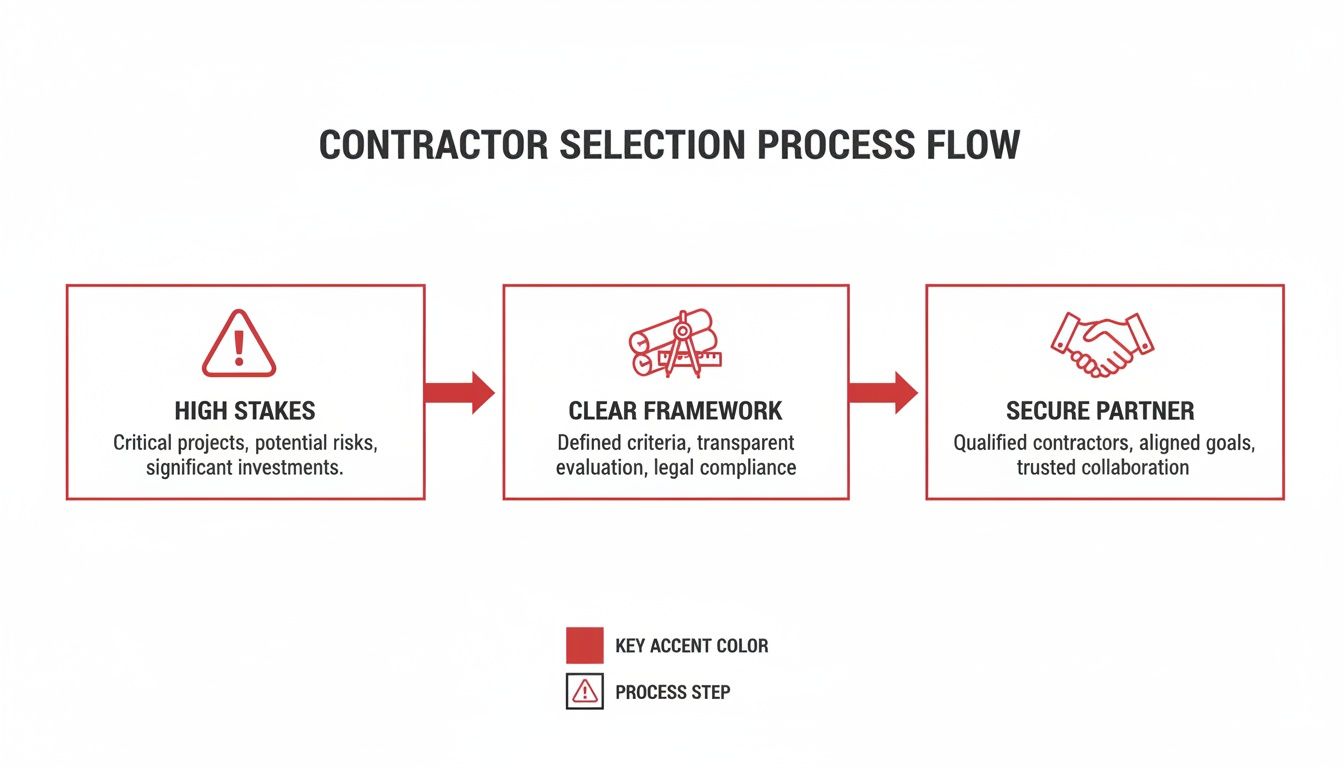
As you can see, a successful outcome isn't about luck. It's about having a clear framework for evaluation that bridges the initial risk with the final goal: a reliable infrastructure partner.
Phase 1: Route Planning and Engineering
Long before the first shovel hits the ground, the project’s success is already being determined in the engineering phase. This is where a contractor’s deep planning expertise truly shines. They’ll kick things off with feasibility studies to map out the most efficient and cost-effective path for your network.
This initial stage is all about the details:
- Route Design: This involves creating meticulous blueprints that consider everything—local geography, existing infrastructure, and right-of-way permissions.
- Permitting: Good contractors know how to navigate the complicated web of local, state, and even federal regulations to secure all the necessary approvals for construction.
- Make-Ready Engineering: For any aerial builds, this means getting utility poles ready for the new fiber cables. This could involve moving existing lines or making sure the poles can handle the extra weight and tension, a critical step that seasoned pros manage seamlessly.
Phase 2: Construction and Installation
Once the plan is locked in, the construction crews get to work. This is the most visible part of the project, where the digital blueprint becomes a physical reality. The methods they use will depend entirely on the environment, whether it's a crowded city center or a wide-open rural landscape.
For underground construction, you might see traditional trenching or, more often, directional boring, which minimizes disruption to the surrounding area. Beyond the fiber-specific work, the quality of the essential groundwork practices is what creates a durable, long-lasting infrastructure. For aerial installations, skilled crews are needed to string and secure the cables on utility poles safely and efficiently.
This work is part of a massive global push. The market for the fiber optic components that fuel these projects was valued at $34.2 billion in 2024 and is expected to hit $87.4 billion by 2034. This explosive growth is driven by huge investments in 5G and telecom infrastructure—a trend that directly benefits experienced partners like Southern Tier Resources who manage these large-scale builds for major carriers and ISPs.
Phase 3: Splicing and Termination
Here’s where the real precision comes into play. Think of fiber splicing as a kind of high-tech surgery. A technician has to align and fuse two strands of glass—each thinner than a human hair—with microscopic accuracy. The goal is to create a perfect, seamless connection for light to pass through without interruption.
A single bad splice can degrade the signal, creating a performance bottleneck that’s incredibly difficult and expensive to find and fix later on. This is why having experienced, certified splicing technicians is non-negotiable for any serious fiber project.
Termination is a closely related process where connectors are attached to the ends of the fiber cables. This is what allows the cables to plug into network equipment like switches and routers, finally completing the physical connection from one end of the network to the other.
Phase 4: Testing and Documentation
With the network physically built, the last phase is all about making sure it works as designed and is easy to maintain down the road. This means rigorous testing is an absolute must to verify the quality of the installation.
Two key testing methods are standard:
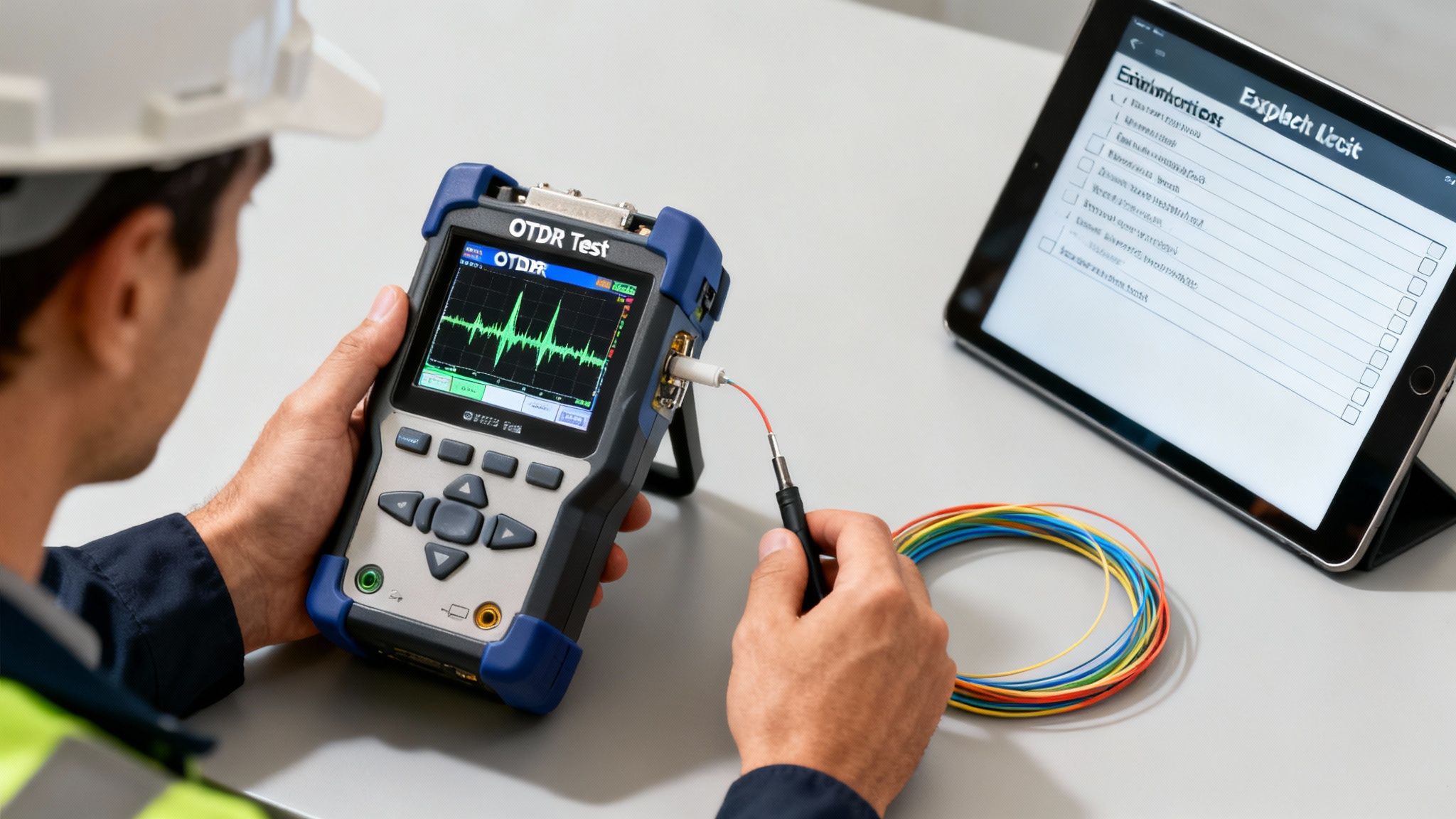
- OTDR Testing: An Optical Time-Domain Reflectometer (OTDR) is a device that sends pulses of light down the fiber to find any faults, like bad splices, sharp bends, or breaks. It essentially creates a "map" of the fiber line's health.
- Power Meter & Light Source Testing: This test measures the total amount of signal loss (or attenuation) across the entire cable link to confirm it meets the design specifications.
Finally, a great contractor provides meticulous as-built documentation. These are the final, updated blueprints showing exactly where every cable, splice enclosure, and connection point is located. This documentation is absolutely critical for future maintenance, troubleshooting, and upgrades. Without it, managing your network becomes a frustrating guessing game.
Your Contractor Vetting Checklist
Choosing the right fiber optics contractor isn't like hiring just any vendor; it's more like bringing on a long-term strategic partner. While cost is always part of the conversation, it should never be the deciding factor. A lowball bid from an underqualified team can quickly turn into a nightmare of costly rework, missed deadlines, and a network that constantly underperforms.
This checklist is designed to help you look past the price tag and conduct the kind of thorough due diligence that protects your investment. A solid vetting process is your best defense against project failure. It's about verifying claims, digging into past performance, and making sure a contractor’s culture of quality and safety aligns with your own.
Verifying Technical Expertise and Certifications
First things first: you need proof that they know what they’re doing. In the fiber optics world, that proof comes from recognized industry certifications. Think of these as the bare-minimum qualifications you’d expect from any skilled tradesperson, like an electrician or plumber.
You’re looking for teams whose technicians hold credentials from respected organizations like the Fiber Optic Association (FOA) or BICSI. These aren’t just pieces of paper; they represent a serious commitment to industry best practices and a deep understanding of the technical details that make or break a network.
- Fiber Optic Association (FOA): A CFOT (Certified Fiber Optic Technician) certification is the global gold standard. It confirms a technician has the foundational skills for proper splicing, termination, and testing.
- BICSI: This organization focuses on the bigger picture of information and communications technology (ICT). A BICSI-certified team understands how your fiber network fits into your overall infrastructure, which is critical for complex builds.
A contractor who invests in certifying their team is a contractor who invests in quality. It’s a clear sign they take their craft seriously.
Prioritizing a Proven Safety Program
Safety is non-negotiable. Period. Fiber construction is full of risks, from working near high-voltage lines on aerial builds to managing heavy machinery for underground trenching. A contractor with a weak safety culture isn’t just a risk—they’re a liability waiting to happen, exposing you to legal trouble, project shutdowns, and damage to your reputation.
A contractor’s safety record isn't just about checking a box. It’s a direct reflection of their discipline, professionalism, and attention to detail. A team that cuts corners on safety will absolutely cut corners on the quality of their work.
Ask for their Experience Modification Rate (EMR). It's a standard insurance metric that scores a company's safety history against the industry average. An EMR below 1.0 means they're safer than most, while a number well above 1.0 is a massive red flag.
Checking References and Past Performance
Whatever you do, don't skip the reference check. This is your single best opportunity to get an unfiltered look at how a contractor performs in the real world. Go beyond generic questions and dig into the specifics.
Get ready with a few targeted questions that reveal how they really operate:
- Communication: How responsive was the project manager? Did you get regular, clear updates?
- Problem-Solving: Tell me about a time something went wrong. How did the contractor handle it?
- Timeliness: Did they hit their deadlines? If not, how did they communicate and manage the delays?
- Documentation: Was the final as-built documentation accurate and delivered on time?
Understanding Service Level Agreements
Finally, if you're looking for a long-term maintenance or emergency response partner, the Service Level Agreement (SLA) is everything. An SLA turns vague promises into a binding contract that defines exactly what you can expect, including guaranteed response times for network outages.
This document is your assurance that when something inevitably goes wrong, your contractor is contractually obligated to fix it within a specific timeframe. It's what protects your operations when you need it most.
To help you organize your evaluation, we’ve put together a simple checklist. Use this table to compare potential partners side-by-side and ensure you’re making a well-rounded decision, not just one based on price.
Key Criteria for Evaluating Fiber Optics Contractors
| Evaluation Category | What to Look For | Why It Matters |
|---|---|---|
| Technical Expertise | FOA, BICSI, or other relevant certifications for technicians and project leads. | Certifications validate that the team follows industry best practices for splicing, testing, and installation, reducing the risk of errors. |
| Safety Record | An Experience Modification Rate (EMR) below 1.0. A documented and actively managed safety program. | A strong safety culture protects your project from costly delays, legal liabilities, and reputational damage. It often indicates higher-quality work. |
| Relevant Experience | A portfolio of completed projects similar in scope, scale, and complexity to your own. | Experience with similar projects means the contractor has likely already solved the challenges you will face, leading to a smoother process. |
| Client References | Direct conversations with 2-3 recent clients. Ask specific questions about communication, problem-solving, and timeline adherence. | References provide an unfiltered view of the contractor's real-world performance, reliability, and professionalism under pressure. |
| Financial Stability | Willingness to provide financial statements or be bonded for the project. | Ensures the contractor has the resources to complete the project without financial distress and can cover potential liabilities. |
| SLAs & Support | Clear, measurable Service Level Agreements for maintenance and emergency response times. | An SLA provides a contractual guarantee for network uptime and repair, protecting your operational continuity. |
Ultimately, taking the time to thoroughly vet your options on the front end will save you from enormous headaches down the road. The right partner won't just build your network; they'll help ensure it performs reliably for years to come.
Decoding Project Costs and Timelines

If you're managing a fiber deployment, getting a handle on the costs and timeline is paramount. No two fiber builds are the same, and knowing what drives the numbers helps you read a quote intelligently and have a real conversation with potential fiber optics contractors.
Think of it like building a custom home. The final price isn't just about square footage. It’s about the foundation, the materials you choose, the complexity of the blueprints, and the piece of land you're building on. A fiber network's cost is a similar mix of factors, and a seasoned contractor knows how to read the terrain and forecast accurately.
The Four Pillars of Project Cost
At the end of the day, a fiber installation budget really boils down to four main components. Each of these can swing wildly depending on your project's specifics and what's happening in the market.
- Labor: This is almost always the biggest chunk of the budget. It covers everyone from the engineers and project managers to the equipment operators and, critically, the highly skilled technicians doing the actual splicing and testing.
- Materials: Of course, the fiber optic cable itself is a major cost. But you also have to account for all the conduits, splice enclosures, connectors, and mounting hardware that go with it.
- Equipment: The specialized gear needed for this work—directional drills, bucket trucks, fusion splicers—is expensive to own, maintain, and operate. Those costs get baked into any project quote.
- Permitting & Fees: Getting the right-of-way and navigating local rules always costs money. These fees can be night-and-day different from one town to the next.
Getting a grip on these four pillars is your starting point. The real art is in understanding how the unique details of your project will make those costs rise or fall. A good contractor will give you a transparent breakdown, so you know exactly where every dollar is going.
How Project Variables Influence Budget and Schedule
Beyond those core costs, a number of dynamic factors can throw a wrench into your schedule and budget. An experienced team sees these coming and builds contingencies into the plan from day one, so you don't get hit with sticker shock down the road.
One major influence is the massive global demand for high-speed internet. The fiber optics market is expected to hit USD 24.1 billion by 2035, growing at a 9.5% CAGR, all thanks to huge investments in 5G and data centers. This boom affects everything from material costs to the availability of skilled labor. You can dive deeper into the fiber optics market forecast to see how these global trends ripple down to local projects.
The physical environment of your build is another game-changer.
- Terrain and Geology: Trying to build in a dense urban area with rocky soil is a completely different (and more expensive) challenge than laying cable across a flat, open field.
- Installation Method: Underground horizontal directional drilling (HDD) is great for minimizing disruption, but it typically costs more per foot than stringing aerial cable on existing utility poles.
- Project Scope: The sheer size of the job—how many miles of cable, how many splice points, the fiber count required—has a direct line to both material and labor costs.
- Local Regulations: Some municipalities have incredibly complex permitting processes or strict restoration rules that can add significant time and money to a project.
Ultimately, a detailed and accurate quote is a reflection of a contractor's deep understanding of all these moving parts. The best fiber optics contractors don't just throw a number at you; they walk you through a clear, well-reasoned forecast that accounts for the specific challenges and opportunities of your deployment.
How to Mitigate Risk and Ensure Quality Control
In a fiber optics project, quality control isn’t something you just check off at the end. It has to be woven into every single step. A single damaged cable, one bad splice, or a piece of lazy documentation can create performance headaches that are incredibly difficult and expensive to hunt down later. True risk management is all about being proactive, not reactive. It starts with choosing a partner whose entire process is built to prevent problems from happening in the first place.
The most common risks we see are often small mistakes with massive consequences. A cable bent just a little too tightly can cause signal loss, while a microscopic speck of dust on a connector can bring an entire circuit to its knees. The best fiber optics contractors know this. They follow a disciplined, systematic approach to quality from the moment materials show up on site to the second the final test results are signed off.
This obsession with quality is more important than ever. The market for fiber optic connectors alone is projected to explode from US$ 9.6 billion in 2026 to US$ 22.9 billion by 2033. This surge is fueled by massive demand from 5G rollouts and AI data centers, putting immense pressure on contractors to deliver perfect installations every time. You can read more about the drivers behind the fiber optic connector market growth.
Foundational Quality Assurance Processes
A contractor’s quality control program shouldn’t be a secret. It should be transparent and something you can actually verify. The process should kick off with rigorous inspections of all materials, making sure every spool of cable and every last connector meets spec before it gets anywhere near the field. This simple step keeps defective parts from ever causing a problem.
During the actual installation, these quality checks have to be constant. This means real-time supervision of trenching depths, conduit installation, and cable pulling tension to guarantee no undue stress is put on those delicate glass fibers. When it comes to fusion splicing, technicians must follow standardized procedures and keep their equipment spotless to achieve the lowest possible signal loss.
True quality is not an accident; it is the result of a contractor's deeply ingrained culture, well-defined processes, and an unwavering commitment to transparency and accountability throughout the project lifecycle.
The Role of Testing and Verification
Once the physical work is done, comprehensive testing is the ultimate proof of quality. This is where a contractor shows you that the network doesn't just "work"—it performs precisely to the design specifications. You should expect a detailed report with results from key industry-standard tests.
Think of these tests as the final quality gate:
- OTDR Testing: An Optical Time-Domain Reflectometer sends pulses of light down the fiber to create a detailed "map" of the line. It's fantastic for pinpointing the exact location and signal loss from splices, connectors, and any sharp bends or breaks.
- Power Meter Testing: This is a more straightforward test that measures the total light lost between two points. It confirms that the end-to-end signal strength is strong enough for reliable data transmission.
- End-Face Inspection: Here, technicians use powerful microscopes to inspect connector ends for microscopic dust, dirt, or scratches that can absolutely cripple network performance.
Communication as a Risk Management Tool
Finally, don't ever underestimate the power of clear and consistent communication. Having a dedicated point of contact who provides regular, detailed progress reports is one of the most effective risk management tools you have. This transparency lets you spot potential issues early and work together on solutions before they blow up the project timeline or budget.
An open line of communication keeps everyone aligned, from your internal engineering team to the contractor's crew in the field. This shared understanding is the bedrock for navigating the complexities of a fiber build and delivering a high-quality network that meets every single one of your requirements.
Finding a True End-to-End Infrastructure Partner
So far, we've walked through the specific services, selection criteria, and hidden risks of a fiber optic deployment. Now it's time to put all those pieces together and look at what a genuine infrastructure partner really brings to the table.
This is about more than just hiring a vendor for a task. It's about finding a single, accountable ally who can steer your project from the first napkin sketch all the way through to long-term maintenance.
This end-to-end model is more than a convenience—it’s a game-changer. When one team handles the engineering, route planning, construction, splicing, and final testing, you eliminate the friction and finger-pointing that can derail complex projects. You get one point of contact, one team responsible for the outcome, and a smooth handoff from one phase to the next.
Frankly, this integrated approach is the most direct path to getting a project done on time, on budget, and to the quality standards you expect.
The Value of a Single Point of Accountability
Picture this common scenario: an engineering firm designs a route, a separate construction crew builds it, and a third company comes in to splice and test the fiber. A problem pops up during testing. Who’s at fault?
The engineers might blame the construction crew for not following the plans. The construction crew could point to a flaw in the original design. This is a costly and frustrating cycle, and an end-to-end partner is your best defense against it.
When all that expertise is under one roof, the responsibility is crystal clear. The same people who designed the network are on the hook for making sure it’s built right and performs flawlessly. This creates a powerful sense of ownership that directly results in a more reliable network for you.
An end-to-end service model isn't just about making your life easier; it's a strategic move that fundamentally de-risks your entire project. It guarantees every decision is made with the final goal in mind, creating a cohesive and well-documented asset.
A partner with this holistic view can spot potential roadblocks that a specialized, single-service vendor might completely miss. They know exactly how a decision made during the permitting phase will affect the splicing crew six months down the line. That kind of foresight is invaluable for smart planning and avoiding nasty surprises.
Hallmarks of a Strategic Partner
Beyond just offering a full menu of services, a true strategic partner embodies a few non-negotiable qualities. These are the tell-tale signs that separate the professional fiber optics contractors from the pack.
- Proven Track Record with Major Carriers: If a contractor has experience building large-scale networks for major telecom providers, that speaks volumes. Those projects are run under a microscope with incredibly high standards, proving the contractor can handle pressure and complexity.
- A Safety-First Culture: As we've covered, safety is a direct reflection of a company’s discipline. Don't just look for a good EMR score; look for a partner who actively promotes a culture where safety is everyone’s job, from the top brass to the crew in the trench.
- Meticulous As-Built Documentation: A great partner doesn't just build your network and walk away. They deliver a complete, accurate "owner's manual" for it. Perfect as-built documentation shows a deep respect for your long-term operational needs.
More Than a Vendor—An Ally in Your Success
Ultimately, you’re looking for a team that feels like an extension of your own. They should communicate clearly, tackle problems head-on, and be just as committed as you are to building a best-in-class network. That collaborative spirit is what turns a project into a lasting partnership.
At Southern Tier Resources, we’ve built our entire business around this end-to-end philosophy. By integrating every piece of the fiber and wireless puzzle, we give our clients the single point of accountability they need to tackle even the most demanding builds. The right partner doesn’t just check a box; they invest in your long-term success, ensuring your network is a solid foundation for whatever comes next.
Common Questions About Finding the Right Fiber Optics Partner
When you're ready to hire a fiber optics contractor, a few key questions always come up. Getting straight, practical answers is the best way to make a good decision and set your project up for success. Let's walk through some of the most common ones to give you the confidence you need.
Think of this as a quick-reference guide that builds on everything we've covered, zeroing in on the details that matter most.
How Can I Tell if a Contractor Really Has the Right Experience?
This is a big one. True experience isn't just about how long a company has been around—it's about relevant, hands-on work. The best way to gauge this is to ask for a portfolio of projects that mirror yours in size, setting, and technical difficulty. A contractor who’s an expert at building a 50-mile rural Fiber-to-the-Home (FTTH) network has a very different set of skills than one who primarily outfits dense, urban data centers.
To dig deeper, look for specific proof points:
- Similar Ground: Have they worked in environments like yours, whether it's a bustling city, a spread-out suburb, or a challenging rural area?
- Matching Scale: Can they point to past projects with similar mileage, fiber counts, or the number of splices required?
- Technical Hurdles: Have they navigated the exact challenges your project faces, like complex aerial make-ready or horizontal directional drilling?
A truly seasoned partner won’t just show you a list of past jobs; they’ll be able to walk you through the specific problems they solved along the way.
What’s the Real Difference Between a Contractor and a Subcontractor?
The company you hire directly is the primary fiber optics contractor. They’re on the hook for the entire project, from the first engineering drawing and permit application to the final tests. They are your single point of contact and accountability.
A subcontractor is a specialist hired by your primary contractor to handle a specific piece of the job, like directional boring or fusion splicing. It's perfectly normal and often efficient for even the best contractors to bring in trusted subs for specialized tasks. The critical difference is this: your primary contractor is 100% responsible for vetting, managing, and guaranteeing the quality of any subcontractor's work. Your agreement is with the main contractor, and they own the result.
The key distinction is accountability. A great primary contractor takes full ownership of every part of the project, including the work of anyone they hire. This shields you from the headache of managing multiple vendors and ensures a single, unified standard of quality.
How Long Does a Fiber Installation Project Actually Take?
It’s the million-dollar question, and the honest answer is: it depends. A simple fiber link for a single business might be done in a few weeks. A large-scale municipal broadband network, on the other hand, could be a multi-year effort.
Several key factors drive the timeline:
- Permits and Paperwork: Securing approvals and right-of-way access from local authorities can be the longest pole in the tent, often taking anywhere from 30 to 180 days or even more.
- Scope of the Build: The total mileage, the number of properties being connected, and the overall complexity of the design are the biggest drivers of the construction schedule.
- Construction Method: Stringing aerial cable on existing poles is typically faster than the more labor-intensive process of underground construction.
- Mother Nature: Seasonal weather can throw a wrench in the works, especially for underground construction in places with harsh winters or heavy rain.
Any contractor worth their salt will give you a detailed project schedule that realistically accounts for all these variables and sets clear, achievable milestones.
At Southern Tier Resources, our goal is to bring this kind of clarity and expertise to every project. We manage the entire process under one roof, giving you a single, accountable partner from design to deployment. The result is high-performance infrastructure you can count on.
Ready to build your network with a team that has your back? Learn more about our comprehensive fiber optic services.