The alarm goes off before the coffee is finished. A tenant says the office is too hot, the breaker won't hold, and somebody needs to make a decision before the morning rush turns into a shutdown. In Florence, that's not a polite customer-service moment. It's a procurement decision with consequences, and the wrong vendor can waste the whole day.
Why Florence SC Buyers Care About Service Quality Right Now
A Monday outage in Florence doesn't stay local for long. A carrier rep is fielding calls, a facility manager is trying to keep tenants calm, and the maintenance team is already asking whether the problem is electrical, mechanical, or both. That's why service quality has become a buying criterion, not a courtesy, in the Pee Dee.
The risk is not just downtime. It's the vendor who shows up once, talks a good game, and then disappears when the second call comes in. In essential building systems work, buyers get burned when they choose based on a slick promise instead of a contractor's ability to keep dispatches moving, keep documentation straight, and keep crews accountable.
Quality Service Company has been operating in Florence since 2003, which gives it more than 20 years of local history in the region, and that kind of continuity matters in a market where buyers remember who answered the phone and who didn't Quality Service Company about us. A company that has stayed rooted at 2208 National Ave, Florence, SC 29501 has already passed a test that many short-lived service brands never do, operational persistence.
Practical rule: if a contractor's public footprint only talks about being “available,” but doesn't show local staying power, treat that as a warning sign.
The buyer's job is simple. Don't ask, “Do they do HVAC, plumbing, and electrical?” Ask, “Can they keep a regional service promise when the call comes in hot, the site is stressed, and the work has to be done right the first time?”
What Defines a Quality Service Company in Florence
A quality service company Florence SC buyers can trust is not just a name on a truck. It's a contractor with a real office, a real crew, and enough structure to absorb a bad day without falling apart. Quality Service Company's long-running base at 2208 National Ave and its 2003 start date are not cosmetic details, they show a fixed operational footprint and a history of accountability Quality Service Company about us.
Start with the structural signals
A serious contractor should be able to show more than a phone number and a website. You want licensed trades, insurance, and a dispatch model that can move people into the field. The company's public profiles also place it in the 10 to 50 employee range and list about 15 employees in one directory, which points to a small-to-mid-sized operation that can support multiple trades without looking like a one-person brokerage BBB profile, ZoomInfo profile.
That size matters because it tells you what kind of service model you're buying. A tiny shop can be nimble, but it often has thin redundancy. A big national outfit may have a call center, but the technician you need might be three dispatch layers away.
Look for client-facing assurance, not slogans
The contractor should be able to describe scope in writing, explain pricing before work starts, and name references from similar jobs. It should also be able to coordinate across trades. Quality Service Company's public materials show a multi-trade footprint in HVAC, plumbing, and electrical work, which is a meaningful sign because broader trade coverage usually requires more licensing, staffing, and dispatch discipline than a narrow specialty shop LinkedIn company profile.
If you want a useful benchmark for response handling, a service model should also be able to route inquiries without dragging its feet. For digital-first inquiry intake, a tool like 24/7 customer inquiry response is relevant because it illustrates the kind of always-on front door customers now expect, even when the actual field work still depends on local crews.
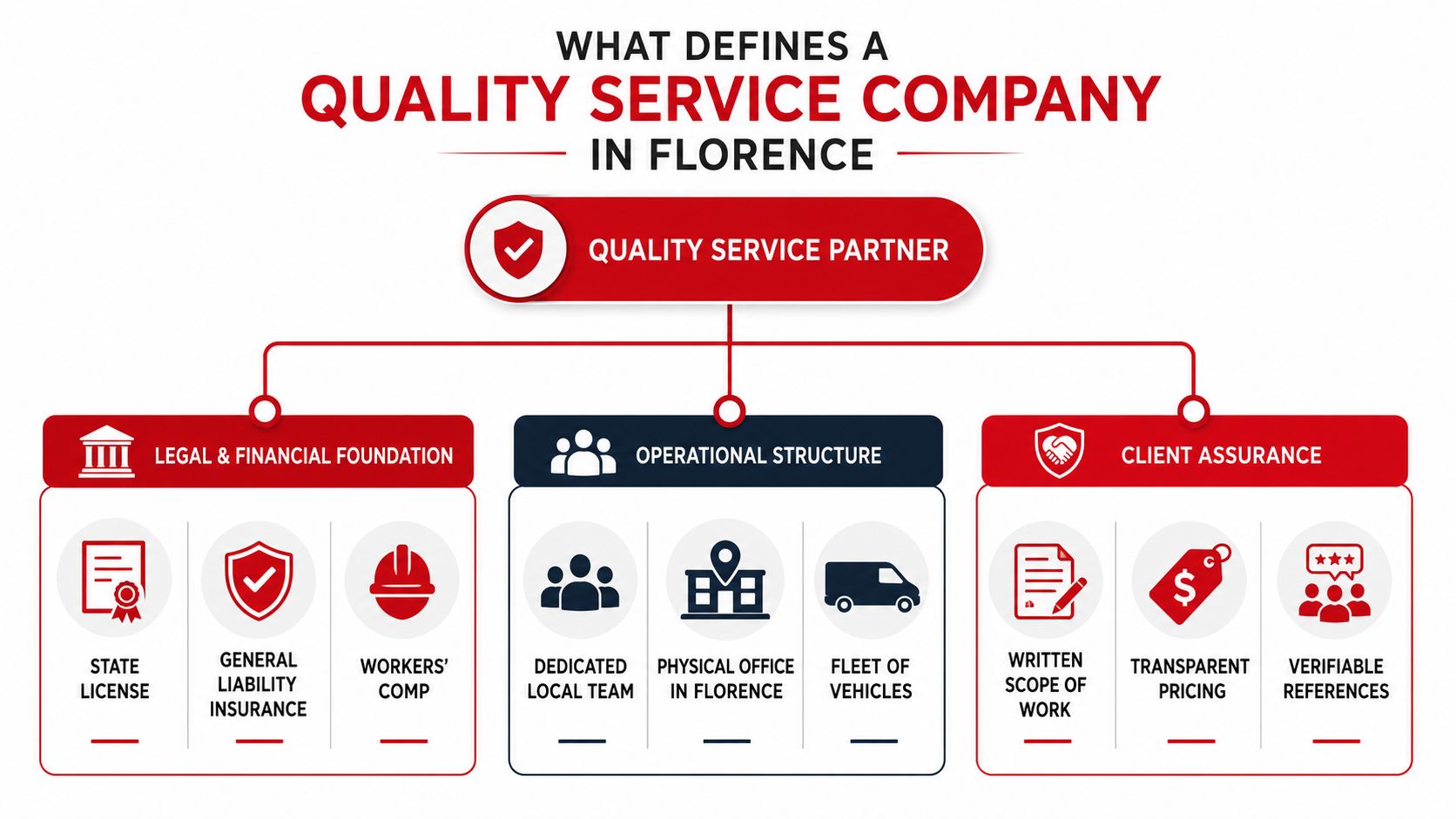
A clean test is this. If the contractor can't tell you who owns the work, where the office sits, how the crew is dispatched, and what paperwork you get at closeout, you're not looking at a quality service company. You're looking at marketing.
Core Service Lines You Should Expect
A real regional contractor doesn't stop at a single trade. In Florence, the work usually shows up in overlapping systems, and the buyer needs one company that can handle the handoff without making the site manager coordinate a three-way blame session.
HVAC, plumbing, and electrical should be connected in practice
HVAC service should cover diagnosis, repair, replacement planning, and the kind of field troubleshooting that gets a unit back online before the day turns ugly. Plumbing work should include leak isolation, fixture problems, line issues, and emergency repair where water intrusion is threatening operations. Electrical service should cover fault finding, panel issues, and corrective work that keeps the rest of the building from tripping over a preventable defect.
Quality Service Company publicly presents itself as a local HVAC, plumbing, and electrical contractor, and that multi-trade position is more than a label LinkedIn company profile. In a Pee Dee setting, a coordinated team can reduce change-order latency because the electrical issue and the mechanical issue get handled in one dispatch window instead of being bounced between separate subs.
Know what belongs in adjacent infrastructure work
Some buyers are really buying continuity, not just repair. That can include support for telecom or facility infrastructure, especially where power, connectivity, and equipment rooms overlap. If you're comparing infrastructure vendors, a company's broader coordination ability matters, especially on jobs that touch network rooms, tenant improvements, or equipment shutdowns. For a useful comparison point on network-side support, see turnkey fiber and network infrastructure services.
The smart question is not “Do they offer everything?” It's “Can they close the gap between trades without turning one repair into three separate appointments?” If the answer is no, expect schedule drag, duplicate diagnosis, and a longer outage than the site can afford.
Local Coverage and Response Capability in the Pee Dee
Florence is the hub, but the work does not stay in Florence. Quality Service Company's listed coverage extends into Darlington, Conway, Aynor, Mullins, Marion, and Clarendon County, which tells you the company is built for a regional route pattern, not a single-neighborhood service loop ZoomInfo profile.
Regional coverage changes how you should think about dispatch
A local contractor with roughly 10 to 50 employees has a real advantage in coordination, but it doesn't have the deep redundancy of a large national account vendor BBB profile. That means you may get faster local judgment and less bureaucracy, but you also need to respect capacity limits when several sites go bad at once.
A national vendor can look impressive on paper and still slow you down with corporate routing. A regional company can often move faster on familiar ground, but only if its crews are in motion and not overbooked. That's why response capability should be judged by operational shape, not by size alone.
Buyer's rule of thumb: ask who is actually driving, who is actually on call, and whether the office can reroute a truck without a committee meeting.
The public listing that shows 24-hour open status is significant, but it should be read carefully alongside weekday hours and emergency availability ZoomInfo profile. A buyer should assume that after-hours coverage exists, then verify what the company treats as urgent, who answers, and how triage works when a job gets stacked against other calls.
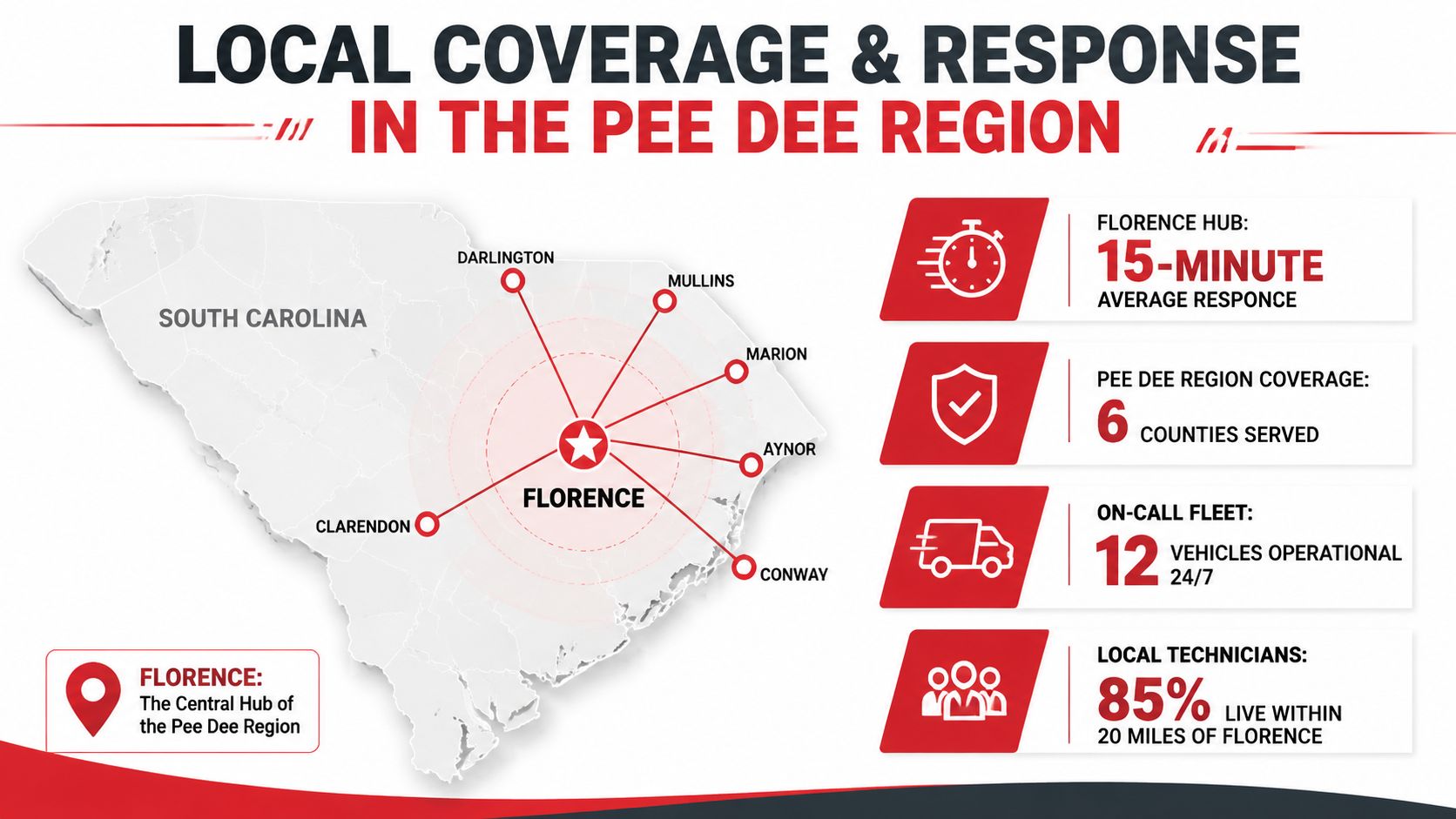
That regional reach is useful only if it comes with disciplined routing. If a company can cover the Pee Dee but can't tell you how it prioritizes emergencies, coverage is just a map. It's not a service commitment.
How to Vet a Florence SC Service Partner
Start with the basics and don't let the conversation drift into sales fluff. Ask for the license type, proof of insurance, who will perform the work, and whether the company uses its own crews or leans on subcontractors. If a vendor can't answer those questions cleanly on the first call, you already have your answer.
Use the paperwork as a filter
You want a written scope of work, not a vague promise. You also want a clear statement on after-hours response, emergency escalation, and what documentation you'll receive when the job closes out. Buyers forget this all the time, then end up hunting for answers when a panel trips on a Sunday.
- Licensing and insurance: Ask for proof before mobilization, not after the truck arrives.
- Reference quality: Request contacts from sites that look like yours, not from unrelated residential jobs.
- Emergency handling: Get the company's definition of urgent service in writing.
- Closeout package: Confirm whether you'll get notes, photos, and any as-built or repair documentation.
- Pricing clarity: Ask how rates change after hours and when a scope expands on site.
That last item is where buyers get surprised. A contractor can advertise free estimates and urgent service, but still leave the after-hours math vague. If the public-facing pages don't explain the emergency threshold or how pricing changes outside normal hours, the buyer needs to press for specifics before work starts Quality Service Company website.
Ask better questions on the first call
If you want to compare service partners in a more technical way, the same discipline applies to telecom and infrastructure contractors too, especially where field coordination and documentation matter. A useful parallel resource is telecommunications contractor selection guidance, because the buyer logic is similar, verify structure before the outage.

Walk away from any vendor that gets defensive when you ask for credentials or scope details. Good contractors expect due diligence. Only weak ones act annoyed by it.
A Realistic Florence Service Scenario
A facility manager in Florence gets a call at 7:30 AM. A breaker has tripped, the HVAC unit won't restart, and the tenant opens at 9:00. That is not a “we'll look at it this week” job. It's a dispatch problem, a triage problem, and a credibility test all at once.
The first move should be simple. The office logs the call, confirms the site, and sends a tech who can assess both the electrical fault and the mechanical failure without waiting for a second appointment. In a properly structured multi-trade contractor, one crew can isolate the power issue, determine whether the HVAC unit failed because of the electrical fault or a separate mechanical issue, and keep the manager out of the middle of a blame loop.
What good on-site behavior looks like
The crew doesn't guess. It checks the panel, looks for the obvious failure point, tests the unit, and explains what is urgent versus what can wait. If the electrical problem is the root cause, the technician fixes the fault or stabilizes the site first. If the mechanical system needs a separate repair, that gets scoped clearly instead of being buried in casual language.
The buyer should expect a short, plain closeout note. What failed, what was corrected, what remains open, and what should be monitored. That documentation matters because it protects the manager when tenants ask why the issue happened and what was done.
A weak contractor turns this into two tickets and a day of finger-pointing. A strong one treats it as one coordinated problem with one accountable lead. That difference is exactly why the market cares so much about structure, not just service labels.
The Questions Most Buyers Forget to Ask
Most buyers are polite on the first call and vague on the hard parts. They ask whether the company can help, then stop short of asking what “help” means when the lights are off, the unit is down, and the clock is running. That's where projects go sideways.

Ask the operational questions that expose weak spots
What qualifies as an emergency? Who answers after hours? If the first technician can't finish the job, who picks it up? How does the company handle change orders once someone is already on site? Those questions sound basic, but they tell you whether the vendor has a real operating model or just a promising front end.
Public listings for Quality Service Company emphasize urgent service and free estimates, but the public-facing details are thin where customers need them most, especially on emergency thresholds and after-hours pricing Quality Service Company website. That's not a reason to dismiss the company. It's a reason to force a real conversation before you sign anything.
The same scrutiny applies if you're buying network or facility support from other infrastructure firms. A vendor can have a polished brochure and still be unclear on response rules. If the answer to a question depends on “it depends,” keep asking until someone gives you a real policy.
Use the video and the conversation together
The right vendor should be able to explain its workflow without hand-waving. If you need a model for what a structured service conversation looks like, review the decision-making process in this service workflow video, then compare it against the answers you get from the contractor.
After that, judge the company on clarity, not charm. You're not buying reassurance. You're buying a response path, a repair process, and a paper trail that holds up when the site gets messy.
Next Steps and How to Engage a Florence Service Company
Stop shopping for slogans and start checking three things, scope, coverage, and escalation. Scope tells you what the company does. Coverage tells you where it can realistically get a truck. Escalation tells you what happens when the first person who answers the phone can't solve the problem.
If you're calling a quality service company Florence SC buyers can use, ask for the license, insurance, office location, after-hours process, and a written explanation of how emergency calls are handled. If the vendor can't answer those cleanly, move on. If it can, keep the conversation focused on the work you need this week, not the marketing story.
For buyers comparing infrastructure partners across trades, the same discipline applies to broader network projects and coordinated site work, including the kind of turnkey coordination discussed in turnkey network solutions.
Pick a contractor that can keep a straight dispatch line, explain the work in plain English, and close the job with documentation you can file. That's how you avoid surprises and keep the site moving.
Southern Tier Resources provides engineering, construction, and maintenance support for infrastructure projects that need coordinated execution and clear accountability. If you're evaluating service partners with the same focus on continuity and documentation, visit Southern Tier Resources and compare its approach to the standards laid out here.