If you're looking at crane rigger jobs because you want work that's hands-on, in demand, and tied to real projects, you're probably also trying to separate the solid paths from the noise. People asking about rigging are not trying to become theory experts, they want to know what a day really looks like, what employers screen for, and whether the job leads to steadier pay or just more certifications to buy.
In telecom, that question gets sharper fast. A rigger on a tower upgrade, a fiber backbone build, or a data center fit-out has to do more than “know rigging.” Hiring managers look for people who can follow the lift plan, communicate clearly with the operator, understand site rules, and show the right credential stack without hesitation.
What a Crane Rigger Actually Does on Telecom Builds
A tower crew rolls in before sunrise, and the rigger is already working before the first lift starts. The crane operator sits in the cab and runs the machine, but the rigger on the ground is the one sorting gear, checking sling condition, confirming the load, and making sure the path is clear. On a cell tower upgrade, that might mean staging antennas, mounts, steel, or reels near the drop zone, then coordinating each move with the signal person and operator.
That's where the work gets real. A clean-looking setup can still be wrong if the load is awkward, the route is tight, or the landing area won't support the placement. If the destination isn't cleared, the load gets held in the air while everyone wastes time, or worse, somebody tries to force the move and turns a routine lift into a problem.
Practical rule: If the rigger can't explain the load path in plain language, the lift isn't ready.
The best ground hands don't just grab the first sling they see. They choose the rigging based on load shape, center of gravity, edge protection, and whether a tagline is needed to control swing. That kind of judgment matters on cell tower construction projects, where the work is often tight, at height, and dependent on clean coordination between multiple trades.
Telecom rigging also has a pacing issue that newcomers underestimate. Some days are steady and methodical, while others involve waiting on weather, access, delivery timing, or another trade to finish. The physical side is obvious, but the mental side matters just as much, because a distracted rigger misses signals, misses hazards, and slows the crew down.
The Five-Step Lift Workflow You Will Run Every Day
The cleanest lifts follow a repeatable sequence. The qualified crane rigger starts by verifying the load weight and center of gravity, then selects the correct crane and rigging gear, checks the route and destination for clearance and floor capacity, attaches slings above the center of gravity or uses taglines if needed, and finishes with a slow, controlled lift kept as low as practical. That workflow comes straight out of basic rigging practice, and the failure points are just as consistent, unknown load weight, poor clearance planning, bad balance, and sling damage from sharp edges or a bad gear match (BNL basic rigging workbook).
Step one starts before the hook moves
You don't guess at weight or “eyeball” a lift because the load feels manageable. You confirm the numbers, check the shape, and think about where the load wants to roll once it leaves the deck. On telecom jobs, that habit matters because odd-shaped components and tight placement zones can make a simple lift behave unpredictably.
Step two is gear selection and route planning
Inexperienced people often lose credibility in an interview. A qualified rigger doesn't just grab slings and hope the crane makes up the difference, because the travel route, landing space, and floor capacity all have to work together. If the load is going through a narrow corridor or onto a limited deck, the plan needs to reflect that before anyone signals “hoist.”
A lot of job candidates talk about safety in general terms and then stumble when asked how they'd protect an edge, stabilize a load, or read the path. Employers notice that immediately. The person who can describe a clean rigging setup usually gets taken more seriously than the person who only repeats slogans.
The field visuals help too, especially when you're comparing certifications with real site demands. A useful reference is the quality transmission anchorage example because it reinforces how telecom work depends on disciplined construction planning, not just lifting hardware.
Here's a short visual aid that matches how many crews think about the lift flow.
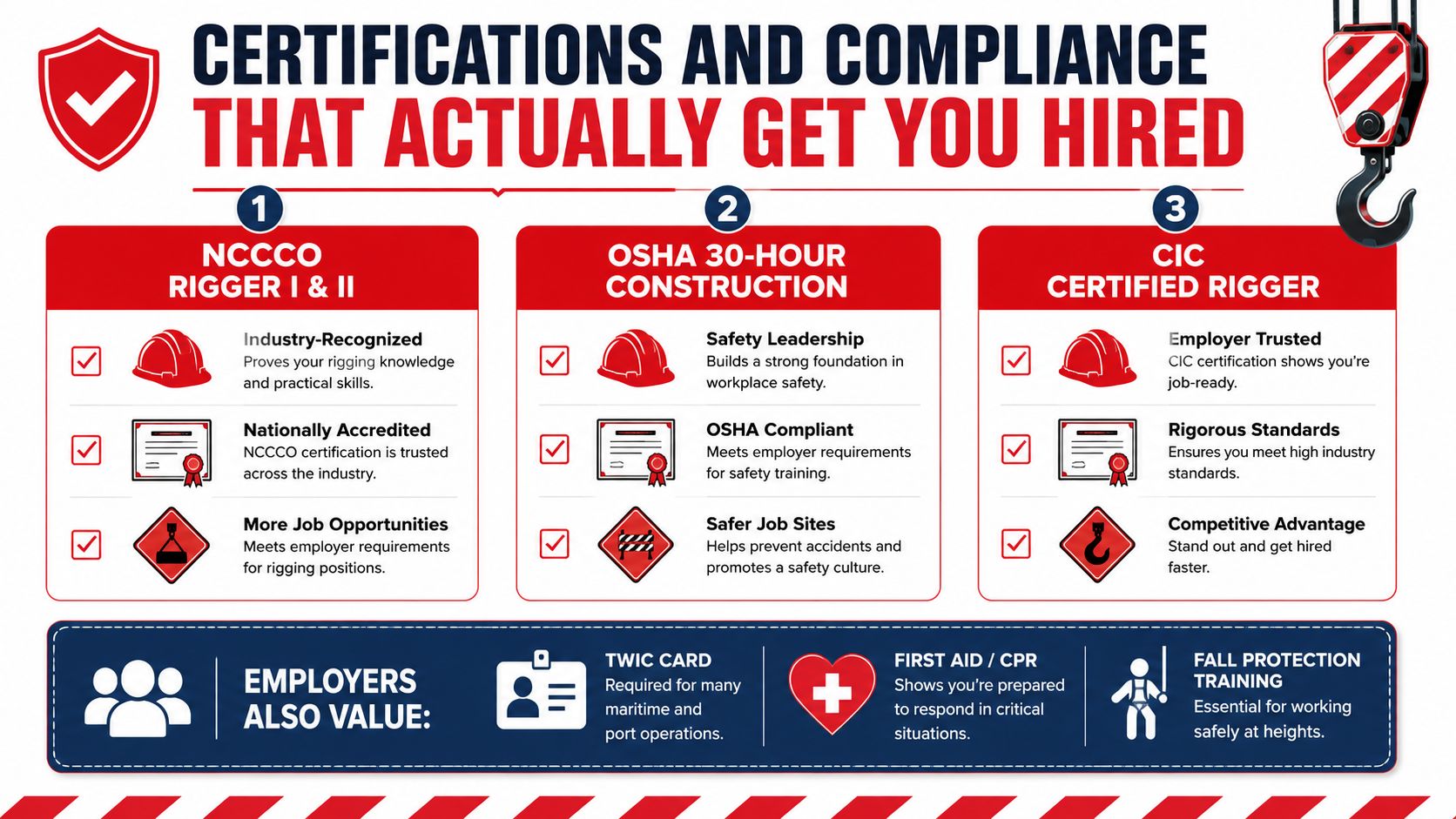
Certifications and Compliance That Actually Get You Hired
The biggest gap in the market is simple. A lot of generic rigging content talks about being careful, but telecom employers are screening for a qualification stack, not a vague attitude. In practice, that means OSHA 1926 Subpart CC compliance, formal signal-person and rigging credentials, and site-specific orientation layers that prove you can work inside their procedures rather than just your own habits.
An Austin crane-rigger posting showed how specific the screen can get. It asked for a valid driver's license, 1 to 3 years operating large cranes, Qualified Signal Person Level 1, and Qualified Rigging Level 1 training, which is a much tighter filter than most interview-prep articles admit (Indeed Austin crane rigger postings). The core issue is this. The market is not only asking whether you can rig safely, it wants proof that you can document, communicate, and qualify under site rules.
What employers usually care about first
- Signal-person qualification: If you can't read and transmit clean signals, you'll frustrate the operator and slow the lift.
- Rigging level training: Hiring managers want evidence that you understand gear selection, load control, and inspection habits.
- Subpart CC familiarity: If you don't know the regulatory baseline, you'll look underprepared in a fast-moving interview.
- Site-specific onboarding: Many telecom jobs layer on customer prem rules, contractor training systems, and job-specific orientations.
One overlooked move is to treat resume preparation like a technical task, not a formality. If you need a structured way to clean up your work history and make the qualifications easy to scan, the step-by-step guide to updating your resume is a practical reference for tightening format, sequencing, and clarity.
Hiring reality: Generic “safety first” language won't carry an interview if you can't name the credential, the inspection process, and the site rule that backs it up.
Telecom contractors also care about adjacency. A candidate who has worked on tower, fiber, or data center scopes can be easier to place because they already understand the pace, access limits, and documentation discipline. That's why the strongest applications read like a qualification record, not a motivational statement.
The broader field also includes contractors that self-perform multiple scopes, such as power line construction contractors, which gives some riggers a path into related utility work if they want more exposure to complex lifts and field coordination.
Building Real Experience From the Ground Up
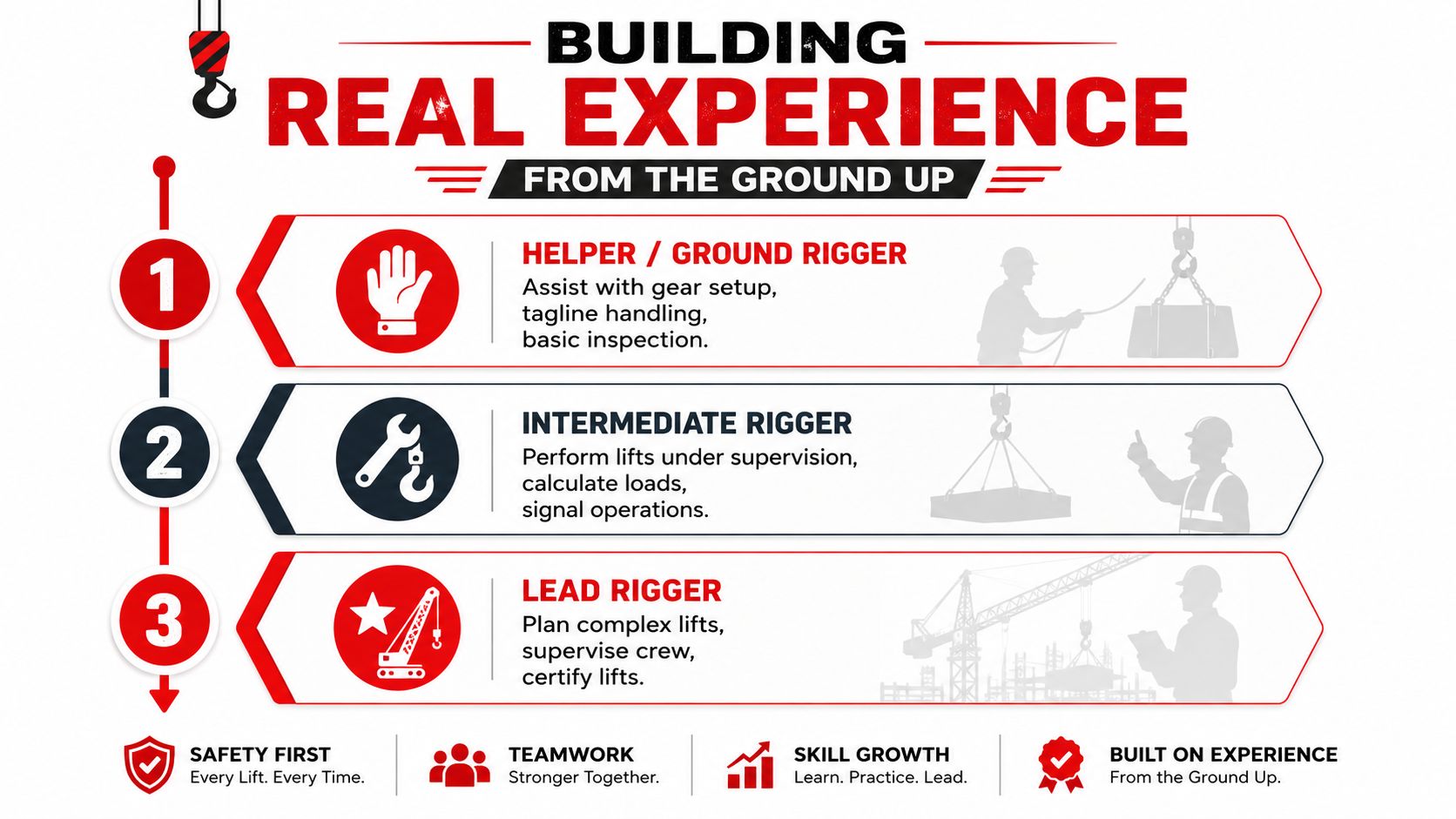
Experience matters more than the title on your hard hat. Training helps you get in the door, but employers trust people who can show a pattern of good lifts, good judgment, and good communication over time. In offshore rigging guidance, one progression benchmark cited by Rigzone is promotion after roughly 12 to 24 hitches and 50 to 100 completed lifts, including several critical or blind lifts, plus advanced rigger or lifting-supervisor certification and a positive competence assessment (Rigzone offshore rigger guidance).
How that progression translates to telecom
Telecom doesn't use the same offshore ladder, but the logic is similar. A new helper starts with gear staging, tagline support, and inspection habits. The next step is supervised lifts, radio discipline, and basic load thinking. After that comes leading simpler lifts, documenting work, and taking part in critical moves where the operator, signal person, and lead rigger all have to stay aligned.
The best crews don't promote based on time alone. They promote when a person has shown reliable behavior across enough real lifts to be trusted with more complex work. That's why a personal lift log helps, even if your employer doesn't ask for one. Write down the crane type, the lift type, what you handled, and what you learned, because that record gives you something concrete to point to when you apply for the next step.
Practical ways to build the stack
- Start with supervised ground work: Learn the gear, the hand signals, and the habit of checking before moving anything.
- Ask for dummy-rigging drills: A dry run reveals weak points before the load is ever attached.
- Volunteer for controlled complexity: Shorter lifts and clearer routes teach judgment without overwhelming you.
- Track every completed lift: Documentation gives you proof when a hiring manager asks what you've done.
- Aim for critical-lift exposure: The people who get better roles are usually the ones who've seen more than routine moves.
Some riggers wait for opportunity. The ones who move up keep asking to be put on lifts that require judgment, because that's where real competence gets visible.
Telecom projects are useful because they can feed operator-adjacent careers later. A rigger who understands tower work, fiber logistics, and data center fit-outs often becomes more valuable than the person who only knows one narrow lift routine.
Resume and Interview Moves That Win Telecom Offers
A generic resume says “performed rigging duties.” That line gets ignored. A telecom-ready resume says what you lifted, what equipment you used, what credentials you hold, and where you've worked under pressure. Employers want a person who can prove fit for the site, not just say they're safety-minded.
The fastest way to tighten a resume is to lead with the work that matters most. Put your signal-person training, rigging level, and any crane familiarity near the top, then list the environments you know, tower, fiber, data center, or industrial. If you've handled critical lifts or worked around larger crane types, name that plainly and keep the wording direct.
Strong resume bullets sound like this
- Supported telecom lifts on tower and data center scopes, coordinated with operator and signal person, and followed pre-lift inspection and clear-zone procedures.
- Handled rigging gear setup including sling selection, tagline control, and load stabilization for awkward or raised placements.
- Maintained lift documentation and communicated site constraints to supervisors, operators, and other trades before each move.
- Worked under site-specific orientation rules and adapted to customer requirements without slowing the crew.
Interview panels usually test judgment, not memorized definitions. They may ask how you would read a load chart, what you'd do if a blind lift lost radio clarity, or whether weather and wind should change the go/no-go call. A strong answer names the process, the communication chain, and the reason you'd stop the lift if the conditions changed.
If you need a structure for tightening your background before you walk into those interviews, the resume update guide from Resumey.Pro is useful because it pushes you to present your work history in a cleaner, more employer-friendly order.
Interview rule: Never answer with “I'd just be careful.” Explain what you'd check, who you'd tell, and what condition would stop the lift.
The common mistakes are easy to spot. Candidates overuse safety clichés, give no lift examples, list every certification without explaining where it was used, or talk around communication problems instead of owning them. The people who get callbacks usually sound like they've already worked around a crane, not like they've only read about it.
Pay, Hours, and Benefits Across Telecom and Adjacent Sectors
Pay for crane rigger jobs is not one clean number. It changes by region, sector, and how much of your schedule is tied to overtime, shutdowns, or travel. A Houston discussion thread reported non-union riggers commonly earning about $32 to $40 per hour, with some refinery roles reaching roughly $36 to $42 per hour, and it also noted schedules ranging from steady 40-hour weeks to much longer runs depending on the job (Houston rigger discussion).
Public Texas listings show even wider dispersion. One crane-rigging posting was listed at $22 to $51 per hour, while a mobile crane technician role leaned more toward modern crane electronics knowledge than pure manual rigging skill (Indeed Texas crane and crane-technician listings). That spread tells you something important, the title alone does not define the lane. The job may be entry-level ground work, a specialty industrial role, or a bridge into crane tech support and operator-adjacent work.
How the sectors feel in real life
Telecom tower and fiber work usually rewards people who like movement, coordination, and project-based schedules. Hours can be steady on some jobs and stretched on others, especially when a project needs weather windows, travel, or after-hours access. Data center fit-outs often value clean coordination and documentation because the work happens around other trades and a controlled site environment.
Refinery and industrial shutdown work tends to be more intense. The pace is sharper, the pay can rise with the schedule, and the work often demands stricter compliance and more fatigue management. Offshore is different again, because the hours come in hitches, the competency gate is tighter, and the lifestyle asks for longer blocks away from home.
If you care more about predictability than raw hourly upside, telecom is often the better fit. If you want compressed schedules and can tolerate heavier operational strain, industrial or offshore may be more attractive. The right choice depends on whether you value home time, travel, or higher-variance earnings more than the other two.
Where to Apply and How to Sequence Your Job Search
Start with the employers that already work across multiple telecom scopes. That includes turnkey contractors, national carriers, tower companies, neutral-host builders, and regional broadband programs. Southern Tier Resources is one example of a contractor that handles wireline and wireless infrastructure work, including cell tower construction and related field execution, so it makes sense to look at companies that already need people who can move between scopes without re-learning the basics.
Apply in layers, not all at once.
- Weeks one and two: Clean the resume, organize cert copies, and build a simple lift log.
- Weeks three through six: Submit applications to contractor career portals, staffing agencies, union halls where relevant, and LinkedIn job posts.
- Weeks seven through twelve: Follow up, prepare for interviews, and bring paperwork to the first call so you can move fast when someone wants to hire.
Attach what proves you're ready. That means your lift log, credential copies, and any OSHA training records you have. If a posting mentions site-specific orientation, say you're ready to complete it. If it wants tower, fiber, or data center experience, name the scopes you've touched instead of stretching the truth.
The goal isn't to chase every open requisition. It's to line up the roles that match your current qualification stack, then move toward the next level with documented lifts and stronger credentials. If you want a direct path into telecom infrastructure work, apply with Southern Tier Resources and bring the same discipline you'd bring to a live lift, clear paperwork, clean communication, and proof that you can do the job safely.