You're standing in the middle of a build where the drawings are approved, the crews are mobilized, and the schedule is already slipping because a permit is stuck, a make-ready pole change got missed, or a data hall handoff depends on three vendors who aren't speaking the same language. That's the moment network infrastructure consulting stops being a buzzword and starts being the work of turning paper plans into something that lights, routes, and stays up in the field.
For carriers, ISPs, hyperscalers, and enterprise teams, the value is rarely in a prettier diagram. It's in the decisions that keep a rural fiber route moving through permitting, or keep a cross-connect and power cutover from turning into a last-minute scramble. If you've ever watched an internal team get buried under regional complexity, strategic IT consulting for SMBs is a useful reminder that outside help exists for a reason, especially when the work spans engineering, coordination, and execution.
What Network Infrastructure Consulting Solves on the Ground
A rural broadband crew can have the splice truck ready, the fiber on hand, and the route mapped, then lose a week because a utility attachment order was sequenced badly. A hyperscale team can have the rack layout locked, then wait on cross-connect coordination because power, cabling, and carrier turn-up were never tied to one accountable plan. Those are field failures, not abstract planning gaps, and they are exactly what network infrastructure consulting is meant to catch before crews are standing around with idle time and rework.
The recurring friction points
Regional complexity is usually the first reason operators bring in consultants. A network can look straightforward on a drawing, then touch multiple counties, carrier handoffs, make-ready rules, or data center vendors and hit a coordination ceiling fast. Outside teams are often used because they can stay focused on one route, one site class, or one build wave without getting pulled into daily operations.
Aging network assumptions are the second problem. Legacy MPLS, older switching layers, and site-by-site growth models can hold together for years, then break down once cloud connectivity, segmentation, or resilience requirements change. Consulting earns its keep by checking whether the current design still matches the traffic pattern and the availability target, not just whether the topology looks familiar.
Practical rule: if the main risk is not “can we engineer it,” but “can we sequence it, permit it, build it, and hand it off without rework,” consulting is already justified.
AI and cloud workloads add pressure because they expose weak capacity planning and weak visibility. Teams do not just need more bandwidth, they need better design discipline across paths, fault domains, and operational ownership. In practice, consulting becomes the bridge between strategy and execution, especially when low-density routes need a clear return path or hyperscale builds need field-ready sequencing instead of paper-only coordination.
For smaller organizations, the problem is usually scope. For larger ones, it is speed. Either way, the job stays the same, reduce the gap between what was approved and what can be delivered reliably in the field. That is why the right outside partner matters, whether the work is a rural fiber expansion or a network program that starts with strategic IT consulting for SMBs and grows into more complex infrastructure decisions.
Defining Network Infrastructure Consulting and the Service Lines It Covers
A network infrastructure consultant is part translator, part general contractor, and part quality gate. The work isn't limited to design drawings, and it isn't the same thing as pure construction. A mature consulting practice usually bundles planning, permitting, coordination, implementation oversight, testing, and handoff so one team can carry accountability across the whole path.
What the scope usually includes
The core service lines tend to cluster into seven practical buckets.
- Outside plant and make-ready planning. This covers route feasibility, pole work sequencing, attachments, and utility coordination.
- Detailed network design. That includes Layer 2, Layer 3, segmentation, wireless, SD-WAN, and cloud-connected topology decisions.
- Permitting and field coordination. Good consulting ties the drawings to what local authorities and utilities will approve.
- Construction oversight. The consultant checks that crews build what was designed, not just whatever is easiest to install.
- Splicing and testing. Fiber work only matters when the splices, OTDR traces, and acceptance results prove the route performs.
- Data center and fit-out coordination. This often covers structured cabling, interconnects, and implementation sequencing with power and network vendors.
- Operations and maintenance transition. Without as-builts, training, and O&M handoff, the project usually leaves hidden risk behind.
The overlap with systems integration is real, but the emphasis is different. A systems integrator often focuses on assembling working components. A consultant is more likely to own the design logic, field sequencing, and acceptance criteria that determine whether those components survive real traffic and real handoff conditions. That distinction matters when you're buying accountability, not just labor.
For readers comparing vendors, a useful benchmark is whether the firm can show real deliverables, not just a slide deck. Sample as-builts, test results, issue logs, permitting artifacts, and closeout documentation signal a mature practice. Thin marketing wrappers usually stop at “design and support” and never explain how the work gets validated in the field.
The Consulting Project Lifecycle From Feasibility to Handoff
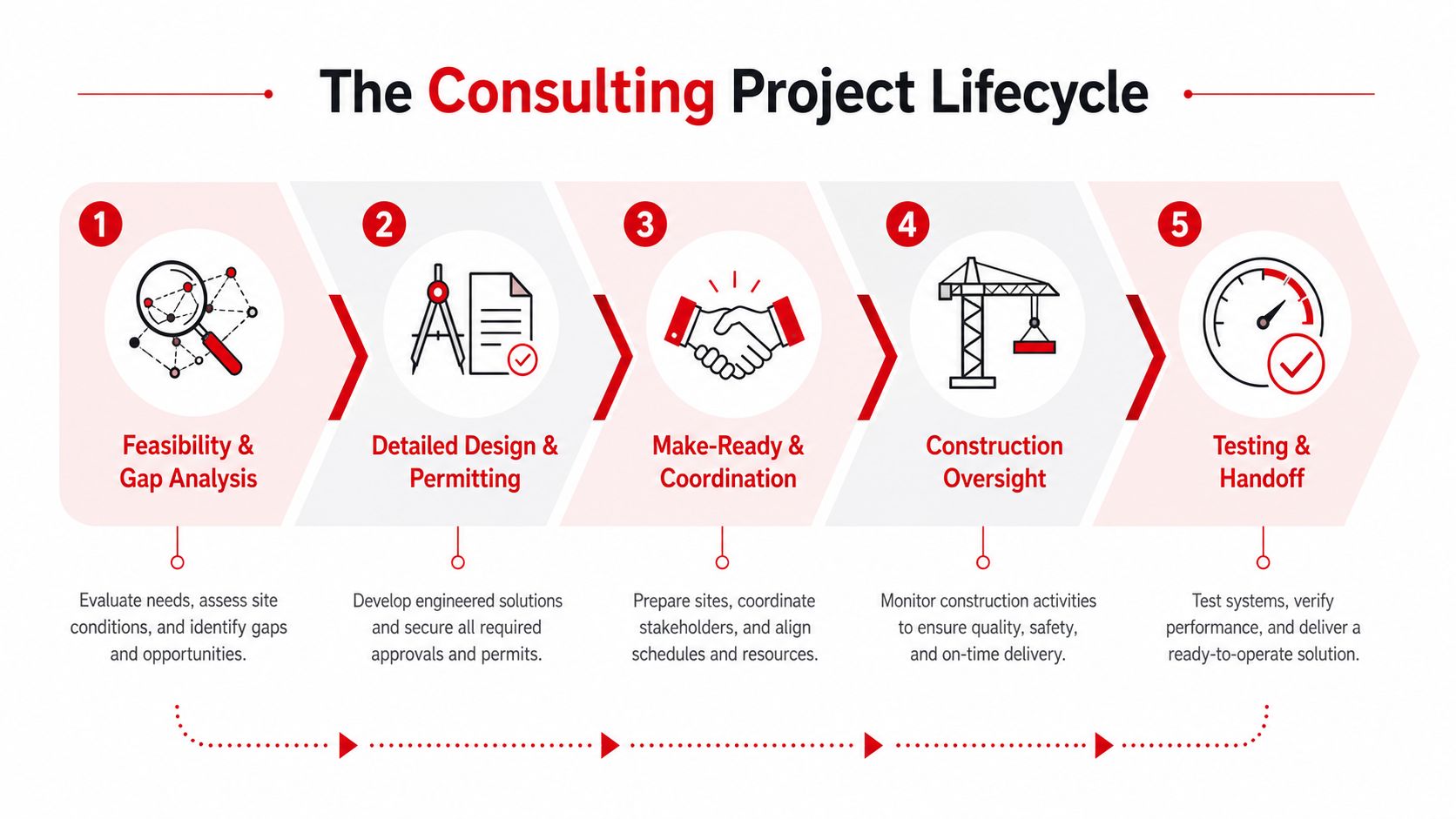
The lifecycle starts with a gap analysis, not a purchase order. A consultant should compare the current network, the growth target, and the field constraints, then identify where design, capacity, resilience, or permitting assumptions don't hold up. The primary reviewer is usually engineering leadership, with operations and finance weighing in when the build has a capital threshold or rollout risk.
Feasibility and detailed design
The first gate is whether the project is buildable. That means route feasibility, site constraints, vendor availability, and design assumptions all get tested before anyone commits to a field calendar. A solid deliverable here is a design package that clearly separates must-have scope from optional scope, because that's what prevents a project from bloating before it leaves planning.
The second gate is permitting and make-ready coordination. Consulting pays for itself most often here, because the design on paper can collapse once poles, duct availability, access windows, or utility review timelines enter the picture. A good consultant tracks each dependency, not as a checklist, but as a sequence that tells crews what can start now, what can't, and what has to move first.
Make-ready sequencing is usually where paper engineering meets the real world. If the sequence is wrong, the build slips even when the drawings are technically correct.
Construction, testing, and handoff
Construction oversight should produce more than status updates. The best reviewers are looking for build conformance, issue resolution, and evidence that the field work matches approved design, especially where fiber routes, wireless placement, or data center interconnects carry the most operational risk. Testing then proves the path, whether that's fiber acceptance, network performance benchmarking, or readiness checks before cutover.
For a practical operating model, the closer a project gets to handoff, the more important as-builts and training become. As noted in Southern Tier Resources' turnkey network solutions overview, the handoff should connect engineering, construction, and maintenance instead of treating them as separate jobs, and their internal process page on turnkey network solutions is a useful reference point for how that looks in a bundled delivery model.
The final gate is O&M transition. If the operations team can't tell what was installed, tested, and accepted, the project isn't really done. It's just moved the risk downstream.
How Consulting Engagements Are Priced and Structured
Pricing should match the kind of uncertainty you're buying down. If the scope is clear and bounded, fixed fee can work well. If the field risks are still moving, time and materials may be safer, but only if the buyer has strong scope controls. The wrong pricing model doesn't just affect cost, it changes behavior.
| Pricing Model | Best Fit Use Case | Primary Risk |
|---|---|---|
| Fixed fee by deliverable | Well-defined audits, designs, or permit packages | Scope gets squeezed or change orders pile up |
| Time and materials | Early-stage work with unknown field conditions | Spend drifts without strong governance |
| Unit priced per foot or per node | Repeatable fiber, wireless, or site rollout work | Incentive can favor volume over quality |
| Recurring managed services | O&M, monitoring, and ongoing optimization | Buyer can lose visibility into day-to-day effort |
Fixed fee works best when the deliverable is specific enough to inspect. That's good for design packages, site surveys, or documentation sets. It punishes the consultant when requirements change midstream, which is why the scope needs clean boundaries.
Time and materials fits uncertain environments. Rural routes, utility coordination, and multi-vendor deployment work often live here because the unknowns are real. It punishes the buyer if internal review is loose, because the consultant will keep moving as long as the work queue stays open.
Unit pricing is practical for repeatable builds. It can help when crews are laying the same class of plant across many nodes or feet of route, but it rewards throughput, so quality controls have to be explicit. Managed services make sense when the network is already in operation and the buyer wants continuity after handoff.
The simple heuristic is straightforward. Use fixed fee when you know what done looks like. Use T&M when the unknowns are still too large to price cleanly. Use unit pricing when the work repeats. Use managed services when the network needs ongoing ownership, not a one-time project team.
Selecting a Consulting Partner With a Weighted Checklist
The fastest way to lose a project is to pick the cheapest bidder without checking who does the critical work. A consultant can look polished in the proposal and still be weak where it matters, inside plant execution, splicing quality, permit coordination, or closeout documentation. Procurement should weight delivery evidence more heavily than slide quality.
What to score before award
- Safety record. Ask for the actual safety program, not just a promise.
- In-house splicing and testing crews. Subcontracted critical path work is harder to control.
- Terrain-specific experience. Rural builds, dense metro work, and hyperscale fit-outs all punish generic teams differently.
- Project management discipline. Look for real tracking tools, issue logs, and change control.
- Financial stability. A partner that can't carry payroll can't carry your schedule.
- Local permitting expertise. If they don't understand the authority having jurisdiction, the design will stall.
One line in the RFP tells you a lot. Ask who holds the test gear, who signs the as-builts, and who owns the field punches. If the answer is vague, the delivery model is probably vague too.
A second warning sign is blanket low bids with no sample closeout set. Those proposals usually hide one of three problems, under-scoped labor, heavy subcontracting, or poor assumptions about permitting and rework. If the partner can't show a sample test package or as-built set, the handoff will likely be messy.
For organizations that need a benchmark against real-world fiber field work, Southern Tier Resources' fiber optic construction companies page is a useful example of how a delivery partner can frame construction, splicing, testing, and documentation in one flow.
Field test: in the reference call, ask what happened when the schedule broke. The best answer explains how they recovered without losing documentation or acceptance discipline.
If the project is high risk, use a pilot scope and write an exit clause that lets you replace the partner without resetting the entire program. That's not distrust. It's governance.
Case Snapshots From Rural Fiber and Hyperscale Data Center Work
A rural build usually fails on economics and sequence, not on engineering talent. A consultant working that kind of project has to think about make-ready order, permit timing, and whether the build model fits the area's cost structure. The public conversation around broadband consulting often stops at route design, but the harder work is deployment strategy, funding fit, and execution planning, which is why the broader broadband consulting discussion matters so much in low-density markets.
Rural fiber build
In one representative rural rollout, the route was technically straightforward but operationally fragile. The consultant's main job was to sequence the make-ready work so utility moves didn't block later construction, then align the build plan with the available subsidy structure and local review timing. The outcome wasn't a fancy redesign, it was a build that could move from paper to field without stranding capital in unfinished segments.
The lesson is blunt. In low-density markets, the value is often in deployment choreography, not drawing production. That's also why Southern Tier Resources' hyperscale data center overview is relevant to readers thinking about scale, because the same discipline changes shape when the site density and uptime expectations rise.
Hyperscale data center fit-out
A hyperscale fit-out faces a different kind of friction. The constraint is usually time, interdependency, and handoff risk across power, structured cabling, and carrier connectivity. In that setting, the consultant earns fee by keeping the sequencing tight, normalizing vendor responsibilities, and preventing the network scope from getting lost inside the broader construction program.
If you want a framework for interpreting investment and operating pressure around these kinds of assets, a cap rate guide for real estate investors can provide context for why schedule and reliability matter so much in capital-heavy facilities. The consulting lesson is the same. When the go-live date is real, coordination discipline matters more than theoretical elegance.
The common thread across both stories is lifecycle accountability. Different environments, same failure mode, a disconnect between design intent and field reality.
Risks, ROI, and What to Do Next
Consulting should be judged as lifecycle risk management, not as a discretionary overhead line. The return shows up when teams reduce rework, shorten the path to revenue, avoid repeat truck rolls, and get first-pass acceptance on splicing, testing, and handoff. That's more valuable than a lower bid that creates field churn later.
The biggest failure mode is fuzzy ownership. If nobody owns acceptance criteria, the project drifts. If the consultant is treated like a vendor instead of a partner in sequencing and validation, the buyer gets a lot of activity and not much accountability.
Rule of thumb: if a deliverable can't be accepted or rejected in the field, it isn't a deliverable yet.
What to do this quarter
- 30 days. Identify one active or upcoming build where field risk is high, then define the gap between paper design and field reality.
- 60 days. Write the acceptance criteria for permits, make-ready, testing, as-builts, and O&M handoff before work starts.
- 90 days. Run a pilot scope with clear exit rights, so the partner can be swapped if documentation, sequencing, or quality slips.
For carriers, ISPs, and data center operators, the question isn't whether to use consulting. It's whether the current program can absorb the cost of avoidable rework and schedule drift. If the answer is no, the right partner should be able to show how the project gets from feasibility to handoff without guesswork, and that's exactly the kind of end-to-end support Southern Tier Resources brings to fiber, wireless, and data center infrastructure work through Southern Tier Resources.