
Texas moves too much product through pipe for contractor selection to be treated like a directory search. The state’s transmission, intrastate, gathering, and integrity workload creates real separation between firms that can sustain production in the field and firms that only look strong on a qualifications sheet. On a Texas job, a bad award usually shows up fast. Crew ramps slip, ROW issues sit too long, weld repair rates rise, and interfaces between spreads, stations, and crossing subcontractors start costing time.
That is why this guide is built from a procurement standpoint. It does not just name major pipeline construction companies in Texas. It compares them on the factors buyers screen for during bid development and final award: Texas project history, the ability to bundle related scopes under one contract, and fit by project type and size. A contractor that makes sense for a long-haul mainline package may be the wrong choice for a gathering buildout, integrity program, or crossing-heavy spread.
Texas also remains active on new gas infrastructure and system expansion. That keeps pressure on owners to choose contractors that can mobilize crews, supervisors, equipment, and specialty support without losing control of welding quality, permitting coordination, or landowner issue response. For upstream and midstream teams tracking active Texas gas project and corridor activity, that distinction matters early, before the bid list is set.
Security planning belongs in that same pre-award conversation. Yards, laydown areas, and remote access points can turn into loss points during active construction, especially on long linear jobs. If your footprint runs through North Texas, coordinate field operations with construction site security in DFW.
The seven companies below are the firms I would shortlist first, depending on whether the work is mainline, gathering, integrity, station-adjacent, or a bundled package with multiple execution risks.
1. Primoris Pipeline (Primoris Services Corporation)
Primoris Pipeline belongs on almost every Texas mainline bid list where the owner wants one contractor to handle more than just ditch and weld. If your package includes stations, integrity scopes, repair work, or HDD coordination, Primoris is one of the few names that can credibly absorb all of it under a single commercial structure.
That matters more than many buyers admit. A lot of projects don’t fail because welding productivity is poor. They fail because handoffs between the pipeline contractor, the station builder, and the specialty crossing team break down. Primoris is attractive when you want fewer interfaces to manage.
Where Primoris fits best
Primoris is strongest on large-diameter, long-distance work where the owner values a bundled approach. Texas owners also benefit from its broad in-state footprint. The company has offices across Houston, Beaumont, Freeport/Oyster Creek, Victoria, Fort Worth, Denton, and Midland, which supports faster regional mobilization and field supervision coverage.
If you’re evaluating crossover infrastructure along shared corridors, it’s worth looking at adjacent utility planning through gas corridor and utility project support, especially when telecom and energy construction need to coexist without fighting over access windows.
What procurement teams should watch
The upside is straightforward. Primoris can reduce owner-side coordination burden. For a midstream client with compressor or pump station needs tied to the line, that can simplify both schedule logic and commercial accountability.
The trade-off is equally straightforward. This is not usually the most cost-efficient option for a small lateral, a short tie-in, or a one-off maintenance-driven build where the owner only needs a lean field crew and basic spread support.
Practical rule: If your package includes mainline construction plus facilities or integrity work, ask Primoris to price it both as a bundled award and as separated scopes. The delta will tell you whether their integration premium is justified.
Procurement read
Primoris is usually a better fit for owners who think in programs, not one-offs. They’re well suited to Gulf Coast, Permian, and East Texas work where you need scale, predictable systems, and enough internal depth to keep the project moving when one work front gets constrained.
I wouldn’t lead with them for the smallest jobs. I would absolutely involve them when the line size is significant, the corridor is long, and the owner wants one accountable builder instead of three specialized firms trying to coordinate in the field.
2. Strike
Strike is one of the more versatile contractors on this list. From a procurement perspective, that versatility is the selling point. If the owner wants engineering, pipeline construction, terminals, E&I, integrity, and maintenance support under one umbrella, Strike deserves a close look.
Its Texas base in The Woodlands helps for in-state responsiveness. That sounds like a soft factor until you’re trying to get decision-makers into a pre-award alignment meeting or need rapid field support after an outage or route issue. Local leadership access still matters.
Why Strike often makes the shortlist
Strike is useful when a project doesn’t fit a clean category. Some Texas jobs start as straightforward pipeline scopes and then expand into facility tie-ins, CP upgrades, or integrity-driven remediation. Contractors built around one narrow work type can struggle when the scope broadens midstream.
Strike’s dedicated integrity, cathodic protection, and E&I capabilities make it more flexible than a pure spread contractor. That can help owners who want fewer contracts and fewer chances for one vendor to blame another.
A related consideration for hybrid utility corridors is hydro excavation and underground infrastructure support, especially where congested subsurface conditions create exposure during tie-ins and modifications.
Where the fit gets weaker
Strike is broad, but broad contractors can create a queue problem. Very small jobs sometimes get deprioritized when larger program work is active. If you’re a buyer with a short lateral, minor terminal modification, or limited repair package, confirm how your work will rank internally before award.
The other issue is emerging-scope validation. Strike has growing CO₂ pipeline experience, but if that’s central to your project, insist on recent and directly relevant references. Don’t accept generic “similar experience” language if your risk profile depends on that specialty.
Ask for the field org chart that would actually execute your project, not just the corporate capability deck. That’s where the truth usually shows up.
Procurement read
Strike is a strong option for owners who need a self-perform EPC-minded contractor without jumping immediately to the biggest national platform. They’re particularly attractive for mixed-scope packages where line work, integrity, and facility interfaces are all in play.
I’d rank them high for projects where coordination complexity is a bigger risk than raw spread size. I’d be more cautious if the job is tiny or if a specialized CO₂ execution record is essential.
3. Price Gregory International (a Quanta Services company)
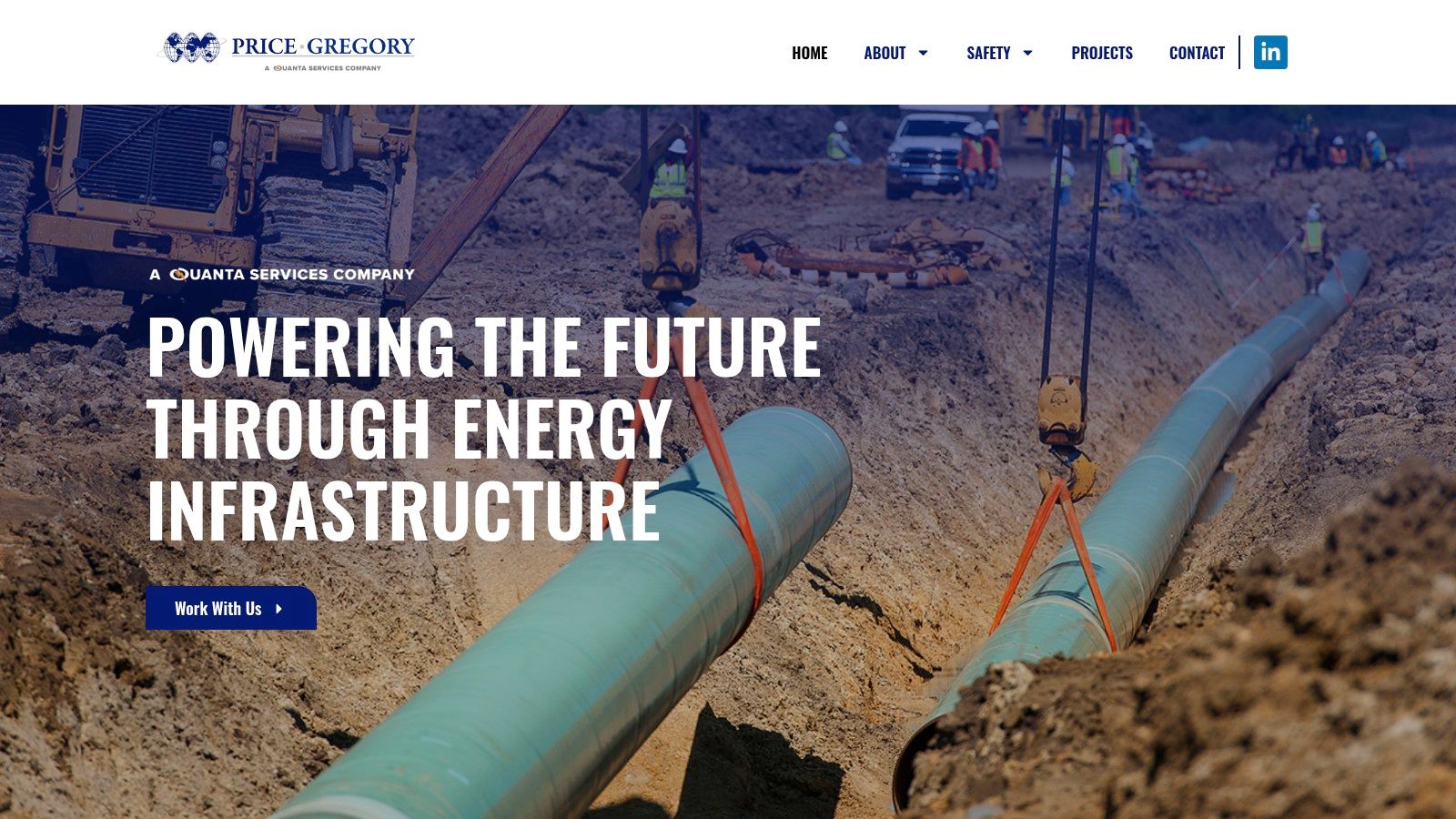
Price Gregory International belongs on any serious Texas bid list for large-diameter transmission work. Procurement teams usually bring them in when spread productivity, crew depth, and long-corridor control matter more than squeezing the last dollar out of unit pricing.
Their advantage is scale with structure. As part of Quanta, Price Gregory can draw on a broader pool of equipment, supervision, and specialty support than many regional contractors. That matters on Texas work because the failure point is often not bid coverage. It is keeping the right field leadership and construction sequence in place once multiple spreads, crossings, and owner interfaces start competing for attention.
From a procurement standpoint, the key question is fit by project type. Price Gregory is strongest on mainline programs where the owner wants one contractor that can handle sustained production, disciplined reporting, and the logistics burden that comes with a long route. I would not rank them the same way for a short lateral, a scattered integrity package, or a small facility-tie scope where overhead can outweigh the benefit of a Tier-1 platform.
Texas project history matters here. Buyers should push past the corporate deck and ask which Texas spreads, superintendents, and welding programs are relevant to the work being bid. That gives a much better read on execution risk than enterprise-wide resumes. For projects tied to broader corridor development, bare line and field infrastructure support can also affect packaging strategy if multiple scopes are competing for the same construction window.
Where Price Gregory tends to win
Owners usually get the most value from Price Gregory on large gas or liquids transmission jobs that need real field depth. Their platform suits projects where schedule slippage gets expensive fast, especially if the route includes challenging logistics, multiple jurisdictions, or concurrent spread activity.
Service bundling is part of the appeal. Backing from a larger parent can help when the job needs coordinated access to related construction resources instead of a single isolated spread.
Trade-offs buyers should price in
That same platform can be a poor commercial fit for smaller work. If the package is narrow, local, or fragmented, a contractor built around major mainline execution may not give it top internal priority. The job can still be done well, but the owner should confirm who is assigned, how quickly they can mobilize, and whether the field team has recent experience on scopes of similar size.
Availability is the other watch item. Mainline contractors with a strong Texas book are often selective during busy cycles. Ask direct questions about slot availability, named field leadership, and whether the proposed spread has worked together before.
- Best match: Large-diameter transmission, long-route construction, and multi-spread programs
- Less ideal: Short laterals, small integrity digs, and distribution-style packages
- Buying tip: Evaluate the Texas-specific execution team, not just the parent-company depth
Procurement read
Price Gregory is a good fit when the primary risk is execution capacity, not contractor familiarity with small local scopes. Their value shows up on jobs where field discipline, reporting control, and sustained production rates are harder to replace than a lower bid.
If I were buying a major Texas mainline package, I would want them in the competitive set. If I were buying a modest corridor segment or a mixed repair package, I would test whether their platform matches the scope before paying for capability I may not need.
4. Pumpco, Inc.
Pumpco matters in Texas because route familiarity changes bid quality. On intrastate gas and Permian-connected work, contractors that know the counties, haul patterns, inspector expectations, and weather disruptions usually produce more believable schedules and fewer surprises after notice to proceed.
That is the core buying case here. Pumpco is not just a recognizable name. It is a contractor with a long Texas operating history, and that tends to show up in practical areas such as spread planning, access strategy, local subcontractor use, and how aggressively they commit on production rates.
Why owners keep Pumpco in the bid list
The company has been involved in major regional projects such as Permian Highway, Waha, Double E, and Whistler. For procurement teams, that project history is more useful than a generic contractor profile. It shows repeated exposure to the type of work many Texas buyers are sourcing: large-diameter gas pipeline construction tied to takeaway capacity, tough schedules, and multi-county coordination.
It also helps clarify where Pumpco fits in a procurement strategy. If the package is a true mainline spread, especially in West or South Texas, they bring relevant field history. If the job is a mixed award with stations, facilities, integrity digs, or smaller maintenance scopes, the buyer should test whether Pumpco wants the full bundle or only the line portion.
Bundling is the primary trade-off. A contractor can be excellent on pipe and still be the wrong commercial choice if the owner wants one award covering every interface.
Where Pumpco is strongest, and where to press harder
Pumpco is strongest on core midstream pipeline construction in Texas. That includes long corridors, heavy spread work, and jobs where ROW access, county-road management, and landowner coordination can affect daily production.
The weaker fit is easier to define too. Buyers with municipal-style work, utility relocation packages, or smaller integrity programs should confirm interest early and ask who would run the job. A company built around large midstream execution does not always price small or fragmented scopes in a way that makes sense for the owner.
I would also press on resource commitment. Regional specialists can be a very good buy, but only if the named superintendent, welding spread, and restoration support are available for your window.
Texas-specific experience has the most value when the schedule is tight, the corridor is congested, and small field decisions turn into cost quickly.
Procurement read
Pumpco belongs on the shortlist for buyers sourcing Texas mainline work, particularly intrastate gas and Permian-linked corridors. Their advantage is less about corporate scale and more about fit. They know the operating conditions, and that usually improves early execution.
The main procurement risk is capacity during busy cycles. Ask for named field leadership, realistic mobilization timing, and a clear statement on what scopes they self-perform versus subcontract. If those answers are solid, Pumpco is often a better match than a larger contractor whose Texas presence looks stronger on paper than in the field.
5. U.S. Pipeline (USPL)
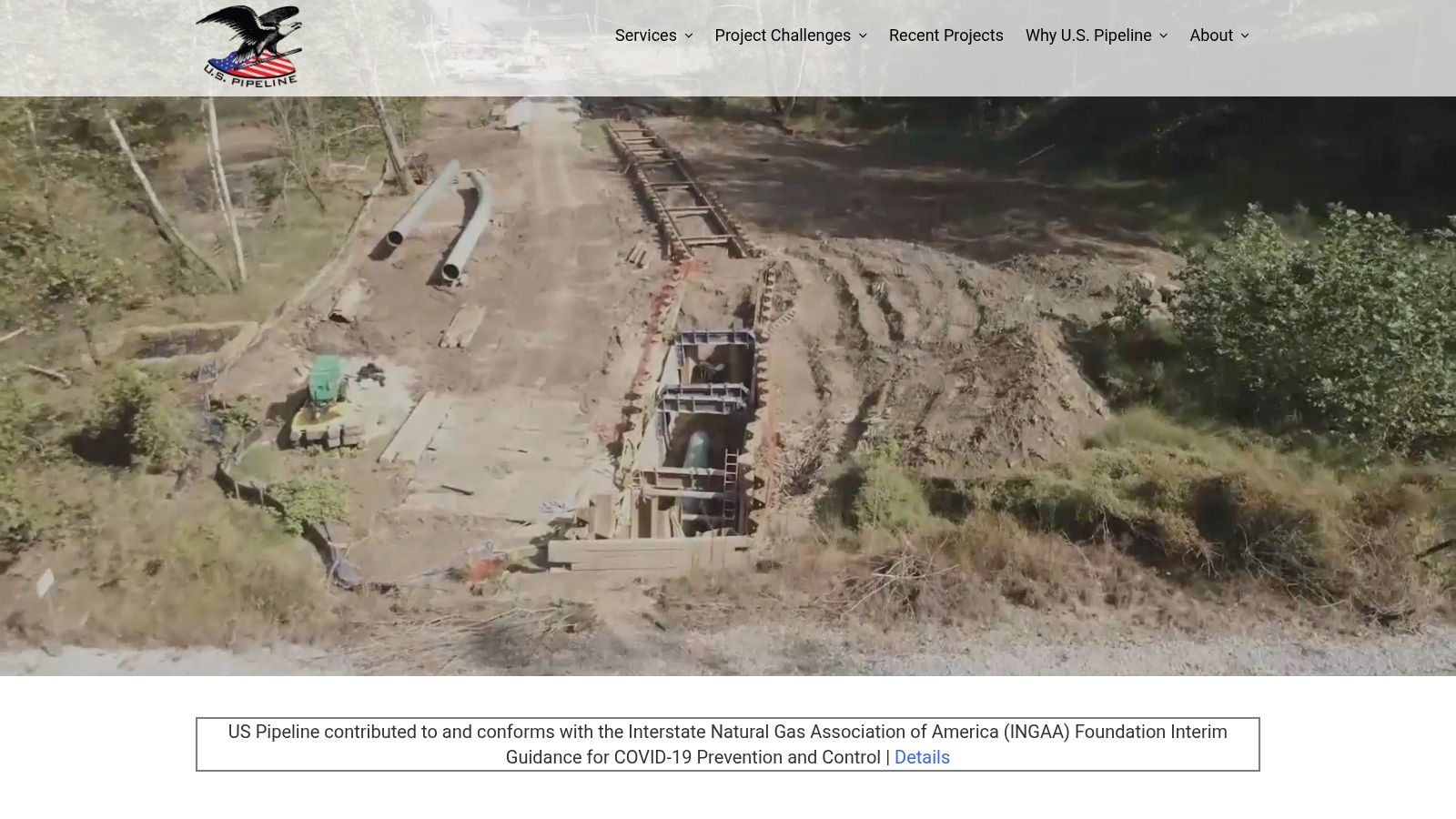
U.S. Pipeline often lands in a useful middle ground. They’re substantial enough for serious mainline and facility work, but they still feel more focused than some of the largest public EPC platforms. For buyers, that can be a good place to be.
USPL is Houston-based and emphasizes both pipelines and related facilities. That balance matters. Plenty of contractors can build line pipe. Fewer handle station and facility interfaces with equal confidence.
Why USPL deserves attention
The company positions itself around safety, quality, and schedule control across difficult environments, including urban and rugged conditions. From a buyer’s standpoint, the relevant question isn’t whether a contractor says those words. It’s whether the company’s portfolio suggests it can manage both open-country productivity and tighter, more constrained execution.
USPL’s history and scale support that case. It’s also the kind of contractor that makes sense when your project mixes line work with aboveground assets and you’d rather not split awards unless there’s a strong reason.
What to validate before award
USPL is still primarily a midstream oil and gas contractor. If you’re an owner with smaller utility, water, or municipal-style scopes, confirm that the job fits their target profile. Don’t assume enthusiasm on the front end means equal enthusiasm after award.
Also look closely at concurrent workload. Contractors with multiple spreads in motion can remain very capable, but your project team should verify exactly who is available and how many experienced supervisors are already committed elsewhere.
- Good fit: Mainline plus stations, terminals, or related facilities.
- Watch item: Appetite for smaller or non-midstream scopes.
- Bid advice: Ask how field QA/QC authority is structured between spread leadership and corporate oversight.
Procurement read
USPL is a practical shortlist candidate for owners who want a balanced contractor. Not too narrow. Not too sprawling. That’s often a smart procurement posture when the project has enough complexity to require depth, but not so much that you need the largest national machine.
I’d view them as especially competitive where schedule discipline and facility coordination matter as much as pure ditch production.
6. Michels Pipeline, Inc. (Michels Corporation)
Michels Pipeline earns a different kind of shortlist position than the broad midstream builders. In procurement terms, they become more attractive as crossing complexity rises, permit windows tighten, and the line route picks up urban utility conflict or industrial interface risk.
That distinction matters in Texas. A contractor that can self-perform or tightly control trenchless work changes the risk profile of the whole job, especially on spreads where one bad bore plan can consume the schedule float for everything behind it.
Where Michels fits best
Michels is a strong option for projects where the hard part is not miles of open ditch, but the segments that can stop the job. Water crossings, railroad crossings, dense utility corridors, refinery and plant approaches, and mixed urban-rural alignments all fit that profile.
From a procurement standpoint, the primary value is service bundling around technically difficult work. If the owner wants one contractor that can carry conventional pipeline construction while also taking responsibility for HDD or other trenchless scopes, Michels deserves a close look. That can reduce interface disputes between the line contractor and a specialty crossing subcontractor, which is often where accountability gets blurry.
Their Texas presence in Houston, Itasca, and Midland also supports local coordination. That does not replace project-specific staffing review, but it helps on logistics, client access, and regional execution support.
Trade-offs buyers should price correctly
Michels is usually easier to justify on projects where crossing execution is central to success. On a straightforward greenfield run with limited congestion and routine bores, owners may find better value from contractors built for volume production rather than specialty-heavy execution.
Capacity planning also deserves more scrutiny here than it does with a purely local builder. Michels works across multiple markets, and the best trenchless personnel are rarely sitting idle. Ask direct questions about who will run the crossing package, whether those crews are committed elsewhere, and how much of the trenchless work will be self-performed versus subcontracted.
A cheap unit rate on the line pipe spread does not help much if the critical crossing team is thin.
Procurement read
I would place Michels higher on the board for integrity replacements, technically constrained reroutes, brownfield segments, and mainline work where a few crossings carry a disproportionate share of execution risk. They are less compelling if your buying strategy is centered on lowest installed cost per mile across simple terrain.
The practical decision is scale-specific. For gathering systems with routine conditions, their specialty depth may be more than the job needs. For larger transmission work or any Texas project where below-grade risk drives schedule and claims exposure, that depth can be worth the premium.
7. MasTec – Oil & Natural Gas Pipeline Construction
MasTec is the portfolio play on this list. If the owner wants more than a line builder, and the capital program touches gathering, transmission, distribution, stations, rehabilitation, or adjacent infrastructure classes, MasTec becomes very compelling.
This is especially true for buyers who think in multi-year frameworks. MasTec is structured for program work, alliance models, and large EPC risk packages that would overwhelm a narrower contractor.
Why MasTec is different
MasTec’s dedicated oil and natural gas pipeline group covers a broad span of services, including gathering, midstream and transmission, compressor and pump stations, HDD, rehabilitation, and retirements. That broad service mix is useful when a Texas owner wants continuity across the asset lifecycle rather than rebidding every phase to a new contractor.
There’s also a strategic angle here for telecom and data-heavy sites. Recent market commentary points out that Texas added over 1.2 million new broadband connections in 2025 and saw a 25% surge in data center capacity since early 2025, creating more crossover demand around shared corridors and utility-adjacent builds, as summarized in this Texas contractor coverage gap analysis. MasTec’s multi-division structure makes that kind of adjacency easier to evaluate than it is with a pure-play pipeline builder.
The practical trade-off
Big platforms solve big problems. They also bring big-company realities. During peak windows, Texas capacity can book out. And if your project is only a small lateral tie-in or a compact repair scope, MasTec may be more contractor than you need.
Owners should also be disciplined about team specificity. A large enterprise can show broad capability while the local execution team varies materially from bid to bid. Procurement should press hard on actual assigned personnel.
- Strongest use case: Multi-asset or multi-year Texas programs.
- Potential drawback: Less efficient for very small standalone scopes.
- Owner move: Evaluate whether adjacent divisions create real value or just a larger proposal package.
Procurement read
MasTec is a smart shortlist addition when the owner wants optionality. Not vague optionality. Real optionality across asset types, phases, and related infrastructure needs.
For stand-alone simple work, I’d usually look smaller first. For broad capital programs with multiple interfaces and long-term buildout potential, MasTec is one of the more defensible choices in the Texas market.
Top 7 Texas Pipeline Contractors Comparison
| Contractor | Implementation complexity 🔄 | Resource requirements ⚡ | Expected outcomes ⭐ / 📊 | Ideal use cases 💡 | Key advantages ⭐ |
|---|---|---|---|---|---|
| Primoris Pipeline (Primoris Services Corporation) | High, large‑diameter, bundled EPC and HDD work | Large in‑state footprint, in‑house integrity/HDD teams | High quality delivery and strong safety record; reliable mainline execution | Long, large‑diameter Texas mainlines and bundled station+integrity contracts | Documented Texas performance and rapid mobilization across multiple offices |
| Strike | Medium–High, end‑to‑end EPC across sectors | Self‑perform across pipeline, integrity, cathodic protection, E&I; TX crews | Consistent delivery for pipelines and facilities; CO₂ capability growing | Local oil & gas pipelines, terminals, projects needing integrity/E&I work | Broad self‑perform capability and Texas HQ for fast response |
| Price Gregory International (Quanta) | High, multi‑spread, schedule‑driven mainline builds | Access to Quanta resources, large equipment pool, deep bench | High productivity on long spreads with established safety practices | Long cross‑country or high‑productivity transmission mainlines in TX | Tier‑1 parent support and proven mainline expertise |
| Pumpco, Inc. | Medium, heavy‑spread mainline focused on regional corridors | Large fleet and experienced Permian crews; local permitting know‑how | Efficient mobilization and delivery on multi‑county Texas routes | Permian Basin and intrastate Texas corridor projects | Strong Permian track record and logistics familiarity |
| U.S. Pipeline (USPL) | Medium, mainline plus stations with complex topography work | Experienced leadership and crews; Texas HQ and local knowledge | Balanced mainline and station execution with emphasis on quality/safety | Projects in rugged or urban Texas conditions needing local expertise | Strong local leadership and portfolio balance across facilities/mainline |
| Michels Pipeline, Inc. (Michels Corporation) | High, complex crossings and trenchless/HDD work | National fleet, specialized HDD/trenchless teams, Texas offices | Excellent performance on congested crossings; premium HDD execution | Congested corridors, waterways and major crossings (e.g., ship channels) | Extensive trenchless/HDD expertise for complex urban/industrial sites |
| MasTec – Oil & Natural Gas Pipeline Construction | High, multi‑asset, programmatic EPC work | Broad resource pool, cross‑division integration, strong financial capacity | Scales to multi‑year programs; integrates pipe, stations and civil works | Large multi‑asset programs and life‑cycle EPC in Texas | Program contracting experience and ability to integrate multiple asset types |
Finalizing Your Contractor Partnership
A contractor award that looks right at bid day can still fail in execution if the fit is wrong. In Texas, that usually shows up in three places first. Weak local project history, poor bundling fit, and a mismatch between the contractor’s operating model and your job size.
That is the filter I would use to close this process.
This list is most useful as a procurement tool, not a winner’s circle. The right pick depends on whether you are buying a greenfield mainline spread, a gathering buildout, an integrity package, or a bundled scope that includes stations, terminals, or civil work. A contractor can be excellent on large-diameter transmission and still be the wrong choice for a fast-turn integrity program or a smaller regional system where overhead and mobilization speed matter more than national scale.
Texas project history should carry real weight in final evaluations. Ask for recent in-state work that matches your terrain, permitting conditions, landowner environment, and crossing profile. A team that has worked West Texas spreads, Gulf Coast congestion, or urban utility conflict in the same part of the state will usually give you a more realistic execution plan than a bidder relying on general national experience.
Service bundling is the next decision point. If the scope includes pipe, stations, integrity digs, commissioning support, and owner coordination across multiple work fronts, companies like Strike or MasTec may justify the higher commercial load because they can carry more interfaces inside one contract. If the job is a straightforward mainline package with repetitive production work, a focused builder such as Pumpco or Price Gregory may be the better commercial fit. Owners often overspend when they buy a full-program platform for a narrow scope that does not need it.
Project scale matters just as much. Primoris, Price Gregory, Michels, and MasTec tend to fit larger or more complex programs where resource depth, specialty crews, and multi-spread management affect schedule certainty. USPL and Strike can be strong options where local knowledge, facilities coordination, and balanced execution matter more than sheer size. Michels stands apart when crossings and trenchless risk can control the whole job. If one HDD, water crossing, or congested utility segment can put your in-service date at risk, evaluate that capability separately instead of burying it in a general scorecard.
Commercial review should go beyond unit rates. Look at self-perform percentages, named superintendent and PM availability, equipment ownership, specialty subcontractor dependence, and how the contractor plans to staff QA/QC and environmental compliance in the field. I also want to see how they handle change management, daily reporting, weld traceability, hydrotest support, and station tie-in coordination. Those details decide whether an owner spends the project managing the builder or managing the asset.
Capacity checks need to happen before final budget lock. Ask each finalist what crews are available, not what could be available. Ask where the spread is coming from, which foremen move with it, and how many Texas jobs are competing for the same craft labor, inspectors, and welding resources. The answer is often more useful than the rate sheet.
Safety discussions should be specific. Request recent Texas incident history, corrective action examples, emergency response expectations, drug and alcohol enforcement, and field authority to stop work. The existing Texas safety and compliance gap review is a useful reminder that owner oversight still matters, especially when contractor presentations stay broad and polished but light on operating detail.
The best partnerships are usually decided before mobilization. Clear scope alignment, proven Texas execution, realistic staffing, and a contract structure that matches the job will do more for project outcomes than a small rate advantage ever will.
Southern Tier Resources is a strong fit for carriers, ISPs, data center operators, wireless teams, utilities, and enterprise owners that need a single accountable partner for fiber, wireless, and network infrastructure work in Texas. If your pipeline or utility corridor project also involves broadband expansion, make-ready construction, fiber splicing and testing, data center connectivity, or wireless deployment, Southern Tier Resources brings end-to-end engineering, construction, maintenance, and 24/7 mobilization backed by more than 20 years of experience.