You’re probably in one of two spots right now.
Either you’re running jobs the old way, bouncing between trailers, sites, vendors, and late-night schedule updates, and you’re wondering whether construction project manager jobs remote are real. Or you’ve already seen those listings, but they look vague, oddly broad, or designed for tech people who’ve never stood in mud, chased permits, or dealt with a crew waiting on material.
The good news is the roles are real. The better news is that telecom, fiber, wireless, and data center work have created a version of remote construction management that makes operational sense. But this shift only works for PMs who understand what can be managed from a desk, what still needs field verification, and how to build systems that close the distance between planning and execution.
I made that transition in telecom infrastructure, and the biggest lesson was simple. Remote project management in construction is not a lighter version of the same job. It’s a sharper one. The PM who succeeds remotely usually isn’t the person with the flashiest resume. It’s the person who can make scope, sequencing, communication, and accountability painfully clear before the first truck rolls.
The Rise of the Remote Construction PM
A lot of construction PMs still assume remote work belongs to software teams, not people coordinating permits, trenching, utility conflicts, inspections, and closeout packages. That assumption is outdated.
Recent job market data shows over 1,100 remote construction project manager roles on Indeed, with salaries commonly ranging from $90,000 to $158,000 annually, and the same dataset ties that demand to infrastructure investment including the $1.2 trillion Infrastructure Investment and Jobs Act of 2021 and a 5% projected growth in construction manager employment from 2022 to 2032 according to the cited labor data in the listing overview on Indeed’s remote construction project manager market snapshot.
What changed is the project mix. Distributed infrastructure is now a major employer of remote-capable PMs. Fiber expansions, small cell programs, utility coordination, and multi-site data center support all require heavy planning, vendor management, document control, cost tracking, and client communication. Those are PM functions that can be done remotely if the field reporting is disciplined.
What remote actually means in construction
Remote doesn't mean detached. It means the PM is no longer spending every day physically present just to prove involvement.
In practice, the strongest remote PMs handle work like this:
- Pre-construction control: scope reviews, permitting status, procurement tracking, scheduling, and subcontractor alignment
- Execution oversight: daily reports, issue escalation, RFI handling, client communication, and budget watch
- Closeout discipline: punch coordination, as-builts, turnover packages, and documentation completeness
The field still matters. Site superintendents, foremen, inspectors, and specialty leads still carry a huge part of execution. But the PM role has become more centralized and digital, especially on multi-location telecom work.
Remote construction management works when the office side gets tighter, not looser.
If you’re trying to gauge whether this path is credible, start by looking at roles focused on telecom, utility broadband, wireless upgrades, and mission-critical infrastructure. Those listings tell you where the model is strongest. A good example of that niche shift shows up in remote telecom-oriented construction opportunities, where planning, coordination, and technical oversight matter as much as physical presence.
Why Telecom and Data Centers Are Going Remote
Telecom and data center construction didn’t move toward remote PMs because it was trendy. They moved because the work is geographically spread out, schedule-sensitive, document-heavy, and hard to staff from a single local market.
A fiber build may involve municipal coordination in one place, utility dependencies in another, and splicing, testing, and restoration happening on separate timelines. A wireless upgrade may require landlord access coordination, material sequencing, tower crew scheduling, and photo documentation across several markets at once. A data center program adds another layer with power integration, structured cabling, vendor turnover requirements, and strict change control.
That kind of work rewards PMs who can manage multiple moving parts without driving site to site all day.
The business case is straightforward
In major markets like Virginia and Maryland, remote construction project managers earn an average salary of $92,364 yearly, with ranges reaching $185,000, and that often reflects a 15% to 20% premium over on-site roles. The same market data points to 284 dedicated remote roles in Virginia, a major data center corridor, tied to fiber broadband, 5G, and scalable cloud infrastructure demand on ZipRecruiter’s Virginia remote construction management listings.
That premium makes sense when you look at the responsibilities. These aren’t passive coordinator jobs. In telecom and mission-critical environments, remote PMs often manage multiple concurrent scopes, keep procurement aligned with fixed delivery windows, and resolve issues before field downtime turns into schedule damage.
Why these sectors fit remote better than general building
Remote PM work is strongest where projects share three traits.
| Project trait | Why it supports remote PM work |
|---|---|
| Distributed sites | One PM can coordinate several markets without losing time to constant travel |
| Repeatable workflows | Fiber, wireless, and data center packages often follow consistent phases and reporting routines |
| High documentation load | Permits, redlines, test results, QA records, and closeouts can be managed centrally |
General commercial building can support hybrid management, but telecom and data center work often produce cleaner remote workflows because the process depends so much on sequencing, approvals, vendor coordination, and reporting.
The more your project depends on information flow, the more valuable a disciplined remote PM becomes.
If your background includes utility coordination, outside plant, low-voltage systems, tower mods, structured cabling, commissioning support, or closeout management, you’re closer to this niche than you may think.
Adapting Your On-Site Skills for Remote Success
The biggest mistake I see is PMs trying to become “remote professionals” as if they’re entering a different trade. You’re not. You’re converting field-tested judgment into a more structured operating system.
If you’ve already managed schedule pressure, subcontractor friction, owner expectations, and field changes, the core skill is there. What changes is your method. Remote success depends on whether you can convert instinct into visible process.
Start with the project model you already know
Construction still runs largely on sequential dependencies. That matters because remote PM work gets easier when the plan is built in phase gates and everyone knows the handoff points.
Verified project management data shows 76% of construction projects use predictive Waterfall models, and one cited case study found 15% better efficiency for remote PMs using cloud-based tools, while also noting that poor requirements definition accounts for 35% of project failures on TaskFino’s construction project management statistics overview.
That matches what works in telecom. If the permit package is loose, the BOM is drifting, the customer’s scope notes are vague, or the field team is working off an outdated drawing set, remote management falls apart quickly. If pre-con is clean, remote management gets much easier.
What to digitize first
Don’t start by chasing every software platform in the market. Start by tightening the few workflows that control most project outcomes.
- Scheduling and dependencies: Use Microsoft Project, Primavera P6, or a disciplined milestone tracker in a shared environment. The key isn’t the brand. The key is one live schedule everyone trusts.
- Document control: Procore, Autodesk Construction Cloud, SharePoint, or a structured cloud folder system can work. What matters is revision control and permission discipline.
- Plan review and redlines: Bluebeam is hard to beat for markups, issue tracking, and keeping design conversations anchored to actual sheets.
- Daily coordination: Teams, Zoom, Slack, and email all work if roles are clear. They all fail when crews, subcontractors, and clients use different channels for critical updates.
Here’s the practical shift. On site, you can often recover from vague communication because you’re present to catch it. Remote, you have to prevent the ambiguity before it reaches the field.
The habits that transfer best
The PMs who transition fastest usually lean on old-school strengths:
Reading scope carefully
If you can spot a missing assumption in a pre-bid walk or turnover call, you can do the same in a remote kickoff.Sequencing work realistically
Telecom jobs fail when people pretend parallel work is possible when it isn’t. Remote PMs need to say that early.Controlling procurement pressure
Material timing doesn’t care where the PM sits. A remote PM with a tight buyout and submittal rhythm often outperforms a distracted on-site manager.
Practical rule: If a field lead has to guess what you meant, your remote process is broken.
For PMs coming from more traditional site-heavy roles, it helps to study how remote-oriented construction employers describe execution, reporting, and coordination expectations in construction management roles built around digital oversight. You’ll notice they’re not asking you to abandon construction fundamentals. They’re asking you to make them visible and repeatable.
Crafting Your Remote-Focused Resume and Profile
Most resumes for construction PMs read like they were written for a local GC in a conference room interview. That’s a problem. Hiring managers for remote telecom and data center roles scan for proof that you can run work through systems, not just presence.
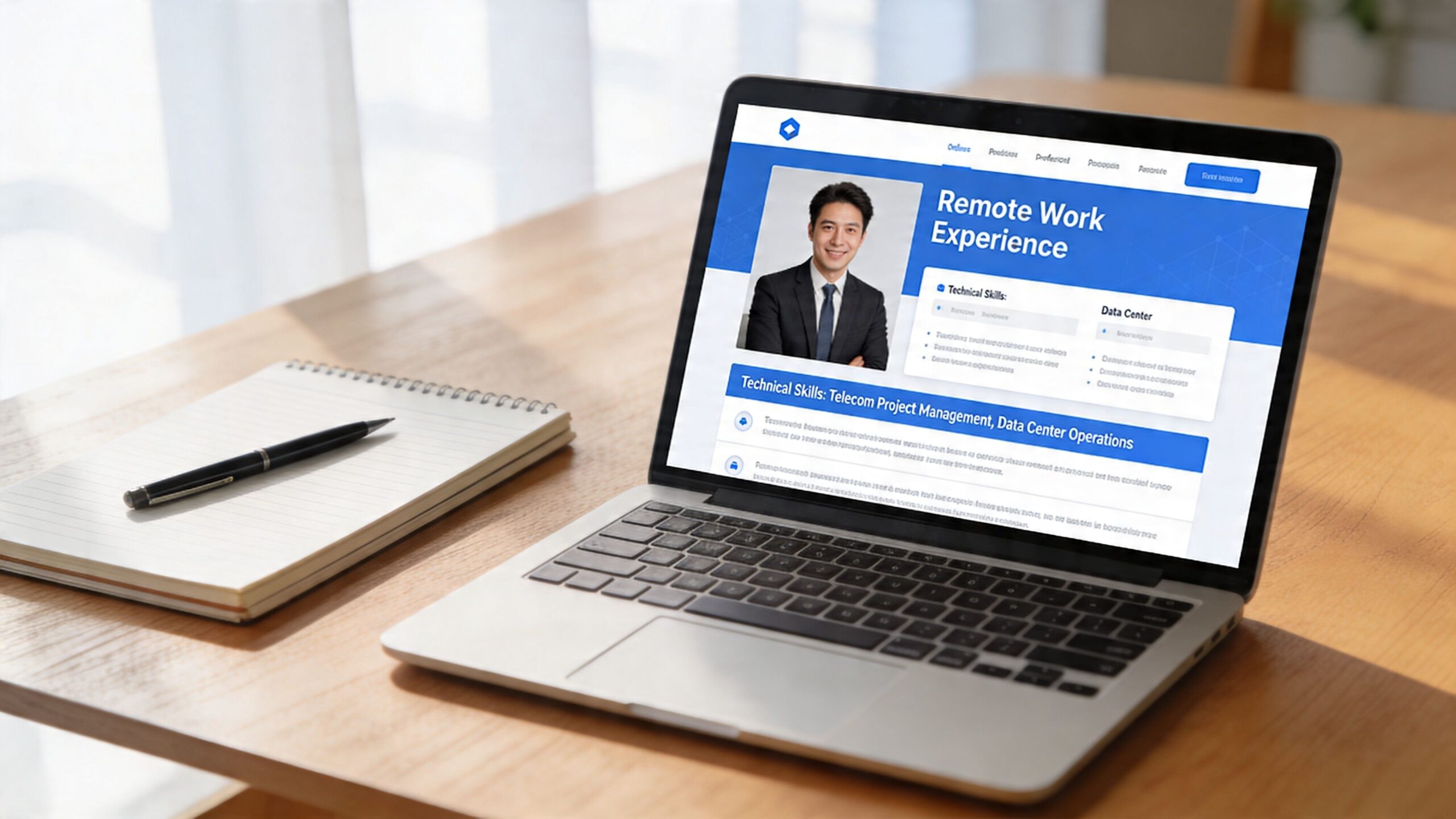
A remote-ready resume should answer four questions fast. Can you manage distributed teams? Can you control scope and documentation? Do you understand telecom or critical infrastructure language? Can you communicate clearly without hand-holding?
Rewrite your experience around outcomes and systems
Don’t just say you “oversaw projects.” That phrase tells nobody how you work.
Use bullets that show remote-relevant execution, such as:
- Coordinated fiber construction across multiple municipalities, including permit tracking, utility communication, and subcontractor scheduling
- Managed drawing revisions and closeout packages using Bluebeam, Procore, or shared document control platforms
- Led remote meetings with field supervisors, vendors, and client stakeholders to resolve schedule constraints and material issues
- Tracked budget exposure, change requests, and procurement status across concurrent infrastructure scopes
You don’t need to invent flashy metrics. In fact, don’t. What hiring teams want is believable operational detail.
Use the right language for the niche
For telecom and data center work, keywords matter. ATS filters won’t save a weak resume, but they can block a strong one if you describe your work too generally.
Include terms that match your actual experience, such as:
- Fiber-optic deployment
- Make-ready construction
- Small cell
- Macro tower upgrade
- Utility permitting
- Structured cabling
- As-built documentation
- QA/QC
- Closeout
- Hyperscale fit-out
If you want a useful breakdown of resume formatting and keyword strategy for remote roles in general, this guide on how to beat ATS and land your next remote job is worth reviewing before you start editing.
If you don’t have a degree
This comes up constantly, and the answer is more practical than people expect.
Verified job market guidance shows there are remote PM openings that don’t require a traditional degree, but the transition path is poorly explained. The clearest bridge is for skilled tradespeople and on-site supervisors to add credentials such as PMP and telecom-specific training, then position themselves for work involving utility permitting, lease negotiations, or macro tower upgrades through Indeed’s no-degree construction project manager listings in New York.
If that’s you, build your profile around credibility, not apology.
- Lead with field responsibility
- Show progression from crew or supervision into coordination
- Put certifications near the top
- Mention software you use
- Highlight remote-friendly tasks you already own, such as permit follow-up, vendor calls, reporting, documentation, and schedule updates
Your lack of a degree matters less when your resume shows that crews, clients, and subcontractors already trust you with execution.
A good final check is to compare your resume language with the wording used in current remote construction and telecom job postings. If your profile sounds generic while the posting sounds specific, rewrite until the gap closes.
How to Nail the Remote Interview
The remote interview is where a lot of solid PMs lose ground. Not because they lack experience, but because they answer like they’re interviewing for a traditional site role. The company is testing two things at once. Your project judgment and your ability to operate clearly through a screen.

Your setup matters more than people admit. Use a stable camera angle, clean audio, neutral background, and decent lighting. If your connection is unreliable, fix it before the interview. A remote PM candidate who struggles to communicate in a remote interview creates an obvious concern.
What interviewers are really trying to hear
They usually care less about polished theory and more about how you think when the field is moving and you aren’t physically there.
Expect questions like these:
| Question | What they’re testing |
|---|---|
| How do you handle a material delay on a site you can’t visit that day? | Escalation logic, vendor management, and schedule recovery |
| How do you verify QA/QC remotely? | Reporting discipline, photo review, camera use, and trust but verify habits |
| How do you keep crews aligned across multiple jobs? | Communication rhythm and prioritization |
| How do you manage scope creep when clients email changes informally? | Documentation control and change discipline |
Strong answers usually follow a sequence. Clarify the issue, identify the decision owner, confirm field reality, document the next step, and close the loop with stakeholders.
Use specific examples without over-talking
A concise answer beats a long one. Try this structure:
- State the scenario
- Describe the process you used
- Explain how you verified the field condition
- End with the business result
For example, if asked about remote oversight, talk about daily reports, photo logs, revised schedule communication, and documented owner updates. Don’t wander into vague leadership language.
This short video is a useful refresher before your call.
Remote interviews favor PMs who sound organized under pressure, not PMs who try to sound impressive.
One more thing. Have your own questions ready. Ask how the company handles field reporting, what software stack they use, how often PMs travel, who owns QA signoff, and how scope changes move from field discovery to client approval. Those questions signal that you already understand the job.
Excelling as a Remote Telecom Project Manager
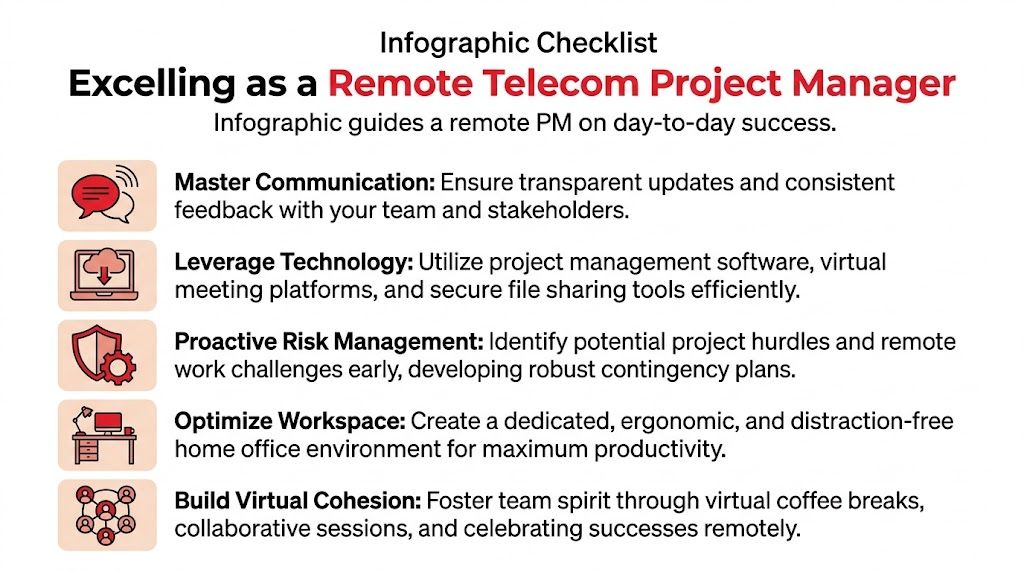
Landing the role is one hurdle. Performing well in it is another. Remote telecom PM work gets messy when teams confuse visibility with control. Seeing more dashboards doesn’t automatically mean the project is healthier. The core job is building a system where field facts reach decision-makers quickly, scope stays stable, and nobody is working from assumptions.
Verified project data shows project performance is nearly identical between remote teams at 73.2% and in-person teams at 74.6%, but construction has unique constraints because only 3% of construction PMs work fully remotely. The same data warns that vague requirements account for 35% of project failures and points to communication structure, construction cameras, and AI cross-checking of requirements as critical controls in remote environments on ElectroIQ’s project management statistics analysis.
What works in the real world
Remote PM success in telecom usually comes down to a few operating rules.
Build one communication chain
If the client uses email, the GC uses Teams, the field texts photos, and the subcontractor calls only when something breaks, you don’t have a communication plan. You have noise.
Set one primary route for each category:
- Urgent field issues: direct call, then written recap
- Daily production updates: standardized report with photos
- Design or scope questions: formal RFI or tracked issue log
- Client-facing status: scheduled update with current decision list
That structure prevents the common failure mode where everyone has part of the story and nobody has the full picture.
Verify conditions visually
Construction cameras help. So do drone captures where appropriate, photo logs, annotated markups, and disciplined daily reports.
I don’t trust “site is on track” as a status update. I trust marked-up plan sheets, timestamped progress photos, open issue logs, and a field lead who can explain what changed since yesterday.
A remote PM should never wait for a problem to become visible in the schedule before checking whether it was visible in the field.
Requirements discipline is the whole game
Most remote failures don’t start with technology. They start with fuzzy assumptions early in the job.
Use a pre-con checklist that forces clarity on:
- Permit status and jurisdiction dependencies
- Material responsibility and long-lead items
- Testing and acceptance criteria
- Closeout deliverables
- Who approves field deviations
- Escalation path for safety or access issues
AI tools can help cross-check requirement lists and catch missing items, but they don’t replace PM judgment. If the base scope is weak, software just helps you move confusion faster.
Keep field trust high
Remote PMs fail when crews feel managed from a distance by someone who doesn’t understand conditions. That’s a relationship problem before it becomes a schedule problem.
Three habits fix that:
Respond fast to field questions
Crews lose confidence when they report blockers and hear nothing.Make reporting useful, not theatrical
Don’t demand forms nobody reads. Ask for what helps decisions.Visit when the moment matters
A remote role can still include targeted travel for kickoff, critical milestones, customer escalations, or turnover.
The best remote telecom PMs aren’t absent. They’re deliberate. They know when to stay in the control tower and when a site visit will solve in one hour what video calls won’t solve in two days.
Frequently Asked Questions About Remote PM Roles
Do remote construction PMs still travel
Usually, yes. Remote rarely means zero travel in telecom or data center work. It usually means you aren’t tied to daily site presence. Expect travel for kickoffs, client meetings, escalations, milestone reviews, or sensitive turnover phases.
Is work-life balance actually better
Sometimes. You cut commute time and random site interruptions, which helps. But remote PM work can also blur boundaries fast because crews start early, vendors call late, and issues arrive from multiple jobs at once. The fix is structure. Set communication windows, keep a hard task list, and don’t let every text become an emergency.
Can someone move into these roles from the field
Yes, especially from superintendent, assistant PM, foreman, fiber supervisor, OSP coordinator, or wireless construction backgrounds. The transition is easier when you already own documentation, scheduling, subcontractor communication, permit follow-up, or closeout tasks. Add certifications if they strengthen your credibility, then make sure your resume shows coordination skill, not just field toughness.
What kind of personality does well remotely
Calm, direct, organized, and hard to rattle. Remote PMs need follow-through more than charisma. If you naturally document decisions, ask clarifying questions early, and close loops without being chased, you’ll do well.
Is remote PM work a good long-term path
It can be. These roles can lead into program management, client-side owner representation, PMO leadership, operations management, or specialized infrastructure delivery roles. The strongest long-term advantage is that you learn to manage systems, not just sites.
If you’re looking for a partner that understands how remote coordination and field execution have to work together in telecom infrastructure, Southern Tier Resources is worth a close look. Their work across fiber, wireless, and data center infrastructure reflects the kind of disciplined planning, documentation, safety focus, and end-to-end accountability that remote construction PMs need to understand if they want to build a durable career in this niche.