
Four bids land within a week of each other, all quoting the same route, and the numbers don't look like they came from the same project. One is low enough that finance wants to sign it today. Another arrives wrapped in assumptions nobody on your side wrote down. The spread is rarely a measure of how badly the expensive contractor wants the work. It measures how differently each bidder filled the gaps in the package you handed them.
This trade exists because fiber stopped being an experiment fast. Two years after the U.S. government ran fiber between computers at the North American Aerospace Defense Command facility in 1975, AT&T installed the first optical telephone system beneath downtown Chicago, with each fiber carrying the equivalent of 672 voice channels, and the first transatlantic cable, TAT-8, entered service in 1988 carrying approximately 40,000 simultaneous voice calls against about 4,000 on the system it replaced (Fiber Optic Association telecom history). Specialist installation work has been a discipline ever since.
Volume explains why buyers get so many bids to compare. Worldwide fiber sales rose from 6.74 million kilometers in the late 1980s to 22.87 million kilometers by 1995, peaked at roughly 80 million kilometers outside China in 2000, fell to 43 million in 2003 and recovered to 128 million in 2013, when cumulative global communications installation passed 2.1 billion kilometers (Optical Society history of optics). That is a market split between new construction and lifecycle work, which is exactly the split you have to price.
The rule I hold to: the bid number is a promise about assumptions. If the assumptions aren't in writing, the number isn't a price. It's an opening position.
Judge fiber optic installation contractors on two things: how ready they are before crews mobilize, and how much measurable evidence they hand back at acceptance. Price per foot is a symptom of both.
RFP Checklist for Fiber Installation Bids
Most of the spread between two bids for the same route comes from different assumptions, not from one crew being dramatically more efficient. A bidder who assumes every pole is ready to attach and every permit clears on the first review is pricing a different project than the bidder who assumes rock, congested poles and a municipal reviewer with a backlog. The only way to compare them is to force both onto the same written package.
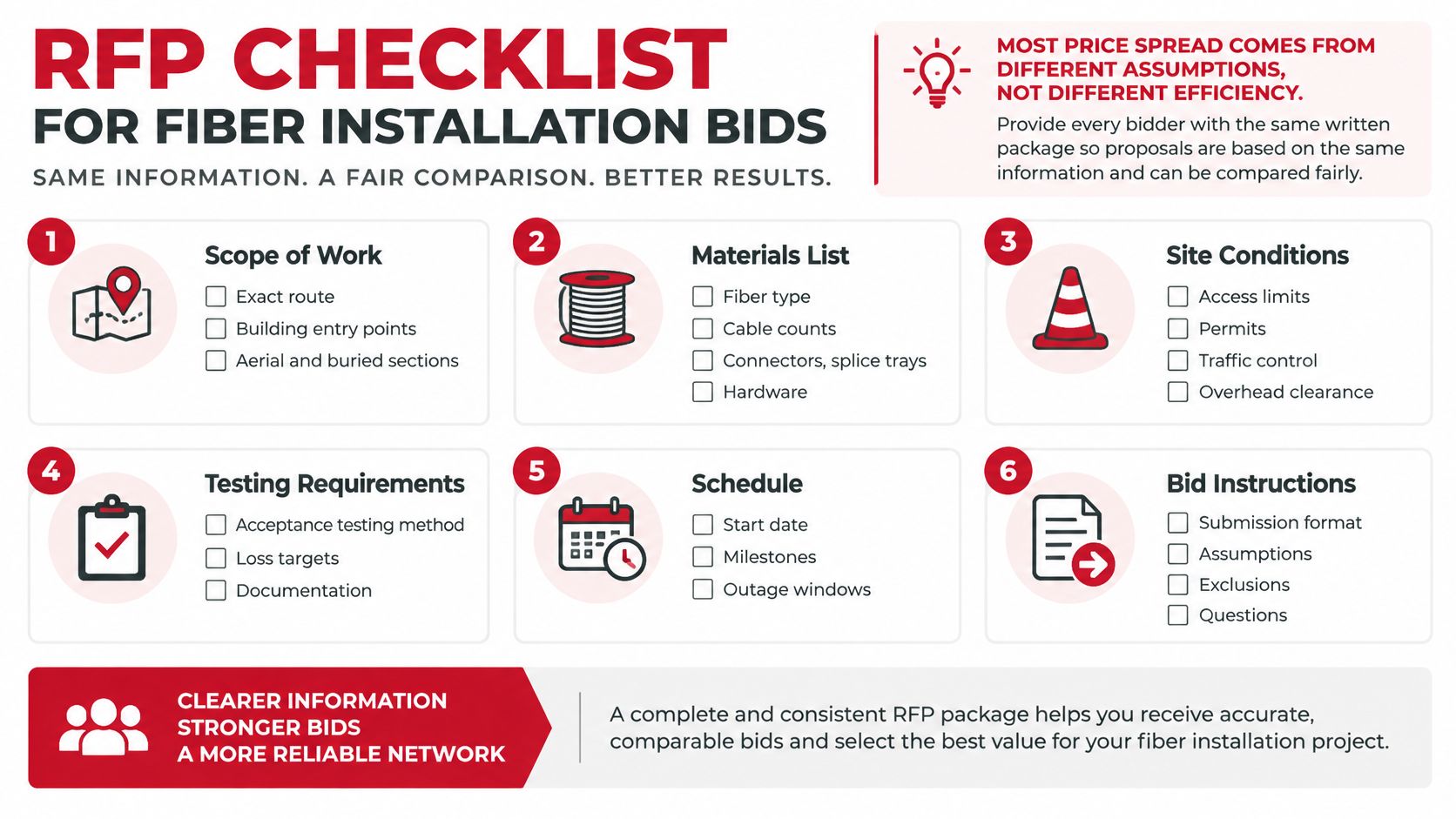
Ten items every bidder receives
- Route maps and GIS files with obstacles marked. Flag rock, existing conduit, congested pole lines, rail crossings and anything that changes method. A bidder who finds rock on day one files a change order. A bidder told about it in the package puts a price on it.
- Pole owner names and attachment data for every segment. Without it, make-ready becomes a guess, and the guess lands on your side of the invoice.
- A permit matrix stating who files each permit, who pays each fee and the expected review time per jurisdiction. Most bid disputes about permits are really disputes about an unstated assumption.
- Aerial versus underground assumptions by segment, with the reason for each. This stops one bidder pricing the whole route as strand and another pricing the whole route as bore.
- Fiber, splice and connector counts, plus the test wavelengths of 1310 nm and 1550 nm. Counts drive material and labor; the wavelengths drive what the test set has to be configured for.
- The acceptance specification, including insertion-loss limits and the per-splice loss benchmark unless a stricter limit applies. A bidder who plans to hand over OTDR traces as its proof is bidding a different acceptance standard.
- The as-built format, file type and delivery date. Say GIS-linked files with test traces attached, not a scanned PDF delivered after final payment.
- Minimum crew size, mobilization window and key personnel. Names or roles, not "experienced crews available."
- Insurance limits and the safety program, including locate-ticket compliance and traffic control responsibility.
- Disclosure of every subcontractor you will see on site, with the scope each one holds.
Set a question deadline ten business days out
Bidders who spot a gap late either pad the number or plan to argue about it later. A question deadline about ten business days before bids close forces gaps into the open while the package can still be fixed. Publish every written answer to every bidder so nobody prices a private version of the job. The mechanics of why the lowest bid can lose run through this exact step, because a bid answered on an unstated assumption is not comparable to anything.
Reject any bid that changes an assumption without an explicit, line-item price adjustment. That single rule does more for budget discipline than another round of negotiation. We keep open solicitations in our RFP Listings section for the same reason: the cleaner the package, the shorter the gap between what the buyer knows and what the bidder knows.
Scorecard and Crew Depth Review
Say two bids come back for a 60-kilometer aerial rebuild. The lower one is missing pole data for a third of the route and names no permit owner. On the form it wins. On the schedule it loses, because that missing data turns into make-ready surprises after crews are already staged and the make-ready clock is running against revenue. A scorecard keeps the award tied to total cost and to evidence you can check, not to the cheapest figure on page one.
The weights and the evidence
| Criterion | Weight | Evidence to request |
|---|---|---|
| Pre-construction and permit readiness | 20% | Named permit owner, pole-record review method, redesign process |
| Make-ready and pole-attachment forecasting | 15% | Make-ready estimate tied to pole data, log of past owner delays |
| Splicing and testing competency | 20% | Certified splicer list, sample insertion-loss and OTDR reports |
| Crew depth and staffing resilience | 15% | Foreman-to-technician ratio, named backup crews |
| Safety record | 10% | Incident rate for the last three years, locate-ticket compliance |
| Documentation quality | 10% | Sample GIS-linked as-builts, test trace delivery format |
| Schedule and mobilization | 10% | Mobilization time in days, baseline schedule with float |
Score each bidder 1 to 5 per criterion, multiply by the weight, add the total. Then apply floors: no score below 3 on permit readiness, splicing and testing competency, or safety. Floors matter more than weights. A bidder that looks strong on documentation and mobilization but scores 1 on permit readiness should be disqualified, not averaged into second place by a good presentation.
Crew depth is the number that moves
A Pew analysis of broadband workforce demand estimates the sector will need approximately 28,000 additional broadband construction workers and 30,000 additional technicians by 2032, while retirements and departures could exceed the number of new workers required. The same summary cites a Government Accountability Office estimate of roughly 477,700 fixed-broadband workers and 88,600 mobile-broadband workers. That is the pool against federally funded deployment volume.
Hiring fast doesn't fix it. The failure mode isn't a shortage of bodies, it's a shortage of supervision. A foreman running three crews of new technicians produces splice loss, rework and as-builts that don't match the field, and you discover all three at acceptance.
Ask this before award: who is the named foreman on this route, and how many technicians has that foreman taken through a full acceptance cycle?
Six questions expose staffing resilience faster than any reference call. What is the foreman-to-technician ratio on the proposed crews? Who on staff is certified to run insertion-loss and OTDR testing, and will those people be on this job? Which senior splicers are named, by name? What backup crews exist if a build slips, and where do they come from? How are subcontractors controlled and audited? How does knowledge pass from a retiring senior splicer to the technicians who will maintain this plant in five years? We hold crews and equipment available around the clock for exactly this reason, since cutovers and outages don't schedule themselves into business hours.
Pre-Construction Readiness and Contract Terms
A bid at $4 a foot looks clean until the permit package is thin and the make-ready numbers came from a pole list nobody walked. Crews stage, the utility still has not released attachments, and the unpriced work shows up as standby, redesign, and another month before the first customer can be turned up. I rank contractors on pre-construction readiness and on acceptance evidence you can measure, and I treat price per foot as the last filter. Permitting and make-ready are the cost drivers that move spend out of the unit price and into change orders, idle time, and delayed revenue. Standardized pole-attachment records tighten both the cost estimate and the schedule, and clearer timeline and cost-allocation rules cut the disputes that stall a route.
Intake data that decides the schedule
A contractor cannot forecast make-ready from pole numbers alone. The bid needs pole and underground records checked against a field survey, locate responsibility named per segment, rights-of-way confirmed rather than assumed, and a permit timeline for each jurisdiction. Ask for the data source behind every make-ready figure. If the answer is "experience," the number is a placeholder for a later invoice.
Aerial or underground, segment by segment
The method turns on pole condition, the owning utility's make-ready backlog, trenching limits such as rock or pavement, and what restoration will cost. Aerial usually wins on unit cost until pole replacements or an owner backlog erase that edge. Underground usually wins on reliability and on fewer attachment fights, until rock or a crossing forces a method change in the middle of the build. Decide per segment, write the reason, and give that reason to every bidder so the unit rates match the work.
| Contract term | What to specify | Why it matters |
|---|---|---|
| Permit responsibility | Named party for each permit and who pays fees | Stops filing delays from becoming a blame argument |
| Route changes and redesign | Unit rates and approval steps for new routes | Keeps a denied attachment from becoming an open check |
| Owner-caused delay | Standby rates and time extension rules | Separates owner delay from contractor slippage |
| Test acceptance | Pass/fail insertion-loss and OTDR limits, retest at contractor cost on failure | Holds payment to measured link performance |
| Warranty and rework | Defect period and response time for faults | Caps repair duty instead of leaving it open |
| Staffing commitments | Mobilization time, crew size and named key personnel | Turns staffing language into a term you can enforce |
| As-built delivery | Format, delivery date and retention of traces | Gives operations a baseline for later fault isolation |
Redesign triggers need their own clause. A denied attachment, a new utility crossing, or a right-of-way refusal will show up on a real route. Without agreed unit rates and a named approver, crews sit while two offices trade letters, and revenue stays off the books.
Four contract answers close the file before award. Who files each permit, and who pays? How many make-ready days does the bid assume, per segment? What is the standby rate when the owner causes the wait? Who approves a route change, and in how many days? Sign only terms that match the scorecard and the RFP, in writing, before notice to proceed. Southern Tier Resources covers that path end to end, from design through deployment and maintenance. Pre-construction questions that need a fast answer can go to (469) 405-4671.
Scheduling, Permitting Workflow and Common Pitfalls
Award is not mobilization. The weeks between them decide whether the schedule holds, and they follow a fixed order.
- Name the permit owner and file. One named person on each side, one tracking log, review time measured against the make-ready window rather than against the calendar.
- Confirm pole-owner make-ready dates. Get dates in writing per attachment before you set crew start dates. An unmade-ready pole is a crew standing still.
- Submit locate tickets and verify clearance per segment. Verify before crews enter the route, not the morning they arrive.
- Issue notice to proceed only after the permit matrix and any route changes are approved in writing. Verbal approvals are how a build ends up half-permitted.
- Mobilize against a baseline schedule with float, and hold a weekly checkpoint on open permits, make-ready status and redesign requests. Same agenda every week, same log.
Five pitfalls and the fix for each
- Pricing on unverified pole data. Fix: require the data source behind each make-ready figure and reject bids that won't name it.
- Nobody owns the permits. Fix: the permit matrix in the RFP, with a named party and a fee payer per permit.
- An OTDR event-loss estimate accepted as total link loss. Fix: make end-to-end insertion-loss testing the payment gate, and treat traces as diagnosis.
- Staffing promises that live only in the proposal. Fix: key-personnel and mobilization terms in the agreement, with the foreman named.
- Accepting a test run with a dirty or damaged reference connector. Fix: endface inspection before every mating and rejection of any test performed without it.
Keep the checkpoint log with the as-built package. When a dispute arrives eight months later, a dated decision beats anyone's memory of the meeting.
Field Controls That Prevent Failures in Aerial and Buried Builds
Route marking and locate accuracy come first because excavation is the dominant external threat to a buried plant. Failure data presented to IEEE 802.3 put dig-ups at 172 reported failures, or 57% of the dataset, with craft or workman errors at 7% (failure data presented to IEEE 802.3).
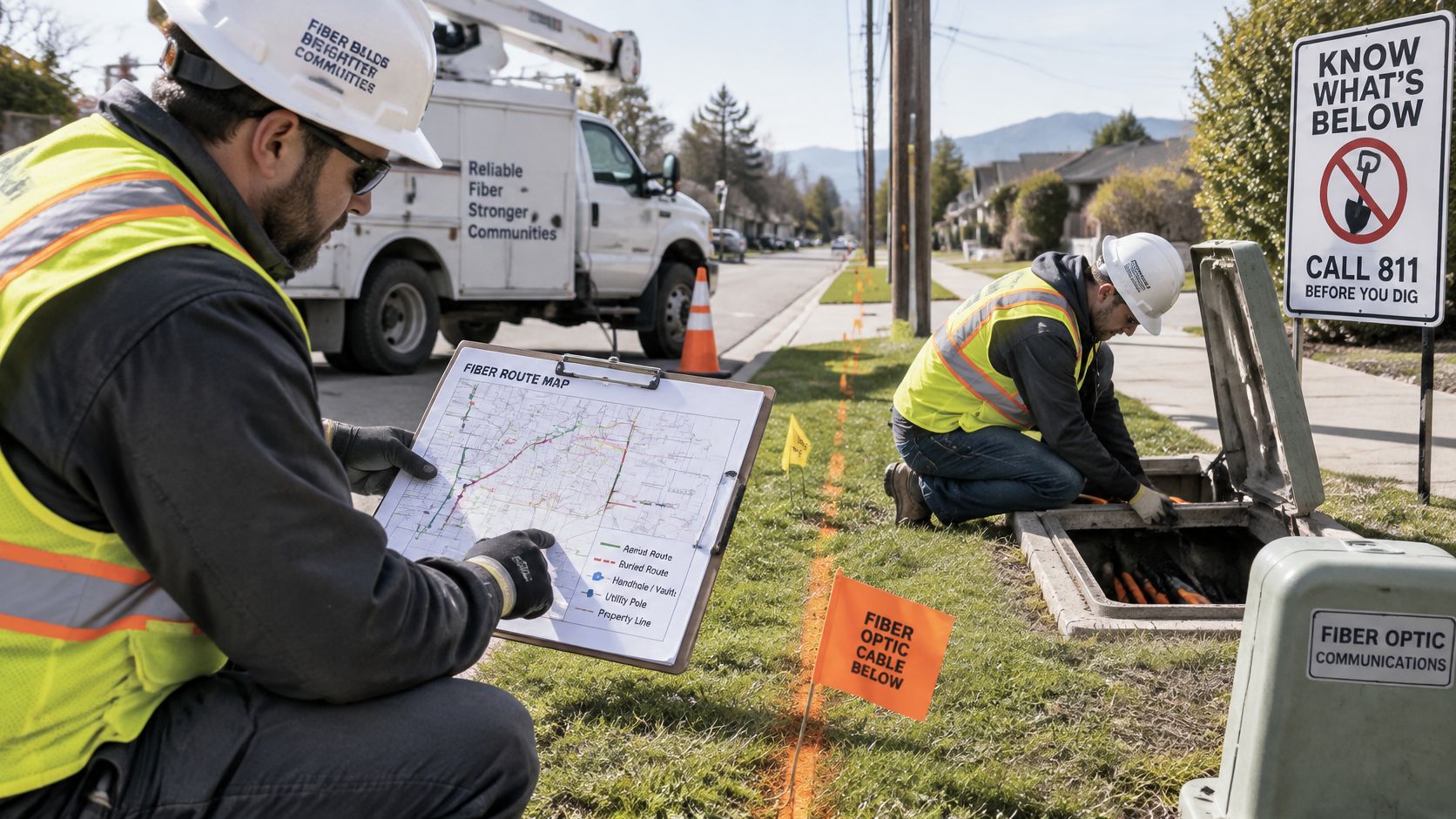
That ratio sets the priority order. Accurate GIS records, visible marking and post-construction protection buy more reliability per dollar than any splicing refinement, because a third-party excavator can undo a perfect splice in one bucket stroke.
The field sequence that holds up
- Reconnaissance and clearance first. Walk the route, verify utility clearances, and resolve conflicts on paper before a reel moves.
- Controlled placement. Monitored pulling tension or blown cable, logged per segment, with minimum bend radius checked at every turn and vault entry.
- Slack and closures. Form slack loops where splicing will happen, then seal closures properly. Slack added after the fact is slack added badly.
- Termination discipline. Connector inspection, approved cleaning materials only, endface inspection and polarity verification before any test is recorded.
Contamination is the second recurring failure, and it's entirely preventable. The same IEEE 802.3 failure review cites an NTT-Advanced Technology study reported by EXFO finding that 96% of installers and 80% of network operators had encountered connector endface contamination, while 81% of installers reported ferrule endface damage. Dust caps during staging, inspection of every mated endface, and no deformation of the cable sheath at clamps and closures cover most of that exposure.
A dirty connector can turn a passing link into a failing one and back again, which is why test results taken with a suspect reference connector are worthless.
Close the loop with field records a maintenance crew can use years later: GPS or GIS-linked as-builts, closure locations, spare slack, cable identifiers, test direction, wavelength and environmental conditions at test time. Records are the only part of the build that outlives everyone who did the work.
Testing and Acceptance Sequence for Fiber Links
Acceptance runs on two complementary measurements, not one. First, calculate the link-loss budget from fiber length, connector count, splice count and wavelength-dependent attenuation. Then verify the built link end to end. Insertion-loss testing with a calibrated light source and power meter, or an optical loss test set, is the primary acceptance measurement, and it is what international cabling practice requires. OTDR traces come second, to check individual splice quality, locate reflective events, find excessive bend loss and troubleshoot a section that reads abnormal.
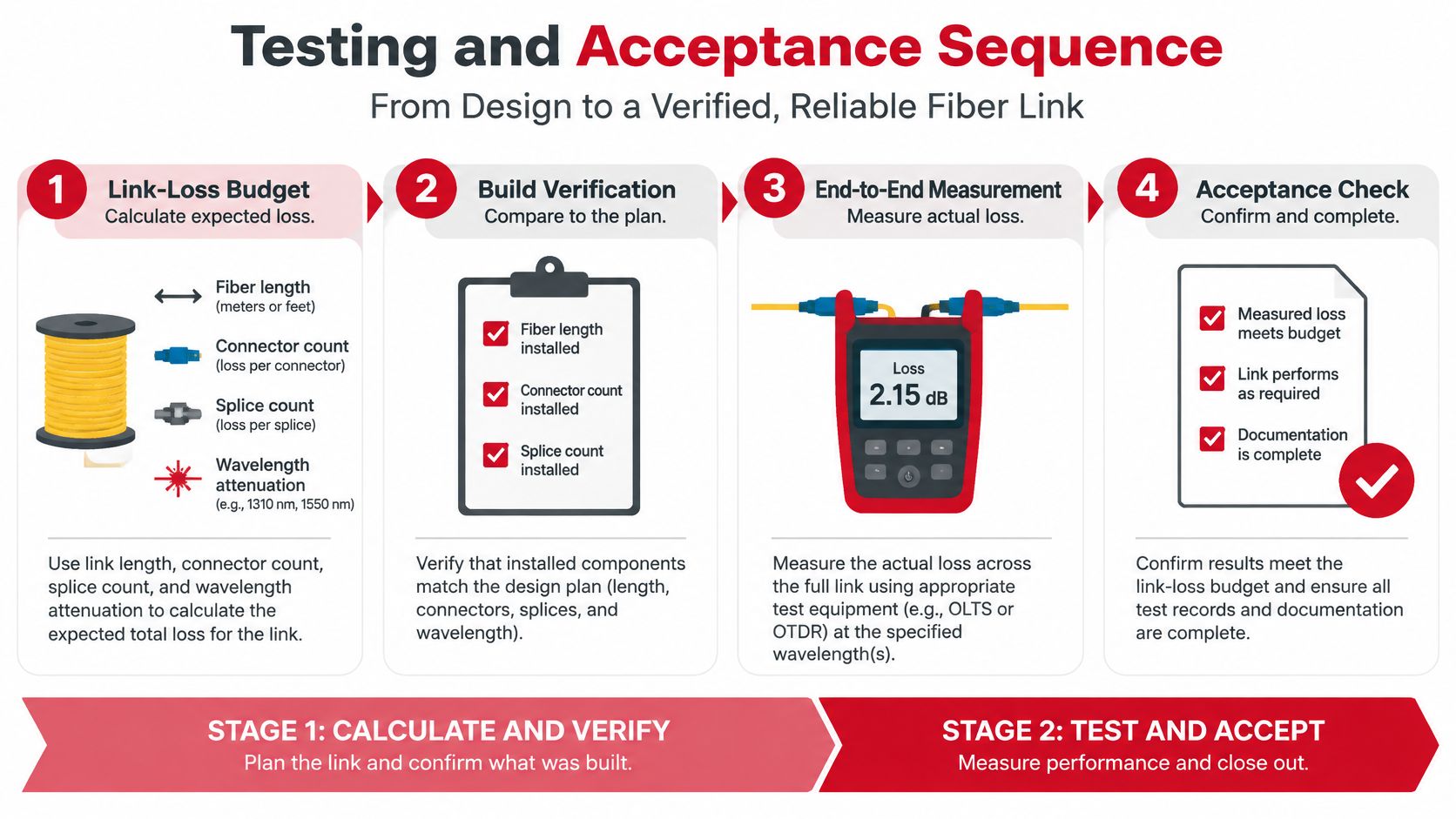
For outside-plant links, test each splice from both directions and average the results to cancel directional measurement effects. A U.S. federal telecommunications specification offers a practical benchmark: unless a contract sets a stricter limit, each single-mode field splice should not exceed 0.2 dB at 1310 and/or 1550 nm, with readings averaged bidirectionally (fiber test accuracy guidance).
The sequence written into the contract
| Test | What it proves | When to run | Pass reference |
|---|---|---|---|
| Link-loss budget calculation | Expected total loss from length, connectors, splices and wavelength | Before installation | Design budget written into the contract |
| End-to-end insertion-loss test | Total measured link loss with a calibrated source and power meter | After splicing, primary acceptance | Contract limit or design budget, whichever is stricter |
| Bidirectional OTDR trace | Individual splice losses, bend loss and reflective events | After splicing, each fiber, both directions averaged | 0.2 dB or less per field splice at 1310 and/or 1550 nm unless stricter |
| Connector endface inspection | Contamination or damage before each mating | Before every connection | Clean, undamaged endface under magnification, re-cleaned and re-inspected if residue appears |
| Polarity verification | Correct transmit and receive pairing across the link | After termination | Matches the as-built polarity map |
The pitfall that causes the most arguments is treating an OTDR event-loss estimate as total transmission loss. OTDR is an indirect diagnostic technique. It does not replace insertion-loss testing for final cable-plant acceptance, and a contract that says otherwise leaves you arguing about two numbers that measure different things.
Keep the whole evidence package: wavelength-specific traces, launch and receive fiber records, instrument calibration records, loss-budget calculations, splice maps and exception reports. That package separates link-level performance from component-level diagnosis, which shortens disputes, backs warranty claims and gives the next crew a baseline. Contract language for this kind of evidence belongs in the same review as the rest of your contracts for telecommunications infrastructure, because acceptance terms written after commissioning are just negotiation.
When you're ready to put these tests into a contract rather than an argument, Southern Tier Resources handles fiber construction, splicing and testing with detailed as-built documentation behind every link, from design through deployment and maintenance. Our crews work aerial and underground routes, including trenching, directional boring, fiber blowing and pole attachments, so the same team that builds the plant can prove it passes. Visit Southern Tier Resources to scope your next build against a package you can compare bids on.