
Make-ready work is the regulated preparation of an existing utility pole so that a new communications attachment can be installed safely. It's the work that has to happen before fiber, coaxial cable, or wireless equipment goes up, not the installation itself.
If you're planning a broadband route, you've probably hit this already. The design's done, the crew's ready to lash fiber, and then someone says the poles aren't ready yet. Months can pass before that changes. That gap isn't usually a crew speed problem. It's misclassified work, incomplete surveys, and waiting time controlled by the pole owner and existing attachers.
I would treat make-ready as your main schedule risk, not a minor field task. Get the classification, engineering, and responsibilities right before you book construction, and your start date becomes far more predictable.
What Make-Ready Work Means for an Existing Pole
A pole route can be designed and a fiber crew booked, yet construction cannot begin until the existing pole is ready for the new attachment. The delay often comes from approvals, engineering, or coordination, not from how quickly a crew works.
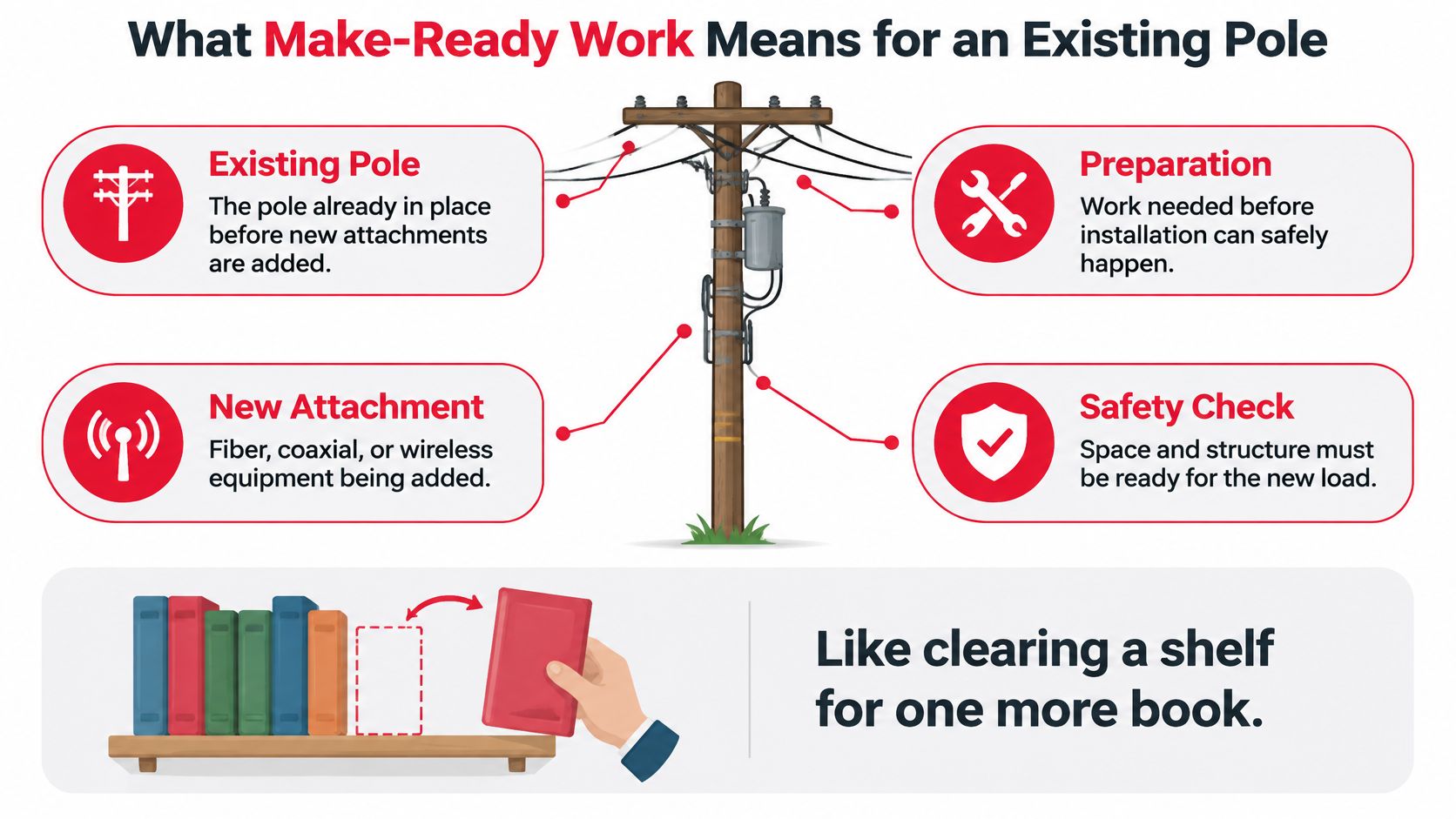
What the work actually includes
For an existing pole, make-ready work prepares the attachment position and surrounding equipment for a new line. It can include relocating existing lines, rearranging equipment, replacing inadequate hardware, and creating required clearance. The pole owner and existing attachers may need to review the request, survey the site, and agree on the work before construction proceeds.
The sequence affects the start date. If the pole cannot support the added load or the proposed attachment lacks required clearance, the design or existing equipment must be addressed before the new network can be installed.
Why it's regulated
The FCC's 2011 pole attachment framework set stages and timelines for typical communications-space requests. Its process covers application review and survey, cost estimation, applicant acceptance, and physical make-ready construction.
For planners, the practical point is that make-ready has distinct handoffs. A survey must inform the estimate, the applicant must accept the cost, and the required construction must be completed before attachment. Treat those steps as schedule dependencies: waiting for reviews or decisions can hold up a broadband build even when field crews and equipment are available.
Pole, Aerial and Underground Make-Ready Types
| Type | Where the work sits | Typical tasks | Main constraint |
|---|---|---|---|
| Pole make-ready | Pole body and attachment points | Transfers, rearrangements, pole replacement, guying | Pole strength and loading |
| Aerial make-ready | Overhead span between poles | Sag and clearance checks, attachment height changes | In-span clearance under sag, wind and ice |
| Underground make-ready | Conduit, ducts, handholes and pedestals | Duct space checks, riser rearrangement, buried line relocation | Locating buried utilities and restricted access |
Pole make-ready happens on the pole itself. Crews transfer attachments to new positions, rearrange equipment, add guys or reinforcement, or replace a pole that can't carry added loads. Pole class and loading control the answer, so a short, heavily loaded pole drives cost faster than a tall pole with free space.
Aerial make-ready happens in the span between poles. Cables don't sit in a straight line. They sag, and that lowest point moves with temperature, wind, and ice. Crews check clearance over roads, driveways, and other lines at mid-span, then raise or lower attachments where the span fails even though the pole face looks fine.
Where the types overlap
Underground make-ready covers conduit, ducts, handholes, and pedestals. You confirm duct space is open, rearrange riser cables where buried plant comes up the pole, relocate buried lines, and work around locate marks and restricted access. A blocked duct or an unlocated utility stops work just as surely as a failed pole.
Most real routes combine all three. One pole with a buried riser can trigger pole transfers, span clearance work, and duct rearrangement at the same location. Planners who budget only for the pole work miss the rest.
Practical rule: Walk the route with the survey notes and mark every location as pole, aerial, underground, or a mix before you request estimates.
That classification also shapes your systems work. If you're reviewing how telecom firms modernize their systems, notice how much depends on clean asset and location data upstream. Bad pole records produce bad estimates, and no software fixes a survey that never happened.
Simple Versus Complex Make-Ready Classification
The classification test is straightforward. Simple make-ready lets communications-space attachments be transferred without a reasonable expectation of outages or facility damage, and without splicing existing attachments. Complex make-ready carries a reasonable likelihood of service interruption or damage.
Under U.S. federal rules at 47 CFR 1.1402, make-ready means modifying or replacing a utility pole, or modifying lines or equipment on it, so new facilities can be installed. The label you assign at survey stage decides crew type, outage planning, and documentation load.
Common complex triggers
- Splicing required: An existing attachment has to be cut and spliced to move it.
- Wireless equipment relocation: Antennas or radios must come down and go back up.
- Pole-top work: Work near the top of the pole, close to power space.
- Tight attachment density: Lines are packed so closely that moving one disturbs others.
- Outage window needed: The move can't happen while the line stays live for customers.
What a complex label changes
Complex work pulls in outage coordination, traffic control, specialized crews, customer-impact planning, and heavier documentation. Each of those needs lead time and a named owner. None of them can be improvised on the day.
The largest schedule risk often isn't construction difficulty. It's misclassifying work before engineering and owner coordination are complete.
Say a survey labels a pole simple, the estimate prices a simple transfer, and the crew finds a splice case that has to move. Work stops. The pole gets re-engineered, re-estimated, and rescheduled around an outage window. You've lost weeks to a labeling error, not to slow field work.
I would flag every pole with splices, wireless gear, pole-top work, or outage exposure during the survey, then fix its category before the estimate is requested. Carry those labels into the schedule so complex poles get their own work waves instead of blocking simple ones.
Technical Checks That Decide Whether Make-Ready Passes
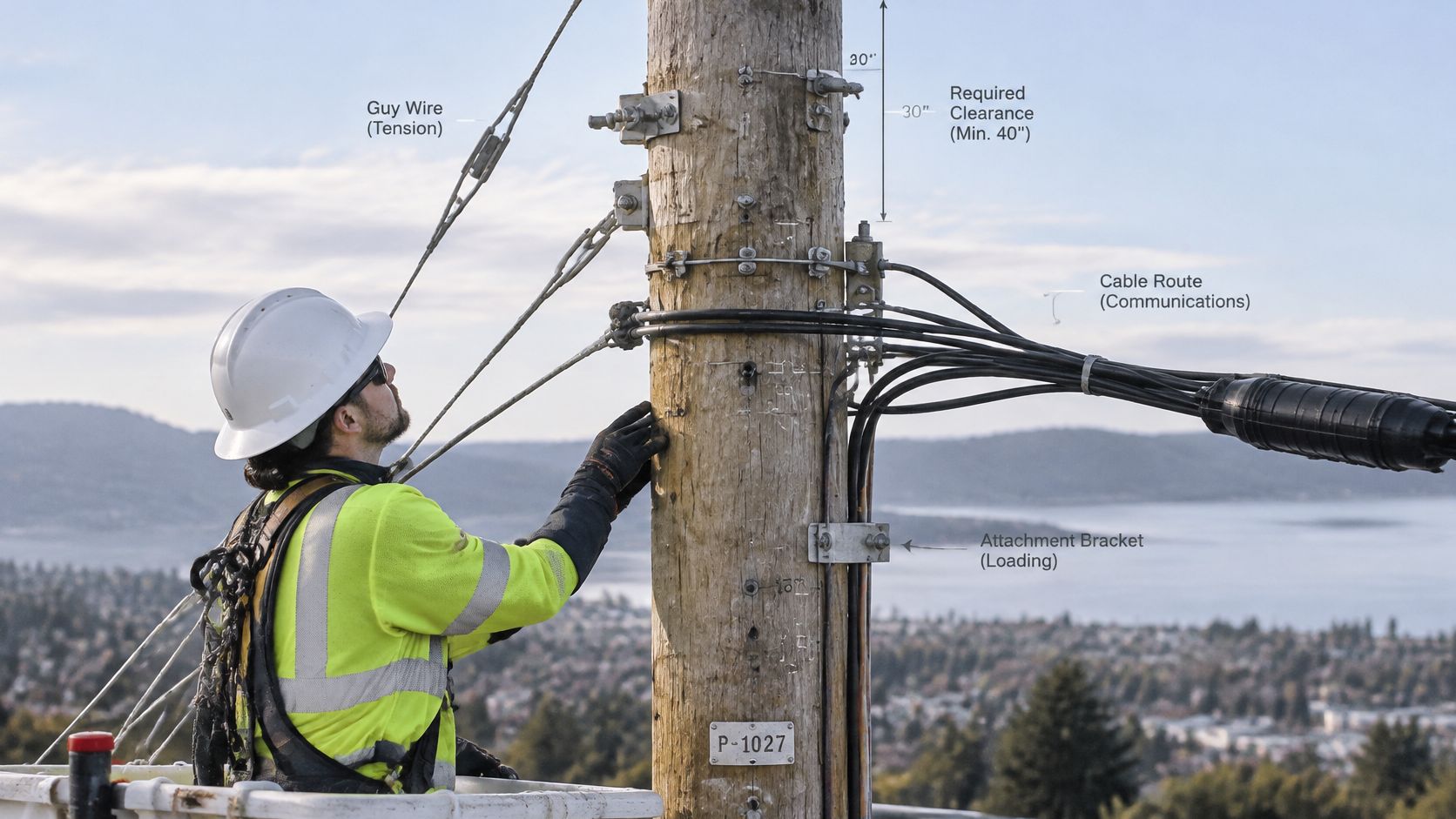
A proposed cable can fit at the pole and still fail the field check. Engineers assess structural loading and electrical separation before an attachment is approved. The Nebraska Public Power District joint pole attachment manual specifies 12 inches of separation between communication lines supported by different suspension strands at the pole, and 6 inches in the span.
Why clearance fails in the span
Clearance must be checked along the span, not just at the pole. Sag and changing field conditions can leave too little separation at the lowest point, even when the attachment looks clear at the pole face. Measurements account for cable surfaces, messengers, and attached equipment, not only the centerlines shown on a drawing.
A clearance shortfall can require rearrangement or pole replacement. A structural concern may call for guying, reinforcement, or a new pole. Each remedy changes the work scope and can hold up the start of construction while the revised design and owner decisions are addressed.
The short video below shows how these checks are performed before crews mobilize.
What a complete package contains
- Sag and tension assumptions: The conditions used to model cable position.
- Attachment elevations: Heights for existing and proposed attachments.
- Pole-class and loading calculations: The basis for assessing the pole and guys against the proposed load.
- Grounding and bonding requirements: How the new attachment connects to the pole ground.
- Clearance exceptions: Locations that miss standard separation and the proposed remedy.
- Traffic-control needs: Lane closures or flaggers required for the work.
- Acceptance photographs: Field evidence that completed work matches the design.
A route map alone does not show whether each pole is ready. Keep the calculations, field measurements, and dated photographs with the as-built records. The AEC documentation guidance from Pinnacle Property Media covers documentation practices that help clarify what was built.
Make-Ready Stages and Timelines by Order Size
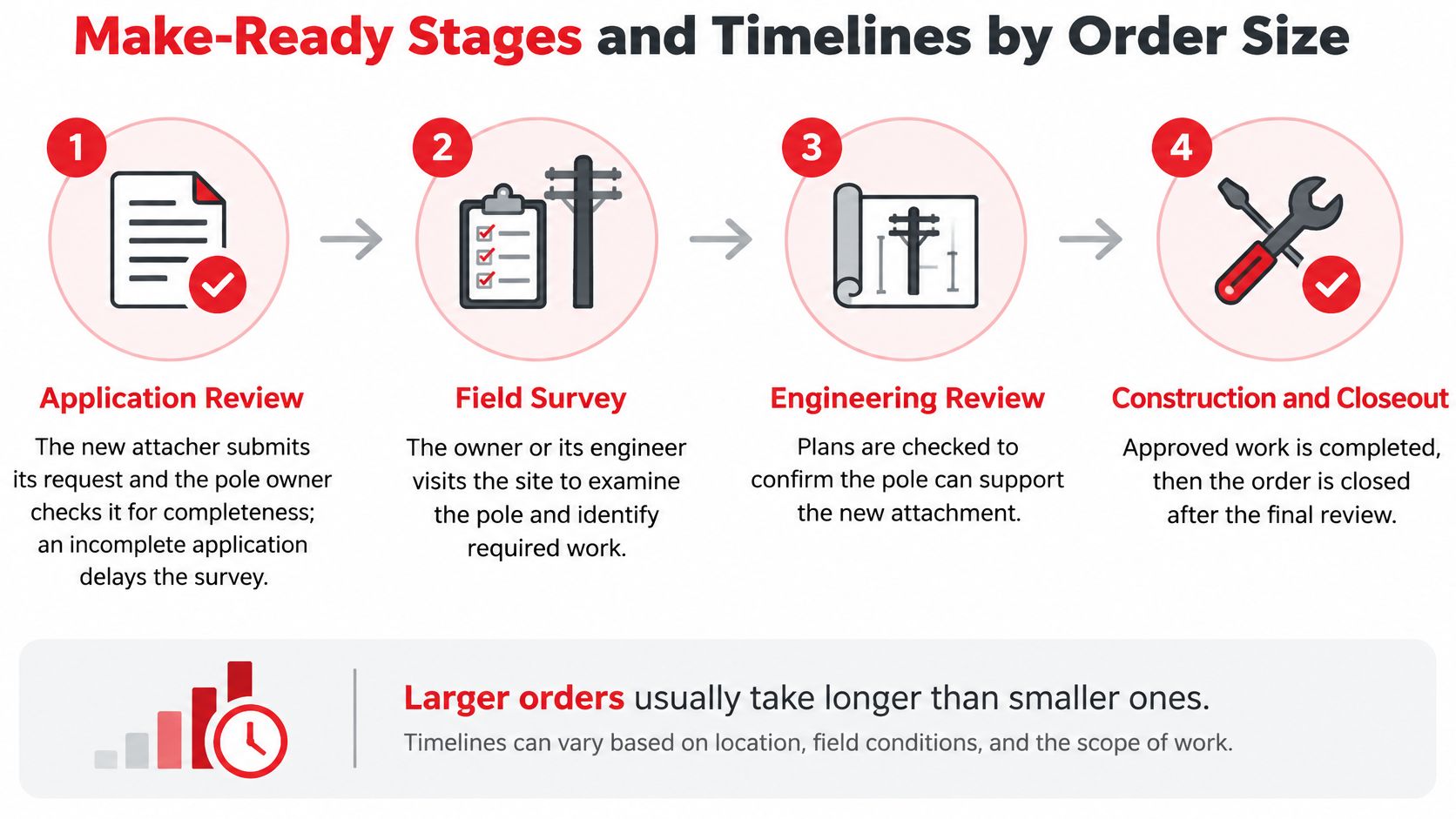
A broadband crew can be ready to build while a pole order is still waiting on an owner's survey, estimate, or transfer work. Those handoffs, not just field production, determine when attachment can start. Treat each stage as a schedule gate, with written confirmation before the next stage begins.
- Application review: Submit the request and let the pole owner check it for completeness. An incomplete application can hold up the survey start.
- Field survey: The owner or its engineer checks pole loading, clearances, and existing attachments. Missing or inaccurate pole information can require another survey.
- Cost estimate: The owner prices the rearrangements, transfers, and replacement work identified by the survey.
- Acceptance and payment: Accept the estimate and pay before work begins. Time spent deciding or arranging payment extends the schedule before construction.
- Make-ready construction: Existing attachments are transferred or rearranged, and poles are replaced where needed. Work can take longer when attachers must move in sequence.
- Final attachment: Your cable or equipment is installed after the pole is cleared and released.
How the deadlines stack up
The FCC timeline tables set different periods by request type and pole count. For requests of 300 poles or fewer, the standard regular-order framework allows up to 148 days overall before acceptance and payment time. Communications-space qualifying requests have a 30-day make-ready completion period after the pole owner notifies existing attachers. Larger qualifying requests cover up to the lesser of 3,000 poles or 5% of a utility's poles in a state.
| Order size | Survey period | Estimate period | Make-ready completion |
|---|---|---|---|
| Regular order, 300 poles or fewer | 45 days | 14 days | Up to 89 days after estimate payment, within the 148-day overall framework |
| Mid-sized order, 301 to 3,000 poles | 60 days | 14 days | 135 days after estimate payment |
| Large order, more than 3,000 poles | 90 days | 29 days | 180 days after estimate payment |
Work above communications space or in electric space carries longer completion periods. Larger routes can require multiple work waves, coordination with existing attachers, engineering review, and power-space clearance or pole replacement. Classifying an order incorrectly can put the wrong deadline in the build schedule before a crew is booked.
Schedule habit: Track owner-controlled waiting separately from construction, and set an escalation trigger for a missed survey due date.
That distinction shows who controls the next move. If a survey or estimate slips, the downstream dates move too, even when the construction crew is ready.
Reading One Make-Ready Schedule
Take a mid-sized order and run the arithmetic. The survey period is 60 days and the estimate period is 14 days. The survey starts once the application is complete, the estimate follows, and then you accept and pay.
Acceptance and payment time isn't fixed, so mark it as unknown in your schedule rather than guessing. Completion then runs up to 135 days after payment.
The math that sets your crew date
- Owner waiting before construction: 60 + 14 = 74 days, plus unknown acceptance and payment time.
- Maximum before final attachment: 74 + unknown + 135 days.
- Regular order comparison: 45 + 14 + unknown + 90 days.
These figures are regulatory deadlines, not guaranteed durations. Work can finish sooner, but you can't promise a customer a date that assumes it will. Book your fiber crew against the deadline-based date, then pull the date in only when written confirmations land.
Write the schedule as three rows, each with a responsible party and a deadline. Owner waiting covers survey and estimate. Make-ready construction covers transfers and replacements after payment. Final attachment covers your own placement once poles are released.
That format makes slippage visible fast. A missed survey date moves every later date, and you'll see it the week it happens instead of the month your crew was supposed to mobilize. Keep unknowns marked as unknowns. A schedule with honest gaps beats one with invented dates.
Roles and Cost Drivers Behind Every Make-Ready Estimate
| Party | Core responsibility | Deliverable |
|---|---|---|
| Pole owner | Surveys, estimates, approves and schedules rearrangements | Survey results and make-ready estimate |
| New attacher | Accepts the estimate, pays it and funds its own attachment | Accepted estimate and payment record |
| Existing attachers | Move or rearrange their equipment when notified | Completed transfers and notices |
| Engineering firm | Pole loading, clearance and sag calculations | Make-ready package and calculations |
| Construction crew | Transfers, replacements, traffic control and splicing | As-built photos and completion records |
Every estimate line should trace back to one of these parties. If a line has no clear owner, that's where disputes start.
Cost drivers in rough order of impact
- Pole count and attachment density: More poles and more attachments per pole mean more moves.
- Number of incumbent attachers: Each existing attacher adds coordination and transfer work.
- Replacement versus rearrangement: A new pole costs far more than moving lines on a sound one.
- Complex work: Outage windows, splicing, and traffic control add crew and planning cost.
- Re-surveys: Survey findings that don't match records send engineers back to the field.
- Power-space work: Work above the communications space needs specialized crews and longer windows.
Cost sharing among attachers depends on the pole owner's rules and agreements, and regional variation is significant. Read the estimate line by line against your survey instead of accepting a lump sum.
Per-pole dollar figures aren't something you can lift from a guide. Treat any cost not backed by a utility estimate as unknown in your budget, and carry contingency for replacements the survey hasn't found yet. Before accepting, match each line item to a row in the roles table and flag any line where the responsible party is unclear.
Pre-Request Scope Gate
Run this gate before you request estimates. If any item fails, fix it first. Estimates built on incomplete scope come back wrong, and rework costs more than the delay you're trying to avoid.
The five checks
- Classification complete: Every pole is labeled simple or complex, with splices, wireless equipment, pole-top work, and outage exposure flagged.
- Survey field-verified: Pole data comes from site visits, not records alone.
- Responsibility assigned: Each stage has a named party and a deadline.
- Engineering package complete: Sag and tension assumptions, attachment elevations, pole-class calculations, grounding requirements, clearance exceptions, traffic-control needs, and acceptance photographs are all present.
- Waiting time visible: The schedule shows owner-controlled waiting separately, with an escalation date for each survey.
Pass all five before you commit a crew. That discipline is what turns make-ready from an open-ended delay into a managed phase with dates you can defend.
We work as one accountable partner from design and permitting through testing, covering engineering, construction, and maintenance for wireline and wireless networks, including make-ready construction. Our trenching services deliver the groundwork needed for underground wiring where routes leave the poles, and we supply crews and equipment to customers 24/7 when outage windows or traffic restrictions dictate the schedule.
Use the gate as your starting point when scoping a route. Bring the five checks to your first scoping conversation and you'll find out quickly whether a start date is real or optimistic.
If your route is stalled on pole readiness, we can scope the make-ready work, engineering, and construction as one accountable program from design and permitting through splicing, testing, and documentation. Bring your survey data and pole list, and we'll help you separate simple work from complex work before estimates go out. Visit Southern Tier Resources to start that conversation.