The popular advice is simple: fiber optic is better, so replace coaxial cable whenever you can. That advice is technically incomplete and financially dangerous. A healthy HFC network can often gain substantial upstream and downstream capacity without abandoning every existing strand, while a new fiber build can create long-term advantages that an incremental coax upgrade can't match.
The practical question in fiber optic vs coaxial cable isn't which material wins in isolation. It's whether a specific route, node, building, or service area should be replaced, upgraded, or left alone. The answer depends on plant condition, construction access, subscriber density, upstream demand, service targets, and the cost of keeping active equipment in the field.
| Decision factor | Fiber optic | Coaxial cable in modern HFC |
|---|---|---|
| Transmission | Light through glass | Electrical signals through copper |
| Typical service profile | Commonly symmetric capacity | Traditionally download-heavy, increasingly upgradeable |
| Long-distance behavior | Low attenuation and no electromagnetic interference | Requires active powering and balancing as distance and frequency rise |
| Existing-plant advantage | Strong choice for new routes and deep fiber architectures | Strong choice where cable-TV plant is usable |
| Upgrade path | Endpoint optics, wavelength and channel expansion | Spectrum expansion, node segmentation and DOCSIS upgrades |
| Main constraint | Civil construction, make-ready work and premise conversion | Shared capacity, return-path limits and active-component complexity |
A carrier making a greenfield decision should usually favor fiber. An operator with dense, serviceable HFC plant should first price a node-level upgrade against a full rebuild. That distinction is where most simplistic comparisons fail.
Why the Cable Choice Is Really a Build-versus-Upgrade Decision
The decision is usually not fiber versus coax in the abstract. It concerns whether a given route, node, or serving area should be rebuilt, upgraded, or left in place for now.
That changes the economics fast. In the field, nobody starts from a blank map. There are poles, ducts, easements, cabinets, power supplies, amplifiers, nodes, drops, maintenance records, and live subscribers. Replacing coax often means replacing much of the operating model around it too, including outside-plant construction, optical distribution, premise equipment, splicing, testing, documentation, and customer cutovers.
Fiber still sets the higher technical ceiling. The Congressional Research Service comparison of fixed broadband technologies describes fiber service tiers of 250 to 1,000 Mbps for both downloads and uploads, while cable service tiers are approximately 10 to 500 Mbps downstream and 5 to 50 Mbps upstream. Those are typical service tiers, not a hard limit for every HFC network. They do establish why fiber is the long-term target when an operator needs symmetric capacity and fewer outside-plant constraints.
What that comparison does not answer is the build-versus-upgrade question. If usable coax, powering, node locations, and customer drops already exist, the practical alternative may be a DOCSIS 4.0 path, node splits, spectrum work, and deeper fiber, not an immediate full overlay. That is the part vendor comparisons usually skip. Lifecycle cost sits at the route and node level, where construction burden, truck rolls, powering, and maintenance history matter as much as raw throughput.
Practical rule: Compare each route to its realistic next step, not to an idealized new build.
For each serving area, start with the plant you have:
- Plant condition: Check sheath integrity, ingress, grounding, amplifier age, node loading, return-path behavior, and record quality.
- Demand profile: Separate ordinary household use from cloud backup, video production, telemedicine, cellular backhaul, and enterprise access.
- Construction burden: Price make-ready work, permitting, trenching, boring, pole attachments, restoration, and premise conversion.
- Revenue timing: A technically better rebuild can still be the wrong move if it delays relief that an upgrade could deliver sooner.
- Future architecture: Decide whether the area needs passive optical distribution, deeper fiber, smaller service groups, dedicated access, or a DOCSIS upgrade with expanded spectrum.
I have seen upgraded HFC beat a greenfield fiber build on payback in dense neighborhoods where the coax plant was healthy and capacity had to be added quickly. Fiber wins when the route is new, the existing plant is deteriorating, upstream demand is structurally high, or the operator wants to reduce dependence on powered field electronics over the life of the network.
How Each Cable Moves Data
Fiber and coax solve the same transport problem with different physics, and that difference drives everything from link budget to truck rolls. Fiber sends pulses of light through glass, usually single-mode fiber for carrier, access, and interconnection routes. Coax sends electrical signals through a copper conductor, wrapped in insulation and shielding that contain the electromagnetic field and limit external coupling.
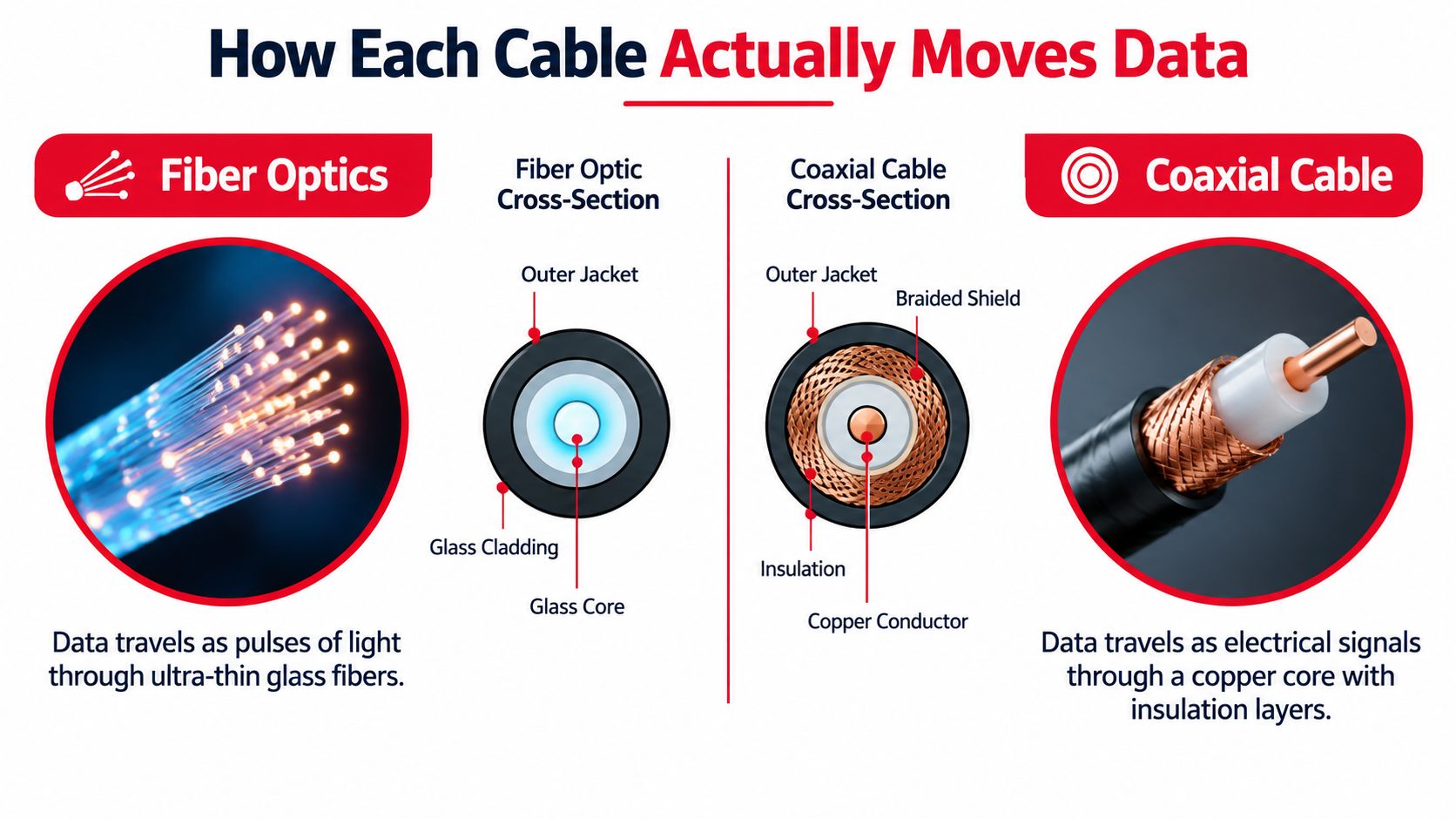
Fiber uses light, coax uses powered electronics
Single-mode fiber operates across optical wavelength windows, with engineering attention concentrated on 1,310 nm and 1,550 nm transmission. Public-sector specifications commonly require attenuation of no more than 0.4 dB/km at 1,310 nm and 0.3 dB/km at 1,550 nm, as documented in New York State fiber specifications. Those numbers matter for a practical reason: low attenuation leaves designers real link-budget margin over long routes, which is what makes passive outside-plant sections viable. A passive splitter in a pedestal costs nothing to power and nothing to balance.
The glass itself carries no electrical power. Electronics sit at the ends, or at selected optical distribution points, converting electrical data to light and back. When you need more capacity, you change optics, wavelengths, channels, or endpoints. The glass stays in the ground. That is the core economic argument for fiber, and it is the reason a well-built fiber route keeps paying out across successive equipment generations.
Coax works differently, and the difference shows up in your operating budget. Copper loss rises with frequency and distance, so HFC networks depend on powered amplifiers, active nodes, return-path balancing, and tightly maintained RF levels. Every active location adds a power feed, a housing, environmental exposure, and one more thing that can fail at 2 a.m. I have spent enough nights tracing intermittent return-path noise to respect how quickly actives accumulate on a long cascade.
The medium determines the maintenance burden
Fiber is immune to electromagnetic interference because the signal is optical, not electrical. It creates no bonding path between buildings, and it is untouched by the ingress, grounding, and RF coupling problems that plague coaxial plant. When a fiber route fails, the cause is almost always physical damage, which makes fault isolation faster and more predictable.
Coax shielding helps, but field reality wins eventually. Loose connectors, poor bonding, water intrusion, damaged drops, and ingress all degrade the return path. Operators manage these problems successfully every day, but management means sweep testing, balancing, replacement work, and disciplined record keeping, year after year.
The customer edge differs too. Fiber access terminates at an optical network terminal or equivalent optical device. Coax terminates at an RF modem or gateway, sharing an RF service group with the rest of the node. Neither endpoint defines service quality on its own. Route architecture, optical budget, RF spectrum, node size, provisioning, and maintenance discipline determine what subscribers experience.
Bandwidth, Latency, and Upload Performance Compared
The question is not which cable advertises the higher download rate. Network performance depends on upload capacity, busy-hour consistency, latency variation, packet loss, outage isolation, and restoration time. A route that looks fast in a single test can still perform poorly under sustained two-way demand.
The tier comparison established earlier shows why fiber generally leaves more room for symmetric service, while coax remains constrained by shared RF capacity in the access segment. The practical difference becomes clearer in independent testing.
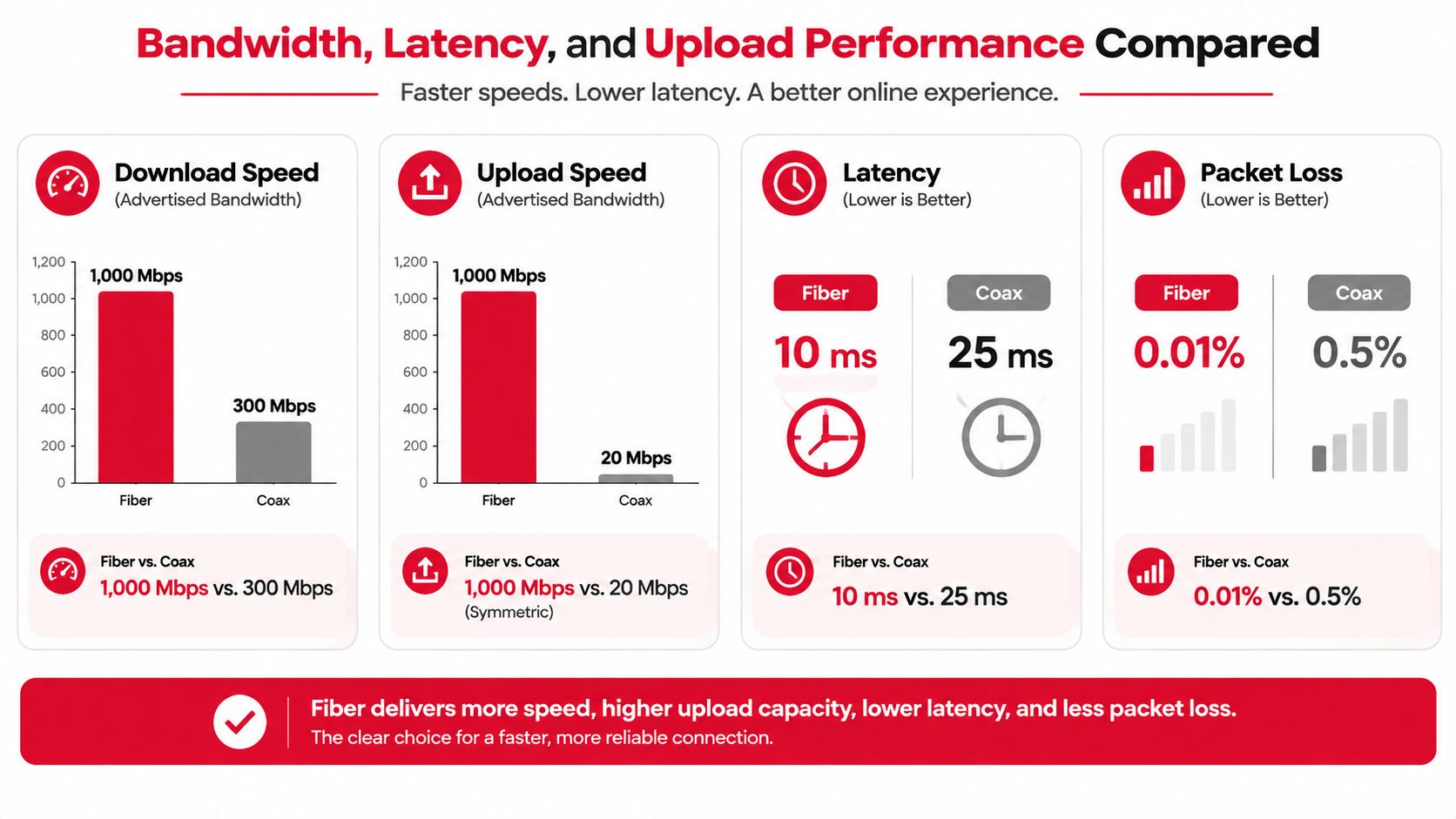
Advertised download speed understates the operational difference
FCC testing covering September through October 2022 found weighted mean advertised download speeds of 586 Mbps for fiber and 483 Mbps for cable, giving fiber an advantage of about 21%. The upload gap was larger in operational terms. Fiber's weighted mean advertised upload speed reached 528 Mbps, while cable upload performance remained much lower.
That asymmetry affects more than file transfers. A household or business can have a strong download tier and still struggle with simultaneous video meetings, cloud synchronization, security-camera uploads, large media exports, and remote desktop sessions. Distributed teams notice the difference because their traffic travels in both directions.
Busy-hour testing matters more than a provisioning label. Measure sustained throughput, latency under load, packet loss, and variation between the customer edge and the upstream service handoff. A useful test plan should connect those network results to application behavior, much like the throughput metrics for DevOps approach does.
Match the medium to the workload
Fiber's consistency is particularly valuable for:
- Cloud backup and data synchronization, where sustained upstream capacity controls completion time.
- Telemedicine and interactive video, where loss and latency variation can disrupt a session even when download speed looks adequate.
- Video production, where teams move large source files and finished assets in both directions.
- Cellular backhaul and enterprise connectivity, where service targets extend beyond a household speed test.
- Data-center interconnection, where predictable behavior matters more than a headline consumer tier.
Cable still wins in situations where existing HFC plant can meet demand without a rebuild. Modernized HFC, node segmentation, and upstream spectrum improvements can address the actual bottleneck for many residential and small-business services. The replacement decision belongs at the route and node level, not in a generic cable-versus-fiber ranking.
Distance, Power, and Lifecycle Cost Trade-offs
Cable price is one line in a network budget. A fair comparison includes active electronics, electrical service, cabinets, grounding, environmental protection, testing, maintenance, restoration, and future capacity work. The attenuation margins documented in the physics section are what allow passive feeder routes of several kilometers without regeneration, and that property drives most of the lifecycle economics below.
Coax pays an active-equipment tax
Coaxial networks need powered electronics because electrical loss rises with distance and frequency. Every time an operator expands spectrum or increases service-group capacity, engineers must revisit amplifier spacing, return-path balance, ingress, node placement, power supplies, and cabinet loading. That work is routine for experienced HFC teams, and existing plant can make it economically sensible. The cost accumulates over the life of the network:
- Powering: Field electronics require reliable electrical service and backup planning.
- Housing: Active equipment needs cabinets, strand access, environmental protection, and physical security.
- Maintenance: Technicians must troubleshoot RF levels, ingress, failed modules, connectors, and power faults.
- Upgrade coordination: Spectrum changes can require work across nodes, amplifiers, taps, drops, customer equipment, and provisioning systems.
- Failure isolation: A fault in an active segment can affect an entire service group and force a field dispatch.
Fiber reduces several of these burdens along passive routes. It still needs optical electronics, closures, splitters, cabinets, and skilled splicing. It also remains vulnerable to cuts, poor bends, damaged closures, and inaccurate records. Fiber is not maintenance-free. It changes the maintenance profile, shifting labor from powered-device upkeep toward outside-plant repair and record accuracy.
Build a route-level lifecycle model
The decision I would make on any given street depends on numbers, not on a generic cable-versus-fiber ranking. A useful model compares at least three scenarios per route:
- Maintain: Keep the current plant and fund the repairs required to meet service targets.
- Upgrade: Use node segmentation, spectrum changes, return-path work, and customer-equipment changes to extend HFC life.
- Replace or overlay: Construct fiber where its capacity, operating simplicity, or service consistency justifies the civil work.
Assign each scenario its construction cost, active equipment, energy, truck rolls, restoration exposure, testing, documentation, and capacity upgrades. An existing coax route often shows a lower near-term cost but a higher long-term operating burden. A fiber route can require heavier upfront construction while offering a simpler passive path and more upgrade headroom. DOCSIS 4.0 changes the middle scenario by pushing usable spectrum further into existing coax, but it does not remove the powered-plant costs, so the maintain-versus-replace math still has to be run route by route.
Where Fiber and Coax Each Win in Practice
The right medium changes with the deployment environment. A new subdivision, an occupied apartment building, a macro cell site, and a data-center hall don't present the same constraints.
Greenfield access and FTTx
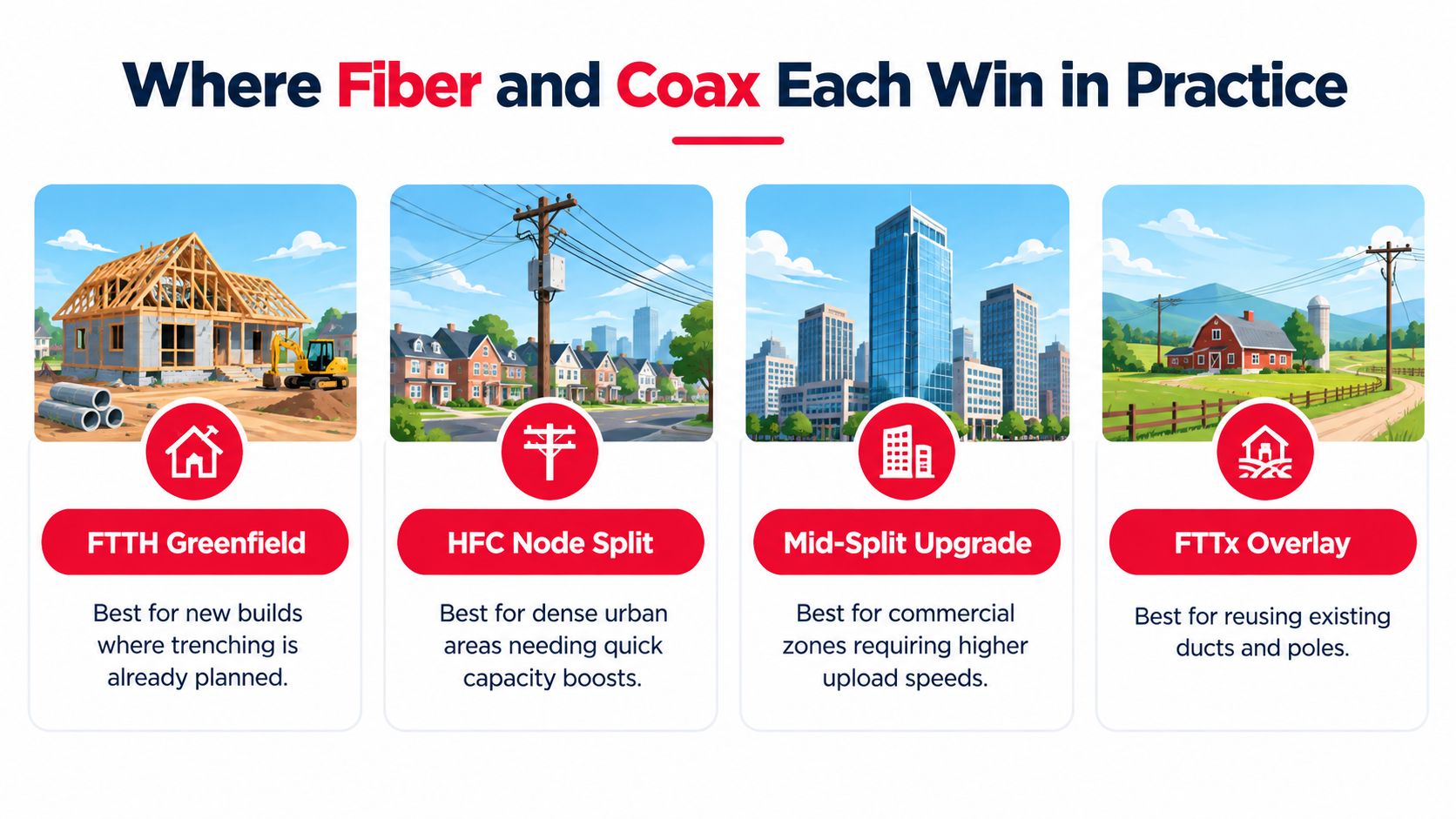
For a new housing development or business park, fiber usually deserves the default position. Trenching, conduit, handholes, pole routes, and distribution points are already part of the construction plan, so installing coax first can create avoidable conversion work later.
Fiber also fits FTTx architectures that place the optical distribution point closer to the customer. The operator can design splitter locations, feeder routes, drop pathways, and premise termination as one system rather than adapting around legacy RF equipment.
Existing HFC neighborhoods
A functioning HFC plant can still be the practical winner in a dense, already-served area. Start with node loading, return-path performance, plant ingress, amplifier condition, drop quality, and customer demand. If the constraint is service-group size or upstream allocation, node segmentation and a mid-split or broader HFC upgrade may deliver useful capacity without full outside-plant replacement.
The decision changes when the route has repeated faults, poor records, inaccessible infrastructure, or insufficient upstream headroom. In that case, continued patching can cost more than a planned fiber overlay.
Backhaul and interconnection
Fiber is the normal choice for cellular backhaul, small-cell aggregation, data-center interconnection, and other routes where operators need predictable upstream behavior and low loss over distance. Coax can serve an in-building RF distribution role or reuse an existing customer network, but it is rarely the strongest new transport medium for high-capacity aggregation.
For data centers, pre-terminated fiber trunks, structured pathways, splice enclosures, testing, labeling, and documentation often matter as much as the cable itself. A poorly documented fiber installation creates operational risk even when the optical budget looks correct.
Last-mile drops and buildings
Single-family drops depend on available ducts, pole routes, premise entry, and installation practices. Fiber provides more capacity headroom, but coax may be easier to connect where an existing drop and in-home RF distribution are usable.
Multidwelling units require a building survey. Existing coax risers can reduce disruption, while fiber may need new riser pathways, firestopping, closets, and optical terminals. The right answer can be a fiber feed to the building with selective reuse of internal coax, provided the service targets and maintenance boundaries are explicit.
Migration Strategies from Coax to Fiber and Hybrid Paths
Few operators can replace an HFC network in one motion. A practical migration plan separates the feeder, node, distribution, drop, and premise decisions instead of declaring the entire service area “fiber” or “coax.”
Three workable paths
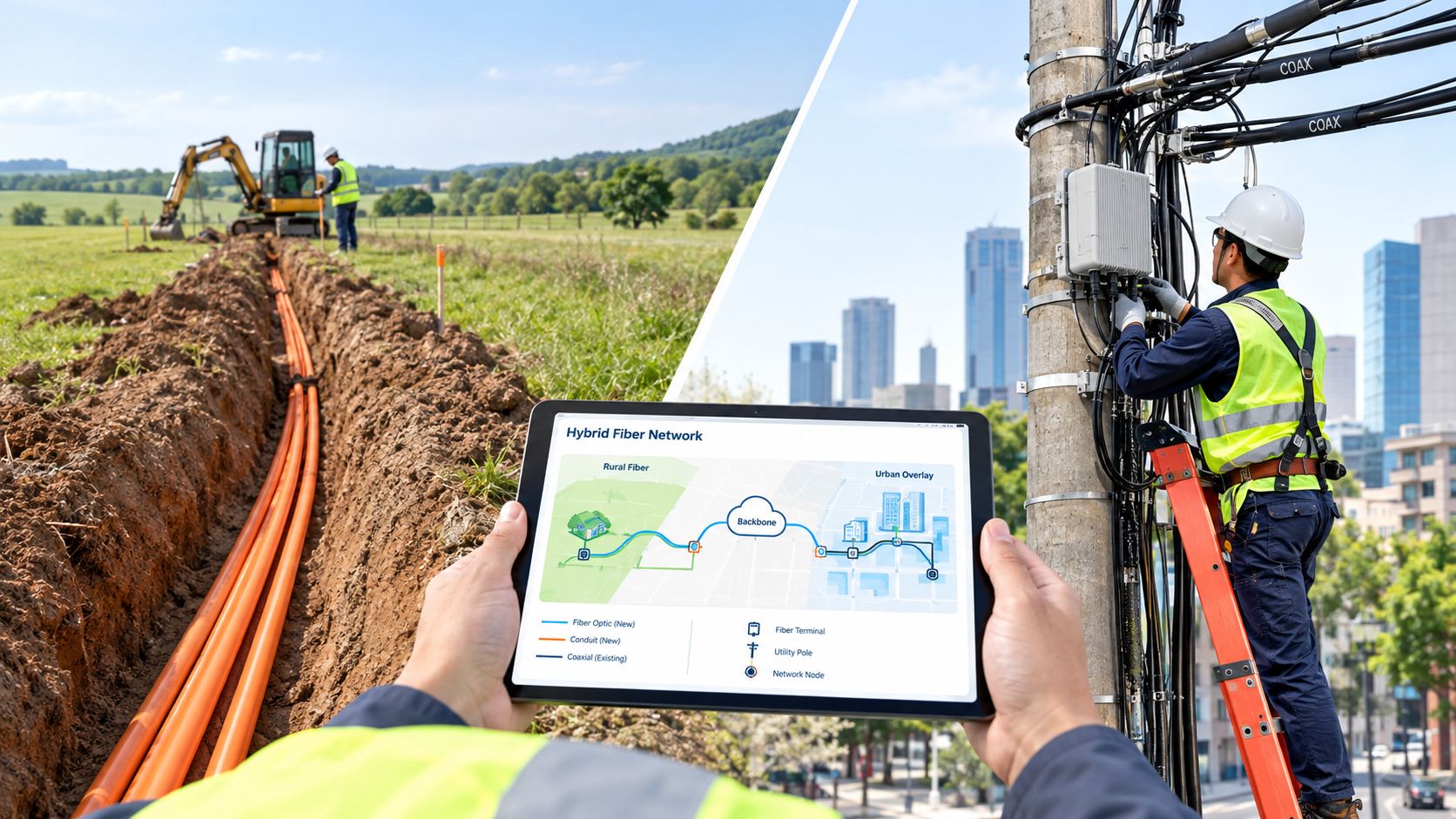
Greenfield fiber fits routes where construction is already unavoidable, existing coax is poor, or the operator needs a durable symmetric-access platform. Design the feeder, distribution, drops, splitters, optical terminals, splice points, and records together. Avoid building a fiber route that still depends on poorly understood legacy sections at the service edge.
Staged FTTx overlay works when ducts, poles, rights-of-way, or node sites can be reused. The operator can place fiber deeper into selected neighborhoods, buildings, or business corridors while keeping HFC service active elsewhere. This approach requires disciplined migration boundaries, because mixed architectures increase inventory and operational complexity if the records aren't precise.
DOCSIS 4.0 upgrade can extend HFC's economic life where the plant is sound. Mediacom's initial deployment tested nearly 9 Gbit/s downstream and almost 3 Gbit/s upstream, with an estimated upgrade cost of approximately $180 to $185 per home passed, according to Light Reading's report on Mediacom's DOCSIS 4.0 deployment. The design uses spectrum expansion to 1.8 GHz and an upstream allocation of 5 to 396 MHz.
Choose by constraint, not by label
DOCSIS 4.0 is not a magic software switch. The route may need amplifier replacement, tap changes, node work, return-path cleanup, customer-premise equipment updates, and tighter RF maintenance. It makes sense where those interventions are cheaper and faster than civil construction.
Fiber remains the better end state for maximum capacity, lower optical loss, and dedicated access. Modern HFC may be the better near-term investment where construction is difficult, subscriber density is high, and existing plant can meet the target after upgrade.
The strongest hybrid plans use HFC upgrades to protect current revenue while fiber construction targets routes with the highest long-term value. They don't pretend that one technology must serve every block.
Recommended Choices by Operator Type
A carrier, municipality, data-center operator, and wireless network owner can inspect the same cable and reach different conclusions. Their funding, construction rights, service obligations, and failure tolerance aren't the same.
Carriers and broadband ISPs
An incumbent carrier should begin with a route inventory and service-target map. Choose fiber for new construction, high-upstream corridors, failing plant, data-center routes, and areas where active equipment creates recurring operational problems. Choose HFC upgrades where the plant is healthy, demand can be met through spectrum and node work, and time to revenue matters.
Municipalities and cooperatives should evaluate open-access, wholesale, and retail models alongside construction. A rural route may justify fiber because replacement access is limited and future expansion matters, but the design still needs realistic pole, make-ready, maintenance, and restoration assumptions.
Data centers and enterprise facilities
Data-center operators should standardize pathways, structured cabling, pre-terminated trunks, labeling, test limits, spare capacity, and change control. Fiber generally belongs in interconnects and high-density backbone paths. Coax may remain useful for specialized RF distribution, monitoring, or legacy systems, but it shouldn't be selected for a new high-capacity data path just because it is familiar.
Wireless operators
Wireless operators need fiber routes that can support macro sites, small cells, aggregation, timing, restoration, and future densification. A route that reaches today's radio site but lacks diverse pathways or maintainable access can become a constraint during the next expansion. Use coax where RF equipment requires it, not as a substitute for transport fiber.
Enterprise and multifamily owners should also separate broadband transport from building operations. A network plan may need both structured connectivity and network security for residential communities, particularly where resident access, staff systems, cameras, and guest services share a building environment.
Decision trigger: Move toward fiber when upstream consistency, route distance, service isolation, or future capacity dominates. Move toward upgraded coax when existing plant is sound and construction delay or cost dominates. Use a hybrid when those conditions vary by route.
Common Questions About Fiber Optic vs Coaxial Cable
When does coax still make sense?
Coax still makes sense when an existing HFC plant is physically sound, service groups can be managed, upstream requirements fit the architecture, and an upgrade can reach the target without excessive active-plant replacement. It can also reduce disruption in buildings with usable coax risers and customer drops.
Which workloads make fiber necessary?
Fiber is the safer choice for sustained upstream demand, data-center interconnection, cellular backhaul, high-consequence enterprise connectivity, and routes where low attenuation and electromagnetic immunity simplify operations. A faster coax tier may serve ordinary access needs, but the application should be tested against latency, loss, busy-hour throughput, and restoration targets.
What should an operator do first?
Start with a route and node audit. Map plant condition, node loading, amplifier inventory, spectrum, upstream performance, construction constraints, subscriber density, and service-level requirements. Then compare maintain, upgrade, overlay, and replace scenarios using lifecycle cost rather than cable price alone.
Southern Tier Resources provides engineering, construction, fiber installation, splicing, testing, documentation, and maintenance for wireline, wireless, and data-center infrastructure. If your team is comparing an HFC upgrade with a fiber build, visit Southern Tier Resources to discuss route-level design and deployment support.