A regional carrier discovers that a recurring splice failure isn't caused by one careless repair. The route record is incomplete, the closure history lives in a contractor's files, and operations can't see which customers depend on the affected path. In a nearby data center, engineers are debating whether to replace a UPS battery fleet that remains within warranty but shows impedance drift. One team sees unnecessary capital expense. Another sees a warning that could become a service event.
Both teams need more than an equipment list. They need a defensible way to connect asset condition, service dependency, risk, cost, and future demand. That is the practical purpose of infrastructure asset management. It turns physical infrastructure into a managed system, from design and construction through operation, renewal, and retirement.
The stakes extend beyond one route or one equipment room. The World Bank estimates that infrastructure disruptions caused by natural hazards, poor maintenance, and mismanagement cost households and firms in low- and middle-income countries at least $390 billion per year (World Bank infrastructure report). For operators, the lesson is direct: spreadsheets, tribal knowledge, and calendar-only maintenance can't support every decision once networks and facilities become interconnected.
A practical program must answer four questions. What exactly do you own? Which systems hold the authoritative record? Which risks deserve work first? And how do you make repair, replacement, or repurposing decisions when demand changes faster than the asset base? A useful overview of the operational environment is available in this guide to refer a telecom company, but the work itself begins with disciplined lifecycle ownership.
Why Infrastructure Asset Management Matters in Telecom and Data Centers
The failing splice closure and the drifting UPS bank look like different problems. Operationally, they share the same failure pattern: a physical asset is being evaluated without a reliable connection to service impact, history, and future use.
A route manager may know that a closure has failed before, while the construction team knows the splice configuration and the finance team knows the remaining book value. If those facts stay separate, the organization can't compare another repair with a route change or replacement. The same problem appears in a data center when a battery is judged by warranty status rather than impedance trend, load profile, redundancy, and the systems it supports.
Infrastructure asset management is the decision discipline that joins those facts. It helps operators manage value, risk, performance, maintenance, renewal, and disposal as one lifecycle rather than treating construction as the finish line. That distinction matters because a newly accepted route can already carry bad coordinates, missing test results, or undocumented field changes.
What the program must make possible
A functioning program lets engineering, construction, operations, and finance work from compatible records. It should make it possible to:
- Find the dependency: Identify the fiber, power system, cabinet, route, or cooling component supporting a service.
- Prioritize exposure: Rank work by failure likelihood and consequence instead of by the loudest request.
- Defend capital decisions: Show why an asset should be repaired, reinforced, replaced, rerouted, or retired.
- Preserve evidence: Keep inspections, test results, work orders, approvals, and as-built records tied to the asset.
ISO standardized the family of asset-management concepts through the publication of ISO 55000 in January 2014. ISO 55000 established common principles and terminology, while ISO 55001 defined requirements for an asset-management system. ISO reports that the framework was updated in 2024 after experience and feedback from more than 50 countries (ISO 55000 overview).
The standard doesn't prescribe one software stack or force every operator into identical maintenance intervals. It does require a coherent relationship between objectives, risk, information, decisions, and controls. That is the difference between maintaining equipment and managing infrastructure as a business system.
Defining Infrastructure Asset Management and the Lifecycle
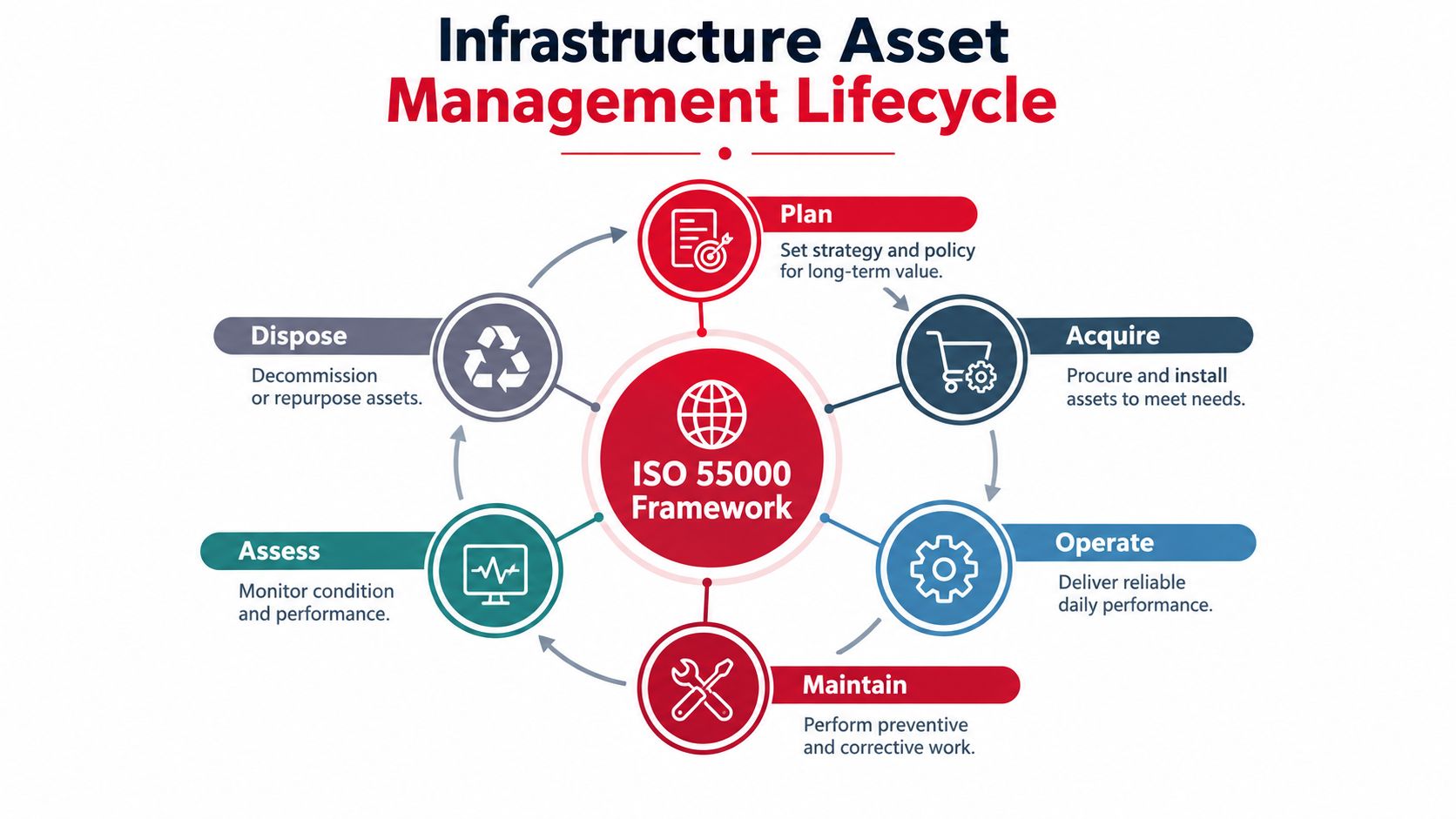
A useful working definition is simple: infrastructure asset management is the coordinated activity of obtaining value from physical assets while managing risk, performance, cost, and lifecycle obligations. ISO 55000 and ISO 55001 provide the common language, but they don't replace engineering judgment. They give the organization a structure for making that judgment consistently.
The lifecycle begins before installation and continues after service ends:
- Plan: Translate service objectives into asset requirements. For fiber, that may mean route diversity, capacity, access constraints, and restoration priorities. For a data center, it includes power, cooling, structured cabling, rack density, and resilience requirements.
- Acquire and build: Control specifications, procurement, permits, installation, inspection, testing, and acceptance. A splice closure isn't operationally complete until its location, configuration, test evidence, and dependencies are recorded.
- Operate: Monitor service performance, alarms, utilization, environmental conditions, and changes. Operations should be able to connect an event to the affected asset and service path.
- Maintain: Combine corrective, preventive, predictive, and condition-based work. Corrective maintenance responds to a defect. Preventive work follows a planned interval. Predictive work uses observed behavior to anticipate deterioration.
- Assess and renew: Compare condition, risk, energy use, performance, and remaining strategic value. Renewal might mean replacing a battery, reinforcing a route, upgrading a radio, or changing a cooling configuration.
- Dispose or repurpose: Decommission safely, preserve required records, recover usable components where appropriate, and update dependencies so retired assets don't remain active in planning systems.
The shift is more important than the labels:
Infrastructure isn't a one-time capital project. It's an integrated system for managing value, risk, performance, maintenance, renewal, and eventual disposal.
Calendar maintenance still has a place, especially where safety or manufacturer requirements dictate an interval. It becomes weak when utilization and condition vary widely. A heavily loaded UPS, a frequently accessed cabinet, and a lightly used redundant asset shouldn't automatically receive identical treatment. Predictive maintenance also isn't created by buying sensors. It depends on trustworthy data, stable baselines, clear thresholds, and work orders that return evidence to the asset record.
The Systems That Run the Program GIS, CMMS, and ERP
Most operators already own the ingredients of an asset-management stack. The trouble starts when each platform claims to be the asset register.
A GIS should answer where an asset is and what it connects to. It is the natural home for outside plant, routes, poles, towers, cabinets, structures, easements, and spatial relationships. A CMMS or EAM should answer what work was requested, performed, inspected, deferred, and repeated. An ERP should answer what was purchased, funded, capitalized, depreciated, and paid for.
| System | Primary Question Answered | Typical Data Owned | Avoid Putting Here |
|---|---|---|---|
| GIS | Where is the asset and what does it connect to? | Coordinates, routes, structures, network topology, spatial dependencies | Detailed labor history, invoices, or technician notes |
| CMMS or EAM | What work has happened and what work is due? | Work orders, inspections, preventive plans, defects, parts, labor, failure history | Full spatial topology or general-ledger controls |
| ERP | What did the asset cost and how is it controlled financially? | Procurement, projects, vendors, capitalization, depreciation, budgets | Field condition detail or splice-level operational history |
The integration pattern that holds
Use one governed asset master with a durable identifier, then expose that identifier across GIS, CMMS or EAM, and ERP. The same fiber route, generator, tower, or UPS system may have different views in each platform, but the identity should remain stable.
The most common failure is not a missing API. It's an unresolved ownership dispute. GIS updates the location, construction updates the installed configuration, operations records the failure, and finance controls the project. If nobody owns reconciliation, each system slowly becomes plausible and collectively unreliable.
Before selecting a vendor, define the exchange rules. Decide which system owns each attribute, how corrections are approved, how retired records are handled, and how exceptions are reported. Vendor-agnostic design matters more than brand preference. Interoperability practices involving standards such as CIM and ISO 19115 can be more valuable than a polished interface if they preserve meaning across systems.
Integration rule: A system of record isn't the platform with the most fields. It's the platform with clear ownership, controlled changes, and a dependable relationship to the other records.
The Data Model Behind Trustworthy Records
A trustworthy asset record starts with identity but can't stop there. For a telecom asset, the record should connect physical characteristics, location, owner, installation and modification history, condition, criticality, failure modes, service dependencies, replacement assumptions, as-built documents, test results, and maintenance history. A data-center record may also need electrical path, cooling zone, load relationship, environmental readings, and commissioning evidence.
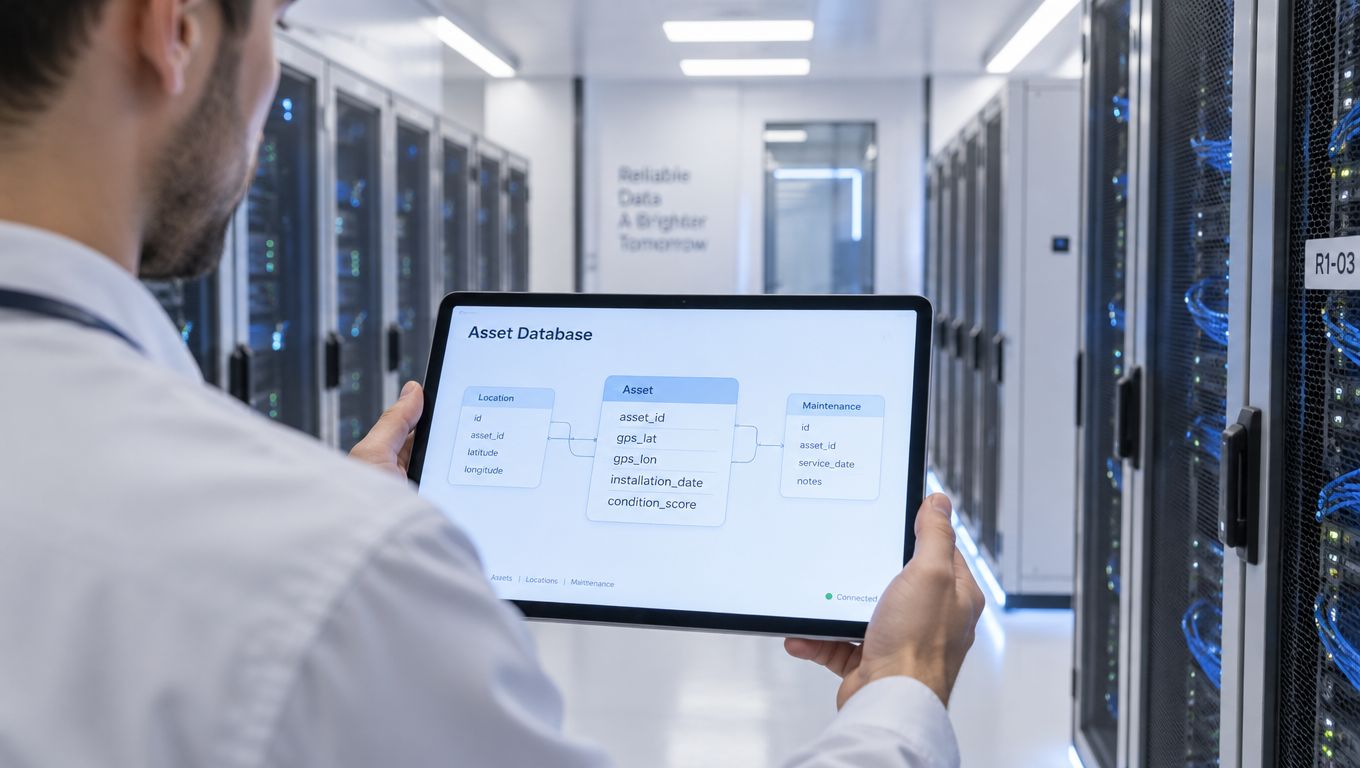
The attribute most often omitted is confidence level. A legacy fiber coordinate copied from an old drawing isn't equivalent to a field-verified coordinate. A battery status inferred from a work-order note isn't equivalent to a measured impedance trend. Marking confidence explicitly lets planners use uncertain data without pretending it is precise.
Digital continuity across handoffs
Treat every handoff as a data acceptance event:
- Design to permitting: Confirm route geometry, asset classes, ownership assumptions, and required approvals.
- Permitting to construction: Preserve approved alignment, constraints, and revision history.
- Construction to splicing: Capture installed locations, materials, configuration, and deviations from design.
- Splicing to testing: Tie splice diagrams and test results to the correct closure, cable, fiber, and path.
- Testing to operations: Reject acceptance until the operational record, dependencies, documents, and status are complete.
- Operations to maintenance: Return field findings, changes, and restoration evidence to the authoritative record.
Undocumented splices are particularly damaging because they break both physical understanding and service-impact analysis. A crew may restore continuity without restoring knowledge. Require contractors to submit structured records, field-verifiable coordinates, splice documentation, test evidence, photos where appropriate, and a clear exception list. Then sample the records in the field instead of treating document delivery as proof of accuracy.
A 2025 government asset-management survey found that 99% of respondents use asset-management data for physical-asset decisions and 96% use software for preventive maintenance, while questions about correction ownership, confidence assignment, and reconciliation across GIS, inventory, work orders, and as-builts remain unresolved (2025 government asset-management survey).
The practical response isn't always another platform. It may be a required handoff schema, a correction queue, an audit sample, and a named data steward.
KPIs and Risk Scoring That Drive the Right Work
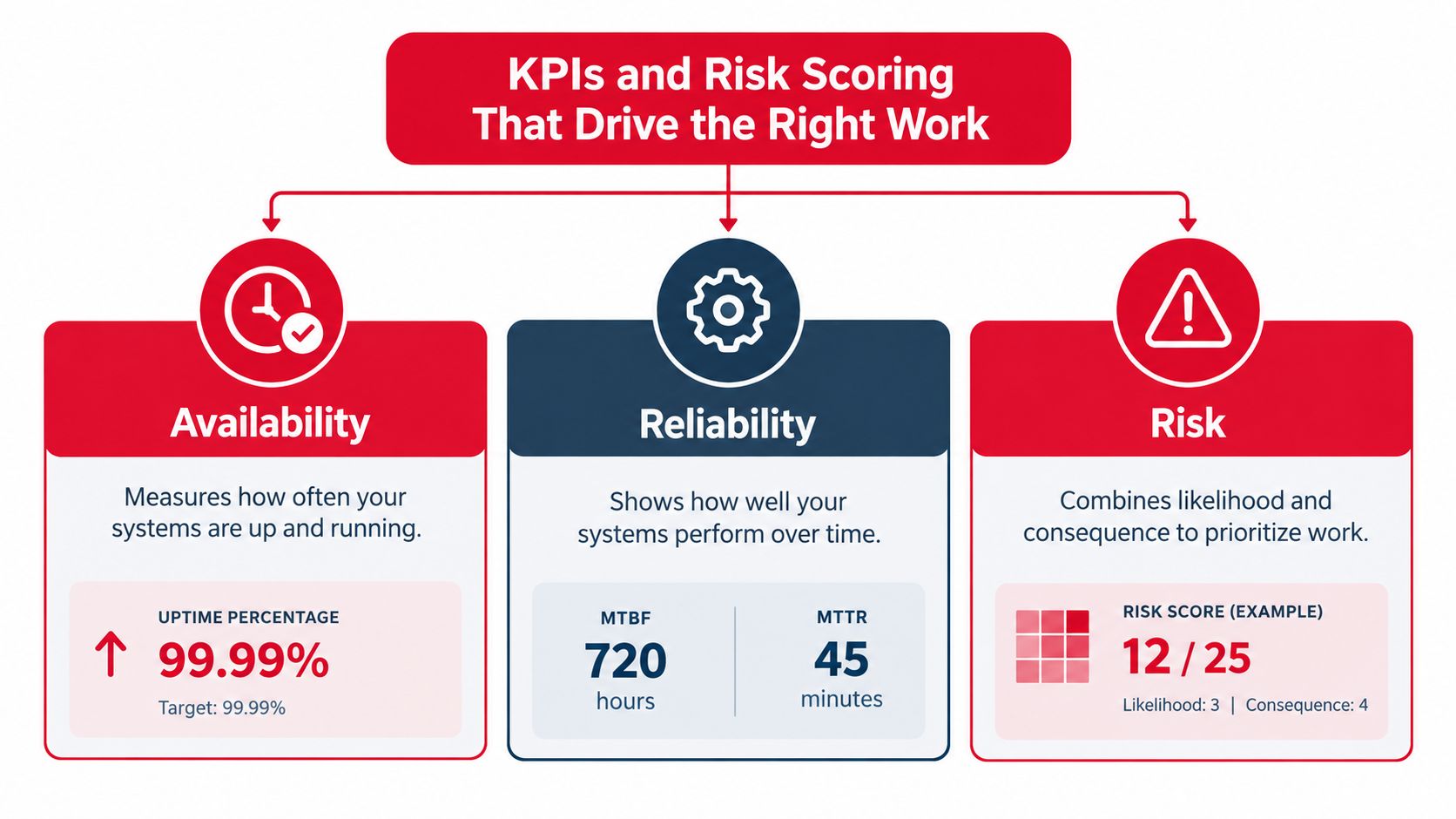
A KPI is useful only when it changes a decision. Availability tells leaders whether service is present. Mean time to repair, or MTTR, shows restoration effectiveness. Mean time between failures, or MTBF, helps expose recurring defects. A condition index describes physical or functional state, while a preventive-to-reactive ratio reveals whether the organization is planning work or responding to it.
Cost measures should follow the asset structure. Useful views include maintenance cost per route, cost per facility, cost per power system, or cost relative to delivered capacity. The exact denominator should match the operating decision. A portfolio manager may need route-level cost, while a data-center operator may need cost by electrical or cooling zone.
Score consequence, not just age
A practical risk model starts with:
Risk = probability of failure × consequence of failure
Probability can draw on condition, failure history, test results, exposure, and known defects. Consequence should include service impact, safety, regulatory exposure, financial loss, customer criticality, restoration difficulty, and route or power-path dependency.
That score should drive action. High-consequence assets may need shorter inspection intervals, dedicated spares, stronger redundancy, or earlier renewal. Low-consequence assets may remain in service with monitoring even when they are older. Age is an input, not a decision.
For data centers, condition-based management depends on measurements that reveal behavior. Independent guidance from Lawrence Berkeley National Laboratory identifies power, temperature, humidity, and air pressure sensors as foundations for real-time monitoring, with metrics including Rack Cooling Index, Return Temperature Index, Energy Reuse Effectiveness, and Airflow Efficiency (data-center monitoring guidance).
Make telemetry operational
A dashboard doesn't maintain an asset. Connect telemetry to a governed record and a work process:
- Fiber: Optical-test results, attenuation trends, splice history, and restoration events.
- Power: Battery impedance, rectifier alarms, UPS load, generator runtime, and transfer events.
- Environment: Cabinet temperature, humidity, airflow, and facility load.
- Network: Repeated alarms, path changes, congestion indicators, and customer dependency.
Use synchronized timestamps, immutable alarm and maintenance histories, asset-class baselines, and work orders tied to the affected asset and service path. Normalize comparisons for load and environmental conditions. Otherwise, managers may mistake seasonal variation for deterioration or overlook a real trend hidden by inconsistent measurement.
Compliance, Risk, and Repurposing Assets Under AI Demand
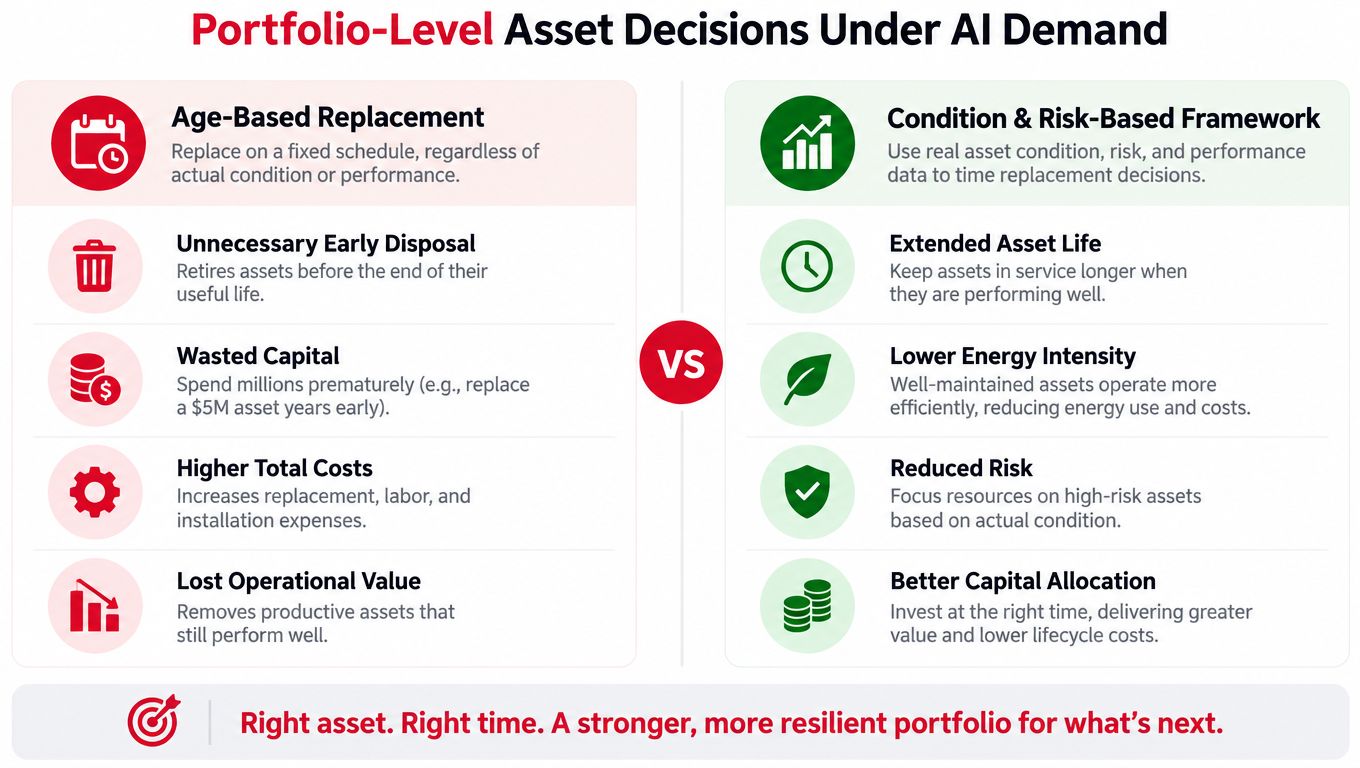
Age-based replacement is easy to explain and often wrong. A route can be old but strategically valuable, well documented, diverse from other paths, and cheap to maintain. A newer asset can be a poor investment if it consumes excessive energy, lacks capacity where demand is moving, or depends on a permit-constrained location.
McKinsey identifies a shift toward tenancy optimization, selective densification, small cells, private networks, edge data centers, and AI-driven operational efficiency. It also describes data-center expansion in Tier 2 cities reshaping fiber routing and investment priorities (McKinsey telecom infrastructure analysis).
Use a portfolio decision lens
For every major intervention, score more than condition:
- Failure exposure: What fails, how often, and with what restoration difficulty?
- Service importance: Which customers, applications, or facilities depend on the asset?
- Energy intensity: Does continued operation impose a growing power or cooling burden?
- Latency and route diversity: Does the asset support a strategic path that alternatives can't match?
- Permitting lead time: Would replacing or rerouting take longer than a controlled repair?
- Option value: Can the asset be reinforced, repurposed, or integrated into a future design?
The output should distinguish among repair, reinforce, reroute, retire, and repurpose. A battery fleet with drifting impedance may justify targeted replacement and closer monitoring rather than immediate wholesale disposal. A fiber route may deserve reinforcement or a diverse parallel path rather than repeated splice repairs. A facility may be better converted for a different workload if power, cooling, and connectivity can support it.
For readers evaluating modular approaches to changing compute and power requirements, Pacific Mobile Structures AI infrastructure provides relevant context on modular construction. The asset-management question remains the same: how will the new facility, power equipment, connectivity, documentation, and maintenance obligations enter the existing lifecycle system?
Compliance should be designed into the record, not added before an audit. Depending on the project and jurisdiction, operators may need evidence supporting FCC reporting, environmental and historic-preservation reviews for federally supported builds, field safety controls, electrical and communications standards, security management, commissioning, and change approval. The exact obligation varies, but every obligation depends on knowing what was installed, where it is, who changed it, and which control applies.
A Practical Implementation Roadmap for Operators
Implementation works when operators start with decisions, not software. The roadmap below can guide a carrier, ISP, wireless operator, or data-center owner without requiring a full replacement of existing platforms.
Assess
Inventory the assets that matter to service continuity, then establish a condition and confidence baseline. Select one route, facility, or asset class with visible operational pain. Deliverables should include an asset hierarchy, critical dependencies, known data gaps, failure history, and an initial risk view.
Avoid trying to clean every legacy record before proving value. A focused baseline exposes which attributes affect work planning.
Govern
Name the asset owner, data steward, engineering authority, operations owner, and finance contact for each critical record type. Approve a policy that connects organizational objectives, value, risk, lifecycle planning, knowledge, data governance, and operational controls. ISO 55001 treats those connections as part of an enterprise asset-management system, not as an isolated equipment register (ISO 55001 guidance).
Create decision rights for corrections. Someone must be able to reject an incomplete handoff, approve a field change, and resolve a conflict between GIS, work management, and financial records.
Integrate
Define the asset master and cross-system identifiers. Map the authoritative source for location, topology, condition, work history, cost, and retirement status. Start with controlled interfaces and reconciliation reports rather than attempting a large data migration with no operating model.
A small data-governance team often provides more value than a large steering committee. Put representatives from engineering, construction, operations, and finance close enough to resolve exceptions quickly.
Instrument
Add telemetry where it changes a decision. For a data center, that may include power, temperature, humidity, pressure, UPS, battery, and cooling measurements. For a telecom network, it may include optical testing, cabinet conditions, rectifier alarms, generator runtime, and network-event history.
Set baselines and escalation thresholds by asset class. Don't create a pilot that produces charts but no work orders. Every alert should have an owner, a response rule, and a way to record the result.
Optimize
Use risk-weighted work planning to select inspections, spares, preventive tasks, renewals, and capital projects. Review whether the work reduced exposure, improved record confidence, or merely increased activity.
Watch for four predictable traps:
- Scope creep: Keep the first deployment tied to a defined service or facility outcome.
- Pilot purgatory: Set an adoption decision and operational owner before instrumentation begins.
- Vendor lock-in: Require exportable identifiers, documented interfaces, and usable data models.
- Ownership disputes: Escalate unresolved corrections through a named governance path.
Organizations evaluating field execution, fiber construction, splicing, testing, documentation, or maintenance support can also review Southern Tier Resources as one potential delivery partner. The important requirement is that any partner returns complete, verifiable records into the operator's lifecycle process.
Bringing It All Together and Your First 90 Days
Return to the failing closure and the drifting UPS bank. A mature program doesn't automatically replace either asset. It confirms the record, maps service dependency, evaluates condition and consequence, checks alternatives, and assigns a decision owner. The result may be a targeted repair, a planned renewal, a reinforcement project, or a controlled repurposing decision. What matters is that the choice can be explained and revisited as evidence changes.
Start the next quarter with a narrow operating cycle:
- Confirm one asset master and assign ownership for corrections.
- Map the handoffs from design through construction, testing, operations, and maintenance.
- Pilot risk scoring on one route or one data-center hall.
- Choose five KPIs that lead to decisions, not just reporting.
- Record confidence levels for critical legacy data.
- Review one repair-versus-replace-versus-repurpose decision using condition, consequence, energy, dependency, and future demand.
You don't need certification or new software on day one. You need a defensible record, a shared risk method, and a work process that returns field evidence to the system. Once those controls operate consistently, better tooling and broader coverage can compound the improvement.
Southern Tier Resources supports telecom, broadband, wireless, and data-center programs with engineering, construction, fiber installation, splicing, testing, documentation, fit-outs, and maintenance across the asset lifecycle. Visit Southern Tier Resources to discuss how its delivery and field-services capabilities can support more reliable infrastructure records and operational continuity.