
A fiber build doesn’t usually fall behind because the prints were wrong. It falls behind because the crew on the ground can’t execute the basics at the pace and quality the job demands.
That often starts with the posting.
A generic job description laborer ad brings in generic applicants. In telecom, that’s a problem from day one. Underground fiber work, small cell support, data center cabling prep, and live-network maintenance all demand more than “must be able to lift materials and clean the site.” Hiring managers who use broad construction language usually end up screening the wrong people, retraining too many of them, and replacing some of them far too soon.
The labor market is active, but that doesn’t mean every applicant fits telecom work. The companies that hire well are the ones that write postings that match the job as it’s really performed. That means naming the environment, the safety expectations, the tools, the physical reality, the schedule, and the type of reliability the crew needs when a project is tied to service turn-up or a municipal deadline.
Why Generic Laborer Job Descriptions Fail in Telecom
The most common hiring mistake is simple. A manager copies a standard construction laborer posting, changes the company name, and assumes the field team will sort out the rest.
That approach breaks fast in telecom.
A laborer supporting a fiber crew isn’t just moving dirt. That person may be assisting with trench prep, conduit staging, material handling around delicate cable, traffic-sensitive work zones, or cleanup around an active right-of-way. On wireless work, the laborer may be supporting tower or small cell crews where site discipline and safety awareness matter every hour of the shift. In a data center, the same title can involve tray prep, cable handling, housekeeping, and working around exacting standards.
What generic postings leave out
Most broad laborer ads focus on three ideas:
- Manual work: lifting, loading, unloading, site cleanup.
- Basic reliability: showing up on time and following direction.
- General construction support: helping trades and maintaining the work area.
All of that matters. None of it is enough.
The gap between generic and specialized job descriptions contributes to high turnover, which can reach up to 30% in infrastructure roles, as workers’ skills and expectations mismatch the reality of telecom projects. At the same time, the market remains active, with 109,900 annual openings projected for laborers, while many postings still fail to mention telecom-specific work such as fiber handling or make-ready support, according to Indeed’s guidance on laborer job descriptions.
A bad posting doesn’t just waste recruiting time. It puts the wrong person on a truck, on a site, and next to work they were never prepared to support.
What works instead
The best telecom hiring teams write postings that filter early.
They state the project type. They define whether the work is underground, aerial, wireless, or inside a data center. They make the physical demands plain. They spell out safety credentials and schedule realities. They describe the role so a serious applicant can decide, before applying, whether the work fits.
That’s how you attract labor that can hold up under real project conditions.
The Anatomy of a High-Impact Telecom Laborer Job Description
A strong telecom job description laborer posting isn’t long for the sake of being long. It’s complete.
Each section has a job to do. If one part is vague, the whole posting gets weaker because candidates fill in the blanks with assumptions.
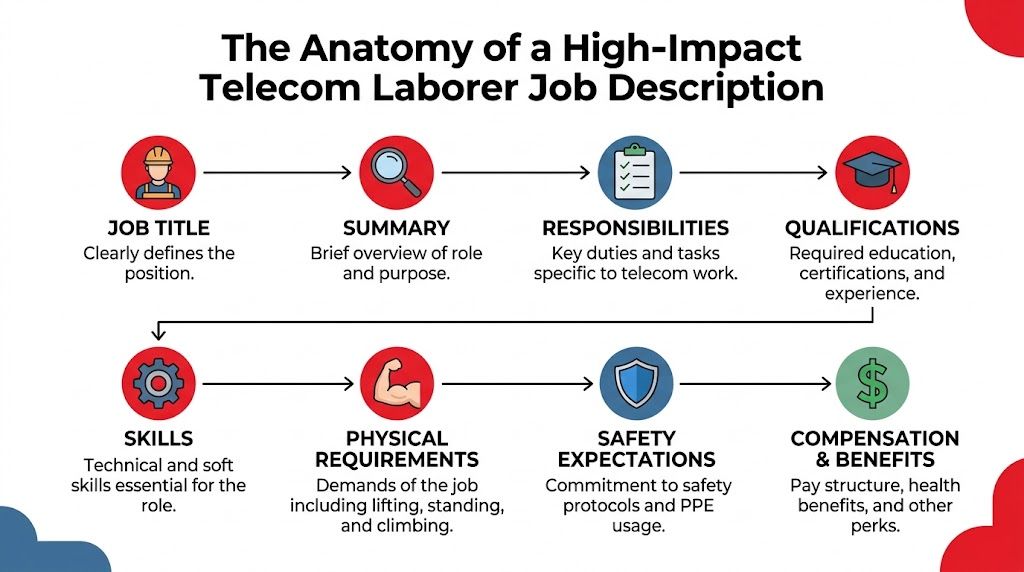
Core parts every posting needs
Job title
Keep it specific and searchable. “Laborer” alone is too broad.
Better examples include:
- Telecom Construction Laborer
- Fiber Construction Laborer
- Wireless Site Laborer
- Data Center Cabling Laborer
The title should tell the applicant what kind of work they’re walking into.
Role summary
This is the hook. It should explain where the person fits, what kind of projects they’ll support, and why the work matters.
Weak summaries read like legal disclaimers. Strong ones read like field reality.
Responsibilities
List actual telecom tasks. Don’t hide behind catch-all language like “other duties as assigned.” Use that line if you want, but only after you’ve named the core work.
Qualifications and certifications
Separate must-haves from preferred items. That keeps the posting credible and easier to fill.
A lot of hiring teams improve results when they shift toward a skills-based hiring approach and evaluate what the worker can safely do in the field, not just whether the resume looks polished.
The sections managers often miss
A posting for telecom labor should also include:
| Section | Why it matters |
|---|---|
| Physical requirements | Screens for readiness for standing, carrying, crawling, and outdoor work |
| Safety expectations | Signals that PPE, site rules, and hazard awareness are non-negotiable |
| Schedule and travel | Prevents surprises around early starts, overtime, call-outs, or changing sites |
| Compensation and benefits | Helps serious candidates self-select |
| Employment status | Clarifies non-exempt classification and overtime eligibility |
| EEO language | Supports fair, compliant hiring practices |
Practical rule: If your foreman would need to explain the basics of the job again during the first phone screen, the posting wasn’t finished.
A good posting pre-screens before a recruiter ever picks up the phone.
Writing a Compelling Laborer Role Summary
Most role summaries are dead on arrival because they sound like they were written for any warehouse, paving crew, or demolition site in the country.
That doesn’t work in telecom. The summary should sell the right candidate on the work, while pushing the wrong candidate away.
Weak summary versus useful summary
A weak version sounds like this:
General laborer needed to perform manual tasks, move materials, clean job sites, and assist crew members as assigned.
Nothing in that summary tells a candidate whether the role involves fiber, wireless, structured cabling, travel, weather exposure, or active utility corridors.
A stronger version sounds like this:
We’re hiring a telecom construction laborer to support fiber, wireless, and network infrastructure projects. This role assists field crews with site preparation, material staging, trench support, cable handling, cleanup, and safe jobsite operations on projects where schedule discipline and attention to detail matter.
That second version does three things right. It gives context, names the environment, and signals expectations.
What a good summary should communicate
Use the summary to answer five questions fast:
- What kind of work is this
- What projects will this person support
- What does success look like
- What conditions should they expect
- Why does this role matter to the crew
Don’t overload the paragraph. Just make it real.
Language that attracts the right people
The best summaries use field language without turning into jargon soup.
Use terms like:
- fiber construction
- small cell support
- material staging
- right-of-way work
- site housekeeping
- crew support
- safe execution
Avoid empty claims like “fast-paced environment” unless you explain what that means on the ground. In telecom, pace usually means tight starts, changing site access, weather pressure, and work that must be done right because downstream testing, turn-up, and inspections depend on it.
A good summary doesn’t try to impress everyone. It helps the right worker say, “Yes, I know what this job is.”
Defining Key Responsibilities for Telecom Projects
Responsibilities are where a job description laborer posting either becomes useful or stays generic.
If you only list “digging, lifting, and cleanup,” you’ll attract people who think they’re applying for broad construction support. If the actual work involves telecom crews, buried facilities, cable handling, and tightly controlled work areas, the posting needs to say that plainly.
Start this section with project-specific duties, not boilerplate.
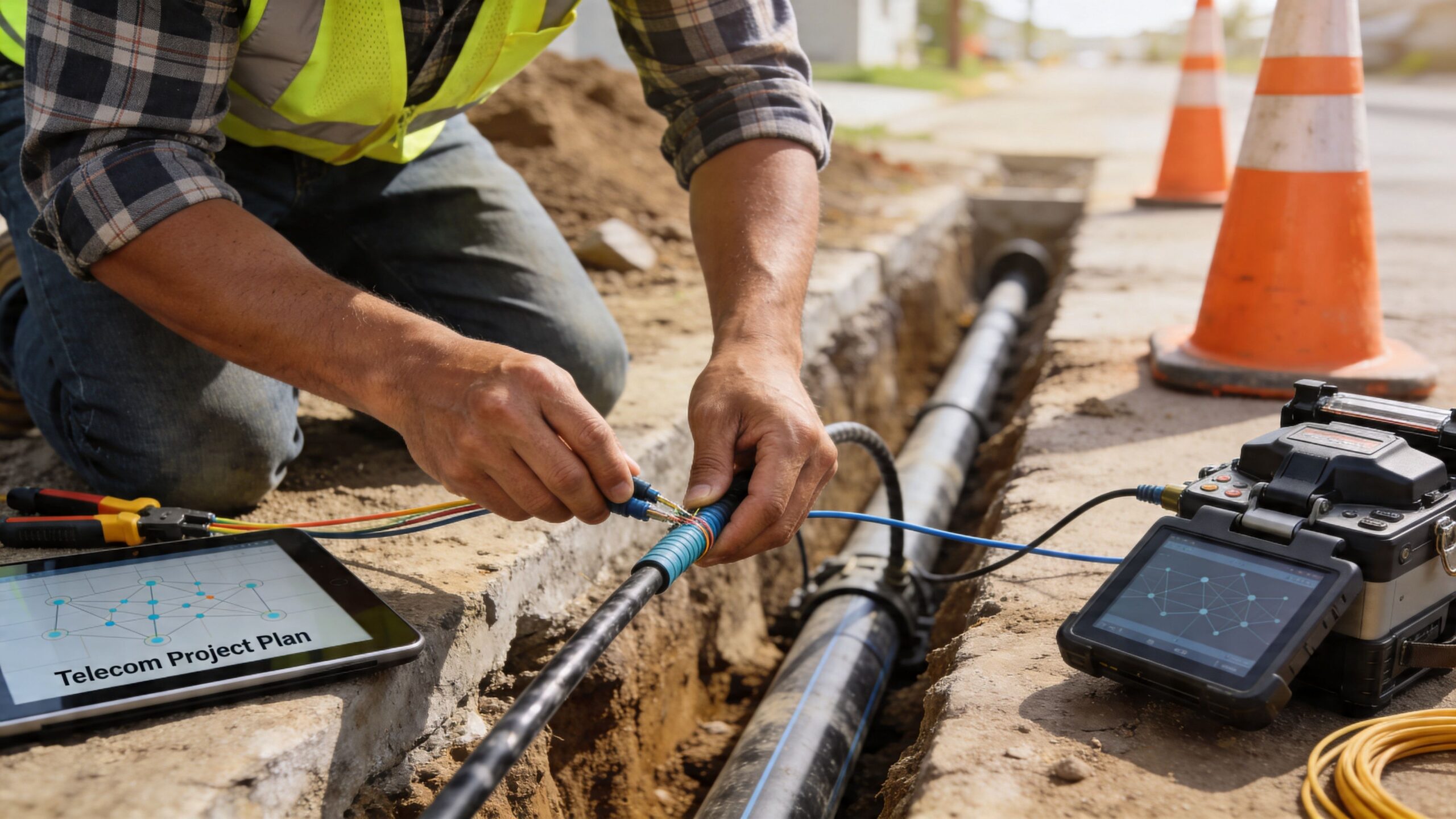
Fiber and wireline construction duties
Underground and aerial fiber work needs laborers who can support production without creating cable damage, site disorder, or safety problems.
Include responsibilities such as:
- Assist with site preparation: clear work areas, stage conduit, hand tools, warning devices, and crew materials before production starts.
- Support trenching and excavation activities: assist operators and crew leaders during trench prep and backfill work where fiber paths and utility separation matter.
- Handle telecom materials carefully: move reels, conduit, handholes, vault components, and jobsite supplies without damaging product or disrupting sequence.
- Support cable pulling operations: help guide and manage fiber placement under crew direction while maintaining clean pathways and organized material flow.
- Maintain jobsite cleanup: remove debris, secure loose materials, and leave rights-of-way, easements, and customer-facing areas in acceptable condition.
For teams hiring around make-ready or outside plant activity, it helps to align the posting language with the actual field support your crews need. This overview of telecom field work can help sharpen that wording: https://southerntierresources.com/s/tool82692999.shtml
Wireless and small cell support
Wireless support roles need a different emphasis. The laborer may spend less time around trench lines and more time supporting site access, material control, and general site readiness.
Use responsibilities like:
- Stage materials for tower or rooftop crews
- Maintain organized ground areas for tools, hardware, and deliveries
- Assist with small cell equipment handling and basic installation support
- Control housekeeping around live work zones and active public areas
- Follow crew direction during mobilization, demobilization, and punch-list work
A wireless laborer doesn’t need to be a climber to be valuable. But the posting should make clear that the person is supporting work where delays on the ground slow everyone above.
Data center and indoor network support
Inside data centers, laborers need discipline. The work is less forgiving than many outdoor sites because cleanliness, cable management, and close coordination matter constantly.
Relevant duties include:
- Support cable tray and pathway preparation
- Assist with pulling Cat6A and multimode fiber under crew supervision
- Stage and organize materials for structured cabling work
- Maintain clean aisles and remove packaging, scrap, and obstructions quickly
- Assist technicians with non-technical support tasks during fit-out and turnover work
Later in the hiring process, it helps candidates understand the kind of field environment your crews operate in. This short walkthrough is useful context:
The more precisely you describe daily work, the fewer “good on paper” applicants you’ll have to wash out in week one.
Essential Skills and Certifications to List
A telecom laborer posting should separate capability from wish-list clutter.
Too many job ads create impossible profiles. They ask for broad construction experience, telecom knowledge, machine operation, traffic control, warehouse discipline, and perfect attendance, then bury the actual requirements. Strong postings don’t do that. They identify what the worker must bring on day one, and what the company can teach.
For telecom labor roles, safety and technical competency are paramount. An effective posting should specify requirements such as OSHA 10-hour training, the ability to operate equipment like jackhammers with 60 to 90 lbs impact energy for trenching to 48-inch depths, and the physical capability to assist with pulling fiber optic cable without exceeding 25 lbs of pull tension, with work quality verified through post-pull OTDR testing, as described in Instawork’s guidance on laborer job descriptions.
Must-have versus preferred
Use this split in the posting so applicants can self-sort.
Must-have items
- Safety readiness: OSHA 10-hour training should be stated when the role requires it.
- Basic tool competence: familiarity with hand tools, power tools, and jobsite material handling.
- Mechanical aptitude: ability to work around trenching support, equipment staging, and crew-directed field tasks.
- Reliability: punctuality, ability to take direction, and willingness to work under changing site conditions.
- Physical capability: readiness for standing, carrying, crawling, and outdoor or indoor production support.
Preferred items
- Telecom exposure: prior work around fiber, wireless, utility, or structured cabling crews.
- Traffic-sensitive work experience: useful for roadside or right-of-way projects.
- Hazardous environment credentials: when legacy buildings, manholes, or contaminated conditions are part of the work.
- Driving or fleet-related qualifications: if your crews expect laborers to move vehicles, trailers, or equipment.
For managers refining candidate standards, this hiring qualification reference is a practical checklist: https://southerntierresources.com/s/quali21205513.shtml
Telecom Laborer Certifications Quick Reference
| Certification | Purpose | Requirement Level |
|---|---|---|
| OSHA 10-hour Outreach Training | Establishes baseline jobsite safety knowledge for field work | Must-have for many telecom field roles |
| HAZWOPER 40-hour certification | Prepares workers for contaminated environments such as sewage-exposed manholes or mold-affected legacy spaces | Preferred unless the work environment requires it |
| CPR and First Aid | Supports emergency readiness on field crews | Preferred |
| Flagger certification | Useful for right-of-way and roadside work where traffic control is part of the job | Preferred |
Don’t confuse credentials with fit
A card in a wallet doesn’t prove field discipline.
Use the posting to list certifications. Use screening to confirm the person can work safely, follow direction, and support a telecom crew without becoming a daily reset problem for the foreman.
Specifying Physical and Safety Requirements
This part of the posting should be blunt.
If the work involves mud, confined spaces, long periods on foot, changing weather, repetitive carrying, and early starts, say so. Serious candidates don’t get scared off by honest language. They respect it.

What to state clearly
Use direct language around physical demands, such as:
- Standing and walking: able to remain on foot through the shift.
- Ground-level movement: able to kneel, bend, crouch, and crawl when site conditions require it.
- Material handling: able to carry tools, supplies, and telecom materials safely.
- Outdoor exposure: able to work in heat, cold, wind, rain, and uneven terrain where project conditions require it.
- Indoor controlled environments: able to follow housekeeping and movement rules in data center or technical spaces.
- Schedule demands: able to report for early starts, overtime, travel, or emergency call-outs if the role includes them.
If your crews work around active roads, utility corridors, rooftops, or occupied facilities, note that too.
Safety language that actually helps
Safety language shouldn’t be vague HR filler. It should describe expected behavior.
A telecom laborer posting should make clear that workers are expected to follow PPE rules, attend job briefings, comply with site-specific procedures, and stop work or escalate concerns when conditions are unsafe. If your operation requires lockout procedures, RF awareness, or special handling around energized environments, that belongs in the posting.
Good workers don’t mind strict safety language. The people who push back on it are usually the ones you don’t want on a critical build.
Sample wording you can adapt
Here’s language that works well in real postings:
This role requires consistent adherence to all company and site safety rules, including PPE requirements, hazard communication, equipment safety procedures, and task-specific work instructions. Candidates must be prepared to work in physically demanding conditions and maintain safe behavior throughout the shift.
That kind of wording protects both sides. It sets expectations before the first interview and gives the field team a better shot at hiring people who understand what the work really demands.
Complete Job Description Templates You Can Use Today
Templates save time, but only if they sound like the job and not like copied boilerplate.
Use these as working drafts. Then tune them to the crew, market, and project type you’re hiring for. If you need help generating a first draft quickly before editing it for field reality, tools like this Job Post Generator can speed up the admin side. Just don’t publish anything until your operations team has cleaned up the details.
Template one for telecom construction laborer
Job title
Telecom Construction Laborer
Role summary
We’re hiring a telecom construction laborer to support underground and aerial network infrastructure projects. This role assists field crews with site preparation, material staging, trench support, conduit handling, cable support, cleanup, and safe worksite operations. The right candidate is dependable, safety-conscious, comfortable with physical work, and able to support production crews under changing field conditions.
Responsibilities
- Assist with site preparation for fiber construction and related telecom projects
- Stage tools, conduit, materials, warning devices, and crew supplies
- Support trenching, excavation, backfill, and restoration activities under crew direction
- Assist with cable pulling, conduit placement, and material handling
- Maintain organized, clean, and safe work areas throughout the shift
- Load, unload, move, and secure tools and materials at job sites
- Follow instructions from supervisors, foremen, and lead technicians
- Comply with all safety procedures, PPE requirements, and site rules
- Support mobilization, demobilization, and daily jobsite housekeeping
- Perform other related field-support duties as assigned
Required qualifications
- Ability to perform physically demanding outdoor work
- Ability to follow direction and work as part of a crew
- Familiarity with hand tools and basic construction site practices
- Strong attendance and punctuality
- Commitment to safe work habits
Preferred qualifications
- OSHA 10-hour training
- Prior experience supporting telecom, utility, or underground construction crews
- Experience working in rights-of-way, easements, or roadside environments
- Familiarity with fiber construction support tasks
Physical and schedule requirements
- Ability to stand, walk, bend, crouch, and crawl as needed
- Ability to work outdoors in changing weather and ground conditions
- Ability to report to varying job sites and work overtime when required
- Non-exempt position eligible for overtime pay
Template two for wireless site technician helper
Job title
Wireless Site Technician Helper
Role summary
We’re hiring a wireless site technician helper to support field crews on macro cell, small cell, and related wireless infrastructure projects. This position provides ground-level support through material staging, site organization, tool handling, cleanup, and safe execution of assigned field tasks. The role fits candidates who are reliable, coachable, and ready to support work where timing, safety, and crew coordination matter.
Responsibilities
- Stage tools, hardware, and materials for field crews
- Maintain clean and organized work areas at wireless project sites
- Assist with small cell and equipment support tasks as directed
- Load and unload deliveries, tools, and installation materials
- Support jobsite setup and closeout
- Follow all site access, PPE, and safety requirements
- Communicate clearly with crew leaders regarding materials and site needs
- Perform general field-support duties tied to wireless construction and maintenance work
Required qualifications
- Dependable attendance and willingness to work outdoors
- Ability to lift, carry, and move equipment and materials safely
- Ability to follow direction and support a production crew
- Basic familiarity with jobsite tools and safe handling practices
Preferred qualifications
- OSHA 10-hour training
- Prior wireless, utility, or construction support experience
- Experience working around active public spaces or controlled work zones
- CPR and First Aid credentials
Physical and schedule requirements
- Ability to remain active for the full shift
- Ability to bend, kneel, climb ladders if assigned, and work on uneven surfaces
- Ability to work early starts, overtime, and changing site schedules
- Non-exempt position eligible for overtime pay
What both templates get right
They don’t pretend the role is generic.
They tell the applicant what kind of work they’re supporting, what the crew expects, and what conditions come with the job. That’s what makes a template useful in telecom.
Tips for Customizing Your Job Description
A template should save time. It shouldn’t replace judgment.
The same job title can mean very different work depending on whether you’re building rural backbone, handling urban make-ready, supporting wireless retrofits, or working inside a data hall. If you don’t customize the posting, you’ll hire against the title instead of the task.
Adjust for the project, not just the department
A rural greenfield posting should emphasize terrain, outdoor exposure, material movement, and production support over distance and changing site conditions.
An urban posting should lean harder on traffic-sensitive work, public-facing professionalism, tight staging areas, and disciplined cleanup. A data center version should stress housekeeping, cable support, and working in controlled environments.
Match the local labor market
If your market has plenty of general construction labor but limited telecom experience, don’t overload the posting with preferences that aren’t required.
Tighten the must-haves around safety, reliability, and physical readiness. Then train the telecom-specific pieces. That usually gives operations a better hiring lane than waiting for the perfect resume to show up.
Add your company’s operating style
Candidates should understand how your crews work.
Use the posting to show whether you run disciplined start times, whether crews move between sites, whether leads expect clean truck habits, and whether communication standards are strict. Good applicants often decide based on operating clarity as much as pay.
The best customizations are small but concrete. Name the project type, the work setting, the schedule pattern, and the kind of crew support the role really involves.
That turns a generic posting into a hiring filter.
Screening Questions to Identify Top Laborer Candidates
A strong posting brings in better applicants. Good screening tells you who can last on the crew.
Resumes won’t reliably show reliability, safety judgment, or coachability. Direct questions will.

Questions that reveal real fit
Ask short questions and listen for specifics.
- Tell me about a job where you had to be ready to start early every day. How did you make sure you were on time?
- Describe a time you saw a safety issue on a site. What did you do next?
- What kinds of tools or equipment have you handled regularly on the job?
- Have you worked outdoors in changing weather for full shifts? What part of that was hardest for you?
- When a supervisor changes the plan in the field, how do you respond?
- Tell me about a day when the work was repetitive, dirty, or physically demanding. How did you stay productive?
- Have you worked on a crew where cleanup and site organization were taken seriously? What did that look like?
What strong answers sound like
You’re listening for ownership, not polished language.
Good candidates describe habits. They mention arriving early, checking tools, asking questions, following crew direction, and speaking up when something looks off. Weak candidates stay vague, blame former supervisors, or talk like safety and housekeeping are someone else’s problem.
One screening mistake to avoid
Don’t overvalue industry vocabulary.
A candidate may not know every telecom term yet and still turn into a solid hire if they show reliability, awareness, and mechanical common sense. On the other hand, someone who talks confidently about construction but can’t explain how they stay organized or safe will create more work than they solve.
Guidance on Compensation and Compliance
Compensation needs to be grounded in the actual market, not in wishful budgeting.
As of 2024, the median annual wage for construction laborers was $46,050, or $22.14 per hour, and employment is projected to grow 7% from 2024 to 2034, faster than the average for all occupations, according to the U.S. Bureau of Labor Statistics’ profile for construction laborers and helpers. In high-demand markets, the same source lists Pennsylvania at $52,290 and Utah at $47,910, which gives hiring teams a useful benchmark when they’re trying to staff telecom work competitively.
What that means for your offer
If your posting asks for safety discipline, schedule flexibility, and physically demanding field work, your pay range has to reflect that reality.
Candidates compare offers fast. If your rate sits below what similar field work can command in your market, the best applicants will screen out before the first call. This compensation reference can help when calibrating job levels and ranges: https://southerntierresources.com/s/salar52503652.shtml
Compliance points that belong in the posting
At minimum, include these items:
- Non-exempt status: laborer roles should generally be identified as overtime-eligible when applicable.
- Clear physical requirements: describe the demands of the job.
- Equal employment language: include a proper EEO statement aligned with your company policy.
- Schedule clarity: state travel, weekend, overtime, or call-out expectations up front.
The companies that hire cleanly don’t treat compliance as a footer. They build it into the posting from the start.
Frequently Asked Questions About Hiring Telecom Laborers
Should you hire contract laborers or full-time employees
It depends on the work mix.
Contract labor can help with spikes, short-duration builds, and geographically scattered projects. Full-time crews usually give you better consistency, stronger safety habits, and less retraining when the work is repeatable and quality-sensitive. For critical infrastructure jobs, many teams use a blended model and keep the most reliability-sensitive functions closest to their core workforce.
Where should you post a telecom laborer opening
Start where field candidates search, not just where corporate recruiters are comfortable posting.
General job boards can work if the ad is specific. Local trade networks, referral channels, workforce partners, and field supervisors often produce better leads because they bring in people who already understand construction rhythm and crew expectations.
How do you reduce washout after hiring
The posting matters, but onboarding matters just as much.
Make day one concrete. Show the worker what the job really is, who they report to, what time the truck rolls, what PPE is required, and what “good” looks like on your sites. Most early attrition comes from mismatch, not mystery. Fix the mismatch before and during onboarding.
What’s the fastest way to improve applicant quality
Tighten the posting before you widen distribution.
Solving quality problems often involves posting in more places. That can increase volume, but it doesn’t improve fit. Better titles, cleaner summaries, telecom-specific duties, and clear physical and safety requirements usually improve quality faster than another round of broad promotion.
If your team needs a dependable partner for telecom engineering, construction, maintenance, or field staffing strategy, Southern Tier Resources brings practical experience across fiber, wireless, and data center infrastructure. When the work has to be built safely, documented correctly, and delivered on schedule, it helps to work with people who understand what qualified field labor really looks like.