You're staring at the same problem again. A crew is on site, the splice tray order is wrong, the access contact is missing, and someone swears this exact issue was “fixed” on the last build. The schedule keeps moving, the field team keeps improvising, and the lesson disappears into a closeout folder no one opens until the next mistake lands.
Lessons learned documentation exists to stop that cycle. In project work, it should turn field experience into something the next crew can find, trust, and apply. The hard part isn't writing things down, it's making sure the note survives the project, gets categorized correctly, and shows up before the next permit call, outage window, or handoff meeting.
Why Lessons Learned Documentation Matters for Telecom Projects
A fiber crew can spend half a day waiting at a site because access wasn't coordinated, only to learn later that the previous build hit the exact same wall. That kind of repeat failure is where lessons learned documentation earns its keep, because it turns a one-off headache into an organizational warning that can be reused on the next job. In telecom, data centers, and other infrastructure work, the same issues keep resurfacing, vendor delays, scope growth, and communication gaps, so informal memory is never enough.
PMI's lifecycle framing is useful because it treats lessons learned as more than a closeout note. Its five-step model, collection, prioritization, documentation, communication, and assimilation, makes documentation the point where prioritized lessons are recorded in a consistent, standardized format for future retrieval, and it explicitly describes documentation as the bridge from raw project experience to reusable organizational knowledge (PMI knowledge management article). That's the part teams often miss. Writing the lesson is not the finish line, it's the handoff to the next build.
Practical rule: if a lesson can't be found during planning, it doesn't exist operationally.
That's why the strongest project environments treat this as a deliverable, not a cleanup task. Southern Tier Resources' own delivery mindset reflects the same reality, projects need records that actually influence the next splice, the next make-ready walk, and the next commissioning window. For a helpful framing on organizational memory, the idea of stop losing knowledge as a team fits the problem well.
The Five-Stage Workflow for Continuous Capture
A fiber-splicing mistake rarely stays isolated. I have seen the same labeling error surface across three builds because the first crew recorded a complaint, not a usable instruction. A field workflow must be quick enough for a supervisor at the end of a long shift and structured enough for a program manager to trust months later.
PMI's implementation guidance uses five steps, identify, document, analyze, store, and retrieve. Each step turns a passing observation into searchable knowledge (PMI implementation guidance). Where Section 1 described the lifecycle model, this workflow is the field-level implementation loop for daily capture. Its purpose is operationalization, turning documentation into trigger-based actions that distributed crews can use before work begins.
Capture while the job is still moving
Closeout is too late for reliable detail. By then, the person who spotted the issue may be on another site, the permit conversation may be buried, and the cause may have become a vague complaint. Capture the lesson during execution while its conditions, evidence, and consequence remain visible.
A make-ready delay illustrates the approach. When a pole attachment review slows the build, record it at the permit stage. Tag the project phase, describe the root cause, and state what must happen before the next similar scope starts. Apply the same method to fiber testing, labeling errors, staged-equipment shortages, and late vendor access.
Use a five-stage loop, not a one-time report
- Identify the event when it occurs.
- Document it in plain, structured language.
- Analyze the cause and its effect.
- Store it where the next crew can search.
- Retrieve it before related work starts.
Retrieval is the test of whether capture created value. A lesson should surface through a project phase, asset type, failure condition, or other trigger, rather than depend on someone remembering a document title. Project-level records can then support management-level metrics and reveal patterns across builds instead of leaving each problem isolated.
Before archiving, validate the entry. It should describe a repeatable condition, identify a clear trigger, and specify an action someone can take. Record successes as well as failures. A lesson that only explains what went wrong leaves out the practice worth repeating.
Common Failure Modes and How to Avoid Them
On three different builds, I have watched crews repeat the same fiber splicing mistakes because the earlier fix existed only in someone's notes. The common failure is nonstandard capture. When each supervisor decides what to record, one produces a useful account while another leaves a sentence in an email thread. Distributed crews then lose the context, evidence, and corrective action when the technician who knew the story leaves the site.
The deadline is usually the reason given. In practice, several pressures combine: forgetfulness, staff turnover, weak forms, and dependence on the writer's skill. A rushed team may record that a splice failed without stating which preparation step, tool setting, or inspection result mattered. The next crew sees a symptom, not a reusable instruction.
Documentation also fails when it is treated as a closing report. A lesson has operational value only when a related task can bring it back to the surface. If a fiber-splicing issue is buried in a project folder, the crew starting similar work will probably never search for it. Store the lesson against the work phase, asset, failure condition, or change that should trigger review.
A UK government review cited in the academic case study and barrier review found that skipping lessons learned wastes about 28% of time repeating the same mistakes. Telecom crews see the same pattern as repeat truck rolls, rework hours, and inspections that uncover an already-known defect.
What structured teams do differently
They build practices that still work when the schedule is tight:
- Use a fixed template: require the same core fields so site staff can record facts quickly.
- Capture by event, not memory: create the entry when the delay, defect, or change is visible.
- Separate observation from blame: describe the condition, decision, and result without targeting an individual.
- Write the trigger and action: state when the lesson should appear and what the next crew must do.
- Assign ownership: one person reviews and publishes the entry, even when several people provide evidence.
A searchable, trigger-based record turns a past mistake into a prompt for the next build. An informal note only records history. It rarely changes field behavior.
Building Your Documentation System, Templates and Tools
Many teams can produce a review, but far fewer can point to a lesson that was searched, read, and applied on the next build. One summary noted that 87% of organizations conduct lessons-learned reviews, but only 33% say project teams review prior lessons before new work and only 18% can show measurable behavior change from them (operationalization gap summary). That's a systems problem, not a writing problem.
Build for retrieval, not storytelling
A narrative-only writeup is hard to scan under pressure. A better template includes an executive summary, the event, the root cause, the impact, the action owner, the recommendation, and the tags that let the next crew find it. The tags matter as much as the text, because future teams search by project type, phase, failure mode, and severity, not by the file name someone chose at 7:45 p.m. on a Friday.
A practical structure for telecom and data-center work can look like this:
- Project context: fiber build, small-cell deployment, or fit-out phase
- Trigger event: permit delay, access issue, labeling mismatch, vendor slip
- Root cause: coordination gap, missing dependency, unclear ownership
- Impact: schedule slip, rework, inspection delay, commissioning risk
- Action owner: role responsible for the fix
- Tag set: phase, failure mode, site type, severity, repeat-risk
That structure works because it turns each entry into a searchable decision aid. A lesson about a make-ready pole condition assessment belongs in the same repository as a commissioning labeling issue, but the tags have to make the difference obvious.
Choose tools that match how crews work
Searchable repositories matter more than polished formatting. If the field team can't access the repository from a phone or tablet, the system won't get used when it matters. For distributed crews, the right tool is the one that supports quick entry, simple search, and tagged retrieval without forcing extra admin work.
The best system is the one people can use between tasks, not after they get back to the office.
For organizations that want an integrated delivery partner, Southern Tier Resources is one option that works in the same operational lane as this approach, since its work includes fiber construction, testing, documentation, and data-center fit-outs. The specific platform matters less than the rule: keep lessons inside the project workflow instead of splitting them into a separate archive nobody visits.
Governance, Stakeholders, and Measuring Success
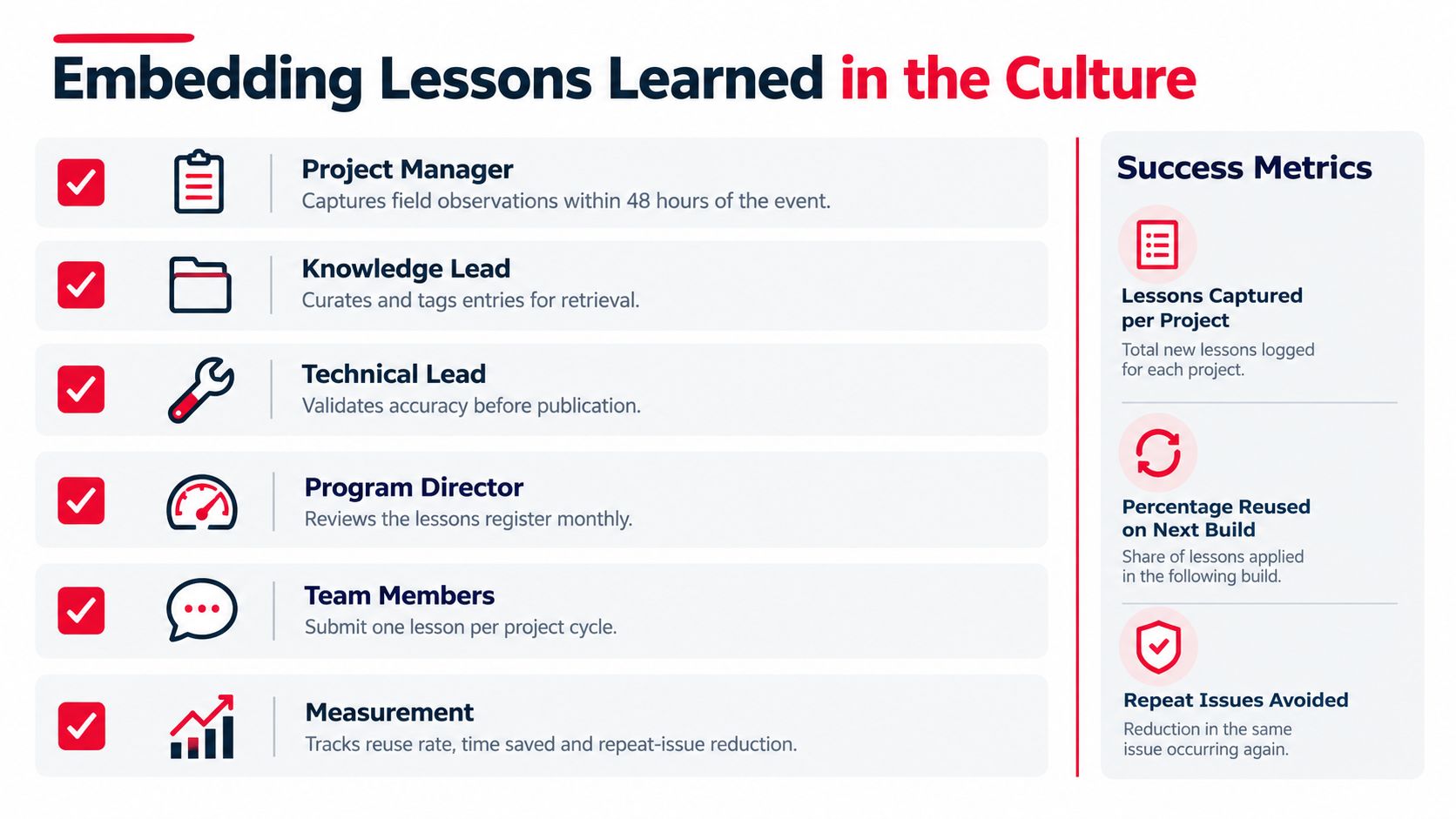
A lessons system fails when everyone thinks someone else owns it. Governance fixes that by assigning clear roles for capture, validation, curation, review, and reuse. The Inter-American Development Bank's four-phase framing, identification, documentation, dissemination, and reuse, reinforces that documentation only matters when it reaches the next project team (cross-case review).
Assign roles that match the work
- Project Manager: captures field observations quickly and keeps the review on the calendar.
- Knowledge Lead: curates entries, adds tags, and makes sure retrieval is easy.
- Technical Lead: verifies accuracy before the lesson goes live.
- Program Director: reviews the register and looks for repeating patterns.
- Team Members: submit real field observations, not just polished closeout language.
- Measurement Owner: tracks reuse, repeat issues, and whether the system is being used.
The goal is to make lessons a required deliverable alongside test reports, as-built plans, and closeout documents. If the lesson isn't owned, reviewed, and searchable, it'll drift into the same drawer as every other forgotten report.
Measure whether the system works
Useful tracking doesn't need to be complicated. The right measures tell you whether lessons are being captured, whether they're being reused, and whether repeat failures are dropping over time. A practical scorecard can include the number of lessons captured per project, the share reused on the next build, and whether repeat issues are being avoided across similar jobs.
Leadership also matters here. When directors reference prior lessons in kickoff meetings and gate reviews, crews learn that the repository is part of execution, not office theater. That behavior changes what gets written down. People stop filing generic notes and start recording the details that will help the next team.
Real-World Examples from Telecom and Data Center Builds
A fiber-greenfield crew once documented that right-of-way permit delays kept pushing a critical handoff into the next window. Because the lesson was tagged by phase and failure mode, the following project manager found it during planning and built buffer time into the schedule. Without that note, the team would've repeated the same scramble, and the delay would've looked “unpredictable” again.

When tagging changes the outcome
A wireless small-cell deployment hit a recurring make-ready issue because pole condition checks were too informal. The crew that documented the lesson tagged it by site condition and preconstruction phase, so the next field lead knew to push the inspection earlier and verify pole readiness before scheduling the rest of the crew. That saved the next team from discovering the same problem after trucks were already parked on site.
A data-center fit-out had a different failure mode, cabling labels didn't match the commissioning sequence. The entry was stored as a searchable lesson tied to structured cabling and commissioning, which made it easy for the next team to adopt a stricter labeling check before turnover. In environments where every hour of confusion ripples through multiple trades, that kind of reuse matters more than a polished retrospective.
What these examples have in common
The lesson wasn't the story itself. It was the combination of context, tags, and actionability that made the story useful on the next build. That's the shift from documentation as a closing ritual to documentation as operational intelligence.
When teams skip that shift, every project becomes a fresh experiment. When they get it right, the next crew starts with a map instead of a memory.
Getting Started, Your First Lessons Learned Implementation
Start small enough that the crew will use it. Pick one simple template, assign one owner for capture, and launch it on the next high-impact project where the cost of repetition is obvious. The goal isn't perfect prose, it's consistent practice that survives deadline pressure and field noise.
A practical launch checklist looks like this:
- Choose one template with a few required fields.
- Name one owner for final entry quality and storage.
- Capture at milestones instead of waiting for closeout.
- Tag by context so the next team can search by phase and failure mode.
- Review the register at kickoff for the next project.
- Track reuse so the system proves it's being used.
If the team pushes back, keep the message simple. Documentation is not admin work for its own sake, it's how crews stop repeating the same fiber, access, labeling, and coordination mistakes under different project names. When it's done well, it supports on-time, on-budget, quality delivery by turning field experience into a reusable operating asset.
| Tool type | Field suitability | Office suitability |
|---|---|---|
| Mobile form or app | Strong for quick capture | Good for review queues |
| Shared spreadsheet | Fair for simple logs | Good for small teams |
| Searchable knowledge base | Strong if mobile access works | Strong for retrieval and governance |
For teams managing fiber, wireless, and data-center work, the best next step is to make lessons learned documentation part of the build, not a separate afterthought. Southern Tier Resources already works in the same delivery space, so this discipline fits naturally with projects that depend on reliable documentation, clear ownership, and repeatable execution.
If you want a practical partner that understands telecom construction, fiber splicing, wireless deployment, and data-center fit-outs, visit Southern Tier Resources. Their project approach aligns with the same goal this guide laid out, turning field experience into documentation crews can use on the next build.