Network scalability is the ability to add nodes, users, traffic, or geographic reach without proportional resource growth or performance degradation. A scalable network keeps latency and throughput within acceptable limits as demand rises, instead of allowing congestion or complexity to consume the gains.
A regional ISP may have a core that worked well when its customer base was smaller and evening traffic was predictable. As subscriptions, video traffic, cloud access, and business services grow, the same design can begin dropping packets during peak hours. The equipment may still be technically operational, but the network is no longer scaling effectively.
What Is Network Scalability in Plain Terms
The practical definition is simple: network scalability means expanding a network without making performance deteriorate or operating effort rise at the same rate. Expansion can mean adding subscribers, routers, cell sites, data-center connections, geographic coverage, or application traffic. A scalable design accommodates that growth through planned capacity, modular infrastructure, and operational processes that don't need a complete redesign every time demand increases.
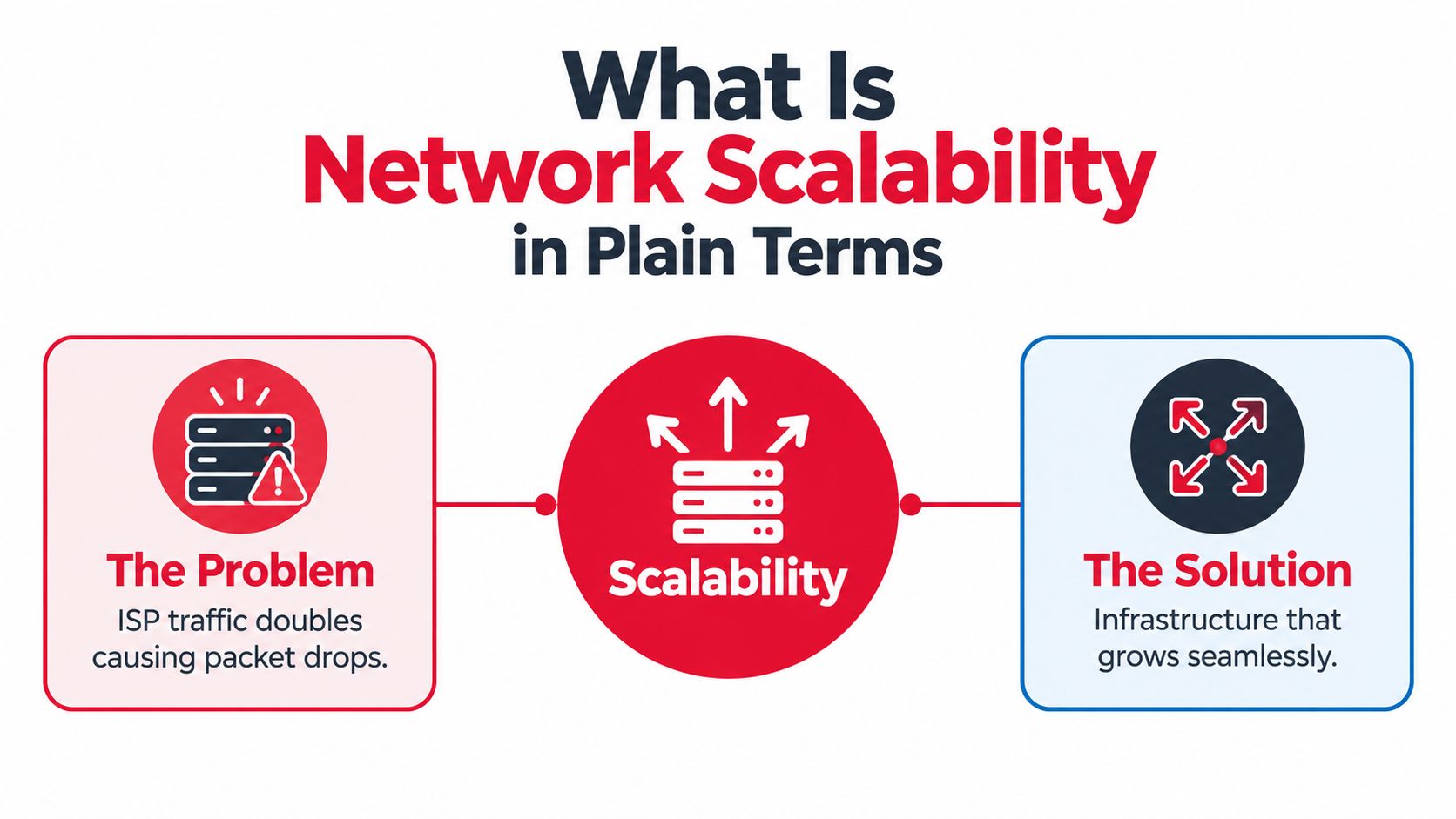
Consider an ISP with a regional fiber backbone. Subscriber demand increases, but the operator does not just add a larger router and hope for the best. The team may add line cards to a modular platform, light additional fiber strands, expand aggregation sites, improve backhaul, or place content and services closer to customers. Each decision increases the network's ability to serve more demand while preserving a predictable user experience.
Acceptable performance needs measurable boundaries. Engineers commonly use throughput and latency as baseline scaling KPIs, rather than relying on a general statement that the network is “performing well.” Network scalability depends on increasing nodes, users, traffic, or geographic reach without proportional resource growth or performance degradation. In practical terms, throughput should remain useful as load rises, while latency should remain within the range required by the service.
Scalability is more than adding equipment
A network can grow physically and still fail operationally. Every new router, route, splice closure, interconnect, or cell site adds inventory, configuration, monitoring, maintenance, and failure scenarios. If the operator needs disproportionate staff time to manage each addition, the architecture may have capacity but poor scalability.
Practical rule: Judge an expansion by what happens under sustained load and during failure, not by the maximum speed printed on a device specification sheet.
By the end of this article, you should be able to distinguish scalability from capacity and elasticity, choose between vertical and horizontal expansion, identify bottlenecks, and build a testing plan for fiber, wireless, carrier, and data-center environments. You'll also see why legacy operations and AI-oriented connectivity now belong in the same scalability discussion.
Scalability Versus Capacity and Elasticity
These three terms describe related but different properties. Confusing them leads to weak expansion plans.
Think of a highway. Capacity is the number of lanes and interchanges available today. Scalability is the road system's ability to add lanes, bridges, and interchanges without rebuilding every connection. Elasticity is the ability to open or close usable lanes as demand changes, often through a control system that responds to current conditions.
The same distinction applies to telecom infrastructure:
- Capacity: A fiber route's currently lit wavelengths, a router's installed line cards, or the bandwidth available on a data-center interconnect.
- Scalability: Spare conduit, additional fiber strands, modular chassis, expandable aggregation, and a design that lets the operator add capacity in stages.
- Elasticity: Bandwidth or compute resources that can be increased and reduced on demand, such as a cloud interconnect service or dynamically allocated network capacity.
A greenfield broadband build may include conduit and fiber that aren't needed immediately. That spare infrastructure doesn't improve today's throughput by itself, but it gives the operator a path to expand without opening the street again. Similarly, a modular router can provide current capacity while leaving room for additional line cards or forwarding resources.
Why a large network can still scale poorly
An operator may own substantial capacity yet struggle to expand it. A monolithic core platform, for example, might have high peak throughput but no practical way to add ports or distribute control-plane work. When the platform reaches its limit, the team must replace the entire system, migrate services, and accept a concentrated maintenance event.
Wireless networks show the same issue. A macro site may have substantial radio capacity, but adding more sectors or larger radios may eventually reach physical, spectrum, power, or structural limits. Horizontal additions such as small cells and new aggregation points may offer a better path, provided the transport network can support them.
Data-center interconnects also require this separation. A connection can have enough capacity for current applications but lack an elastic provisioning model or diverse physical paths. Planners should ask three separate questions:
- How much demand can the network serve now?
- How can the network add capacity later?
- Can capacity respond to changing demand without a disruptive rebuild?
Capacity answers the first question. Scalability answers the second. Elasticity answers the third.
Vertical Versus Horizontal Scaling Explained
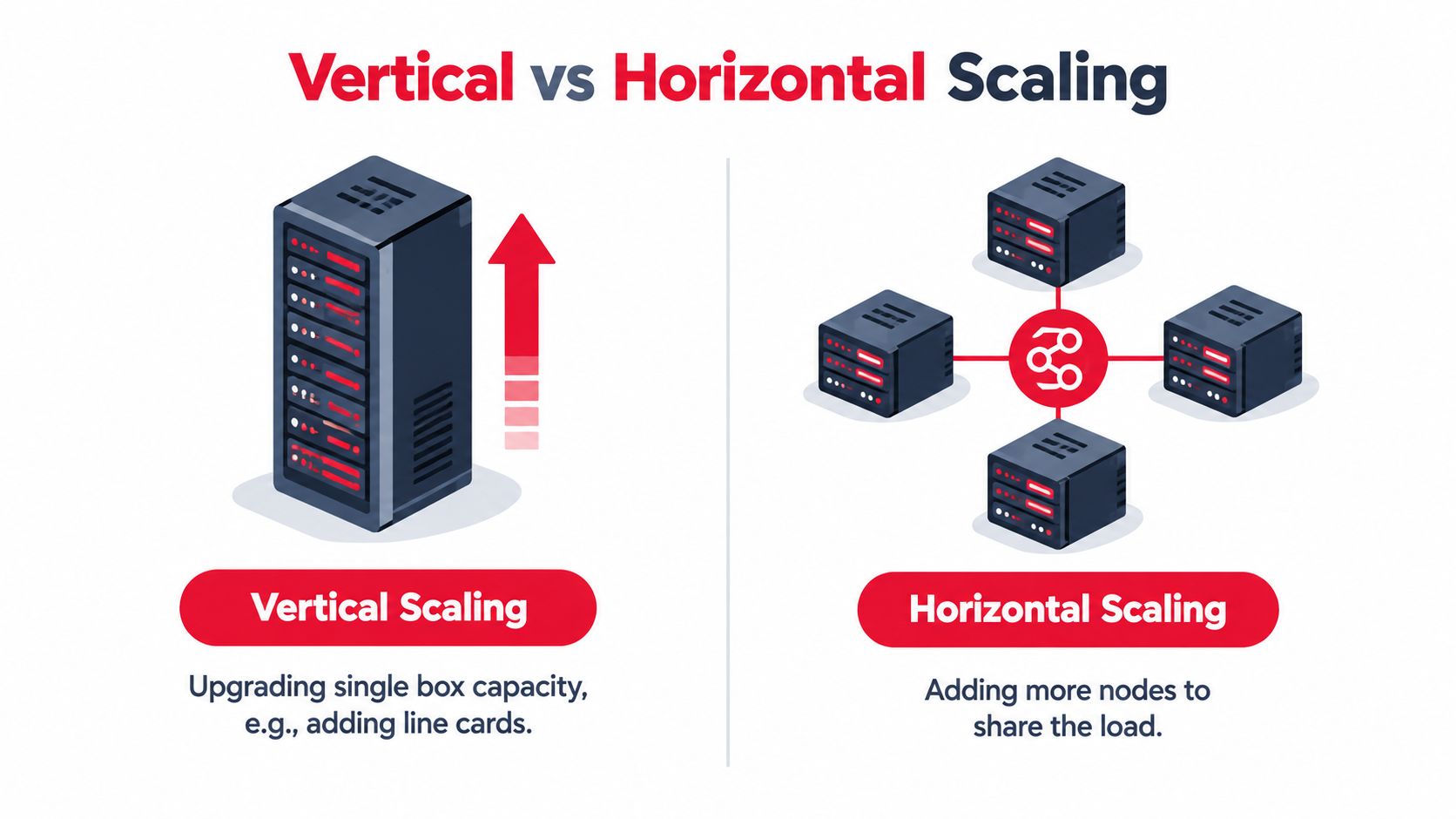
Vertical scaling means making an existing component larger or more capable. Horizontal scaling means adding components and distributing the load across them. Both approaches belong in a carrier or ISP design, but they solve different constraints.
Replacing an aggregation router with a higher-capacity model is vertical scaling. Adding line cards to a modular chassis is also vertical scaling. In a fiber route, using higher-capacity optics over existing strands follows the same principle. The operator keeps the basic topology and increases the capability of a current element.
Horizontal scaling adds parallel resources. An ISP might deploy a second aggregation router, create another regional point of presence, or distribute subscribers across additional nodes. A wireless operator might add small cells to a busy area instead of relying only on upgraded macro sectors. A data-center operator might add interconnect paths or edge nodes so traffic doesn't depend on one device or facility.
Choosing the right path
Vertical expansion is usually easier to operate because it preserves established routing, monitoring, and physical layouts. It can also simplify migration when the existing platform supports modular upgrades. The limitation is the device's hard ceiling. A larger box remains one box, which may leave the network exposed to a concentrated failure or a future replacement event.
Horizontal expansion spreads load and can improve resilience, but it introduces more devices, links, routing relationships, and operational records. The team must manage load balancing, route policy, software consistency, telemetry, and maintenance across the larger system.
| Criterion | Vertical Scaling | Horizontal Scaling |
|---|---|---|
| Basic method | Upgrade one component | Add more components |
| Telecom example | Replace an aggregation router or add line cards | Add an aggregation router or regional node |
| Fiber example | Use higher-capacity optics on existing plant | Add parallel routes or additional distribution points |
| Wireless example | Upgrade sectors or radios at a macro site | Add small cells or new sites |
| Main advantage | Simpler topology and operations | Greater distribution and resilience |
| Main limitation | Hard capacity and failure-domain ceiling | More management and coordination |
| Best fit | Shorter-term growth within a modular platform | Sustained growth across locations or traffic domains |
Apply the decision by infrastructure layer
Vertical scaling often fits a constrained site where power, space, and operations favor fewer devices. Horizontal scaling makes more sense where demand is geographically distributed, where a single failure domain is unacceptable, or where the operator expects ongoing additions.
Neither approach should be selected in isolation. A carrier may vertically scale core platforms while horizontally scaling access and aggregation. A wireless operator may upgrade macro radios and add small cells at the same time. The correct question isn't which method is universally better. It's where should the network become larger, and where should it become more distributed?
Key Metrics and Where Networks Hit Bottlenecks
A scalability test needs more than a device's advertised maximum. It needs measurements taken while traffic increases and the network handles realistic routing, queuing, failover, and service policies.
Throughput is the amount of data transferred over time. Latency is the delay experienced by a packet or request. Under congestion, these values often move in opposite directions. Queues grow, packets wait longer, and useful throughput can fall even though the links remain physically active.
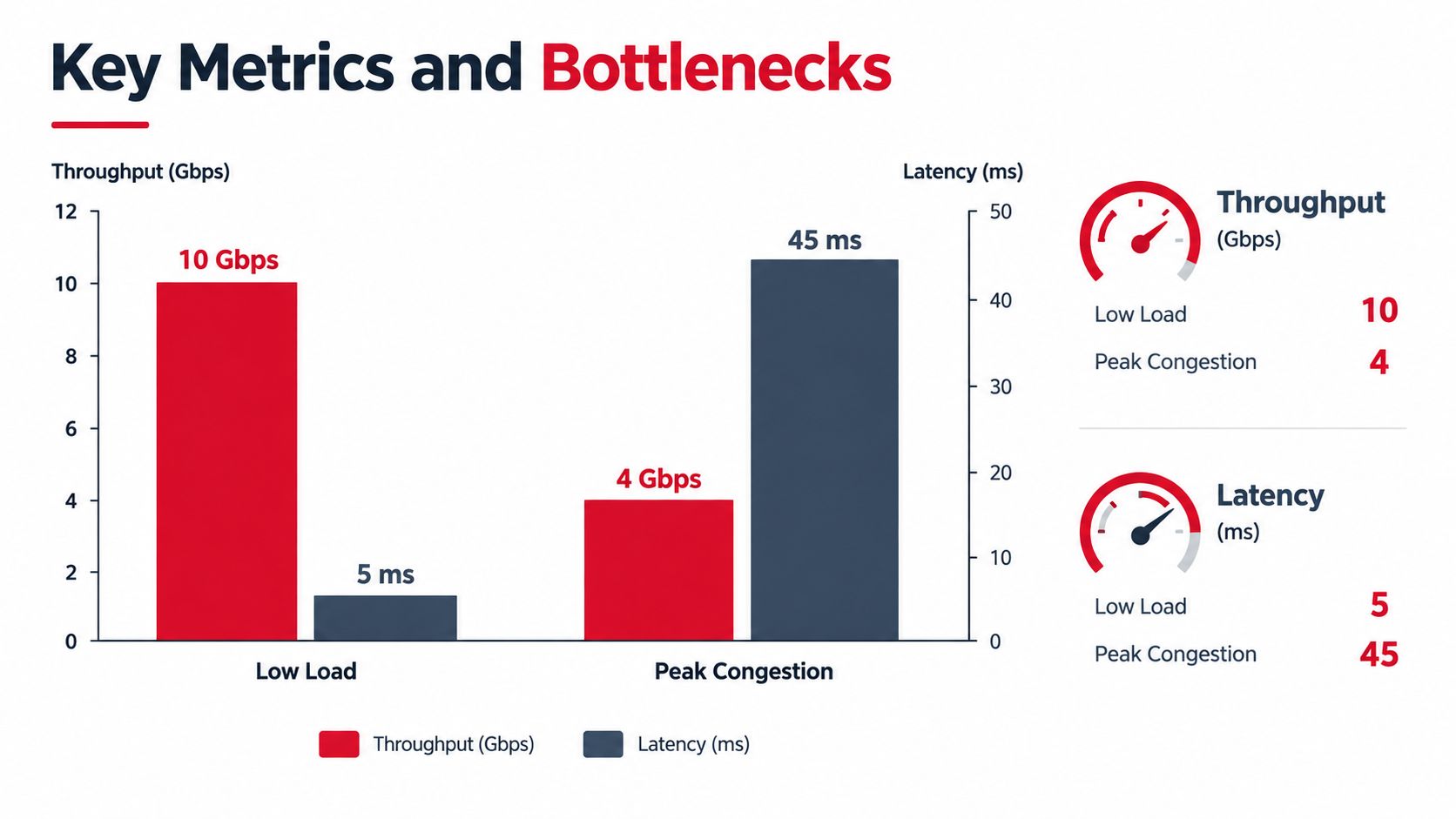
A network that sustains high Mbps or Gbps throughput while keeping latency in the low-millisecond range as traffic rises is demonstrating meaningful scalability, not merely peak capacity. Throughput measures transferred data over time, while latency measures packet or request delay. The important result is the behavior under load, not the best result at an empty or lightly used link.
Look beyond the core
Bottlenecks often appear between major platforms:
- Backhaul links: An access network may add subscribers successfully, then encounter an oversubscribed link between the access and aggregation layers.
- Aggregation tiers: A regional router or switch can become the narrow point even when the backbone has ample capacity.
- Feeder routes: Fiber exhaustion can force construction work when the operator has no unused strands or conduit.
- Data-center facilities: Power and cooling can limit the deployment of dense equipment before ports or optics become the constraint.
- Failover paths: Routing convergence and policy changes can create delay during a failure, even when the backup link has enough bandwidth.
A useful benchmark increases load gradually, records throughput and latency at each stage, and identifies the point where the service leaves its acceptable operating range. Repeat the test with the expected routing policies, security inspection, traffic shaping, and redundancy enabled. Testing only a clean path can hide the condition that customers will experience.
Interpret results as a curve
Peak-speed marketing numbers answer a narrow question: how fast can the component operate under specified conditions? Scalability planning asks a broader question: how does the service behave as utilization rises, as more nodes join, and as one path or component becomes unavailable?
A flat performance curve is usually more valuable than an impressive starting point. If latency rises sharply before the link reaches its nominal limit, the operator needs to investigate queueing, buffering, route design, or an upstream bottleneck. If throughput stops increasing while demand continues, the team should locate the constrained layer instead of just purchasing a faster device.
Design Patterns for Scalable Network Infrastructure
Scalable infrastructure begins with choices made before equipment arrives. Permitting, route selection, conduit placement, equipment rooms, power, and documentation can determine whether future growth requires a controlled expansion or a disruptive rebuild.
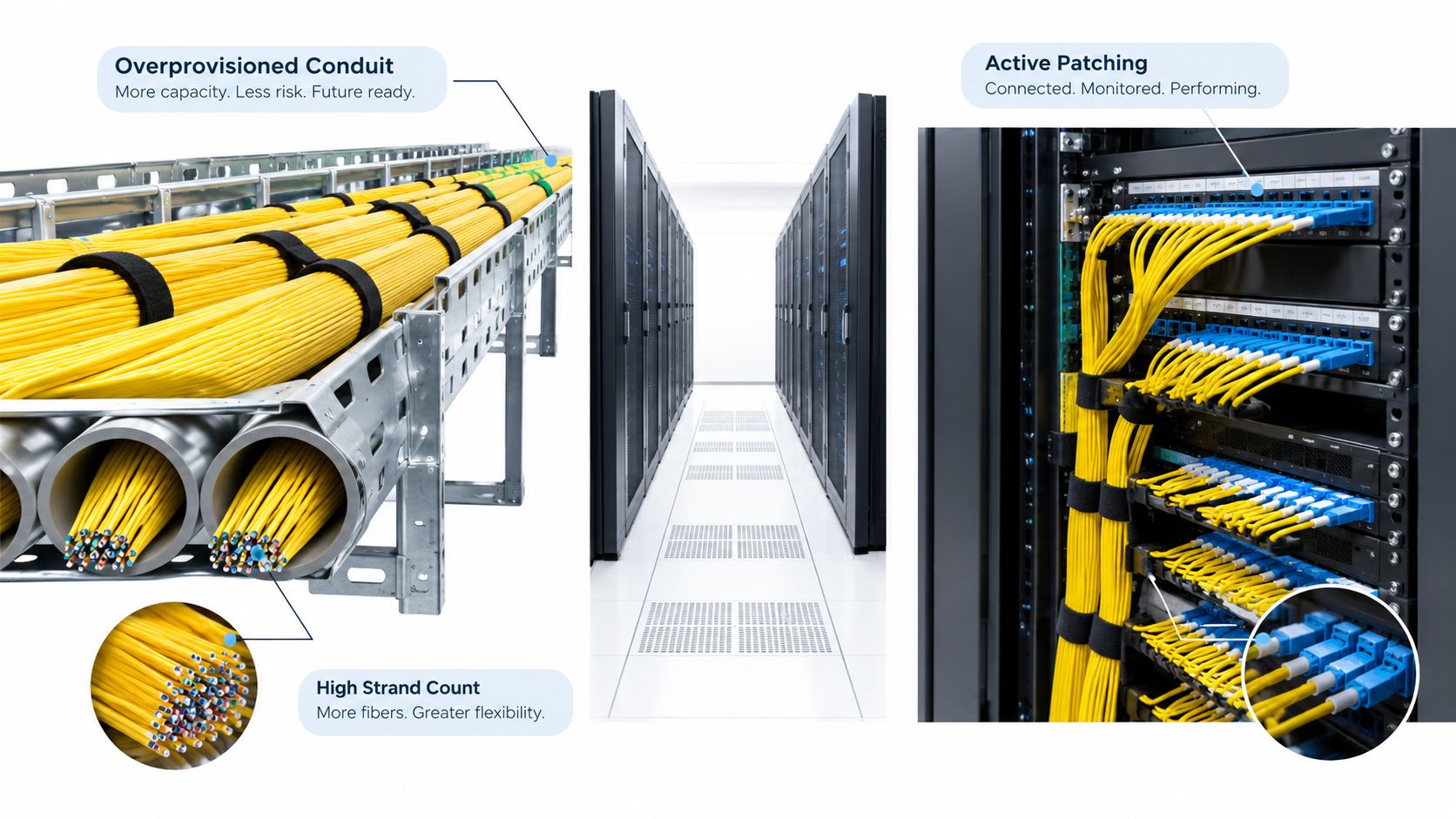
Start with the physical plant. Fiber routes with spare conduit and available strands allow operators to add capacity by lighting more infrastructure or installing new optical systems. That approach can reduce dependence on new excavation, but it requires the original design to account for bend radius, access points, route diversity, and records that remain accurate after construction.
Build the layers as a system
Backhaul and edge placement determine where traffic enters, exits, and travels. Additional aggregation sites or edge locations can shorten paths to users and distribute demand, but each location adds power, space, security, monitoring, and maintenance requirements. The design should place capacity where traffic concentrates, rather than spreading equipment evenly without regard to demand.
Routing design should isolate failures and support controlled convergence. Summarized routes, clear hierarchy, and deliberate policy boundaries can limit the impact of a local event. Operators should validate route behavior during link loss, device maintenance, and partial facility outages, not only during normal operation.
Redundancy also needs geographic and physical thought. Diverse routes, ring topologies, and dual-homed interconnects can prevent a single cut or facility problem from becoming a broad outage. Redundancy isn't achieved merely by installing two devices in the same room or two cables in the same conduit.
Connect growth with operational discipline
Every scalable design needs a repeatable way to provision, test, document, and maintain additions. As the network grows, technicians need current fiber assignments, splice records, port maps, route policies, equipment inventories, and restoration procedures. Guidance on resilient systems and software architecture principles is useful here because network resilience depends on both physical diversity and disciplined system design.
A practical design review should ask:
- Capacity path: Can the operator add ports, wavelengths, strands, nodes, or interconnect bandwidth without redesigning the whole layer?
- Failure path: What happens when the preferred route, device, facility, or power feed is unavailable?
- Operations path: Can teams provision and troubleshoot the expansion using existing tools and records?
- Cost path: Does the design reduce future construction, or does it shift complexity into maintenance and integration?
These questions keep scalability grounded in operator choices. A network that grows quickly but leaves incomplete as-builts, inconsistent configurations, or fragile restoration processes has transferred the problem from construction to operations.
Capacity Planning and Testing in the AI Era
Capacity planning now has to account for two pressures at once. Operators must support new traffic patterns while maintaining systems that already consume time, budget, and engineering attention.
KPMG reports that 66% of telecom companies allocate 41% to 60% of their technology budgets to maintaining existing systems and infrastructure. That finding appears in KPMG's 2026 telecom research. The implication for scalability is direct: a new capacity layer can produce limited value if legacy integration, fragmented tooling, and maintenance work absorb the resources needed to operate it.
AI-era traffic adds a different design pressure. Demand is shifting toward high-capacity metro fiber, data-center interconnects, and backend networks that connect dense computing environments. PwC describes AI infrastructure spending as a driver of telecom mergers and acquisitions, while the same industry coverage notes that global data-center capacity may nearly double to about 200 GW by 2030 and that less than 10% of U.S. inventory is currently capable of true AI-dense critical load. Those figures are projections and current-industry estimates, not a universal forecast for every market.
Plan for operational drag
A carrier or data-center operator should test each expansion against four questions:
- What demand is being added? Separate residential access, mobile traffic, enterprise services, cloud connectivity, storage movement, and AI backend flows. They have different latency, routing, and locality requirements.
- Which layer will carry it? Map the path through access, aggregation, metro, core, interconnect, and facility infrastructure.
- What legacy dependency remains? Identify older platforms, manual provisioning, incompatible management systems, and records that could slow deployment or restoration.
- What happens after launch? Include monitoring, spares, software maintenance, field access, documentation, and escalation ownership in the plan.
AI-oriented connectivity also changes the meaning of proximity. A network may serve many users adequately while still failing to connect dense compute clusters with the required combination of bandwidth, power availability, and predictable latency. Metro fiber, structured cabling, optical systems, facility power, and cooling need to be planned as a connected capacity system.
Test the actual growth path
Model several demand scenarios qualitatively or with the operator's own traffic history. Then benchmark throughput and latency under increasing load, test route changes, and simulate the loss of a primary path. A test that passes only while every component is healthy doesn't establish resilience.
Phase construction where demand and permitting make that practical, but preserve the physical options needed for later growth. Spare conduit, equipment space, diverse entry paths, and structured patching may cost more during the initial build, yet they can reduce future disruption and operational complexity.
The best plan balances three curves: demand growth, available physical capacity, and the team's ability to operate what it builds. If those curves diverge, adding equipment alone won't solve the scalability problem.
Real-World Scalability in Practice and Key Takeaways
A municipal broadband project shows why early civil design matters. If the route includes usable spare conduit and well-documented access points, the operator can expand service along the existing corridor rather than repeating the entire construction process. The benefit isn't only more fiber. It's a controlled path for future splicing, testing, restoration, and maintenance.
A wireless operator faces a different constraint. Adding small cells can improve coverage and distribute radio demand, but every site needs transport, power, permitting, synchronization, and operational support. If the backhaul design can't accommodate each new location, radio expansion merely moves the bottleneck into the transport layer.
A data-center fit-out has its own version of the same problem. Power, cooling, structured cabling, fiber entrances, patching, and interconnect capacity must be considered together. Installing servers first and treating connectivity as a later task can leave the facility with equipment that can't be deployed where the network and power systems can support it.
Make lifecycle work part of scalability
A turnkey infrastructure partner can support the full sequence, from engineering and permitting through make-ready construction, fiber splicing, testing, as-built documentation, and ongoing maintenance. That lifecycle view matters because a network can outgrow its records and restoration processes even when its physical capacity remains adequate.
Southern Tier Resources provides wireline and wireless infrastructure services, including fiber-optic construction, small-cell and macro-site work, data-center fit-outs, splicing, testing, documentation, and maintenance. For a carrier, ISP, municipality, wireless operator, or data-center team, the relevant value is having design decisions, field execution, test results, and operational records connected across the project lifecycle.
The core takeaways are straightforward:
- Scalability is behavior under growth: The network must add demand, nodes, or reach without proportional degradation or resource strain.
- Capacity isn't scalability: Current bandwidth doesn't guarantee an easy path to future expansion.
- Vertical and horizontal scaling solve different problems: Bigger platforms simplify some operations, while distributed nodes improve reach and resilience.
- Throughput and latency reveal the truth: Measure both under increasing load and during failure conditions.
- Physical and operational design are inseparable: Fiber routes, power, cooling, routing, documentation, and maintenance determine whether expansion remains manageable.
- AI changes the target: Dense, low-latency data-center connectivity can be more important than serving more endpoints.
Before the next expansion, ask one question: Can this network grow without creating more operational complexity than the organization can reliably manage?
Southern Tier Resources helps carriers, ISPs, wireless operators, municipalities, and data-center teams plan and deliver scalable infrastructure through engineering, construction, fiber deployment, testing, documentation, and maintenance. Visit Southern Tier Resources to discuss a network expansion that supports future capacity without losing operational control.