A fiber-splicing crew reaches a rural cabinet after a long drive, only to discover that the latest work order is still sitting in an office inbox. The outage ticket has changed, the replacement optic isn't on the truck, and the crew can't upload test results from the site. Meanwhile, a cell-site escalation is moving through the service desk with no reliable view of who is available, where the nearest qualified technician is, or whether the required equipment has already been issued.
That isn't a scheduling problem by itself. It's a continuity problem. Mobile workforce management gives telecom operators a connected operating layer for assigning work, coordinating dispersed crews, tracking assets, capturing proof of service, and keeping records usable when field conditions are difficult. The strongest systems don't just show where a technician is. They help the operator know what the technician needs, what has been completed, what remains unresolved, and whether the job can be closed with defensible evidence.
Why Telecom Operators Need Mobile Workforce Management
Telecom work rarely follows a clean office-to-field handoff. A construction supervisor may need to coordinate permit constraints, make-ready dependencies, traffic control, materials, crew qualifications, and customer commitments before a technician can begin. A maintenance dispatcher may be balancing planned inspections against emergency faults while trying to protect response-time obligations. Paper forms, phone calls, spreadsheets, and disconnected ticket updates create uncertainty at every step.
Mobile workforce management addresses that uncertainty by connecting the control room with people working across cabinets, poles, rooftops, towers, underground vaults, data centers, and customer premises. It isn't a generic HR application. In telecom, it's an operational backbone that links job assignment, location, skills, equipment, instructions, safety checks, field evidence, and closeout data.
The category has reached a meaningful scale. One industry forecast estimated the market at USD 7.18 billion in 2025, with projected growth to USD 13.19 billion by 2030 and a 13% CAGR. Another forecast estimated USD 7.59 billion in 2025, rising to USD 22.47 billion by 2031 at a 19.83% CAGR. The forecasts differ, but both point to the same operational conclusion: mobile workforce management has moved beyond a niche tool and into a major enterprise software category, as detailed in TechSci Research's mobile workforce management market analysis.
The operating consequences
For a telecom operator, the value appears in the handoffs that determine whether work gets done correctly the first time.
- Dispatchers assign with context: The system can combine location, availability, skills, job priority, and asset requirements instead of treating every crew as interchangeable.
- Technicians receive the current job packet: Engineering drawings, site notes, access instructions, safety requirements, and prior history travel with the work order.
- Supervisors see exceptions sooner: A stalled job, missing material, failed test, or incomplete form can be addressed before it becomes a customer escalation.
- Engineering and billing receive usable evidence: Photos, signatures, test readings, time records, and as-built details can flow back into downstream processes.
The productivity case is also practical. An industry summary reports that technicians in manual workflows spend only 38% of their day on billable work, while modern mobile field-service systems raise that figure to 52% to 58%. The same source associates that shift with about 2.3 additional jobs per technician per day and a 75% reduction in paperwork time through mobile automation and digital workflows, as reported by Fieldproxy's field-service statistics summary.
Practical rule: If a platform can't improve the handoff from dispatch to field evidence, it isn't solving the operational problem that puts telecom SLAs at risk.
Core Components of a Mobile Workforce Management System
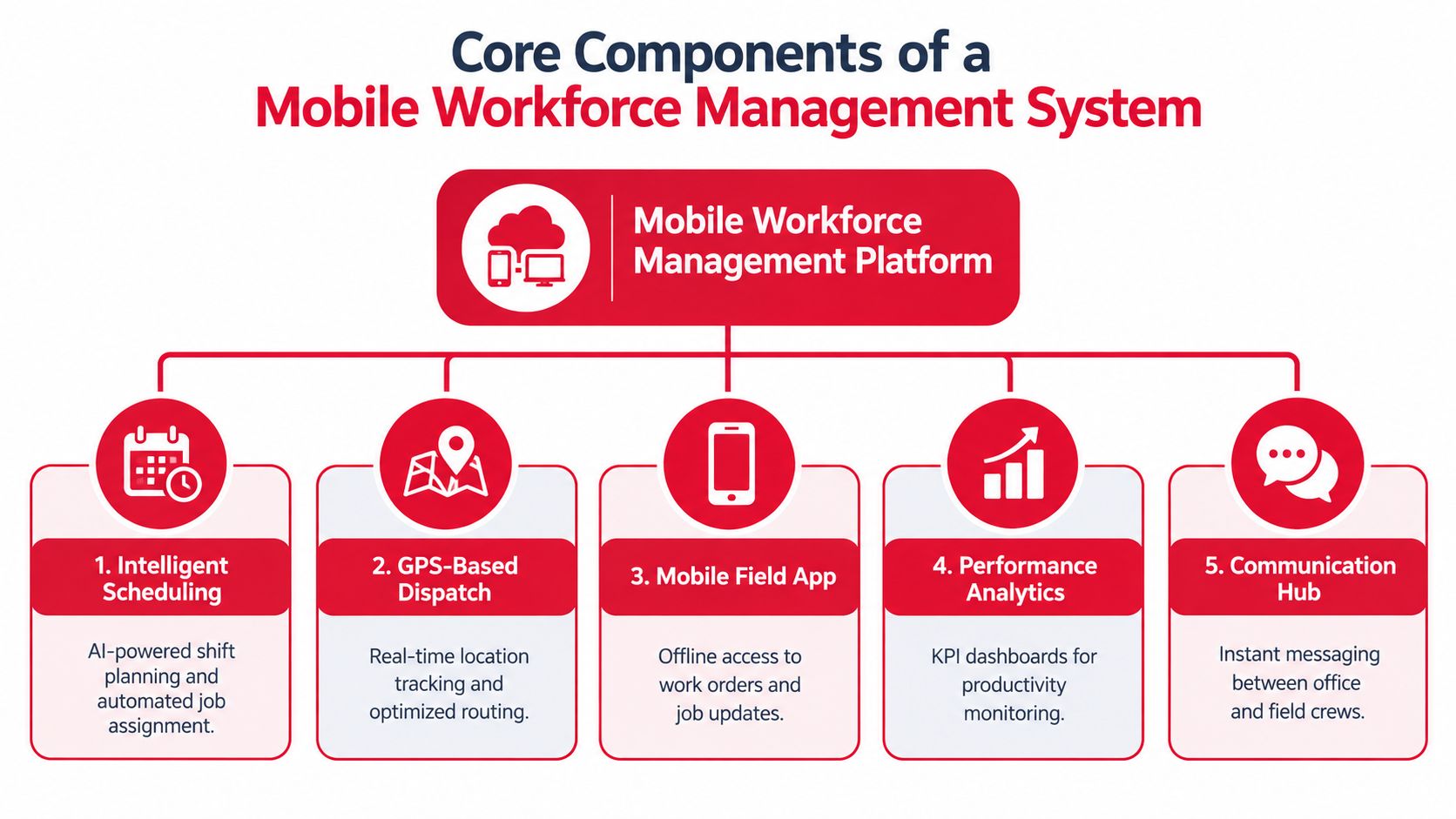
A basic calendar can assign a job. A true mobile workforce management system manages the job's full lifecycle, from demand intake through verified closeout. Telecom operators should evaluate the components as an interlocking chain, because a weakness in one area usually appears as a failure somewhere else.
Scheduling and dispatch
Intelligent scheduling starts with job requirements, not just open time slots. The platform should understand crew skills, shift constraints, geography, priority, access windows, and the materials needed for the assignment. GPS-based dispatch then gives the operations team a live view of field activity and route conditions, allowing supervisors to respond when a crew is delayed or a higher-priority fault emerges.
Scheduling is only as reliable as the data behind it. If the system doesn't know that a fusion splicer is unavailable, a bucket truck is committed elsewhere, or a technician lacks the required tower qualification, an apparently efficient schedule can still fail in the field.
Mobile execution and evidence
The field app is where the operating model either becomes real or collapses back into phone calls. Technicians need to open work orders, view site information, follow guided forms, record readings, capture photographs, collect signatures, and update status from a phone or tablet. Those functions should remain available when signal quality is poor, with clear synchronization behavior once connectivity returns.
Proof of service deserves special attention. A completed status without supporting evidence doesn't give engineering, billing, or the customer enough confidence to close the work. The platform should connect photos, test results, timestamps, location context, materials used, and technician notes to the correct job record.
Assets, safety, and analytics
Asset and inventory tracking completes the operational picture. Dispatch should account for vehicles, test equipment, spares, cable, closures, optics, and other job-specific materials. Safety modules should guide pre-work checks, lone-worker procedures, site hazards, permits, and required acknowledgements. Analytics should then expose patterns such as repeat visits, incomplete closeouts, excessive travel, material shortages, and missed response commitments.
For readers comparing broader workforce platforms with field-service tools, an AI workforce experience platform can provide useful context on employee communication and workforce coordination. Telecom buyers still need to confirm that any platform supports the technical depth of network construction and maintenance workflows.
The best architecture makes each action reinforce the next:
- A work order defines the job and required capability.
- Scheduling selects a suitable crew and time.
- Dispatch provides location and route visibility.
- The mobile app supplies instructions and captures execution data.
- Asset and safety records validate readiness and compliance.
- Proof of service feeds reporting, billing, engineering, and customer updates.
That chain is what separates a digital field operation from a digitized calendar.
The Offline-First Challenge in Telecom Field Operations
A platform can have advanced routing and an impressive AI roadmap and still fail the crew at the moment that matters. Telecom technicians work in rural broadband corridors, underground structures, enclosed facilities, remote tower compounds, and disaster-affected areas where mobile coverage can weaken or disappear.
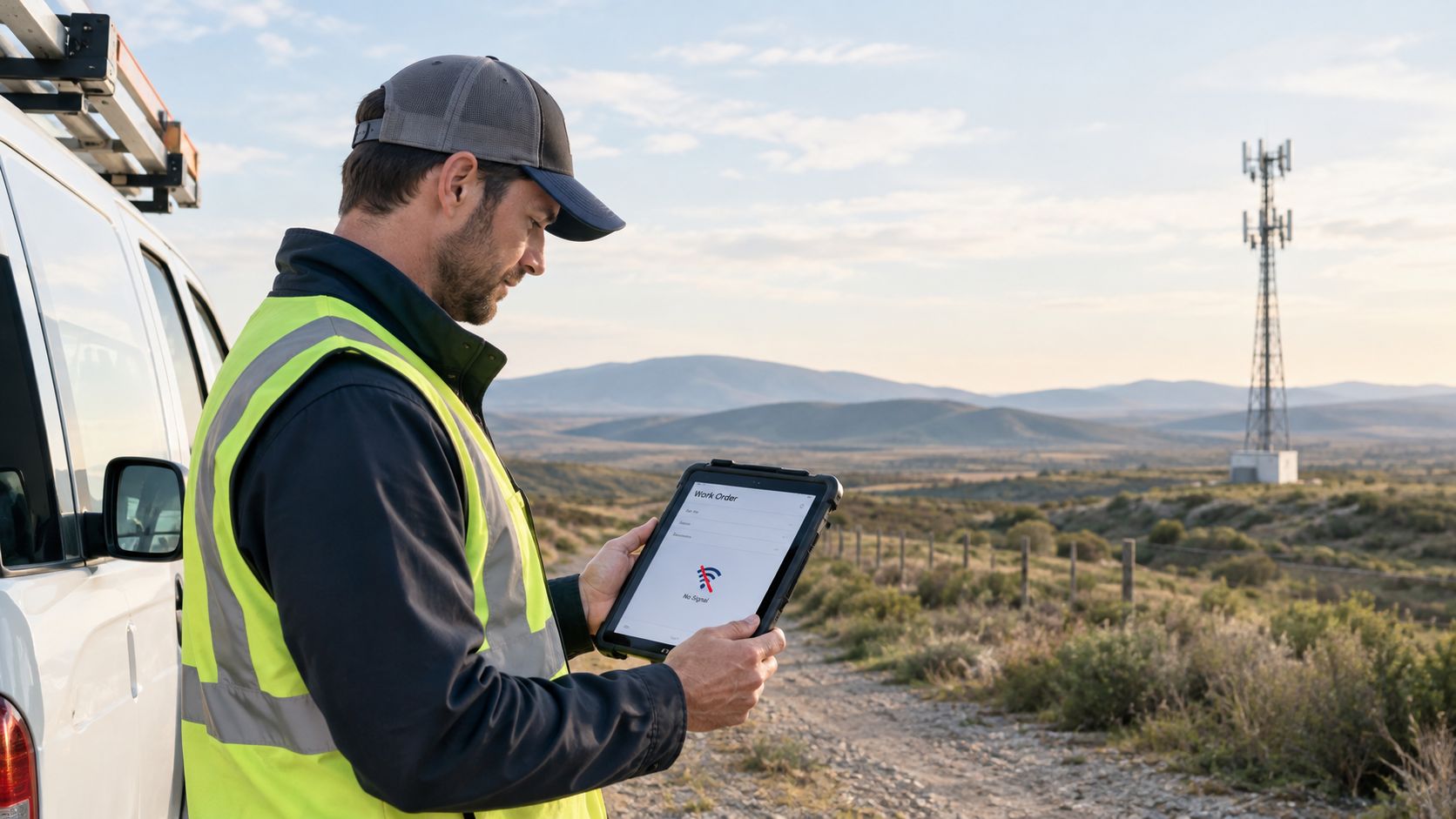
The operational question is simple: can the crew continue the job safely and preserve the record when the network doesn't work? An offline-first design should cache the assigned work order, relevant drawings, forms, asset data, safety instructions, and prior notes locally. It should let technicians create updates, attach evidence, record readings, and complete required checks without relying on a live connection.
Synchronization then becomes a controlled process, not a vague promise that data will upload later. The system should identify conflicts, preserve timestamps, prevent duplicate submissions, and show supervisors which records are pending, accepted, or require review. If a technician updates a work order offline while the office changes its priority, the platform needs a clear rule for reconciling those events.
A 2026 field-service survey found that 69% of respondents identified data synchronization and offline gaps as their top mobile workforce challenge, according to TrueContext's report on managing a mobile field-service workforce. That finding should change the order of priorities in a telecom technology evaluation. A routing engine can't compensate for a crew that can't access the as-built plan or submit proof of service.
What resilient field operations require
Look for these behaviors during a live demonstration:
- Local access: Assigned work remains usable without a signal.
- Selective caching: The device stores the data needed for the current job, rather than an uncontrolled copy of the entire system.
- Reliable attachments: Photos, signatures, test files, and notes queue safely for synchronization.
- Visible status: The technician knows whether information is saved locally, queued, or confirmed centrally.
- Conflict handling: The platform explains what happens when office and field records change independently.
- Controlled recovery: Supervisors can identify incomplete or failed synchronization before closing the operational period.
Remote-site communications also deserve a wider view. For teams working in isolated industrial environments, information about Hytera solutions for NZ mines offers useful context on communication requirements where ordinary mobile coverage may be unreliable.
The same survey reported that 73% had not achieved effective results from agentic AI, while 41% described their implementations as ineffective, reinforcing a practical point. Data quality, process discipline, and operational continuity still matter more than adding intelligence to a workflow that can't reliably capture its inputs.
Telecom-Specific Workflows and Use Cases
The right configuration depends on the work type, but the operating pattern remains consistent. Start with a defined job, assign the right crew and assets, give the field team the information needed to execute, and require evidence that supports closeout.
Fiber-optic splicing dispatch
For a greenfield broadband build, dispatch should begin with the splice plan, cabinet or closure location, cable information, required testing, and material availability. The crew receives the work package on the mobile app, confirms site conditions, records safety checks, and documents splice completion with photos and test results.
The closeout record should identify what was installed, where it was installed, and whether the result meets the engineering requirement. If the team has to leave the site before reconnecting, offline capture prevents a finished splice from becoming an unfinished administrative task.
Preventive maintenance
A maintenance workflow should turn recurring inspections into structured work, not informal reminders. The system assigns tower, shelter, power, cabinet, or facility inspections based on skill and geography. Technicians follow a guided checklist, record exceptions, attach photographs, and escalate defects with the correct priority.
This approach creates a usable history for each asset. Supervisors can distinguish a new fault from a recurring condition and plan parts, access, and specialist support before the next visit.
Fault repair
Emergency dispatch requires speed without sacrificing evidence. The dispatcher identifies the outage location, checks crew proximity and qualifications, confirms equipment requirements, and sends the latest fault information to the field. The technician records arrival, diagnosis, repair actions, replaced components, test outcomes, and restoration status.
A reliable system should also support partial completion. A crew may restore service but need a follow-up civil repair, engineering review, or permanent replacement. Treating the first update as final can hide the remaining risk.
Customer installation
Last-mile installation combines appointment management, construction readiness, customer communication, and technical acceptance. The installer needs the correct address and service order, current network information, equipment details, safety prompts, and a clear process for recording activation or failure reasons.
Photo documentation and customer sign-off should attach directly to the order. That reduces the need for office staff to interpret handwritten notes and gives customer-care teams a more dependable status view.
Across all four workflows, asset tracking connects field execution to planning. A missing closure, optic, test set, or vehicle can delay an otherwise ready crew. The platform should therefore expose material constraints before dispatch, not after the technician reaches the site.
Integration Requirements for Seamless Operations
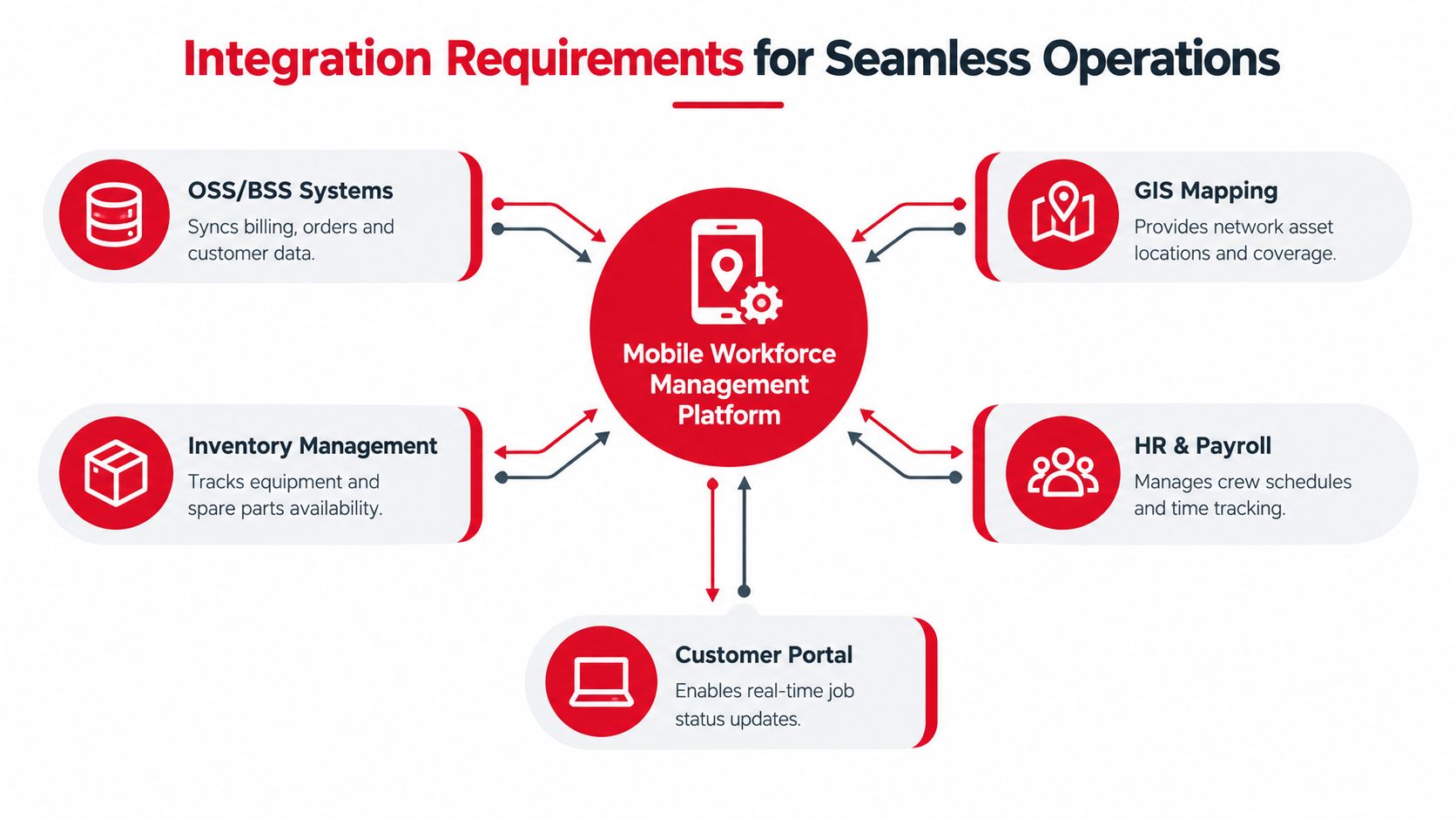
Mobile workforce management becomes valuable only when field data reaches the systems that act on it. A technician may complete a job correctly, but the operator still has an operational failure if the order remains open in the OSS, the GIS shows the wrong asset state, inventory doesn't reflect the material used, or billing lacks the evidence required for invoicing.
The integration map should start with the work order's source of truth. Determine where orders originate, which system owns customer and service data, where network assets are maintained, and which platform controls inventory. Then define which events must move in each direction.
The systems that must connect
OSS and BSS systems provide the commercial and operational context. They may supply customer orders, outage priorities, service commitments, and billing conditions. The workforce platform should return status, completion details, failure codes, time records, and evidence without forcing office staff to re-enter the same information.
GIS platforms anchor work to physical network assets. Technicians need accurate locations, routes, structures, and service boundaries. Field updates should flow back to the spatial system when construction changes the installed network or maintenance identifies an asset condition that matters to future crews.
Inventory systems protect schedule integrity. The work order should communicate required materials, while the field record should report what was issued, consumed, returned, or substituted. Without that loop, planners may dispatch crews toward jobs that aren't materially ready.
HR and payroll systems handle crew availability, time, qualifications, and rostering. The workforce platform shouldn't become a second employee database with conflicting records. It should consume the authoritative information and return approved time or attendance events where appropriate.
Customer portals depend on clean status events. Customers don't need every internal workflow detail, but they do need accurate appointment, delay, completion, and follow-up information.
A field app isn't a single source of truth by itself. It becomes dependable when every connected system agrees on ownership, identifiers, status definitions, and synchronization rules.
Avoid beginning with a broad promise to integrate everything. Map one critical transaction, such as a fault order from creation through restoration and evidence acceptance. Test the full path, including offline completion, duplicate messages, failed attachments, cancelled orders, and a technician working from an outdated assignment. Those edge cases reveal more than a successful demonstration.
Vendor Selection and Implementation Roadmap
Vendor selection should reflect the operator's operating model, not the most attractive feature list. A small regional crew may value a quick-deploy SaaS product with configurable forms and a short implementation cycle. A national carrier or large infrastructure contractor may need deep OSS, GIS, inventory, security, identity, and reporting integration that takes longer to design and govern.
The trade-off is control versus speed. A lightweight platform can reduce initial complexity, but it may require workarounds for network-specific assets, offline conflict handling, or multi-stage approvals. An enterprise platform can support more complex processes, but excessive customization can create upgrade burdens and make field workflows harder to use.
Vendor evaluation criteria for telecom operators
| Criteria | Quick-Deploy SaaS | Enterprise Platform |
|---|---|---|
| Offline capability | Confirm offline forms, work-order access, attachments, and synchronization behavior. | Expect configurable offline policies, conflict management, device controls, and auditability. |
| GIS integration | Often relies on standard connectors or embedded mapping. Validate asset updates and coordinate accuracy. | Better suited to governed spatial data flows, complex network layers, and multiple GIS environments. |
| Proof of service | Strong for configurable photos, signatures, notes, and basic checklists. | Better for multi-stage acceptance, engineering evidence, testing records, and customer-specific requirements. |
| Integration depth | Faster connection to selected systems through APIs or prebuilt connectors. | Designed for broader OSS, BSS, inventory, identity, analytics, and data-governance requirements. |
| Total cost of ownership | Lower starting complexity, but watch for add-ons, user limits, storage, and custom integration fees. | Higher implementation effort, with more capacity for standardized enterprise operations. |
| Change management | Easier to pilot with a focused crew and limited workflow scope. | Requires stronger governance, training, release management, and regional adoption planning. |
A controlled rollout
Begin with one crew type and one workflow that matters to service performance. Fiber splicing, fault repair, or preventive maintenance can each expose different requirements. Keep the pilot narrow enough to observe behavior, but complete enough to test dispatch, offline execution, evidence, integration, and reporting.
Next, validate the data contract. Confirm identifiers, status values, location formats, attachment handling, and ownership for every integrated record. Train supervisors before the wider crew because supervisors translate the new process into daily decisions.
Scale by region only after the pilot produces reliable operational evidence. Don't customize every local preference into the core platform. Standardize the workflow where consistency protects safety, quality, or reporting, and leave room for controlled configuration where site conditions differ.
Mobility costs should also appear in the business case. A fleet benchmark reported average annual vehicle-program spending of $8,734 per mobile worker in 2017, with FAVR reimbursement averaging $8,815, as documented in the 2018 Motus Benchmark Report. Those figures are historical benchmarks, not current pricing, but they illustrate why vehicle policy, mileage, and mobile operating costs belong in the per-worker model rather than disappearing into general overhead.
Measuring Success with KPIs and a Rollout Checklist
A rollout needs measures that connect field behavior to service outcomes. Track a baseline before changing the workflow, then compare the same definitions after adoption.
KPI framework
- Technician utilization rate: Measure productive field time against available time, using a consistent rule for travel, waiting, training, and administrative work.
- Jobs completed per day: Segment by job type. A splice, tower inspection, emergency repair, and customer installation shouldn't share an unqualified productivity target.
- SLA adherence: Record whether the operator met the promised response, arrival, restoration, or completion condition.
- Mean time to repair: Start the clock and stop it using definitions that match the operator's service commitments.
- Paperwork time savings: Measure how much time crews and coordinators spend preparing, re-entering, correcting, and chasing field documentation.
- Synchronization exceptions: Count records that remain queued, conflict, lose attachments, or require manual reconciliation.
The field-service summary cited earlier reports a shift from 38% billable time in manual workflows to 52% to 58% with modern mobile systems, along with about 2.3 additional jobs per technician per day and a 75% reduction in paperwork time. Treat those as external benchmark claims, not guaranteed results. Your own baseline, job mix, connectivity conditions, and adoption quality will determine the outcome.
Rollout checklist
- Audit current dispatch, closeout, safety, asset, and integration processes.
- Select one representative crew and workflow for the pilot.
- Test offline access, local capture, synchronization, conflict handling, and attachment recovery.
- Validate OSS, BSS, GIS, inventory, HR, and customer-status integrations.
- Train supervisors on exception management, not just button clicks.
- Train technicians with realistic rural, underground, and emergency scenarios.
- Review KPI results and unresolved adoption barriers.
- Scale regionally with controlled configuration and recurring optimization reviews.
The first acceptance test should happen without a signal. If the platform can preserve the job, the evidence, and the safety record under that condition, it has earned the right to support the connected parts of the operation.
Southern Tier Resources helps carriers, ISPs, wireless operators, data center teams, and infrastructure partners deliver engineering, construction, splicing, testing, maintenance, and documentation across complex telecom environments. Visit Southern Tier Resources to discuss dependable field execution and infrastructure support built around operational continuity.