
A fiber build rarely slips because nobody attended the kickoff. It slips because the permitting office believes the utility has approved the route, the utility is waiting for revised attachment data, the contractor is working from an older drawing, and the owner assumes the issue is already escalated. By the time those assumptions surface, crews may be mobilized, materials may be staged, and rework may be unavoidable.
That is the operating reality of telecom infrastructure. A single program can connect owners, carriers, ISPs, engineering firms, construction contractors, pole administrators, utilities, municipalities, landlords, data-center operators, commissioning teams, and field technicians. Stakeholder coordination has to control the relationships between those parties, not just distribute meeting notes.
Introduction to stakeholder coordination in telecom projects
On a fiber deployment, the visible work is straightforward. Crews prepare the route, complete make-ready activities, place cable, splice fibers, test the network, and hand over the records. The difficult work happens at the interfaces. A city needs a corrected traffic-control plan, a utility needs pole data, the construction manager needs a release, and the customer needs confidence that the route will be ready for service.
A meeting-heavy approach doesn't solve that problem by itself. Meetings can expose an issue, but they don't automatically assign decision rights, establish a deadline, or confirm which document controls. Without those mechanisms, teams create more status updates while leaving the underlying dependency untouched.
Modern project teams increasingly treat coordination as a network problem, rather than a simple communication task. A 2024 study of a large hospital construction project in northern Finland used social network analysis to examine contractual, supply, and information relationships among stakeholders. Its practical implication for telecom is direct: contractual relationships, supply dependencies, and information paths can shape coordination and control differently.
Practical rule: If you only map the organizational chart, you'll miss the people who actually control progress.
The useful framework is operational. First, map the stakeholder network and its approval chokepoints. Then define RACI assignments and decision rights, establish a shared vocabulary, build a communication cadence, manage permits as schedule-controlled deliverables, track meaningful KPIs, and formalize handoff. Teams that want a practical starting point for documenting repeatable workflows can also boost team collaboration with StepCapture, especially where field instructions and process records need to remain accessible across organizations.
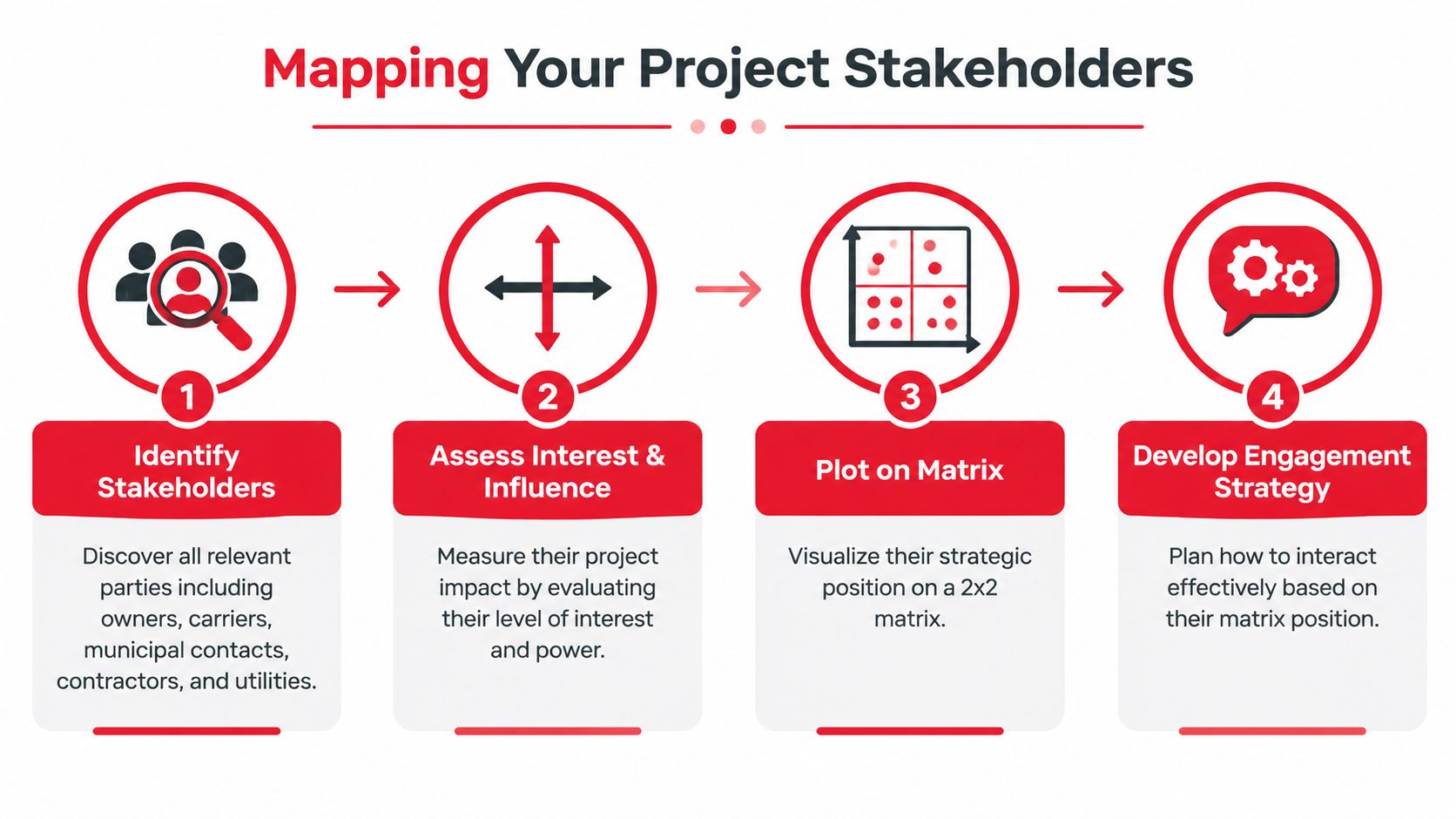
Stakeholder mapping and analysis
Start with a complete stakeholder inventory, not a short list of contract signatories. Include the asset owner, carrier, ISP, network operations team, design consultant, general contractor, directional-drilling subcontractor, splicing crew, pole owner, utility cooperative, municipal permitting contacts, right-of-way administrators, property owners, data-center facilities staff, safety representatives, and commissioning personnel.
For each party, record four practical facts:
- Scope touched: Identify the work, document, approval, or physical interface affected by the stakeholder.
- Interest: Establish whether the party is directly affected by schedule, disruption, safety, service readiness, or public impact.
- Influence: Record whether the stakeholder can approve, reject, stop, redirect, or materially constrain the work.
- Required decision: State exactly what that party must provide, approve, review, or accept.
Build the matrix, then draw the network
Plot each stakeholder on a two-axis matrix using interest and influence. High-influence, high-interest parties need active management. High-influence parties with limited day-to-day interest still need reliable decision briefings. Highly interested technical contributors may need structured consultation without being invited into every executive discussion.
The matrix is useful, but it isn't enough. Add a network diagram showing who exchanges information with whom. Use different line styles for contractual, supply, information, and approval relationships. This reveals hidden paths, such as a field supervisor who receives the actual release decision from a utility coordinator even though the formal contract runs through a prime contractor.
Look for three specific patterns:
- Single points of approval: One person or office controls a permit, design release, utility clearance, or site-access decision.
- Unmanaged interfaces: Two teams share a boundary, but neither owns the deliverable between them.
- Indirect dependencies: A stakeholder doesn't appear on the main reporting line but can stop work through a prerequisite or inspection.
For example, right-of-way construction may depend on a utility conflict review, which depends on an attachment design, which depends on accurate pole data. The diagram should make that chain visible before the crew receives a start instruction.
Turn the map into engagement rules
Don't invite every stakeholder to every meeting. Assign an engagement method to each relationship. A municipality may need formal submittals and milestone follow-ups. A pole administrator may need a technical issue register. An executive sponsor may need exception-based reporting. A field crew needs current drawings, constraints, and a clear escalation contact.
Review the map whenever the route, design, contractor, permit status, or commissioning plan changes. Stakeholder mapping is a living control document, not a kickoff artifact that sits untouched in a project folder.
Defining roles with RACI and decision rights
RACI works when it describes real decisions, not vague workstreams. For a telecom build, “construction” is too broad to assign usefully. Break it into activities such as route design approval, permit submission, utility conflict resolution, site preparation, fiber splicing, OTDR testing, as-built acceptance, and customer handoff.
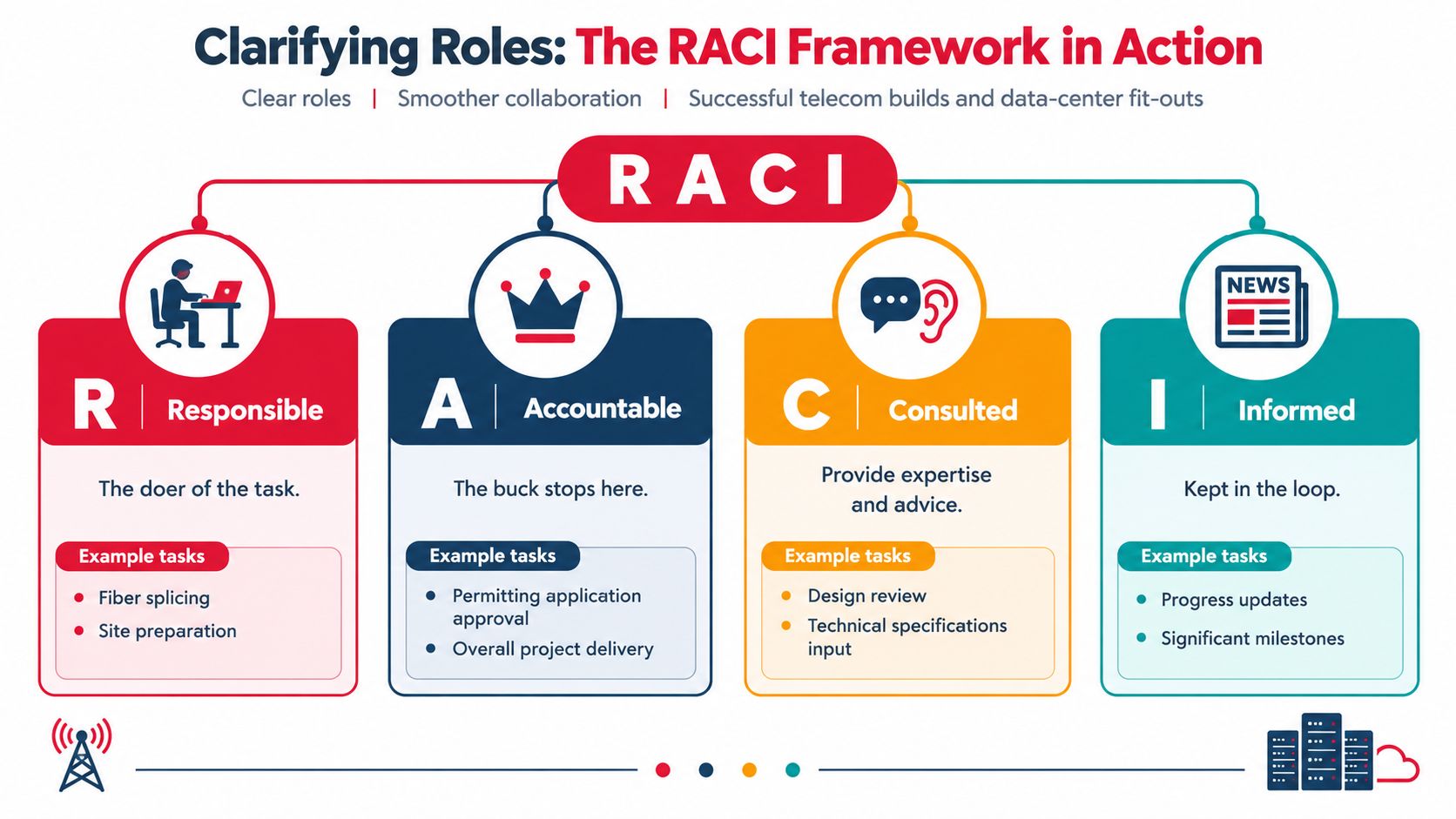
The four roles are simple:
- Responsible: The person or team doing the work. A splicing crew can be responsible for completing splices and recording test results.
- Accountable: The person who owns the outcome and accepts the decision. A project director may be accountable for delivery, while a permitting manager is accountable for an application approval package.
- Consulted: The specialist whose input is required before the decision. Engineering, operations, utilities, or data-center facilities may fill this role.
- Informed: The party that needs the decision or status, but doesn't approve or execute the work.
Assign one accountable owner
A task can have several responsible contributors, but it should have one accountable decision owner. If a permit is rejected, the matrix should show who owns the corrected submission. If a fiber test fails, it should show who decides whether to retest, repair, or escalate to design.
Add decision rights beside the RACI letters. Define which decisions a field lead can make, which changes require project-manager approval, and which scope, cost, safety, or customer-impact decisions require executive sign-off. The threshold might concern a route change, a material substitution, a service-impacting outage, or a change to the commissioning sequence. The exact threshold belongs to the project charter. What matters is that everyone can find it.
A RACI matrix should answer these questions without a meeting:
| Decision or deliverable | Responsible | Accountable | Consulted | Informed |
|---|---|---|---|---|
| Permit application package | Permit coordinator | Project manager | Designer and municipality contact | Owner |
| Utility conflict resolution | Utility coordinator | Construction manager | Pole owner and engineering | Field supervisor |
| Fiber splice approval | Splicing lead | Network quality owner | Design and operations | Customer |
| Data-center cabling readiness | Installation contractor | Facilities project lead | IT, security, and commissioning | Executive sponsor |
Standardize the language
Coordination breaks down when people use the same term differently. Research on project stakeholder communication found that stakeholders can be unfamiliar with concepts including benefits, the iron triangle, critical path, uncertainty, and project leadership, creating ineffective communication even when formal structures exist. The findings are discussed in research on stakeholder communication under insufficient project-management knowledge.
Create a short project glossary. Define “critical path,” “ready to build,” “permit approved,” “scope change,” “blocked,” “substantial completion,” “test accepted,” and “handoff complete.” Pair each term with evidence. For example, “permit approved” might require the issued permit, approved drawing set, fee confirmation, and any traffic-control conditions.
Role-based access also matters when teams manage customer or operational information. A team reviewing securing AI customer support platforms can apply the same access-control thinking to project records, ensuring people see and edit the information appropriate to their responsibilities.
Scheduling communications meetings and escalation paths
The right cadence is not the most frequent cadence. It is the cadence that puts the right information in front of the right decision-maker before the work is blocked.
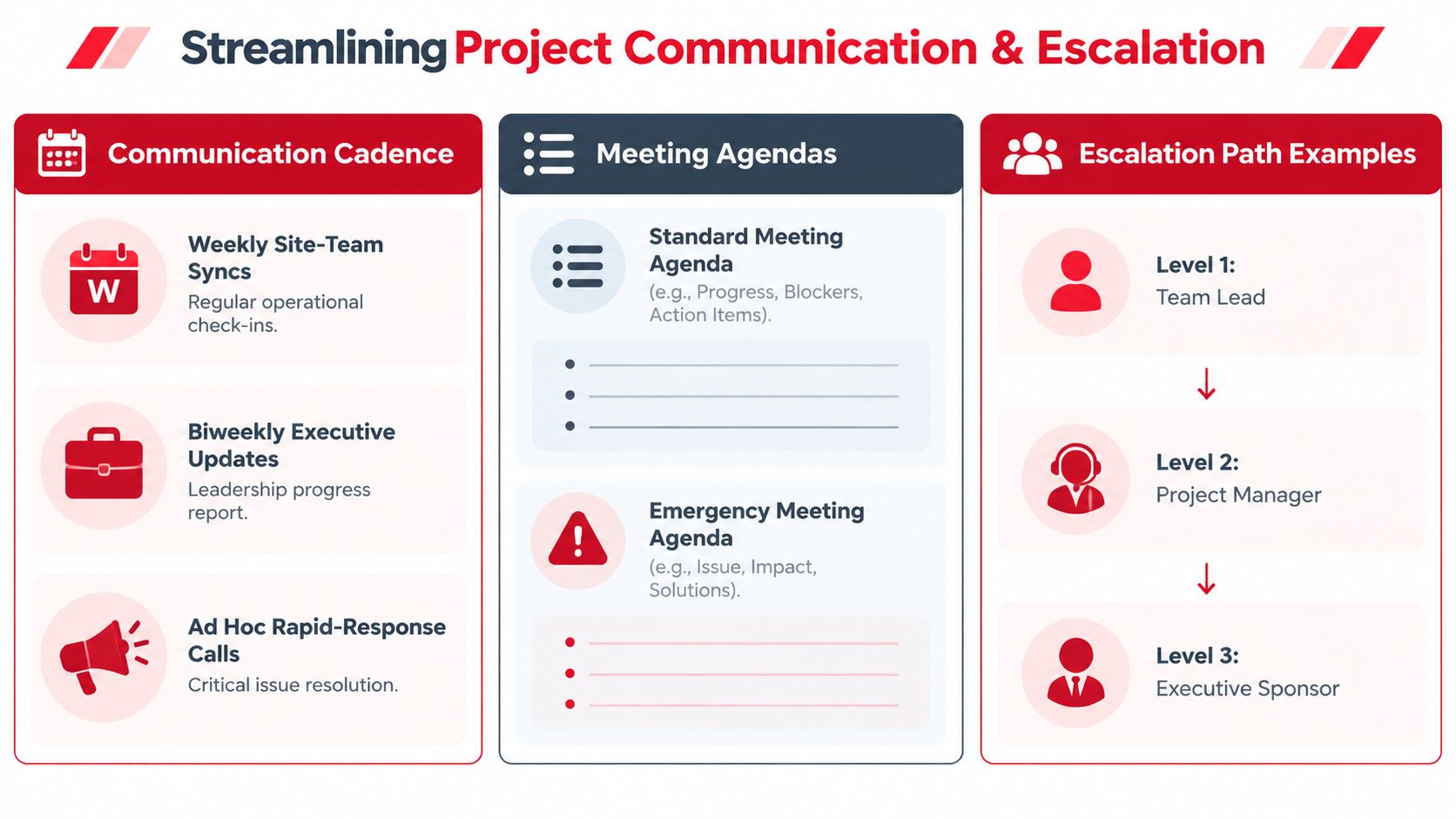
A fiber program usually needs separate operating rhythms for field execution, management control, and urgent exceptions. Keep the groups distinct so a routine production issue doesn't consume executive attention, and a serious approval risk doesn't remain buried in a site call.
Use a meeting architecture
A weekly site-team sync should focus on work released, work completed, constraints, safety concerns, inspection readiness, and actions due before the next meeting. An executive update should focus on milestone confidence, material exceptions, decisions required, customer impact, and risks that need sponsorship. A rapid-response call should address one urgent issue, its impact, options, owner, and decision deadline.
Use fill-in-the-blank agendas:
Standard site agenda
- Progress: What was completed, and what evidence supports completion?
- Blockers: Which activity cannot proceed, why, and who controls the constraint?
- Next release: What work will be released, under which drawing or permit revision?
- Actions: Who owns each action, and when is the next update due?
Emergency agenda
- Issue: What happened, where, and when?
- Impact: Which crew, permit, milestone, customer, or service is affected?
- Options: What can the team do now, and what trade-off does each option create?
- Decision: Who has authority, and by what time must the decision be made?
Teams working across regions should document time zones, attendance rules, and the system of record. A comprehensive guide for cross-platform teams can help when calendars, field schedules, and management meetings span different platforms.
Escalate by condition, not emotion
Don't wait for a missed milestone to discover that nobody knows who should be called. Define escalation triggers in advance. A delay can be escalated because it threatens a permit window, blocks another contractor, affects a safety control, or requires a decision outside the current owner's authority.
| Issue level | Trigger | Initial owner | Escalate to |
|---|---|---|---|
| Level 1 | Local field constraint with an available workaround | Team lead | Project manager if unresolved |
| Level 2 | Cross-team dependency, permit risk, or design conflict | Project manager | Sponsor or functional executive |
| Level 3 | Scope, safety, customer, or contractual decision | Executive sponsor | Required owner, legal, or governance body |
Use time-based follow-ups only after defining the issue type and impact. A short delay on a noncritical task isn't equivalent to a delayed permit that blocks an entire route. Record the escalation, decision, evidence, and next action in the project system. Verbal urgency without a written owner creates noise, not control.
Managing permitting and municipal coordination
Permitting should sit on the integrated project schedule as a chain of deliverables. Treating it as administrative support is how construction teams discover too late that a route lacks an access agreement, a drawing revision, or a required utility clearance.
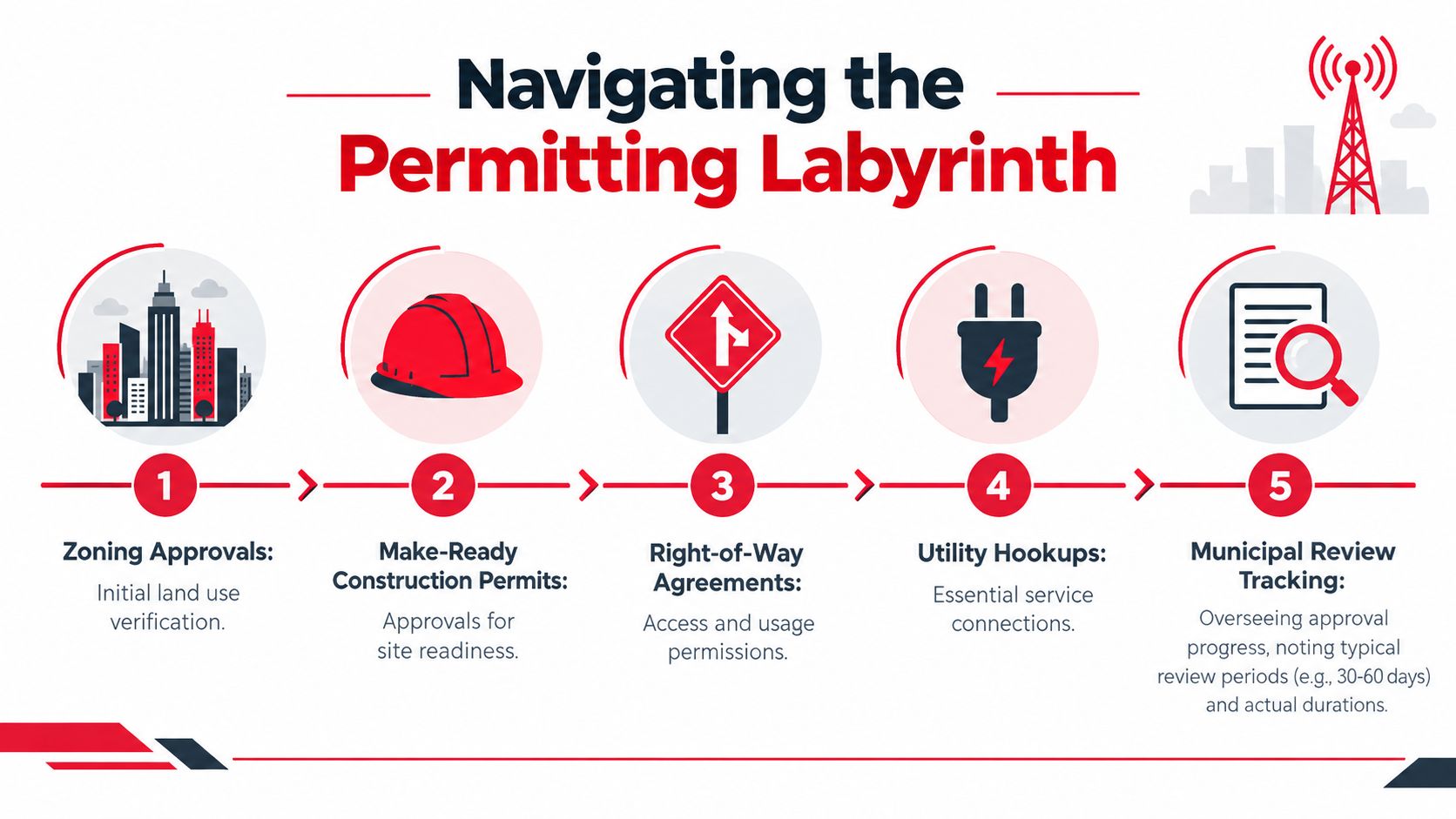
Start with a jurisdiction matrix. For each route segment or facility, identify the municipality, agency, permit type, submission owner, prerequisite documents, review contact, expected review window, expiration condition, inspection requirement, and closeout evidence. Include zoning approvals, construction permits, right-of-way permissions, traffic-control requirements, utility agreements, and service connections where applicable.
Control the permit lifecycle
A permit record should move through explicit states, such as draft, internal review, submitted, comments received, resubmission required, approved, inspection pending, inspected, and closed. Each state needs an owner and evidence. “Submitted” means a complete package was delivered and acknowledged, not that someone sent an email with an attachment.
Track municipal review activity against the schedule and distinguish the expected review period from the actual elapsed time. The infographic includes an example of typical review periods, but project teams should use the governing agency's current requirements and their own recorded dates rather than treating an example as a commitment.
At each milestone, contact the stakeholder who can remove the next constraint. Before submission, that may be the design reviewer. After comments, it may be the municipal coordinator. Before construction, it may be the right-of-way owner or utility representative. Tie permit expiration and inspection conditions to work-package release rules so crews don't begin on an approval that no longer covers the planned activity.
Governance check: No crew should receive a “ready to build” release until the permit, drawing revision, access right, and inspection dependency are visible in one record.
Prepare site plans for review, not merely for internal design. Show route limits, crossings, restoration details, equipment locations, property boundaries, traffic controls, and utility conflicts at the level the reviewing authority needs. When information is missing, reviewers create comments, and comments create another coordination cycle.
Local utility cooperatives and pole administrators can be valuable working relationships, but the process still needs written records. Track the utility owner, route-specific prerequisite, pole data, attachment design, conflict note, response, and release. Personal familiarity can accelerate a conversation. It can't replace an auditable approval.
A 2026 PMI-reported regional study found that stakeholder decision-making delays affected 47% of complex projects in South Asia, compared with a global average of 34%. The figures are reported in coverage of the PMI-reported study, and the operational lesson applies broadly: approval governance belongs in the risk process, not at the edge of it.
Tracking KPIs documentation and handoff procedures
A dashboard should show whether the project is becoming more buildable, not just whether people are entering updates. Choose measures that expose waiting, rework, quality failure, and incomplete ownership.
Useful telecom indicators include:
- Permit turnaround: Record submission, comment, resubmission, approval, inspection, and closeout dates.
- Release readiness: Track whether each work package has the current drawing, access permission, material confirmation, safety requirement, and assigned owner.
- Test quality: Record RF test pass rates where relevant, fiber-splice acceptance, OTDR results, exception notes, and retest status.
- RACI performance: Monitor actions and decisions against their assigned due dates.
- Handoff completeness: Show whether as-builts, test reports, permit closeouts, acceptance records, and customer sign-offs are present.
Don't create a metric unless someone will act on it. If an OTDR exception appears, the dashboard should identify the responsible quality owner, the affected segment, the next decision, and the evidence required for closure. If a permit remains in review, the record should show the next follow-up and the person responsible for contacting the agency.
Make the handoff a controlled release
Maintenance and network operations shouldn't inherit a folder of loosely named files. Build the handoff as a checklist tied to the asset or work package.
A practical handoff should verify:
- As-built drawings: Route, splice points, closures, cabinets, equipment locations, and revision status are complete.
- Test records: Fiber, RF, grounding, power, and structured-cabling results are attached to the correct asset or segment.
- Permit closeout: Inspection evidence, restoration confirmation, agency correspondence, and closure status are recorded.
- Configuration data: Labels, ports, circuits, panels, and identifiers match the approved records.
- Acceptance evidence: The customer or operational owner has signed the applicable acceptance form.
- Open items: Every exception has an owner, due date, impact, and agreed disposition.
Centralize those records in a system with controlled permissions, revision history, and search. A shared drive can store documents, but it won't necessarily tell a new operations team which drawing is current or whether a test exception is still open. The handoff owner should reject incomplete packages rather than transferring uncertainty into maintenance.
Empirical research supports treating this work as a delivery control. A 2022 study using survey data from 216 experienced project-management professionals found that stakeholder management improves project results in terms of time and cost, as reported in the published project-management research. Documentation is one of the mechanisms that makes stakeholder management actionable. It gives teams a shared record of what was decided, what was delivered, and what remains unresolved.
Conclusion and implementation tools
Effective stakeholder coordination starts before the first construction release. Map the network, identify approval chokepoints, define RACI roles, document decision rights, standardize project language, establish communication rules, control permitting, measure execution, and make handoff a formal acceptance event.
Use tools according to the problem they solve. Asana can support RACI actions and decision follow-up. Monday.com can present milestone, permit, and exception dashboards. GIS-based mapping software can connect route segments to stakeholders, jurisdictions, utilities, and constraints. A customizable permitting log can hold agency contacts, prerequisites, review status, expiration conditions, and closeout evidence.
Start with one route, facility, or work package. Train the project manager, permit coordinator, construction lead, and operations representative on the same definitions and workflow. Then test whether the system answers practical questions quickly, such as who owns the next approval, which drawing is current, and what prevents handoff.
For organizations that need an accountable delivery partner across engineering, permitting, construction, fiber splicing, testing, documentation, and maintenance, Southern Tier Resources provides telecom infrastructure services for wireline, wireless, and data-center environments. Its documented approach to route delivery and infrastructure records can complement a governance-first coordination model.
Southern Tier Resources offers end-to-end engineering, construction, maintenance, fiber deployment, splicing, testing, and data-center infrastructure support for carriers, ISPs, operators, and facility teams. Visit Southern Tier Resources to discuss a project where clear ownership, reliable documentation, and coordinated execution matter.