
The crew is halfway through a suburban fiber splice when the project manager gets the call: an OSHA compliance officer is at the gate. The trench is open, traffic control has shifted twice, and the competent person is working at another front. Someone has a folder somewhere with the job hazard analysis, utility locate ticket, equipment checks, and training records, but nobody knows whether it contains the documents that match the conditions on the ground.
That gap is what makes site safety inspections difficult. Regulators aren't measuring the thickness of your safety binder. They're comparing your written controls with the excavation, tower, vault, roadway, or electrical task in front of them, then testing those controls through worker interviews and observation. OSHA's inspection system reached 34,625 federal inspections in fiscal year 2024, after 31,820 in FY 2022 and 21,710 in FY 2020. In FY 2025, OSHA recorded 30,273 inspections, including 13,962 programmed and 16,311 unprogrammed inspections, according to OSHA's inspection statistics.
For telecom contractors, that means an inspection program has to do more than confirm that a form exists. It must anticipate why a particular crew, task, or project could attract attention, then produce evidence that supervisors identified the risk, applied a control, and followed through when conditions changed.
A Day an Inspector Shows Up at Your Site
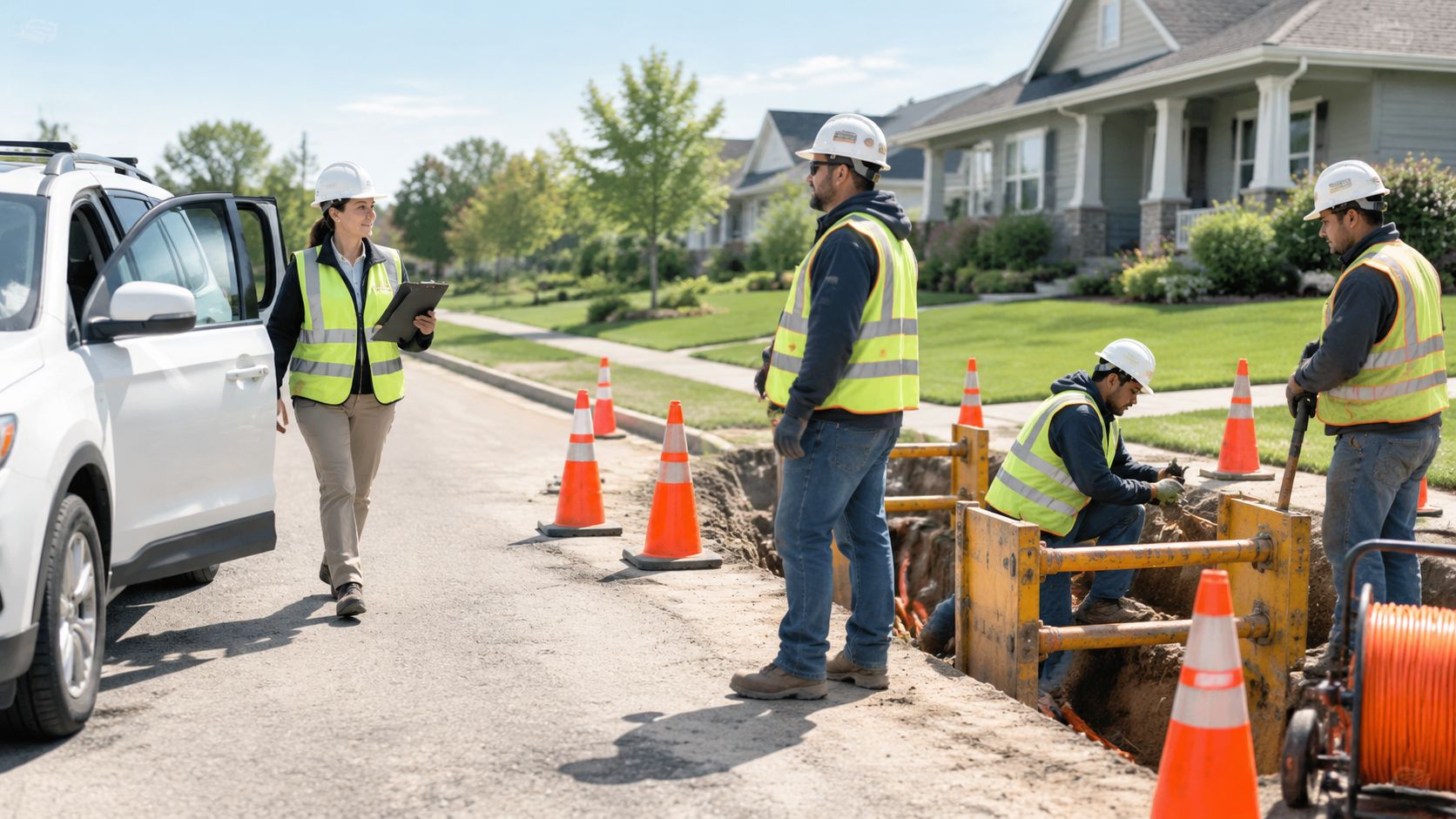
At mid-morning, a suburban fiber-splice crew is still open-pitting a four-foot trench across a residential sidewalk. Barricades are in place, but pedestrians are squeezing past the work zone. The excavator is parked beside the cut, spoil sits close to the edge, and the crew is preparing to lower conduit.
An OSHA compliance officer steps out of a vehicle and identifies herself. The first exchange is procedural. She presents credentials, asks for the employer representative, and begins an opening conference. She'll want to understand the scope of work, who controls the site, which subcontractors are present, and who has authority over excavation safety.
The competent person walks over with a phone and a partial folder. The officer asks for the excavation inspection log. The answer is that it's in the truck. She asks for the protective-system design or tabulated data supporting the trench box or sloping decision. Nobody can produce it. The one-call ticket is in a supervisor's email, and the daily log has yesterday's date.
The officer doesn't need to guess what happened. She can observe the trench, photograph the setup, ask workers how they were briefed, and conduct private interviews. OSHA's construction rules address excavation preparation and worker protection through 29 CFR 1926.651 and 29 CFR 1926.652, while crane-related work may bring 29 CFR 1926.1408 into the review. Manhole and vault splicing can raise 29 CFR 1910.146 concerns when the space and entry conditions meet the applicable confined-space criteria.
What the officer is testing
The officer is testing whether the crew's controls are real, current, and understood. A written excavation procedure won't carry much weight if the competent person can't explain the soil assessment, protective-system selection, access route, and inspection frequency.
The same pattern appears at a tower site when operator certification is missing, at a data center when lockout boundaries don't match the energized equipment, or at a vault when atmospheric-monitoring records don't support the entry decision. The ground condition and the worker's explanation usually matter more than the size of the paperwork file.
Field rule: Every document in the inspection packet should answer a question an officer could ask while standing beside the work.
OSHA enforcement data shows why construction supervisors should treat inspections as a normal operating condition. CPWR reports that OSHA conducted about 37,500 federal and state construction inspections in 2019 and issued about 70,300 citations that year, with construction representing 44.4% of federal or state OSHA inspections across all industries from 2011 to 2020. Those figures appear in CPWR's construction safety data bulletin.
The Three-Phase Inspection Method That Actually Works
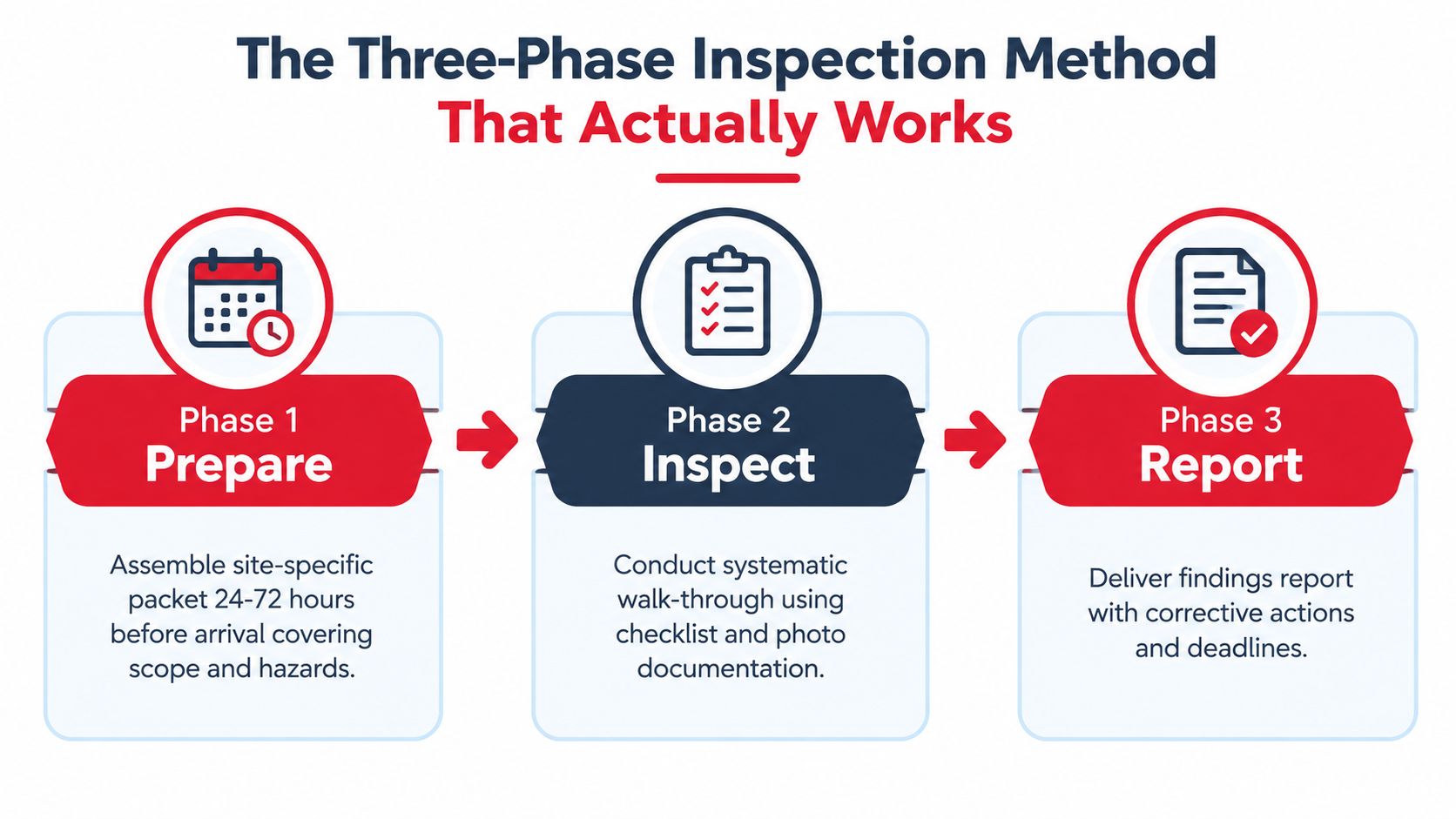
A reliable inspection method has three phases: prepare, inspect, and report. The sequence matters because a field walk without preparation becomes a tour, while a report without ownership becomes a record of unresolved problems.
Prepare before the crew is under pressure
Preparation starts before the work front opens. For a scheduled internal inspection, assemble a site-specific packet during the planning window, ideally 24 to 72 hours before arrival. The packet should reflect the actual work package, not a corporate template copied from another project.
Include:
- Scope and hazard documents: Current scope, JHA or AHA, task sequence, site map, and emergency contacts.
- Utility controls: Utility locates, one-call ticket numbers, mark-out verification, and any owner coordination records.
- Competency evidence: Competent-person designations, operator credentials, fall-protection training, confined-space training, and qualified electrical worker designations.
- Equipment records: Pre-use checks, rigging inspections, crane or hoist documentation, generator checks, and maintenance status.
- Prior findings: Citation history and recurring observations from similar projects, used to target the walk rather than decorate the packet.
The ILO construction inspection framework recommends adapting the checklist to the site's conditions, trade mix, and risk profile. Its guidance on occupational safety and health inspection in construction also emphasizes document review, field observation, worker interviews, and follow-up.
Inspect the work, not just the checklist
The lead inspector should walk the active work front with the competent person. Start with the opening meeting, then observe work as it happens. Review records at the location where the control is being used, and interview workers separately when their understanding matters.
For a telecom project, that field packet may include the current excavation checklist, PPE register, tower rescue plan, confined-space permit, atmospheric-monitoring results, and lockout-tagout procedure. The inspector should connect each record to a visible condition. A rescue plan that names equipment unavailable at the site isn't an effective plan.
Use photographs to establish location and condition, but don't let the camera replace judgment. Ask why a control was selected, who verifies it, and what changes if weather, access, crew composition, or the work method shifts.
Report findings with an owner and a deadline
The report should classify each observation, attach photo evidence, record relevant employee statements, assign a responsible party, and set a corrective or preventive action. Internal classifications can distinguish imminent danger, serious, other-than-serious, and de minimis conditions, provided the team understands how those labels guide escalation.
A 72-hour corrective-action commitment can create discipline for routine findings, but imminent hazards require immediate control, not a deadline. The purpose isn't to hide deficiencies. It's to demonstrate that the safety management system identifies problems, stops exposure when necessary, and verifies closeout.
Inspections by Work Type Across Telecom Projects
A generic checklist fails because telecom projects place different crews in different exposure environments. An excavation crew, tower climber, vault splicer, traffic-control team, and data-center electrical crew may share a project number, but they don't share an inspection scope.
Excavation and trenchless work
The competent person should verify the soil and protective-system decision, then inspect the excavation as conditions change. Look at sloping, benching, or trench-box use, spoil-pile placement, access, water accumulation, adjacent structures, and pedestrian routing. For open cuts near schools, shops, or residential sidewalks, the route around the excavation can be as important as the trench itself.
Trenchless work still requires surface-level control. Locate records, bore-path planning, utility exposure procedures, and response plans for an unexpected strike belong in the inspection conversation.
Tower and rooftop wireless work
At towers and rooftops, the inspection centers on fall exposure and rescue capability. Verify tie-off behavior, anchor documentation, climbing systems, gin-pole and hoist condition, dropped-object controls, weather limits, and RF coordination around active antennas. A rescue plan must identify equipment, trained rescuers, access routes, and communications, not merely state that rescue will occur.
Traffic control
Roadway work requires inspection of the traffic-control plan, taper and buffer arrangement, flagger qualifications, high-visibility apparel, pedestrian protection, and night visibility. The key decision is whether cones provide enough separation for the duration and exposure, or whether positive protection is needed. Inspectors should compare the approved traffic-control setup with what drivers and pedestrians encounter.
Vault, manhole, and data-center splicing
Splicing in a vault or manhole demands atmospheric monitoring, ventilation, entry authorization, communications, retrieval equipment, and emergency response. Indoor data-center work adds hot-aisle access, restricted routes, housekeeping, and coordination with facility operations. Hot work inside an enclosure needs its own permit and controls.
Electrical and DC power work
For -48V telecom plant and data-center switchgear, check qualified-worker designations, boundaries, voltage identification, insulated tools, arc-flash information, and lockout-tagout sequencing. The inspection should follow the energy path from source to equipment, rather than relying on a completed form.
| Work Type | Primary OSHA Standards | Top Inspection Priorities |
|---|---|---|
| Excavation and trenchless work | 29 CFR 1926.651, 1926.652 | Protective system, competent-person log, utility locates, access, spoil, pedestrian routing |
| Tower and rooftop wireless | 29 CFR 1926 Subpart M, applicable tower and crane requirements | Tie-off, anchors, rescue, hoists, dropped objects, RF coordination |
| Traffic control | OSHA construction requirements and applicable roadway-control requirements | TCP setup, flaggers, visibility, pedestrian separation, positive protection |
| Vault and indoor splicing | 29 CFR 1910.146, applicable electrical and hot-work requirements | Atmospheric testing, ventilation, retrieval, permits, facility coordination |
| Electrical and DC power | 29 CFR 1910.147 and applicable electrical requirements | Qualified workers, isolation, boundaries, LOTO sequence, energized-work controls |
How Regulators Pick the Sites They Inspect
OSHA inspections arrive through two broad paths. Programmed inspections use enforcement priorities and establishment data to target workplaces associated with selected hazards or performance concerns. Unprogrammed inspections follow events or information that demand a response, including complaints, referrals, injuries, fatalities, and imminent-danger reports.
OSHA's FY 2025 total of 30,273 inspections included 13,962 programmed visits and 16,311 unprogrammed visits, as documented in OSHA's current enforcement summary. That split matters to telecom leaders because a clean routine inspection process won't prevent a complaint-driven visit after a trench collapse, fall, electrical event, or worker report.
Targeting changes with the work and the establishment
Programmed targeting may use Form 300A injury and illness data, industry classification, and measures such as DART and DAFW rates. Telecom contractors can operate across several NAICS classifications, including communications construction, electrical work, and specialized trade work. The classification attached to an establishment can affect which comparison group and targeting logic apply.
OSHA also concentrates programmed activity around specific hazards. The agency identifies emphasis areas such as falls, heat, silica, combustible dust, chemicals, and ship-breaking in its enforcement materials. A crew working on a broadband build may therefore face a different inspection focus from a tower crew or a data-center electrical team, even when the employer is the same.
Records that reduce confusion
Records don't guarantee that an inspector won't arrive. They do make it easier to demonstrate control when one does. Keep the following current and accessible:
- Written programs: Lockout-tagout, confined-space entry, respiratory protection, fall protection, heat response, and emergency procedures.
- Training records: Crew certifications, operator credentials, competent-person designations, and refresher documentation.
- Work records: JHAs, daily briefings, excavation inspections, equipment checks, permits, and subcontractor coordination.
- Injury records: OSHA 300, 300A, and 301 records where applicable, maintained accurately and consistently.
A low recordable count paired with missing daily logs can create questions rather than confidence. The stronger position is a record system that reflects the work, captures changed conditions, and shows that supervisors acted on findings.
State-plan jurisdictions add another layer. Crews crossing California, Washington, or Oregon need a jurisdiction-specific review before mobilization, because state requirements, enforcement practices, and documentation expectations can differ from federal OSHA operations. A national checklist should be a baseline, not the final authority.
| Trigger Type | What Triggers It | Key Records That Lower Risk |
|---|---|---|
| Programmed inspection | Targeted hazards, industry classification, or establishment performance data | Accurate injury records, current written programs, hazard-specific inspections |
| Complaint | Worker, public, or representative complaint | Complaint response log, corrective-action records, worker communication |
| Referral | Information from another agency, employer, or inspection | Coordination records, permits, utility and owner notifications |
| Injury or fatality | Reportable event or serious incident | Incident response, investigation, training, equipment, and corrective-action evidence |
| Imminent danger | Conditions presenting immediate serious exposure | Stop-work records, escalation process, emergency controls, competent-person actions |
Frequency, Documentation, and Corrective Action
Inspection frequency should follow exposure, work pace, and change. A tower crew beginning a new climb, a bore crew crossing a congested utility corridor, and a data-center team entering a live facility don't need the same review pattern.
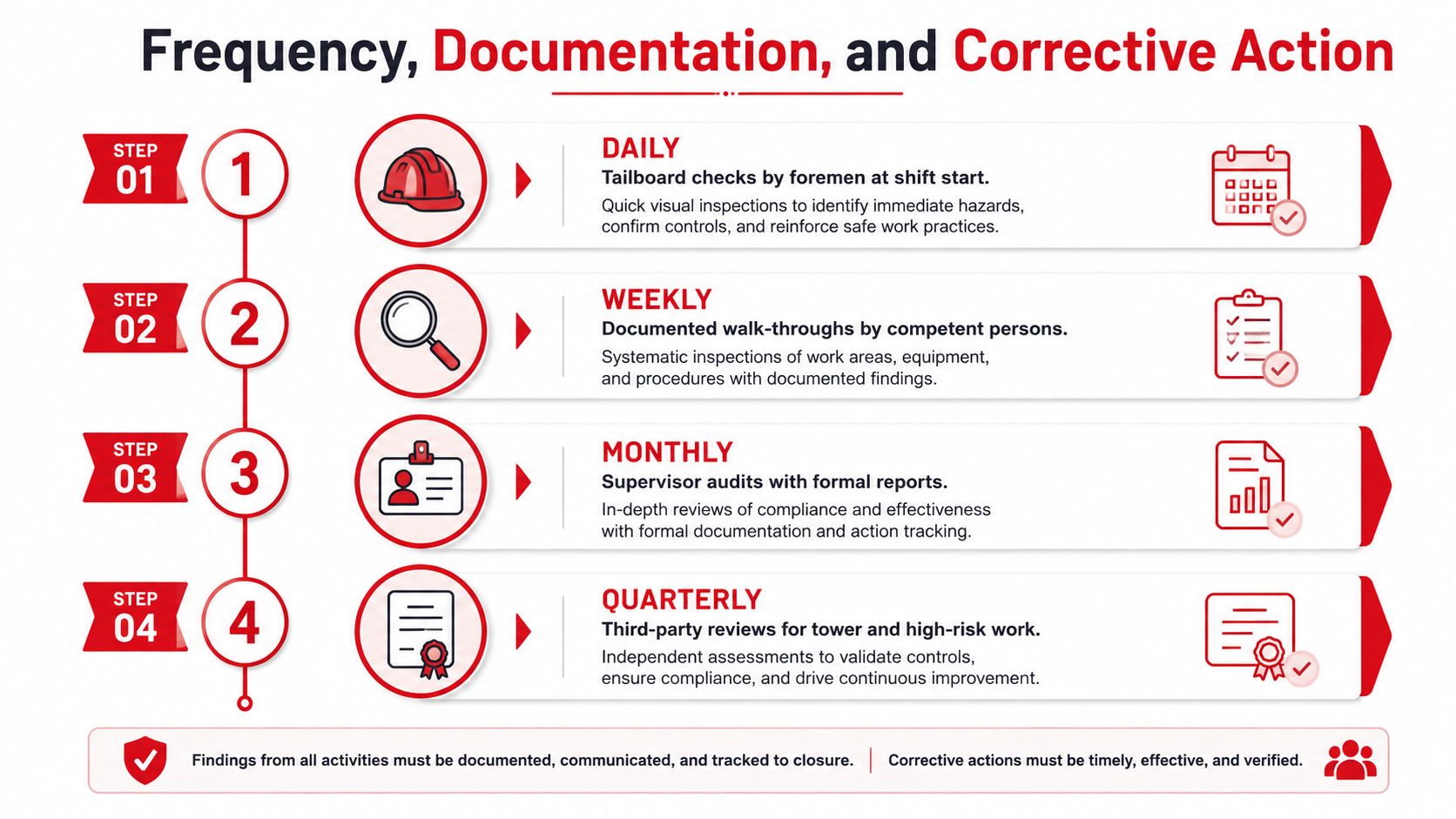
A workable cadence gives each level a defined job:
- Daily: The foreman conducts a tailboard check before the shift and revisits it when the task or conditions change.
- Weekly: The competent person completes a documented walk-through across active fronts.
- Monthly: A supervisor audits records, field conditions, subcontractor controls, and repeat findings.
- Quarterly: An independent or third-party reviewer examines tower, electrical, data-center, or other high-risk scopes.
The cadence only works when one named lead inspector owns the site for each shift. That person signs the daily inspection, knows which crews are present, can stop work, and can explain how findings move to closure.
Use forms that support decisions
A pre-task hazard analysis should identify the work step, exposure, control, responsible person, and trigger for reassessment. An equipment pre-use form should identify the asset and operator, then cover the failure points that can stop work, including rigging, capstan hoists, fusion splicers, generators, and access equipment.
For excavation, the daily form should record the competent person, location, soil and protective-system decision, access, water or weather changes, adjacent loads, and corrective action. For confined spaces, the permit should connect atmospheric readings, ventilation, attendant, entrant, retrieval, communications, and rescue resources.
Documentation test: A stranger should be able to reconstruct what the crew faced, what control was selected, who verified it, and whether the problem was closed.
Make corrective action auditable
A corrective-action tracker should include:
- Hazard ID and location
- Photo evidence
- Root cause
- Responsible party
- Due date
- Immediate control
- Verified closeout
- Preventive action for similar crews or sites
Classify findings by urgency. A missing trench protective system is an exposure to stop immediately. A damaged label may need prompt repair, but it shouldn't receive the same response pathway. Review open items in the project safety committee, then share relevant lessons with foremen and subcontractors.
For a practical treatment of what happens after an inspection identifies a defect, use this resource on correcting defects after inspection. The useful principle is simple: an observation isn't complete when someone types “corrected.” It's complete when a responsible person verifies the control in the field and records the evidence.
When an incident is recordable, the corrective-action process should also connect with OSHA recordkeeping. Don't use inspection forms to rewrite an incident history. Use them to show which controls were present, which failed, and what changed afterward.
From Inspection Counts to Inspection Quality
A high inspection count can conceal weak field work. A supervisor may complete every scheduled walk-through and still miss the crew working from an unverified anchor, the subcontractor using an expired certification, or the vault team entering without a complete rescue setup.
Quality begins with coverage. Sample more than the best-behaved crew and the easiest work front. Compare what the JHA says with what the newest worker understands. Check whether certificates match the actual people operating equipment. For tower work, verify that anchor documentation supports the system being used, rather than accepting a generic statement that the anchor is rated.
Track the signals that precede failure
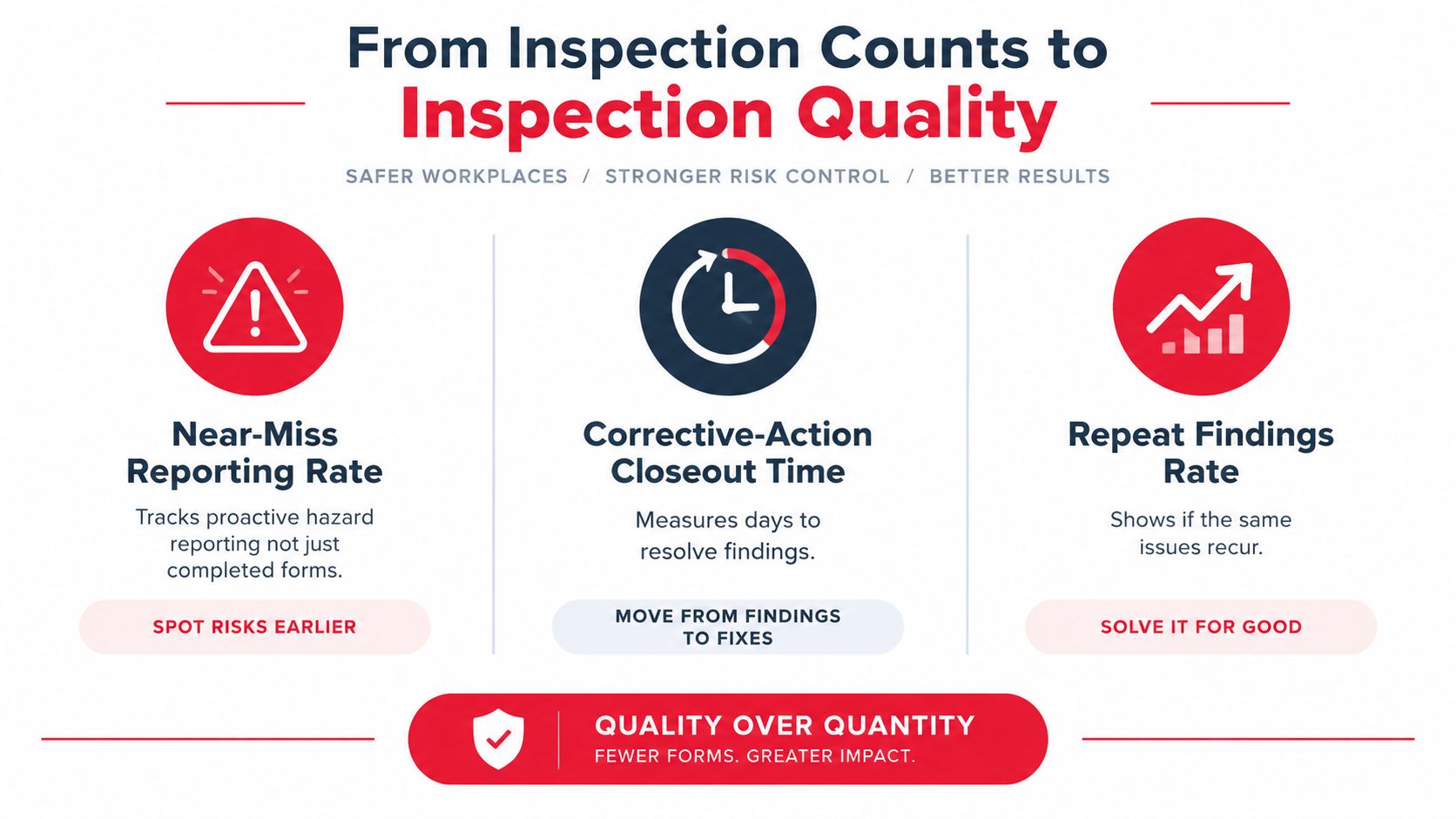
The most useful inspection dashboard doesn't stop at completed forms. Track:
- Near-miss reporting: Are workers reporting hazards before someone gets hurt?
- Corrective-action closeout time: How quickly does the responsible party remove or control exposure?
- Repeat findings: Does the same trench access, tie-off, housekeeping, or LOTO error return?
- Control verification: Did the supervisor confirm the engineering or administrative control in the field?
- Crew coverage: Did the audit reach every subcontractor and active task?
These measures help distinguish activity from effectiveness. A rising near-miss count can indicate better reporting, not worsening safety. A falling inspection count can mean reduced work, missed audits, or a change in targeting. The number needs context.
Prioritize hazards with evidence
Construction inspection data supports a clear priority for falls. CPWR reports that fall-related penalties totaled about $49 million in 2019, representing more than one-third of construction citation penalties, as summarized in its analysis of OSHA enforcement data. That doesn't mean every inspection should become a fall-protection audit, but it does mean tower, rooftop, leading-edge, ladder, and access reviews deserve serious attention.
NYC provides a useful example of why inspection quality matters. Its Department of Buildings conducted 416,290 field inspections in 2024, the highest level since tracking began, while construction-related incidents declined from 841 in 2023 to 638 in 2024, and injuries declined from 692 to 482. The department's reported figures are available through the OSHA construction enforcement summary. The figures don't prove that inspections alone caused the decline, but they show why leaders should examine targeted prevention and outcomes together rather than treating more inspections as the finish line.
The executive case is strongest when findings lead to design or process changes. Move a splice point away from traffic, add engineered edge protection, redesign a material-handling route, improve anchor access, or change the isolation sequence. Retraining has a place, but repeated findings usually indicate that the system makes the safe action difficult.
Your Practical Site Safety Inspection Playbook
Hand the crew a short card, not a manual they'll leave in the truck. On Monday morning, the safety lead should confirm that the JHA, crew certifications, operator records, and site-specific controls match the work scheduled.
Then stage the pre-task brief around the day's highest-citation hazards. For an excavation crew, that means protection, access, utilities, spoil, and pedestrians. For tower work, it means tie-off, anchors, rescue, hoisting, and dropped objects. For a vault crew, it means atmosphere, ventilation, entry authorization, retrieval, and communications.
Assign one site-safety lead for the shift and give that person clear stop-work authority. The lead should verify the chain from pre-inspection photographs and forms through assigned corrective action and field-verified closeout.
Use the final fifteen minutes of the weekly review to examine the prior week's findings. Look for repeat hazards, crews that weren't sampled, overdue actions, and controls that exist on paper but fail during production pressure. Keep the review short, factual, and tied to the next work plan.
A one-page inspection card can list the top five triggers for each trade, the documents that must be available, and the person who can stop work. Pair that card with practical site-access and perimeter controls, especially on projects where equipment, materials, and public interfaces create security concerns. Guidance on construction security for WA projects can help project teams think beyond worker protection to site access, asset control, and unauthorized entry.
Southern Tier Resources supports telecom, fiber, wireless, and data-center projects with engineering, construction, maintenance, and safety-focused field execution. If you need a partner that can connect disciplined site inspections with reliable network delivery, visit Southern Tier Resources to discuss your next build.