Before you even think about sending out a Request for Proposal (RFP), it's critical to get your own house in order. The success of any major power line project absolutely hinges on the quality of your internal planning. This is where you transform a broad objective—like upgrading the grid or powering a new data center—into a concrete, buildable plan.
A rock-solid project brief is your single best tool for attracting the right power line construction contractors and setting clear expectations from day one.
Defining Your Project Before You Hire
I’ve seen it time and time again: the most common point of failure in large-scale infrastructure projects isn't the actual construction. It's a vague or incomplete project definition at the very beginning.
When the scope is fuzzy, you’re basically asking contractors to bid on a guess. That’s a recipe for a flood of change orders, blown budgets, and painful schedule delays. Taking the time to build a comprehensive plan before you engage with bidders is the most powerful move you can make to control costs and ensure the finished project actually meets your needs. It also means you can evaluate every proposal on a true apples-to-apples basis.
This process is all about translating your vision into detailed technical specifications. You have to move past the high-level goals and nail down the specifics that will dictate every aspect of the build.
Developing Your Technical Specifications
Think of your technical specs as the project's DNA. These details drive everything from material sourcing to the construction methods used in the field. Don't leave room for interpretation here.
Your specs must clearly outline:
- Voltage and Conductor Needs: Be specific about the operating voltage (69kV, 138kV, 345kV, etc.) and the exact conductor type (like ACSR or ACCC) required to manage the electrical load.
- Structure Design and Materials: Will the project use steel monopoles, lattice towers, or traditional wood poles? This decision, along with foundation designs based on geotechnical surveys, must be defined upfront.
- Hardware and Components: Create a detailed list of required insulators, dampers, grounding systems, and other critical hardware. This ensures you get the system reliability and lifespan you're paying for.
Preliminary Route Planning and Right-of-Way
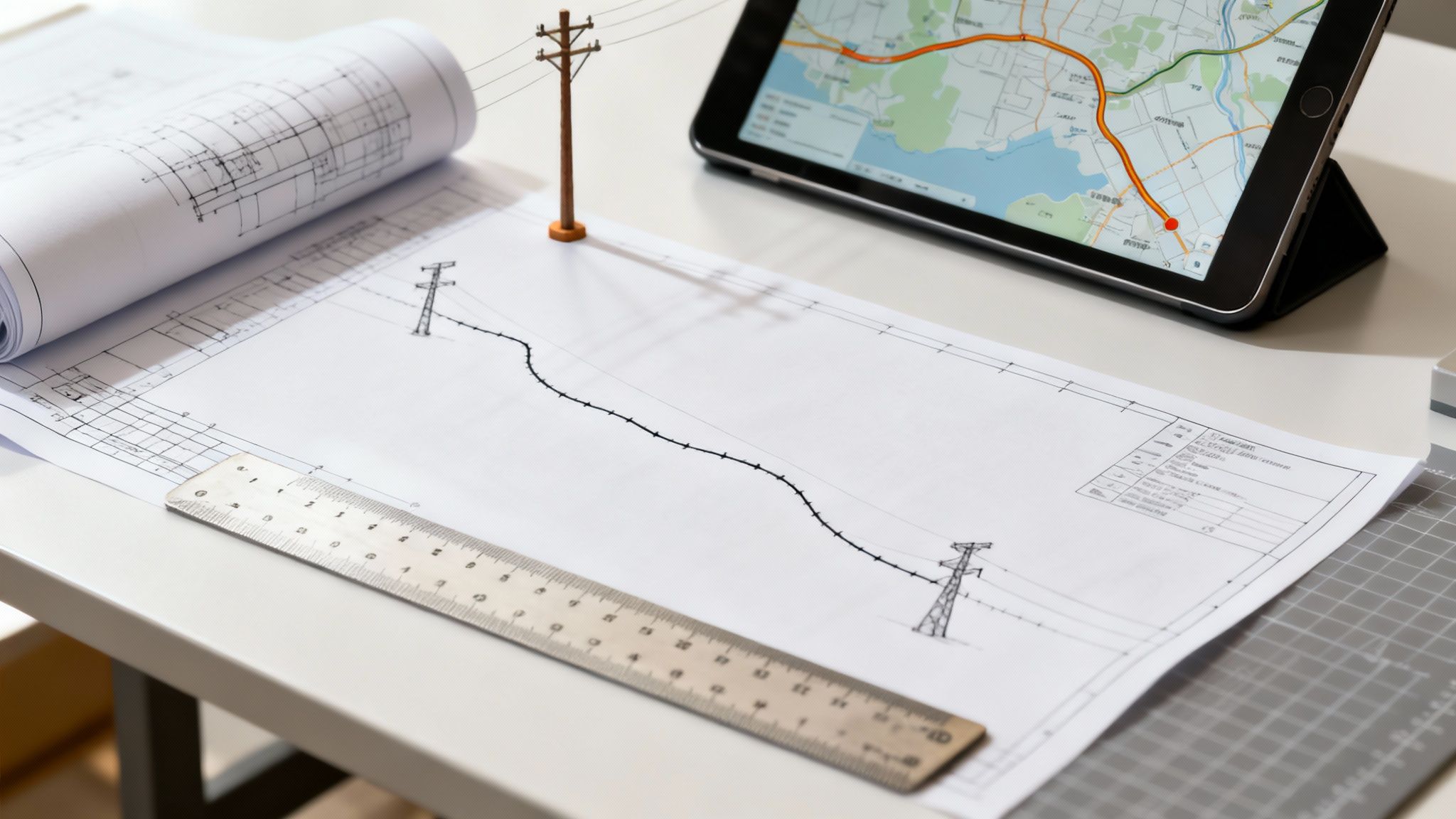
Finding a viable route for a power line is far more complex than just drawing a line on a map. You'll need to lean on GIS data and preliminary field surveys to identify the path of least resistance—both physically and legally. This initial work is essential for spotting potential roadblocks early.
This is also where you start identifying necessary easements and anticipating right-of-way (ROW) acquisition hurdles. Opening conversations with landowners, local governments, and regulatory bodies at this stage can save you from massive delays later. You'll also need to assess environmental impacts, from wetlands and endangered species habitats to historical sites. These findings will directly shape your permitting strategy.
For particularly challenging underground installations, our guide on specialized trenching services offers deeper insights into navigating those unique complexities.
A project’s initial definition serves as its constitution. It sets the rules of engagement, defines the boundaries of the work, and acts as the ultimate reference point when questions or disputes arise during construction.
To help you get started, we've put together a checklist of the absolute must-haves for your project definition phase. Running through this before you engage with contractors will save you a world of headaches.
Critical Pre-Selection Project Definition Checklist
| Planning Area | Key Action Items | Why It Matters |
|---|---|---|
| Scope & Objectives | – Clearly state the project goal (e.g., "Increase grid capacity by 20%"). – Define start/end points and key interconnections. – List all deliverables (e.g., transmission line, substation upgrades). |
Eliminates ambiguity and ensures all stakeholders and potential bidders are working from the same set of goals. |
| Technical Specs | – Finalize voltage levels, conductor types, and structure materials. – Specify hardware, grounding, and OPGW requirements. – Complete preliminary geotechnical and soil analysis for foundation design. |
Provides contractors with the precise information needed for accurate material costing, labor estimation, and construction planning. |
| Route & ROW | – Complete a preliminary route analysis using GIS and aerial surveys. – Identify all parcels requiring new easements or ROW acquisition. – Document known environmental, cultural, or landowner constraints. |
Proactively identifies the biggest sources of project delays and allows for realistic scheduling and budgeting for land acquisition and permitting. |
| Permitting | – List all required federal, state, and local permits. – Hold initial meetings with key regulatory agencies (e.g., environmental protection, historical commissions). – Develop a preliminary permitting timeline. |
Ensures the project timeline accounts for lengthy agency review cycles and avoids costly stop-work orders due to non-compliance. |
| Risk Assessment | – Identify potential risks (e.g., supply chain delays, severe weather, community opposition). – Develop initial mitigation strategies for the top 3-5 risks. – Set a preliminary contingency budget (10-15% of estimated cost is a common starting point). |
Forces a realistic view of project challenges and demonstrates to contractors that you are a prepared and sophisticated project owner. |
Treating this checklist as non-negotiable will put you in a position of strength, ensuring the bids you receive are grounded in reality and directly comparable.
The entire project definition process boils down to three core stages: defining the technical requirements, mapping the physical route, and assessing all the external factors that could impact the work.
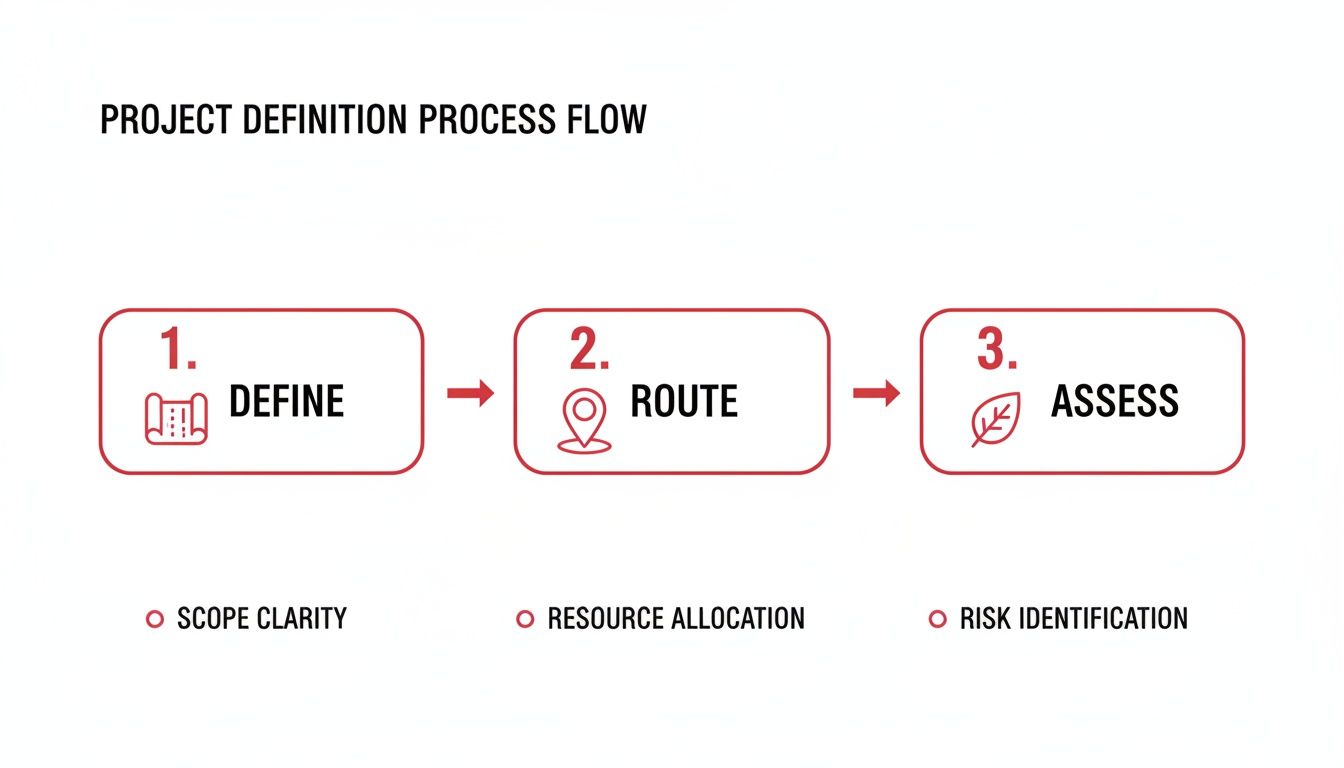
This systematic approach—where each planning step logically informs the next—is what creates a cohesive and truly actionable project brief. This kind of disciplined, forward-looking planning is more important than ever. With the global power transmission lines and towers market valued at $34.87 billion and projected to grow at a 7.8% CAGR through 2035, the demand for well-managed projects is only going to increase.
Vetting a Contractor's Experience and Capabilities
Once you have a solid project plan, the real work begins: finding the right partners. This is so much more than a background check. Think of it as a forensic examination of a contractor's proven ability to deliver on a project just like yours. A meticulous vetting process is your single best defense against the delays, budget blowouts, and safety nightmares that can derail a project.
The first step is to build a shortlist of power line construction contractors whose track record genuinely mirrors your project's demands. Don't get distracted by a slick website or a lowball bid. The real proof is in their portfolio.
Analyzing Past Project Portfolios
When you start digging into a contractor's past work, you're looking for relevance—in both scale and complexity. A company that’s a rockstar at stringing rural distribution lines might be completely out of its depth on a high-voltage transmission project cutting through a dense urban corridor.
Insist on seeing detailed case studies and talking to references for at least three projects from the last five years that are a close match to yours.
You need to ask specific questions about:
- Voltage and Structure Type: Have they really worked with the 138kV or 345kV systems and steel monopole structures your project calls for? Or are they just saying they can?
- Geographic and Environmental Conditions: Do they have scars to show from working in similar terrain, dealing with the same weather patterns, or navigating environmentally sensitive areas?
- Project Scope: Have they successfully managed projects with a similar budget, timeline, and logistical headaches, including right-of-way acquisition and complex, multi-agency permitting?
This is where you separate the true contenders from the pretenders. A contractor with directly applicable experience will anticipate the unique challenges of your project long before they ever break ground.
Assessing Technical and Equipment Capabilities
At the end of the day, a contractor is only as good as their people and their iron. The most experienced firm on the planet can’t get the job done without the right equipment and the skilled crews to run it. When you’re vetting them, you have to get granular about their operational readiness.
Get ready to ask some pointed questions about their resources:
- Equipment Fleet: Do they own or lease their critical machinery? Ownership often points to better financial stability and a more rigorous maintenance schedule. Ask for a detailed list, especially of big-ticket items like tension stringing equipment, cranes, and specialized access vehicles.
- Crew Expertise: What's the tenure of their linemen, foremen, and project managers? A team with low turnover is a huge plus—it means they’ve built a culture of expertise and safety that you can count on.
- Technology and Software: How are they managing schedules, tracking progress, and communicating with you? A contractor who is fluent in modern construction management software is showing you they’re organized, transparent, and serious about efficiency.
The real measure of a contractor’s capability isn’t just what they’ve built, but how they built it. Their investment in modern equipment, skilled labor, and project management technology directly translates to project efficiency and quality.
Verifying Financial Stability and Credentials
Before a single contract is signed, you must do your due diligence on the business itself. This is non-negotiable. A contractor that’s financially overextended or carrying inadequate insurance is a massive liability for your project and your organization.
This part is straightforward but absolutely critical.
- Confirm Licenses and Insurance: First, verify they hold every required state and local license. Then, ask for their Certificate of Insurance (COI) and have your own risk manager confirm it meets—or, preferably, exceeds—your project’s liability coverage requirements.
- Verify Bonding Capacity: Bonding is your financial safety net. A surety bond protects you if the contractor can't finish the job or fails to pay their subcontractors. You need to call their surety company directly and confirm their bonding capacity is enough to cover the full value of your project.
It helps to have some market context. The U.S. transmission line construction industry is projected to hit $125.5 billion in revenue in 2025, with over 10,500 businesses in the game. That's a huge pool to choose from, which underscores why picking a financially sound partner is so important.
To get a better sense of the daily realities contractors face, you can explore these specific use cases in construction. For a closer look at the complexities of managing different partners, our guide on subcontractor management offers some helpful insights. https://southerntierresources.com/goodscode/subcontractor/500636204
By methodically vetting experience, capabilities, and credentials, you’ll build a shortlist of contractors who don't just claim they can do the work—they have the history to prove they can deliver it safely, efficiently, and to the highest standard.
Evaluating Safety Records and Regulatory Knowledge
When you’re vetting a power line construction contractor, nothing matters more than their safety culture. This isn’t just a box-checking exercise; it’s a direct window into their discipline, their respect for the work, and their ability to protect your project, their people, and the public. A contractor with a flimsy safety program is a massive liability waiting to happen.
You have to look past the promises in their proposals and get into the hard data. The numbers don't lie.
Decoding the Safety Metrics
Before a bid even hits your desk, ask for their safety documentation. Two metrics are absolutely essential: the Experience Modification Rate (EMR) and their OSHA 300 logs. Knowing how to read them is key.
The Experience Modification Rate (EMR) is a metric insurers use to price workers' compensation premiums, and it’s a powerful indicator of a company’s safety performance. An EMR of 1.0 is the industry average. Anything below 1.0 is a good sign, suggesting a better-than-average safety record. A number consistently above 1.0 is a serious red flag.
Don’t dismiss a high EMR. It’s not just an insurance data point; it points to real, systemic problems in how they manage risk on the job site.
Next, dive into their OSHA 300 logs. These are the official records of work-related injuries and illnesses. You're not just looking for a clean sheet—you're looking for patterns. What kinds of incidents are happening? And, more importantly, what did they do about it? A truly professional contractor will walk you through these incidents and show you the concrete process changes they made to prevent them from happening again.
Verifying Deep Regulatory Knowledge
A contractor's ability to build a line is useless if they can't navigate the maze of local, state, and federal regulations. A misstep here can bring your project to a screeching halt, trigger massive fines, and put you, the project owner, in a serious legal bind.
A top-tier partner doesn’t just follow the rules; they stay ahead of them. They should have a dedicated expert or a rock-solid process for managing compliance from day one.
Get specific in your interviews. Ask them to share their experiences with:
- Environmental Permitting: How have they handled projects with tricky environmental constraints like wetlands, endangered species habitats, or historical sites?
- Right-of-Way (ROW) Acquisition: Walk me through your process. How do you work with landowners to secure easements and navigate the legal hurdles?
- Local Ordinances: Give me an example of when you had to adapt a work plan for a specific town’s noise restrictions, traffic control requirements, or work-hour limitations.
A contractor's regulatory expertise is the immune system for your project. A strong one proactively fights off the diseases of delays, fines, and legal battles. A weak one leaves you exposed to every threat in the book.
The Importance of Proactive Compliance
Being proactive about compliance is about more than just dodging penalties; it’s about building the project on a solid legal and ethical foundation. When you're looking at potential partners, see if they've invested in formal systems like an occupational health and safety certification. This kind of certification shows a genuine, auditable commitment to managing safety.
You want a contractor who sees regulatory agencies as stakeholders, not adversaries. The best ones have already built relationships with local planning departments and environmental commissions. That familiarity almost always leads to a smoother, faster permitting process.
Ultimately, you're searching for a partner who treats safety and compliance as fundamental parts of their business, not as annoying afterthoughts. Their ability to master these domains is a direct reflection of their ability to manage a high-stakes infrastructure project successfully.
Deconstructing Bids and Choosing a Contract Model
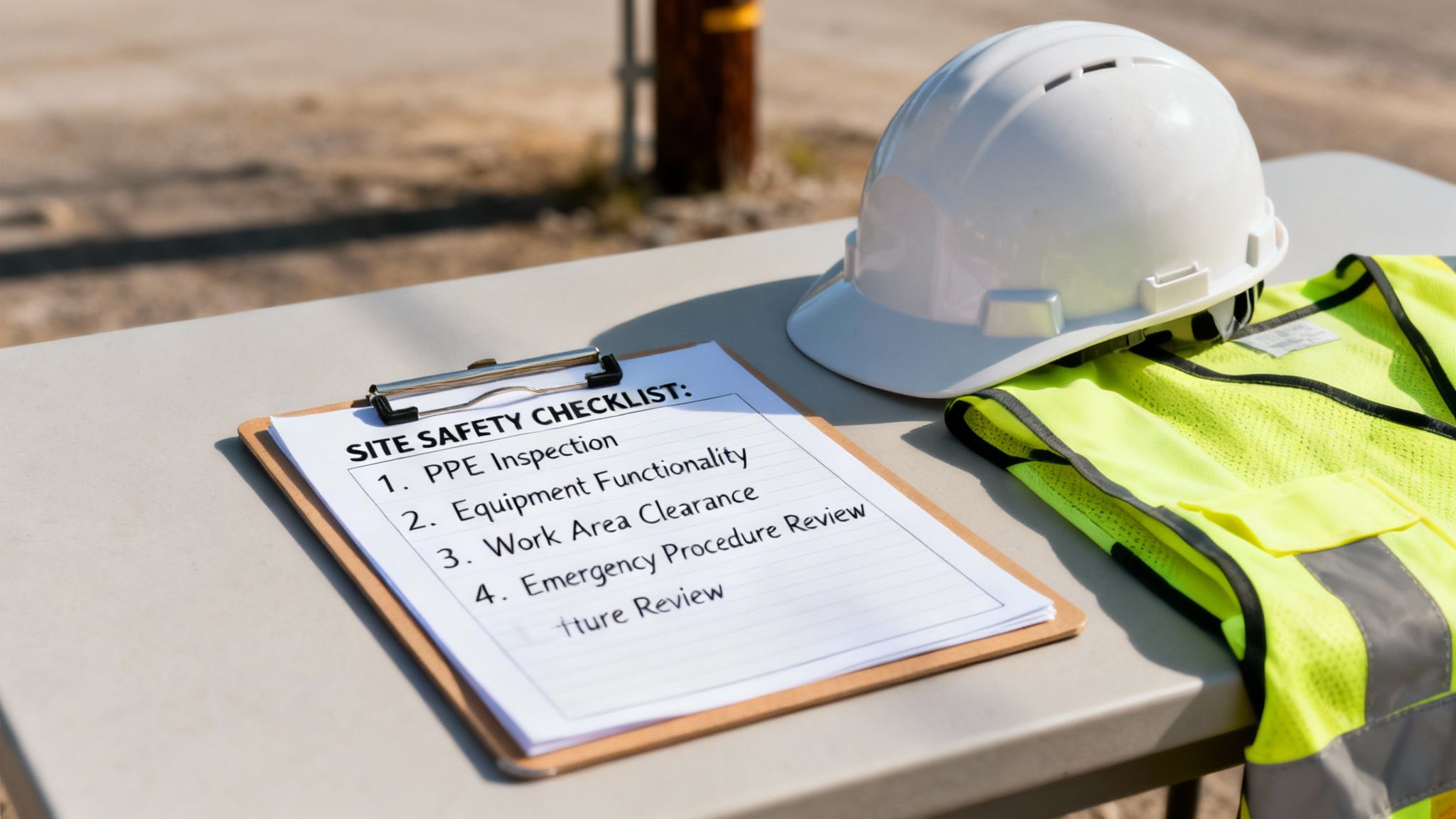
The bids are in. Now the real work begins. It’s all too easy to let your eyes drift to the bottom-line price, but seasoned project owners know that’s a rookie mistake. The true value—and the hidden risks—are buried in the details.
Think of a professional bid as a transparent roadmap for your project, not just a price tag. Your job is to deconstruct that roadmap, piece by piece, to understand the contractor’s logic, their assumptions, and where things could go wrong. The lowest number isn’t always the best value. In fact, an unusually low bid often signals that the contractor has misunderstood the scope, plans to use subpar materials, or is about to cut corners on safety.
Beyond the Bottom Line: Analyzing Line Items
A high-quality bid should offer a crystal-clear, itemized breakdown of costs. This level of transparency is non-negotiable. If a contractor hands you a single lump-sum figure with no backup, see it for the red flag it is. True partners aren't afraid to show their work.
As you dig into the line items, zone in on these three critical areas:
- Labor Costs: Is the bid specific about crew compositions and estimated hours? You need to see if their labor rates align with regional standards for skilled linemen and equipment operators. Vague labor projections can be a cover for inflated costs or a sign the contractor hasn’t properly planned the job.
- Material Costs: The proposal must specify major materials—think poles, conductor types, and essential hardware. Cross-reference these specs with your project’s technical requirements. This is where you’ll catch a contractor trying to win the bid with lower-grade materials that won’t meet your standards.
- Equipment and Subcontractor Costs: Make sure the bid outlines all necessary equipment, from bucket trucks to specialized tension stringing machines. Pay close attention to any costs from subcontractors, like those handling foundation drilling or environmental monitoring. Ambiguity here can quickly lead to surprise rental fees and costly delays down the road.
Scrutinizing the line items isn't about micromanaging. It's about confirming their plan is grounded in reality and matches the project you need built. You're looking for a partner who has thought through every detail, not just the final invoice.
Selecting the Right Contract Model
After you've found a contractor with a competitive and realistic bid, the next move is to decide on the contractual framework that will define your relationship. The model you choose determines how risk is shared, how costs are managed, and what truly motivates performance.
There's no single "best" contract. The right choice depends entirely on your project's complexity, your timeline, and your organization's comfort level with financial risk. Each model serves a different purpose, and understanding them is key to protecting your interests while building a collaborative partnership.
Choosing the right contracting model is a strategic decision that sets the tone for the entire project. It's about aligning incentives and making sure everyone is pulling in the same direction from day one.
Comparison of Construction Contracting Models
The table below breaks down the three most common models in the industry. Each has distinct advantages and is better suited for certain types of projects and risk profiles.
| Contract Model | Best For | Owner's Risk Level | Contractor Incentive |
|---|---|---|---|
| Fixed-Price (Lump Sum) | Projects with a clearly defined, unchanging scope and minimal unknown variables. | Low | To complete the work as efficiently as possible to maximize profit. |
| Cost-Plus | Complex projects where the scope is likely to evolve or contains significant unknowns. | High | To complete the work to the highest quality standard, with less pressure on cost control. |
| Time and Materials (T&M) | Smaller projects, repair work, or when the scope is impossible to define upfront. | High | To log hours and material usage accurately, with little incentive for efficiency. |
A Fixed-Price contract gives you budget certainty, which is ideal for public utilities or any project with tight financial oversight. The catch? It puts the risk of unforeseen site conditions squarely on the contractor, which can lead to friction if major changes pop up.
On the other hand, a Cost-Plus model offers the flexibility to adapt as challenges arise, making it perfect for complex urban jobs or projects with tricky environmental factors. While this approach encourages collaboration, it demands rigorous oversight from your team to keep costs from spiraling. Ultimately, the contract you sign will shape your working relationship and the project's outcome.
Turning the Plan into Reality: Active Project Management
Signing the contract isn't the finish line; it’s the starting gun. The best-laid plans and most meticulously vetted contractors mean very little without active, intelligent project management once the work begins. This is where your vision is transformed into a reliable, long-lasting physical asset.
Effective management is built on a foundation of clear, consistent communication. Ambiguity is the enemy of progress. From the moment your chosen power line construction contractors mobilize to the site, a structured communication protocol is absolutely essential to keep everyone aligned and informed.
Don't Just Talk—Communicate with Purpose
You can't leave communication to chance or rely on a flurry of informal emails. A disciplined rhythm of meetings and reporting is what keeps a project on the rails. This isn't about micromanagement; it's about creating predictable touchpoints for progress updates, issue resolution, and forward planning.
The core components of a solid communication plan are simple but non-negotiable:
- Weekly Progress Meetings: These are a must. The agenda should be consistent, covering safety incidents, work completed, a two-week lookahead, material delivery status, and any potential roadblocks. No surprises.
- Monthly Stakeholder Updates: This is the high-level summary for executives and other key stakeholders. It should focus on budget, schedule adherence, and major milestones. Keep it concise and to the point.
- A Single Source of Truth: Use a shared dashboard or platform to track key performance indicators (KPIs) in real-time. This prevents conflicting reports and ensures everyone is working off the same information.
With a global power generation construction pipeline valued at a staggering $8.27 trillion, the scale of these projects demands disciplined oversight. A huge 59.6% of this value is still in the early planning stages, which means the opportunity to implement robust management practices from the start is immense. You can explore more insights on the global power construction pipeline on businesswire.com.
Quality Assurance: Your Best Defense Against Future Headaches
Quality assurance (QA) isn't just about a final inspection. It’s a continuous process that kicks off the moment materials arrive on site and only ends after the final system is commissioned. A proactive QA plan stops small mistakes from snowballing into costly, systemic failures down the road.
Your QA process should be documented and agreed upon with the contractor before a single shovel hits the ground. It has to cover several critical checkpoints.
We always focus our QA efforts on these areas:
- Material Inspection on Delivery: Verify that all delivered components—from poles and conductors to insulators and hardware—match the project's technical specs before they are installed.
- In-Process Construction Audits: Get out in the field regularly. These audits ensure crews are adhering to approved construction standards, like proper foundation depth or correct torque settings on hardware.
- System Testing and Commissioning: This is the final exam. It involves a rigorous series of tests to confirm the entire system operates safely and meets all performance requirements before you flip the switch.
A strong Quality Assurance plan is an investment, not an expense. I can tell you from experience that every defect caught and corrected in the field saves you ten times the cost and complexity of fixing it after the system is in service.
Finishing Strong: The Critical Project Closeout
The end of a project is just as important as the beginning. A sloppy closeout can create long-term operational headaches and seriously undermine the value of your new infrastructure. Proper documentation is the cornerstone of a successful handover.
Your contractor’s final deliverables must include a complete closeout package. For more details on what this involves, our guide on emergency preparedness for infrastructure projects touches on why having accurate, accessible records is so vital.
Here’s what you absolutely must get:
- As-Built Drawings: These are the revised construction drawings showing exactly how the project was built, including any field modifications. They are your bible for future maintenance and repairs.
- Maintenance Manuals and Warranties: A comprehensive package detailing all manufacturer warranties and required maintenance schedules for key components.
- Final Lien Waivers: This is your legal protection. These documents from the contractor and all subcontractors confirm they have been paid in full, protecting you from future claims.
By actively managing communication, quality, and closeout, you ensure the final product not only meets the contract specifications but also stands as a reliable asset for decades to come.
Answering Your Key Contractor Questions
When you're navigating a major power infrastructure project, tough questions are inevitable. The decisions you make when selecting and managing your contractors can make or break the entire endeavor, so getting clear answers to common concerns is non-negotiable.
Let's dive into the real-world issues that I've seen determine a project's success or failure time and time again. Tackling these head-on will save you headaches, money, and a whole lot of stress down the line.
What Are the Most Common Red Flags to Watch for When Vetting Contractors?
Spotting trouble early is your best defense against project derailment. Be on high alert for a bid that seems too good to be true—it almost always is. An unusually low number often signals that the contractor has misunderstood the scope, plans to use subpar materials, or is ready to cut corners on safety to protect their margin.
Another huge warning sign is a lack of recent, relevant references. If they can’t point you to a happy client from a similar project within the last two years, that's a problem. Any hesitation to provide safety records, like their EMR rating or proof of insurance, should be an immediate deal-breaker.
Finally, pay close attention to how they answer questions. Vague responses about their project management approach, crew availability, or whether they own their equipment can point to disorganization or a lack of resources. A solid, trustworthy power line construction contractor will have this information ready and will share it without you even having to push for it.
How Important Is Experience with Both Power and Fiber?
In today's world, it's not just valuable—it's often critical. Power and communications infrastructure are so intertwined now that they're frequently deployed together. Having a contractor who truly understands both sides of the coin is a massive advantage.
This is especially true for "make-ready" work, where utility poles need to be prepared for new fiber optic lines. A crew that can expertly manage the power system requirements while understanding the delicate handling needed for fiber can execute the job much more efficiently.
Having a single, accountable partner who is fluent in both power and fiber systems minimizes coordination delays between different specialized crews. It reduces project complexity and creates a single point of accountability for two critical infrastructures that must coexist.
What Should Be Included in the Final Contract to Protect Our Interests?
Think of your contract as your ultimate safety net. It needs to go way beyond just a price and a high-level scope. A rock-solid agreement will include:
- A highly detailed scope of work leaving no room for interpretation.
- A firm project schedule with crystal-clear milestones.
- A payment schedule that is explicitly tied to hitting those milestones.
- Specific insurance coverage minimums and bonding requirements.
- A clear, formal process for handling change orders.
- A predefined procedure for dispute resolution.
It should also lock in clauses on safety compliance, quality standards, and the required closeout documentation, like as-built drawings and warranty info. Spending a little extra on a final legal review before signing is an investment that always pays off.
How Do You Handle Unexpected Site Conditions or Delays?
No project goes exactly according to plan. The difference between a good contractor and a bad one is how they manage the unexpected. Your contract must lay out a clear process for this, usually involving a formal "Request for Information" (RFI) or a change order proposal from their team.
This document should detail the specific issue, their proposed solution, and any potential impacts on cost or schedule. But the process is only half the battle—proactive communication is everything. A great partner will give you a heads-up on potential issues early, talk through the options transparently, and keep meticulous records to justify any changes needed to keep things moving.
At Southern Tier Resources, we provide the end-to-end engineering, construction, and maintenance services needed to build and manage high-performance telecom infrastructure. Our commitment to safety, quality, and transparent communication ensures your project is delivered on time and to the highest standards. Discover how we can be your single accountable partner for wireline and wireless networks by visiting us at https://southerntierresources.com.