A permit is still pending, the utility locate hasn't cleared, and the splicing crew is committed to another route. None of those issues looked large when the carrier commitment was set. Together, they can move construction, testing, documentation, and activation beyond the promised date.
That's why reliable telecom delivery needs more than a Gantt chart with optimistic dates. A working schedule must connect the baseline to field dependencies, crew capacity, permitting, quality gates, protected buffers, objective progress evidence, formal change control, and reporting that stakeholders can act on. The schedule should tell the project manager what changed, why it changed, what the change affects, and which decision can recover the plan.
The need for discipline is clear. The PMI Practice Standard for Scheduling describes scheduling as the planning, development, maintenance, communication, and reporting of an effective schedule model. The same standard recommends practical controls such as right-sized tasks, defined start and completion milestones, and contingency before completion. Independent construction research cited by PMI also finds that 75% of projects experience delays, with typical delays measuring roughly 20% to 40% of total project duration. Telecom teams can apply the lesson across fiber, wireless, tower, and data center work.
The following schedule management best practices turn scheduling into an operating system for delivery, not a document that gets refreshed after problems have already occurred. For broader IT project management expertise, the same operating principles apply to technology programs with complex dependencies and changing constraints.
1. Critical Path Method for Project Sequencing
The Critical Path Method, or CPM, identifies the longest chain of dependent activities that determines the shortest possible project duration. It gives a telecom project manager a way to separate work that can move independently from work that directly threatens the carrier commitment.
A greenfield fiber build may include route design, right-of-way approval, utility locates, make-ready work, trenching, conduit placement, cable installation, splicing, testing, and documentation. These activities aren't interchangeable. If make-ready work is incomplete, construction may be blocked. If splicing isn't finished, testing can't provide a complete acceptance record. CPM makes those relationships visible instead of leaving them buried in task notes.
The U.S. Government Accountability Office schedule-assessment guide defines schedule quality through controls such as complete activity capture, duration estimates, sequencing logic, resource loading, and a valid critical path. A schedule with dates but no defensible logic may look detailed while providing little control.
Build logic that reflects field reality
Break major work packages into activities that crews can measure and supervisors can update. For fiber, separate installation from splicing, testing, remediation, and as-built documentation. For a data center fit-out, connect power readiness, connectivity provisioning, structured cabling, testing, and customer acceptance. For tower work, include design approval, permitting, equipment delivery, installation, RF testing, and activation.
Review the critical path during active construction, especially after a permit change, material delay, utility conflict, or failed test. Don't compress every task just because the finish date is under pressure. First determine whether the affected activity has float, whether another sequence can proceed, and whether the recovery action creates rework or safety exposure.
Practical rule: If a field update doesn't change logic, dates, remaining duration, or a documented constraint, it probably hasn't improved schedule control.
The CPM view should be shared with carriers, municipalities, utilities, subcontractors, and internal leaders. Stakeholders don't need every line item, but they do need to know which milestones are date-sensitive and what decision protects them.
A CPM schedule is useful only when it remains connected to actual work. Treat it as a living control model, not a baseline that gets defended after reality has invalidated it.
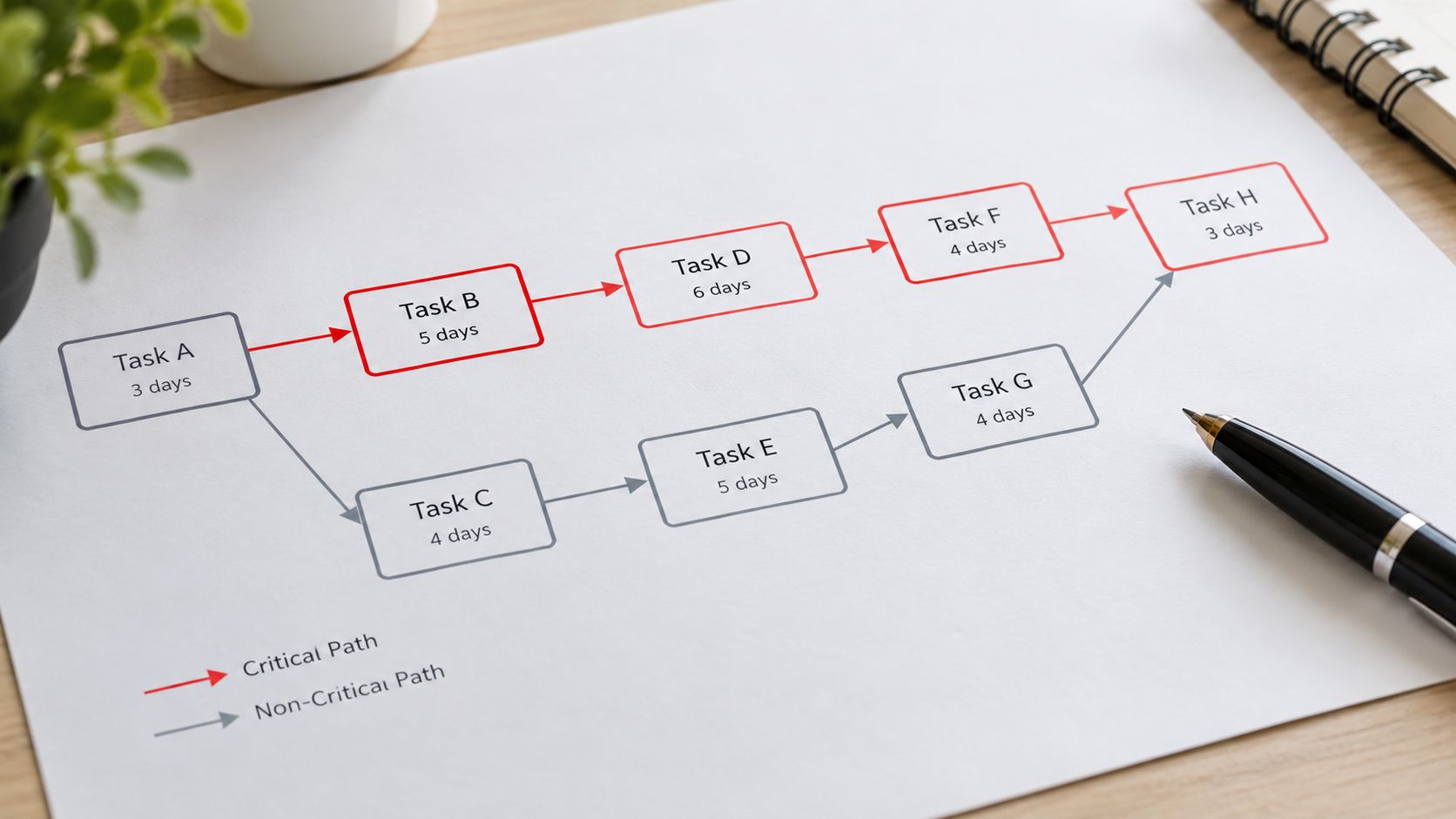
The practical value of CPM becomes clearer when a project includes multiple locations, specialized crews, and material delivery dependencies. The longest path might run through permitting on one site and through equipment delivery or testing on another. That distinction tells the manager where attention will protect the completion date.
2. Resource-Constrained Scheduling
A fiber project can have permits approved and materials delivered, yet still miss its date because the qualified splicing crew is committed elsewhere. A schedule that assumes unlimited crews, equipment, and specialist availability is a forecast, not an operating plan. Resource-constrained scheduling builds the sequence around actual capacity and exposes the trade-offs before field work begins.
Fiber splicing teams, OTDR testers, tower crews, climbers, data center cabling specialists, and certified supervisors often support multiple projects. Assigning one specialist to overlapping work creates false progress. The conflict may surface only after installation, when the project is waiting for testing, acceptance, or correction.
Maintain a resource register covering each crew's location, certifications, specialties, travel limits, planned leave, training needs, and current assignment. Include scarce equipment such as fusion splicers, test sets, lifts, cranes, and access vehicles. The schedule should answer a direct question: if this activity starts on its planned date, who will perform it, and what equipment will they use?
Smooth demand before it becomes a crisis
Resource smoothing moves noncritical work away from demand peaks when available float permits, while preserving the planned finish date. Resource leveling changes the sequence, and potentially the finish date, when available capacity cannot support the original plan. A realistic later date is more useful than an early date dependent on an unavailable crew.
Useful controls include:
- Map specialist capacity: Identify which teams can perform fiber splicing, testing, tower installation, or hyperscale cabling, and define where each team can work.
- Protect handoffs: Reserve testing and documentation capacity behind installation. Completed construction does not equal a releasable site.
- Use qualified partners deliberately: Southern Tier Resources may support telecom programs with engineering, construction, splicing, testing, and maintenance capabilities.
- Plan seasonal constraints: Outdoor construction, tower access, travel, and weather can reduce practical capacity even when labor appears available.
Review the resource plan with field supervisors, permitting staff, subcontractors, and quality leads. Confirm that crew assignments align with access approvals, material readiness, inspection points, and customer commitments. This connects labor capacity to the schedule's actual control points instead of treating resources as a separate spreadsheet.
Transparent assignments also improve field decisions. Crews can see which project has priority, why a move occurred, and which work must remain protected. That clarity is better than repeatedly shifting technicians through informal calls.
Resource planning is not about maximizing utilization at every moment. A crew with no recovery time, excessive travel, or constant reassignment may look fully loaded while producing unreliable output. Capacity should support safe, repeatable delivery and preserve the testing, correction, and acceptance work that turns installation into a completed milestone.
3. Buffer Management and Risk-Based Scheduling
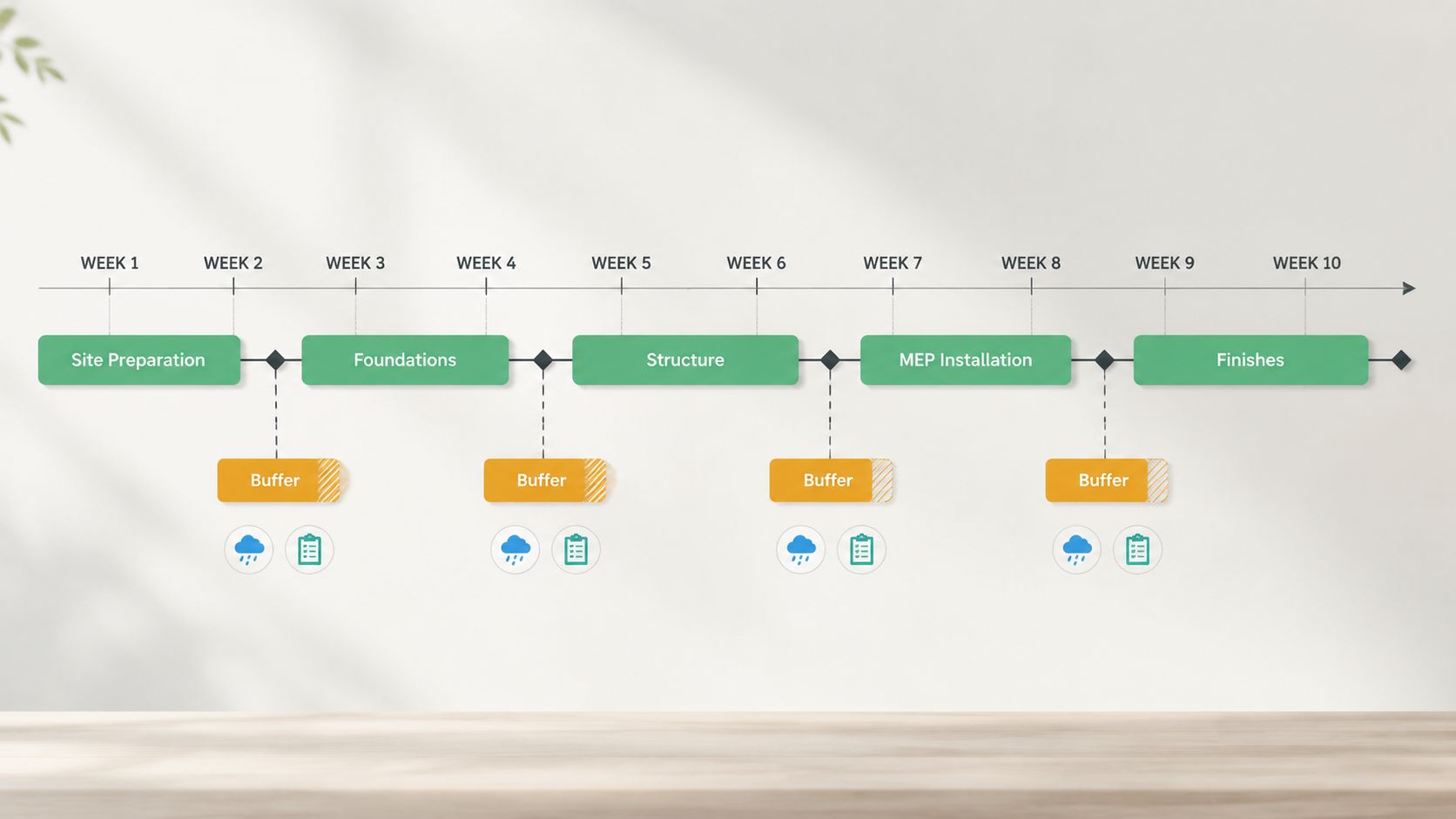
A permit slips, a utility marks an unexpected conflict, or a test fails after the crew has demobilized. Without deliberate protection, that single event can move every customer commitment behind it. Buffer management turns uncertainty into a visible operating control, while risk-based scheduling shows where the protection belongs.
A fiber build may require protection around municipal approvals, utility coordination, underground conditions, weather-sensitive splicing, and testing. A tower program faces different exposure, including equipment delivery, site access, crane availability, and weather. A data center fit-out may depend on operator coordination, power readiness, cutover windows, and acceptance. The schedule should reflect those differences instead of applying one padding rule to every activity.
The PMI scheduling standard describes placing a contingency task before project completion, with defined start and completion milestones. Keeping contingency visible gives managers a clear point for review and avoids burying unexplained float inside individual tasks.
Give every buffer an owner
Run a risk workshop with field supervisors, engineers, permitting staff, procurement, subcontractors, and customer representatives. Identify where work has stopped before, which conditions must exist before mobilization, and which risks the team can reduce before they consume schedule protection.
Assign protection by risk class:
- Permitting protection: Covers approval uncertainty and conditions imposed by municipalities or utilities.
- Construction protection: Covers access issues, ground conditions, weather, and rework.
- Resource protection: Covers scarce crews, equipment conflicts, travel, and specialist availability.
- Acceptance protection: Covers failed tests, documentation corrections, and customer review.
Review buffer consumption weekly against the remaining work. If protection is being used faster than planned, escalate the cause, owner, and recovery options before the completion date becomes the first warning. Define who can authorize buffer use, what evidence is required, and when the customer receives notice.
A buffer is not permission to start late. It is a visible reserve that should trigger a decision when consumed.
Use history from comparable routes, sites, crews, and working conditions where available. A duration supported by field evidence is more useful than a precise date with no basis. Risk-based scheduling earns trust by making uncertainty explicit.
4. Integrated Schedule and Budget Management
A telecom schedule can show green while costs rise, because teams may be paying for overtime, resequencing, expedited materials, or repeat work to protect the finish date. Schedule and budget therefore need one operating view. Earned Value Management, or EVM, links planned work, completed work, and actual cost to a controlled baseline.
Build that view around work packages that reflect delivery decisions. A fiber program may separate route construction, cable installation, splicing, testing, restoration, and documentation. A data center program may track power infrastructure, connectivity, structured cabling, testing, and acceptance. Wireless work can be measured by site or package across labor, equipment, materials, installation, integration, and RF testing.
EVM is useful because it defines what counts as progress. Mobilization spending does not equal earned progress if the route remains incomplete or the installation fails inspection. The baseline should be established before execution, with budgeted cost assigned to work that can be verified in the field.
Measure completion with evidence
Update progress and actual cost from records such as approved quantities, completed route segments, test results, installation signoffs, equipment receipts, and accepted documentation. This keeps the schedule connected to quality gates and customer commitments rather than relying on crew activity alone.
Use the weekly review to separate three conditions:
- Schedule variance: Work is ahead of or behind the planned sequence.
- Cost variance: Spending differs from the value of completed work.
- Combined exposure: The project is late while spending increases, or appears on time because the team is paying to accelerate it.
A project may be on schedule and over budget. It may also be under budget because planned work has not occurred. Those conditions require different actions, so one traffic-light status cannot represent schedule health accurately. The project manager should record the cause, accountable owner, recovery action, and forecast finish for each material variance.
Structured infrastructure reporting can support this process. Southern Tier Resources provides engineering, construction, maintenance, fiber splicing, testing, documentation, data center fit-outs, and wireless services that can be organized around defined work packages and acceptance evidence.
Set variance thresholds according to project risk and work type, not by habit. Crossing a limit should trigger an explanation and an updated forecast. State whether the variance affects the finish date, final cost, scope, or customer commitment, then decide whether to resequence work, add capacity, protect a quality gate, or accept the impact. That decision turns budget reporting into an active schedule control.
5. Dependency Mapping and Constraint Management
A schedule becomes an operating system for telecom delivery when every handoff has a condition, owner, and decision date. A dependency is not just an arrow between tasks. It identifies what must be ready before work can start, which team controls readiness, and how a change affects crews, permits, quality gates, or customer commitments.
For a fiber build, route design, right-of-way approval, utility locate requests, make-ready completion, trenching, cable placement, splicing, testing, and documentation form an interconnected chain. Data center work may rely on power readiness, connectivity provisioning, cabling access, testing windows, and operator acceptance. Tower delivery may wait on design approval, permitting, equipment delivery, installation, RF testing, and carrier activation.
Map internal task logic separately from external constraints. Internal logic shows the work sequence. External constraints show who controls the decision, what evidence is required, and what the team can do if the expected date moves. That separation helps project managers distinguish a crew productivity issue from a permit, supplier, utility, or customer decision.
Convert constraints into decisions
For each dependency, record:
- Owner: The person or organization responsible for the next action.
- Decision and latest safe date: What must be decided, and when delay begins to affect the forecast.
- Readiness evidence: The approval, delivery confirmation, test record, access release, or other proof required.
- Fallback plan: The resequencing, alternate crew, work-package change, or customer commitment decision available if the constraint remains open.
Replace “permit pending” with the specific approval, submission status, outstanding condition, and parallel work that can continue. Ask whether documentation can start while construction closes, whether another site can proceed, and which party can remove the blockage.
Use the Pebb team management platform where it helps simplify resource sharing and make ownership visible across teams. The tool matters less than the operating discipline. Every open constraint needs a named owner, a next action, and a forecast impact.
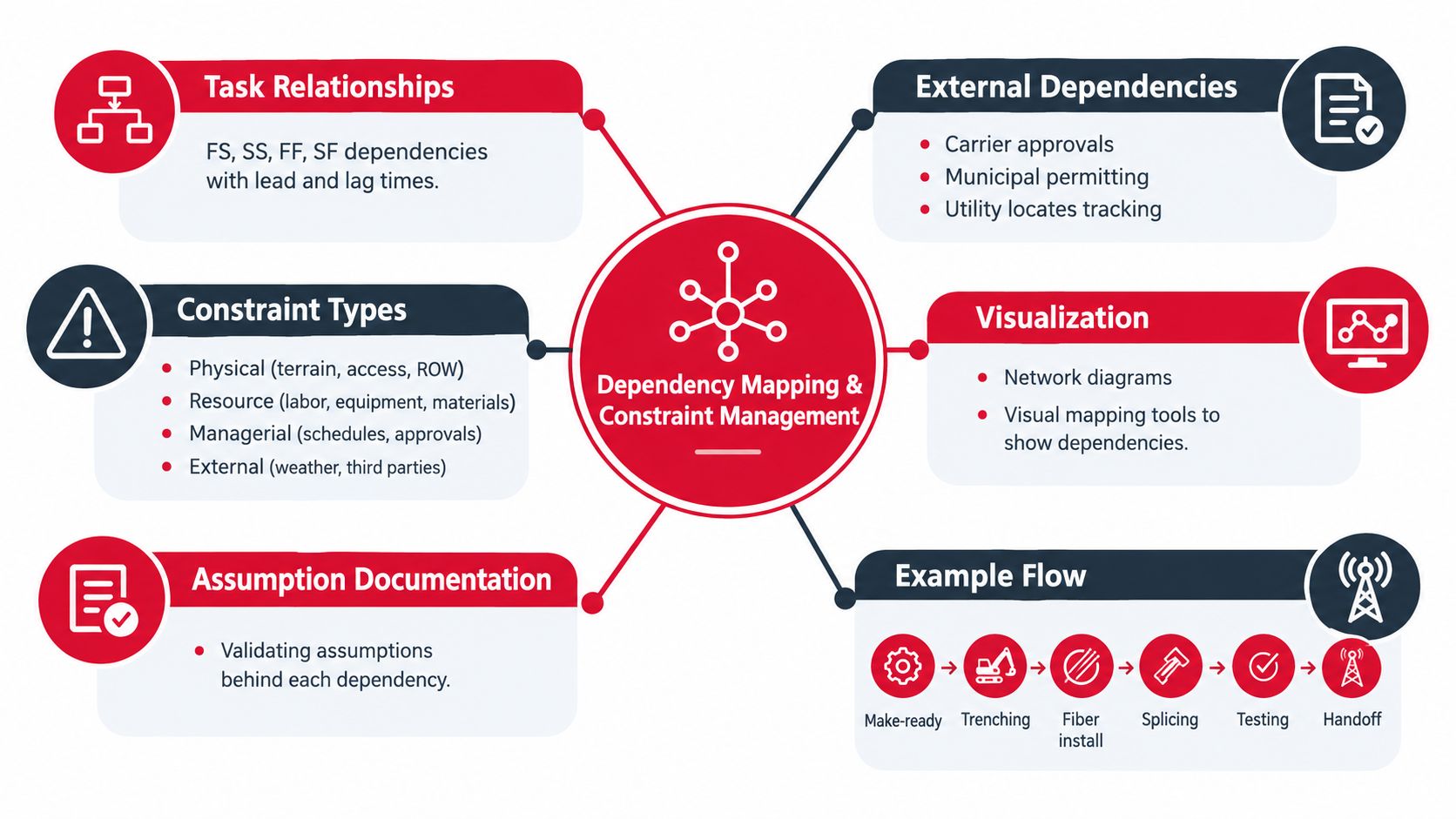
Review the map at kickoff and during execution. Field conditions, supplier dates, approvals, access windows, and customer requirements change. Update the dependency record when they do, then measure whether constraints are aging, clearing, or shifting the forecast finish. A static map cannot control a live telecom schedule.
6. Milestone-Based Scheduling and Gateway Reviews
A fiber crew can finish installation on plan while testing records, defect closures, or customer approvals remain open. The schedule may show high completion, yet the next phase cannot start safely or without rework. Milestones prevent that false progress by defining the outcomes that release work.
For a greenfield fiber build, gateways may cover route survey acceptance, make-ready completion, installation, splicing, testing, and documentation handoff. A data center schedule may move from design approval to power readiness, connectivity, cabling, testing, and operator acceptance. On a tower project, equipment delivery and installation do not release the site if RF testing or carrier activation is still unresolved.
Set each milestone around evidence and a decision. “Splicing complete” should identify assigned segments, test records, defect resolution, and required signoff. “Documentation complete” should specify the as-built package, redlines, asset records, and customer acceptance requirements. A date can forecast the gateway, but it cannot prove readiness.
Use the gateway to control the next commitment
Invite the owners of the next phase, including field supervision, testing, quality, permitting, and the customer where acceptance is required. Review the completed outcome, supporting evidence, open exceptions, and the effect of starting early. The review should produce one clear disposition:
- Proceed: Acceptance criteria are met, so the next phase can begin.
- Proceed with conditions: Remaining items have owners and due dates, and they do not compromise safety, quality, or the next activity.
- Hold or replan: Evidence is incomplete, a constraint remains, or starting would create unacceptable rework.
Record the decision in the schedule, along with the approver, conditions, and forecast impact. That record connects field execution to stakeholder commitments and gives project managers a measurable gateway health view. Track planned versus achieved dates, overdue acceptance items, reopened defects, and the age of conditions. These indicators show whether milestones are releasing work or merely reporting activity.
Objective gateways also support customer updates and invoicing. Carriers, ISPs, municipalities, and data center operators receive a concise progress view without interpreting every task.
Keep the set small and consequential. In a multi-site program, one site may reach acceptance while another remains blocked. Preserve that distinction instead of averaging both into an uninformative status.
7. Rolling Wave Planning and Progressive Elaboration
Telecom projects often begin with uncertainty that cannot be eliminated through more spreadsheet detail. Permitting durations, field conditions, carrier requirements, utility coordination, and site access may remain uncertain until earlier work produces better information.
Rolling wave planning accepts that reality without abandoning control. The near-term work gets detailed enough for crews to execute, while later phases remain at a higher level until their assumptions can be tested. As the project advances, the next wave becomes the execution plan.
A fiber program might detail design and make-ready work while keeping later installation and splicing at a work-package level. A data center team may detail rough-in activities while holding later cabling and acceptance at a higher level until infrastructure readiness is confirmed. A tower program can detail the current site and keep upcoming sites structured around known approvals, equipment, access, and installation assumptions.
Detail the work that can be known
Create a regular planning cycle. Review the next execution wave with engineering, permitting, procurement, field supervisors, testing teams, and the customer. Confirm the activities, logic, resources, constraints, acceptance criteria, and risks that are now knowable.
Keep a live assumptions register. When an assumption is invalidated, record the impact and update the future wave. This prevents the team from carrying obsolete dates into the next planning cycle.
Rolling wave planning has a trade-off. It can improve realism, but stakeholders may worry that later dates aren't firm. Explain which dates are committed, which are forecast, and what information will convert a forecast into a committed plan. That distinction builds trust more effectively than presenting false precision.
Don't let a delay in the current phase automatically push the next planning cycle forward. Decide whether to resequence work, change scope, add capacity, or reset the commitment. Planning must continue even while recovery decisions are being made.
Use milestone gateways to trigger progressive elaboration. Once a route survey, design package, or infrastructure phase reaches an accepted state, the team should have enough information to detail the next wave.
8. Crew Scheduling and Labor Planning Optimization
Crew scheduling is where a good network plan meets human capacity. The schedule must account for certifications, travel, fatigue, supervision, training, geography, and the sequence between installation and testing.
A fiber splicing crew may serve several builds across a region. A tower crew may need a carefully routed sequence because access equipment and travel consume meaningful capacity. A data center cabling team may have to meet strict site standards while moving between projects with changing readiness dates. A testing team scheduled too early will wait. Scheduled too late, it will create a commissioning backlog.
Create a skill matrix that identifies who can perform each activity and under which customer, safety, or technical requirements. Then connect that matrix to the program schedule so a task can't be considered resourced merely because a person's name appears on an assignment.
Plan capacity in layers
Use a rolling labor forecast that separates firm assignments from likely demand. Keep near-term assignments specific and later capacity at a planning level. Include travel time, equipment movement, training, certification renewal, safety meetings, and recovery between intense work periods.
The most important controls are practical:
- Protect geographic continuity: Keep crews in sensible regions where possible, while avoiding a sequence that traps a specialist far from the next critical site.
- Follow the handoff: Schedule testers, inspectors, and documenters behind installation with enough time to act on defects.
- Track overload and idle time: Repeated overload creates safety and quality risk, while repeated idle time signals weak readiness or poor sequencing.
- Build bench strength: Cross-training reduces dependence on one specialist and creates more recovery options when a crew becomes unavailable.
Schedule transparency matters to field teams. Crews need to understand priorities, access requirements, expected durations, and what evidence closes an activity. The field service scheduling guidance provides a useful reference point for coordinating assignments and operational information.
Southern Tier Resources can be relevant when a program needs telecom engineering, construction, testing, maintenance, or specialized field capacity through one partner. The decision should still be based on the work package, qualifications, availability, and acceptance requirements.
9. Schedule Compression and Acceleration Techniques
Acceleration should be a controlled response to a specific schedule threat, not a permanent management style. When a carrier commitment is at risk, the project manager can evaluate crashing, fast-tracking, scope phasing, prefabrication, or process improvement. Each option changes cost, risk, supervision needs, or quality exposure.
Crashing adds resources to a critical activity. A second splicing crew may help if the route is ready, work fronts are separable, equipment is available, and supervision can maintain quality. It won't help if the constraint is a permit, utility conflict, missing material, or a single testing window.
Fast-tracking overlaps activities that were previously sequential. Beginning cabling before every power activity is complete may shorten a data center fit-out, but only where access, safety, isolation, and rework controls are clear. Overlapping tower installation and RF testing may help in a controlled sequence, but only when the test team can work safely and the configuration is ready.
Compress the constraint, not the whole project
Before accelerating, ask what is driving the date and whether the date is mandatory. Then compare recovery options against their consequences:
- Add capacity: Check qualifications, supervision, equipment, workfront separation, travel, and material availability.
- Overlap phases: Document what could cause rework and define the hold points that prevent unsafe or premature work.
- Change sequence: Move unaffected sites or work packages forward rather than disrupting every activity.
- Phase scope: Protect the highest-value or most time-sensitive areas while formally documenting deferred work.
- Improve the method: Use standardized assemblies, prefabrication, clearer handoffs, or better staging where quality remains verifiable.
Never compress safety inspections, training, equipment checks, permits, testing integrity, or required documentation. A faster installation that produces failed tests, incomplete as-builts, or unsafe work is not schedule recovery. It's deferred schedule and cost exposure.
Communicate the acceleration plan with the carrier or customer. State the added resources, assumptions, risks, decision dates, and quality controls. After an intense recovery period, restore sustainable crew capacity instead of rolling the same strain into the next project.
10. Stakeholder-Driven Schedule Alignment and Communication
A schedule serves different audiences at the same time. Field supervisors need access dates, workfronts, constraints, and handoffs. Carriers and ISPs need milestone confidence and early warning. Municipalities and utilities need approval actions and coordination dates. Data center operators need readiness, testing, cutover, and acceptance information. Executives need decisions, exposure, and recovery choices.
Build a stakeholder map that records what each group needs, who provides it, how often it's updated, and which decisions require formal approval. One schedule can support all audiences, but the report should not be identical for everyone.
Report evidence, impact, and action
A useful weekly update explains what was planned, what was completed, what changed, why it changed, and what happens next. It should connect field evidence to the baseline. For fiber, that may include accepted route segments, splicing records, test results, restoration status, and documentation progress. For wireless, it may include site readiness, equipment installation, RF testing, and activation dependencies. For data centers, it may include power, connectivity, cabling, testing, and operator acceptance.
When a date slips, present three things:
- The problem: Identify the permit, material, crew, utility, access, quality, or customer constraint.
- The impact: Explain which activities, milestones, resources, and commitments are affected.
- The proposal: Give the recovery action, decision owner, required date, cost or risk implication, and remaining uncertainty.
Use separate views for field teams, project controls, customers, and executives. Keep the underlying logic consistent so a polished dashboard doesn't contradict the detailed schedule.
Report the decision the stakeholder needs to make, not only the status they need to read.
Document approvals, assumptions, commitments, and changes. A shared schedule becomes a coordination instrument when everyone can see the same dependencies and understand who owns the next action. It becomes a liability when updates are subjective, late, or disconnected from evidence.
10-Point Schedule Management Comparison
| Approach | Implementation Complexity 🔄 | Resource Requirements ⚡ | Expected Outcomes 📊 | Ideal Use Cases 💡 | Key Advantages ⭐ |
|---|---|---|---|---|---|
| Critical Path Method (CPM) for Project Sequencing | Medium–High 🔄, detailed task breakdown & monitoring | Moderate ⚡, PM software, schedulers, task estimates | Clear critical tasks; fewer delays; improved on‑time delivery 📊 ⭐⭐⭐⭐ | Multi‑phase fiber builds, tower construction, data center fit‑outs | Prioritizes work that impacts finish date; enables resource leveling |
| Resource‑Constrained Scheduling | High 🔄, complex multi‑project resource modeling | High ⚡, resource database, crew/productivity data, tools | Realistic timelines; balanced utilization; fewer conflicts 📊 ⭐⭐⭐⭐ | Concurrent projects with limited skilled crews or equipment | Prevents over‑allocation; improves equipment and crew utilization |
| Buffer Management & Risk‑Based Scheduling | Medium 🔄, risk sizing and governance required | Low–Moderate ⚡, historical data, risk workshops | Greater schedule reliability; protected completion date 📊 ⭐⭐⭐⭐ | Projects with weather, permitting, or field uncertainty | Strategic buffers reduce cascade of delays; improves predictability |
| Integrated Schedule & Budget Management (EVM) | High 🔄, strict baselines and disciplined reporting | High ⚡, cost tracking systems, trained staff, WBS costing | Objective progress metrics; early cost/schedule warnings 📊 ⭐⭐⭐⭐⭐ | Large material‑intensive projects; carrier/government contracts | Quantified SPI/CPI forecasting; data‑driven corrective actions |
| Dependency Mapping & Constraint Management | Medium–High 🔄, detailed dependency workshops | Moderate ⚡, stakeholder input, mapping/visual tools | Fewer surprises; better parallelization opportunities 📊 ⭐⭐⭐⭐ | Builds with many external approvals, suppliers, or utility dependencies | Identifies external bottlenecks and validates assumptions early |
| Milestone‑Based Scheduling & Gateway Reviews | Low–Moderate 🔄, define gates and criteria | Low ⚡, governance, stakeholder review cadence | Clear deliverables and decision points; simpler reporting 📊 ⭐⭐⭐ | Phased deployments and stakeholder‑funded projects | Simplifies communication, invoicing, and quality checkpoints |
| Rolling Wave Planning & Progressive Elaboration | Medium 🔄, continuous replanning cycles | Moderate ⚡, planning cadence, team time for elaboration | Flexible plans; reduced wasted effort; adaptable schedules 📊 ⭐⭐⭐ | Projects with early unknowns (permits, site conditions) | Plans near term in detail and refines future phases as info emerges |
| Crew Scheduling & Labor Planning Optimization | High 🔄, complex geographic & skill optimization | High ⚡, crew skill matrix, scheduling software, forecasting | Higher utilization; improved safety and morale; predictable delivery 📊 ⭐⭐⭐⭐ | Telecom firms with specialized crews across regions | Maximizes billable time, reduces travel/fatigue, supports safety culture |
| Schedule Compression & Acceleration Techniques | Medium 🔄, risk/cost trade‑off analysis required | Variable ⚡, extra crews, subcontracting, pre‑fab materials | Shorter durations but increased cost and risk if misapplied 📊 ⭐⭐⭐ | Time‑sensitive carrier requests or competitive rollouts | Enables fast delivery options (crash/fast‑track) when justified |
| Stakeholder‑Driven Schedule Alignment & Communication | Medium 🔄, stakeholder mapping & cadence setup | Low–Moderate ⚡, communication tools, governance, reporting | Fewer surprises; stronger trust and aligned expectations 📊 ⭐⭐⭐⭐ | Projects involving carriers, ISPs, municipalities, utilities | Improves coordination, accountability, and stakeholder confidence |
Turn the Schedule Into a Delivery Control System
Schedule management becomes valuable when it changes decisions before delay becomes unavoidable. The baseline should capture the work, assumptions, logic, resources, milestones, cost structure, and customer commitments. Once execution begins, the team should compare actual evidence with that baseline and explain every meaningful variance.
The operating cadence can stay practical:
- Baseline the work and record the assumptions behind each major date.
- Map internal and external dependencies, then assign every constraint an owner.
- Validate crew, equipment, access, testing, and supervision capacity before committing work.
- Protect risk buffers at permitting, construction, resource, and acceptance points.
- Review critical path movement, milestone evidence, resource conflicts, buffer consumption, and cost exposure weekly.
- Govern changes formally, including scope changes, resequencing, acceleration, and customer-approved date movement.
- Tailor reporting to field teams, carriers, municipalities, utilities, data center operators, finance, and executives.
The historical evidence supports this level of discipline. A 2022 analysis reported that 85.5% of large construction projects were delivered late, while 59.4% missed by at least two months and 13.4% were delayed by at least a year. The same source reported median delay of more than 200 days during the pandemic era, compared with roughly 100 days before the pandemic. Those figures come from construction data, not a guarantee about any individual telecom program, but they show why static schedule tracking is a weak defense against changing conditions. The analysis of construction project delays reinforces the value of frequent updates, dependency logic, and early variance detection.
Other schedule benchmarks point in the same direction. A large dataset of more than 70,000 programmes found that 76% finished later than the original baseline, while only 12% of baseline schedules met best-practice quality standards, as summarized by PMI's scheduling reference. A separate construction scheduling source reports that only 34% of organizations consistently deliver on time, with average schedule overruns of 46%, and associates structured scheduling techniques with about 40% better on-time delivery. Those external benchmarks shouldn't be copied into a telecom forecast without qualification, but they do make one point clear: schedule quality and delivery performance are connected. The project scheduling research summary provides that additional context.
Start with one active project. Audit its critical path, external constraints, crew plan, resource conflicts, buffers, milestone evidence, change history, and reporting rhythm. Then use the findings to improve the next planning cycle instead of trying to redesign the entire organization at once.
A reliable schedule protects more than the finish date. It supports safer work by reducing rushed mobilization, protects quality by preserving testing and documentation gates, controls cost by exposing inefficient sequence and resource use, and gives customers earlier choices when commitments are threatened. For carriers, ISPs, tower companies, municipalities, and data center operators, that transparency protects operational continuity as much as it protects project delivery.
Southern Tier Resources can fit this operating model as a telecom infrastructure partner supporting engineering, construction, fiber splicing, testing, documentation, data center fit-outs, wireless work, and maintenance. Its published company information describes support for wireline and wireless networks, data center infrastructure, carriers, ISPs, and technology partners across the project lifecycle. Use the same evaluation discipline for any partner: confirm scope, capacity, qualifications, schedule inputs, acceptance evidence, communication practices, and accountability before assigning critical work.
The best schedule isn't the one with the most lines or the most confident dates. It's the one that tells the team what must happen, what can block it, how much protection remains, who owns the next decision, and what evidence proves the work is ready to move forward.
Southern Tier Resources provides end-to-end telecom infrastructure services across fiber, wireless, tower, and data center projects, including engineering, construction, splicing, testing, documentation, and maintenance. Visit Southern Tier Resources to discuss how its field capabilities and project delivery support can strengthen your schedule control and execution plan.