Most telecom safety advice still talks like the job is a hard hat, a climb line, and a short PPE checklist. That framing is too small for how crews work now. The risk sits in joint-use corridors, fiber-heavy urban builds, data-center fit-outs, and energized telecom equipment where the failure usually comes from poor coordination, not a missing helmet.
The standards themselves have also changed shape. In the U.S., OSHA 29 CFR 1910.268 has been a compliance baseline since 1975, and it's been amended repeatedly over the years, which is a clear sign that telecom safety standards have kept moving as networks and work methods changed, instead of freezing in the 1970s OSHA's telecommunications standard history. At the equipment level, the conversation now runs through hazard-based safety, not just legacy component rules.
That shift matters to project managers and carrier operations leaders because the job is no longer just keeping people off the pole. It's making sure the work zone, the equipment design, the power environment, and the handoffs between contractors all fit the same safety logic. If those pieces don't line up, the site can be technically complete and still be operationally unsafe.
Why Telecom Safety Demands More Than Climbing Discipline
The common mistake is to treat telecom safety as a climbing problem. That view fit earlier work, when the hardest calls were pole access, ladder use, and fall protection. It falls apart on modern builds, where crews move through shared utility corridors, rooftop installs, underground paths, and equipment rooms with backup power.
The job changed before the paperwork caught up
Telecom crews now work across very different environments in one project. A field team may start with make-ready work, move into fiber placement, then hand off to another crew for splicing, testing, or a data-center tie-in. Every handoff creates a chance for hazard information to get lost, and that is where a lot of serious safety failures begin.
OSHA's telecommunications rule still focuses on approach distances, guarding, grounding, lighting, and handling fallen or crossed wires, which is the right baseline for field work OSHA 1910.268. The problem on active jobs is that those requirements now sit inside much broader project scopes, where a carrier, pole owner, utility, and subcontractor may each assume another party owns the same control point. That same coordination problem shows up in other regulated work, including the alignment of security system standards in Australia with site access and electrical interfaces.
Practical rule: if no one can say who controls the work zone, the job is not ready.
Good teams handle telecom safety like a working system, with clear handoffs, defined control points, and field checks that force the next crew to see the same hazard picture. Weak teams depend on memory, informal radio calls, and the hope that someone will catch the risk before anyone gets hurt.
The Layered Compliance Stack You Need to Know
Telecom safety standards form a layered stack. Field rules, equipment rules, and regional standards each do a different job, and the failure mode is usually a handoff problem. If you mix those layers together, you start asking the wrong authority to answer the wrong question.
Start with the field baseline
In the United States, OSHA 29 CFR 1910.268 sets the field baseline for telecommunications operations. It anchors line work, pole work, and related outdoor tasks, and its amendment history shows how the rule has been updated as the industry changed OSHA telecommunications standard. For field crews, that is the first reference point when the issue involves worker exposure, approach distances, guarding, or site handling.
Add the standards bodies that shape design and infrastructure
The standards picture reaches well beyond U.S. labor rules. ETSI started as a smaller standards body and grew into a major global system, with a long history of expanding telecom coverage as the industry broadened ETSI history. In the U.S., TIA has shaped structured cabling and data-center infrastructure, including ANSI/TIA-568 and TIA-942, which is a reminder that telecom safety and infrastructure consistency now sit close to reliability planning.
The equipment layer works differently again. ITU-T K.51 points to fire, electric shock, and injury as the main hazard classes for telecom network infrastructure equipment, and it references IEC 60950-1 and IEC 62368-1 as base safety standards ITU-T K.51. In practice, that means design review is a safety gate, not a paperwork check.
The same layering shows up outside telecom as well. The documentation on security system standards in Australia is a useful reminder that mature industries do not rely on one rulebook. They combine field, product, and operational requirements until responsibility lines are clear.
The practical test is simple. A climb or pole job points you back to OSHA. Hardware approval points you to IEC-based product safety. A carrier-grade deployment across multiple markets pulls in both the standards body and the local regulator, and the project team has to satisfy each one on its own terms.
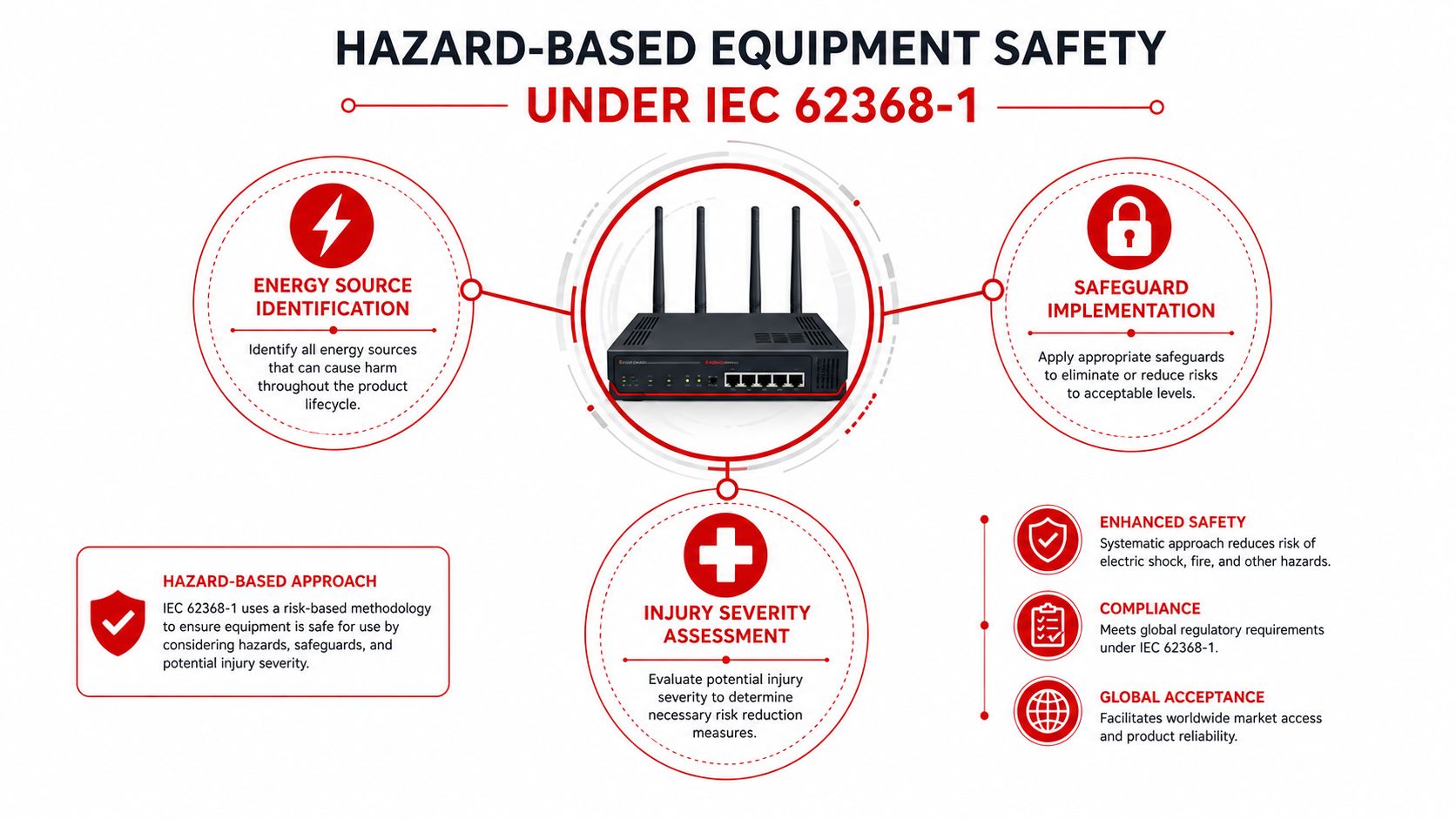
Hazard-Based Equipment Safety Under IEC 62368-1
The move from IEC 60950-1 to IEC 62368-1 changed how telecom equipment is reviewed. The older model relied on fixed categories. The newer one starts with hazards, which matters the moment you are looking at a power supply, a PoE device, a remote radio, or a battery-backed cabinet that behaves well on the bench but still leaves an accessible risk in the field.
Why hazard-based safety changes engineering decisions
Under IEC 62368-1, the review shifts from part classification to energy-source analysis, what energy exists, what a person can reach, and which safeguard keeps that energy from becoming an injury. That changes how engineers handle enclosure design, insulation, creepage, access controls, and power limiting. It also changes when safety needs to enter the design cycle, because safeguards added late rarely satisfy approval without rework.
Singapore's IMDA makes that concrete. It requires IEC 62368-1 compliance, at minimum Edition 2, for equipment designed for 50 V to 1000 V AC or 75 V to 1500 V DC IMDA equipment safety requirement. That puts common telecom power ranges directly inside the safety review scope.
A device can still pass functional testing and fail safety approval if accessible energy, thermal rise, or fault containment is not controlled.
Where K.51 fits in practice
ITU-T K.51 keeps the telecom equipment discussion anchored on fire, electric shock, and injury. Telecom networks are not generic consumer electronics, and carrier, ISP, and data-center equipment often brings service access, remote power behavior, and maintainability demands that need more than the base IEC rules.
The trade-off is straightforward. Hazard-based standards give design teams room to solve the core problem, but they also remove the comfort of checkbox compliance. If the engineering team does not understand the hazard model, the product can look fine in review and still get held up in the field.
For teams coordinating field rollout, the same discipline applies beyond product approval. A practical community engagement approach for shared worksites helps avoid the kind of confusion that turns a clean design into a messy deployment.
Joint-Use Worksites and Multi-Party Coordination
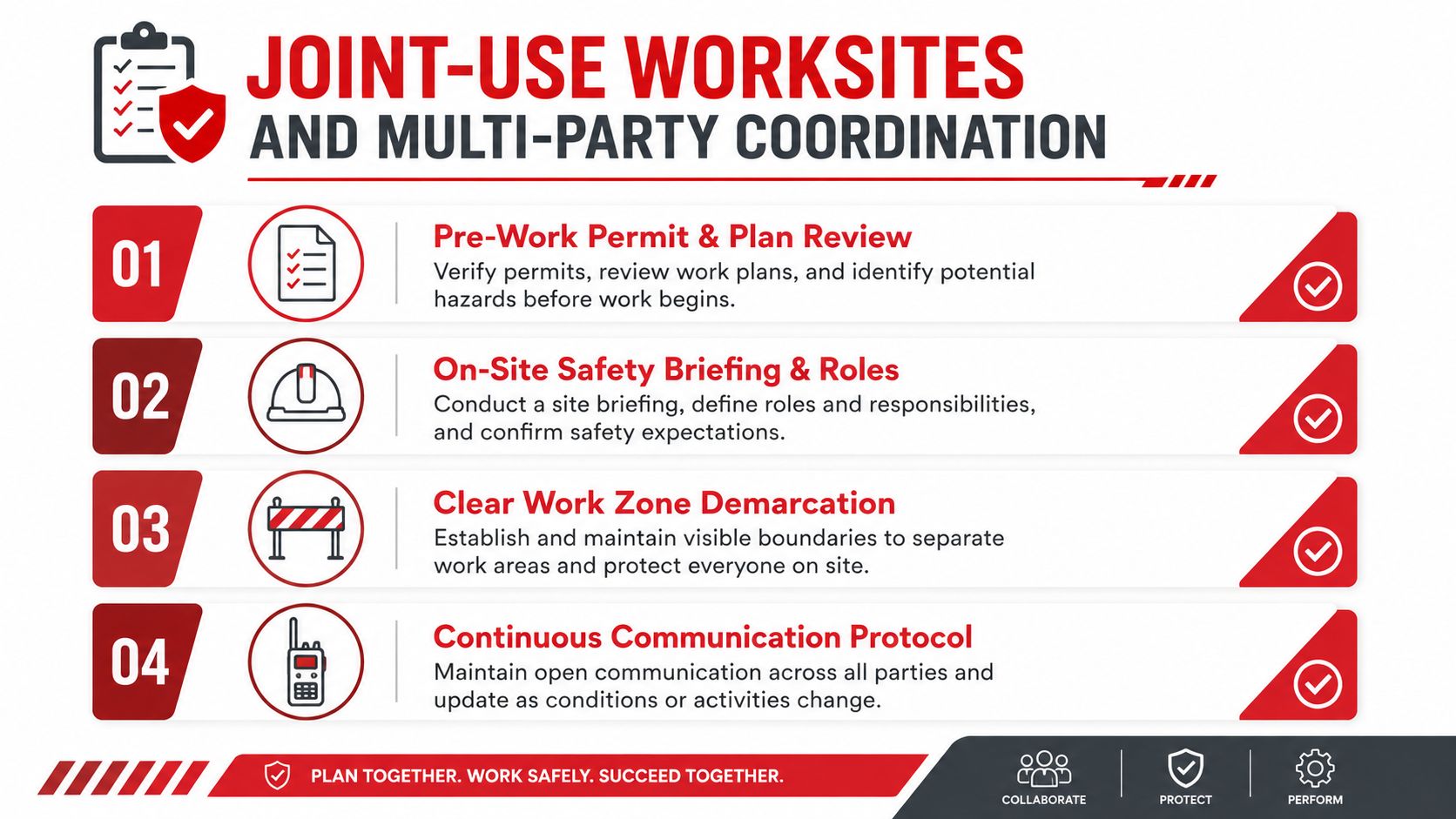
Joint-use sites are where telecom safety standards become difficult in practice. A shared pole or conduit does more than add hardware to a job. It creates overlapping authority, and that is where crews lose time, miss handoffs, and make avoidable mistakes. The carrier may own the schedule, the pole owner may control access, the electric utility may control clearance rules, and the subcontractor may be the one physically touching the plant.
Why the standards alone don't solve the site
OSHA still focuses on approach distances, guarding, grounding, lighting, and handling fallen or crossed wires. That baseline matters, but it does not settle the coordination questions that drive most problems on modern broadband builds in joint-use corridors. Who gives the hazard notification, who confirms qualification, and who stops the job if the scope changes in the middle of the shift?
That gap is where incidents happen. The rules can be detailed, and the work still falls apart when the site is treated like a set of separate tasks instead of one controlled job. A crew that starts in construction scope and ends the day in maintenance scope can lose control if handoffs are not documented and the supervisor does not re-brief the crew.
A field checklist that actually holds up
Use a simple sequence every time the site is shared:
- Pre-work permit review, confirm the scope, owners, and access permissions before anyone rolls a truck.
- Qualification verification, make sure each worker is cleared for the task and the location.
- Hazard notification, push clear information to every party touching the pole, conduit, rooftop, or right-of-way.
- Work zone control, define barriers, clearances, and stop-work authority before tools come out.
- Shift handoff, re-brief when the scope changes or a new crew arrives.
The missing piece in many public explanations is accountability. A checklist helps only if one person owns the site decisions from start to finish. For a useful operational parallel on community-facing coordination, the approach outlined in community engagement strategies shows the same principle, clear ownership prevents confusion.
Fiber, Data Centers, and Modern Power Environments
The old story says telecom safety is mostly about towers and poles. That misses the work filling a large share of current schedules. Fiber routes, underground builds, UPS rooms, low-voltage power gear, and battery installations bring hazards that look more like electrical and civil work than classic climbing work.
New infrastructure means new hazards
The IFC guidance for telecommunications explicitly covers fiber-optic cables, underground cable identification before excavation, grounding of masts or towers, and strict de-energizing procedures. That matters because fiber-heavy urban builds often look harmless until a crew cuts into the wrong route or enters a space that was not properly identified.
India's TEC expanded telecom equipment safety coverage in 2024 to include radio-communication equipment, uninterruptible power systems, low-voltage switch-mode power supplies, and secondary batteries or battery installations. That is a clear signal that telecom safety now reaches deep into energized rooms and backup power environments.
Why this changes project planning
A data-center fit-out does not fail because someone missed a tower-climbing rule. It fails when power distribution, cabling, labeling, and maintenance access were not planned together. The same problem shows up on fiber builds that cross underground utilities or enter dense campus environments, where excavation control and route identification matter as much as the cable install itself.
If you are managing these scopes, treat the job as a blended civil, electrical, and infrastructure project. The safety plan has to cover what is under the ground, what is inside the room, and what is still connected to live services. For a practical look at how those room-level systems are organized, the overview of data center power distribution systems fits this broader safety model.
How an Infrastructure Partner Operationalizes Safety
Standards only matter when someone turns them into daily behavior. A telecom infrastructure partner earns trust by making safety part of design reviews, crew qualification, testing, documentation, and maintenance, not by treating it as a separate policy binder nobody opens in the field.
What real operational control looks like
The strongest delivery models keep one accountable team across the lifecycle. That reduces the handoff loss that happens when design, permitting, construction, and maintenance sit with different vendors. It also makes as-built documentation more reliable, because the people who built the network are often the same people who have to maintain it later.
Training matters just as much. Crews need documented qualification for fiber splicing, tower work, testing, and inspection, and that training has to be current enough to matter in the field. Audit routines matter too, because a safety program that never gets checked tends to drift into habit rather than discipline.
Safety becomes real when the crew, the paperwork, and the field condition all tell the same story.
A partner with a strong operational model also communicates clearly with carriers and ISPs when conditions change. That transparency is what keeps a minor site issue from becoming a bigger outage or a stop-work event. If a vendor can't describe how it handles the lifecycle from design through maintenance, the safety program probably isn't mature enough either.
For readers comparing delivery models, the work profile described under utility contracting companies is a good proxy for how broad the coordination burden gets on real network builds.
Common Pitfalls and a Safety-First Checklist
The failures that catch teams off guard usually look mundane at the start. A crew shows up with outdated lockout/tagout habits. As-builts lag behind the field. A subcontractor assumes the utility already cleared the hazard. Nobody revalidates who's qualified after the scope changes.
The mistakes that matter most
The first problem is stale documentation. If the as-built record doesn't match the plant, the next crew is making decisions in the dark. The second problem is mixed qualification levels on the same site, because a worker who's fine for one scope may not be cleared for another.
The third problem is weak post-job learning. Crews see the same near miss twice when nobody writes down what changed and what to do differently next time. That's where a safety program loses credibility.
Use this checklist before the next project starts:
- Review design and permit documents, confirm the scope matches the site plan.
- Verify equipment approval, check that the hardware safety basis fits the power and environment.
- Run a pre-construction hazard analysis, especially for shared corridors and energized rooms.
- Confirm crew qualifications, don't assume a worker cleared for one task is cleared for all tasks.
- Inspect the site audit trail, make sure changes are documented before handoff.
- Close the loop after incidents or near misses, update the method, not just the report.
The best telecom safety standards program is the one the field can run under pressure. If the checklist depends on perfect conditions, it won't survive the first schedule squeeze.
Southern Tier Resources helps carriers, ISPs, data center operators, and network teams turn telecom safety standards into field-ready execution across design, construction, testing, and maintenance. If you need a partner that treats coordination, documentation, and crew accountability as part of the work itself, visit Southern Tier Resources and see how a single accountable team can support safer network delivery.