Popular advice about next edge networks usually starts in the wrong place. It talks about orchestration, workload placement, and latency as if the network is a software toggle, when the project often stalls on power, fiber, make-ready work, access agreements, and permitting. If the utility can't deliver capacity, the municipality won't approve the route, or the site can't physically host the gear, the elegant architecture diagram doesn't matter.
That's why the practitioners who ship edge builds tend to think like construction managers as much as network engineers. They look at where the plant can be built, how the fiber will reach it, what the utility will allow, and how the site will be maintained after turn-up. The software layer matters, but it sits on top of a much harder physical system.
Why Next Edge Networks Are a Physical Infrastructure Problem
The biggest misconception about next edge networks is that latency is mainly solved in software. In real deployments, latency is often blocked by things no optimizer can hide, like a bad fiber path, an underpowered facility, a slow make-ready cycle, or a site that isn't ready for construction.
The network starts with the ground work
A build team can't place edge capacity where the land, power, and access don't support it. That means the first questions are usually operational, not digital. Can the site be reached safely. Is there room for cabinets, radios, or shelter equipment. Can the utility provide the load the design needs. Those answers determine whether the project is viable long before anyone tunes traffic engineering.
The physical side gets even more important in municipal and roadside environments, where crews need coordination with property owners, utility companies, and permitting offices. Delays there don't just move schedules, they change cost and sometimes force a redesign. For a practical view of the heavy civil work that often sits underneath telecom builds, heavy civil construction is a better mental model than a cloud dashboard.
Practical rule: if the site can't support power, access, and fiber on day one, the edge strategy isn't mature enough yet.
Why construction realities decide performance
Edge performance depends on the path the signal takes in the physical world. Shorter paths help, but they don't compensate for poor make-ready, weak backhaul, or a site that was rushed into service before documentation and acceptance testing were complete. That's why teams that plan the physical layer first usually get more predictable turn-up and fewer surprises in operations.
The engineering lesson is simple. Treat edge as an infrastructure program with software on top, not as a software program that happens to need hardware. The projects that fail usually fail at the handoff points, between design and field work, or between field work and operations.
Understanding Next Edge Network Architecture
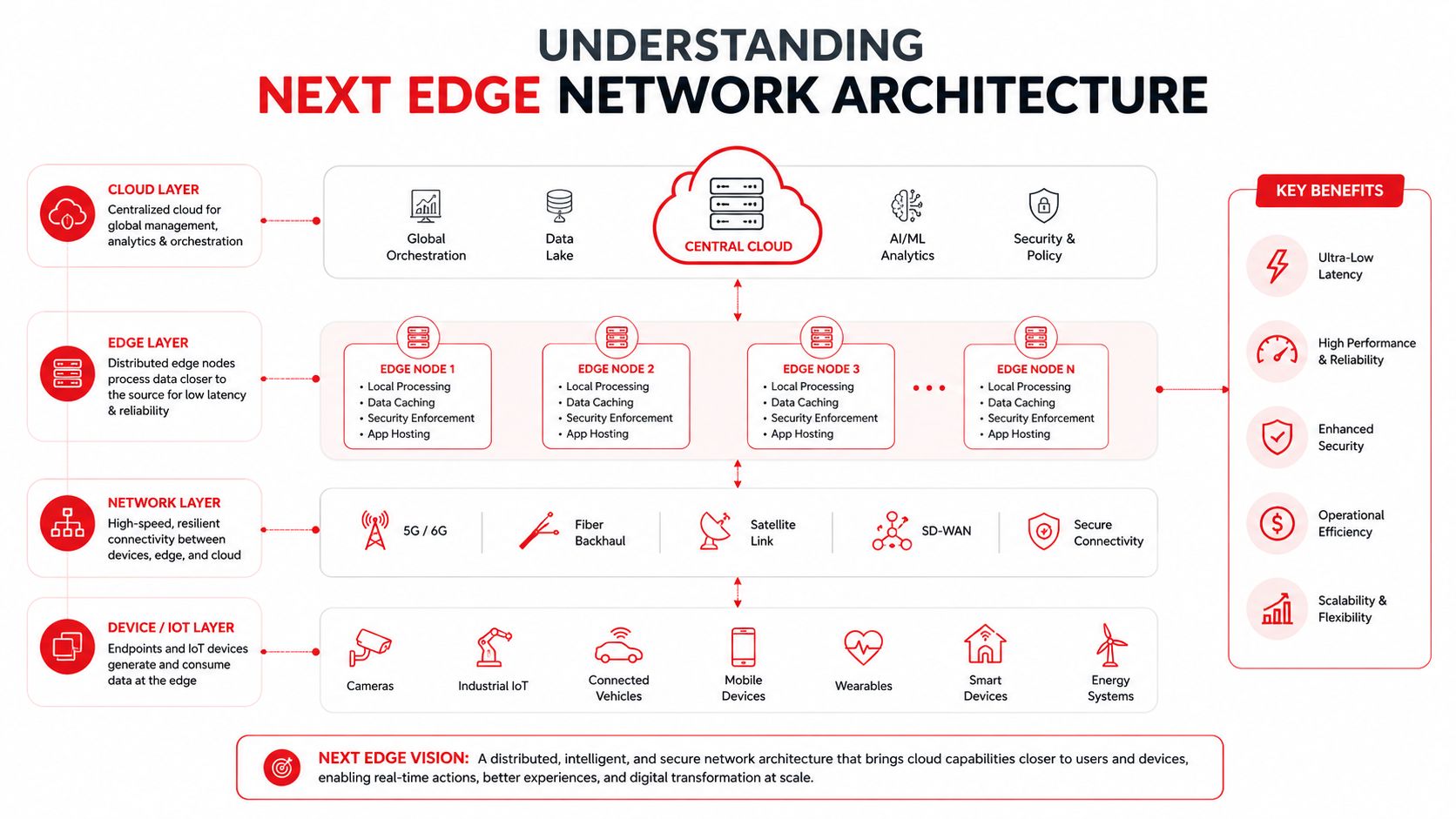
At a practical level, next edge networks are about putting the right functions in the right place. A core data center handles heavy centralized processing, a regional point of presence trims distance, a telecom edge site brings compute closer to the radio or the user, and an enterprise edge location keeps local workloads close to the business that needs them.
Layering the architecture
Think of the architecture like a distribution chain. The core is the big warehouse, the regional PoP is the local depot, and the edge site is the service counter that needs fast response and a narrow operating footprint. A CDN edge can cache and deliver content efficiently, but a MEC site or private 5G edge is where local decision-making happens for applications that can't wait on a faraway data center.
That distinction matters because not every workload belongs at the same layer. Content delivery, enterprise applications, industrial control, and device coordination have different tolerance for delay, jitter, and local autonomy. A good design doesn't just push everything closer to the user, it places each function where the operating model can support it.
If you want a compact reference for how modular infrastructure can be packaged and deployed, the data center in container guide is useful context for thinking about footprint, power, and deployment constraints.
Fronthaul, midhaul, and backhaul
The transport paths matter as much as the compute layer. Fronthaul connects radio-adjacent elements, midhaul links intermediate functions, and backhaul carries traffic deeper into the network. Once you separate those paths mentally, it becomes easier to see why edge is not just “closer compute”, it's a transport design problem with very different timing and resilience needs.
Teams that compare edge options should also look at fiber topology early. Fiber optic network design is where the architecture becomes real, because route diversity, splice strategy, and serviceability shape what the edge can deliver.
What the layers do in practice
A CDN edge is usually about efficiency and reach. A telecom edge is about local transport and service quality. An enterprise edge is about control, data locality, and application response. The wrong move is to treat them as interchangeable, because each one solves a different problem and carries a different cost profile.
The distinction becomes clearer when you map the workload to the site. A containerized or modular environment can help when space is limited or deployment speed matters, but only if the power and fiber ecosystem around it is already settled. Otherwise, the “portable” solution just moves the bottleneck somewhere else.
A helpful way to frame it is this, the architecture is not one edge, it's a chain of decision points. Each one either reduces distance and risk, or adds another place for failure.
Where a modular build helps
A modular deployment can make sense when teams need a compact footprint, a controlled environment, or a staged rollout. That's why infrastructure buyers often compare edge rooms, containerized builds, and traditional facilities before committing to a site pattern. The right answer usually depends on site access, cooling strategy, and how much operational control the owner wants to keep on premises.
Latency Budgets and Transport Requirements
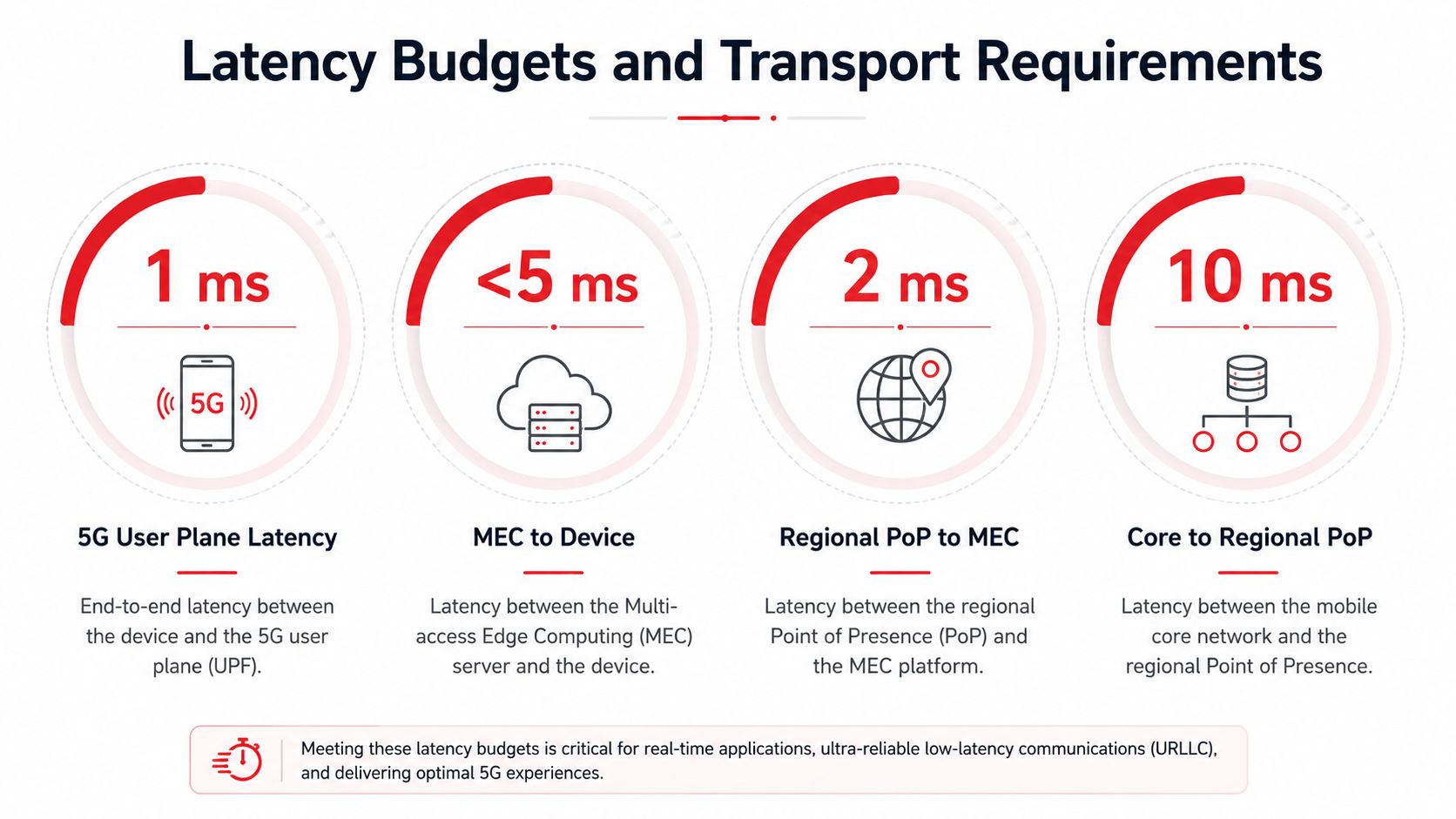
5G transport guidance from 5G Americas makes the engineering reality clear. It calls for 1 ns PTP timestamp accuracy targets for 4G and 5G timing, and it maps typical latency budgets to roughly <5 ms for the last-mile network, ~1 to 5 ms for access, ~5 to 20 ms for edge computing, with an overall need of <20 ms for many edge use cases (5G Americas edge white paper).
Timing matters more than raw bandwidth
Bandwidth headlines get attention, but edge applications usually fail on timing before they fail on throughput. Packet delay variation, synchronization error, and uneven path quality can break AR/VR, industrial control, and MEC workloads even when the pipe looks wide enough on paper. That's why a clean transport design beats a bigger one with poor timing discipline.
The practical implication is straightforward. Engineers need synchronized transport, short physical paths, and QoS isolation. If those pieces are missing, the edge site may be geographically close but operationally too noisy to support the workload.
What changes in the design
A transport network for edge needs tighter control than a traditional best-effort extension of the core. That means disciplined timing, fewer unnecessary hops, and strong separation between traffic classes that compete for the same resources. It also means field teams need to validate the path, not just the equipment, because the route itself can undermine the latency budget.
Engineering takeaway: if jitter and timing drift aren't measured during acceptance, they'll show up later as application complaints.
For teams comparing performance targets and service levels, performance benchmarking is a better planning discipline than chasing a single headline latency number.
Why edge isn't just a faster core
The edge is not a mini core network with a shorter name. It has to behave predictably under local constraints, often with fewer redundant paths and more limited physical options than a central facility. That's why latency budgets need to be translated into construction decisions, not just turned into design slides.
In practice, the winning designs are the ones that connect timing, routing, and site layout early. When those three are aligned, the network behaves like a system. When they aren't, each layer works against the others.
Choosing the Right Edge Layer for Your Workloads
The architectural question isn't whether to build edge. It's where the workload belongs. Some applications need a CDN or regional PoP, some need a MEC site, and some only make sense at a private 5G location close to the process or device that generates the traffic.
A decision matrix that reflects how teams actually buy edge
| Workload Type | Latency Requirement | Optimal Edge Layer | Primary Use Case |
|---|---|---|---|
| Video delivery and static content | Moderate, but tolerant of caching delay | CDN or regional PoP | Faster content reach and reduced backbone load |
| Enterprise applications with regional users | Lower than centralized hosting, but not ultra-tight | Regional PoP | Shared application access and traffic offload |
| Industrial control and local automation | Tight and deterministic | MEC or private 5G site | Local decision-making and process responsiveness |
| Remote operations in weak terrestrial areas | Coverage resilience and service continuity | Distributed edge with resilient transport | Keep services alive where core reach is limited |
The strongest use case isn't always the fastest one
Independent research on multi-access edge computing over non-terrestrial networks frames edge as especially valuable for remote areas, disaster recovery, and places where terrestrial infrastructure is weak or unavailable (MECON review). That points to a business case built on coverage resilience, not just raw latency.
That matters because many buyers overfund speed and underfund continuity. If a site can't survive a terrestrial outage, or if the network can't be maintained where it's deployed, low latency alone doesn't create a usable service. The edge layer should match the operational problem, not the marketing slogan.
Trade-offs that should guide the choice
CDN and PoP layers are usually easier to scale and maintain. MEC and private sites offer more control and faster local response, but they also raise the burden on power, access, and operations. In underserved markets, the deployment challenge is often not demand creation, it's building something supportable in the first place.
Practical rule: fund the shallowest edge layer that solves the workload, then move deeper only when the application proves it needs more control.
Commercial providers keep expanding into regions that traditional cloud and CDN platforms have overlooked, including Africa, Central Asia, Southeast Asia, and the Middle East. That pattern says less about a universal latency race and more about the economics of serving hard-to-reach places.
Practical Deployment Considerations
A clean edge design can still fail if the deployment sequence is wrong. Site acquisition, utility coordination, fiber access, small cell installation, and make-ready work all have to line up, and they rarely line up without active management from the owner and the field teams.
Start with the site, not the equipment
The first pass should answer basic feasibility questions. Can the location support the footprint. Is there a clear path for utility service. Will the property owner sign the right access terms. Are there construction restrictions that will slow the build. Those answers matter before procurement, because they drive both schedule and scope.
Next comes power provisioning. Edge sites are only useful if the power plant is stable enough for the equipment and the operating profile. Redundancy, grounding, and utility coordination all need to be settled early, not after cabinets are delivered. Fiber connectivity then has to be confirmed in a way that reflects the actual path, not a simplified drawing.
Make-ready is where many projects slip
Make-ready work is where schedules get exposed. Pole attachments, conduit work, underground access, and relocation tasks can all create dependencies that are outside the network team's direct control. That's why detailed field notes, photos, and as-built records matter so much after commissioning, because the next crew needs to understand what was built.
For teams that need a practical reference on cabling discipline, low voltage cabling advice from Access Electrical and Lighting is a useful complement to the broader telecom build process.
Operational insight: if the as-built package is weak, the maintenance team inherits the same confusion the construction team had.
Sequence and testing
A solid sequence usually looks like this, even if the site type changes.
- Site acquisition: confirm access, rights, and construction feasibility before committing equipment or labor.
- Power provisioning: verify utility readiness, backup strategy, and grounding requirements before installation.
- Fiber connectivity: validate route, handoff, and serviceability so the edge node has a reliable transport path.
- Small cell installation: place and align the radio or edge equipment after the physical plant is stable.
- Site make-ready: finish acceptance work, labeling, and documentation so operations can support the site cleanly.
Testing should check more than whether traffic passes. It should verify timing behavior, path stability, and whether the site can be maintained without improvised workarounds. That's the difference between a build that turns up and a build that can be operated.
Real-World Use Cases and Performance Tradeoffs
Industrial automation is where edge value becomes obvious fast. A plant floor doesn't need a generic cloud extension, it needs predictable local behavior, tight control over timing, and transport that keeps working when conditions change. The trade-off is that the closer the compute gets to the process, the more responsibility the operator takes on for site support and lifecycle maintenance.
Industrial IoT and control environments
In industrial IoT, the strongest edge designs keep decision-making local and use the wider network for coordination, reporting, and model updates. That reduces sensitivity to backhaul variability and helps the operator preserve control during intermittent connectivity. The downside is obvious, the site now depends on local power quality, local physical security, and disciplined maintenance.
AR, VR, and user-facing experiences
For AR and VR, the benefit of edge is consistency, not just raw speed. If timing fluctuates, the experience feels unstable even when average latency looks acceptable. The best deployments keep the response chain short and isolate traffic so other services don't crowd the workload during busy periods.
That said, not every immersive application needs the deepest edge layer. Some are better served from a regional PoP, especially when the user base is broad and the economics of a per-site build don't close. Centralized architecture still wins when the service is tolerant of slightly longer paths and the cost of distributed operations would outweigh the user experience gain.
Underserved regions and resilience
In underserved markets, edge often works best as a resilience strategy. The goal is to place service closer to users where the main network is weak, incomplete, or fragile. That can improve continuity and local availability, but it also raises the importance of construction access, maintenance planning, and shared infrastructure.
The MIT research on next-generation networks points to the importance of edge sharing and pooled deployment models (MIT paper). That fits what operators see in the field, because a shared approach can make hard-to-serve locations more practical than a fully dedicated build. The trade-off is governance. Shared infrastructure needs clear ownership, clear operational responsibility, and a design that can survive real-world access constraints.
Migration Checklist and Implementation Support
A sensible migration starts with a hard inventory of what already exists. Teams need to assess current fiber paths, power capacity, site rights, and maintenance constraints before selecting an edge layer or vendor. That keeps the project from drifting into a design that looks elegant but doesn't fit the field reality.
A practical sequence
- Define scope. Decide which workloads need edge treatment and which ones can stay centralized.
- Assess infrastructure. Check power, fiber, access, and site readiness before committing to build.
- Select vendors. Compare partners on engineering depth, construction capability, and documentation discipline.
- Pilot and validate. Turn up one site or path, then test timing, throughput, and maintainability.
- Scale with controls. Expand only after operations can support the first deployment cleanly.
Southern Tier Resources supports edge projects across engineering, construction, fiber splicing, testing, and maintenance, so teams can keep one accountable partner across the lifecycle. That matters when the build spans permitting, utility coordination, make-ready work, and post-turn-up support, because handoffs are where a lot of schedules slip.
Final check: if the site can't be documented, maintained, and expanded, the migration isn't done yet.
If you're planning a next edge deployment, Southern Tier Resources can help you move from site review to construction, testing, and ongoing maintenance without juggling multiple contractors. Visit Southern Tier Resources to discuss engineering, fiber, wireless, and make-ready support for your next build.