Horizontal directional drilling is a three-stage trenchless method, pilot bore, reaming, and pullback, used to install conduit or pipe under roads, rivers, and crowded rights-of-way with only small entry and exit pits. The key consideration isn't whether HDD avoids digging, it's whether the crossing can be drilled safely, kept within tolerance, and delivered at a cost that makes sense for the build.
That's the situation many telecom teams are in tonight. The route is drawn, the crossing is fixed, and the sponsor wants to know whether HDD is the right call or a riskier way to buy time.
Horizontal Directional Drilling in Plain Language
A fiber planner usually meets HDD at a hard crossing, a four-lane arterial, a rail line, or a river where open-cut work would trigger too much disruption. In that moment, what is horizontal directional drilling becomes a practical question, not a textbook one. HDD is the method that lets crews place conduit or pipe underground with the surface exposed only at the start and finish points, which is why it's so common on roadway, river, and utility-crossing work.
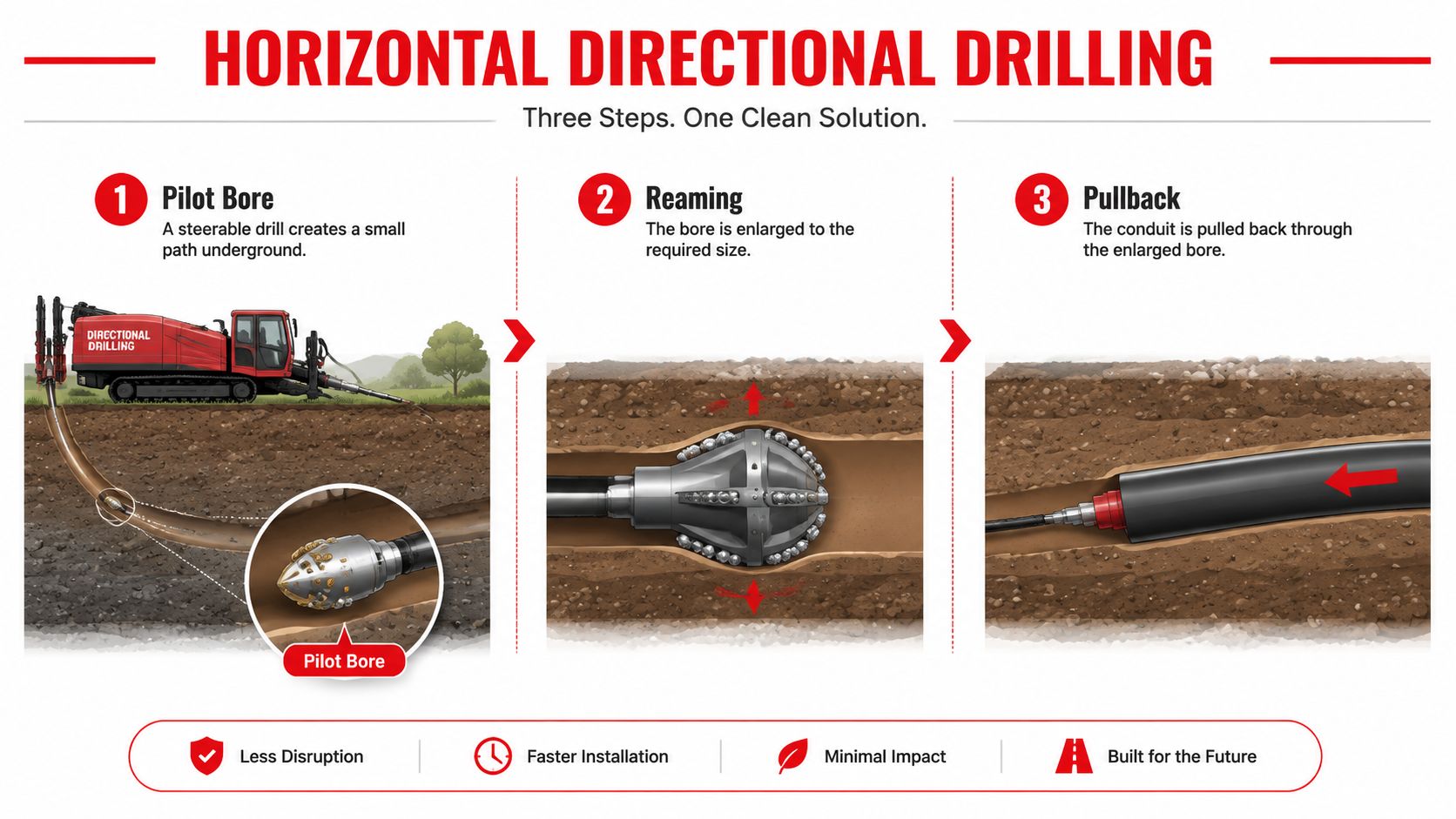
The simplest way to explain it to a city reviewer is this, a drill rig bores a guided path underground, the hole gets enlarged, and the conduit gets pulled into place. That three-stage sequence is the core technical difference from trenching, and it's what makes HDD a standard tool for congested corridors and rights-of-way where an open cut would be slow, disruptive, or both.
Practical rule: if the crossing has to stay live for traffic, utilities, or customers, HDD is often the first method worth studying, but it's not automatically the cheapest or safest option.
The part most overview pages skip is the decision gate. One question is whether the route can physically be drilled within the geometry, soil, and equipment limits. The other is whether HDD is the right method versus open cut, microtrenching, or another trenchless approach.
For a useful comparison on how HDD fits into broader sewer and utility repair thinking, a related reference on pipe burst sewer failure repair can help frame why trenchless methods get chosen when surface disruption matters.
How the Three-Stage HDD Process Actually Works
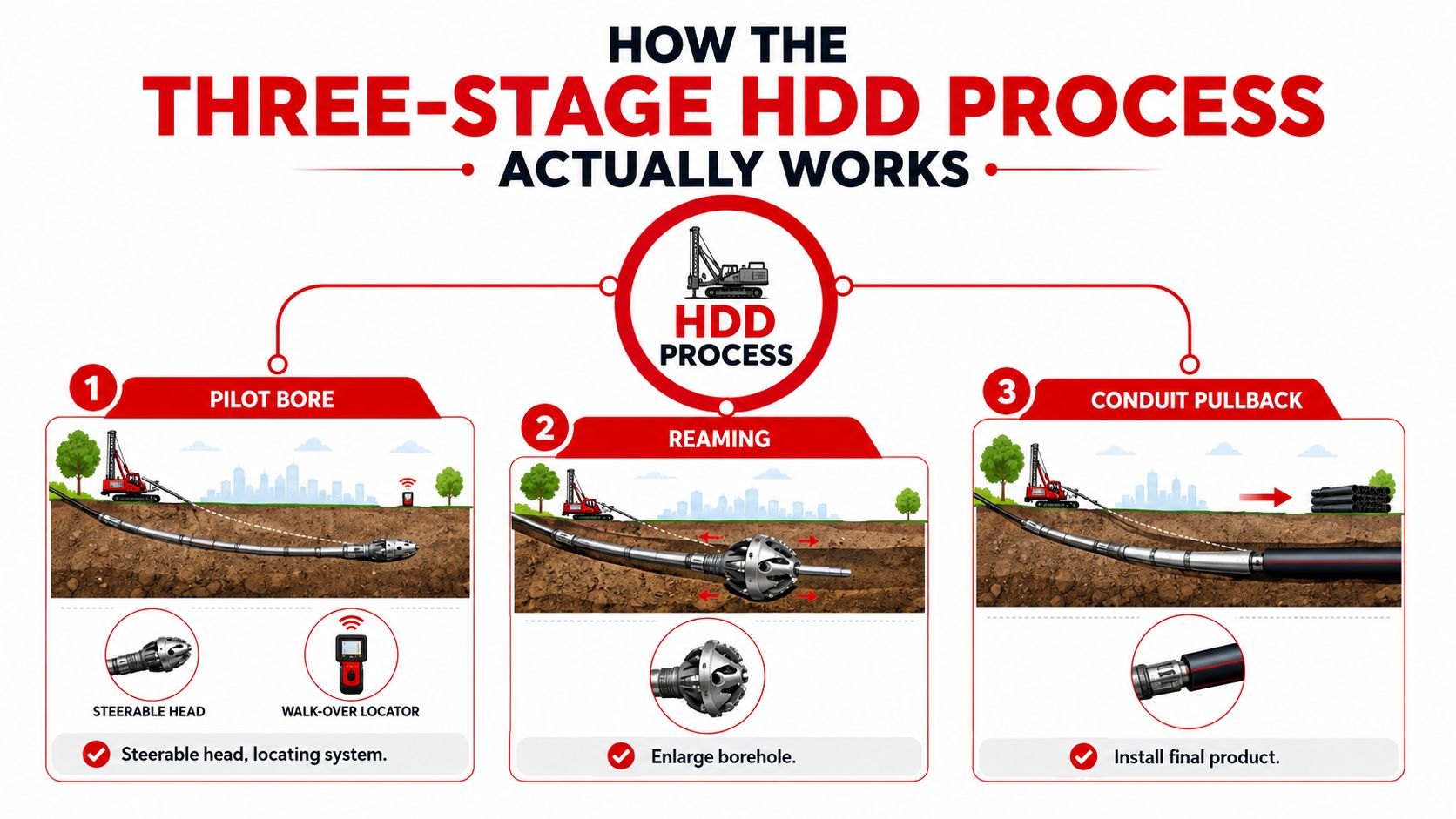
The work starts with the pilot bore, which is the controlled, steerable pass that sets the path underground. The drill head is tracked as it advances, and the operator uses the locating system to keep the bore on the designed alignment. If the pilot bore drifts, every later stage inherits that error, so discipline matters most.
Once the pilot hole is complete, the crew swaps to reaming. That's the enlargement pass, and it's where the bore gets opened enough for the product to fit without excessive friction. A common technical rule is to enlarge the bore to about 1.5 times the conduit diameter before pullback, which helps lower pullback load and reduces the chance of coating damage during installation. That margin matters more in sticky soils, long pulls, or runs with limited room for correction.
Then comes pullback, the part sponsors usually picture as the finish line. The conduit or pipe is attached behind the reamer or a swiveling pullhead, and the rig pulls the product through the stabilized bore. Done right, the pipe slides into a formed underground path with only the entry and exit pits disturbed at the surface.
A field crew thinks about these stages in terms of control, not just sequence:
- Pilot bore: establish direction, depth, and curvature.
- Reaming: stabilize the opening and manage cuttings with drilling fluid.
- Pullback: install the final product without overloading the pipe or coating.
The drilling fluid is part of the system, not an accessory. It cools the tooling, helps carry cuttings out, and keeps the bore from collapsing while the crew works through each pass. If fluid management is weak, the bore can become unstable and the whole installation starts getting expensive fast.
The source video below is useful for showing non-technical stakeholders how the pieces fit together, especially when the sponsor needs to visualize why the reaming pass is not optional.
Why Fiber, 5G, and Broadband Now Drive HDD Demand
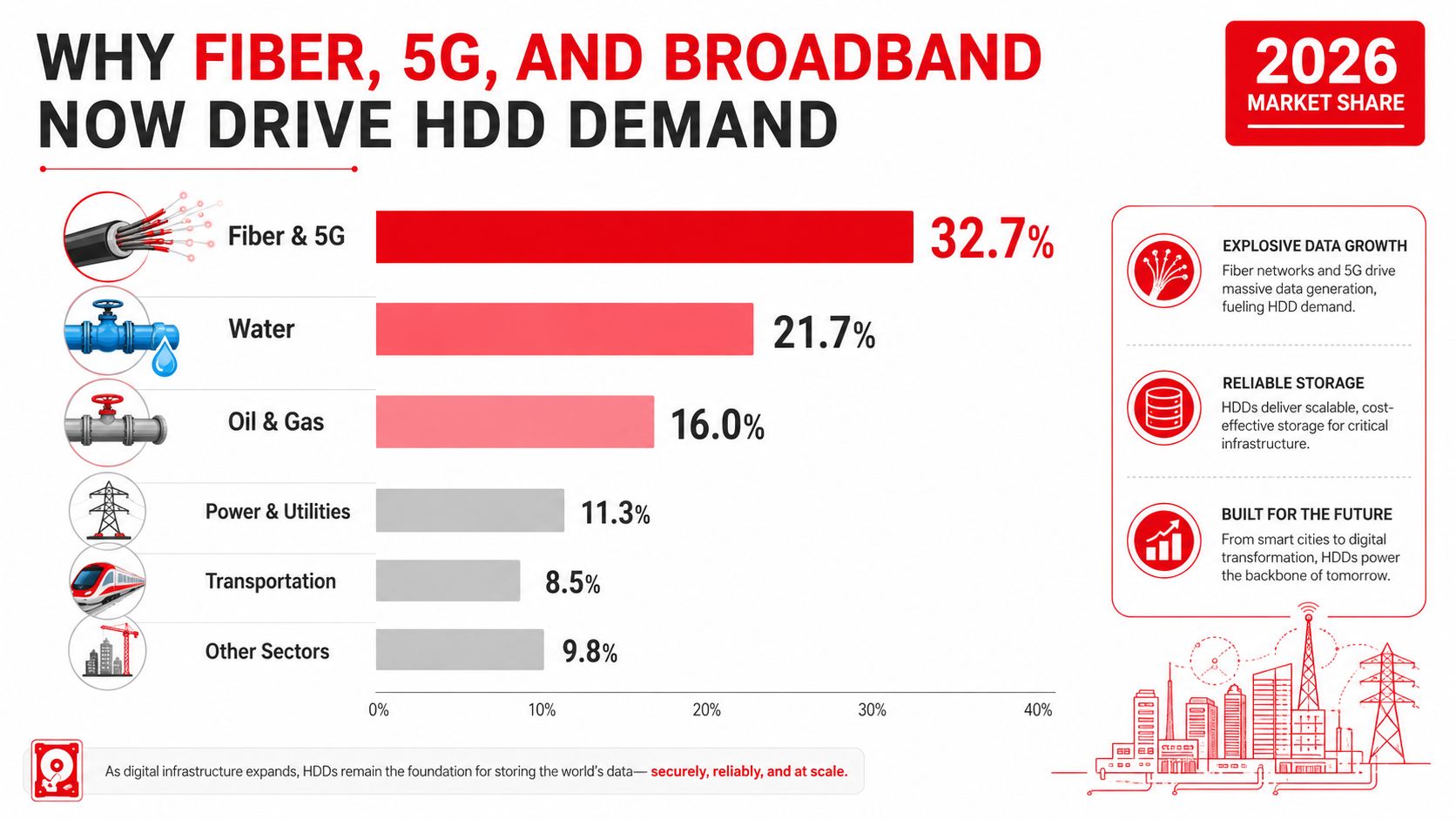
HDD used to be discussed like a niche utility technique. That's not the market reality anymore. In the 2026 survey data, fiber and 5G accounted for 32.7% of HDD market share, ahead of water at 21.7%, gas distribution at 16.0%, and electric work at 17.1%. For telecom sponsors, that means HDD isn't a specialty move on the edge of the business, it's central to how modern broadband gets placed.
The market scale reinforces that shift. Grand View Research estimates the HDD market at USD 8.18 billion in 2024 and projects USD 16.08 billion by 2030, which implies a 11.6% CAGR from 2025 to 2030. It also reports that North America held about 34% of global revenue in 2024, which matches what field teams already see, dense utility corridors, mature fiber markets, and a steady stream of crossing work where trenchless methods beat open cut on disruption.
That matters because carriers and ISPs aren't just buying a hole in the ground. They're buying a way to keep a build moving through traffic, business districts, and waterway crossings without tearing up every surface in sight. As a result, HDD has become a mainstream broadband construction method, not an exotic option reserved for unusual sites.
Decision-maker takeaway: if your route book is full of road crossings, service corridors, and utility conflicts, HDD is now one of the default methods the market is built around.
The equipment fleet tells the same story. The survey data says the world's rig manufacturers produced about 2,750 units in 2025, with sales forecast to rise to 2,877 units in 2026, a 4.3% increase. It also says 29.4% of active rigs were less than two years old, while rigs more than 10 years old made up 8.1% of the fleet. Modern rigs and newer tracking systems change what contractors can hold to in the field, which is why the feasibility conversation now starts with tolerance, not just distance.
For carriers comparing build partners, a useful internal reference on broadband telecom services helps show how HDD fits into a larger fiber deployment scope.
Equipment and Geometry That Decide If HDD Is Feasible
The jobsite usually includes more than a drill. A workable HDD spread needs the drill rig, the locator and tracking system, the reamers and downhole tools, a mixing or recycling system for drilling fluid, and the pipe handling gear to manage long product lengths without damage. The rig provides thrust and pullback force, while the locator keeps the operator aligned with the planned path underground. If either side is undersized for the crossing, the build starts losing margin before the first bore turns.
Geometry is the primary gatekeeper. HDD paths are curved, not straight, and the entry and exit angles have to work with the equipment and with the product pipe's bend tolerance. In practice, entry angles are commonly designed around 8° to 20°, and exit angles are often around 5° to 12°. Those numbers aren't decorative, they're part of the physical envelope that determines whether the crossing can be built at all.
The problem is that a route can look simple on a plan and still fail in the field. A short roadway crossing can be impossible if the required curvature is too tight, the setup space is too small, or the pipe's bend radius can't tolerate the arc. That's why a feasibility call should always include the alignment geometry, not just the distance and depth.
Rule of thumb: if the engineer can't show how the entry angle, curvature, and exit geometry stay inside the product pipe's bend limits, the crossing isn't ready for approval.
For larger builds, a contractor's approach matters. A solid team will talk about rig size, reamer choice, fluid flow, and tracking method in the same conversation as angle limits. A weak team will only talk about “getting under the road,” which is where schedule risk starts to hide.
The broader heavy-civil context also matters, especially when HDD is one piece of a larger corridor package. A useful reference on heavy civil construction can help frame how these crossings fit into roadwork, utilities, and restoration sequencing.
HDD Compared With Open Cut, Microtrenching, and Other Trenchless Methods
HDD is often chosen for one reason, it keeps the surface intact. That advantage is real, but it comes with trade-offs that project sponsors should see clearly before they commit. On simple greenfield runs, open cut or microtrenching can be faster and cheaper. On constrained crossings, HDD is usually the method that preserves the surface while still getting the conduit in place.
| Method | Best for | Surface disruption | Typical cost profile | Key risk |
|---|---|---|---|---|
| HDD | Road, rail, river, and congested utility crossings | Low at the surface, only pits exposed | Higher upfront than simple trenching | Bore instability, steering difficulty, fluid management |
| Open cut | Straightforward routes with easy access | High | Often lowest on simple runs | Traffic impact, restoration burden, service conflicts |
| Microtrenching | Shallow urban fiber placement along pavement edges | Moderate, localized pavement disturbance | Often efficient for short fiber routes | Depth limits, pavement restoration quality |
| Pipe ramming or auger boring | Short crossings where a casing or rigid path is acceptable | Low to moderate | Site-dependent | Limited steering and alignment flexibility |
The key difference is control. HDD can get around obstacles and stay out of the way of the public, but it introduces real operational risk. Bore instability, steering difficulty in certain soils, and the need for careful fluid management can turn a manageable crossing into a slow one if the crew doesn't control the job tightly.
That's also why HDD is the wrong choice on some builds. If the route is wide open, shallow, and simple to restore, trenching may be the cleanest answer. If the pavement edge is the only constraint and the conduit can stay shallow, microtrenching may make more sense. If the crossing is short and rigid alignment is acceptable, other trenchless methods can be better suited.
A practical estimating tool can help teams compare those paths before the field commitment hardens. For contractors and owners who want to sanity-check scope, Exayard construction estimating software is one of the tools that can be used to organize quantity, risk, and restoration assumptions without pretending every method costs the same.
Project Workflow and Permitting From Route Study to Restoration
A clean HDD job starts long before the rig shows up. The first pass is the route study and desktop survey, where the team checks the corridor, identifies crossings, and looks for obvious conflicts. After that comes the geotechnical investigation, because soil classification, groundwater, and cobble or rock risk change both the method and the price. If the subsurface is misunderstood, the bore plan becomes guesswork.
The permit path is usually where telecom projects slow down. Right-of-way approvals, highway work permits, railroad coordination, environmental conditions, and waterway crossing requirements all take time, and each one can affect the bore window. Utility locating and one-call tickets have to happen early, because strike avoidance isn't optional when the route passes through a live corridor.
A PM can hand the following checklist to a junior and keep a job from slipping between sales handoff and closeout:
- Route Study & Desktop Survey: confirm crossings, access, and surface constraints.
- Geotechnical Investigation: verify soil class, groundwater, and obstacle risk.
- Engineering & Design: set alignment, depth, and product requirements.
- Permitting & Agreements: secure roadway, railroad, environmental, and waterway approvals.
- Construction & Installation: complete pilot bore, reaming, and pullback.
- Restoration & Closeout: document the as-built and return the site to standard.
The construction phase itself starts with site setup and fluid containment, then moves into the pilot bore with continuous tracking. Reaming passes follow, then the swab or gauge run, pipe prefabrication, pullback, and any pressure or mandrel testing that the scope requires. As-built documentation closes the loop, and that paperwork matters because the sponsor still owns the asset after the crew leaves.
When the route crosses sensitive ground or a public corridor, restoration has to be part of the schedule from day one, not an afterthought. The best crews don't “finish” when the pipe is in, they finish when the surface, the records, and the permit conditions are all closed out cleanly.
Safety, Environmental, and Cost Practices Decision-Makers Should Require
A good HDD program in 2026 is built around control. The safety side starts with drilling fluid management, strike-avoidance on existing utilities, traffic control at entry and exit pits, and a plan for frac-out response if fluid migrates where it shouldn't. Those items should be in the contractor's submittal, not discussed only after something goes wrong.
Environmental discipline matters just as much. Returned slurry has to be handled, groundwater crossflow has to be watched, and protected waterway crossings need tighter oversight than a routine suburban bore. Noise and vibration also matter near occupied structures, especially when the setup area sits close to homes, businesses, or active public ways.
Cost control is mostly about avoiding waste. Mobilization and rig day rate are only part of the bill, the bigger swing often comes from extra mud and water usage, unnecessary reaming passes, or a reamer choice that isn't suited to the soil. If cobble or rock is possible, the contingency should be real, not optimistic.
Buyers should require three things in the RFP, locating and tracking deliverables, a fluid management plan, and as-built documentation that matches the sponsor's GIS or asset records.
That's where a telecom-focused contractor can add value, because utility work is not just excavation with a drill rig. Teams that handle fiber, testing, documentation, and restoration as one scope tend to manage handoffs better than crews that only price the bore.
For safety standards and field expectations tied to telecom builds, see telecom safety standards.
Southern Tier Resources supports fiber and telecom builds with engineering, construction, and documentation services that fit HDD-heavy routes and complex utility corridors. If you're approving a crossing tonight, visit Southern Tier Resources and compare how a single accountable partner can help carry the job from design and permitting through installation and closeout.